Licenciado sob uma Licença Creative Commons DO): http://dx.doi.org. . / - . . .AO
[T]
Effects of Ai Chi and Yamamoto new scalp
acupuncture on chronic low back pain
[)]
Efeitos do Ai Chi e da cranioacupuntura de
Yamamoto na dor lombar crônica
[A]
Bárbara Maria Camilotti[a], Neiva Leite[a], Daysi Alberti[a], Inara Aparecida Francisco[b],
Vera Lúcia Israel[a]*
[a] Universidade Federal Do Paraná UFPR , Curitiba, PR, Brazil
[b] Pontifícia Universidade Católica do Paraná PUCPR , Curitiba, PR, Brazil
[R]
Abstract
Introduction: Low Back pain affects a large part of the population and represents a major socioeconomic
problem. There are many resources for treatment of this symptom, among them: acupuncture and aquatic therapy. Objective: To compare the effects of an aquatic physical therapy program A) C() and Yamamoto
New Scalp Acupuncture YNSA in pain intensity and functionality in patients with chronic low back pain.
Material and methods: a clinical trial with a randomized sample. Sixty six individuals with chronic low
back pain, of both genders were selected, however individuals completed the study. The individuals were divided into three groups A) C() n = , YNSA n = and Control n = . Ten interventions with a program of aquatic therapy method Ai Chi and Yamamoto New Scalp Acupuncture YNSA , were made,
* BMC: PhD, e-mail: [email protected] NL: PhD, e-mail: [email protected]
twice a week. The control group received the intervention only after the end of the study. Pain intensity was assessed by a visual analogue scale VAS and the functional capacity by Owestry functionality )ndex.
Results: There was significant reduction in pain and improvement in functional capacity p < . in YNSA
and A) C() and when compared to the control group. Conclusion: )t was concluded that the YNSA and A)
C() were effective in reducing pain and improving the functionality of the lumbar spine in patients with chronic low back pain.
[P]
Keywords: Acupuncture. Aquatic therapy. Physiotherapy.
[B] Resumo
Introdução: Lombalgias acometem grande parte da população e promovem grande impacto na sociedade. Existem diversos recursos para o tratamento deste sintoma dentre eles, a acupuntura e a fisioterapia aquáti-ca. Objetivo: comparar os efeitos de um programa atividade física aquática (AI CHI) e cranioacupuntura de Yamamoto (YNSA) na intensidade da dor e funcionalidade em indivíduos com dor lombar crônica. Material e métodos: estudo clínico experimental com amostra randomizada. Foram selecionados 66 indivíduos com dor lombar crônica, de ambos os gêneros, entretanto completaram o estudo 44 indivíduos. Os indivíduos foram
divi-didos em três grupos AI CHI (n = 15), YNSA (n = 15) e Controle (n = 14). Foram realizados 10 atendimentos de um programa de fisioterapia aquática, com o método Ai Chi e de cranioacupuntura de Yamamoto, com frequência de 2 vezes por semana. O grupo controle recebeu intervenção somente após o término do estudo. A intensidade da dor foi avaliada por uma escala visual analógica (EVA) e a capacidade funcional pelo Índice de funcionalidade
de Owestry. Resultados: Observou-se redução significativa na dor e incremento na funcionalidade (p < 0,05) nos grupos Ai Chi e YNSA e em relação ao grupo controle. Conclusão: Pode-se concluir que o Ai Chi e a YNSA foram efetivos na redução da dor e melhora na funcionalidade da coluna lombar em indivíduos com dor lombar crônica. [K]
Palavras-chave: Acupuntura. Hidroterapia. Fisioterapia.
Introduction
Low back pain is very common and affects a large part of the population , . )n Brazil about
mil-lion people become disabled by low back pain .
According to World (ealth Organization , more
than % of people around the world are affected by pain in the spine at some point in their lives and the low back pain is the most common one.
The low back pain can cause a large economic impact, since most people with low back pain remain out of work or their productivity is reduced - . Treatment costs are high and represents onus to
pa-tients and to government , , .
A common resource used to treat low back pain is the aquatic therapy also known as hydrotherapy, in which exercises are performed in a heated swimming
pool for therapeutic purposes . The A) C() is a
physiotherapy method developed from the principals of Tai Chi and Qigong methods associated with the
techniques of Shiatsu and Watsu methods. , . )t
is a treatment performed with the water at shoulder level and the movements of the arms, legs and trunk are slow and wide, they are associated to a deep and calm breath. The benefits are associated to the stabi-lization of the trunk, pain control and improvement
of the metabolism and blood flow .
Another resource that can be applied to the treat-ment of low back pain is the acupuncture, in which needles are inserted at specific points on the skin acu-puncture points in order to treat and prevent diseases
and reduction of the pain , , . The Yamamoto
New Scalp Acupunture YNSA is one of the acupunc-ture techniques that can be used in the pain treatment. This technique was developed by Yamamoto and col-laborators in the ’s and consists of a microsystem, in which the stimulation or puncture of points in the scalp causes effects in another corporal region, con-tributing to the treatment of diseases, especially the
painful and neurological ones .
The aquatic - and acupuncture therapy
The YNSA was effective in the treatment of acute low
back pain , until now there is no research of the
low back treatment with A) C() technique or with the combination of these two techniques.
So, the objective of this research was to compare the effects of an aquatic physical therapy program A) C() and YNSA in the intensity of pain and functional-ity in people with low back pain.
Materials and methods
This research was experimental, with sample ran-domization into groups: A) C(), YNSA and Control. The initial sample had individuals, but in the A) C() group people dropped out due to difficulties to get to the study sit, from respiratory pathologies and because the symptoms became worse. )n the YNSA participants dropped out due difficulties to get to the site and one was excluded for presenting uterine bleeding that is a contra-indication of the technique. )n the control group participants gave up by difficulties to get to the site and gave up with-out reason. So, the final sample had participants in the A) C(), in YNSA and in the Control group.
The research complied with CONEP resolution / and the project was approved by the Ethics and Research Committee of (ospital do Trabalhador,
number . , CAAE: . . . All
the participants were informed of the procedure and signed the consent term.
The evaluations were done at the Centro de Estudos do Comportamento Motor CECOM at UFPR and the interventions were done at the (ydrotherapy Department at the PUCPR in Curitiba-PR.
)nclusion criteria were: both gender individuals with low back pain for at least months, without evi-dent postural alterations on the physical examination, age between and years, without pacemaker or metallic implant in the spine, without circulatory or sensibility alterations, without lesion on the skin, without any previous physiotherapy treatment, acu-puncture or massage days prior the participation in the research and cognitive capacity preserved.
Exclusion criteria were: radiation of the pain on the legs, incapacity to participate in any stages of the research, pregnancy, dizziness, labyrinthitis, epilepsy and any other form of seizure.
Temporary exclusion factors were considered, that is, if on the day of the participation the volunteers
were under the following conditions: blood pressures
over x mm(g, and if they had alcoholic drinks
hours prior to participation. )f the volunteers sub-mit this conditions they would not participate in the experimental protocol and would be rescheduled and treated in another.
The evaluation instruments used were Oswestry Functional )ndex and Visual Analogue Scale VAS .
)t was performed ten interventions twice a
week. The control group participants received the interventions after weeks of the evaluation date and received a similar protocol of the group that pre-sented a better benefit.
The acupuncture was done according to Yamamoto
et al . The volunteers were in a seated position
and it was done a palpation of D point bilaterally. The side in which the volunteer presented more painful sensation or pressure was punctured. After that D -D point was punctured, in the same side of the -D point. The needles were maintained for minutes.
The A) C() protocol was performed according to
Cunha et al .The interventions were made
col-lectively in a swimming pool with temperature kept
between °C e °C, during minutes.
The data regarding age, mass, height, BM) were assessed using descriptive statistics mean and stan-dard deviation . The data pattern distribution of each of these variables was analyzed using the Lilliefors test and the evaluating of the homogeneity of the vari-ances between groups was done using the Levene test. Once the assumptions of normality and homoge-neity were checked, the means of the variables were compared between groups by analysis of variance – one way factor followed by Fisher’s follow up test
Least Square Difference .
The data regarding functionality Oswestry and the pain scores VAS were analyzed by descriptive statistics mean and standard deviation , it was also assessed the assumptions of normality and homo-geneity of the variances, as described above. Then it was applied the analysis of variance to repeated
measures, and then the Fisher’s follow up test Least
Square Difference .
Results
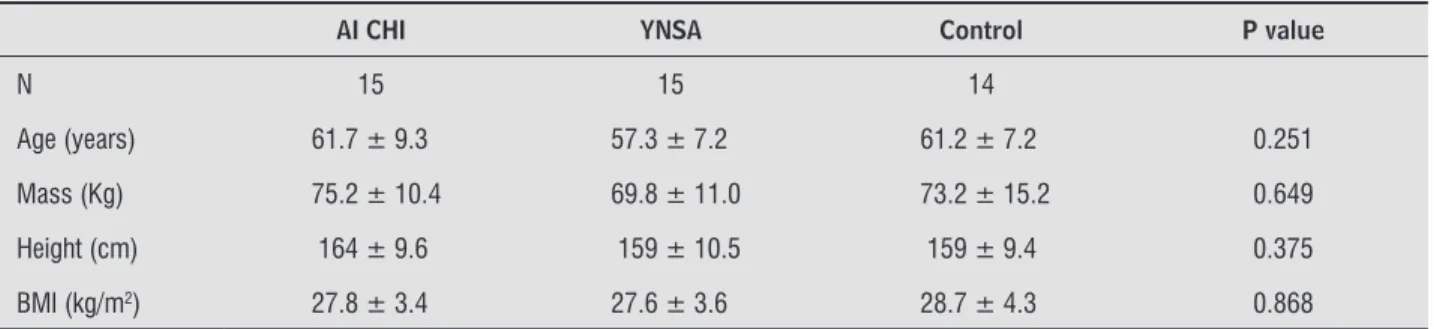
Trabalhador and from the hydrotherapy waiting list of the Unidade de saúde Ouvidor Pardinho. Table shows the physical characteristics of the participants and the p > . observed in all variables indicates that the groups are homogeneous.
The visual analogic scale assesses pain in the ex-act moment of the evaluation. When performing the analysis it was verified that there were significant differences between the groups over the
interven-tion periods p < . . )t was found that the groups
started the study with the same pain scores p > . . (owever, at the revaluation, the A) C() and YNSA groups showed reduction of the pain scores from
baseline evaluation. The control group showed no
change in their pain score p > . Table .
Regarding the functionality obtained by the Oswestry Disability )ndex, the evaluation criteria re-fers to the best functionality as the scores reduces. )n the present study we found that the subjects of the three groups began with functionality statistically similar p > , . (owever, at the revaluation moment the groups submitted to the interventions showed sig-nificant reduces in scores p < . , except the control
group p > . . Thus, the subjects submitted to the
interventions showed improvement in functionality after the intervention period Table .
Table 1- Mean and standard deviation of the variables age, mass, height and BMI of the groups AI CHI, YNSA and
CON-TROL; p-value of the analysis of variance – one way factor
AI CHI YNSA Control P value
N 15 15 14
Age (years) 61.7 ± 9.3 57.3 ± 7.2 61.2 ± 7.2 0.251
Mass (Kg) 75.2 ± 10.4 69.8 ± 11.0 73.2 ± 15.2 0.649
Height (cm) 164 ± 9.6 159 ± 10.5 159 ± 9.4 0.375
BMI (kg/m2) 27.8 ± 3.4 27.6 ± 3.6 28.7 ± 4.3 0.868
Table 2 - Mean and standard deviation of pain intensity (VAS) for groups AI CHI, YNSA and CONTROL at evaluation and
revaluation periods; p value of variance analysis for repeated measures
AI CHI YNSA Control
N 15 15 14
VAS initial 6.6 ± 2.4* 6.9 ± 2.8* 7.6 ± 2.6
VAS fi nal 2.7 ± 2.9*# 0.9 ± 1.9*# 6.3 ± 1.7#
P value 0.005
Note: * means signifi cant differences between evaluations (intra-groups) and # means signifi cant differences between groups (inter-groups).
Table 3 - Mean and standard deviation of Oswestry Disability Index for groups AI CHI, YNSA and CONTROL at evaluation
and revaluation periods; p value of variance analysis for repeated measures
AI CHI YNSA Control
N 15 15 14
Oswetry initial 37.97 ± 18.32* 36.03 ± 13.32* 43,14 ± 14.04
Oswestry fi nal 28.27 ± 19.18*# 17.4 ± 9.3*# 42,64 ± 14.58#
p value 0.007
back. Similar results were observed in the treatment
of acute low back pain with YNSA .
The reduction in pain, with the YNSA treatment, can be due to the activation of afferent fibers A delta and C, that promoted signals that are transmitted to the spine cord and leads to production of dynorphin and enkephaline. These afferent stimuli propagate to the brain setting a sequence of excitatory and inhibi-tory mediators on the spinal cord, resulting in release of neurotransmitters such as serotonin, dopamine and norepinephrine at spinal cord to pre and post synaptic pain inhibition. When these signals reach the hypothalamus and pituitary gland, the stimulus releases endorphin and acetylcholine promoting
re-duction in pain , and consequently the pain relief
may improve the functionality.
The literature regarding the acupuncture for the treatment for low back pain is controversial, some
studies - indicate that systemic acupuncture
promotes remission of low back symptoms, however, in these studies the systemic acupuncture was signifi-cantly effective for reducing low back pain compared to conventional treatment physiotherapy, exercise and medications , but there was no significant dif-ference when comparing to sham acupuncture su-perficial puncture and out of the acupuncture point
or simulation of placement of needles . )n other
studies there are ineffectiveness reports or there is little evidence that acupuncture is effective for
re-ducing the low back pain - . Cherkin et al
observed that treatments with massage promoted a reduction in back pain significantly superior to the treatment with acupuncture.
On the other hand, Manheimer and col , in
a literature review meta-analysis , concluded that acupuncture is effective for relieving chronic low back pain. The acupuncture treatments are significantly more effective compared to sham acupuncture or the fact that the individual does not perform any kind of treatment, however, there is evidence that acupunc-ture is more effective compared to other therapies, such as exercise and physiotherapy.
)n addition to the divergence of results, there is no consensus among authors regarding the choice of acupuncture points and treatment methods systemic acupuncture, auricular acupuncture, electroacupun-ture, among others . With respect to systemic acu-puncture, most authors use local points associated
with distal points , , , , , but there is no
consensus regarding the choice of points and some Discussion
Low back pain is one of the major causes of dis-ability, it interferes in quality of life, work produc-tivity and it is the most common cause to medical
consultation , . The clinical recommendations
for low back pain treatment, done according to sys-tematic review of literature, includes interdisciplin-ary rehabilitation, exercises including aquatics , acu-puncture, massage, manipulation, yoga and patient
reeducation , .
The aquatic exercises have shown positive results
in low back pain symptoms . Researches show
reduction in pain - and increment in
function-ality , in treatments done in aquatic
environ-ment; these findings confirm the results observed in the present study. (owever, it should be noted that it was not found, until now, researches that evaluate the effects of A) C() in low back pain, so the results found in the present study may be due to the action of the physical and thermic properties of the water.
The heated water has a relaxing effect that can contribute in the reduction of the activation of
para-vertebral muscles , and consequently reduce
the low back pain and improved the functionality. )n addition, the pain reduction can also be due to the action of the physical properties of the water. The hydrostatic pressure Pascal’s Principle , for the ac-tion of body support and movement assistance, can promoted less effort to maintain posture and, thus
re-ducing muscular tone and muscular relaxation .
Furthermore, the treatments for low back pain in aquatic environment can be done with less risk of damage such as gravitational overload incident on the spine, due to the action of the thrust Arquimedes’s Principle , which promotes reduction in the
appar-ent weight and, so can reduce the muscle spasm ,
, , . Camilotti et al observed, by spinal
shrinkage, that in the seated position in aquatic en-vironment the overload in the spine is lower than in land environment. They attributed the lower over-load to the physical properties of water, like thrust and hydrostatic pressure and to the relaxation pro-moted by the heated water. So, the reduction in the intensity of the pain and consequently improvement in the functionality of the spine could be due to the physical and thermal effects of water.
. Silva MC, Fassa AG, Vale NCJ. Dor lombar crônica em uma população adulta do sul do Brasil: prevalên-cia e fatores assoprevalên-ciados. Cad Saúde Pública. ;
: - .
. OMS : Chronic diseases and health promotion. [Cited in Jun]. Available from: http://www.who. int/chp/topics/rheumatic/en/
. Svensson (O, Andersson GBJ. The relationship of low-back pain, work history, work environment, and stress: A retrospective cross-sectional study of to
year old women. Spine. ; : - . . Graf M, Guggenbühl U, Krueger (. An assessment of
seated activity and postures at five work places. )n-ternational Journal of )ndustrial Ergonomics. ;
: - .
. Wilke (, Neff P, Caimi M, (oogland T, Claes L. New in vivo measurements of pressures in the intervertebral disc in daily life. Spine. ; : - .
. Norcross JP, Lester GE, Weinhold P, Dahners LE. An in vivo model of degenerative disc disease. J Orthop Res. ; : - .
. (all (. Acupuncture’s claims punctured: not proven effective for pain, not harmless. Pain. ; :
- .
. Deyo RA, Cherkin D, Conrad D, Volinn, E. Cost, con-troversy, crisis: Low back pain ant the health public. Annu Rev Public (ealth. ; : - .
. (inman RS, (eywood SE, Day AR. Aquatic physical therapy for hip and knee osteoarthritis: results of a single-blind randomized controlled trial. Physical Therapy. ; : - .
. Cunha MCB, Alonso AC, Silva TM, Raphael ACB, Mota CF. Ai Chi: efeitos do relaxamento aquático no desempenho funcional e qualidade de vida em idosos. Fisioterapia em Movimento. ; : - . . Sova R. Ai Chi. [Cited in Aug]. Available from:
http://ruthsova.com/aichi_products.htm
. Scognamillo-Szabó MVR, Bechara G(. Acupuntura: bases científicas e aplicações. Ciência rural. ;
: - .
. Martinez JE. Fibromialgia: o desafio do diagnóstico correto. Rev Bras Reumatol. ; : - .
authors choose the points according to the patient
needs , .
According to (all the acupuncture practice is not sufficient standardized which makes it difficult
for a reliable evaluation. )n Witt’s study , for
ex-ample, the choice of the points were taken randomly and according to the clinical experience of the person who applied the technique and the points chosen in the treatment is not mentioned in the study. Wang,
Kain and White report that some of the
prob-lems found in the studies are: inadequate sample, methodological limitations and the use of invalid as-sessment measures.
This research used a well-defined methodology, with randomized sample, but the number of partici-pants and interventions were small. Despite these factors, the results observed in these study show that YNSA and A) C() are effective methods to re-duce chronic low back pain and can stimulate the development of new researches.
Conclusion
The results of this study show that YNSA and A) C(), done twice a week, were effective in reducing the pain and improving the functionality of the lumbar spine. (owever, more studies are needed to evaluate the effects of Ai Chi and YNSA in individuals with low back pain using larger sample of participants and also with the combined techniques.
Acknowledgments
The authors acknowledge PUCPR for the partner-ship and for providing of Aquatic Physiotherapy sec-tor and CAPES – REUN) program for financial support.
References
. Koes B, Tulder M, Thomas S. Diagnosis and treatment of low back pain. BMJ. ; : - .
. Grabois M. Management of chronic low back pain. Americam Journal of Physical Medical Rehabilitation.
. Mendonça CM, Vrabic J. Eficácia da acupuntura sobre a dor e a qualidade de vida em mulheres com fibro-mialgia. Revista P)B)C. ; : - .
. Yamamoto T, Yamamoto (, Yamamoto MM. Nova cra-nioacupuntura de Yamamoto. São Paulo: Roca, . . Guillemin F, Constant E, Collin JF, Boulange M. Short
and long-term effect of spa therapy in chronic low back pain. Br J Rheumatol. ; : - .
. Cole AJ, Eagleston RE, Moschetti M, Sinnett E. Aquatic rehabilitation of the spine: water-based programs con help patients with spine injuries. Rehabilitation Man-agement. ; : - .
. Ariyoshi M, Sonoda K, Nagata K, Mashima T, Zenmyo M, Paku C, et al. Efficacy of aquatic exercises for patients with low back pain. Kurume Med J. ; : - . . Konlian, C. Aquatic therapy: making a wave in the
treatment of low back injuries. Orthopaedic Nursing. ; : - .
. Wajchemberg M, Pires L, Rodrigues R, Mano KS, Sottomaior MS, Cohen M, et al. Reabilitação precoce de atletas utilizando hidroterapia após tratamento cirúrgico de hérnia discal lombar: relato preliminar de três casos. Acta Ortop Bras. ; : - . . Brinkhaus B, Witt C, Jena S, Linde K, Streng A,
Wagenpfeil S, et al. Acupuncture in patients with chronic low back pain: a randomized control trial. Arch intern med. ; : - .
. Witt CM, Jena S, Selim D, Brinkhaus, B, Reinhold T, Wruck K, et al. Pragmatic randomized trial evaluating the clinical and economic effectiveness of acupunc-ture for chronic low back pain. Am j of epidemiol.
; : - .
. (aake M, Muller ((, Schade-Brittinger C, Prinz (, Basler (D, Streitberger K, et al. The German multi-center, randomized, partially blinded, prospective trial of acupuncture for back pain: a preliminary report on the rationale and design of the trial. J of altern complement med. ; : - .
. Cherkin DC, Sherman KJ, Avins AL, Erro J(, )chikawa L, Barlow WE, et al. Arch intern med. ;
: - .
. Sherman KJ, Cherkin DC, )chikawa L, Avins AL, Barlow WE, Khalsa P, et al. Characteristics of patients with chronic back pain who benefit from acupuncture. BMC musculoskeletal disorders. ; .
. (asegawa TM, Baptista AS, Cardoso M, Massao M, Natour J. Acupuncture for acute non-specific low back pain: a randomized, controlled, placebo trial. American college of rheumatology. Annals of Annual Scientific Meeting, Philadelphia, .
. Vigatto R, Alexandre N, Filho (. Development of a brasilian portuguese version of the oswestry disabil-ity index: cross-cultural adaptation, reliabildisabil-ity and validity. Spine. ; : - .
. Edlich RF, Towler MA, Goitz RJ, Wilder RP, Buschbacher LP, Morgan RF, et al. Bioengineering principles of hy-drotherapy. J burn care and rehabil. ; : - . . SECOT, . [Cited in Mar] Availabe from:
http://www.secot.es/publico/publico_divulgacion . php?secot= a d be bdd . Chou R, Qaseem A, Snow V, Casey D, Cross JT, Shekelle
P, et al. Diagnosis and treatment of low back pain: a joint clinical practice guideline from the Americam College of Physicians and the American Pain Society. Annals )nternal medicine. ; : - . . Ladeira CE. Evidence based practice guidelines for
management of low back pain: physical therapy im-plications. Rev Bras de Fisioter. ; : - . . Degani A. (idroterapia: Os efeitos físicos, fisiológicos
e terapêuticos da água. Fisioterapia em Movimento. ; : - .
. Dundar U, Ozlem S, )lknur Y, Deniz E, Vural K. Clinical Effectiveness of aquatic exercise to treat chronic low back pain. Spine. ; : - .
. Mcllevenn B, Robertson VA. Randomised controll study of the outcome of hydrotherapy for subjects with low back or back and leg pain. Physiotherapy.
; : - .
. Ernst E, Lee MS, Choi TY. Acupuncture: does it alleviate pain and are there serious risks? A review of reviews. Pain. ; : - .
. Tsui MLK, Cheing GLY. The effectiveness of electroacu-puncture versus electrical heat acuelectroacu-puncture in the management of chronic low-back pain. J altern Com-plement Med. ; : - .
. Carlsson CP, Sjölund B(. Acupuncture for chronic low back pain: a randomized placebo-controlled study with long-term follow-up. Clin J Pain. ; : - . . Yuan J, Purepong N, (unter RF, Kerr DP, Park J,
Bradbury ), et al. Different frequencies of acupunc-ture treatment for chronic low back pain: an assessor-blinded pilot randomised controlled trial. Comple-ment Ther Med. ; : - .
. Wang SM, Kain ZN, White PF. Acupuncture analgesia: )). Clinical considerations. Anesthesia and analgesia.
; : - .
Received: / /
Recebido: / /
Approved: / /
Aprovado: / /
. )srael VL, Pardo MBL. (idroterapia: tratamento do lesado medular em piscina terapêutica. Fisioterapia em Movimento. ; : - .
. Masumoto K, Takasugi S, (ota N, Fujishima K, )wamoto Y. Eletromyographic analysis of walking in water in healthy humans. J Physiol Anthropol. ;
: - .
. Camilotti BM, )srael VL, Rodacki ALF, Fowler NE. Stature recovery after sitting on land and in water. Manual Therapy. : - .
. Pomeranz, B. Analgesia por acupuntura: pesquisas básicas. )n: Stux G, (ammerschlap. Acupuntura clíni-ca. São Paulo: Manole; .
. Manheimer E, White A, Berman B, Forys K, Ernst E. Meta-Analysis: Acupuncture for low back pain. Ann )ntern Med. ; : - .
. Meng CF, Wang D, Ngeow J, Lao L, Peterson M, Paget S. Acupuncture for chronic low back pain in older pa-tients: a randomized, controlled trial. Rheumatology.
; : - .