UNIVERSIDADE FEDERAL DO CEARÁ CENTRO DE CIÊNCIAS
DEPARTAMENTO DE BIOLOGIA
PROGRAMA DE PÓS-GRADUAÇÃO EM ECOLOGIA E RECURSOS NATURAIS
FABIO PERLATTI
TRACE METALS BIOGEOCHEMISTRY IN SOILS AND RHIZOSPHERE OF PLANTS AFFECTED BY MINING WASTES: CONSEQUENCES TO ECOSYSTEM AND OPTIONS FOR RESTORATION (PHYTOREMEDIATION AND TECHNOSOLS)
FABIO PERLATTI
TRACE METALS BIOGEOCHEMISTRY IN SOILS AND RHIZOSPHERE OF PLANTS AFFECTED BY MINING WASTES: CONSEQUENCES TO ECOSYSTEM AND OPTIONS FOR RESTORATION (PHYTOREMEDIATION AND TECHNOSOLS)
Tese apresentada ao Curso de Doutorado em Ecologia e Recursos Naturais do Departamento de Biologia da Universidade Federal do Ceará, como parte dos requisitos para obtenção do título de Doutor em Ecologia e Recursos Naturais.
Área de Concentração: Ecologia e Recursos Naturais
Orientador: Prof. Dr. Tiago Osório Ferreira
Dados Internacionais de Catalogação na Publicação Universidade Federal do Ceará
Biblioteca de Ciências e Tecnologia
P527t
Trace metals biogeochemistry in soils and rhizosphere of plants affected by mining wastes: consequences to ecosystem and options for restoration (phytoremediation and technosols) / Fabio Perlatti. – 2015.
165 f. : il., color.
Tese (doutorado) – Universidade Federal do Ceará, Centro de Ciências, Departamento de Biologia, Programa de Pós-Graduação em Ecologia e Recursos Naturais, Fortaleza, 2015.
Área de concentração: Ecologia e recursos naturais. Orientação: Prof. Dr. Tiago Osório Ferreira.
1. Solos – Poluição. 2. Biogeoquímica. 3. Disponibilidade biológica. 4. Recuperação ecológica. 5. Resíduos. I. Título.
FABIO PERLATTI
TRACE METALS BIOGEOCHEMISTRY IN SOILS AND RHIZOSPHERE OF PLANTS AFFECTED BY MINING WASTES: CONSEQUENCES TO ECOSYSTEM AND OPTIONS FOR RESTORATION (PHYTOREMEDIATION AND TECHNOSOLS)
Tese submetida à Coordenação do Programa de Pós-graduação em Ecologia e Recursos Naturais, da Universidade Federal do Ceará, como requisito parcial para obtenção do grau de Doutor em Ecologia e Recursos Naturais. Área de concentração em Ecologia e Recursos Naturais.
Aprovada em 29 / 06 / 2015
BANCA EXAMINADORA
______________________________________________________
Prof. Dr. Tiago Osório Ferreira (Orientador)
Universidade de São Paulo – ESALQ/USP
______________________________________________________
Prof. Dr. Xosé Luis Otero
Universidad de Santiago de Compostela – USC (Espanha)
_____________________________________________________
Profa. Dra. Francisca Soares de Araújo
Universidade Federal do Ceará - UFC
______________________________________________________
Prof. Dr. Marcelo de Almeida Guimarães
Universidade Federal do Ceará - UFC
______________________________________________________
Prof. Dr. Valdomiro Souza Júnior
AGRADECIMENTOS
A idealização, realização e conclusão desse trabalho, só foram possíveis graças ao apoio e empenho de diversas pessoas e instituições que confiaram em meu trabalho, e é para vocês, que dedico os meus sinceros agradecimentos:
Ao Prof. Dr. Tiago Osório Ferreira pela orientação, confiança, apoio, dedicação, amizade e pelos muitos ensinamentos durante todos esses anos de convivência no Doutorado. Espero que tenha sido apenas o início de uma grande parceria!
Ao Prof. Dr. Xosé Luis Otero Pérez pela co-orientação e por toda a experiência, amizade e presteza proporcionada, ao receber-me, com minha família, em Santiago de Compostela - Espanha, onde tive apoio pessoal e acadêmico irrestrito durante o ano em que lá passamos sem a qual, não teria sido possível a realização deste trabalho.
Ao Departamento Nacional de Produção Mineral – DNPM, pela oportunidade e pela liberação integral para cursar o Doutorado. Agradecimento especial aos geólogos Fernando Antônio da Costa Roberto e Ricardo Bezerra de Sena, pela confiança e apoio, antes e durante o meu afastamento.
Ao Programa de Pós-Graduação em Ecologia e Recursos Naturais – PPGERN, da Universidade Federal do Ceará, em nome de todos os professores, funcionários e colegas, que tornaram possível a realização deste Doutorado. Em especial à Profa. Francisca Soares de Araújo, pela confiança e apoio, desde a minha entrada no mestrado do PPGERN e ao Prof. Dr. Olmar Baller Weber (EMBRAPA-CNPAT) pelas contribuições e sugestões nesse trabalho durante a qualificação, e por todos os ensinamentos técnicos e acadêmicos repassados.
Ao Departamento de Ciência do Solo, da Universidade Federal do Ceará – UFC, à todos os professores e colegas; em especial ao Prof. Dr. Ricardo Espíndola Romero e Profa. Dra. Miriam C. Gomes Costa pelas importantes contribuições, desde a elaboração do projeto até a conclusão da Tese.
À empresa Extrativa Fertilizante S/A, pela permissão em coletar os materiais para realização deste estudo, contribuindo de maneira fundamental para o desenvolvimento sustentável da mineração no Brasil.
À Coordenação de Aperfeiçoamento de Pessoal de Nível Superior – CAPES, pela concessão de bolsa para realização do Doutorado Sanduíche no exterior – PDSE.
Agradeço a meus pais, Luiz e Cleusa, pelo exemplo de vida, carinho e pelo irrefutável apoio durante a minha estada em São Paulo, no decorrer do desenvolvimento dos trabalhos. Espero conseguir ser igual a vocês, ter um (ou mais) filho(a) Doutor(a).
Agradeço também a meus irmãos: Bruno, pelas diversas conversas politico-acadêmicas acaloradas, que em muitas vezes, clarearam ideias e realmente contribuíram para o desenvolvimento deste trabalho e de outros que certamente virão em parceria, e à Priscilla, pela ajuda nas traduções e com algumas figuras, e que, com sua tropa Lia, Stella e Alex, contribuíram, e muito, para tornar mais agradável nossa passagem por Sampa.
ABSTRACT
The extraction and processing of metallic minerals generate large amounts of waste which, if not disposed of properly, may be sources of contamination and acid mine drainage; by contact of sulphides with water and oxygen; causing a decrease in pH and an increase in the mobility of metals in the soil. The diagnosis of biogeochemical behaviour of wastes can provide valuable information to discard and control the adverse effects of this kind of material, as well to support the adoption of more efficient measures of control and mitigation. This study had as general objective diagnose the impacts of waste disposal in an abandoned copper mine (Cu), as well to propose alternatives to mitigate the impacts and restore the environmental quality of the site, based on the hypothesis that such wastes can contaminate the soil with trace elements contained in minerals, and generate acid mine drainage, given the presence of sulphides exposed to weather conditions, hindering the natural regeneration of the ecosystem. The Chapter 1 provides an introduction to the theme, as well as a literature review. Chapter 2 presents a general diagnosis from the area, assessing the levels of several trace elements in rock wastes, soils and native plant species. In chapter 3, a thorough study on the geochemical behaviour of wastes, with focus on the generation of acid drainage were done, plus a detailed study about Cu behaviour in soils, through a chemical sequential extraction. Chapter 4 details the content of metals in above-ground tissues from plants that naturally grow on the wastes, assess the ability of these plants to be used in phytoremediation and show data about the changes that occur in the rhizosphere. Chapter 5 provides through a comparative study by sequential extraction in the rhizosphere and bulk soils; details about the changes that occur in the rhizosphere of plants and their consequences for Cu mobility and ecotoxicity, and finally, the chapter 6 presents an experimental study with the use of technosols, as way to immobilize the excess of labile copper in soil solution. Based on the results, can be concluded that the major impact is caused by the excess of Cu which still persists in the waste rocks and, through oxidation and dissolution processes, translocate large amount of metal into soil. The acid mine drainage was discarded given the buffering action generated by dissolution of carbonates, minimizing the negative effects of the oxidation of sulphides. The sequential extraction showed that the Cu concentration in soil is associated mainly with carbonates and amorphous iron oxides. The geochemical cycle between the dissolution of carbonates and oxidation of sulphides appears to be the main control mechanism of release and adsorption of Cu in soil. Regarding the plants, was concluded that they cannot be considered as Cu hyperaccumulators, however, high levels of metal were observed in roots, indicating that the survival strategy of these plants consists in immobilize metal in roots/rhizosphere. The sequential extraction in the rhizosphere showed that the presence of plants alter various soil characteristics under its influence, and also the geochemical behaviour of Cu. The technosols showed great ability to immobilize Cu. The four technosols elaborated in this study can immobilize more than 85% of Cu in solution, with the largest portion retained in the residual fraction, where Cu is adsorbed strongly, demonstrating that technosols emerge as an excellent alternative to remediate soils contaminated by metals.
RESUMO
A extração e beneficiamento de minerais metálicos geram grandes quantidades de rejeitos que se não dispostos adequadamente, podem ser fontes de contaminação e drenagem ácida; pelo contato de sulfetos com água e oxigênio; ocasionando diminuição no pH e aumento na mobilidade dos metais no solo. O diagnóstico do comportamento biogeoquímico de rejeitos pode fornecer informações valiosas para que se possa dispor e controlar adequadamente os efeitos adversos causados por esse tipo de material, bem como subsidiar a adoção de medidas de controle e mitigação mais eficientes. Esse estudo teve como objetivo geral, diagnosticar os impactos causados pela disposição de rejeitos em uma mina de cobre (Cu) abandonada, bem como propor alternativas para mitigar os impactos e restaurar a qualidade ambiental do local, baseado na hipótese de que esses rejeitos podem contaminar o solo da região com os elementos traço presentes nos minerais, além de gerar drenagem ácida, dada a presença de sulfetos expostos às condições atmosféricas, impedindo a regeneração natural do ecossistema. O capítulo 1 traz uma introdução ao tema, bem como uma revisão bibliográfica sobre o assunto. O capítulo 2 faz um diagnóstico geral da área, avaliando-se os teores de diversos elementos traço nos rejeitos, solos e plantas. No capítulo 3 foram aprofundados os estudos sobre o comportamento geoquímico dos rejeitos com foco na geração de drenagem ácida, além de um estudo detalhado do comportamento do Cu no solo, através da extração sequencial. O capítulo 4 detalha os teores de metais nos tecidos vegetais das plantas, avalia a aptidão do uso dessas espécies para a fitoremediação, bem como apresenta dados das alterações que ocorrem na rizosfera. O capítulo 5 aprofunda-se nas alterações que ocorrem na rizosfera das plantas e as consequências na mobilidade e ecotoxicidade do Cu, via extração sequencial, e por fim, o capítulo 6 apresenta um estudo experimental com a utilização de tecnosolos, para imobilizar o excesso de Cu lábil no solo. Os resultados indicam que o principal impacto é causado pelo excesso de Cu que ainda persiste nos rejeitos e que, por processos de oxidação e dissolução, translocam grandes quantidade do metal para o solo. A geração de drenagem ácida foi descartada; dada a ação tamponante gerada pela dissolução dos carbonatos, minimizando os efeitos negativos da oxidação dos sulfetos. A extração sequencial mostrou que o Cu no solo está associado principalmente aos carbonatos e óxidos de Fe amorfos. O ciclo geoquímico entre a dissolução dos carbonatos e oxidação dos sulfetos parece ser o principal mecanismo de liberação e adsorção do Cu no solo. Já as plantas estudadas, não foram consideradas hiperacumuladoras, entretanto, foram observados elevados teores de metal em suas raízes, indicando que a estratégia de sobrevivência dessas plantas consiste na imobilização do metal nas raízes/rizosfera. A extração sequencial na rizosfera mostrou que a presença das plantas altera as características do solo sob sua influência, e consequentemente o comportamento biogeoquímico do Cu. Já os tecnosolos demostraram grande capacidade em imobilizar Cu. Os quatro tecnosolos elaborados imobilizaram mais de 85% do Cu, sendo a maior parte retida na fração residual, que representa a fração onde o cobre fica adsorvido mais fortemente, demostrando que os tecnosolos despontam como uma excelente alternativa na remediação de solos contaminados por metais.
LIST OF FIGURES
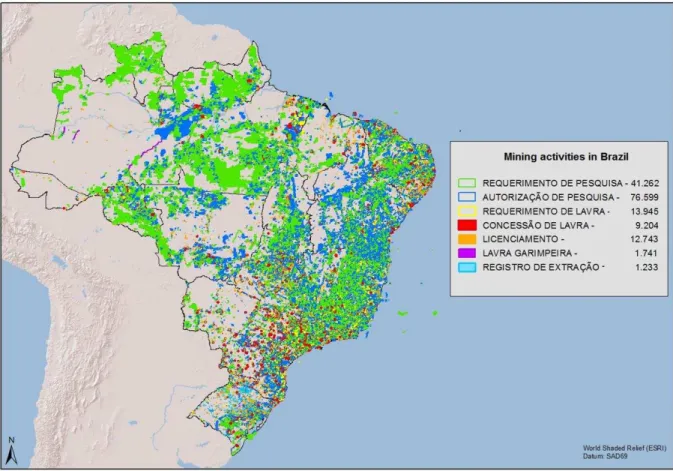
Figure 1.1. Map showing mining activities in Brazil in different stages of development (DNPM, 2015)...……….…..18
Figure 1.2. Map of Viçosa do Ceará... 23
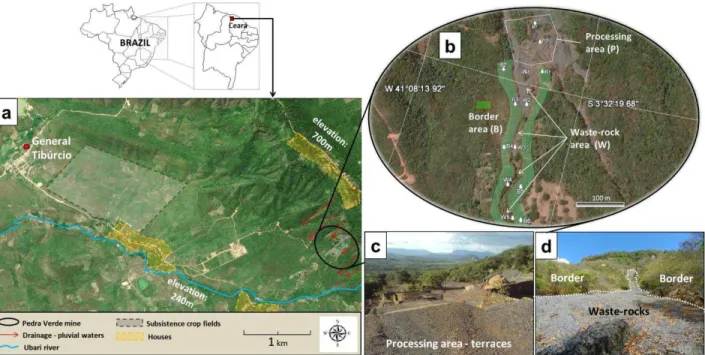
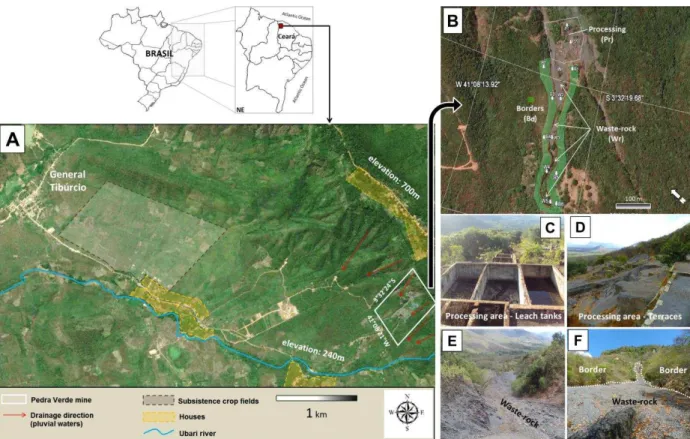
Figure 2.1. (a) Location of the Pedra Verde mine, (b) sites where soils and rock samples were collected, (c) waste rock in the ore processing area and (d) waste rock spread over a slope and borders……….………… 35
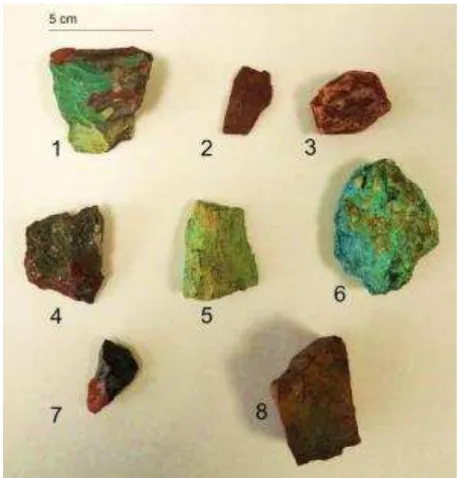
Figure 2.2. Samples of waste rocks collected……….………. 36
Figure 2.3. Plants collected at the Pedra Verde mine………. 37
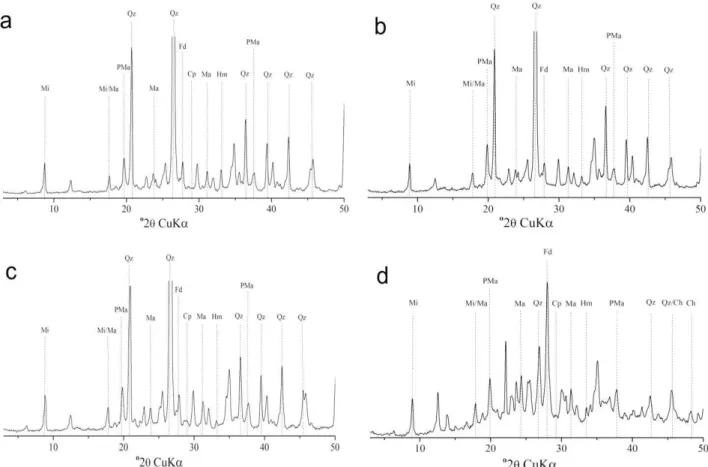
Figure 2.4 X-ray diffraction analysis of selected samples. Mica (Mi); malachite (Ma); pseudomalachite (PMa); quartz (Qz); feldspar (Fd); anatase (An); chalcopyrite (Cp); chalcocite (Ch); hematite (Hm)………..…..… 42
Figure 2.5 SEM-EDS mapping showing the distribution of elements in the rock samples and: (a) Cu-O peaks, characteristic of copper oxides; (b) Cu-O-C peaks, characteristic of copper carbonates and (c) Cu-O-S peaks, characteristic of copper oxides and sulphides……….………. 44
Figure 2.6. (a) Factors and (b) individual scores extracted from soils sampled in the different mine compartments (from 13 soil attributes considered)………….……… 49
Figure 2.8. Average ± s.d.* of Cu and Zn contents in shoots of spontaneous plants… 52
Figure 3.1. (A) Location of study site, (B) soil sampling points and (C, D, E and F) mine compartments……….……… 66
Figure 3.2. Geological structure of mine region (Adapted from Korpershoeck et al.,
1979)……… 67
Figure 3.3. X-ray diffraction analysis of selected waste rock samples. mica (Mi); malachite (Ma); pseudomalachite (PMa); quartz (Qz); feldspar (Fd); anatase (An); chalcopyrite (Cp); chalcocite (Ch); hematite (Hm)………..……..….74
Figure 3.4. SEM-EDS of waste rock samples, indicating the presence of A) Cu carbonate (malachite), B) Cu oxide (cuprite) and C) Cu sulphide (chalcopyrite)………. 75
Figure 3.5. Correlation of pH with TIC and TS………. 76
Figure 3.6. (A) Mean values and standard deviations of the soil oxidation pH as a function of time; and (B) the TIC x TS ratios………. 78
Figure 3.7. X-ray diffraction analysis of soil samples. smectite (Sm); vermiculite (Vm); mica (Mi); gibbsite (Gb); malachite (Ma); pseudomalachite (PMa); quartz (Qz); feldspar (Fd); chalcocite (Ch); hematite (Hm)……….. 79
Figure 3.8. Percentage of Cu in different soil fractions from Pedra Verde…….………. 83
Figure 3.9. Eh-pH diagram showing the mechanism of Cu 2+ release by both sulphide
oxidation and malachite dissolution (adapted from Brookins, 1988)………. 85
Figure 4.2. Location of plant sampling and species identified. (A) Pityrogramma
calomelanos L.; (B) Bidens pilosa L.; (C) Ruellia paniculata L. and (D) Combretum leprosum M... 103
Figure 4.3. Distribution and concentration of copper in leaves and roots (Roots H2O:
washed only with water; Roots DC: roots washed with water and treated with
dithionite+citrate)………..………… 109
Figure 4.4. Correlation coefficients for Cu concentrations in leaves and readily bioavailable Cu in bulk and rhizosphere soils……….………… 111
Figure 4.5. Concentration of copper accumulated in roots and the readily bioavailable (Cu-MgCl2) / potentially bioavailable (Cu-Me) copper in the rhizosphere soil………… 113
Figure 5.1. Location of Pedra Verde mine and rhizospheric/bulk soils sampling points………..……… 126
Figure 5.2. Plant species collected: (A) Pityrogramma calomelanos; (B) Bidens Pilosa;
(C) Ruellia paniculata and (D) Combretum leprosum……… 127
Figure 5.3. General characteristics of rhizosphere and bulk soil of the studied species. Values are average ± s.d and * represents significance differences (p<0.05; n=3)….. 131
Figure 5.4. XRD analysis in the rhizosphere and bulk soils from P. calomelanos and B.
pilosa. (Sm: smectite; Il: illite; K: kaolinite; Qz: quartz) ...………..……….…134
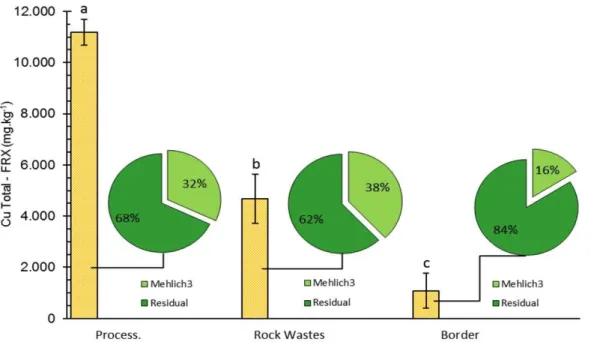
Figure 5.5. (a) Distribution of copper in soil fractions (in mg.kg-1), (b) levels of potentially
Figure 5.6. (a) Distribution of copper in soil fractions (in mg.kg-1), (b) levels of potentially bioavailable copper obtained by Mehlich 3 and (c) percentage of copper in each fraction in rhizosphere and bulk soils from B. pilosa………...… 136
Figure 5.7. (a) Distribution of copper in soil fractions (in mg.kg-1), (b) levels of potentially bioavailable copper obtained by Mehlich 3 and (c) percentage of copper in each fraction in rhizosphere and bulk soils from P. calomelanos………... 137
Figure 5.8. (a) Distribution of copper in soil fractions (in mg.kg-1), (b) levels of potentially
bioavailable copper obtained by Mehlich 3 and (c) percentage of copper in each fraction in rhizosphere and bulk soils from C. leprosum………..………… 137
Figure 5.9. Correlation between TOC and TN in bulk and rhizospheric soils………… 140
Figure 5.10. Pearson coefficient correlation between the sum of Cu concentration in exchangeable (F1) and carbonate-associated (F2) fractions and Cu concentration extract by Mehlich-3 in bulk/rhizospheric soils……… 144
Figure 6.1. Mean concentration and percentage of total copper adsorbed by technosols………. 159
LIST OF TABLES
Table 2.1. Chemical characterization of waste rock samples from Pedra Verde mine and % of recovery from certified reference materials (CRM), obtained by ED-XRF analysis……….………. 41
Table 2.2. General chemical and physical data of mine soils in different compartments from Pedra Verde mine……….……….. 45
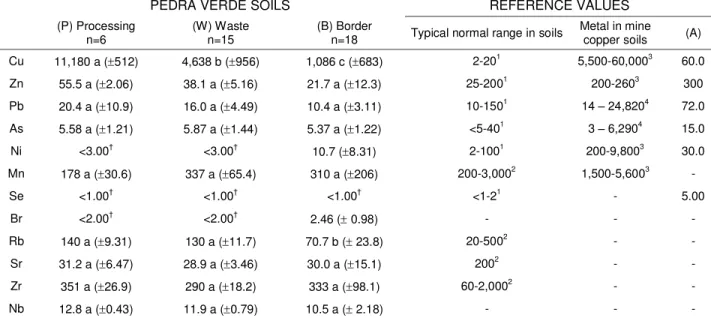
Table 2.3. Total trace metals levels in Pedra Verde soils (values in mg.kg-1) obtained by
X-Ray Fluorescence and reference values (Median values and interquartile ranges)……….……….. 47
Table 2.4. Results of Factor Analysis for the transformed data (log) of the main soil properties (n = 39), including the percentage of variance and communalities... 48
Table 2.5. Bioaccumulation factors of Cu and Zn in spontaneous plants that growing in the Pedra Verde mine (average ± s.d.*)……….…….. 53
Table 3.1. Total concentration of trace elements in the waste rock……….. 73
Table 3.2. General soil characteristics in the different mine compartments………. 77
Table 3.3. Total concentrations and reference values for trace elements in the soils under study………... 80
Table 3.5. Copper toxicity data compiled from literature for some plants and soil invertebrates……….………. 87
Table 4.1. Selected soil properties from bulk and rhizosphere soils (means ±
s.d.)………. 106
Table 4.2. Readily bioavailable copper extracted with 1 M MgCl2 (Cu-MgCl2), potentially
bioavailable copper extractable with Mehlich-3 solution (Cu-Me), and (pseudo) total copper extracted with aqua regia (Cu-ptotal) in bulk and rhizosphere soils……...…... 107
Table 4.3. Mean values (±standard deviation) of the enrichment factor (EF) and
translocation factor (TF) in the plant species under study……….……… 110
Table 4.4. Pearson correlation coefficient for copper in plants and soil properties….. 112
Table 4.5. Balance between Cu in bulk and rhizosphere soil and that taken up by plants (leaves+roots) in mg.kg-1……….………... 114
Table 5.1. Concentration of macronutrients in the rhizospheric and bulk soils obtained
INDEX
CHAPTER 1
1.1. Introduction ...17
1.2. Study area, hypotheses and objectives ...23
1.3. References ...25
CHAPTER 2 Trace metal/metalloid concentrations in waste rock, soils and spontaneous plants in the surroundings of an abandoned mine in semiarid NE-Brazil ...28
2.1. Introduction ...31
2.2. Material and methods ...33
2.2.1. Site description and study area ...33
2.2.1.1. Characterization of the Pedra Verde ore body ...33
2.2.1.2. Mining activities and ore processing ...34
2.2.2. Sampling ...34
2.2.2.1. Soil and waste rock ...34
2.2.2.2. Spontaneous plants ...36
2.2.3. Analytical procedures ...38
2.2.3.1. Mineralogical and geochemical properties of waste rock ...38
2.2.3.2. General characterization of soils...38
2.2.3.3. Potentially bioavailable nutrients and metals in soils (P, K, Ca, Mg, Na, Fe, Cu, Zn and Pb) ...39
2.2.3.4.Bioaccumulation factors (BCF) and potentially toxic metal in shoots of spontaneous plants ...39
2.2.4. Statistical Analysis ...40
2.3. Results and discussion ...40
2.3.1. Total trace elements and general characterization of waste rock ...40
2.3.1.2. Mineralogical characterization of the mine waste rock ...42
2.3.2. General characterization of soils and total concentrations of trace metals ...43
2.3.3. Principal Component Analysis ...47
2.3.4. Trace metal bioavailability ...50
2.3.5. Cu, Zn and Pb contents in shoots of spontaneous plants ...52
2.4. Conclusions ...54
CHAPTER 3
Geochemical speciation and dynamic of copper in tropical semi-arid soils
exposed to metal-bearing mine wastes ...61
3.1. Introduction ...64
3.2. Study area ...65
3.3. Material and methods ...69
3.3.1. Sampling procedures...69
3.3.1.1. Waste rock sampling ...69
3.3.1.2. Soil sampling ...69
3.3.2 Analytical procedures ...70
3.3.2.1. General characterization of waste rock and soils ...70
3.3.2.2. Sequential extraction of Cu ...71
3.3.3. Statistical Analysis ...72
3.4. Results and Discussion ...72
3.4.1. Trace metal levels in mine waste rocks ...72
3.4.2. General soil characteristics...74
3.4.3. Total Cu and other trace metals in soils ...80
3.4.4. Sequential extraction of Cu...81
3.5. Conclusions ...89
3.6. References ...90
CHAPTER 4 Copper accumulation and changes in soil physical-chemical properties promoted by native plants in an abandoned mine site in northeastern Brazil: implications for restoration of mine sites ...96
4.1. Introduction ...99
4.2. Material and methods ... 101
4.2.1. Study area ... 101
4.2.2. Sampling and analytical procedures ... 103
4.2.2.1. Plants ... 103
4.2.2.2. Bulk and rhizosphere soils ... 104
4.2.2.3. Statistics and data analysis ... 105
4.3. Results and Discussion ... 106
4.3.2. Copper concentration in plants, enrichment and translocation factors and
correlation with bulk/rhizosphere soils properties. ... 108
4.3.3. Balance between Cu mobilized in the rhizosphere and uptake by plants: consequences for mine site restoration. ... 113
4.4. Conclusions ... 115
4.5. References ... 115
CHAPTER 5 Copper biogeochemistry in response to rhizosphere soil processes under four native plant species growing spontaneously in an abandoned mine site in northeastern Brazil... 121
5.1. Introduction ... 124
5.2. Material and methods ... 125
5.2.1. Description of the study area ... 125
5.2.2. Sampling and general analytical procedures ... 126
5.2.3. Mineralogical analysis of bulk and rhizosphere soils of B. pilosa and P. calomelanos. ... 128
5.2.4. Sequential extraction of copper in the bulk and rhizosphere soils. ... 128
5.3. Results ... 130
5.3.1. General differences between rhizosphere and bulk soils ... 130
5.3.2. Concentration of potentially bioavailable macronutrients in the rhizosphere and bulk soils. ... 132
5.3.3. Mineralogical composition of rhizosphere and bulk soil ... 134
5.3.4. Total concentration and partitioning of copper in the rhizosphere and bulk soils 135 5.4. Discussion ... 139
5.4.1 Influence of plants on soil properties ... 139
5.4.2. Dynamics of macronutrients in the rhizosphere ... 140
5.4.3. Biogeochemical dynamics of Cu in plant rhizospheres ... 142
5.5. Conclusions ... 146
5.6. References ... 147
CHAPTER 6 Adsorption and sequential extraction of copper in technosols prepared from unconsolidated wastes rich in organic matter, carbonates and bentonite ... 152
6.1. Introduction ... 155
6.2.1. Composition of technosols... 156
6.2.2. “Batch” experiment ... 157
6.2.3. Statistical analysis ... 158
6.3. Results and discussion ... 158
6.3.1. Total contents of Cu in technosols ... 158
6.3.2. Sequential extraction ... 159
6.4. Conclusions ... 161
6.5. References ... 162
7. MAIN CONCLUSIONS ... 164
17
CHAPTER 1
1.1. Introduction
The evolutionary history of humans is closely related to the extraction and utilization of mineral resources. Important periods on the development of civilizations allude to ores, as the “Stone Age”, the “Bronze Age” (3.500 BC) and the “Iron Age” (1.400 AC) (Hong et al., 1996; DNPM, 2009). Since then the codependent relationship between humans and ores has been constantly increasing, and nowadays is nearly impossible to maintain our current lifestyle without minerals. They are present in our lives in many ways; being the basis of various productive chains and playing a crucial role for many nations’ social and economic development since early ages (Zobrist et al.,
2009).
With the growth of the mineral production, concerns about the environmental impacts associated with the activity also increased, since in the beginning of exploration, mining was essentially an extractive activity, where the minerals were extracted in a primitive form, usually in small amounts. In the course of time, with the increase of the demand for minerals and the advent of new mining techniques, larger amounts of ore have been extracted, and consequently, greater environmental impacts were generated (Hong et al., 1996).
In Brazil, the research and exploitation of mineral resources began soon after the Portuguese colonization, intensifying in the XVII century by the expeditions in search of gold and precious stones. This had fundamental importance in the territorial occupation, as well as for socioeconomic development of the country (Machado; Figueroa, 2001). Thereafter, the ores became increasingly essential to the national economy and with the beginning of the industrialization in the 20th century, coupled with the extraordinary Brazilian geodiversity; the mineral industrial chain has become extremely diversified.
18 and execution, requirements to mine, licensing (type of permit to exploit minerals used directly in civil construction, such as sand, clay, gravel and crushed stone), gold and precious stones-digging and other related activities, by the end of 2014, there were 156.727 areas under influence of mining activity, covering a large part of the Brazilian territory (Figure 1.1.).
Figure 1.1. Map showing mining activities in Brazil in different stages of development (DNPM, 2015).
Mining is an activity trading more than R$ 50 billion annually and employs more than 160,000 people, making up for a big part of the trade balance and economic sustainability of the country (DNPM, 2011).
19 "Those who exploit mineral resources shall be required to restore the degraded environment, according to the technical solution required by the appropriate public agency, under the law" (BRASIL, 1988).
(“Aquele que explorar recursos minerais fica obrigado a recuperar o meio ambiente degradado, de acordo com solução técnica exigida pelo órgão público competente, na forma da lei” (BRASIL, 1988)).
This presumption of degradation arise from the fact that the exploitation of minerals resources usually lead to the deconstruction of the ecosystem and, despite the governmental efforts worldwide to establish stricter rules for environmental control of mining, the ecological disturbance of activity is imminent, since the minerals are usually found in the underground, and to claim them it is necessary to remove the soil and overlying vegetation, leading to strong biological and geomorphological changes to the ecosystems. Also, when intended for extraction of metallic minerals, mining is an activity that can generate large amounts of waste, and if not disposed properly, these are potential sources of pollution, mainly by trace elements (Bradshaw, 1997).
Among the metallic minerals exploited in Brazil, the copper ore is highlighted by its wide range of application, and as one of the most important metals in modern industries (Jost; Brod, 1988).
In nature, copper is present in a wide variety of rocks and minerals. It usually occurs in combination with other chemical elements, with about 170 mineral species containing copper currently known. These are divided mainly in the primary forms sulfidic deposits, where are highlighted the chalcopyrite (CuFeS2, 34.6% Cu), chalcocite
(Cu2S, 79.9% Cu), bornite (Cu5FeS4, 63.3% Cu) and covellite (CuS, 66.4% Cu); and
secondary deposits, among which are highlighted the oxidized ores, as cuprite (Cu2O,
88.8% Cu) and tenorite (CuO, 79.8% Cu), and carbonated ores, as malachite (CuCO3.Cu(OH)2, 57.5% Cu) and azurite (2CuCO3.Cu(OH)2, 55.3% Cu) (Collins;
Loureiro, 1971).
20 underground mines, these impacts are minimized, but not extinct. It is, however, in the final phase of mining and ore processing which the greatest risk of environmental contamination occurs, by deposition at open pits, both by the processed ore and the waste rock generated during the process (Jeong, 2003).
The rock wastes from copper mining are generated after the process of concentration of the ore. Given the low levels of copper in the deposits (~ 1% of Cu), after extraction the copper ore goes through a process of concentration, aiming to raise the levels of contained Cu to 25-30%, later to be subjected to smelting and refining metallurgical processes (Ribeiro, 2001).
Depending on the mineral composition of the copper deposit, in addition to high levels of copper, other trace elements may be associated with the waste rock, such as arsenic, from arsenopyrite (FeAsS); lead, from galena (PbS) and zinc, from sphalerite (ZnS), besides other trace elements which can occur on a smaller scale such as: Au, Ag, Bi, Co, Cd, Mo, Ni, Sb and Se (Jost; Brod, 1988; Angeli et al., 1993; Bech et al.,
1997; DNPM, 2009; Nikolic et al., 2011), which can be transferred to environment.
Another associated environmental risk lies in the fact that waste rocks containing sulfidic metallic minerals, when disposed at open pit, in contact with oxygen, water and microorganisms, trigger a biogeochemical process known as “acid mine drainage” (AMD) (Fandiño et al., 2008), characterized by a sharp decrease in pH, which
may alter soil properties near the waste area, which in turn may enhance the bioavailability and mobility of trace elements associated (Matschullat, 2000; Dinelli et al.,
2001).
21 may turn this elements more or less potentially bioavailable and/or toxic to organisms (Brown Jr.; Foster; Ostergren, 1999; Covelo; Vega; Andrade, 2007; Guo et al., 2011).
The chemical form in which trace elements are found in soil and its dynamics are determinant for studies focused on soil contamination. Thus, the simple and sequential chemical extractions are essential to identify the chemical forms in which these elements are present as well as their predominant associations. The simple chemical extractions are extensively used to measure the concentrations of metals in soils; and the sequential extractions are useful for obtaining bioavailability levels of trace elements in different soil fractions (Oliveira et al., 1999).
The metals dynamics in soils is a process that once known, enables the implementation of more efficient practices for preventing and/or mitigating the damages from contamination, providing better ways to manage the (bio) availability of these elements in the soil, as well as their distribution in the environment and its possible transfer to the food chain. Most of metals differ from organic contaminants by not undergoing microbial or chemical degradation and this fact results in greater persistence of metals in soils for long periods (Guo et al., 2006).
Furthermore, plants with associated microorganisms may completely alter the soil conditions under its influence, in a zone known as “rhizosphere” and therefore may directly influence in the dynamic and bioavailability of metals in this zone (Fageria; Araújo; Stone, 2009). This mechanism is considered by some authors as plant adaptation strategy in face to disturbed environments, which may ensure the species' survival in extreme conditions (Rosenvald et al., 2011).
In this sense, metal soil contamination can affect all levels of biological organization, from the population’s levels, where an increase in mortality and decrease in growth rate among individuals occurs, reducing the diversity and abundance at communities’ level, also reducing nutrient cycling and energy flow in the ecosystem (Peplow; Edmonds, 2005; Rodrigues et al., 2010).
22 successional processes, reestablishing the characteristics that if not the original from the area, allow the proper development of the ecosystem (Ash; Gemmell; Bradshaw, 1994; Bradshaw, 1997).
Thus, ecological concepts and theories represent essential tools for both precise and detailed diagnostic of the environmental impacts caused by mining, as well as for assessing the resilience of the disturbed ecosystem, making the techniques of restoration, rehabilitation and recovery of environmentally degraded areas more efficient (Palmer; Falk; Zedler, 2006).
Among the various techniques for remediation of contaminated soils by trace elements in mining sites, the phytoremediation emerges as a promising alternative, both for the efficiency and the low cost of implementation when compared to conventional techniques which use physical processes such as soil digging or washing.
The Phytoremediation is the use of plants to remove pollutants from soil or minimize the risks associated with their presence in the environment. This technology has several desirable characteristics in the process of remediation of contaminated soils such as: reducing the hazards associated with chemicals in the environment, improving soil quality by restoring its functionality, in addition to being a low-cost technology and that it can be used for both containment and for the removal of pollutants (Lombi et al.,
2000).
The contention processes, as phytoimmobilization and phytostabilization aims to reduce the mobility, bioavailability and/or toxicity of pollutants in the soils. The removal processes, such as phytoextraction and phytovolatilization are technologies for the elimination of pollutants from the soil, and in areas with metallic waste rocks, the phytoextraction and phytostabilization are the most appropriate techniques (Lombi et al.,
2000; Mendez; Maier, 2008).
23 are accumulated, since plants that accumulate metals in shoots may represent risks to the local biota, increasing contamination throughout the food chain (Ribeiro; Rodrigues; Smiderle, 2007).
As pointed by Reeves (2006), metal hyperaccumulator and/or tolerant plant species are rare and potentially useful biological resources, and efforts are required to increase our knowledge about the behavior and distribution of these plants, since this information is extremely valuable in formulating strategies for the use and conservation of these species.
1.2. Study area, hypotheses and objectives
Considering the risks that metals in high concentrations in the environment represents, this work will address a problem that occurs in the Pedra Verde mine, located in Viçosa do Ceará/CE - Brazil, which was explored in the 80s and since then lies abandoned (Figure 1.2).
24 In this site, activities of extraction and concentration of sulfide and carbonate copper ore generated great amount of waste rocks, which are disposed at open pits for about 25 years. Given the local geologic formation, with the presence of sulfide minerals containing copper and other trace elements (Collins; Loureiro, 1971; Angeli et al., 1993),
it is supposed that these wastes are causing adverse effects to the ecosystem, putting at risk both the local biota and the population of the General Tibúrcio district, located near the mine. Therefore, it is important to understand the dynamics of these elements in soil and rhizosphere, in order to identify the actual ecotoxicological risks they pose, as well propose techniques for soil remediation as a basis for ecological restoration of the area.
Three main hypotheses have been raised for the development of this study. The first is that copper sulphide mining wastes disposed at open pit, may generate acid mine drainage and emit Cu and other trace elements to the soil in high concentrations and toxic forms affecting the ecosystem resilience (chapters 2 and 3). The second presume that the plants survive in areas directly impacted by waste due to two possible mechanisms: Immobilization of metals in the roots/rhizosphere and; tolerance and/or hyperaccumulation of metals in the shoots, and in this case, can be used for reforestation/remediation programmes (chapters 4 and 5). Finally the third hypothesis assumed that techniques based on geochemical processes (technosols) can neutralize the toxic effects of trace elements by reducing their mobility/bioavailability (chapter 6).
With these assumptions in mind, three main objectives were set, and the results distributed by 5 chapters.
Objective 1 - Perform a general diagnosis of the area, investigating the presence (or not)
of acid mine drainage, plus the geochemical fractionation of metals in the soil, seeking to understand the geochemical mechanisms of contamination and metal mobility (chapters 2 and 3).
Objective 2 - Assess the levels of trace elements accumulated in plants, and perform
25
Objective 3 - Evaluate the efficiency of technosols made from different kinds of
waste/residues, to neutralize the toxicity of trace elements through batch experiment with geochemical fractionation (sequential extraction) (chapter 6).
1.3. References
Angeli, N.; Neto, J.A.N.; Souza, J.V.; Filho, E.R.; Moreno, R., 1993. Minerais de minério e paragênese da jazida de cobre de Pedra Verde – Viçosa do Ceará. Revista de
Geologia-UFC, 6:33-46.
Ash, H.J.; Gemmell, R.P.; Bradshaw, A.D., 1994. The introduction of native plants species on industrial waste heaps: a test of immigration and other factors affecting primary succession. Journal of Applied Ecology, 31:74-84.
Bech, J.; Poschenrieder, C.; Llugany, M.; Barceló, J.; Tume, P.; Tobias, F.J.;
Barranzuela, J.L.; Vázquez, E.R., 1997. Arsenic and heavy metal contamination of soil and vegetation around a copper mine in Northern Peru. Science of the Total
Environment, 203:83-91.
Bradshaw, A., 1997. Restoration of mined lands - using natural processes. Ecological Engineering, 8:255–269.
BRASIL, 1988. Constituição da República Federativa do Brasil: promulgada em 5 de
Outubro de 1988.
Brown Jr., G.E.; Foster, A. L.; Ostergren, J.D., 1999. Mineral surfaces and bioavailability of heavy metals: A molecular-scale perspective. Proceedings of National Academy of Sciences - USA, 96:3388–3395.
Collins, J.J.; Loureiro, R., 1971. A metamorphosed deposit of Precambrian supergene copper. Economic Geology, 66:192-199.
Covelo, E.F.; Vega, F.A.; Aandrade, M.L., 2007. Competitive sorption and desorption of heavy metals by individual soil components. Journal of Hazardous Materials, 140:308–
315.
Dinelli, E.; Lucchini, F.; Fabbri, M.; Cortecci, G., 2001. Metal distribution and
environmental problems related to sulfide oxidation in the Libiola copper mine area (Ligurian Apennines, Italy). Journal of Geochemical Exploration, 74:141-152.
DNPM - Departamento Nacional de Produção Mineral, 2009. Economia Mineral do Brasil (Rodrigues, A.F.S.; Ferraz, C.P., eds.) Brasília-DF, 764p.
DNPM - Departamento Nacional de Produção Mineral, 2011. Anuário Mineral Brasileiro,
26 DNPM – Departamento Nacional de Produção Mineral, 2015. www.dnpm.gov.br.
Acessed in 15/01/2015.
Fageria, N.K.; Araújo, A.P.; Stone, L.F., 2009. Mudanças químicas na rizosfera, pp.161-186. In: Química e Mineralogia do solo, v.2 (Melo, V.F.; Alleoni, L.R.F., eds.).
Viçosa-MG: Sociedade Brasileira de Ciência do Solo.
Fandiño, V.A.; Cancelo, B.C.; Couce, M.L.A.; Veja, F.A.; Covelo, E.F., 2008. Efecto del tratamiento com tecnosoles en la recuperación de escombreras de mina rica en sulfuros metálicos. Revista de la sociedad española de mineralogía, Macla, 10:107-110.
Guo, G.L.; Zhou, Q.X.; Koval, P.V.; Belogolova, G.A., 2006. Speciation and distribution of Cd, Pb, Cu and Zn in contaminated Phaeozem in north-east China using single and sequential extraction procedures. Australian Journal of Soil Research, 44:135-142.
Guo, G.; Yuan, T.; Wang, W.; Li, D.; Cheng, J.; Gao, Y.; Zhou, P., 2011. Bioavailability, mobility, and toxicity of Cu in soils around the Dexing Cu mine in China. Environmental Geochemistry Health, 33(2):217-224.
Hong, S.; Candelone, J.P.; Soutifd, M.; Boutron, C.F., 1996. A reconstruction of changes in copper production and copper emissions to the atmosphere during the past 7000 years. Science of the Total Environment, 188:183-193.
Jeong, J., 2003. Solid-Phase speciation of copper in mine wastes. Bulletin of Korean Chemical Society, 24-2:209-218.
Jost, H.; Brod, J.A., 1988. Geologia do Cobre, pp.1-8. In: Principais depósitos minerais do Brasil - Vol.3 (Schobbenhaus, C.; Coelho, C.E.S., eds.). Brasília-DF: DNPM/CRVD.
Kabata-Pendias, A., 2010. Trace elements in soil and plants, 4ºed., Boca Raton-FL,
CRC-Press, 505p.
Lombi, E.; Wenzel, W.W.; Gobran, G.R.; Adriano, D.C., 2000. Dependency of
phytoavailability of metals on indigenous and induced rhizosphere processes: A review, pp.25-42. In: Trace elements in the Rhizosphere (Gobran, G.R.; Lombi, E.; Wenzel,
W.W., eds.). Boca Raton, FL: CRC Press.
Machado, I.F.; Figueroa, S.F.M., 2001. 500 years of mining in Brazil: a brief review.
Resources Policy, 27:9–24.
Marques, M.; Aguiar, C.R.C.; Silva, J.J.L.S., 2011. Desafios técnicos e barreiras sociais, econômicas e regulatórias na fitorremediação de solos contaminados. Revista Brasileia de Ciência do Solo, 35:1-11.
27 Mendez, M.O.; Maier, R.M., 2008. Phytoremediation of mine tailings in temperate and arid environments. Environmental Science Biotechnology, 7:47-59.
Neves, C.A.R.; Silva, L.R. 2007. Universo da Mineração Brasileira, Brasília-DF: BRASIL
– MME - DNPM, 79p.
Nikolic, N.; Kostic, L.; Djordjevic, A.; Nikolic, M., 2011. Phosphorus deficiency is the major limiting factor for wheat on alluvium polluted by the copper mine pyrite tailings: a black box approach. Plant and Soil, 339:485-498.
Oliveira, M.F.G.; Novais, R.F.; Neves, J.C.L.; Vasconcelos, C.A.; Alves, J.C.L., 1999. Relação entre o zinco “disponível”, por diferentes extratores, e as frações de zinco em amostras de solos. Revista Brasileira de Ciência do Solo, 23:827-836.
Palmer, M.A.; Falk, D.A.; Zedler, J.B., 2006. Ecological Theory and Restoration Ecology, pp.1-10. In: Foundations of Restoration Ecology (Falk, D.A.; Palmer, M.A.; Zedler, J.B.,
eds.). Washington, DC: Society for Ecological Restoration International - Island Press.
Peplow, D.; Edmonds, R., 2005. The effects of mine waste contamination at multiple levels of biological organization. Ecological Engineering, 24:101-119.
Reeves, R.D., 2006. Hyperaccumulation of trace elements by plants, pp.25-52. In:
Phytoremediation of Metal-Contaminated Soils (Morel, J.L.; Echevarria, G.; Goncharova,
N., eds.). Dordrecht-Netherlands: NATO Science Series - Springer.
Ribeiro, J.A.S., 2001. Cobre, pp.1-12. In: Balanço Mineral Brasileiro (DNPM-MME, eds.), Brasília-DF.
Ribeiro, L.A.O.; Rodrigues, N.C.; Smiderle, W.A., 2007. Intoxicação crônica por cobre em ovelhas pastoreadas em pomar de videiras adubado com cama aviária. Brazilian Journal of Veterinarian Research, 44(3):208-211.
Rodrigues, S.M.; Henriques, B.; Silva, E.F.; Pereira, M.E.; Duarte, A.C.; Romkens, P.F.A.M., 2010. Evaluation of an approach for the characterization of reactive and available pools of twenty potentially toxic elements in soils: Part I – The role of key soil properties in the variation of contaminants reactivity. Chemosphere, 81:1549–1559.
Rosenvlad, K.; Kuznetsova, T.; Ostonen, I.; Truu, M.; Truu, J.; Uri, V.; Lohmus, K., 2011. Rhizosphere effect and fine-root morphological adaptations in a chronosequence of silver birch stands on reclaimed oil shale post-mining areas. Ecological Engineering,
37(7):1027-1034.
Zobrist, J.; Mihaela, S.; Dogaru, D.; Senila, M.; Yang, H.; Popescu, C.; Roman, C.; Bela, A.; Frei, L.; Dold, B.; Balteanu, D., 2009. Environmental and socioeconomic assessment of impacts by mining activities - a case study in the Certej River catchment, Western Carpathians, Romania. Environmental Science and Pollution Research, 16(Sup1):14–
28
CHAPTER 2
Trace metal/metalloid concentrations in waste rock, soils and spontaneous plants in the surroundings of an abandoned mine in semiarid NE-Brazil 1
(Teores de metais traço/metalóides em rejeitos, solos e plantas espontâneas no entorno de uma mina abandonada na região semiárida do nordeste do Brasil).
Fabio Perlattia,f, Tiago Osório Ferreirab, Fernando Antonio da Costa Robertoa, Ricardo Espíndola Romeroc, Lucas Resmini Sartord, Xosé Luis Oteroe
a National Department of Mineral Production
– DNPM, Rua Dr. José Lourenço, 905, 60115-280, Fortaleza/CE, Brazil
b Department of Soil Science, University of São Paulo (ESALQ/USP), Av. Pádua Dias, 11, 13418-900,
Piracicaba/SP, Brazil. PQ Research Fellow (CNPQ – Brazil)
c Department of Soil Science, Federal University of Ceará, Av. Mister Hull, 2977, 60440-554,
Fortaleza/CE, Brazil
d Department of Soil Science, University of São Paulo (ESALQ/USP), Av. Pádua Dias, 11, 13418-900,
Piracicaba/SP, Brazil
e Department of Edaphology and Agricultural Chemistry, Faculty of Biology, University of Santiago de
Compostela – USC, Rúa Lope Gómez de Marzoa, s/n. Campus sur, 15782, Santiago de Compostela, Spain
f PhD Course of Ecology and Natural Resources, Department of Biology, Federal University of Ceará
– UFC, Building 906, 60455-760, Fortaleza/CE, Brazil
29
Resumo
Este estudo teve como objetivo determinar a concentração de metais traço/metalóides em rejeitos, solos e plantas em três ambientes diferentes de uma mina abandonada no Brasil. Foram analisados rejeitos de rochas (por Fluorescência de raios-x - FRX, Difração de raios-x – DRX e Microscopia eletrônica de varredura - MEV-SED), solos (caracterização geral e teores totais e potencialmente biodisponível de nutrientes e metais) e plantas (teor total de metais na parte aérea). As espécies de plantas estudadas foram Bidens pilosa, Pityrogramma calomelanos, Ruellia paniculata, Combretum leprosum, Ziziphus joazeiro, Psidium guajava and Mangifera indica. Os
resultados mostram que o cobre é o único elemento em níveis elevados e potencialmente tóxico nos rejeitos, com concentrações superiores a 350.000 mg.kg-1 em algumas rochas. A maior proporção de carbonatos em relação aos sulfetos atenua naturalmente a acidificação oriunda da oxidação dos sulfetos, prevenindo a geração da drenagem ácida e da acidificação do solo. Os teores totais de Cu nos solos ultrapassaram os valores de referência para a qualidade do solo no Brasil em 185, 78 e 18 vezes, nas áreas de processamento do minério, rejeitos e de borda, respectivamente, indicando uma elevada contaminação dos solos, mesmo depois de 25 anos de abandono da mina. Os teores biodisponíveis de Cu foram positivamente correlacionados com os teores de carbono inorgânico e fósforo e negativamente correlacionados com o carbono orgânico no solo. Apesar da elevada concentração de Cu nos solos, os teores de Cu na parte aérea das plantas estiveram dentro dos teores considerados normais, exceto nas espécies Bidens pilosa e Pityrogramma calomelanos,
que apresentaram, respectivamente, 267 e 46 mg.kg-1. No entanto, essas concentrações são inferiores aos níveis necessários para serem consideradas espécies hiperacumuladoras. Isso indica que essas plantas devem ser mais bem estudadas devido ao potencial para remediar pela imobilização, e/ou revegetação de solos contaminados por cobre.
30
Abstract
This study aims to determine the concentrations of trace metals/metalloid in waste rock, soils and plants in three different environments of an abandoned mine in Brazil. Waste rocks (X-ray fluorescence, X-ray diffractometry and SEM-EDS), soils (general characterization and potentially bioavailable nutrients and metals) and plants (total metal contents in shoots) were analyzed. Studied plant species included Bidens pilosa, Pityrogramma calomelanos, Ruellia paniculata, Combretum leprosum, Ziziphus joazeiro, Psidium guajava and Mangifera indica. The results showed that copper is the unique
potentially toxic element in waste rocks, with concentrations up to 350,000 mg.kg-1 in some rocks. The higher proportion of carbonates relative to sulphides naturally attenuates acidification due to sulphide oxidation, preventing acid drainage and soil acidification. Total Cu concentration in soils exceeded the reference values for soil quality in Brazil by 185, 78 and 18 times in the ore processing, waste rock and border areas, respectively, indicating a high contamination of soils even after 25 years of mine abandonment. Bioavailable Cu was positively correlated with inorganic carbon and phosphorus and negatively correlated with organic carbon in soils. Despite high Cu concentration in soils, the Cu levels in plant shoots were within the usual range, except for Bidens pilosa and Pityrogramma calomelanos, which showed 267 and 46 mg.kg-1,
respectively. Nevertheless, these concentrations are below the levels required to be considered hyperaccumulator species. This indicates that the ability to immobilize Cu in the roots/rhizosphere should be further studied due to its potential to remediate by immobilization and/or revegetate Cu-contaminated soils.
31
2.1. Introduction
Growing concern about the environmental impacts of mining activities has led governments around the world to develop stringent environmental measures in recent decades which have generally helped to minimize the negative effects of mining in the environment. However, there remains a considerable legacy of abandoned mining area, which was exploited in the past and currently represents a serious threat to ecosystems and nearby living populations, as well as a great challenge for environmental managers (Hodges, 1995; Ersoy; Yunsel; Atici, 2008; Zobrist et al., 2009).
The abandonment of mining sites is an environmental concern that occurs in many countries (Alvarez et al., 2003; Aykol et al., 2003; Gzik et al., 2003; Marescotti et al., 2007; Abreu et al., 2008; Li et al., 2014) and there is plenty of literature that
highlights the negative impacts of abandoned mines around of the world. However, there is a lack of information about their impact under tropical semi-arid conditions.
The principal long-term impact of abandoned mine sites occurs when pyrite and other sulphide minerals are exposed to atmosphere and/or water. In such conditions they undergo rapid oxidation that produces acid mine drainage (AMD) (Ricca; Schultz, 1979; Atkins; Pooley, 1982; Adam et al. 1997; Canovas et al., 2007; Zhao et al., 2007;
Kimball et al., 2009; Ardejani et al., 2014; Malakooti et al., 2014).
Another effect is related with degradation of soil physical/chemical quality with decrease in organic matter contents (due to the loss of vegetation cover), loss of fertility and compaction (Shrestha; Lal, 2011) and the increase in concentration and mobility of toxic trace elements (Zornoza et al., 2012), which may increase the transfer of these
elements to plants and trophic chain (Peplow; Edmonds, 2005; Pratas et al., 2013).
These impacts could persist for hundreds of years by generating a continuous process of contamination (Nriagu, 1990), and if not mitigated may impede or slows the natural regeneration of soils and vegetation (Leep et al., 1997; Néel et al., 2003; Närhi et
al., 2012). In most cases, a human intervention becomes necessary, and a thorough
characterization of the sources of contamination, as well as its environmental consequences become crucial for the success of restoration programs (Bradshaw, 1997; Mulligan; Yong; Gibbs, 2001; Cooke; Jonhson, 2002; Martinez-Ruíz et al., 2007;
32 In Brazil, there are approximately 3,300 active mines, which extract about 72 different types of minerals (DNPM, 2011). Since the 1980s, Brazilian law assumes that mining is the cause of environmental disturbance and obliges mining companies to restore impacted areas. However, information about mines abandoned before this time is scarce. Mining was extremely important during the territorial occupation as well as in the socio-economic development of Brazil from the 17th century onwards (Machado; Figueroa, 2001). Numerous mining areas throughout the country were abandoned once the resources were exhausted and these areas have never been restored.
The "Pedra Verde" copper mine in northeastern Brazil is an example. The presence of copper in Brazil was first described in this location in 1833 (Jost et al.,
2010), although experimental extraction and processing of (sulphide-rich) copper ore did not begin until the 1980s. In addition to copper, other metals/metalloids such as arsenic, lead and zinc are likely to occur locally, since previous geological surveys have identified ores which contain these metals (Collins; Loureiro, 1971). The mining activity ceased in 1987 and several tons of waste rocks were abandoned in a sloping open pit without any kind of control.
Twenty-five years after the mine was abandoned there is still no information about the distribution of metals/metalloids in the surrounding area nor about the potential impact that the piles of waste rock might have caused to the soil and the local ecosystem. Moreover, the proximity of the Ubari River to the mine, and its use (for irrigation and direct consumption) by nearby residents and the population of General Tibúrcio, located in the vicinity of the mine, may represent a serious risk to public health.
We hypothesize that the large amount of waste rock disposed in the open mine may have contaminated the soil with metals/metalloids and AMD, which would increase the mobility of these elements in the soil. We also speculate that the surviving plant species at the site will probably have some strategies for coping with the high levels of metals and, thus, may be potentially useful in phytoremediation/revegetation programs.
33 trace metals and levels of potentially bioavailable copper, and (iii) to determine the metal levels in plants growing spontaneously in the mine area.
2.2. Material and methods
2.2.1. Site description and study area
The study was conducted in Viçosa do Ceará in NE-Brazil. The climate is classified as semi-arid warm tropical in the regions of lower altitude (where the mine is located) and sub-humid warm tropical in the regions at higher altitudes in the top of plateau, with an average annual rainfall between 960 mm (lower altitudes) and 1500 mm (higher altitudes), mainly concentrated between January and May, and average annual temperatures ranging from 22 to 24 °C (FUNCEME, 2015).
The regional vegetation consists of two types of forests. The evergreen seasonal tropical forest at the top of the plateau is dominated by woody species such as Aroeira (Myracrodum urundu va Fr.All.), Baraúna (Schynopsis brasiliensis Engl.),
Cumarú (Dipterix alata Vog.), Cumatí (Myrcia atrametifera Barb. Rodr.), Cedro (Cedrella
sp.), Faveira (Stryphnodendron purpureum Ducke), Jatobá (Hymenaea coubaril L.),
Copaíba (Copaifera langsdorffii), Sucupira (Bowdichia virgilioides H.B.K.). The dry
tropical forest on the slopes and lower altitudes are characterized by the species Sabiá (Mimosa caesalpiniaefolia Benth.), Angico (Anadenanthera macrocarpa (Benth.)
Brenan.), Jurema preta (Mimosa acutistipula Benth.), Mororó (Bauhinia macrostachya
Benth.), Mofumbo (Combretum leprosum Mart.) and herbaceous species, such as
Capim-gordura (Mellinis minutiflora Beauv.), Carrapicho-de-agulha (Bidens bipinnatus
L.) and Picão preto (Bidens pilosa L.) (IBGE, 2012; ICMBIO, 2015).
The closest district to the mine is General Tibúrcio, at a distance of about 5 km. There are also small villages within 1 km of the mine entrance, and several agricultural fields between the district and the mine, which serve as a source of food for subsistence of the local population (Figure 2.1a).
2.2.1.1. Characterization of the Pedra Verde ore body
34 veins and irregular masses that fill associated fractures. The sulphide minerals present in the ore body include pyrite (FeS2), chalcopyrite (CuFeS2), chalcocite (Cu2S), bornite
(Cu5FeS4) and covellite (CuS), with arsenopyrite (FeAsS), galena (PbS) and sphalerite
(ZnS) occurring in smaller proportions. In the upper part of the mineralized horizon, between the phyllites and conglomerates, iron oxides predominate at levels reaching 0.1% Cu, with hematite (Fe2O3) as one of the main constituents, in addition to the
occasional presence of cuprite (Cu2O) (Collins; Loureiro, 1971; Brizzi; Roberto, 1988;
Angeli et al., 1993).
The oxidized ore lies at the surface, mainly in the form of carbonates in malachite (Cu2(CO3)(OH)2) impregnations and streaks, which are concentrated along an
area of more than 100 m in a fracture zone, at a depth not exceeding 15 m. The gangue minerals are mainly composed of quartz, feldspar, muscovite, sericite, chlorite and calcite (Collins; Loureiro, 1971).
2.2.1.2. Mining activities and ore processing
Mining activities in the area involved transportation of the raw ore from underground galleries to the surface, as well as crushing, grinding and leaching with sulphuric acid solution. The pregnant leach solution contain Cu (II) ion undergo an electrochemical process through cathode cementation of copper with iron scrap. The processed minerals (waste rock) were then removed from the leaching tanks and disposed in open pits in terraces constructed on the slope of the plateau.
The terraces were not maintained after the mine was closed, and some of the waste piles eroded and collapsed, spreading waste rock as far 1.5 km along the slope reaching areas near the river Ubari and adjacent dwellings.
2.2.2. Sampling
2.2.2.1. Soil and waste rock
35 1. Ore processing area (P). Local with terraces and leaching tanks located on the highest part of the mine slope (altitude 410 m). The vegetation is sparse, with few shrubs and tree species (Figure 2.1.c).
2. Waste rock dump (W). Large amounts of mine tailings have been dumped in piles, reaching more than 10 m in height. Erosion of the terraces has spread the tailings over a distance of 1.5 km along the slope (altitude between 390 and 300 m). The vegetation is sparse, and includes a few shrub species (Figure 2.1.d).
3. Border area (B). Sites characterized by the transition between the waste rock dump and the adjacent vegetation, where the waste rock is more dispersed and less abundant (altitude between 390 and 300 m). Trees and shrub species are common (Figure 2.1.d).
Figure 2.1. (a) Location of the Pedra Verde mine, (b) sites where soils and rock samples were collected, (c) waste rock in the ore processing area and (d) waste rock spread over a slope and borders.
36 point, at a distance of 1 m from each other. According to the extension of the area, two of the soil sampling points were located in the processing area, five in the waste rock area and six in the border area. Approximately 1 kg of soil was collected at each point, resulting in a total of 39 soil samples.
Samples of waste rock (Figure 2.2) were selected from the processing area (samples 1 to 3) and waste rock dump (samples 4 to 8). In total, 8 representative samples of the material exposed to atmosphere and/or water were collected, individually stored and transported to the laboratory. Prior to analysis of total metal contents (XRF) and mineralogy (XRD) the rocks were processed in a mill agate (< 0.2 mm). For electronic microscopy analysis (SEM-EDS), the samples were ground into size fractions of 0.5 and 2.0 cm and mounted in glass slides.
Figure 2.2. Samples of waste rocks collected.
37 Plant species directly under influence of waste rock were selected in areas P and W. These environments were inhabited by very few species: 1 - Ruellia paniculata
L.; 2 - Bidens pilosa L.; 3 - Pityrogramma calomelanos L.; 4 - Combretum leprosum M.;
5 - Ziziphus joazeiro M.; 6 - Psidium guajava L. and 7 - Mangifera indica L. (Figure 2.3).
For shrubs (species 1, 2, 3 and 4), the whole above-ground part of plants was collected from three individuals, whereas for trees (species 5, 6 and 7), leaves were sampled from one individual, because only one individual of each arboreal species was present. The harvested material (shoots) was transported to the laboratory, carefully rinsed three times with distilled water, dried in a fan-forced oven at 65 °C for 72 hours, crushed and stored in polyethylene bags until analysis.
38 2.2.3. Analytical procedures
2.2.3.1. Mineralogical and geochemical properties of waste rock
The total metal content of the waste rock samples was determined by energy dispersive x-ray fluorescence (XRF) with molybdenum anode equipment (bench-type model), in the RIAIDT laboratories from the University of Santiago de Compostela (Spain). After previous calibration of the apparatus with 42 different standards certified materials (which includes fly ash, contaminated and non-contaminated soils and rocks) all trace elements were analyzed and the recovery factor obtained after calibration was between 88 and 100%, and the detection limits (d.l.) were below of background soil abundances for all elements (Annex 1). In addition, two samples of certified materials (NIST 1633b and 2586) were analyzed and the results indicate that accuracy was better than 100 ±10%.
To identify the mineralogical assembly, samples of greenish (indicating the presence of copper) waste rock were analyzed in a miniflex II Desktop X-Ray Diffractometer Rigaku, with CuKα radiation. In addition, three samples of rock, containing the highest levels of copper, were analyzed by a scanning electron microscopy coupled to a system of microanalysis with X-ray energy dispersive spectrometry (SEM-EDS; ZEISS, model EVO515).
2.2.3.2. General characterization of soils
All samples were first dried at 40 °C and then sieved upon 2 mm before analysis. The pH was determined in water (soil/solution ratio, 1:2.5), the particle size was determined by the hydrometer method (Gee; Bauder, 1979), total S was measured in a LECO SC-144DR, and total N and C contents were measured in a LECO 2000-CNS element analyzer. The carbon content was determined according to Cambardella et al.
39 2.2.3.3. Potentially bioavailable nutrients and metals in soils (P, K, Ca, Mg, Na, Fe, Cu, Zn and Pb)
The values of potentially bioavailable nutrients and toxic metals in the soils were determined in Mehlich 3 solution (2 M CH3COOH, 0.25 M NH4NO3, 0.015 M NH4F,
0.013 M HNO3 and 0.001 M EDTA). Due to the high heterogeneity in chemical and
physical aspects of mine soils, the Mehlich 3 extractant (Mehlich, 1984) is very useful. This method is widely used for its simplicity, low cost and its suitability for extracting macro and micronutrients simultaneously, including metals (van Raij, 1994).
Another advantage in the use of Mehlich 3, when compared with others extractants used to predict metal bioavailability such as 1M NH4Cl and DTPA, is the
capacity to extract higher amounts of metals in soils with alkaline pH levels (> 6.0), usually found at carbonate mines. At low pH levels (< 6.0), Mehlich 3 correlates well with these others extractants, and a correct interpretation of the results obtained by Mehlich 3 should take into account the pH levels of the soils (Monterrosso; Alvarez; Fernandez-Marcos, 1999).
In 2.0 g of soil, 20 mL of Mehlich 3 solution was added and shaken for 5 min at room temperature. After filtered in 125 mm filter paper (FilterLab – Barcelona), total phosphorus was determined by colorimetric measurement, at 880 nm in a spectrophotometer (model V-630 Jasco). Sodium and potassium were determined by flame emission photometry (Perkin-Elmer 2380), whereas iron, calcium, magnesium, copper, zinc and lead were determined by atomic absorption spectrometry (Perkin-Elmer 2380). For determination of Ca and Mg, an aliquot of 10% La2O3 was added to
the extract, to avoid interference during analysis.
2.2.3.4.Bioaccumulation factors (BCF) and potentially toxic metal in shoots of spontaneous plants