International Journal for Quality research UDK- 378.014.3(497.11)
Short Scientific Paper (1.03)
P.M Andre
1), N.H. Afgan
2),
M.G. Carvalho
2)1) Instituto Superior
Tecnico, Lisbon, Portugal
2) AQE Group Ltd. Chicago,
USA
Management System Sustainability
(Based on QMS, EMS, H&S and Business
Indicators)
Abstract:
Sustainability is one of those buzz words recently
introduced in our vocabulary to explain present state of life
support systems. In this respect there are number of
definitions which are describing specific aspect of
sustainability notion. The management system is complex
system and requires adequate tool to measure
sustainability as the complexity property of management
system. The lecture will enlight the historical background
of the sustainability development and emphasizes its
importance for the management system validation. The
complexity of sustainability notion is characterized by
multi-dimensional structure including indicators of
different scale. The application of sustainability
development to the management system requires respective
methodology and procedure. The complexity of
management system is defined as structure of elements
which comprise individual functionality within the
management system. Each element is described with
number of indicators. The methodology is based on
multi-criteria evaluation of the system. The Sustainability Index,
which introduces the quality measure for the management
system, is derived by agglomeration of indicators for those
systems elements. Quality of the management system is an
immanent property which requires specific procedure and
methodology to be measured. One of the most reliably
methods is the multi-criteria Sustainability Index
measurement. This evaluation method is based on the
priority list formation among the options under
consideration, the essential feature of the evaluation
method possibility to obtain the effect of different constrain
on the priority list.
Keywords:
Sustainability, multi-criteria analysis,
management system, sustainability index, complex system,
economic indicator, environment indicator, social
indicator.
1. INTRODUCTION
Sustainable development encompasses
present without compromising the ability of future generations to meet their own needs.”[1,2] This definition is based on ethical imperative of equity within and between generations. Moreover, apart from meeting; basic needs of all; sustainable development implies sustaining the natural life-support systems on Earth, and extending to all the opportunity to satisfy their aspirations for a better life. Hence, sustainable development is more precisely defined as 'a process of change in which the exploitation of resources, the direction of investments, the orientation of technological development, and institutional change are all harmony and enhance both current and future potential to meet human needs and aspiration.
This definition involves an important transformation and extension of the based concept of physical sustainability to the social and economic context of development. Thus, terms of sustainability cannot exclusively be defined from an environmental point of view or basis of attitudes. Rather, the challenge is to define operational and consistent terms of sustainability from an integrated social, ecological, and economic system perspective. This gives rise to two fundamental issues that need to be clearly distinguished before integrating normative and positive issues in an overall framework.
The first issue is concerned with the objectives of sustainable development; that is, “what should be sustained” and “what kind of development do prefer”. These are normative questions that involve value judgments about society's objectives with respect to social, economic, and ecological system goals. These value judgments are usefully expressed in terms of a social welfare function, which allows an evaluation of trade-offs among the different system goals.
The second issue deals with the positive aspect of sustainable development; that is, the feasibility problem of “what can be sustained” and “what kind of system we can get”. It requires one to understand how the different systems interact and evolve, and how they could be managed. Formally, this can be represented in a dynamic model by a set of
differential equations and additional constraints. The entire set of feasible
combinations of social, economic and ecological states describes the inter-temporal
transformation space of the economy in the broadest sense.
Complexity is the property which describes the state of complex system [6,7]. It is multi-criteria indicator which comprises all individual characteristics of the system. Complex system is entity which characterizes the structure with a large number of elements interacting among themselves. There is different structure of elements. Elements in biology are structured to perform specific function. Typical example is DNK molecule, comprising large number of elements interacting among themselves. In the information theory the structure of elements is described as the internet network with large number of nodes for information exchange. In energy system we can describe complex system as the system which produces, transport and utilize different energy sources. The complexity of these systems is the internal property of the system expressed as the wholeness property. This imply that the complexity describe the essential characteristic of the system. If the complexity is described in thermodynamic words, it represents the internal parameter of the system expressed by agglomerated indicators describing specific property of the system. If we take into a consideration only material system, we can take the entropy of the system as the macroscopic property of the system. These can be applied to chemically bounded molecules. Prigogine [8.9] has determined the characteristic property of these systems as the entropy generation. This means that every interaction between elements accompanying with mass, momentum and energy exchange ultimately is connected and contribute to the entropy generation in the system. It should be taken into a consideration that the entropy generation is defined per unit mass of the system and represent specific property of the system. So the entropy generation represents the complexity property of the system.
increase of informativity of the system, we can see that the increase of informatively is equivalent to the increase of the complexity of the system. In this respect the informativity is equivalent to complexity.
The management system is also complex system with defined functionality to produce, transfer and utilize different sources. Each of elements of the system is an open sub-system with different processes which perform its function by the exchange of capital and products. These transfer processes always include exchanges which are measuring parameters of the system.
If the multi-criteria evaluation of energy system is introduced in this analysis, indicators which are reflecting all potential interaction of the system and surrounding must be also recognized. In this respect, the indicators the integral parameters of the system, which comprise resource, economic, environment and social indicators will be used.
Since these indicators are given in different scales it is necessary to convert them into the specific quantities which are expressed in the same scale. Convolution of these indicators wills represent an integral measuring parameter which will reflect the total quality of the system. Any degradation of the system will lead to the decrease of Sustainability Index.
2. MANAGEMENT SYSTEM
Management system is structured organization system aimed to monitor and control performance, configuration, accounting, faults and security of the system. Elements of organizational structure are interacting among themselves leading to changes of the characteristic parameter of the system. Monitoring system is complex system and characterized by the complexity property. The complexity is measurement of interaction between elements of the system. In Fig. 1 is presented the increase of complexity of the management system. From very simple system of industrial revolution in 1800, scientific management in 1890, www in 1980 to Enron in 2001 the complexity has increased exponentially [3]
3. SUSTAINABILITY INDEX OF
MANAGEMENT SYSTEM
3.1 Sustainability
Lately, in a number of years “sustainability “has become a popular buzzword in the discussion of the resources use and environment policy. Before any further discussion on the subject, it is necessary to define and properly assess the term we are going to use. So, what is sustainability? Among the terms most often adapted are the following: a.) for the World Commission on Environment and Development (Brundtland Commission) [1] “development that meets the needs of the present without compromising the ability of future generation to meet their own needs “ b.) for the Agenda 21, Chapter 35 [2] “development requires taking long-term perspectives, integrating local and regional effects of global change into the development process, and using the best scientific and traditional knowledge available “
c.) for the Council of Academies of Engineering and Technological Sciences, Declaration of the Council Engineering and Technological Sciences, 1995 [3] “It means the balancing of economic, social, environmental and technological consideration, as well as the incorporation of a set of ethic values “
d.) for the Earth Chapter (The Earth Chapter, 1995) [4] “The protection of the environment is essential for human well-being and the enjoyment of fundamental rights, and as such requires the exercise of corresponding fundamental duties “
e.) Thomas Jefferson, Sept.6 1889 ( Jenkinson C.S.,1987) [5] “Then I say the earth belongs to each generation during its course, fully and in its right no generation can contract debts greater than may be paid during the course of its existence”
3.2 General sustainability index for management system
The definition of General Sustainability Index is essential requirement for the measurement of sustainability as the property of the system [11, 12]. It implies that the
system under consideration is complex system. Close link between General Sustainability Index and complexity of the system the essential property of the system. It reflects multi-dimension and multi-criteria properties as the essential parameters in the assessment and validation of the system. It has been shown [13] any complex system is in essence is composed of a number of element which are in interaction among themselves. These interactions are described as the non-linear processes imposing some chaotic behavior.
Management system is entity with a number of elements devoted to the specific function of the system [14]. For the identification of management system, it is of importance to clarify elements function and their contribution to the general behavior of the system. Each element is defined with respective number of indicators describing their multi-criteria attributes. Since all indicators are defined in different scale their contribution to the general property of element have to be appropriately defined , in order to meet requirement for the general scale in which the property of element is defined.
General Management
Index
Organisation
Operation
Finance
Resources
Education
Knowledge Base
Economic
Environment
Social
Capacity
Building
Elements Properties
Indicators
Data Base
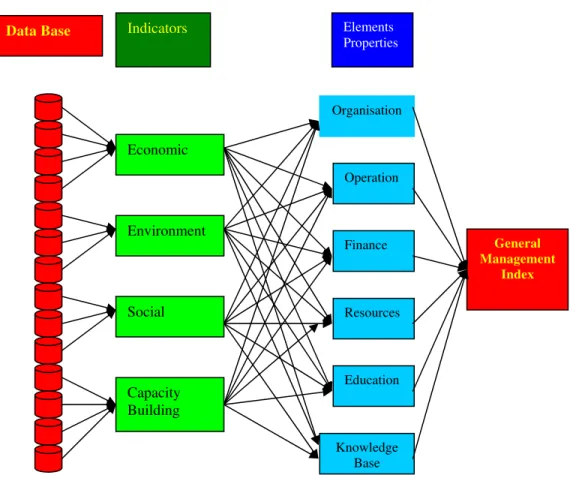
Fig. 1 Management property structure
3.3 Indicators for management system
In general, every management system is characterized with organization, operation, financial, resource, social and capacity building properties. The assessment and evaluation of the management system requires taking into a consideration all properties of the system. Contribution of each property to the General Management Index is defined with appropriately selected weighting coefficients.
The management system is defined as the multi-level decision-making procedure which includes different aspects of the quality designation for the specific system.
The General Management Index is agglomeration function of the elements representing individual characteristic of management system. It is anticipated that each element is function of the set of indicators
representing economic, social, environmental and capacity building indicators. Indicators are defined as specific parameters characterizing criteria imposed to the description of elements. The data base is a set of data comprising values of sub-indicators measuring the specific quality of indicators.
corresponding criterion. It is supposed that these indices are necessary and sufficient for the systems’ quality estimation [19].
Let initial (“zero-level”, “0-level”) indices of the management system under investigation are ) 0 ); 0 ( ( ),..., 0 ]; 0 [ ( ),..., 0 ; 1
( Qi Q m
Q (1)
where
- number m(0) of all initial indices is sufficiently large (m(0)>>0) and include indices of the “ zero/level”
Without loss in generality it may be assumed that initial indices meet the condition of normalization:
1 ) 0 ]; 0 [ (
0≤Qi ≤ ,i[0]=1,...,m(0). (2) As this normalization takes place, the minimal value Q(i[0];0)=0 of
i
[
0
]
-th criterion is correlated with a system, which manifests the minimal degree of the quality under consideration, and the maximal value1 ) 0 ]; 0 [
(i =
Q is associated with a system, which manifests the maximal degree of this quality. So, the complex systems are described by values of the m(0)-dimensional variable vector )) 0 ); 0 ( ( ),..., 0 ]; 0 [ ( ),..., 0 ; 1 ( ( ) 0
( Q Qi Qm
Q = (3)
of the initial indices (the indices of 0-level). Suppose that these initial indices are aggregated into new general indices, which are formed in a m(1)-dimensional vector
))) 1 ( ( ),..., 1 ]; 1 [ ( ),..., 1 ; 1 ( ( ) 1
( Q Qi Q m
Q = (4)
of the first-level (1-level) indices, where -
i
[
1
]
-th component Q(i[1];1) of the vector Q(1) is a synthesizing function (convolution))
1
];
1
[
);
0
);
0
(
(
),...,
0
];
0
[
(
),...,
0
;
1
(
(
)
1
];
1
[
);
0
(
(
)
1
];
1
[
(
i
m
Q
i
Q
Q
Q
i
Q
Q
i
Q
=
=
(5) of the vector Q(0) of initial (0-level) indices.
Then we can form a m(2)-dimensional variable vector )) 2 ); 2 ( ( ),.., 2 ]; 2 [ ( ),..., 2 ; 1 ( ( ) 2
( Q Qi Qm
Q = (6)
of second-level (2-level) indices Q(i[2];2), ) 2 ( ,..., 1 ] 2 [ m
i = ,
i
[
2
]
-th second-level index being a function)
2
];
2
[
);
1
);
1
(
(
),..,
1
];
1
[
(
),...,
1
;
1
(
(
)
2
];
2
[
);
1
(
(
)
2
];
2
[
(
i
m
Q
i
Q
q
Q
i
Q
Q
i
Q
=
=
=
(7) of the vector Q(1) of 1-level indices.Finally, we can form
( )
1;3 )) 3 ); 3 ( ( ),..., 3 ]; 3 [ ( ),..., 3 ; 1 ( ( ) 3( Q Qi Qm Q
Q = =
Having this in mind we can define the General Management Index as the linear function of all elements, so we can write
)
0
];
0
[
(
)
0
];
1
[
];
0
[
(
)
1
];
1
[
(
) 0 ( 1 ] 0 [i
Q
i
i
w
i
Q
mi
∑
==
, (8)(9)
∑
∑
∑
∑
= = = = = = ⎥ ⎥ ⎦ ⎤ ⎢ ⎢ ⎣ ⎡ = = = ) 1 ( ), 0 ( 1 ] 1 [ ], 0 [ ) 1 ( 1 ] 1 [ ) 0 ( 1 ] 0 [ ) 1 ( 1 ] 1 [ , ) 0 ]; 0 [ ( )] 1 ]; 2 [ ]; 1 [ ( ) 0 ]; 1 [ ]; 0 [ ( [ ) 0 ]; 0 [ ( ) 0 ]; 1 [ ]; 0 [ ( ) 1 ]; 2 [ ]; 1 [ ( ) 1 ]; 1 [ ( ) 1 ]; 2 [ ]; 1 [ ( ) 2 ]; 2 [ ( m m i i m i m i m i i Q i i w i i w i Q i i w i i w i Q i i w i Q∑ ∏
− = − = ⎥⎦ ⎤ ⎢ ⎣ ⎡ − − =(0),...,(31)1 ] 1 3 [ ],..., 0 [ 3 1 ) 0 ]; 0 [ ( ) 1 ]; [ ]; 1 [ ( ) 3 ]; 3 [ ( m m i i l i Q l l i l i w i Q (10)
This implies representation of a 3-level index in the form of an additive convolution ) 3 ]; 3 [ (i Q
)
0
];
0
[
(
)
3
];
0
[
(
)
3
];
3
[
(
) 0 ( 1 ] 0 [i
Q
i
w
i
Q
mi
∑
==
(11)of the initial indices with weight-coefficients ) 0 ); 0 ( ( ),..., 0 ; 1
( Qm
Q
∑ ∏
− = − = ⎥⎦ ⎤ ⎢ ⎣ ⎡ − − = (1),...,(31)1 ] 1 3 [ ],..., 1 [ 1 ) 1 ]; [ ]; 1 [ ( ) 3 ]; 0 [ ( m m i i t l l l i l i w i
w (12)
where w(i[0];t)≥0, i[0]=1,...,m(0), and
∑ ∏
∑
− = − = = = ⎥ ⎦ ⎤ ⎢ ⎣ ⎡ − − = (0),...,(31)1 ] 1 3 [ ],..., 0 [ 1 ) 0 ( 1 ] 0 [ 1 ) 1 ]; [ ]; 1 [ ( ) 3 ]; 0 [ ( m m i i t l m i l l i l i w i w (13)
4. DEMONSTRATION OF
GENERAL MANAGEMENT
INDEX
elements: business and financial effect, quality, health and safety and environment concern. Each of the elements will include a number of indicators. Indicators are clusters of sub-indicators reflecting quality of the criteria imposed on the element of the system. In this evaluation we will take into a consideration
several options which are defined with appropriate numerical values of sub-indicators. These values are supposed to express the differences in qualities of the management system. In TABLE 1 are presented values of the sub-indicators and their aggregation [20]
Business& Financial Effects
Quality
Unit Cost Increase
in sale
Profit Rejected
parts (internal)
Rejected parts (external)
Late Delivery
Complains
$Product $/product $/product $/product $/product Per unit Per unit
1 285 9% 11% 0.03% 0.006% $ 0.04 0.003
2 7,859 16% 14% 0.007% 0.0005% $0.00 0. 0007
3 32,440 1.4% 21% 0.04% 0.00001% $ 0.02 0.000
4 192 28% 14% 0.4% 0.07% $ 0.00 0.000
Table 1 – A
Health & Safety Environmental Concern
Injuries Lost Time Legal Third party
complaints
Legal citation Env. impact
Hr/worked Hr/worked Hr/worked Per 1K empl Per 1K empl Per 1KEmpl.
1 per 94K 0.0006 2.47 per 100K 0..000 None 11,229
1 per 122K
0.00003 3.14 per
100K
0.03 None 15,677
1 per 228K
0.000006 3.14 per
100K
0.0005 0.007 22,7894
1 per 89K
0.0008 3.14 per
100K
0.000 0.0003 8,560
1 per 177K
0.00004 3.14 per
100K
0.0008 0.00008 48,556
Table 1 – B
This exercise is devoted to the automobile industry having products as the single item directly exposed to the market. In this analysis we will start from the zero level indicators. These indicators are expressed in different scale, and they are agglomerated in indicators of first level. It is assumed to have four indicators defining respective characteristics of the management system and representing the first level of indicators. These indicators are the quantitative measurement of respective criteria. In this analysis the criteria with following indicators are introduced: economic, environmental, capacity building and social indicators. Each of these indicators is component of the second level indicators which describes a specific characteristic of the management system. The General Management Index represents measuring parameter of the management system to be analyzed and represents the agglomeration indicator of second level indicators. Fig.2 presents the structure of the General Management Index.
4.1 INDICATOR AGGLOMERATION
In the design of the General Management Index structure, we have assumed three agglomeration processes. Namely,
Agglomeration at the first level
Pr Pr
q
w
q
w
q
w
Q
Uc Uc Is IisCom
=
+
+
(14) Comp Comp Ld Ld xt xt R R qua q w q w q w q w
Q = int int+ Re2 Re 2+ +
(15) Le Le LT LT In In S H
q
w
q
w
q
w
Q
&=
+
+
(16) Eni Eni Lc Lc Thp Thp Env q w q w q w
Q = + + (17)
Agglomeration at the second level
Env Env S H S H en Qua Qua Com Com GMI
Q
w
Q
w
Q
w
Q
w
Q
+
+
+
+
=
& & (18)The first level of agglomeration implies the need for normalization of each indicator of the zero level and determination of the weight coefficient of each indicator.
Normalization procedure is performed with selection of Max and Min values of indicator among the options under
consideration and by the use of linear normalization function
q x
if x MIN i x MIN i
MAX i MIN i if MIN i x MAX i if x MAX i
i i i i i i ( ) , ( ), ( ) ( ) ( ) , ( ) , ( ) = ≤ − − ⎛ ⎝⎜ ⎞
⎠⎟ < ≤ > ⎧ ⎨ ⎪⎪ ⎩ ⎪ ⎪ 0 1 λ ( ), (19) or
( )
⎪ ⎪ ⎩ ⎪⎪ ⎨ ⎧ > ≤ < ⎟⎟ ⎠ ⎞ ⎜⎜ ⎝ ⎛ − − ≤ = ) ( , 1 ), ( ) ( , ) ( ) ( ), ( , 0 ) ( i MIN x if i MAX x i MIN if i MIN i MAX x i MAX i MAX x if x q i i i i i i λ (20) The weight coefficients are determined by randomization procedure. In order to define weight-coefficient vector the randomization of uncertainty is introduced. Randomization produces stochastic with realizations from corresponding sets of functions and a random weight-vector. It is assumed that the measurement of the weight coefficients is accurate to within a steps h = 1/n, with n a positive integer. In this case the infinite set of all possible vectors may be approximated by the finite set W(m,n) of all possible weight vectors with discrete components. In our case, we will use m and n, so that the total number of elements of the set W(m,n) is N(m,n).For each agglomeration indicator n and m parameters have to be selected. Also the priority of indicator has to be predefined.
With application of this procedure to all indicators and their agglomeration, among options under consideration we will obtain the General Management Index rating. Changing priority constrain in this procedure we can obtain the effect of the different constrain to the finale rating list. This will lead to the quality assessment of management system under predefined constrains.
5. RESULTS
Index Rating.
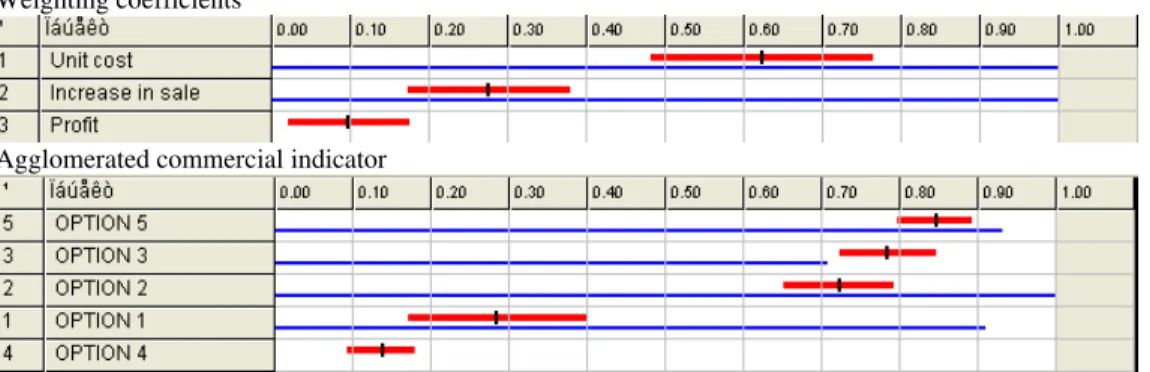
5.1 Agglomerated commercial indicators
In our exercise for the demonstration of the General Management Index rating, a following constrains for the Commercial
Indicator are used:
1. Case 1 :Unit cost > Increase in sale > Profit 2. Case 2: Increase in sale > Unit cost > Profit 3. Case 3 :Profit > Unit cost > Unit cost
Case 1: Unit cost>Increase in Sale>Profit
Weighting coefficients
Agglomerated commercial indicator
Fig. 3 Agglomerated Commercial Indicator for Case 1
Case 2: Increase in sale >Unit cost>Profit
Weighting coefficients
Agglomerated commercial indicator
Fig. 4 Agglomerated Commercial Indicator for Case 2
Case 3 : Profit >Increase in sale >Unit cost
Weighting coefficients
Agglomerated commercial indicator
Fig. 5 Agglomerated Commercial Indicator for Case 3 The same procedure is adapted for
agglomeration of other indicators as follows R R xt xt LdLd CompComp qua
q w q w q w q w
Le Le LT LT In In S H
q
w
q
w
q
w
Q
&=
+
+
(22) Eni Eni Lc Lc Thp Thp Env
q w q w q w
Q = + + (23)
Also, there have been adapted respective
constrains. And following results are obtained. Agglomerated Commercial Indicator for constrains as defined inn the Table2.
QCOM Constrains Unit cost>Increase in
sale>Profit
Increase in sale>Unit cost>Profit
Increase in sale>Unit cost>Profit
Option 1 0.286 0.519 0.690
Option 2 0.724 0.500 0.710
Option 3 0.786 0.850 0.326
Option 4 0.138 0.099 0.465
Option 5 0.848 0.800 0.577
Agglomerated Quality Indicator for constrains as defined inn the Table 3 QQUA
Constrains Reject-int>Reject-ext>Late del.>Complains
ext> Reject-int>Late del.>Complains
Late del Reject- int>Reject-ext.>Complains
Complains> Reject- int>Reject-ext>Late del.
Option 1 0.278 0.450 0.296 0.161
Option 2 0878 .0.830 0.930 0.797
Option 3 0.725 0.726 0.400 0.882
Option 4 0.191 0.191 0.580 0.580
Option 5 0.750 0.694 0.621 0.380
Table 3
Agglomerated Health&Security Indicator for constrains as defined inn the Table QH&S
Constrains Injury>Lost time>Legal Lost time>Injury>Legal Legal>Injury>Lost time
Option 1 0.120 0.132 0.632
Option 2 0.561 0.710 0.372
Option 3 0.906 0.882 0.526
Option 4 0.025 0.028 0.156
Option 5 0.860 0.835 0.506
Table 4
Agglomerated Environment Indicator for constrains as defined inn the Table 5 QENV
Constrains Third party>Legal citation>Env. impact
Legal citation> Third party >Env. impact
Env. impact >Third party>Legal citation
Option 1 0.840 0.847 0.845
Option 2 0.320 0.634 0.523
Option 3 0.414 0.209 0.445
Option 4 0.692 0.530 0.846
Option 5 0.692 0.686 0.289
Table 5 Using the data obtained for agglomerated indicators and the same procedure as defined for the agglomeration of indicators, it can be calculated the General Management Index. In
QGMI Constrains Unit cost>Increase
in sale>Profit
Reject-int>Reject-ext>Late del.>Complains
Injury>Lost time>Legal
Third party>Legal citation>Env. impact
Option 1 0.286 0.278 0.120 0.840
Option 2 0.724 0878 0.561 0.320
Option 3 0.786 0.725 0.906 0.414
Option 4 0.138 0.191 0.025 0.692
Option 5 0.848 0.750 0.860 0.692
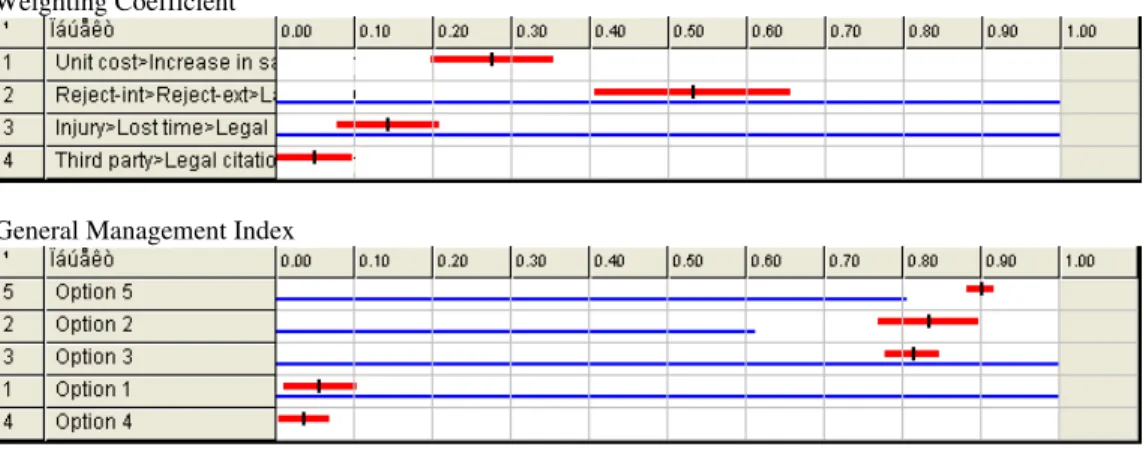
In the following figures are given graphical presentations for the General Management Index obtained for Commercial Indicator (Reject-int>Reject-ext>Late del.>Complains)
Case and Environment Indicator (Third party>Legal citation>Env. Impact) Case
In Fig.6 we can notice the case with Quality indicator with constrain
Reject-int>Reject-ext>Late del.>Complains has priority in comparison with other indicator with respective constrains, Options 5, 2 and 3 are having priority in comparison with other Options. Small difference between General Management Index among Options 5,2 and 3 proves that the general quality measurement of the different management systemamong options.
Weighting Coefficient
General Management Index
Fig. 6 General Management Index with Quality indicator with constrain Reject-int>Reject-ext>Late del.>Complains has priority
Weighting Coefficient
General Management Index
From this exercise, it can be seen that there is obvious sensitivity of the multi-criteria assessment to the change of the sub-indicators as well indicators as defined in this evaluation. Also, it is of interest to notice that the General Management Index represent the quality measurement of management system.
6. CONCLUSIONS
Quality of the management system is an immanent property which requires specific procedure and methodology to be measured. The multi-criteria General Management Index measurement leads to the evaluation of management system. Presented evaluation method is based on the priority list formation among the options under consideration, The essential feature of the evaluation method possibility to obtain the effect of different constrain on the priority list.
The management system is defined as the multi-level decision-making procedure which includes different aspects of the quality designation for the specific system. The General Management Index is the agglomeration function of elements representing individual characteristic of management system.. It is anticipated that each element is function of the set of indicators representing economic, social, environmental and capacity building indicators. Indicators are defined as specific parameters characterizing criteria imposed to the description of elements. The data base is a set of data comprising values of sub-indicators measuring the specific quality of indicators.
Results presented are obtained from the demonstration exercise for the five Management system options and number of sub-indicators as defined in the paper.
REFERENCES:
[1]
Report of The United Nation Conference on Environment and Development,
Vol.1,Chapter 7,June,1992
[2]
Agenda 21, Chapter 35, Science for Sustainable Development, United Nation Conference
on Environment and Development,1992
[3]
Declaration of the Council of Academies of Engineering and Technological Sciences
[4]The Earth Chapter : A Contribution Toward its Realisation, Franciscan Center of
Environment Studies, Roma,1995
[5]
M.Gianpiero, K.Mayuari, G. Postar, Energy Analysis as a Tool for Sustainability : Lessens
for Complex System Theory. Annals of the New York Academy of Sciences, 879,
pp.344-367,1999
[6]
F. Heylighen, The Science of Self-organization and Adaptively, Free University of
Brussels, Belgium
[7]
Progogine I., Evaluation Criteria, Variational Properties and Fluctuations, Non-equlibrium
Thermodynamics Variational Techniques and Stability, Ed. R.J.Donnely,R.Herman,
I.Prigogine, The University of Chicago Press, Chicago,1966
[8]
I. Prigogine, D. Kondepudi, Modern Thermodynamics: From Heat Engine to Dissipative
Processes, John Wiley and son, Chichester, 1998,
[9]
Hovanov, N.V.
Analysis and Synthesis of Parameters under Information Deficiency
, St.
Petersburg University Press, St. Petersburg, 1996 (In Russian).
[10]
Hovanov, N.V. & Fedotov, Yu.V. & Zakharov V.V. The making of index numbers under
uncertainty, In:
Environmental Indices. Systems Analysis Approach
, ed. Yuri A. Pykh et
al., pp.83-99, EOLSS Publishers Co., Oxford, 1999.
[12]
Afgan N.H, Carvalho M. G., Sustainability Assessment Method for Energy Systems,
Kluwer Academic Publisher, New York,2000
[13]
![Fig. 1 Complexity of Management system There are three interrelated approaches to the modern study of complex systems [4,5], (1) how interactions give rise to patterns of behavior, (2) understanding the ways of describing complex systems, and (3) the](https://thumb-eu.123doks.com/thumbv2/123dok_br/18447771.363924/3.807.425.681.122.326/complexity-management-interrelated-approaches-interactions-patterns-understanding-describing.webp)