Marília Mendes Nunes
I, Tânia Alteniza Leandro
I, Marcos Venícios de Oliveira Lopes
I, Viviane Martins da Silva
II Universidade Federal do Ceará, Faculty of Pharmacy, Dentistry and Nursing,
Postgraduate Program in Nursing. Fortaleza, Ceará, Brazil.
How to cite this article:
Nunes MM, Leandro TA, Lopes MVO, Silva VM. Clinical indicators for nursing diagnosis Ineffective protection in adolescents with cancer. Rev Bras Enferm [Internet]. 2017;70(6):1330-6. DOI: http://dx.doi.org/10.1590/0034-7167-2016-0571
Submission: 11-24-2016 Approval: 02-09-2017
ABSTRACT
Objective: To investigate scientific evidence related to the term protection and clinical indicators and etiologic factors for nursing
diagnosis Ineffective protection in adolescents with cancer. Method: Integrative literature review in the databases of Scopus, Web of
Science, National Library of Medicine and National Institutes of Health (PubMed) and Cochrane; by intersection of the descriptors
protectionand childhood cancer, which resulted in seven articles. These were insufficient for a comprehension of the term protection
and aspects related to its impairment, therefore it was necessary to include a further three reference books. Results: Five clinical indicators
and three etiologic factors associated to Ineffective protection were identified some of which were not cited in NANDA-International.
Conclusions: There are clinical and etiologic factors important for the identification of ineffective protection in adolescents with cancer.
Descriptors: Nursing Diagnosis; Protection; Immunological System; Cancer; Adolescent.
RESUMO
Objetivo: Investigar as evidências científicas acerca do termo proteção e dos indicadores clínicos e fatores etiológicos do
diagnóstico de enfermagem Proteção ineficaz em adolescentes com câncer. Método: Realizou-se uma revisão integrativa nas
bases de dados Scopus, Web of Science, National Library of Medicine and National Institutes of Health (PubMed) e Cochrane;
por meio do cruzamento dos termos protection and childhood cancer, que resultou em sete artigos. Estes não foram suficientes
para a compreensão do termo proteção e dos aspectos associados à sua alteração, sendo necessário incluir três livros. Resultados:
Foram identificados cinco indicadores clínicos e três fatores etiológicos associados a uma proteção ineficaz, alguns não citados
na NANDA-Internacional. Conclusões: Existem indicadores clínicos e fatores etiológicos que podem ser importantes para
identificar uma alteração na proteção de adolescentes com câncer.
Descritores: Diagnóstico de Enfermagem; Proteção; Sistema Imunológico; Neoplasias; Adolescente.
RESUMEN
Objetivo: Investigar las evidencias científicas acerca del término protección y de los indicadores clínicos y factores etiológicos
del diagnóstico de enfermería Protección ineficaz en adolescentes con cáncer. Método: Se realizó una revisión integradora en
las bases de datos Scopus,Web of Science, National Library of Medicine andNationalInstitutesof Health (PubMed) y Cochrane;
por medio del cruce de los términos protection and childhood cancer, que resultó en siete artículos. Estos no fueron suficientes
para la comprensión del término protección y de los aspectos asociados a su alteración, siendo necesario incluir tres libros.
Resultados: Fueron identificados cinco indicadores clínicos y tres factores etiológicos asociados a una protección ineficaz,
algunos no citados en la NANDA-Internacional. Conclusión: Existen indicadores clínicos y factores etiológicos que pueden ser
importantes para identificar una alteración en la protección de adolescentes con cáncer.
Descriptores: Diagnóstico de Enfermería; Protección; Sistema Inmunológico; Neoplasias; Adolescente.
Clinical indicators for nursing diagnosis Ineffective
protection in adolescents with cancer
Indicadores clínicos do diagnóstico de enfermagem Proteção ineficaz em adolescentes com câncer
Indicadores clínicos del diagnóstico de enfermería Protección ineficaz en adolescentes con cáncer
Marília Mendes Nunes E-mail: [email protected]
INTRODUCTION
Cancer represents an important global public health problem(1);
in Brazil alone, there were an estimated 596 thousand new cases of the disease in 2016. Of these, approximately 12,600 new cases
of cancer in children and adolescents were pediatric tumors(2).
Childhood cancer is the first cause of death due to illness among children and adolescents in Brazil and developed
coun-tries(3). In the United States, for example, the rate of cancer
inci-dence increased by 0.6% per year between 1975 and 2012. In contrast, mortality rates declined steadily from 6.5 (per 100,000 population) in 1970 to 2.4 in 2012, representing a global
reduc-tion of 63% (65% in children and 60% in adolescents)(1).
With regard to adolescence, it is highlighted that this is a phase in which profound physical, cognitive, social and
emo-tional changes occur(4), which can lead to modifications in the
way of understanding and interacting with the world. From 10 to 14 years of age, growth is accelerated, physical changes and development of sexual characteristics occurs, which may
be a source of anxiety for the individual(5). In addition, there is
acceleration in the electrical and physiological development of the brain, with duplication of the number of cells and reor-ganization of the neural networks, which has an impact on the
emotional, physical and mental capacity of the adolescent(6).
In the final phase of adolescence (15 to 19 years), cigarettes,
alcoholic drinks and other drugs can be abused(5) as an
alter-native to dealing with adverse situations(7). In addition,
adoles-cents present habits and behavior that can lead to situations of violence and illness. Such vulnerabilities are generated by the social context of these individuals and result from historical pro-cesses of exclusion and discrimination (poverty, lack of access to education and low levels of schooling, exploitation of labor and
exposure to the various forms of violence)(7).
Adolescents need information for their protection, as well as an appropriate space to experience the various transformations inherent in this phase. Consequently, support from the family, school, community and health services is of major importance.
In this context, diverse clinical situations can occur among ado-lescents that demand special attention from the health professional, as in the case of childhood cancer. Given that adolescents as a pop-ulation are exposed to situations of vulnerability, the nurse should be familiar with those clinical indicators that infer a diagnosis of Ineffective Protection. In this study, the terms “clinical indicators” and “defining characteristics” are considered to be synonymous.
According to NANDA-I, the Nursing Diagnosis Ineffective Pro-tection (0043) is defined as a “decrease in the ability to guard self
from internal or external threats, such as illness or injury”(8). The
defining characteristics proposed for Ineffective Protection include: alteration in clotting, alteration in perspiration, anorexia, chilling, coughing, deficient immunity, disorientation, dyspnea, fatigue, im-mobility, insomnia, itching, maladaptive stress response, neurosen-sory impairment, pressure ulcer, restlessness, and weakness. The factors related to this human response are: abnormal blood profile, cancer, extremes of age, immune disorder, inadequate nutrition,
pharmaceutical agent, substance abuse and treatment regimen(8).
Understanding the importance of knowing the manifes-tations and causes of changes in the individual’s ability to
protect self can contribute to an early identification of this problem by the nurse. Thus, this study aims to investigate the scientific evidence focused on the term protection and clinical indicators and etiological factors of nursing diagnosis ineffec-tive protection in adolescents with cancer.
METHOD
An integrative review study was carried out based on the following steps: problem formulation (elaboration of the guid-ing question, keywords and inclusion criteria); search proce-dures (inclusion of relevant literature on the topic of interest); data evaluation (extraction of relevant information from select-ed articles); data analysis and interpretation (data integration
process); and presentation of the review(9).
For the first step of the review, the following guiding ques-tions were elaborated: How is the term protection addressed in the context of childhood cancer? What are the clinical indi-cators of ineffective protection? What are the factors that can lead to ineffective protection?
The search for articles was realized by two members of the research team, who later discussed the relevance and inclusion of the articles in the final review. This search was performed in the databases of Scopus, Web of Science, National Library of Medicine and National Institutes of Health (PubMed) and Cochrane, in January and February 2015, using as keywords the terms protection and childhood cancer. At the intersection of the descriptors, we used the Boolean operator AND.
We used the opposite term for nursing diagnosis Ineffective protection to identify its components in the context of child-hood cancer, considering that for NANDA-I, the focus of this diagnosis is the word protection. The term ineffective refers to the axis of judgment and is defined as that which does not
produce the intended or desired effect(10). Protection was used
as a defining term, so that later it was possible to interpret which elements are important to identify changes in an indi-vidual’s capacity to guard self.
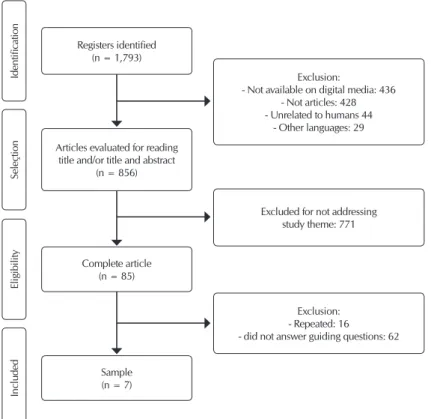
The following inclusion criteria were then applied to refine the search: complete articles and electronically available in Portuguese, English or Spanish that addressed the guiding ques-tions. The search and selection process of the articles was based on the Preferred Reporting Items for Systematic Review and Me-ta-Analyses (PRISMA), as shown in the flow diagram (Figure 1).
The selection process for the studies was carried out by reading the title, abstracts and, later, the complete article. In this manner, the final selection included seven articles that met the inclusion criteria, three of these from the Scopus da-tabase, one from Web of Science, one from Pubmed and two from Cochrane. The articles were then classified according to
the level of scientific evidence proposed by Howick et al.(11).
The choice of books was based on the references used to teach Immunology. Three were selected and these contributed to understanding the elements associated with Ineffective
pro-tection, namely: Cellular and Molecular Immunology(12), Kuby
Immunology(13) and The Immune System(14). The
articles and books were organized in a frame-work according to the findings for reference, clinical indicators and etiological factors.
RESULTS
During the reading of selected material, in-formation that answered the guiding questions was extracted. The results found in the litera-ture pointed to five clinical indicators and three etiological factors for Ineffective protection (see Chart 1).
Analysis of the articles revealed that no study had been developed by nurses and that 57.1% of articles were published in 2014. Different interpretations were found of the term protec-tion related to childhood cancer: two authors related protection to a positive response of the body after use of specific medications, while the remainder referred to an immune response of the body after vaccination or against infections.
Regarding the level of evidence, three
ar-ticles were classified as level I(15,18-19), two as
level II(17,20) and two as level III(16,21). No studies
located addressed the nursing diagnosis Ineffec-tive protection among children and adolescents with cancer. In relation to the clinical indicators of protection in the context of childhood cancer, analysis of
the articles and books identified the following: Injured oral
mucosa, Injured gastrointestinal mucosa, insufficient anti-body titers, recurrent infections and opportunistic infections.
Chart 1 – Synthesis of the results, Brazil, 2016
Title Clinical Indicators Etiological Factors
Protection against chemotherapy induced mucositis by TGF-b2 in childhood cancer patients: Results from a randomized cross-over study(15)
Injured oral mucosa, Injured
gastrointestinal mucosa Side effects of treatment (chemotherapy and radiotherapy)
Assessment of hepatitis B immunization status after
antineoplastic therapy in children with cancer(16) Insufficient antibody titers Side effects of treatment (chemotherapy), missed routine vaccinations
A prospective study of chemotherapy immunologic effects and predictors of humoral influenza vaccine responses in a pediatric oncology cohort(17)
Insufficient antibody titers Side effects of treatment (chemotherapy), Missed routine vaccinations
Interventions for preventing oral mucositis for patients with
cancer receiving treatment(18) Injured oral mucosa, Injured gastrointestinal mucosa Side effects of treatment (chemotherapy and radiotherapy)
Vaccines for prophylaxis of viral infections in patients with
hematological malignancies(19) Insufficient antibody titers Side effects of treatment (chemotherapy), missed routine vaccinations
Immune response after influenza vaccination in children with cancer(20)
Insufficient antibody titers Side effects of treatment (chemotherapy), missed routine vaccinations
Differential loss of humoral immunity against measles, mumps, rubella and varicella-zoster virus in children treated for cancer(21)
Insufficient antibody titers Side effects of treatment (chemotherapy), missed routine vaccinations
Cellular and Molecular Immunology(12); Kuby
Immunology(13); The Immune System(14). Recurrent infections; Opportunist infections Secondary Immunodeficiencies (cancer, immunosuppressive treatment)
Exclusion:
- Not available on digital media: 436 - Not articles: 428 - Unrelated to humans 44
- Other languages: 29
Excluded for not addressing study theme: 771
Exclusion: - Repeated: 16 - did not answer guiding questions: 62 Complete article
(n = 85)
Sample (n = 7)
Included
Eligibility
Seleçtion
Identification
Registers identified (n = 1,793)
Articles evaluated for reading title and/or title and abstract
(n = 856)
The etiological factors of Ineffective protection in children and adolescents with cancer identified in the articles were:
side effects of treatment (chemotherapy and radiotherapy), ab-sence of routine vaccines and secondary immunodeficiencies.
DISCUSSION
The results of this research show that most of the articles were published in 2014, which could mean a growing interest in the subject in view of the increased incidence of childhood cancer. It is underscored that in Brazil 2016, there were an estimated 12,600 new cases of cancer in children and adolescents. The Southeast-ern and NortheastSoutheast-ern regions presented a higher estimated
num-ber of cases when compared to the rest of the country(2).
Different interpretations of the term protection related to childhood cancer were found, and no study was located that ad-dressed the nursing diagnosis Ineffective protection among chil-dren and adolescents with cancer—denoting a lack of research in this area. It is underscored that protection refers to a term that is difficult to characterize. In nursing, protection is referred to as the fifth basic need identified in the physiological mode of Roy
AdaptationModel(22). This theory focuses on the individual and
his relationship with the environment, considering the mutual influences between them. The “protection” component is an im-portant adaptation process because it is through the process of life defense that the integrity of the body is maintained.
NANDA-I appears to use a broader meaning for protection, bearing in mind the definition of nursing diagnosis ineffec-tive protection: “decreased ability to protect oneself against
internal or external threats, such as illness or injury”(8). This
definition presents broad terms, such as internal or external threats, that make it difficult to understand the diagnosis and characteristics that aid in its identification.
However, when analyzing nursing studies that identified this diagnosis in different populations, we can see an association be-tween the presence of the diagnosis and impaired immunity. This fact is evidenced by the defining characteristics and / or related factors used for inference of the diagnosis in the studies by Cane-ro, Carvalho and Galdeano(23), Silva et al.(24) and Neves et al.(25).
In relation to the clinical indicators of protection in the context of childhood cancer after analysis of the articles and
books we identified: Injured oral mucosa, Injured
gastrointes-tinal mucosa, insufficient antibody titers, recurrent infections
and opportunistic infections.
On comparing these results with the defining characteris-tics proposed by NANDA-I, it was observed that three of the
five identified in this review may be included in the impaired
immunity indicator, presented by said taxonomy. These
indi-cators are: Injured gastrointestinal mucosa, Injured oral
mu-cosa and insufficient antibody titers.
Impaired immunity is known to be related to a decrease or failure in the performance of the body’s defense function
against invading agents(12), including therefore inadequate
in-nate immune or adaptive immune responses. The cells of the hematopoietic system divide rapidly and are highly vulner-able to application of chemotherapeutic agents. When sup-pressed by drugs, the bone marrow is unable to replenish
circulating blood elements, thereby decreasing the number of leukocytes (leukopenia), erythrocytes (anemia) and platelets
(thrombocytopenia)(26).
Suppression of the immune system in cancer patients ren-ders them vulnerable to infections, such as those that can be
prevented by vaccines. For example, Karaman et al.(16), when
evaluating the pre-treatment immunization status of patients against hepatitis B virus infection, identified a reduction of anti-HBs antibody titer to below the protection level in 33% of patients with positive antibodies prior to treatment.
Another study that analyzed the loss of protective immunity (immunity at diagnosis and immunity after treatment comple-tion) against preventable diseases in children treated for malig-nant disease has shown that a significant number of these lose humoral immunity against measles, mumps, rubella and
varicel-la after chemotherapy(21). This contextualizes the clinical
indica-tor insufficient antibody titer, demonstrating that the protection afforded by vaccines may be affected following the application of antineoplastic therapy, thereby exposing children and adoles-cents to diseases that should not occur after immunization.
In addition, nursing assessment should focus on the recogni-tion of clinical indicators that demonstrate an increased risk for
the patient. Injured oral mucosa, for example, was found in this
review to be an indicator of impairment in the individual’s pro-tection of self, as it is an innate component in human immunity. Mucositis, a common side effect of treatment for cancer, manifests as inflammation and ulceration of any part of the oral and gastrointestinal mucosa, compromising the alimentary
ca-nal(27). Both chemotherapy and radiotherapy generate chemical
substances that lead to cellular destruction in the mucosa of the epithelium, connective tissue and blood vessels of the oral
cav-ity, resulting in ulceration and compromised oral tissues(26).
An injury to the oral mucosa represents a means of entry for infectious agents and consequent susceptibility to infection. At this point, it is emphasized that poor oral hygiene, existing dental disease, impaired nutritional status, among other factors involved,
may contribute to the morbidity associated with this condition(26).
Another clinical indicator found refers to the loss of intes-tinal integrity, which predisposes to bacterial translocation and can lead to severe infections in the immunosuppressed patient. These side effects may lead to a reduction in
chemo-therapy intensity, compromising treatment efficacy(15).
Besides the above mentioned aspects, it is pertinent that the skin and mucosa are the first barriers that the pathogen encoun-ters when trying to reach the individual. Loss of skin integrity rep-resents a port of entry for the invasion of microorganisms.
Another important clinical indicator refers to recurrent
infections, which are related to the installation of infectious
processes in a repetitive manner. According to Abbas(12), this
is the main consequence of impaired immunity. The nature of the infection depends on the defective immune system component, i.e. a deficiency of humoral immunity results in increased susceptibility to infections with pyogenic bacteria, whereas a deficiency in cellular immunity leads to infections
with viruses and other intracellular microorganisms(12).
to secondary causes, including viral infections; malignancies; metabolic disease; medications (immunosuppressive agents, immunomodulatory agents, and cytotoxic drugs); iatrogenics; surgery, including the removal of immunologically relevant
or-gans (thymus and spleen); and undergoing transplantation(13).
Regarding the indicator opportunistic infections, this term
is related to the establishment of an infectious process caused by microorganisms that healthy individuals can tolerate with-out consequences, but which cause diseases in those with
im-paired immune function(12). The literature highlights that the
most common opportunistic microorganisms are: Candida
spp, Mycobacterium, Aspergillus spp., Pneumocystiscarinii,
herpes simplex virus, and Cryptococcus neoformans(28).
The etiological factors of Ineffective protection in children and adolescents with cancer identified in the articles were:
side effects from treatment (chemotherapy and radiotherapy),
missing routine vaccines and secondary immunodeficiencies. When comparing with the related factors of nursing diagnosis Ineffective protection present in NANDA-I (2015-2017), we
realized that secondary immunodeficiencies and side effects
from treatment (chemotherapy and radiotherapy) coincide.
This taxonomy brings immunological disorders as a related
factor, which includes the secondary immunodeficiencies(8).
Regarding side effects from treatment (chemotherapy and
radiotherapy), the main effects are alterations in cell production
by the bone marrow(18). Chemical agents can inhibit lymphocyte
proliferation and their specificity for the immune response. These drugs interfere with DNA synthesis, arresting the cell cycle and inducing apoptosis. They are capable of inhibiting the prolifera-tion of T and B lymphocytes and, consequently, any new immune responses. Depending on the dose applied, they inhibit cellular and antibody responses that have been previously sensitized. Therefore, the main limitation of these agents is the damage to hematopoietic and non-hematopoietic cells, with the develop-ment of cytopenias and deterioration of the skin and gastrointesti-nal mucosa. These cytopenias contribute to the state of secondary
immunodeficiency and susceptibility to infections(29).
Secondary immunodeficiencies, another etiological factor found in the review, refer to the negative impact that some en-vironmental factors (immunosuppressive drugs, for example)
can cause in the immune system(14). Chinen and Shearer(29)
cite that this type of deficiency in the immunity is manifested by increasing the frequency of common infections or unusual complications of these infections, as well as the occurrence of opportunistic infections.
Another etiological factor identified in the articles was
missing vaccines. It is known that the expected response after vaccine application is a specific immunity to a particular infec-tion causing agent. However, common childhood infecinfec-tions
can be dangerous, and children should not be immunized against such diseases (measles, mumps, rubella, and polio) when the immune system is depressed, since attenuated
virus-based vaccines can cause severe infection(30).
It is noted that there are clinical indicators and etiological factors that may be important to identify the diagnosis Ineffec-tive protection in adolescents with cancer beyond those cited by NANDA-I. Therefore, it is suggested to carry out a future clinical validation study, to refine the diagnosis in question, including the elements identified in this review.
Study limitations
The limitations of the study were the definition of inclusion criteria and keywords, which may have restricted the identi-fication of studies important for the review. In addition, the number of databases included for the search of the articles, such that it is important to continue research in other data-bases to complement the results of this study.
Contribution to nursing, health or public policy
It is important to understand the aspects associated with a decreased protection capacity of the individual, especially in the context of childhood cancer. Awareness of the clinical in-dicators that these individuals may present, as well as the pos-sible causes for this impairment may help the nurse to identify such alteration earlier.
CONCLUSION
This study found that changes in the ability to protect against possible diseases or injuries have been poorly ad-dressed, especially when referring to a nursing phenomenon. This indicates the need to develop nursing research that ad-dresses this question. In short, various interpretations of the term protection related to childhood cancer were found: posi-tive response of the organism after use of specific medica-tions; and immune response of the body after vaccination or against infections.
In addition, this study allowed the identification of five clin-ical indicators of a change in the protection of the individual:
Injured oral mucosa, Injured gastrointestinal mucosa, insuf-ficient antibody titers, recurrent infections and opportunistic infections. Regarding the factors that may lead to a decrease in
the protection capacity, we found: side effects from treatment
(chemotherapy and radiotherapy), missing routine vaccines
and secondary immunodeficiencies. It is underscored that here are clinical indicators and etiological factors that may be important to identify an alteration in the protection of adoles-cents with cancer that are not mentioned in NANDA-I.
REFERENCES
1. Siegel R, Miller KD, Jemal A. Cancer Statistics. CA Cancer J Clin[Internet]. 2016 [cited 2016 Jan 9];66:7-30. Available from: http:// onlinelibrary.wiley.com/doi/10.3322/caac.21332/full
3. Brasil. Ministério da Saúde. Instituto Nacional do Câncer. Tipos de câncer infantil[Internet]. Rio de Janeiro: INCA, 2012[cited 2016 Mar 30]. Available from: http://www2.inca.gov.br/wps/wcm/connect/tiposdecancer/site/home/infantil
4. Hockenberry MJ, Wilson D. Wong: fundamentos de enfermagem pediátrica. 8 ed. Rio de Janeiro: Elsevier; 2011.
5. UNICEF. United Nations Children’s Fund. Situação Mundial da Infância, 2011[Internet]. New York, NY: Hatteras Press, 2011[cited 2016 Mar 30]. Available from: http://www.unicef.org/sowc2011/pdfs/SOWC-2011-Main Report_EN_02092011.pdf
6. Johnson SB, Blum RW, Giedd JN. Adolescent Maturity and the Brain: The promise and pitfalls of neuroscience research in adolescent health policy. J Adolesc Health[Internet]. 2009 [cited 2015 Jul 22];45(3):216-21. Available from: https://www.ncbi. nlm.nih.gov/pmc/articles/PMC2892678/
7. Brasil. Ministério da Saúde. Atenção psicossocial a crianças e adolescentes no SUS: tecendo redes para garantir direitos[Internet]. Brasília: Ministério da Saúde; 2014[cited 2016 Mar 30]. Available from: http://www.crianca.mppr.mp.br/arquivos/File/publi/ cnmp/atencao_psicossocial_criancas_adolescentes_sus.pdf
8. Herdman TH, Kamitsuru S (Eds.), NANDA International Nursing Diagnoses: definitions & classification. 2015–2017, Wiley-Blackwell: Oxford; 2014.
9. Mendes KDS, Silveira RCCP, Galvão CM. Revisão integrativa: método de pesquisa para a incorporação de evidências na saúde e na enfermagem. Texto Contexto Enferm [Internet]. 2008 [cited 2015 Jan 7];17(4):758-64. Available from: http://dx.doi.org/10.1590/ S0104-07072008000400018
10. Herdman TH. Diagnósticos de enfermagem da NANDA: definições e classificação 2012-2014. Porto Alegre: Artmed, 2013.
11. Howick J, Chalmers I, Glasziou P, Greenhalgh T, Heneghan C, Liberati A, et al. OCEBM Levels of Evidence Working Group. “The Oxford Levels of Evidence 2”. Oxford Centre for Evidence-Based Medicine The Oxford 2011 Levels of Evidence [Internet]. 2011[cited 2017 Feb 1]. Available from: http://www.cebm.net/ocebm-levels-of-evidence
12. Abbas AK, Lichtman AH. Pillai S. Imunologia Celular e Molecular. 6 ed. Rio de Janeiro: Elsevier, 2008.
13. Kindt TJ, Goldsby RA, Osborne BA. Imunologia de Kuby. Silva AC (Trad.). 6 ed. Porto Alegre: Artmed, 2008.
14. Parham P. The Immune System. 3 ed. London: Garland Science, 2009.
15. Koning BAE, Philipsen-Geerling B, Hoijer M, Hählen K, Büller HA, Pieters R. Protection against chemotherapy induced mucositisby tgf-b2 in childhood cancer patients: results from a randomized cross-over study. Pediatr Blood Cancer[Internet]. 2007 [cited 2015 Jan 13]48:532-9. Available from: http://onlinelibrary.wiley.com/wol1/doi/10.1002/pbc.20910/full
16. Karaman S, Vural S, Yildirmak Y, Urganci N, Usta M. Assessment of hepatitis B immunization status after antineoplastic therapy in children with cancer. Ann Saudi Med[Internet]. 2011 [cited 2015 Jan 15]31(6):573-6. Available from: https://www.ncbi.nlm. nih.gov/pmc/articles/PMC3221126/
17. Kersun LS, Reilly A, Coffin SE, Boyer J, Prak ETL, McDonald K, Hou X, et al. A prospective study of chemotherapy immunologic effects and predictors of humoral influenza vaccine responses in a pediatric oncology cohort. Influenza Other Respir Viruses[Internet]. 2012 [cited 2015 Jan 13]7(6):1158-67. Available from: https://www.ncbi.nlm.nih.gov/pmc/articles/PMC4634289/
18. Worthington HV, Clarkson JE, Bryan G, Furness S, Glenny AM, Littlewood Anne, et al. Interventions for preventing oral mucositis for patients with cancer receiving treatment. Cochrane Database of Systematic Reviews. In: The Cochrane Library, Issue 12, 2014, Art. No. CD000978. DOI: 10.1002/14651858.CD000978.pub1
19. Cheuk DK, Chiang AK, Lee TL, Chan GC, Ha SY. Vaccines for prophylaxis of viral infections in patients with hematological malignancies. Cochrane Database of Syst Rev. In: The Cochrane Library,Issue 12, 2014, Art. No. CD006505. DOI: 10.1002/14651858.CD006505.pub3
20. Matsuzaki A, Suminoe A, Koga Y, Kinukawa N, Kusuhara K, Hara T, et al. Immune Response After Influenza Vaccination in Children With Cancer. Pediatr Blood Cancer[Internet]. 2005 [cited 2015 Feb 2]45:831-7. Available from: http://onlinelibrary. wiley.com/wol1/doi/10.1002/pbc.20470/full
21. Bochennek K, Allwinn R, Langer R, Becker M, Keppler OT, Klingebiel T, et al. Differential loss of humoral immunity against measles, mumps, rubella and varicella-zoster virus in children treated for cancer. Vaccine[Internet]. 2014[cited 2015 Jan 28]32(27):3357-61. Available from: https://www.ncbi.nlm.nih.gov/pubmed/24793952
22. Roy C. The Roy Adaptation Model. New Jersey. 3 ed. Upper Saddle River, NJ: Prentice Hall Health, 2009.
23. Canero TR, Carvalho R, Galdeano LE. Diagnósticos de enfermagem para o pós-operatório imediato de pacientes submetidos a transplante hepático. Einstein. 2004;2(2):100-4.
24. Silva MR, Bettencourt ARC, Diccini S, Belasco A, Barbosa DA. Diagnósticos de enfermagem em portadores da Síndrome da Imunodeficiência adquirida. Rev Bras Enferm[Internet]. 2009[cited 2015 Feb 7]62(1):92-9. Available from: http://www.scielo.br/ pdf/reben/v62n1/14.pdf
25. Neves JF, Paixão FRC, Lima TC, Ceolim MF. Nursing diagnoses of patients admitted for Infectious Diseases. Acta Paul Enferm[Internet]. 2010[cited 2015 Feb 6]23(6):818-23. Available from: http://www.scielo.br/pdf/ape/v23n6/en_16.pdf
26. Smeltzer CS, Bare BG, Hinkle JL, Cheever KH. Brunner & Suddarth:tratado de enfermagem médico-cirúrgica. 11 ed. Rio de Janeiro: Editora Guanabara/Koogan, 2009.
from: https://www.ncbi.nlm.nih.gov/pubmed/12100102
28. Klastersky J, Aoun M. Opportunistic infections in patients with cancer. Ann Oncol[Internet]. 2004 [cited 2015 Jan 30]15(4):329– 35. Available from: http://annonc.oxfordjournals.org/content/15/suppl_4/iv329.full.pdf
29. Chinen J, Shearer WT. Secondary immunodeficiencies, including HIV infection. J Allergy Clin Immunol[Internet]. 2010[cited 2015 Feb 4];125(2). Available from: https://www.ncbi.nlm.nih.gov/pubmed/20042227