w ww . e l s e v i e r . c o m / l o c a t e / b j p
Original
Article
Comparative
HPTLC
analysis
of
bioactive
marker
barbaloin
from
in
vitro
and
naturally
grown
Aloe
vera
Devendra
Kumar
Pandey
a,
Sidharth
Parida
b,
Abhijit
Dey
c,∗aDepartmentofBiotechnology,LovelyFacultyofTechnologyandSciences,LovelyProfessionalUniversity,Phagwara,Punjab,India
bDepartmentofBiotechnology,MITSSchoolofBiotechnology,AffiliatedtoUtkalUniversity,Bhubaneswar,Odisa,India
cDepartmentofBiologicalSciences,PresidencyUniversity(ErstwhilePresidencyCollege),Kolkata,India
a
r
t
i
c
l
e
i
n
f
o
Articlehistory:
Received13May2015 Accepted18August2015 Availableonline31December2015
Keywords:
Aloevera
Barbaloin
Invitro
HPTLC Densitometry
a
b
s
t
r
a
c
t
Aloevera(L.)Burm.f.,Xanthorrhoeaceae,asucculent,producesbarbaloin,abioactivecompoundsused invariouspharmaceuticalproducts.Extractspreparedfromtheleaveshavebeenwidelyusedas bitter-ingagents,tastemodifiersandalsoascatharticagentagainstsevereconstipation.Barbaloinisreported foritsanti-inflammatory,anticancer,antiviralandanticanceractivitiesandthesepropertiesaremostly mediatedbyitsantioxidativecapacity.Presently,astudyhasbeenconductedonthecomparativeHigh PerformanceThinLayerChromatographyanalysisofbarbaloinfromthedriedleafskinpowderofinvivo andinvitrogrownA.vera.ShoottipsofA.verawereculturedinMurashigeandSkoogmediasupplemented withdifferentcombinationof6-benzylaminopurineand1-naphthaleneaceticacid.[Bestmultiplication responsewasnotedinbenzylaminopurine(2.0mg/l)+1-naphthaleneaceticacid(0.1mg/l)supplemented MurashigeandSkoogmedia].Thequantitativedeterminationofbarbaloinwasperformedonsilicagel60 F254HPTLCplatesasstationaryphase.Thelinearascendingdevelopmentwascarriedoutinatwintrough
glasschambersaturatedwithamobilephaseconsistingofethylacetate:methanol:water(100:16.5:13.5) atroomtemperature(22±2◦C).CAMAGThinLayerChromatographyscanner-3equippedwithCATS software(version:1.4.4.6337)wasusedforspectrodensitometricscanningandanalysisintheultraviolet regionat=366nm.Themethodwasvalidatedforlinearity,precisionandaccuracy.Correlation coeffi-cient,limitofdetection,limitofquantificationaswellasrecoveryvalueswerefoundtobesatisfactory. Outofthefivepopulationsstudied,theleafskinofA.veracollectedfromJodhpur(Rajasthan,India)and raisedinvitrowasfoundtocontainhigheramountofbarbaloin(2.78%)whencomparedtoitsnaturally growingcounterparts(2.46%)andotherplantpopulations.
©2015SociedadeBrasileiradeFarmacognosia.PublishedbyElsevierEditoraLtda.Allrightsreserved.
Introduction
Aloevera(L.)Burm.f.,Xanthorrhoeaceae,isasucculentplant indigenoustoNorthernAfricaandMediterraneancountriesand hasbecome naturalized almost in all parts of India (Klein and Penneys, 1988). The original commercialuse of theplant was meantfortheproductionofalatexsubstancecalledbarbaloin(1) or aloin (molecularformula: C21H22O9)which is yellow-brown incolorwithandlingeringtasteandwasusedaslaxativeuntil worldwar-II(Saeedetal.,2004).A.verahasexhibitedanticancer, woundshealing,immunomodulatory,antiviral,anti-inflammatory, dentalprotective, laxative,antiseptic,gastroprotective, moistur-izingandanti-agingproperties(Surjusheetal.,2008;Parketal., 2011;Yoneharaetal.,2015;Hashemietal.,2015;Mangaiyarkarasi
∗ Correspondingauthor.
E-mail:[email protected](A.Dey).
etal.,2015).OraladministrationofA.veraforthetreatmentof dia-betesmellitusanddyslipidemiahasalsobeeninvestigated(Ngo etal.,2010).Besidesbarbaloin,theothermainingredientofA.vera
iscalledleafgel,aclear,colorlessandtastelesssubstance,which coversinnerportionsoftheleaves(ReynoldsandDweck,1999).The gelisusedforcommercialuseinpharmaceuticals,functionalsfoods andcosmetics(Hamman,2008).SterolspresentinA.veragel stim-ulatedcollagenandhyaluronicacidsynthesis byhumandermal fibroblasts(Tanakaetal.,2015).A.veragelalsopromotedcesarean woundhealinginwomen(Molazemetal.,2014).Barbaloin(also namedaloin),theC-glucosideofaloeemodinanthrone,localizes intheouterrindoftheplanthasbeenreportedtoconstituteupto 30%oftheplant’sdriedleafexudates(GroomandReynolds,1987) andproposedasapartofthedefensemechanismsagainst herbi-vores(GuttermanandChauser-Volfson,2000;Changetal.,2006). Barbaloinwasreportedforitshistaminereleaseinhibitory, anti-inflammatory,antiviral,antimicrobial,anticancer,antioxidantand catharticeffects(Pateletal.,2012)
http://dx.doi.org/10.1016/j.bjp.2015.08.016
162 D.K.Pandeyetal./RevistaBrasileiradeFarmacognosia26(2016)161–167
In another Aloe species A. ferox, aloesin, aloeresin a and anthraquinone(asbarbaloin)wasestimatedbyareversed-phase high-performanceliquidchromatographic(HPLC)method(Zahn etal.,2008).InleafexudateofA.secundiflorathemajor compo-nentswereanalyzedbyHPLC-massspectroscopy(Rebeccaetal., 2003). Barbaloinin aloe capsule wasalsodetermined by HPLC methods (Chen et al., 2002). Aloin was selectively determined in different matrices by HPTLC densitometry in fluorescence mode (Coran et al., 2011). Earlier, barbaloin was estimated in
A.veraandinitscommercialproducts(Pandeyetal.,2012).An efficient micropropagation protocol was adopted in A. vera in Murashigeand Skoog(MS)mediumsupplemented withgrowth regulators (Aggarwal and Barna, 2004). Rapid propagation by theshootgenerationcalliwasachievedinpolyvinylpyrrolidone (PVP)andgrowthregulatorsupplementedMSmedium(Royand Sarkar,1991).However,noattempthasyetbeenmadetoquantify barbaloin(1)comparativelyinnaturalorinvitropopulationsof
A.vera.Sincebarbaloinisconsideredasanimportantbiologically activecompound in A. vera, thepresent investigationdepicts a validated HPTLC protocol for determination of barbaloin from
insituandinvitrogrownpopulationsofA.vera.
O
OH OH
HO
O H
HO OH
OH OH
1
1
Materialsandmethods
Plantmaterialandchemicals
Different populations of Aloe vera (L.) Burm. f., Xanthor-rhoeaceae,werecollectedfromfivedistricts(fromfourdifferent states of India) viz. Jalandhar (Punjab), Jodhpur (Rajasthan), VaranasiandLucknow(UttarPradesh)andBhubaneswar(Odisha). Plantswith9–11leavesandofalmostsamesizeandagewere har-vestedintheirvegetativestageduringthemonthofJune2012to September2012andmaintainedattheherbalmedicinalgarden, LovelyProfessionalUniversity,Punjab.Thematerialswere identi-fiedandauthenticatedonthebasisofmorphologicalcharactersby abotanistintheDepartmentofBotany,BanarasHinduUniversity, Varanasi.Avoucherspecimen(VoucherNo.080912)wasdeposited attheDepartmentofBiotechnology,LovelyProfessional Univer-sityforfuturereference.Allsolvents(HPLCgrade)wereobtained fromE.Merck(Mumbai,India).Standard barbaloin(∼97%pure) waspurchasedfromSigma–Aldrich(USA).
MicropropagationofAloevera
MS (Murashige and Skoog) medium supplemented with 6-benzylaminopurine(BAP)(0.5–2.0mg/l)and1-naphthaleneacetic acid(NAA)(0.1–1.0mg/l)andagar(0.8%)wasusedforshoot pro-liferation.After4–5weeksofcultureperiod,theinvitrogrown plantletswithnewlyformshootsweretakenoutasepticallyandthe shootswereexcisedfromtheparentplantwiththehelpofsterile scalpelbladeandforcepsandinoculatedintonewbottles contain-ingsolidMSmediumwithdifferentsetofgrowthregulators(PGR) asmentionedearlier.Newlyformedshootsmeasuring3–4cmin lengthwereexcisedindividuallyfromtheparentplantandwere transferredintothetwotypesofrootingmedia:MSmedia sup-plementedwithNAA(0–2.0mg/l)andindole-3-butyricacid(IBA)
(0–2.0mg/l)individually.Allcultureswereincubatedunder16h photoperiod(cool,whitefluorescentlight(30M/s))and temper-atureof25±1◦Cwith50–80%relativehumidity.After30daysof cultureonrootingmedia,theplantletswereshiftedtoplasticpots forhardeningpriortofinaltransfertonaturalconditions.For hard-ening,plantswithnewlyformedroots weretakenoutfromthe culturebottleswithutmostcaretopreventanydamagetotheroots. Theplantswerethendippedinwarmwatertoremoveanytraces ofagarfollowingwhichtheplantsweredippedin1%(w/v)solution ofBavistintopreventanyfungalinfectioninthenewlydeveloped plants.Theplantletswerethenplantedinplasticpotscontaining 1:1mixtureofsoilandmanure.
Preparationofsampleandstandardsolution
ThesheddriedleafskinofA.verawerepowderedinamixer grinder(ChampEssentials,MorphyRichards,India).Leafskin(0.1g each from in situ and in vitro grown plants) were separately extractedwithmethanol(2×20ml)for15minunderrefluxona waterbathat70◦C.TheextractswerefilteredthroughWhatman no:1filterpaper(separatelyforinsituandinvitrosamples)and wereevaporatedundervacuumusingarotaryevaporator(Eyela, N-1100,China)tofurnishasolidmassofextract.Theextractwaskept infreezingtemperaturefreeofmethanolbecausebarbaloin(1)is convertedintoaloeemodinandanumberofunknowncompounds astheglucosepartisremovedfromthecompoundwhenkeptin methanol(Changetal.,2006).Theextract(0.1g/ml)obtainedfrom each sample wereprepared in HPLC-grade methanolfor quan-titativeanalysis. Stocksolutions of barbaloinwere preparedby dissolving10mgofthecompoundin10mlofmethanol.
Chromatographicconditions
The HPTLC system was composed of a CAMAG (Muttenz, Switzerland)Linomat-5automaticsampleapplicatorandCAMAG TLCscanner-3providedwithCATSsoftware(version:1.4.4.6337). Thestationaryphasewascomposedofpre-coatedsilicagel60F254 HPTLCplates(20cm x10cm;with0.25mmthickness).Samples wereadministeredtotheplatesas5mmwidebandsvia Linomat-5 automatic sample applicator (with nitrogen flow) equipped witha100lHamiltonsyringe.DeliveryratefromtheHamilton syringewasfixedat100nl/s.Linearascendingmodeof develop-mentuptoa distanceof80mm,withethylacetate:methanol: water(100:16.5:13.5)asmobilephase(WagnerandBladt,1996; GuttermanandChauser-Volfson,2000),wasimplementedatroom temperature(22±2◦C) and 50% relative humidityin a CAMAG twintroughglasschamber(20cm×10cm)saturatedearlierwith mobilephase vapour for 20min.Afterdevelopment,the plates weredriedat100◦Cfor10min,derivatized with100mlof10% (v/v)alcoholicKOHsolution,followingwhichdensitometric scan-ningwasexecutedat366nm(WagnerandBladt,1996).Theslit dimensions were5mm×0.45mm and the scanningspeed was 100nm/s. For calibrationand toestimate thelinearity, marker stocks(0.3,0.6,0.9,1.2,1.5l)wereadministeredtotheplateto furnishamountsintherange300–1800ngperband.Peakareas wereplottedagainstthecorrespondingconcentrationsand regres-sionanalysiswasexecutedtogeneratethecalibrationequation.To analyzeplantsamples,1.0lextractofeachofthesampleswas administeredtotheplate.Afterdevelopment,derivatization, scan-ningandmeasurementofpeakareatheamountofbarbaloin(1) wasdetermined,assumingthepurityofthemarkertobe100%. ChromatogramsareshowninFigs.2and3.
Methodvalidation
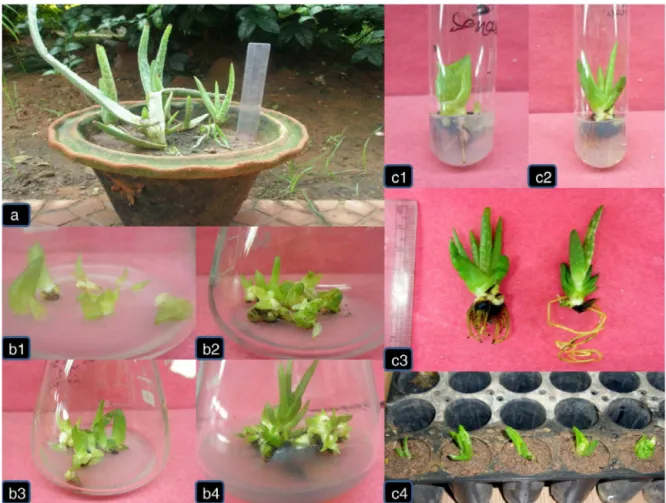
Fig.1.DifferentstagesoftissuecultureinAloeveraplants:a.explantsource,b.(1–4).shootproliferationafter8weeksofcultureonMSmedium,c.(1–4):invitroroot inductiononmicroshootsandacclimatizationofrootedplantlets.
1000 [AU] 800 700 600 500 400 300 200 100 0
0.00 0.10 0.20 0.30 0.40 0.50 0.60 [Rf] 0.80 100
80
70
60
50
40
30
20
10
0 [mm]
Fig.2.HPTLCfingerprintingofbarbaloinalongwiththemethanolicextractof dif-ferentpartsofinvitrogrownA.veraplants(1–5:standard;6:lightgreen-gel,7: yellow-root;8:red-leafskin)fromJodhpur.
repeatability,percentagerecovery,intra-dayandintermediate pre-cision.Eachof thestandard solutionsofbarbaloin (0.3,0.6,0.9, 1.2,1.5gperband)wasadministeredintriplicate.The calibra-tionplotwasdevelopedbyplottingpeakareaagainsttheamount ofbarbaloinandlinearityrangewasresolved.Instrument preci-sionwasexaminedbyscanningthesamebarbaloinband(1g) sixtimes.Themean,standarddeviation,andcoefficientof varia-tion(CV)(%)weredeterminedforpeakareaandretentionfactor (Rf).Repeatabilitywasdeterminedbyanalyzingthebandfor bar-baloinafterapplicationofstandardsolutiontotheplate(n=10),
100.0
[AU]
80.0
70.0
60.0
50.0
40.0
30.0
20.0
10.0
0.0
200.0 250.0300.0 350.0 400.0450.0 500.0 550.0 600.0 [nm] 700.0 100.0
[AU]
80.0
70.0
60.0
50.0
40.0
30.0
20.0
10.0
0.0
Fig.3.Overlayspetraofbarbaloin.
164 D.K.Pandeyetal./RevistaBrasileiradeFarmacognosia26(2016)161–167
Table1
InvitromultipleshootformationfromlateralshootsofAloeveraasinfluencedbythegrowthregulators(4replicatespertreatment).
MS+growthregulators(mg/l) %ofculturesshowingshoot proliferation
Averagenumberofshootper explant(after4weeks) (mean±SE)
Averagenumberofshootper explant(after8weeks) (mean±SE)
BAP NAA
0.5 0.5 50 1.32±0.22 3.3±0.2
0.5 1.0 44.2 1.3±0.31 2.21±0.6
1.0 0.5 70.2 2.00±0.32 5.2±0.3
1.0 0 65.34 2.33±0.36 4.1±0.3
2.0 0.5 83.2 2.8±0.52 5.6±0.2
2.0 0.1 100 4.1±0.25 8.12±0.3
Datarepresentthemeanof3replicatesforeachtreatment.
Determinationofbarbaloininsamples
Sampleextractsandstandardsolutionmixtures(0.3,0.6,0.9, 1.2,1.5l)wereadministeredto20cm×10cmsilicagel60HPTLC platesandanalyzedasdescribedabove.Peakareaswerenotedand acalibrationplotwasgeneratedbyplottingpeakareaagainstthe amountofstandardbarbaloin(1)administered.Thecalibrationplot
wasusedtodeterminetheamountsofstandardspresentinthe
samples.
Resultsanddiscussion
EffectofPGRonorganogenesis
Inordertoachieve multipleshootinduction,various combi-nationsofcytokininandauxinwereinvestigated.Appearanceof shootsfromlateralshootexplants(suckers)wasfoundaftertwo weeksofcultureinallthehormonecombinations(Table1).Shoot budsinitiated werelight green to yellowish in colorand were formedeitherassingleorin clusters.Themaximumnumberof shootbud(4)perexplantwasnotedinMSmediasupplemented with2.0mg/lBAPand0.1mg/lNAAwithinfourweeksofculture.
EffectofPGRonshootmultiplicationandelongation
Shoot buds proliferated in MS medium supplemented with 2.0mg/lBAPand0.1mg/lNAAweremultipliedintoclustersofsmall budsandwereelongatedwhensubculturedinthesame regenera-tionmedia.Maximumshootswereobtainedwithineightweeksof cultureinthesamemedium(Table1).However,MSmedia contain-ing0.5mg/lBAPand1.0mg/lNAAhasyieldedsignificantlylower numberofshoots.
Rootinginregeneratedshoots
Rootingwasobservedwithintwoweeksinallrootingmedia (Fig. 3).Maximum (87%) rooting wasfound in MS media sup-plementedseparatelywith0.5mg/lNAAand2.0mg/lIBAwithin two weeks of culture (Table 2). Significant difference in root
numberwasnotedaftertwoweeksofcultureintworootingmedia. Therootlengthwassignificantlydifferentandthemaximumroot elongationwasobservedintheaforesaidmedium(Table2).Roots regeneratedinthismediumwererelativelythickandstrong com-paredtoothermediumevenduringinitialstagesofdevelopment.
Acclimatizationofrootedplantlets
Welldevelopedrootedplantlets(3.0–5cm)wereobtainedafter twomonthsofcultureonMSbasalmediumwhichwerethen trans-ferredtopotscontainingsoilandsandof1:1ratioand100%of theexplantsweresurvivedduringandaftertheacclimatization process.ThestagesofmicropropagationarepresentedinFig.1.
MethodvalidationbyHPTLC
PreparatoryTLCstudiesshowedthatthesolventsystemethyl acetate:methanol:water(100:16.5:13.5)wasidealasmobilephase whichproducedasinglespotwithanRf0.4forbarbaloin(1)and wellresolvedspotswerefoundforthetestsamples.Thespotswere observedat366nmaftersprayingwith10%(v/v)ethanolicKOH. Thethreedimensionaldensitogrampatternsofthetestsamples andbarbaloin demonstratedthat thepeakscorrespondingtoRf 0.4weresuperimposableinallthesamples.Thespectrum char-acteristicscorrespondingtothispeakwerealsonotedtomatch exactlydenotingthecompoundscorrespondingtoRfofthe stan-dardsandthetestsamplestobeidentical.Thepeakpuritytestwas performedbycomparingtheabsorptionspectraofthestandard barbaloinandthetestsamples;clearsuperimpossibilityspecified thepurityofthepeak(Fig.2).Linearityofthecalibrationcurve wasfoundbetween0.3and1.5g.Thecorrelationcoefficientfor acalibrationcurvebetween0.3and1.5gwasfoundtobe0.998 forbarbaloin.Theregressionequationforthecalibrationplotfor barbaloinissummarizedinTable3.Percentageofbarbaloinwas determinedbyusingthepeakareaparameter.ThisHPTLCmethod wasvalidatedforprecision,accuracyandrepeatability.Themethod isspecificforbarbaloinbecauseitresolvedthecompound(Rf=0.4) wellinthepresenceofothercomponentsinA.vera(Fig.2).A lin-earrelationshipwasachievedbetweenresponse(peakarea)and amountof barbaloin in therange 0.3–1.5gper band(Fig.4).
Table2
EffectofdifferentconcentrationsofIBAandNAAonthenumberofrootandrootlengthinAloevera.
MS+growthregulators(mg/l) %ofshootsproducingroots (mean±SE)
Numberofrootspershoot (mean±SE)
Averagerootlengthin(cm) (mean±SE)
IBA NAA
0.5 0.5 43.21±1.5 1.17±0.18 1.76±0.3
0.0 1.0 16.7±2.1 1.98±0.37 1.13±0.2
1.5 2.0 64.22±1.3 4.19±0.15 2.11±0.2
2.0 0.5 87.56±2.0 7.14±0.16 3.47±0.4
1.0 0.0 42.19±1.3 4.01±0.21 1.96±0.2
1.6 1.4 1.2 1.0 0.8 0.6 0.4 0.2 2600
2400
2200
2000
1800
1600
1400
1200
1000
Conc
Area
S 84.3814
R-Sq 98.1% R-Sq(adj) 97.5%
Fitted line plot
Area=834.4 + 1115 conc
Fig.4. Standardcurveofbarbaloin.
Table3
Methodvalidationparametersforthequantificationofbarbaloin.
Parameters Results
Rf 0.4
Linearityrange(ng/spot) 300–1500ng Regressionequation(area) Y=834+1115×X
LOD 50ng
LOQ 150ng
Standarddeviation(SD) 5.36 Correlationcoefficient(R2) 0.99
Table4
Intra-andinter-dayprecisionstudy(intermediateprecision)thequantificationof barbaloin.
Markercompound Concentration(g) Intra-day Inter-day
Barbaloin 0.5 1.34 1.45
1.0 1.65 1.23
1.5 1.39 1.56
Instrumentprecisionwasobservedbyscanningthesamespotof barbalointentimes(%CV=0.52;n=10).Therepeatabilityofthe methodwasinvestigatedbyanalyzingtenapplicationsofthesame standardsolution(%CV=0.62;n=10).Theaccuracyofthemethod wasdemonstratedatfourlevels(0,50,100,and150%)via addi-tionofknownamountsofbarbalointoleafskinextractofA.vera. Recovery atthefourlevels wasnotedtobe100, 100.5,100.25 and99.25%respectively(Table5).Repeatabilityandprecisionwere estimatedbymeasuringintra-dayandinter-day variation.Little intra-dayandinter-dayvariationwasnoted(Table4).Specificityof themethodwascalculatedbyacquiringthespectrumofbarbaloin standardandthecorrespondingpeakinthetest samplesinthe range200–800nm.Thespectraobtainedfromthebarbaloinand thebarbaloinpresentinleafpowdermatchedexactly,indicating
Table6
Barbaloincontentinvariouspopulations(insituandinvitro)ofAloevera.
Populations Barbaloincontent (insitu
populations)(%)
Barbaloincontent (invitropopulations) (%)
Jalandhar(Punjab) 2.23 2.32 Jodhpur(Rajasthan) 2.46 2.78 Varanasi(UttarPradesh) 2.34 2.38 Lucknow(UttarPradesh) 2.15 2.27 Bhubaneswar(Odisha) 2.20 2.29
nointerferencefromotherplantconstituents(Fig.3).LODandLOQ weredetermined(Table3)byusingtheequationsLOD=3×N/Band LOQ=10×N/B,whereNisthestandarddeviationofthepeakarea ofthestandard(n=3),takenasameasureofthenoiseandBisthe slopeofthecorrespondingcalibrationplot.
Barbaloincontentinsamples
Thepresentmethodwasusedtodeterminetheamountof bar-baloin (1)in leafskin extracts of A. vera.The identificationof barbaloinwasdoneonthebasisofRfvalues(Fig.3)and compari-sonofspectra(max362nm)(Fig.3).Agoodseparationofbarbaloin wasachieved(Fig.2).Calibrationcurveforbarbaloin(Fig.4)was foundtobelinearasshowninTable3.Thechromatogramsof var-iouspartsofinvitroraisedA.verafromJodhpurdistrictareshown inFig.2.LeafskinofinvitroculturedA.verafromJodhpurdistrict wasfoundtocontainthehighestamountofbarbaloin(2.78%) fol-lowedbytheinsitugrownleafskinsamplesfromthesamedistrict (2.46%).TheinsitugrownleafskinsamplecollectedfromLucknow districtwasfoundtocontaintheminimumamountofbarbaloin (2.15%).Intrapopulationalvariationsinbarbaloincontentamong
Table5
RecoverystudyofbarbaloinbyproposedHPTLCmethod.
Markercompound Amountpresentinthesample(g/mg) Amountadded(g) Amountfounda(g) Recovery(%) Averagerecovery(%)
Barbaloin 27.8 15 42.8±0.34 98.64 98.9
27.8 30 60.86±0.45 98.36
27.8 45 72.9±0.32 99.72
166 D.K.Pandeyetal./RevistaBrasileiradeFarmacognosia26(2016)161–167
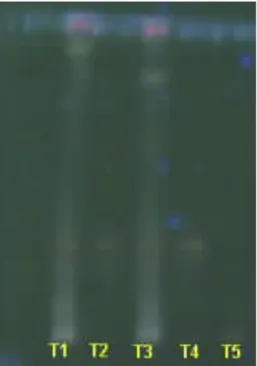
T1=methanolic leaf extract (100 µg) (tissue cultured) T2=standard (barbolin) (4%)
T3=methanolic leaf extract (100 µg) (naturally grown) T4=standard (barbolin) (8%)
T5=methanolic gel extract (200 µg)
Fig.5.Achromatogram.
insituandinvitrogrownplantsamplesaretabulatedinTable6.A chromatogram(photographofTLCplateisprovidedinFig.5).
Anumberoffactorssuchasgenotype,culturemedium (includ-ing PGR and their combinations), physical environment and developmentalstageoftheexplantaffecttheadventitiousshoot regeneration fromtissue cultured explants (Zhang et al., 1998; Baiand Qu,2001).Moreover,theinvitroregenerationof direct adventitiousshootsisanessentialcomponenttoproduceplants fromelitematerialsastoavoidformationofsomaclones.Inthis presentstudy,BAPandNAAwereselectedforshootregeneration andmultiplicationasthesearereportedlyamongthePGRsused mostoftenfortheshootorganogenesis(KantiaandKothari,2002). Shootamplificationoccurredinalmost allthehormone combi-nationsbutacombinationofBAPandNAAwasnotedcrucialfor directshootregeneration.AccordingtoChaudhuriandMukundan (2001),thebestmediumforshootinductionfromshoottipsofA. verawasMSmediumsupplementedwith10mg/lBAP,160mg/l adeninesulphateand0.1mg/lIBA.However,thisisincontrastto theresultsobtainedinthepresentinvestigationaswhenBAPata higherconcentrationandincombinationwithNAAwasadded,it reducedtheshootproduction.OtherstudiesindicatethatBAPis moreefficientthanNAAforshootproliferationinA.vera(Velcheva etal.,2005;Debiasietal.,2007).Accordingtotheliterature,BAP isbetterthanothercytokininsforshootinitiationand prolifera-tion.TheshootsshowedrootinginMSmediumsupplementedwith 2.0mg/lBAP+0.5mg/lNAA.Someresearchersreportedrootingin hormone-freemedium(Natalietal.,1990;AggarwalandBarna, 2004)whilesomeothersshowedthepresenceofPGR is neces-saryforrooting(MeyerandStaden,1991;AbrieandStaden,2001; Velchevaetal.,2005).
Micropropagationisbeingconsideredasanadvancedtoolfor theproductionofhighvaluephytochemicalswithmedicinal poten-tial(Debnathetal.,2006).Growthregulatorsusedinvitrowasfound toenhancesomebiologicalactivityandmodulatephytochemical contentintissuecultureplantletswhichareotherwisedifferentin
theiracclimatizedcounterparts.Inonestudy,variouscytokinines werefoundtoinfluencephenolicacidsandantioxidantactivityof tissueculturedandacclimatizedMerwillaplumbea(Aremuetal., 2013).Inourpresentinvestigation,wehavefoundenhanced bar-baloincontentfromtheleavesofmicropropagatedplantsgrowing undertheinfluenceoftwogrowthregulators.Similarlyplantcell culturesarealsoreportedasasourceofmicro-propagationof virus-freeplantsusefulfornovelsecondarymetaboliteproduction(Sato, 2013).Invitropropagationalsoservesasavaluabletoolfor prop-agationavoidingtheoverexploitationofnaturalpopulationsand toapplybiotechnology-basedapproaches(Gonc¸alvesandRomano, 2013).
Inthepresentstudy,asimpleandvalidatedHPTLCmethodfor theseparation and quantification ofbarbaloin in A. vera leaves frominvitroand naturallygrown plantswaspresented. Italso quantifiesbarbaloincontentfrominvitroandinsitugrownplant samples.Invitroderivedleaveswerefoundtocontainmore bar-baloin than in situ grown samples. Besides being useful as a reproducible methodfor quantification of barbaloin fromplant samples,theresultsalsoindicatethepossibleenhancementof sec-ondarymetaboliteproductionfromtissueculturedplant.Bioticand abioticstressesdevelopedduringtissueculturalconditionmaybe exploitedinordertomodulatesomeplantmetabolitewithpossible therapeuticvalue.
Authorcontributions
DKPmonitoredtheexperimentsandpreparedthemanuscript draft.SPperformedtheexperiments.ADdesignedthe experimen-tationandfinalizedthemanuscript.
Conflictsofinterest
Theauthorsdeclarenoconflictsofinterest.
Acknowledgements
TheauthoristhankfultotheDepartmentofMedicinal Chem-istry, Institute of Medical Sciences, Banaras Hindu University, VaranasiforprovidingHPTLCfacilityforanalysisoftheplant mate-rials.
References
Abrie,A.I.,Staden,J.V.,2001.MicropropagationoftheendangeredAloepolyphylla. PlantGrowthRegul.33,19–23.
Aggarwal,D.,Barna,K.S.,2004.TissueculturepropagationofeliteplantofAloevera L.J.PlantBiochem.Biotechnol.13,77–79.
Aremu,A.O.,Gruz,J., ˇSubrtová,M.,Szüˇcová,L.,Doleˇzal,K.,Bairu,M.W.,etal.,2013. Antioxidantandphenolicacidprofilesoftissueculturedandacclimatized Mer-willaplumbeaplantletsinrelationtotheappliedcytokinins.J.PlantPhysiol.170, 1303–1308.
Bai,Y.,Qu,R.,2001.Factorsinfluencingtissuecultureresponsesofmatureseedsand immatureembryosinturf-typetallfescue.PlantBreed.120,239–242. Chang,X.L.,Wang,C.,Feng,Y.,Liu,Z.,2006.Effectsofheattreatmentsonthe
sta-bilitiesofpolysaccharidessubstancesandbarbaloiningeljuicefromAloevera Miller.J.FoodEng.75,245–251.
Chaudhuri,S.,Mukundan,U.,2001.AloeveraL.micropropagationand characteriza-tionofitsgel.Phytomorphology51,155–157.
Chen,J.D.,Li,W.,Li,S.Y.,2002.Quantitativedeterminationofbarbaloininaloe capsulebyhighperformanceliquidchromatography.SePu20,367–368. Coran,S.A.,Bartolucci,G.,Bambagiotti-Alberti,M.,2011.Selectivedetermination
ofaloinindifferentmatricesbyHPTLCdensitometryinfluorescencemode.J. Pharm.Biomed.Anal.54,422–425.
Debiasi,C.,Silva,C.G.,Pescador,R.,2007.MicropropagationofAloeveraL.Rev.Bras. PlantMed.Botucatu9,36–43.
Debnath,M.,Malik,C.P.,Bisen,P.S.,2006.Micropropagation:atoolfortheproduction ofhighqualityplant-basedmedicines.Curr.Pharm.Biotechnol.7,33–49. Gonc¸alves,S.,Romano,A.,2013.Invitrocultureoflavenders(Lavandulaspp.)and
Gutterman, Y., Chauser-Volfson, E., 2000. The distribution of the phenolic metabolitesbarbaloin,aloeresinandaloeninasaperipheraldefense strat-egyinthesucculentleafpartsofAloearborescens.Biochem.Syst.Ecol.28, 825–838.
Hamman,J.H.,2008.CompositionandapplicationsofAloeveraleafgel.Molecules 13,1599–1616.
Hashemi,S.A.,Madani,S.A.,Abediankenari,S.,2015.ThereviewonpropertiesofAloe verainhealingofcutaneouswounds.Biomed.Res.Int.2015,714216. Kantia,A.,Kothari,S.L.,2002.Highefficiencyadventitiousshootbudformationand
plantregenerationfromleafexplantsofDianthuschinensisL.Sci.Hortic.96, 205–212.
Klein,A.D.,Penneys,N.S.,1988.Aloevera.J.Am.Acad.Dermatol.18,714–720. Mangaiyarkarasi,S.P.,Manigandan,T.,Elumalai,M.,Cholan,P.K.,Kaur,R.P.,2015.
BenefitsofAloeveraindentistry.J.Pharm.Bioallied.Sci.7,S255–S259. Meyer,H.J.,Staden,J.V.,1991.RapidinvitropropagationofAloebarbadensisMill.
PlantCellTissueOrgan.Cult.26,167–171.
Molazem,Z.,Mohseni,F.,Younesi,M.,Keshavarzi,S.,2014.Aloeveragelandcesarean woundhealing;arandomizedcontrolledclinicaltrial.Glob.J.HealthSci.7, 203–209.
Natali,L.,Sanchez,I.C.,Cavallini,A.,1990.InvitrocultureofAloebarbadensisMill.: micropropagationfromvegetativemeristems.PlantCellTissueOrgan.Cult.20, 71–74.
Ngo,M.Q.,Nguyen,N.N.,Shah,S.A.,2010.OralAloeverafortreatmentofdiabetes mellitusanddyslipidemia.Am.J.HealthSyst.Pharm.67,1806–1808. Pandey,D.K.,Malik,T.,Banik,R.M.,2012.Quantitativeestimationofbarbaloinin
AloeveraanditscommercialformulationsbyusingHPTLC.Int.J.Med.Aromatic Plants2,420–427.
Park,C.H.,Nam,D.Y.,Son,H.U.,Lee,S.R.,Lee,H.J.,Heo,J.C.,etal.,2011.Polymer fractionofAloeveraexhibitsaprotectiveactivityonethanol-inducedgastric lesions.Int.J.Mol.Med.27,511–518.
Patel,D.K.,Patel,K.,Tahilyani,V.,2012.Barbaloin:Aconcisereportofits pharmaco-logicalandanalyticalaspects.AsianPac.J.Trop.Biomed.2,835–838.
Rebecca,W.,Kayser,O.,Hagels,H.,Zessin,K.H.,Madundo,M.,Gamba,N.,2003.The phytochemicalprofileandidentificationofmainphenoliccompoundsfromthe leafexudateofAloesecundiflorabyhigh-performanceliquid chromatography-massspectroscopy.Phytochem.Anal.14,83–86.
Reynolds,T.,Dweck,A.C.,1999.Aloeveraleafgel:areviewupdate.J. Ethnopharma-col.68,3–37.
Roy,S.C.,Sarkar,A.,1991.InvitroregenerationandmicropropagationofAloeveraL. Sci.Hortic.47,107–113.
Saeed,M.A.,Ahmad,I.,Yaqub,U.,Akbar,S.,Waheed,A.,Saleem,M.,etal.,2004.Aloe vera:aplantofvitalsignificance.Q.Sci.Vis.9,1–13.
Sato,F.,2013.Characterizationofplantfunctionsusingculturedplantcells,and biotechnologicalapplications.Biosc.Biotechnol.Biochem.77,1–9.
Surjushe,A.,Vasani,R.,Saple,D.G.,2008.Aloevera:ashortreview.Ind.J.Dermatol. 53,163–166.
Tanaka,M.,Misawa,E.,Yamauchi,K.,Abe,F.,Ishizaki,C.,2015.Effectsofplantsterols derivedfromAloeveragelonhumandermalfibroblastsinvitroandonskin conditioninJapanesewomen.Clin.Cosmet.Investig.Dermatol.20,95–104. Velcheva,M.,Faltin,Z.,Vardi,A.,Eshdat,Y.,Perl,A.,2005.RegenerationofAloe
arborescensviasomaticorganogenesisfromyounginflorescences.PlantCell TissueOrgan.Cult.83,293–301.
Wagner,H.,Bladt,S.,1996.Plantdruganalysis:athinlayerchromatographyatlas. SpringerScience&BusinessMedia.
Yonehara,A.,Tanaka,Y.,Kulkeaw,K.,Era,T.,Nakanishi,Y.,Sugiyama,D.,2015.Aloe veraextractsuppressesproliferationofneuroblastomacellsinvitro.Anticancer Res.35,4479–4485.
Zahn,M., Trinh,T.,Jeong,M.L., Wang,D.,Abeysinghe, P.,Jia,Q.,etal.,2008. Areversed-phasehigh-performanceliquidchromatographicmethodforthe determinationofaloesin,aloeresinAandanthraquinoneinAloeferox. Phy-tochem.Anal.19,122–126.