O
ri
gi
na
l
a
rt
ic
le
s
Association between cognitive decline and the quality of life of
hypertensive elderly individuals
Anety Souza Chaves1,2
Alcione Miranda dos Santos2,3
Maria Teresa Seabra Soares de Britto e Alves2,3
Natalino Salgado Filho4
1 Universidade Federal do Maranhão, Hospital Universitário Presidente Dutra, Serviço de Nefrologia.
São Luís, MA, Brasil.
2 Universidade Federal do Maranhão, Programa de Pós-graduação em Saúde Coletiva. São Luís, MA, Brasil.
3 Universidade Federal do Maranhão, Centro de Ciências da Saúde, Departamento de Saúde Pública. São
Luís, MA, Brasil.
4 Universidade Federal do Maranhão, Centro de Ciências da Saúde, Departamento de Medicina I. São
Luís, MA, Brasil.
Correspondence Anety Souza Chaves
E-mail: [email protected]
Abstract
Objective: To evaluate the association between cognitive decline and quality of life in hypertensive elderly persons. Methods: A quantitative, cross-sectional, analytical study involving 125 hypertensive elderly individuals of both genders attending the HIPERDIA Program in São Luís, in the state of Maranhao, was performed. The Mini Mental State Exam (MMSE) was used to evaluate cognitive decline and quality of life was assessed using the Medical Outcomes Study 36 Short-Form Health Survey (SF-36). The normality of the data was verified by the Shapiro-Wilk test. The Mann-Whitney test was also applied (quality of life). The association between cognitive decline and quality of life was evaluated using Spearman’s coefficient. Results: The prevalence of cognitive decline was 20.8% and there was a predominance of elderly persons with a low educational level (45.83%). Hypertensive elderly individuals with cognitive decline had a poorer quality of life than those without cognitive decline. A positive association between cognitive function and quality of life was observed for the following domains: functional capacity (r=0.222; p=0.01), pain (r=0.1871; p=0.04), and emotional aspects (r=0.3136; p=0.0005).
Conclusion: The results of this study suggest that cognitive decline directly affects the quality of life of the elderly by limiting the capacity to perform activities of daily living, especially if associated with painful medical conditions and emotional disturbances.
INTRODUCTION
The growth of the elderly population is a worldwide phenomenon with direct consequences on public health systems. In Brazil, this phenomenon is strongly linked to several important processes, such as the significant decrease in fertility and birth rates, the progressive increase in life expectancy, advances in technology, access to health services and cultural changes, among other factors.1
The human aging process, like the other development stages of life, involves a transformation of the body that is reflected in its physical structures, as well as in cognitive manifestations and in the subjective perception the individual has of these changes.2
The aging process involves alterations that tend to affect the activities of daily living, without necessarily threatening the autonomy of the elderly individual. However, when this process is accompanied by chronic and progressive conditions that compromise the vascular and nervous systems, among others, cerebral problems are more severe and functional losses may follow.Thus, the cognitive functions of the elderly are affected by alterations that may interfere in their activities of daily living.3
Cognition involves the acquisition, processing and application of information in our daily lives in order to make decisions, perform tasks, analyze situations and learn. It is associated with all human activities and forms a basis for the establishment of self-determination and autonomy among the elderly.4 Thus, the preservation of cognitive capacity will indicate the conditions that an individual should possess in order to safeguard his or her physical, psychological and social integrity.5
Studies of the prevalence of cognitive decline among the elderly in Brazil have provided a wide range of estimates (ranging from 7.1% to 73.1%), due to the different effects of socio-cultural and economic contexts.6,7 In international studies, this estimate ranges from 6.3% to 46%.8,9
The risk of developing cognitive decline can be associated with intrinsic and extrinsic factors in the life of an individual. Education levels have been reported as one of the most significant determinants of cognitive decline in several studies of the factors associated with this phenomenon.6-8,10,11 Other factors have also been highlighted, such as gender, marital status, smoking and alcohol consumption.12
Therefore, cognitive dysfunction is determined by a complex association of factors, including individual and social conditions, and can directly affect the quality of life of the elderly individual.
Quality of life can be defined as the perception of the individual of his or her position in life based on his or her own cultural context and system of values, considering individual goals, expectations, standards and concerns.13
The ability to face physical limitations and disease, as well as the dimension of expectations in relation to aspects of health, differ among people. Individual opinions can exert a decisive influence on a person’s perception of his or her state of health and its importance, as well as satisfaction with life.2 Thus, quality of life during old age can be understood as the perception that elderly individuals have about their daily life, based on an assessment of activities that they can perform independently and healthily up to that point.
Arterial hypertension has been identified in several studies as a risk factor for the impairment of cognitive function and a decline in the quality of life of the elderly population.14,15 Although correlations between arterial hypertension and cognitive decline are not yet fully understood, with many controversial results,16,17 studies have indicated that individuals with arterial hypertension are more likely to be affected by a decline in cognitive capacity.18,19
high arterial pressure is one of the risk factors for strokes, leading to the development of vascular dementia. Therefore, physiologically, multiple heart attacks can cause dementia, depending on the volume of the brain affected, whether the attacks are local or bilateral, and the presence of white matter lesions in areas of demyelination and narrowing of the vessel lumen, which are associated with both SAH and cognitive dysfunction.18 Contrastingly, according to certain investigations, the control of arterial hypertension through antihypertensive drugs also influences the appearance/evolution of cognitive decline, due to the deleterious effect on cerebral white matter and the cerebrovascular function.10,20
There are currently very few studies that address the correlation between cognitive decline and the quality of life of hypertensive elderly individuals. In a randomized study conducted by Innocenti et al.21 of 2,791 hypertensive elderly individuals, the results confirmed that a greater level of cognitive function was correlated with higher levels of well-being, self-control and current health status, all of which are reflected in the quality of life of the individual.
A study of a group of elderly individuals in Rio Grande do Sul showed that those who did not exhibit cognitive decline exhibited better mean dimensions for quality of life, including functional capacity, physical aspects, general health, vitality, emotional aspects and mental health. Concerning the dimensions pain and social aspects, the elderly individuals with cognitive decline exhibited the lowest mean values.22
Another study investigated the effect of cognitive decline on the quality of life of 129 elderly individuals who had suffered a stroke and demonstrated that damaged cognitive function, difficulties in performing activities of daily living and global health disorders were significantly correlated with a worse quality of life in this population.23 These results corroborated those of another study that was conducted in a retirement community in Porto Alegre-RS. The results of this study confirmed significant correlations
between cognitive variables and the physical and psychological dimensions of quality of life.24
Therefore, considering the consequences that arterial hypertension and cognitive alterations can have on an individual’s life, and given the growing need for investigations into the epidemiological aspects of this disorder in order to avoid sequelae that have a strong impact on activities of daily living, the aim of the present study was to analyze the correlation between cognitive decline and quality of life in hypertensive elderly individuals who are registered in the Ministry of Health´s HIPERDIA program.
METHODS
The present study is part of a research project known as “Healthcare for Hypertensive Patients in Basic Health Units in the Municipality of São Luís-MA”. This cross-sectional study was carried out between February and December of 2010. The aim of the project was to assess hypertensive patients registered in the HIPERDIA program (Ministry of Health’s Registering and Monitoring System for Hypertensive and Diabetic Patients) and monitored in Basic Health Units (UBS) in the neighborhoods of Cohab and São Francisco, in the municipality of São Luís-MA.
The minimal sample required was calculated considering the population of 365 hypertensive elderly individuals registered in the HIPERDIA program in 2010, with a cognitive deficit prevalence of 12%, a margin of error of 5% and a 95% level of confidence. The total number of elderly in the sample was estimated at 113 individuals. Given the possibility of losses, 10% was added to this estimate, giving a final total of 125 elderly individuals.
appeared at the UBS, the study was explained to them and they were invited to participate.
With regard to the life perspective of the population and the comparative analysis with international studies, the authors of the present study opted to use a sample composed of male and female individuals aged 65 years or more who were registered in the HIPERDIA program and attended the selected UBS. The following exclusion criteria were adopted: bedridden patients; patients undergoing kidney replacement therapy; patients with chronic consumptive diseases, such as cancer, severe heart failure and AIDS. Data related to the exclusion criteria were obtained by self-report.
The data was collected between February and December of 2010. Firstly, the elderly individuals answered a questionnaire that contained information about socio-demographic (gender, age, marital status, economic class, education), anthropometric (body mass index), clinical (presence of diabetes, period of diagnosed arterial hypertension) and lifestyle characteristics (smoking, alcohol consumption and physical activity).
Education was assessed in terms of years completed and categorized as follows: less than four years completed; between four and seven years completed and; more than seven years completed. This is the classification model adopted in the Mini-Mental State Examination (MMSE).25 Marital status was assessed based on the presence of a partner and categorized as follows: married/stable union; single/separated/ widowed and others. Economic class was defined based on the Brazilian Economic Classification Criteria (CCEB),26 using the categories AB, C and DE.
Concerning occupation, the authors considered professional activity to be work or specialized activities, usually carried out by a professional who is competent in that field. The assessment of body mass index (BMI) was
conducted using weight data (in kilograms) obtained from a portable digital scales (Plena®) and height data (in meters), measured by a stadiometer (Alturexata®). The final result was obtained from the ratio between body weight and height, with the values categorized as follows: normal (18.6<BMI<24.9); overweight
(25<IMC<29.9) and obese (IMC≥30).27
People who stated that they smoked cigarettes in the interview were classified as smokers, regardless of the daily quantity consumed. Similarly, those who stated that they consumed alcohol were classified as drinkers, regardless of the type, quantity or frequency of alcohol consumed. In the present study, walking, running, gymnastics and weights training were classified as physical exercise, among others. Thus, the elderly individuals were classified as active if they performed one physical activity two or more times a week. Those who did not partake in any physical activity were classified as sedentary.
Systolic and diastolic blood pressure (SBP and DBP) were measured with a digital sphygmomanometer (Omron ® HEM-705, Japan). The patient remained seated at rest for at least five minutes, with the upper limb at the height of the heart, the palm of the hand turned upwards and the elbow slightly flexed. Three blood pressure measurements were taken, with a minimal interval of 10 minutes between each measurement, to obtain a mean value. Individuals with a pressure level >140/90 mmHg were considered hypertensive, as recommended by the Ministry of Health and adopted by the HIPERDIA program.28 The period of arterial hypertension was calculated based on the moment the disease was diagnosed. The period was then classified as follows: less than five years; between five and ten years or more than ten years. Patients who claimed to be diabetic in the interview were classified as diabetic.
the presence or absence of cognitive decline. The MMSE questionnaire was adopted for this process. When abnormal cognitive function was identified, the patients were sent to the hospital in the Federal University of Maranhão (HU-UFMA).
Developed by Folstein et al.,29 the MMSE assesses cognitive function as a whole and gives a score. The test involves several questions, broken down into seven categories: time awareness (5 points); place awareness (5 points); record of three words (3 points); care and calculation (5 points); memory of three words (3 points); language (8 points) and constructive visual capacity (1 point). The total score can range from 0 to 30 points and the test can be applied in between 5 and ten minutes.
The cutoff points adopted in the identification of cognitive decline were as follows: less than or equal to 18 points for the illiterate; less than or equal to 21 points for those with one to three years of education; less than or equal to 24 points for those with four to seven years of education and less than or equal to 26 points for those with more than seven years of education.25
The SF-36 generic questionnaire (Medical Outcomes Study 36 – Short-Form Health Survey) was used to assess the quality of life aspects of the participants. This questionnaire was translated and validated for use in Brazil by Ciconelli.30 The SF-36 is a multidimensional questionnaire containing 36 items, distributed in eight dimensions: functional capacity (10 items); physical aspects (four items); pain (two items); general health (five items); vitality (four items); social aspects (two items); emotional aspects (three items); mental health (five items) and one further question for a comparative assessment between current health conditions and those from one year earlier. The total value of each dimension ranges from 0 to 100 points, in which the higher score indicates a better state of health or quality of life, whereas lower scores indicate a worse situation or a limited quality of life.
Stata 10.0 software (Stata Corporation, 2003) was used for the statistical analysis. The qualitative variables were displayed using frequencies and percentages whereas the quantitative variables were displayed using the standard deviation (mean± sd) or median and interquartile range (IQR). The Shapiro-Wilk test was used to test the normality of the quantitative variables.
The internal consistency of the SF-36 was confirmed using Cronbach´s alpha index. The Mann Whitney test was used to compare the scores of the SF-36 dimensions among elderly individuals with and without cognitive decline. The correlation between MMSE scores and the quality of life dimensions was assessed using Spearman´s coefficient, given that the scores did not exhibit a normal distribution. The level of significance was set at 5%.
The present study was approved by the Research Ethics Committee of the Universidade Federal do Maranhão (UFMA) hospital under protocol number 3.128/2009. All of the elderly individuals that agreed to participate signed a term of free and informed consent.
RESULTS
In the sample studied (n=125), there was a prevalence of 20.80% for cognitive decline. The mean age was 72.72±5.71 years, with 86 (68.80%) women in the sample. Concerning marital status, 76 (60.80%) were married or in a stable union. The majority (58.40%) were sedentary, while 41 (32.80%) were smokers and 18 (14.40%) regularly consumed alcohol. The vast majority (95.97%) used antihypertensive drugs (Table 1).
Table 1. Sociodemographic, clinical and lifestyle characteristics of hypertensive elderly individuals. São Luís, MA, 2013.
Variable Total (%)
Gender
Male 39 (31.20)
Female 86 (68.80)
Years of study
<4 years 32 (25.60)
4 to 7 years 44 (35.20)
>7 years 49 (39.20)
Economic class
A,B 19 (15.20)
C 61 (48.80)
D,E 45 (36.00)
Marital status
Married/stable union 76 (60.80)
Single/separated/widower 11 (8.80)
Other 38 (30.40)
Drinker
Yes 18 (14.40)
No 107 (85.60)
Sedentary
Yes 73 (58.40)
No 52 (41.60)
Smoker
Yes 41 (32.80)
No 84 (67.20)
Body mass index
Normal 48 (38.40)
Overweight 54 (43.20)
Obese 23 (18.40)
Period of arterial hypertension
In total, 45.83% of the elderly individuals who exhibited cognitive decline had completed less than four years of study (Table 2).
Upon assessment of the internal consistency of the SF-36, the greatest alpha coefficient value was obtained for the dimensions emotional aspects and functional capacity (0.88). The
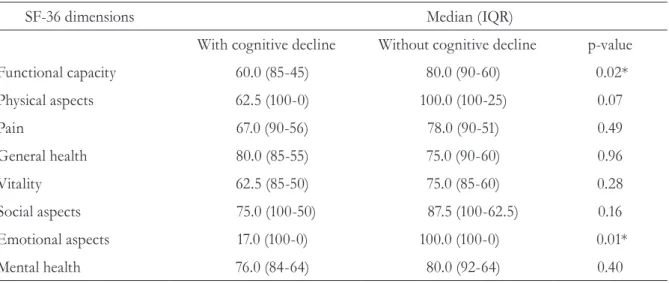
Upon comparison of the median scores of the SF-36 for elderly individuals with and without cognitive decline, statistically significant differences were confirmed for the dimensions: functional capacity: 60 (45-85) versus 80 (60-90), with p=0.02; and emotional aspects: 17 (0-100) versus 100 (0-100), with p=0.01(Table 4).
A positive correlation was found between cognitive function and quality of life for hypertensive elderly individuals in the dimensions functional capacity (r=0.222; p=0.01), pain (r=0.1871; p=0.04) and emotional aspects (r=0.3136; p=0.0005) (Table 5).
Table 2. Prevalence of cognitive decline among hypertensive elderly individuals according to years of
study. São Luís, MA, 2013.
Education (years)
With cognitive decline Without cognitive
decline
Total
<4 years 11 (45.83%) 21 (20.79%) 32 (25.60%)
4 a 7 years 7 (29.17%) 37 (36.63%) 44 (35.20%)
>7 years 6 (25.00%) 43 (42.57%) 49 (39.20%)
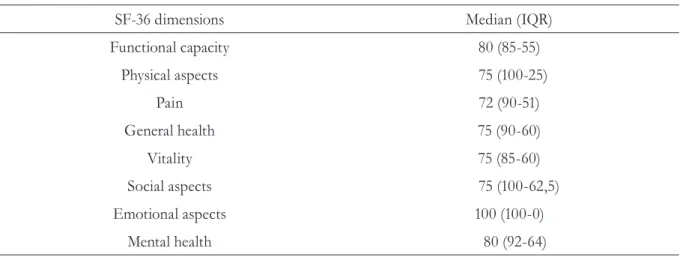
Table 3. Median scores and interquartile range of the SF-36 dimensions. São Luís, MA, 2013.
SF-36 dimensions Median (IQR)
Functional capacity 80 (85-55)
Physical aspects 75 (100-25)
Pain 72 (90-51)
General health 75 (90-60)
Vitality 75 (85-60)
Social aspects 75 (100-62,5)
Emotional aspects 100 (100-0)
Mental health 80 (92-64)
IQR= interquartile range.
lowest alpha coefficient value was obtained for the dimensions pain and general health (0.63).
DISCUSSION
Data from the sample confirmed the predominance of elderly individuals with more than seven years of study. However, according to the presence of cognitive decline, there was a notable inversion of the results and it became clear that the majority of the elderly individuals with cognitive decline completed less than four years of study, thereby confirming the correlation between scores on the cognitive screening test (MMSE) and education levels.
These findings corroborate the studies of Herrera et al.6 and Gurian et al.,7 who reported that elderly individuals with a low level of education obtained the lowest scores. Conversely, no correlation was found between the variable education and the MMSE score in a study conducted by Innocenti et al.21
It is important to highlight that the variable for education level is complex and individual, given that the cerebral capacity of an individual is usually determined by the development
Table 4. Comparison of the SF-36 dimensions of elderly individuals with and without cognitive decline.
São Luís, MA, 2013.
SF-36 dimensions Median (IQR)
With cognitive decline Without cognitive decline p-value
Functional capacity 60.0 (85-45) 80.0 (90-60) 0.02*
Physical aspects 62.5 (100-0) 100.0 (100-25) 0.07
Pain 67.0 (90-56) 78.0 (90-51) 0.49
General health 80.0 (85-55) 75.0 (90-60) 0.96
Vitality 62.5 (85-50) 75.0 (85-60) 0.28
Social aspects 75.0 (100-50) 87.5 (100-62.5) 0.16
Emotional aspects 17.0 (100-0) 100.0 (100-0) 0.01*
Mental health 76.0 (84-64) 80.0 (92-64) 0.40
IQR= interquartile range; *p-value<0.05.
Table 5. Correlation between the MMSE score and the dimensions of the SF-36. São Luís, MA, 2013.
SF-36 dimensions Coefficient** p-value
Functional capacity 0.2222 0.0156*
0.1217
Physical aspects 0.1433
Pain 0.1871 0.0425*
General health 0.1110 0.2316
Vitality 0.0819 0.3780
Social aspects 0.1251 0.1771
Emotional aspects 0.3136 0.0005*
Mental health 0.1555 0.0927
of the Central Nervous System (CNS) and how susceptible they are to the effect of environmental risks associated with low levels of education (inadequate nutrition, a lack of neuropsychomotor stimulation, a greater exposure to dangerous living conditions). These can be reflected in adult life and contribute to the intellectual decline of elderly individuals.7
Another significant finding of the present study is the fact that most of the elderly individuals took medication to control their arterial hypertension. Studies that investigated the impact of antihypertensive treatment on the correlation between hypertension and cognition have produced controversial results.10,16,17 It is assumed that untreated hypertension is a predictor for cognitive decline and the use of antihypertensive drugs is a protector of cognitive function. Di Nucci et al.10 reported no significant abnormalities in the cognition of hypertensive elderly individuals who used antihypertensive medication on a regular basis. However, studies with more adequately structured designs are required.
Concerning the SF-36 parameters, the alpha coefficient values found in the present study suggest that the assessment tool, with its homogeneity between questions and correlations between the items assessed, provided reliable data. The SF-36 is interpreted as follows: the closer the Cronbach alpha value is to 1, the more reliable the assessment tool can be considered. This corroborates the findings of the present study.31
During this research, it was confirmed that hypertensive elderly individuals with cognitive decline exhibited a lower quality of life in the dimension functional capacity than those without cognitive decline. Compromised functional capacity reduces performance levels for activities of daily living.
The dimension functional capacity assesses the presence and extent of limitations related to physical capacity. Impaired functional capacity has significant implications for all aspects of the
elderly individual´s life, including their family, community and health system. This can lead to a greater vulnerability and dependence, which in turn cause a decrease in well-being and quality of life. Thus, the functional incapacity of the elderly individual is represented by the difficulty (or impossibility) encountered while attempting to perform activities of daily living. 32
Cognitive function is a determinant for the maintenance of an independent lifestyle and its loss is considered an indicator of decline and physical/functional weakness, which affect the individual’s ability to perform activities of daily living.24 Therefore, the results found for the dimension functional capacity could be explained by the degree of cognitive skills that the individual´s daily work and domestic activities demand, for which they require reason, spatial and temporal awareness, a healthy memory and communication skills. Activities of daily living are limited when these skills begin to decline.33
The results also showed that hypertensive elderly individuals with cognitive decline exhibited a greater impairment in the dimension emotional aspects, when compared with hypertensive elderly individuals without cognitive decline.
The dimension emotional aspects assesses limitations related to the type and quantity of work and activities of daily living performed as a result of emotional problems. Experiences that involve psychological factors reflect the subjective perspective of the individual and their assessment of the situation, which are significant elements in the adherence to healthy behavior and the perception of social support, as well as strategies to combat limiting or unfavorable situations and personal adjustment.3
It is well known that as old age approaches, individuals become more exposed to adverse intrinsic events, such as alterations in all of the body’s organs and systems, an increase in the occurrence of chronic diseases and functional disabilities. These individuals are also exposed to extrinsic events such as retirement and the consequent loss of social functions, which often cause the person to feel useless and reduces the standard of living they had previously enjoyed. When advancing age is associated with cognitive impairment, these alterations exhibit a greater proportion and have a significant impact on daily tasks.33 These individuals tend to be apathetic and emotionally unstable. They also tend to engage in inadequate social behavior and experience progressive difficulty in dealing with emotional issues.35
These observations were confirmed in a study conducted by Beckert et al.,24 whose results showed that better emotional control leads to a better cognitive performance in certain tasks.
Another significant finding in the present study was the correlation between pain and cognitive abnormalities. The dimension pain is relevant as it involves the measurement of pain intensity and its effect on daily work and
activities. In the present study, hypertensive elderly individuals with cognitive decline exhibited greater impairment for the dimension pain, in terms of quality of life, than hypertensive individuals without cognitive decline. This result corroborates the findings of Leite et al.,22 who reported that pain was associated with the worst mean values among elderly individuals with poor cognitive capacity.
Pain is highly prevalent among the elderly and causes long-term impairments and disabilities. In this context, pain can be seen as a disease rather than a symptom, resulting in several significant consequences that affect quality of life.36
As well as being a limiting factor for functions, pain increases the risk of emotional stress and can lead to social isolation in more severe cases. Pain effects daily activities and is associated with high levels of functional disability, greater fragility and increased comorbidity among these patients.37
The neural structures associated with the pain process are also involved in the processing of cognitive functions, which could affect cognitive activity and explain this correlation. Furthermore, the percentage of sedentary and overweight elderly individuals was high in the present study, which predisposed them to mobility-related pain in the joints and spine.36
The present study has a number of limitations. Since this was a cross-sectional study, it was not possible to comment on causal relationships. It was only possible to make comparisons and test correlations concerning possible risk factors. Furthermore, the instruments used are limited in that the influence of education levels is very strong in the MMSE, while the subjective assessment is very important in the SF-36.
order to better assess the correlation between quality of life and cognitive decline in the elderly.
CONCLUSION
The aim of the present study was to analyze the correlation between cognitive decline and the quality of life of hypertensive elderly patients. The sample that was identified contained a majority of overweight, sedentary women with a low level of education.
Concerning the aspects that correlated cognitive decline and the quality of life of hypertensive elderly individuals, the results of the present study suggest that the decline in
capacity directly affects the quality of life of this population, in that it limits their capacity to perform the functions necessary in their daily lives. It may also affect the intensity of painful symptoms and the risk of emotional stress.
These results suggest the need to perform cognitive diagnoses on hypertensive elderly patients. This would favor more adequate and efficient coping strategies and the promotion of healthier aging. Assessing the cognitive capacity of these elderly individuals enables interventions based on specific action plans that can postpone the decline and rehabilitate the disabilities detected, thereby reducing dependence and consequently, improving the quality of life of the individual.
REFERENCES
1. Ministério da Saúde, Secretaria de Vigilância em Saúde, Departamento de Análise de Situação de Saúde. A vigilância, o controle e a prevenção das doenças crônicas não transmissíveis: DCNT no contexto do Sistema Único de Saúde brasileiro. Brasília, DF: Ministério da Saúde; 2009. 2. Parente MAMP, organizador. Cognição e
envelhecimento. Porto. Alegre: Artmed; 2006. 3. Rabelo DF. Declínio cognitivo leve em idosos: fatores
associados, avaliação e intervenção. Rev Min Ciênc Saúde 2009;1(1):56-68.
4. Clark F, Azen SP, Zemke R, Jackson J, Carlson M, Mandel D, et al. Occupational therapy for independent- living older adults: a randomized controlled trial. J Am Med Assoc 1997;278:1321-6. 5. Moraes EN. Princípios básicos de gerontologia e
geriatria. Belo Horizonte: Coopmed; 2008. 6. Herrera JE, Caramelli P, Nitrini R. Estudo
epidemiológico populacional de demência na cidade de Catanduva. Rev Psiquiatr Clín 1998;25(2);70-3. 7. Gurian MBF, De Oliveira RC, Laprega MR,
Rodrigues Júnior AL. Rastreamento da função cognitiva de idosos não-institucionalizados. Rev Bras Geriatr Gerontol 2012;15(2):275-84.
8. Graves AB, Larson EB, Edland SD, Bowen JD, McCormick WC, McCurry SM, et al. Prevalence of dementia and its subtypes in the Japanese American population of king country, Washington state. The Kame Project. Am J. Epidemiol 1996;144(8):760-71.
9. Aevarsson O, Skoog I. Dementia disorders in a Berth Cohort Followed from age 85 to 88: the influence of mortality refusal rate, and diagnostic change on pPrevalence. Int Psychogeriatr 1997;9(1):11-23. 10. Di Nucci FRCF, Coimbra AMV, Neri AL, Yassuda
MS. Ausência de relação entre hipertensão arterial sistêmica e desempenho cognitivo em idosos de uma comunidade. Rev Psiquiatr Clín 2010;37(2):52-6. 11. Ferreira PCS, Tavares DMS, Rodrigues RAP.
Características sociodemográficas, capacidade funcional e morbidades entre idosos com e sem declínio cognitivo. Acta Paul Enferm 2011;24(1):29-35. 12. Nascimento NMR. Estudo comparativo sobre a
prevalência de declínio cognitivo entre dois grupos de idosos. [dissertação]. Porto Alegre: Pontifícia Universidade Católica do Rio Grande do Sul; 2008. 13. The WHOQOL Group. The World Health
Organization quality of life assessment (WHOQOL): development and general psychometric
properties. Soc Sci Med 1998;46(15):69-85. 14. Dos Santos CCC, Pedrosa R, Da Costa FA,
De Mendonça KMPP, Holanda GM. Análise da função cognitiva e capacidade funcional em idosos hipertensos. Rev Bras Geriatr Gerontol 2011;14(2):241-50.
16. Cavalini LT, Chor D. Inquérito sobre hipertensão arterial e décifit cognitivo em idosos de um serviço de geriatria. Rev Bras Epidemiol 2003;6(1):7-17.
17. Posner HB, Tang X, Luchsinger J, Lantigua R, Stern Y, Mayeux R. The relationship of hypertension in the elderly to AD, vascular dementia, and cognitive function. Neurology 2002;58(8):1175-8.
18. Harrington F, Saxby BK, McKeith IG, Wesnes K, Ford GA. Cognitive performance in hypertensive and normotensive older subjects. Hypertension 2000;36(6):1079-82.
19. Haan MN, Weldon M. The influence of diabetes, hypertension, and stroke on ethnic differences in physical and cognitive functioning in an ethnically diverse older population. Ann Epidemiol 1996;6(5):392-8.
20. Guo Z, Viitanen M, Fratiglioni L, Winblad B. Low Blood pressure and dementia in elderly people: the kungsholmen Project. BMJ 1996;312:805-8. 21. Innocenti AD, Elmfeldt D, Hansson L, Breteler
M, James O, Lithell H, et al. Cognitive function and health-related quality of life in elderly patients with hypertension-baseline data from the study on cognition and prognosis in the elderly (SCOPE). Blood Press 2002;11(3):157-65. 22. Leite MT, Winck MT, Hildebrandt LM, Kirchner
RM, Da Silva AA. Qualidade de vida e nível cognitivo de pessoas idosas participantes de grupos de convivência. Rev Bras Geriatr Gerontol 2012;15(3):481-92.
23. Kwa VIH, Limburg M, Haan RJ. The role of cognitive impairment in the quality of life after ischaemic stroke. J Neurol 1996;243:599-604. 24. Beckert M, Irigaray TQ, Trentini CM. Qualidade de
vida, cognição e desempenho nas funções executivas de idosos. Estud Psicol Campinas 2012;29(2):155-62. 25. Caramelli PC, Nitrini R. Como avaliar de forma breve
e objetiva o estado mental de um paciente? Rev Assoc Med Bras 2000;46(4):301.
26. Associação Brasileira de Empresas de Pesquisa. Critério de Classificação Econômica Brasil. Dados com base no Levantamento Sócio Econômico 2008 – IBOPE [Internet]. São Paulo: ABEP; 2010 [acesso em 14 jan 2010]. Disponível em: www.abep.org.
27. World Health Organization. Physical status: the use and interpretation of antropometric. Report of a WHO expert committee. Genebra: WHO; 2004. 28. Lima ST, Silva NSB, França AK, Salgado Filho
N, Sichieri R. Dietary approach to hypertension based on low glycaemic index and principles of Dietary Approaches to Stop Hypertension (DASH): a randomised trial in a primary care service. Br J Nutr 2013;110(8):1472-79.
29. Folstein MF, Folstein SE, McHugh PR. Mini Mental State: a practical method for grading the cognitive state of patients for the clinician. J Psychiatr Res 1975;12(3):189-98.
30. Ciconelli RM. Tradução para o português e validação do questionário genérico de avaliação de qualidade de vida “Medical OutcomesStudy 36-Item Short Form Health Survey (SF-36)” [tese]. São Paulo: Universidade Federal de São Paulo, Escola Paulista de Medicina;1997.
31. Pasquali L. Psicometria: teoria e aplicações. Brasília, DF: Universidade de Brasília; 1997.
32. Rosa TEC, Benicio MHD, Latorre MRDO, Ramos LR. Fatores determinantes da capacidade funcional entre idosos. Rev Saúde Pública 2003;37(1):40-8. 33. Figueiredo CS. Mudanças funcionais e cognitivas
em idosos no município de Belo Horizonte: estudo longitudinal [dissertação]. Minas Gerais: Universidade Federal de Minas Gerais, Escola de Educação Física; 2012.
34. Stival MM, Lima LR, Funghetto SS, Silva AO, Pinho DLM, Karnikowski MGO. Fatores associados à qualidade de vida de idosos que frequentam uma unidade de saúde do Distrito Federal. Rev Bras Geriatr Gerontol 2014;17(2):395-405.
35. Moragas RM. Gerontologia Social. São Paulo: Paulinas; 1997.
36. Sleutjes A. Relações entre dor crônica, atenção e memória [dissertação]. São Paulo: Universidade de São Paulo, Faculdade de Medicina; 2001.
37. Celich KLS, Galon C. Dor crônica em idosos e sua influência nas atividades da vida diária e convivência social. Rev Bras Geriatr Gerontol 2009;12(3):345-59.