O
ri
gi
na
l
a
rt
ic
le
s
Analysis of elderly functional capacity in the municipality of
Avaré, São Paulo: associated factors
Carlos Alexandre Kagawa1
José Eduardo Corrente2
1 Universidade Paulista, Departamento de Saúde. Bauru, SP, Brasil.
2 Universidade Estadual Paulista, Instituto de Biociências, Departamento de Bioestatística. Botucatu, SP,
Brasil.
Financed by: Fundação para o Desenvolvimento da Universidade Estadual Paulista (FUNDUNESP).
Correspondence Carlos Alexandre Kagawa
E-mail: [email protected]
Abstract
Objective: The aim of the present study was to evaluate the influence of quality of life
and socio-economic aspects on the functional capacity of elderly residents in the town of Avaré, São Paulo. Methodolog y: A cross-sectional study of 365 elderly persons living in the urban area of Avaré was performed. A sociodemographic questionnaire, the Flanagan Quality of Life Scale (FQLS), the Katz Activities of Daily Living Scale (ADL) and the Lawton & Brody Instrumental Activities of Daily Living Scale (IADL) were used for data collection. Results: Positive associations were found between the ADL and IADL of elderly persons who reported having a poor quality of life. The same was found for certain aspects of quality of life as measured by the FQLS. Of the 15 items of this scale, four influenced ADL: health, self-awareness, work and leisure, while seven influenced IADL: self-awareness, health, work, community involvement, relations with friends, socializing (making friends) and learning through courses and lectures.
Conclusion: Elderly people with a good quality of life and more elevated socio-economic
status are less functionally dependent, and there are specific aspects of quality of life that most influence functional disability in the performance of ADL and IADL.
INTRODUCTION
From the age of 30, the functional performance of individuals progressively declines due to the physiological process of aging.1 Studies show that
functional capacity becomes a new paradigm with respect to the health of elderly people, and personal autonomy is one of the main factors that is considered when defining public health policy as it affects the elderly, i.e., the capacity to make their own choices, as a function of their physical health, mental clarity, functional dependence, social integration, family support and financial independence.2
Functional capacity or functional limitation can be defined as the capacity of the individual to take care of him or herself and live independently, which is to say, to maintain his or her physical and mental faculties throughout the range of basic and instrumental activities of daily living.3-5
In terms of basic activities, functional capacity consists of the capacity of a person to take care of him or herself, such as: eat, take baths, put on clothes, use the toilet, walk, move from the
bed to a chair and control one's sphincter.6
Instrumental activities consist of the elderly person's ability to manage the environment within which he or she lives, such as: prepare food, wash clothes, perform household chores, make purchases, go to the doctor and participate in social and religious commitments.6
Functional limitations frequently impact daily life more than chronic diseases, as long
as such diseases are controlled.2 As such,
functional capacity and quality of life are new social paradigms when it comes to the health of the elderly, or in other words, promoting the autonomy of elderly individuals, even though these people may suffer from one or more chronic diseases.
In light of this new paradigm, the aim of the present study was to evaluate the influence of quality of life and socio-economic aspects on the functional capacity of elderly residents of the town of Avaré, São Paulo.
METHODOLOGY
A cross-sectional study was conducted within the urban area of the municipality of Avaré, in the state of São Paulo. The population that was examined consisted of people that were 60 years of age or older. Data collection was performed between January and August, 2011.
Population sampling was conducted via the use of a database based on information held by the following organizations: the Basic Health Units (BHUs) and the Family Health Strategy (FHS) located in the town.
In order to estimate the size of the sample, an unknown expected prevalence of 50% was used for the criteria of quality of life, a confidence index of 95% and a margin of error of 5% were adopted as study parameters, which resulted in a minimum study group of 365 elderly individuals, providing an adjustment factor for this finite population.
Sampling of the elderly participants was
executed using the SAS program for Windows,
version 9.2, employing the Survey Select function and the PPS method (Probability Proportional to Size) which was proportional to participant age. When an elderly individual that was selected was not found, or had died, another person was selected at random to complete the sample.
by trained professionals, who performed the following evaluations: a sociodemographic questionnaire (age, gender, employment, income, schooling, marital status, retirement),
the Flanagan Quality of Life Scale (FQLS),7
which was translated and validated by Nassar & Gonçalves,8 the Activities of Daily Living Scale
(ADL) 9 and the Instrumental Activities of Daily
Living Scale (IADL).10
The data was analyzed using the SAS for
Windows software program version 9.2. Initially, frequencies and percentages of the qualitative variables regarding sociodemographic data (ADL, IADL and FQLS) were calculated, in addition to the descriptive measures with respect to the quantitative variables that served to characterize the population sample. The association between functional capacity and quality of life was obtained using the Chi-square test.
Considering ADL and IADL as binary response variables (dependent/independent), a logistic regression model was created, taking
into account the sociodemographic and quality of life characteristics as a response variable to complement bivariate analysis. In each of the tests, a 5% significance level was adopted, or, alternatively, a corresponding p value. The present study was approved by the Research Ethics Committee of the Faculdade de Medicina de Botucatu under registration No.255/2010. Each of the participants signed a Free and Informed Consent Form.
RESULTS
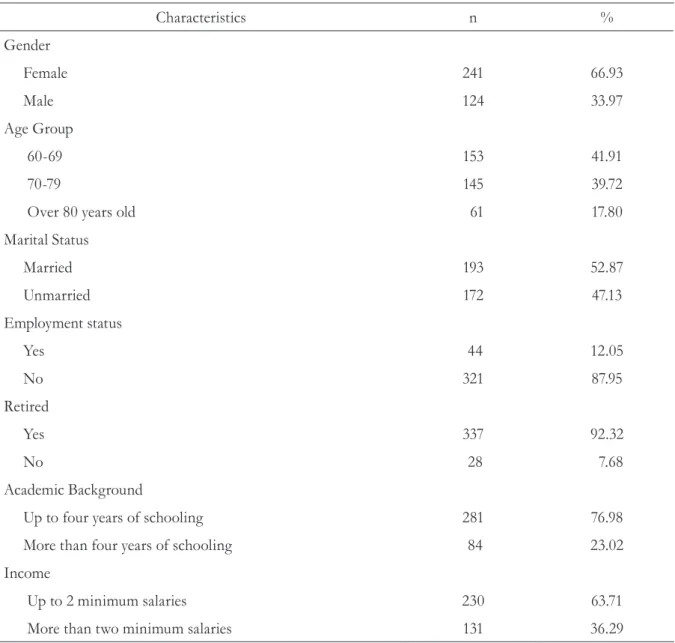
The prevalence of dependence in ADL was 8.49%. With regard to each of ADL's parameters, dressing oneself without help was the activity that registered the greatest degree of dependency (3.01%), followed by bathing oneself (2.46%) and urinating and defecating (2.20%).
A prevalence of 10.96% was measured with respect to dependency in performing IADL.
With regard to each of IADL parameter,
washing and pressing one's clothes were the activities that registered the greatest degree of dependence (10.95%), followed by household
chores such as small repairs (9.86%), and caring for one's finances (6.02%).
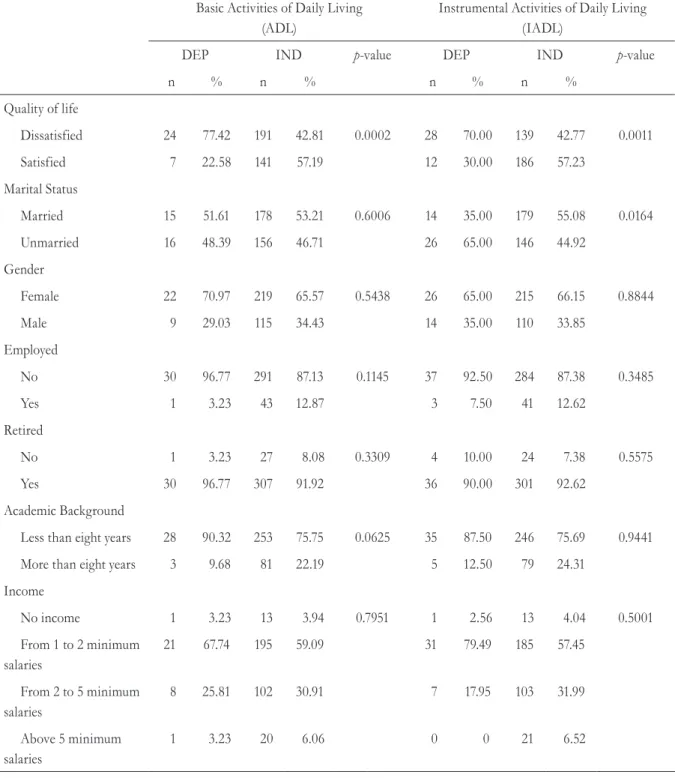
Associations between ADL and IADL were uncovered with respect to quality of life (satisfied/ dissatisfied) (p=0.0002; p=0.0011, respectively) and marital status (married/unmarried), with respect to IADL only (p=0.0164). The remaining variables did not display significant associations between ADL and IADL. Women registered greater functional dependence for ADL (9.12%) than men (10.78%). Contrastingly, men registered greater functional dependence in performing IADL (11.29% and 10.78%, respectively) (table 2). Table 1. Description of the sociodemographic characteristics of elderly people. Avaré, São Paulo, 2011.
Characteristics n %
Gender
Female 241 66.93
Male 124 33.97
Age Group
60-69 153 41.91
70-79 145 39.72
Over 80 years old 61 17.80
Marital Status
Married 193 52.87
Unmarried 172 47.13
Employment status
Yes 44 12.05
No 321 87.95
Retired
Yes 337 92.32
No 28 7.68
Academic Background
Up to four years of schooling 281 76.98
More than four years of schooling 84 23.02
Income
Up to 2 minimum salaries 230 63.71
For ADL, quality of life was a risk factor for functional dependency [OR=4.995, CI95%=(2.024-12.39)] whereas age was found to be a protective factor [OR=0.921, CI95%=(0.885-0.979)] (table 3).
Of the 15 items that compose the FQLS, four are associated with ADL: self-awareness (recognizing one’s potential and limitations) (p=0.0093), health (p<0.0001), work (p=0.0002) and leisure (p=0.0007).
Table 2. Results of the bivariate analysis between functional ADL and IADL activities, including quality of life and socio-economic variables. Avaré, São Paulo, 2011.
Basic Activities of Daily Living (ADL)
Instrumental Activities of Daily Living (IADL)
DEP IND p-value DEP IND p-value
n % n % n % n %
Quality of life
Dissatisfied 24 77.42 191 42.81 0.0002 28 70.00 139 42.77 0.0011
Satisfied 7 22.58 141 57.19 12 30.00 186 57.23
Marital Status
Married 15 51.61 178 53.21 0.6006 14 35.00 179 55.08 0.0164
Unmarried 16 48.39 156 46.71 26 65.00 146 44.92
Gender
Female 22 70.97 219 65.57 0.5438 26 65.00 215 66.15 0.8844
Male 9 29.03 115 34.43 14 35.00 110 33.85
Employed
No 30 96.77 291 87.13 0.1145 37 92.50 284 87.38 0.3485
Yes 1 3.23 43 12.87 3 7.50 41 12.62
Retired
No 1 3.23 27 8.08 0.3309 4 10.00 24 7.38 0.5575
Yes 30 96.77 307 91.92 36 90.00 301 92.62
Academic Background
Less than eight years 28 90.32 253 75.75 0.0625 35 87.50 246 75.69 0.9441
More than eight years 3 9.68 81 22.19 5 12.50 79 24.31
Income
No income 1 3.23 13 3.94 0.7951 1 2.56 13 4.04 0.5001
From 1 to 2 minimum salaries
21 67.74 195 59.09 31 79.49 185 57.45
From 2 to 5 minimum salaries
8 25.81 102 30.91 7 17.95 103 31.99
Above 5 minimum salaries
1 3.23 20 6.06 0 0 21 6.52
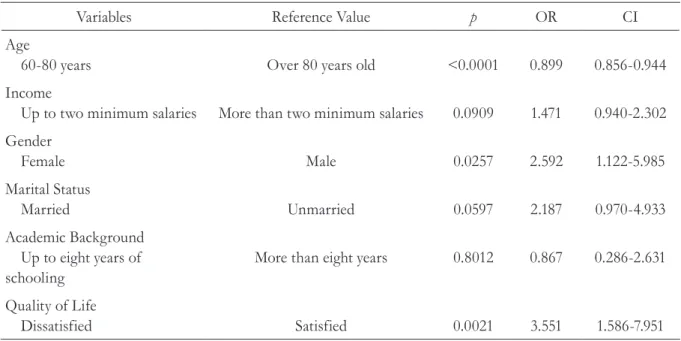
With respect to IADL, after fitting of the logistic regression model, not having good quality of life and being of the feminine gender were risk factors for functional dependency, [OR=3.551, CI95%=(1.586-7.951)] and [OR=2.592, CI95%=(1.122-5.985)], respectively. Being younger was a protective factor with respect to functional dependency [OR=0.899, CI95%=(0.856-0.944)] (table 4).
Seven of the 15 FQLS items were found to be associated with IADL: health (p<0.0001);
employment (p<0.0001); self-awareness
(recognizing one's potential and limitations)
(p<0.0001); meeting friends (p=0.0028);
socializing (making new friends) (p=0.0189);
participation in the community (p=0.0009) and learning through classes and lectures (p=0.0334). Table 3. Results of logistic regression model fit for variables associated or not with Basic Activities of Daily Living (ADL). Avaré, São Paulo, 2011.
Variables Reference Value p OR CI
Age
60-80 years Over 80 years old 0.0055 0.931 0.885-0.979
Income
Up to two minimum salaries More than two minimum salaries 0.5550 0.921 0.700-1.212
Gender
Female Male 0.7722 0.869 0.337-2.242
Marital Status
Married Unmarried 0.5010 0.746 0.318-1.752
Academic Background Up to eight years of schooling
More than eight years 0.2628 2.139 0.565-8.090
Quality of Life
Dissatisfied Satisfied 0.0005 4.995 2.024-12.329
p= p value; OR= Odds Ratio; CI – Confidence Interval
Table 4. Results of logistic regression model fit for variables associated or not with Instrumental Activities of Daily Living (IADL). Avaré, São Paulo, 2011.
Variables Reference Value p OR CI
Age
60-80 years Over 80 years old <0.0001 0.899 0.856-0.944
Income
Up to two minimum salaries More than two minimum salaries 0.0909 1.471 0.940-2.302
Gender
Female Male 0.0257 2.592 1.122-5.985
Marital Status
Married Unmarried 0.0597 2.187 0.970-4.933
Academic Background Up to eight years of schooling
More than eight years 0.8012 0.867 0.286-2.631
Quality of Life
Dissatisfied Satisfied 0.0021 3.551 1.586-7.951
DISCUSSION
Some limitations of this study should be considered. Despite the fact that a sample size was calculated and elderly people were selected at random according to age range, the data that was obtained in the BHUs and FHS was out of date, or in other words, many of the elderly individuals had either died or were not found. Therefore, many potential elderly participants were substituted and, as a result, the sample became one of convenience, which introduced the influence of selective bias, meaning the sample did not greatly represent the population.
This selection bias, as a result, in all likelihood accounts for why women were prevalent within the sample (66% of the participants). However, in other population surveys, women are also prevalent within the population studied.9-11 In
addition, according to the last census, women represent 55% of the total amount of elderly people in Brazil.12
Within the municipality of Avaré, in the state of São Paulo, elderly people of low schooling were more abundant (76.98% attended school for less than eight years). These individuals also had incomes of less than two minimum salaries (63.71%), which is a factor that corroborated the results of surveys in the cities of Goiânia, Botucatu and São Paulo.11,13-15 In addition, low
levels of schooling and income are characteristic of this generation of elderly Brazilians, considering that 25% of this population are still illiterate and more than 44 million Brazilians live on, at most, one minimum salary.13
According to the results that were obtained with the study sample, 8.49% and 10.96% of elderly participants were functionally dependent with respect to ADL and IADL, respectively; these results were considered low when compared to other Brazilian municipalities.15-17 However, the
fact that various functional capacity evaluation tests exist, the cut-off values of which are not standardized, makes comparison of results with other studies difficult.
A study conducted in the city of Pelotas, in the state of Rio Grande do Sul, found a prevalence of functional incapacity of 28.3% and 26.8%
for ADL and IADL, respectively.18 A different
population based study in the municipality of Botucatu, in the state of São Paulo, found that 5.7% and 14.0% of elderly participants suffered from functional incapacitation with respect to ADL and IADL, respectively, results similar to those of the present study.19
A study of elderly people residing in the rural areas of the municipality of Uberaba, in the state of Minas Gerais, registered a lower percentage for ADL when compared to the present study (0.2%); in contrast, however, the results for IADL were comparable (13.1%).20 The difference
between elderly people who live in rural areas and those in urban areas could possibly represent protective factors with respect to functional incapacitation.21
Elderly persons living within the urban areas in the city of Porto Alegre, Rio Grande do Sul, suffered from more severe degrees of functional dependency, in that they were dependent in at least seven types of basic and instrumental activities when compared to elderly people living in the rural areas of the municipality of Encruzilhada do Sul, in the state of Rio Grande do Sul.22
With respect to ADL, dressing oneself (3.01%) and bathing oneself (2.46%) were activities that registered the highest prevalence of incapacitation. In terms of IADL, washing and pressing clothes (10.95%) and household chores, such as small repairs (9.86%), were the activities that were affected the most. Identical ADL results were found in other studies. Elderly residents in the city of Uberaba, in the state of Minas Gerais, complained of greater functional incapacitation with respect to taking baths (0.5%)
In the present study, women suffered more from functional incapacitation when performing ADL than men (9.12% and 7.25%, respectively). On the other hand, men registered greater functional dependence with respect to IADL (11.29% and 10.78%, respectively). Some studies have revealed that elderly women are more functionally dependent, while other studies have contradicted this, finding that men are more functionally dependent for instrumental activities.18,23
Among all the sociodemographic variables, only the variables gender and age associated themselves with IADL. Studies found in literature showed a positive correlation with the sociodemographic variables (race, schooling and marital status), not only with respect to ADL but also IADL.24-26
In the present study, the following sociodemographic characteristics were revealed to have greater functional dependency with respect to ADL: gender = female, unemployed, low income and with less schooling. Conversely, the following sociodemographic characteristics were revealed to have greater functional dependency with respect to IADL: gender = male, unmarried, unemployed, retired and with less schooling.
The results of this study demonstrated that quality of life factors had a strong influence on functional activities. The elderly who reported having a poor quality of life were 4.99 and 3.55 times more likely to suffer from functional incapacitation for ADL and IADL, respectively.
Of the 15 components that comprise FQLS, only such aspects as health, employment, self-awareness (recognition of one's potential and limitations) and meeting friends were associated with ADL.
Regarding IADL, a positive correlation was found for the following aspects: self-awareness (recognizing one's potential and limitations), health, employment, participation in the community, meeting friends, socializing, making new friends and learning through classes and lectures. Other authors encountered such associations, but with the use of other tests, such
as the WHOQOL-Brief 26 and the
WHOQOL-Old. 27 No studies were found that made use of
the FQLS in this context.
However, the fact that the maintenance of functional capacity has direct implications in one's quality of life, as it is related to the capacity that the elderly have for relating to one another, working, participating in activities inside and outside of their homes, taking advantage of leisure activities and other aspects of life and all that it offers.
Therefore, successful aging is the result of the interaction of factors related to physical and mental health, independence in everyday tasks and economic and psychosocial aspects.
CONCLUSIONS
In this sense, the present study provides relevant information so that social policy planning, in terms of health care for the elderly individual, becomes a priority, focusing on how to improve and broaden the humanization of care for the elderly, heightening the quality of life of this group of people. And as quality of life has such a strong impact on functional
capacity, it is necessary to investigate strategies that aim not only to treat the disease, but also improve overall health and quality of life.
In light of this, a multi-professional group, consisting of doctors, physical therapists, psychologists and social workers should develop integrated initiatives for the elderly, especially in terms of basic health care.
REFERENCES
1. Paixão Jr CM, Heckman MF. Distúrbio de postura, marcha e quedas. In: Cançado FAX, Doll J, Gorzoni ML. Tratado de Geriatria e Gerontologia. FREITAS EV, PY Ligia, editoras. 3ª ed. Rio de Janeiro: Guanabara Koogan; 2011. p. 960-61.
2. Schneider RH, Marcolin D, Dalacorte PR. Avaliação funcional de idosos. Sci Med 2008;8(1):4-9.
3. Nakatani AYK, Silva LB, Bachion MM, Nunes DP. Capacidade funcional de idosos na comunidade e proposta de intervenção pela equipe da saúde. Rev Eletrônica Enferm [Internet] 2009 [acesso em 01 set 2011];11(1):144-50.
4. Costa EFA, Porto CC, Almeida JC, Cipullo JP, Martin JFV. Semiologia do idoso. In: Porto CC. Semiologia médica. 4ª ed. Rio de Janeiro: Guanabara Koogan; 2005. p. 165-97.
5. Fiedler MM, Peres KG. Capacidade funcional e fatores associados em idosos do sul do Brasil: um estudo de base populacional. Cad Saúde Pública 2008;24(2):409-15.
6. Ministério da Saúde. Envelhecimento e saúde da pessoa idosa. Brasília, DF: Ministério da Saúde; 2007. (Série A. Normas e Manuais Técnicos), (Cadernos de Atenção Básica, n.19).
7. Flanagan JC. Measurement of quality of life: current state of the art. Arch Phys Med Rehabil 1982;63(2):56-9.
8. Nassar SM, Gonçalves LHT. A avaliação de uma medida de qualidade de vida. Texto Contexto Enferm1999;8(3):99-110.
9. Katz S, Ford AB, Moskowitz RW, Jackson BA, Jaffe MW. Studies of illness in the aged. The index of ADL: a standardized measure of biological and psychosocial functional. JAMA 1963;185(2):914-9.
10. Lawnton MP, Brody EM. Assessment of older people: self-maintaining and instrumental activier of daily living. Gerontologist 1969;9(3):179-86.
11. Lima-Costa MF, Matos DL, Camargos VP, Macinko J. Tendência de dez anos das condições de saúde dos idosos brasileiros: evidências da Pesquisa Nacional por Amostra de Domicílios (1998, 2003, 2008). Ciênc Saúde Coletiva 2011;16(9):3689-96.
12. Instituto Brasileiro de Geografia e Estatística. Censo demográfico 2010: características da população e dos domicílios: resultados do universo. Rio de Janeiro: IBGE; 2010.
13. Fiedler MM, Peres KG. Capacidade funcional e fatores associados em idosos do Sul do Brasil: um estudo de base populacional. Cad Saúde Pública 2008;24(2):409-15.
14. Nunes DP, Nakatani AYK, Silveira EA, Bachion MM, Souza MR. Capacidade funcional, condições socioeconômica e de saúde de idosos atendidos por equipes de Saúde da Família de Goiânia (GO, Brasil). Ciênc Saúde Coletiva 2010;15(6):2887-98.
15. Azis MM, Calvo MC, Schneider IJC, Xavier AJ, D´Orsi E. Prevalência e fatores associados ao acesso a medicamentos pela população idosa em capital do sul do Brasil: um estudo de base populacional. Cad Saúde Pública 2013;27(10):1949-50.
16. Freitas RS, Fernandes MH, Coqueiro RS, Reis WMR Junior, Rocha SV, Brito TA. Capacidade funcional e fatores associados em idosos: estudo populacional. Acta Paul Enferm 2012;25(6):933-9.
Received: July 15,2014 Revised: Jan 22, 2015 Accepted: May 02, 2015
18. Antoniucci JM. Capacidade funcional como fator preditivo de sobrevivência em idosos [dissertação]. Botucatu: Universidade Estadual Paulista, Faculdade de Medicina de Botucatu; 2012.
19. Tavares DMS, Gávea AS Junior, Dias FA, Santos NMF, Oliveira PB. Qualidade de vida e capacidade funcional de idosos residentes na zona urbana rural. Rev Rene;12 n. esp:895-903.
20. Silva MDC, Guimarães HA, Trindade EM Filho, Andreoni S, Ramos LR. Fatores associados à perda funcional em idosos residentes no município de Maceió, alagoas. Rev Saúde Pública 2011;45(6):1137-44.
21. Parayba MI, Veras R, Melzer D. Incapacidade funcional entre mulheres idosas no Brasil. Rev Saúde Pública 2005;39(3):338-91.
22. Aires M, Paskualin LMG, Morais EP. Capacidade funcional de idosos mais velhos: estudos
comparativos em três regiões do Rio Grande do Sul. Rev Latinoam Enferm 2010;18(1):1-7.
23. Del Duca GF, Da Silva MC, Hallal PC. Incapacidade funcional para as atividades básica e instrumentais da vida diária em idosos. Rev Saúde Pública 2009;43(5):796-805
24. Santos MB, Ribeiro SA. Dados sociodemográficos e condições de saúde de idosas inscritas no PSF de Maceió, AL. Rev Bras Geriatr Gerontol 2011;14(4):613-24.
25. Torres GV, Reis LA, Reis LA, Fernandes MH. Qualidade de vida e fatores associados em idosos dependentes em uma cidade do interior do Nordeste. J Bras Psiquiatr 2009;58(2):39-44.
26. Tavares DMS, Dias FA. Functional capacity, morbidities and quality of life of the elderly. Texto & Contexto Enferm 2012;21(1):112-20.
27. Ramos LR. Fatores determinantes do