DOI: http://dx.doi.org/10.5007/1980-0037.2016v18n3p371
Tactic determinants of game practiced by
middle attacker in men’s volleyball
Determinantes táticas do jogo praticado pelo atacante
central no voleibol masculino
Gustavo De Conti Teixeira Costa1
Juliana Sampaio Ceccato2
Breno Ferreira de Britto Evangelista2
Auro Barreiros Freire2
Alexandre Silva de Oliveira3
Michel Milistetd4
Heitor de Andrade Rodrigues1
Herbert Ugrinowitsch3
Abstract – Among volleyball skills, spike is responsible for the highest number of scores, and the irst tempo of attack is related to the higher incidence of score a point, by hindering the defensive opponent’s action. However, most of the studies show general results and do not specify the conditions and constraints of each attack zone. hus, the aim of this study was analyzing the ofensive game (complex I) performed by the middle attacker at the 2014/2015 National men’s Brazilian Championship (Superliga). he sample was composed by 142 games of 12 teams, totaling 5350 receptions, setting and spikes actions. he results showed that the middle spikes occurred mostly after receptions A and B, be-ing the most frequent attack scorbe-ing point as well as the most powerful one. Moreover, the relationship between the reception efect and setting efect was observed, showing that the best receptions inluenced the setting type and the attack efect. herefore, the middle attack had efective efect in the winning score, since it decreased the chances of opponent’s defense, due to the reduced time to defensive organization. Finally, the situ-ational constraints delimited the middle attacker actions. Based on the above, we suggest that future studies should restrict the analysis conditions and situational constraints of each speciic game situation.
Key words: Analysis of Situation; Eicacy; Volleyball.
Resumo – Dentre os fundamentos do voleibol, o ataque mostra-se como responsável pelo maior número de pontos, sendo que o ataque de primeiro tempo se relaciona com a maior ocorrência do ponto, por diicultar a ação defensiva do adversário. Contudo, a maior parte desses estudos apre-sentam resultados generalizados, não especiicando as condições situacionais e os constrangimentos especiicadores de cada zona de ataque. Assim, o presente estudo tem por objetivo analisar o jogo no complexo I praticado pelo atacante central da Superliga Brasileira de Voleibol Masculina 2014/2015. Compõem a amostra 12 equipes, sendo observados 142 jogos, totalizando 5350 ações de recepção, levantamento e ataque. Para a análise exploratória recorreu-se à estatística descritiva e para a associação entre as variáveis recorreu-se ao teste do Qui-Quadrado. Os resul-tados apontaram que os ataques ocorreram, em sua maioria, após recepções A e B, sendo o ponto de ataque mais recorrente, bem como os ataques potentes. Além disso, observou-se a relação entre o efeito da recepção e o tipo de levantamento com tipo de ataque, bem como relação do tipo de levantamento com o efeito do ataque. Assim, conclui-se que o jogo praticado pelo atacante central se mostrou eiciente para a conquista do ponto, uma vez que diminuiu as chances de defesa do adversário, devido a redução do tempo para a organização defensiva. Por im, veriicou-se que as restrições situacionais delimitaram a ação do jogador central, sugerindo que futuras pesquisas busquem restringir as situações de análise e os constrangimentos situacionais de cada situação
1 Federal University of Goiás. Goiâ-nia, GO. Brazil.
2 Estacio University Center. Belo Horizonte, MG. Brazil.
3 Federal University of Minas Gerais. Belo Horizonte, MG. Brazil.
4 Federal University of Santa Catari-na. Florianópolis, SC. Brazil.
Middle attacker in men’s volleyball
Costa et al.
INTRODUCTION
he game analysis is one of the research areas that plays an essential role in the development of sports1. It searches for explanations for the
emer-gence of behavioral patterns and is used to facilitate the description and understanding of the game contributing to promote more eicient tactical strategies by the coaches of the teams2.
Among the volleyball actions, spike is responsible for the highest num-ber of points3,4, being inluenced by the setting velocity i.e., the tempo of
attack1,4. According to Marcelino et al.4, there are three tempos of attack,
namely: irst tempo of attack - the attacker jumps when the setter contacts the ball and relates to the higher occurrence of points for obstructing the opponent’s defensive action1,5 6; second tempo of attack - the attacker
performs two or three steps after the setting and is associated with the point although there is reduction of this success when compared to the irst tempo of attack5,7; third tempo of attack - the attacker waits for the
ball to reach the peak of an upward trend, and only then, starts running for the spike, favors the game continuity and error of attack6.
Another determining factor in the analysis is the skills involved in the coordinated actions of the team during the game phases. In this sense, two complexes are traditionally considered in volleyball: complex I or “side-out” (organization of the attack after receiving the serve) and complex II or transition (organization of the counterattack after defense)8. Studies
indicate that attackers achieve greater success in “side-out” and play faster than in the counterattack9,10. hus, the middle attacker plays an important
role because, among spikers, he is responsible for attacking most of the fastest balls, i.e., the irst time balls7.
Studies of volleyball game analysis show, regardless of game situations, that attack has association with the quality of execution of the other fun-damentals11,12,13. In this context, there is a relationship between reception
quality and the attack efect14,15; the tempo of attack, the attack type and
opposition faced with the attack efect7,9 and the relationship between
re-ception quality and the attack efect or between attack velocity and attack efect5,14,16. However, most of these studies have shown general results, not
specifying the situational conditions and constraints speciic of each attack zone. hus, knowing that the literature indicates the trend of the fastest attacks to score, this study aimed to analyze the game in the complex I practiced by the middle attacker of the 2014/2015 National Men’s Brazilian Championship (Superliga). It is noteworthy that Brazil consistently is ranked among the top three men’s world volleyball teams (www.ivb.org) and most of those players participate in the Brazilian Championship (Superliga).
METHODOLOGICAL PROCEDURES
Sample
It was analyzed the minimum of 22 games and the maximum of 26 games of each team. Erroneous receptions were excluded from the sample, since they did not allow the continuity of action and subsequent middle attack performance.
Variables
Reception Quality: To evaluate the reception quality, the instrument pro-posed by Eom and Schutz17 was adapted. he following categories were
used: poor reception (C), moderate reception (B) excellent reception (A). Setting type: corresponds to the set type for the middle attacker in relation to the distance from the setter. he categories deined by Afonso et al.9 were used:
• Positive: the attack carried out in front and close to the setter, and the ball must be contacted at the right of the central axis of the body.
• Negative: the attack carried out in front and close to the setter, and the ball must be contacted at the left of the central axis of the body.
• Back one: the attack carried out behind and close to the setter.
• Inside shoot: the attack carried out forward and one meter away from the setter.
Among the scenes analyzed, attack carried out back and away from the setter was not found, which resulted in the absence of these categories for analysis.
Attack Type: corresponds to the attack type and direction conducted by the middle spiker. Attack type was analyzed using an adaptation of Costa et al.18. he following categories were used: powerful attack to position 5,
powerful attack to position 6, powerful attack to position 1 and tip (ball positioned at any place of the court).
Attack efect: it was evaluated through an adaptation of the instrument proposed by Marcellin et al.4. hus, the following categories were obtained
for attack: error, blocked, defense and score.
Data collection procedure
All games were recorded from the top view, i.e., about 7-9 meters behind the bottom line and the camera was positioned about three meters above ground level. A Sony camera with deinition of 1080p HD and frequency of 60 Hz was used and the software used for data analysis was Data Vol-ley4. Observers were volleyball statisticians with minimum experience of
5 years in this speciic function and had degree in Physical Education.
Statistical procedures
vari-Middle attacker in men’s volleyball
Costa et al.
ables, chi-square was used with Monte Carlo correction. Residual adjust-ments were calculated, and only values higher than 2 were considered. In the data treatment, the SPSS software (Statistical Package for Social Sciences) version 20.0 for Windows was used.
To calculate the concordance, 20% of actions were reanalyzed within ifteen days interval, exceeding the reference value of 10%19. Cohen’s Kappa
values for inter and intra-observer, respectively, were: reception efect = 0.98 and 0.96; setting type = 0.90 and 0.92; attack type = 1.00 and 1.00; attack efect = 1.00 and 1.00. In this sense, concordance values were above the reference value of 0.75 20.
RESULTS
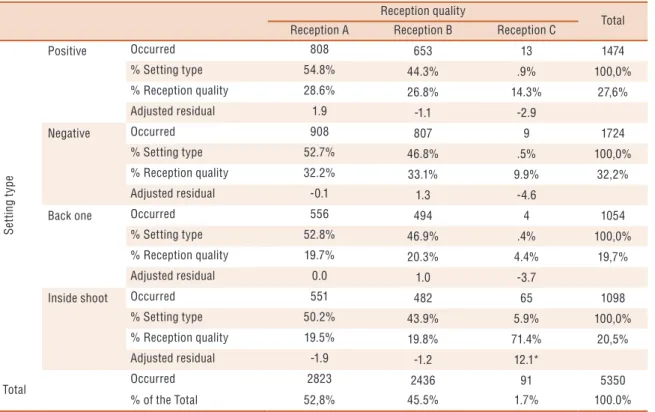
he inferential analysis of the reception quality with the setting type found a statistically signiicant association (X2 = 150.352, p < 0.001) and the trend
observed in the descriptive analysis was conirmed, since inside shoot set-ting was positively associated with reception C, while positive, negative and back time settings were negatively associated with reception efect.
Table 1. Association between reception quality and the setting type
Reception quality
Total Reception A Reception B Reception C
S
et
ti
n
g t
yp
e
Positive Occurred 808 653 13 1474
% Setting type 54.8% 44.3% .9% 100,0%
% Reception quality 28.6% 26.8% 14.3% 27,6%
Adjusted residual 1.9 -1.1 -2.9
Negative Occurred 908 807 9 1724
% Setting type 52.7% 46.8% .5% 100,0%
% Reception quality 32.2% 33.1% 9.9% 32,2%
Adjusted residual -0.1 1.3 -4.6
Back one Occurred 556 494 4 1054
% Setting type 52.8% 46.9% .4% 100,0%
% Reception quality 19.7% 20.3% 4.4% 19,7%
Adjusted residual 0.0 1.0 -3.7
Inside shoot Occurred 551 482 65 1098
% Setting type 50.2% 43.9% 5.9% 100,0%
% Reception quality 19.5% 19.8% 71.4% 20,5%
Adjusted residual -1.9 -1.2 12.1*
Total Occurred 2823 2436 91 5350
% of the Total 52,8% 45.5% 1.7% 100.0%
* Positive association> 2
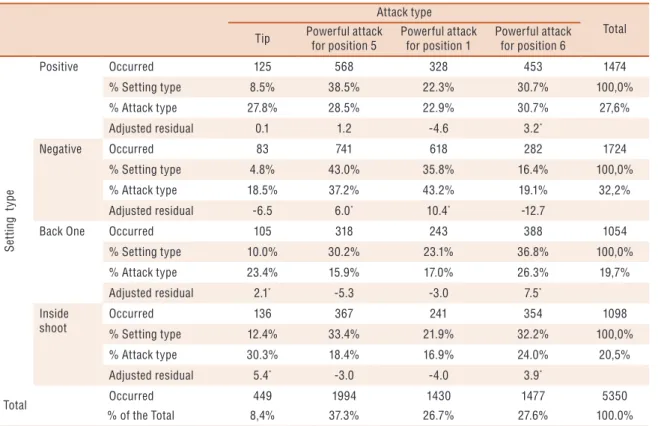
he inferential analysis of the attack type with the setting type found a statistically signiicant association (X2 = 289.121, p < 0.001). he inferential
associated with the positive, back one and inside shoot set. he powerful attack for position 6 was positively associated with the positive, back one and Inside shoot set and negatively to the negative attack.
Table 2. Association between attack type and setting type
Attack type
Total Tip Powerful attack
for position 5
Powerful attack for position 1
Powerful attack for position 6
S
et
ti
n
g t
yp
e
Positive Occurred 125 568 328 453 1474
% Setting type 8.5% 38.5% 22.3% 30.7% 100,0%
% Attack type 27.8% 28.5% 22.9% 30.7% 27,6%
Adjusted residual 0.1 1.2 -4.6 3.2*
Negative Occurred 83 741 618 282 1724
% Setting type 4.8% 43.0% 35.8% 16.4% 100,0%
% Attack type 18.5% 37.2% 43.2% 19.1% 32,2%
Adjusted residual -6.5 6.0* 10.4* -12.7
Back One Occurred 105 318 243 388 1054
% Setting type 10.0% 30.2% 23.1% 36.8% 100,0%
% Attack type 23.4% 15.9% 17.0% 26.3% 19,7%
Adjusted residual 2.1* -5.3 -3.0 7.5*
Inside shoot
Occurred 136 367 241 354 1098
% Setting type 12.4% 33.4% 21.9% 32.2% 100,0%
% Attack type 30.3% 18.4% 16.9% 24.0% 20,5%
Adjusted residual 5.4* -3.0 -4.0 3.9*
Total Occurred 449 1994 1430 1477 5350
% of the Total 8,4% 37.3% 26.7% 27.6% 100.0%
* Positive association> 2
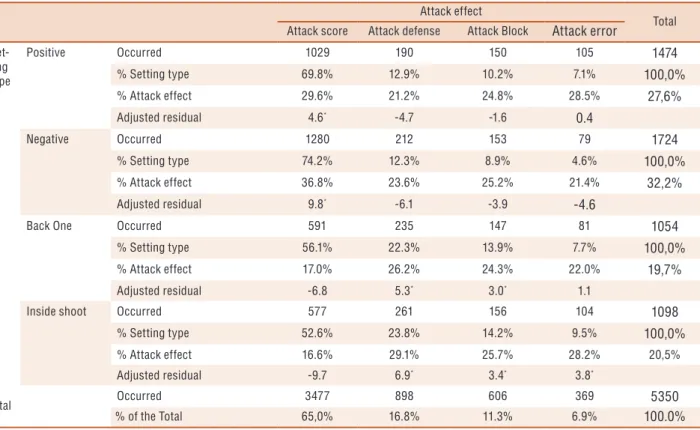
Based on results of the chi-squared test shown in Table 3, statisti-cally signiicant association was observed (X2 = 202.351, p < 0.001). he
inferential analysis showed that the attack score was positively associated with positive and negative attack and negatively with back one and inside shoot set. Defended attack was positively associated with back one and inside shoot set and negatively with positive and negative attack. Blocked attack was positively associated with back one and inside shoot set and negatively to negative attack. Attack error was positively associated with Inside shoot set and negatively to negative attack.
DISCUSSION
as-Middle attacker in men’s volleyball
Costa et al.
sociated. his trend corroborates the study of Afonso et al.21, who observed
increased use of fast play near the setter in attacks carried out by zone 3. In another study, Marcelino et al.22 found that the reception quality inluences
the distribution strategy and the fast game requires high quality of receptions. he men’s game is played faster and faster and searches for using four attackers, speciically from zone 4, zone 3, zone 6 and zone 1 or zone 2, avoiding plays that delays the attack speed13. In this regard, high-quality
receptions allow the performance of fast play close and away from the setter as well as in front and behind the setter 22. However, poor-quality
recep-tion, reception C, hinders the achievement of fast play near the settler due to temporal and spatial aspects22, that is, the setter is away from the net
most of the time, which hinders the distribution of positive, negative and back one sets. However, the most distant balls become viable, as there is enough space between the setter and the middle attacker for this setting, especially the inside shoot set.
hus, the game held near the setter improved speed and accuracy, speciically positive, negative and back one set, restricting the opponent’s defensive system. his trend conirms the study of Afonso and Mesquita22,
who realized that attacks performed at position 3 and in 1st tempo of attack
limited the structuring of the opponent’s defensive system, i.e., reduced the occurrence of double and triple blocks.
Results of the association between attack type and setting type showed that the powerful attacks were the most frequent, while tip was the less
Table 3. Association between attack effect and the setting type
Attack effect
Total Attack score Attack defense Attack Block Attack error
Set-ting type
Positive Occurred 1029 190 150 105 1474
% Setting type 69.8% 12.9% 10.2% 7.1% 100,0%
% Attack effect 29.6% 21.2% 24.8% 28.5% 27,6%
Adjusted residual 4.6* -4.7 -1.6 0.4
Negative Occurred 1280 212 153 79 1724
% Setting type 74.2% 12.3% 8.9% 4.6% 100,0%
% Attack effect 36.8% 23.6% 25.2% 21.4% 32,2%
Adjusted residual 9.8* -6.1 -3.9 -4.6
Back One Occurred 591 235 147 81 1054
% Setting type 56.1% 22.3% 13.9% 7.7% 100,0%
% Attack effect 17.0% 26.2% 24.3% 22.0% 19,7%
Adjusted residual -6.8 5.3* 3.0* 1.1
Inside shoot Occurred 577 261 156 104 1098
% Setting type 52.6% 23.8% 14.2% 9.5% 100,0%
% Attack effect 16.6% 29.1% 25.7% 28.2% 20,5%
Adjusted residual -9.7 6.9* 3.4* 3.8*
Total Occurred 3477 898 606 369 5350
% of the Total 65,0% 16.8% 11.3% 6.9% 100.0%
avoid attack error and powerful attacks increase error possibility, these are necessary for the overlay to defensive systems, which are increasingly better structured24,25.
In this sense, it was observed that due to the association between inside shoot and back one with tips, the setting distribution or quality could not allow excellent conditions for scoring point. In contrast, powerful attacks for positions 1 and 5 were positively associated to negative set, suggesting that the completion condition was excellent for this setting type. In addi-tion, powerful attack for position 6 was positively associated with setting types back one and inside shoot, indicating that block was not formed at the moment of attack. his trend is in line with the study of Afonso et al.9,
who observed the central blocker’s strategy and found that the positioning of this blocker was related to the reception quality and setting type, suggesting that the decisions that players make are dependent on signals relevant of each situation 26, particularly situational constraints. hus, these constraints
create contexts that are conigured from constraints imposed on players. he results on the attack efect showed that the point of attack was the most recurring efect, corroborating the study of Rocha and Barbanti 5, who
analyzed attacks from positions 2, 3 and 4 and observed higher occurrence of attack point efect, while the attack error was the lowest frequent efect. In addition, there was association between attack efect and setting type, and positive and negative sets were positively associated with the attack point, while the other sets were associated with the game continuity or with the attack error. In this context, although other variables such as individual characteristics of the middle attacker and play combinations have not been analyzed in this study, it could be inferred that positive and negative sets were one of the most efective strategies for score point when analyzing the game played by the middle attacker. his trend was conirmed by studies in this area, demonstrating that the middle attack hinders the blocking structure and favors the attack with fewer blockers9,22.
However, the analysis of the phenomenon only in men’s teams and in the context of complex I are recognized as limitations of this study, which suggests caution in generalizing the indings.
CONCLUSIONS
It was concluded that there was association between reception efect and the setting type with attack type, as well as the setting type with the attack efect. It was also observed that among the middle spiker’s attack actions, most occurred after receptions A and B and the attack point was the most recurrent. Moreover, powerful attacks were the most used, while tips while the less widely used.
distribu-Middle attacker in men’s volleyball
Costa et al.
tion strategy. Furthermore, inside shoot and back one are possibly used as game variations, suggesting that the need to use these types of setting arises from a situational demand, due to the change in the blocking structure or attack strategy. In this context, this study suggests that further studies seeking to understand the situational constraints regarding the middle at-tacker in the complex II should be carried out to avoid the generalization of results, and others should observe the performance of other game positions.
REFERENCES
1. Costa GC, Barbosa RV, Freire AB, Matias CJAS, Greco PJ. Análise das es-truturas do complexo I à luz do resultado do set no voleibol feminino. Motriz 2014;10(3):40-9.
2. Claver FR, Castuera RJ, Arias AG, Domínguez AM, Arroyo MPM. Relation-ship between performance in game actions and match results in volleyball training stages. J Hum Sport Exerc 2013;8(3):651-9.
3. Maia N, Mesquita I. Estudo das zonas e eicácia da recepção em função do jogador recebedor no voleibol sênior feminino. Rev Bras Educ Fís Esp 2006;20(4):257-70.
4. Marcelino R, César B, Afonso, J, Mesquita, I. Attack-tempo and attack-type as predictors of attack point made by opposite players in volleyball. Int J Perf Analysis Sport 2009;9(3):398-411.
5. Rocha CM, Barbanti VJ. Uma análise dos fatores que inluenciam o ataque no Voleibol masculino de alto nível. Rev Bras Educ Fís Esp 2004;18(4):303-14.
6. Costa GC, Mesquita I, Grego PJ, Ferreira N, Moraes JC. Relação entre o tempo, o tipo e o efeito do ataque no Voleibol masculino juvenil de alto nível competitivo. Rev Bras Cineantropom Desempenho Hum 2010;12(6):401-34.
7. Castro J, Mesquita I. Estudo das implicações do espaço ofensivo nas características do ataque no Voleibol masculino de elite. Rev Port Cien Desp 2008;8(1):114-25.
8. Stutzig N, Zimmermann B, Busch D, Siebert T. Analysis of game variables to predict scoring and performance levels in elite men’s volleyball. Int J Perf Analysis Sport 2015;15(3):816-29.
9. Afonso J, Mesquita I, Palao JM. Relationship between the use of commit-block and the numbers of blockers and block efectiveness. Int J Perf Analysis Sport 2005;5(2):36-45.
10. César B, Mesquita I. Caracterização do ataque do jogador oposto em função do complexo do jogo, do tempo e do efeito do ataque: estudo aplicado no Voleibol feminino de elite. Rev Bras Educ Fís Esp 2006;20(1):59-69.
11. Monteiro R, Mesquita I, Marcelino R. Relationship between the set outcome and the dig and attack eicacy in elite male Volleyball game. Int J Perf Analysis Sport 2009;9(3):294-305.
12. Castro J, Souza A, Mesquita I. Attack eicacy in volleyball: elite male teams. Percept Mot Skills 2011;113(2):395-408.
13. Silva M, Lacerda D, João P. Match analysis of discrimination skills according to the setter attack zone position in high level volleyball. Int J Perf Analysis Sport 2013;13(2):452-60.
14. Papadimitriou K, Aggelousis N, Antoniou P, Mellas S, Taxildaris K. Video Analysis in the Assessment of the Volleyball Setter’s Competitive Bahavior. Int J Comput Sci Sport 2004;2(1):166-8.
15. Palao, JM, Santos JA, Ureña A. Efect of the manner of spike execution on spike performance in volleyball. Int J Perf Analysis Sport 2007;7(2):126-38.
16. Mesquita I, Manso FD, Palao JM. Defensive participation and eicacy of the libero in volleyball. J Hum Mov Stud 2007;52(2):95-107.
CORRESPONDING AUTHOR
Gustavo De Conti Teixeira Costa Avenida Esperança s/n, Campus Samambaia,
Faculdade de Educação Física e Dança,
Goiás, Goiânia, Brasil CEP:74690-900.
E-mail: [email protected]
ed. New York: Wiley-Interscience; 2003.
20. Landis JR, Koch GG. he measurement of observer agreement for categorical data. Biometrics 1977;33(1):159-74.
21. Afonso J, Mesquita I, Marcelino R, Silva J. Analysis of the setter’s tactical action in high-performance women’s volleyball. Kinesiology 2010;42(1):82-9.
22. Marcelino R, Afonso J, Moraes JC, Mesquita I. Determinants of attack players in high-level men’s volleyball. Kinesiology 2014;46(2):234-41.
23. Afonso J, Mesquita I. Determinants of block cohesiveness and attack eicacy in high-level women’s volleyball. Eur J Sport Sci 2011;11(1):69-75.
24. Garcia-De-Alcaraz A, Ortega E, Palao J. M. Efect of age group on male volleyball players technical-tactical performance proile for the spike. Int J Perf Analysis Sport 2015;15(2):668-86.
25. Laporta L, Nikolaidis P, homas L, Afonso J. Attack coverage in high-level men’s volleyball: organization on the edge of chaos? J Hum Kinet 2015;47(1):249-57.