Submitted30 May 2014 Accepted 12 September 2014 Published7 October 2014
Corresponding author Christophe Dessimoz, [email protected]
Academic editor Freddie Salsbury Jr
Additional Information and Declarations can be found on page 14
DOI10.7717/peerj.607
Copyright 2014 Wittwer et al.
Distributed under
Creative Commons CC-BY 4.0
OPEN ACCESS
Speeding up all-against-all protein
comparisons while maintaining
sensitivity by considering
subsequence-level homology
Lucas D. Wittwer1,2,3,4, Ivana Piliˇzota1,4, Adrian M. Altenhoff1,2,3and Christophe Dessimoz1,2
1University College London, London, United Kingdom 2Swiss Institute of Bioinformatics, Zurich, Switzerland
3ETH Zurich, Department of Computer Science, Zurich, Switzerland 4These authors contributed equally to this work.
ABSTRACT
Orthology inference and other sequence analyses across multiple genomes typically start by performing exhaustive pairwise sequence comparisons, a process referred to as “all-against-all”. As this process scales quadratically in terms of the number of sequences analysed, this step can become a bottleneck, thus limiting the number of genomes that can be simultaneously analysed. Here, we explored ways of speeding-up the all-against-all step while maintaining its sensitivity. By exploiting the transitivity of homology and, crucially, ensuring that homology is defined in terms of consistent protein subsequences, our proof-of-concept resulted in a 4×speedup while recovering>99.6% of all homologs identified by the full all-against-all procedure on empirical sequences sets. In comparison, state-of-the-artk-mer approaches are orders of magnitude faster but only recover 3–14% of all homologous pairs. We also outline ideas to further improve the speed and recall of the new approach. An open source implementation is provided as part of the OMA standalone software at
http://omabrowser.org/standalone.
Subjects Bioinformatics, Computational Biology, Evolutionary Studies, Genomics, Computational Science
Keywords All-against-all, Sequence alignment, Homology, Orthology, Smith–Waterman
INTRODUCTION
1997;Lynch, 2000;Altenhoff& Dessimoz, 2012;Gabald´on & Koonin, 2013). Therefore, protein function can be assigned by identifying regions of orthology between a newly sequenced and an already annotated genome (e.g.,Gaudet et al., 2011;Altenhoffet al., 2012). Orthology inference is also of high interest to infer phylogenetic species trees and to study the evolution of gene families (Altenhoff& Dessimoz, 2012).
Due to the high biological interest for orthology detection, many orthology inference algorithms and associated databases have been developed (reviewed inDessimoz et al., 2012;Sonnhammer et al., 2014). Some of these can be large, with databases comparing thousands of genomes of different species: eggNOG with currently 3686 genomes (Powell et al., 2013), Roundup with 2044 (DeLuca et al., 2012), OMA with 1613 genomes (Altenhoff et al., 2011) and OrthoDB with 1425 genomes (Waterhouse et al., 2013).
To detect homology, these resources rely on all-against-all protein comparison. All pairs of sequences are aligned using BLAST (Altschul et al., 1997) or dynamic programming (Smith & Waterman, 1981). They are then inferred as homologous if their alignment score is above a certain threshold and alignment length constraints are satisfied (Dessimoz et al., 2005;Roth, Gonnet & Dessimoz, 2008). Even orthology databases based on reconciled gene/species trees (Vilella et al., 2008) or hidden Markov model profiles (Mi, Muruganujan & Thomas, 2013) typically start their procedure with an all-against-all step, before proceeding to clustering.
However, the all-against-all procedure scales quadratically in the number of sequences compared and hence rapidly becomes very costly. For instance, the all-against-all phase in OMA, the resource developed in our lab, has already consumed over 6.1 million CPU hours to date, despite the use of a highly optimised implementation (Szalkowski et al., 2008) of theSmith & Waterman (1981)pairwise alignment algorithm. Furthermore, in the all-against-all phase of OMA, about half of the time is spent on unrelated gene pairs (see
Supplemental Information 1) which are not used for further orthology inference. Previous methods have been proposed to speedup the all-against-all phase, but they tend to come at a cost of lower sensitivity. CD-HIT (Li & Godzik, 2006), UCLUST (Edgar, 2010), and kClust (Hauser, Mayer & S¨oding, 2013) are methods to reduce the complexity by clustering the dataset based on the number of common or high-scoring words (k-mers) in each sequence. This works well to identify closely related sequences—e.g., close paralogs or “redundant” sequences—but such approaches are less sensitive than full dynamic programming alignment and thus tend to miss distant homologs. Another approach was proposed in the Hieranoid method (Schreiber & Sonnhammer, 2013): by using the species tree as guide and iteratively merging terminal sister taxa into ancestral genomes, the computational cost only grows linearly with the number of genomes. However, reconstructing ancestral sequences or profiles can prove challenging among distantly related species. Moreover, the guide tree must be clearly defined and known, which is a problem for many prokaryotes and eukaryotes.
merely whole protein-level homology. As a result, sequences can belong to multiple clusters. On sets of empirical bacterial and fungal protein sequences, our new approach achieves a reduction in computational time of∼75% while maintaining the sensitivity of
all-against-all procedure (>99.6% of all pairs identified by all-against-all).
MATERIALS AND METHODS
We start by motivating our method under the assumption of perfect input data, then present the modifications required to perform well on real, imperfect data. We then describe thek-mer methods we used as points of comparison. Finally, we present the empirical datasets used to evaluate the new method.
Building homologous clusters from perfect data
Typical downstream analysis of the all-against-all step requires an alignment score for every significant pair of proteins (putative homologs). Therefore, aligning these significant pairs seems difficult to avoid. In contrast, avoiding the alignment of unrelated pairs can potentially reduce the overall runtime of the all-against-all. One way to avoid some pairs is by using the transitive property of homology: typically—we discuss pathological cases in the next section—if sequence A is homologous to sequence B, and sequence B is homologous to sequence C, then sequences A and C are homologous. A corollary of this is that if sequence A is homologous to sequence B, and sequence A isnothomologous to sequence C, then sequences B and C arenothomologous.
Proof of corollary: Let S1 denote “A is homologous to B”, S2 “B is homologous to C” and S3 “A is homologous to C”. The transitivity of homology states that S1S2⇒
S3. By material implication, that it is equivalent toq(S1S2)∨S3. De Morgan’s law yields the equivalent expression (qS1∨qS2)∨S3 which is, due to the associativity and
commutativity of disjunction, equivalent to (qS1∨S3)∨qS2. Using the De Morgan’s law again, the expression transforms to the equivalentq(S1qS3)∨qS2. Finally, by material implication it is equivalent to the expression S1qS3⇒qS2.
Therefore, in this particular scenario, if we infer that A and B are homologous and A and C are non-homologous, there is no need to align sequences B and C. Another way to consider this situation is that A acts as a representative for its homologous sequence B. We can generalise this idea to more than three sequences by building clusters of homologs for which a single sequence acts as a representative for all members (trivial proof by induction).
Figure 1 Diagram of potential problems with transitivity of homology.(A) The transitivity of homol-ogy does not hold if the residues involved are inconsistent. (B) Homologous relationships can be missed if significant sequence parts are not covered by the representative sequence. To address this problem, our approach would create a new cluster, with the sequence that is not fully covered as its representative.
Under the assumptions that homology is transitive and that homology can be perfectly ascertained through sequence alignment, this procedure guarantees that all homologous sequences end up in a common cluster inO(nk), wherenis the number of proteins andk
is the number of clusters. Sincek≤n(and possiblyk≪n), this is more efficient than the
O(n2)runtime of the standard all-against-all procedure.
In practice, however, homology at the level of proteins is not always transitive and homology cannot be perfectly ascertained. Therefore, refinements to the basic idea are required.
Building homologous clusters from real data: multiple representatives, multiple clusters, and subsequence-level homology
The two assumptions underlying the algorithm for ideal data are not tenable on real data. First, highly distant (and thus dissimilar) homologous sequences can be very difficult or impossible to reliably identify. Thus, if the representative is very distant to a particular homologous sequence, homology can nevertheless be missed. Second, homology does not necessarily apply uniformly across all residues of a protein. For transitivity to hold, it is essential that homology applies to a common set of residues. However, insertions and gene fusion can lead to situations where this is not the case (seeFig. 1Afor an illustrative example).
subsequence-level homology: we ensure that the entire length of a particular protein (minus a tolerance parameter, set to 20 amino-acid residues in this study) is covered by the cluster(s) to which the sequence belongs. If this is not the case, a new cluster is created with the sequence as representative. Note that this is in addition to inclusion into any cluster with significant alignment (Fig. 1B).
Putting these ideas together, our approach for building homologous clusters is as follows. First, we sort the input genomes by their number of sequences in descending order. For every genome, starting with the one with the highest number of sequences, we process its sequences one by one as they are listed in the database file. As there are no clusters at the beginning of the process, the first sequence founds a cluster and becomes its representative. Every subsequent sequence is aligned with the representatives of the current cluster(s) usingSmith & Waterman (1981). We run the vectorised Smith–Waterman implementation ofSzalkowski et al. (2008)using the 224 GCB scoring matrix (Gonnet, Cohen & Benner, 1992). If the score is above the minimum threshold of 135.75, the sequence is added to the cluster. Furthermore, if the number of cluster representatives in the particular cluster is below the maximum allowed, the newly added sequence becomes a representative. We also keep track how much the sequence is covered by the representatives of the assigned clusters. We do not introduce any restrictions on the size of the clusters nor on the number of clusters that a sequence is assigned to. After an exhaustive search through all cluster representatives, we assess whether the sequence was added to one or multiple clusters. If the full length of the sequence (minus a tolerance of 20 amino acids) is not covered by the clusters to which the sequence was added, an additional cluster is created with the sequence as a representative. The same applies if the sequence was not assigned to any clusters (see
Fig. 2for pseudocode).
Computing all-against-all within each cluster
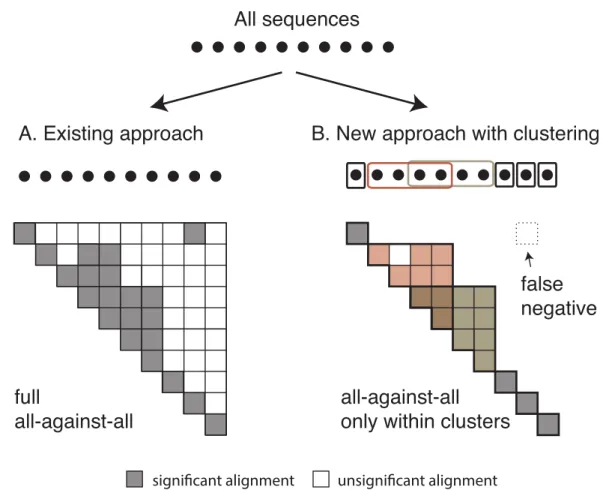
Once we have identified all homologous clusters, we compute an all-against-all within each cluster using the same criteria as the global all-against-all (Fig. 3). This ensures that all retained pairs agree with the score and length requirements of the full all-against-all, and provides scores for all homologous pairs, which are often required for downstream analyses.
Comparison with full all-against-all and other methods
Figure 2 Pseudocode of the proposed cluster building procedure.
Figure 3 Comparison between the current and the new approach.Diagram of (A) the current OMA all-against-all step and (B) the new approach with homologous clustering and sequence coverage. In the proposed approach, the sequences are first clustered and then the all-against-all is run only within clus-ters. The overall number of computations is considerably reduced, but some homologous relationships can be missed.
Datasets
We analysed the performance of the new approach on two distinct datasets: bacteria and fungi. Bacteria dataset contained 14 proteomes, fungi contained 12, all sampled from the OMA database (Altenhoffet al., 2011) (March 2014 release; seeFile S1for complete list). The distribution of sequence lengths and evolutionary distances among significant pairs is provided inFigs. S1–S2. To assess the scaling behaviour of each variant, we ran them on subsets which were formed as follows: all genomes in the dataset were sorted by their size and the ones in the middle of the list were chosen to form a subset. By choosing the central 2, 4, 6, 8, 12 and finally all 14 proteomes, subsets of bacteria were constructed. We repeated the procedure for fungi and obtained subsets of size 2, 4, 6, 8, 10 and 12 proteomes.
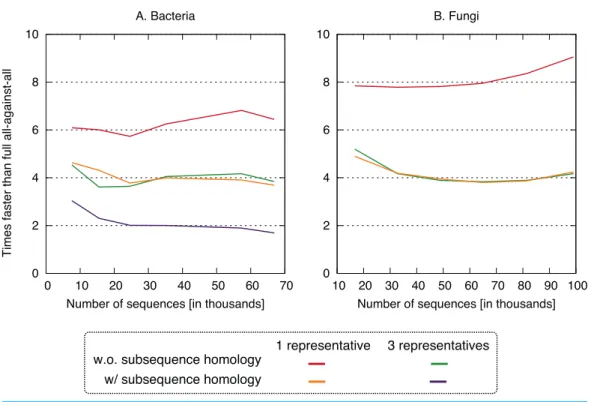
Figure 4 Speed up using the new approach.The proposed approach is 2–9×faster, depending on datasets and variants. On the fungi dataset, only the three fastest variants were computed.
RESULTS
To assess the time and accuracy of our new approach, we compared the four clustering variants—one or three cluster representatives, each combined with either taking into account residue-level homology or not (see Methods)—on empirical bacterial genomes. We also repeated the three fastest variants on empirical fungal datasets.
All four clustering variants decreased runtime compared to the full all-against-all algorithm, with a speedup factor of 2–9 depending on the variant and dataset (Fig. 4). Unsurprisingly, the reduction was strongest in variants considering a single representative sequence per cluster. Likewise, ignoring residue-level homology lead to faster runtime, though the difference was more modest.
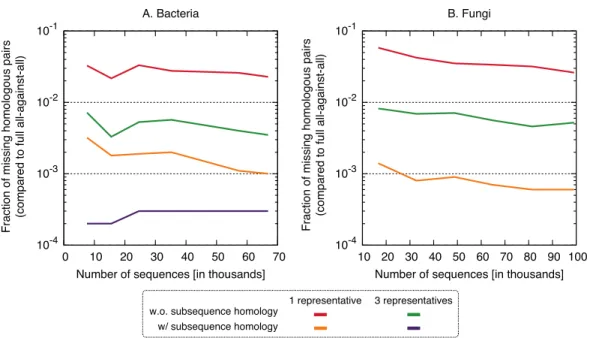
Figure 5 Fraction of the pairs missed when using the proposed algorithm.The new approach misses 0.4–6% of the pairs from the full all-against-all in its simple variant (1 and 3 representatives), and 0.01–0.3% taking into account sub-sequence homology.
Putting runtime and accuracy together, the best results were obtained by taking into account subsequence-level homology using a single representative sequence, which achieved a∼4×speedup while maintaining>99.6% recall in both datasets.
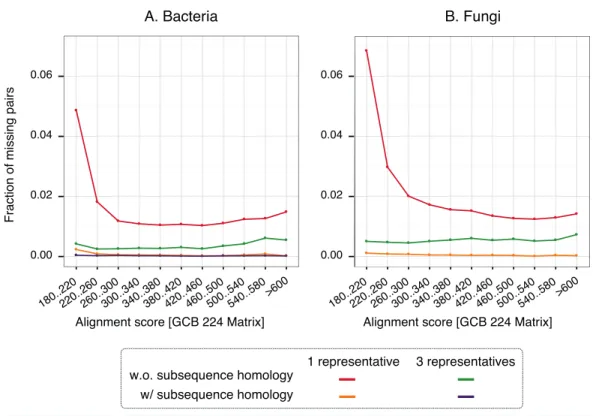
To gain insight into the nature of missing pairs, we analysed the distribution of alignment scores of missing pairs compared to that of all significant matches (Fig. 6). For all method variants, but especially those taking into account subsequence-level homology, the distribution is heavily skewed toward low-scoring matches. This is favourable, because low-scoring matches are less reliable in the first place and therefore downstream analyses are already designed to cope with missing homologous relationships among distant pairs (e.g.,Altenhoffet al., 2013). We also note that the higher recall observed with three representatives instead of one is mainly concentrated on low scoring matches. Furthermore, a per-gene analysis of the rate of missing pairs suggests that errors are distributed quite evenly across all family sizes (Fig. S7).
Figure 6 Distribution of alignments scores of missing pairs.With a single representative, the distribu-tion is heavily skewed toward low-scoring pairs.
many sequences included in multiple clusters (Fig. S11) suggests improvement potential by merging some of the clusters (see alsoDiscussionbelow).
To assess the impact of the new clustering approach on orthology inference, we ran the OMA standalone software (Altenhoffet al., 2013) using our best new variant (1 representative, with subsequence homology) compared to the full all-against-all as a reference. On the largest Bacteria and Fungi dataset, the proportion of orthologs that were recovered was 99.71% and 99.87% respectively. This is slightly lower than the proportion of recovered homologs (99.9% and 99.94%), but remains very high.
Furthermore, to test whether large genomes and/or multidomain proteins could affect the performance of the new approach, we conducted an additional comparison on a genome set containing two vertebrates (Human andXenopus tropicalis), one plant (Arabidopsis thaliana) and three unicellular organisms (Plasmodium falciparum, Saccha-romyces cerevisiae, andBacillus subtilis). We applied the variant with one representative and subsequence homology. It resulted in a considerably higher speedup factor of 12.05, with a recall of 99.94%. This suggests that the new approach behaves well in the presence of large genomes and numerous multi-domain proteins as well.
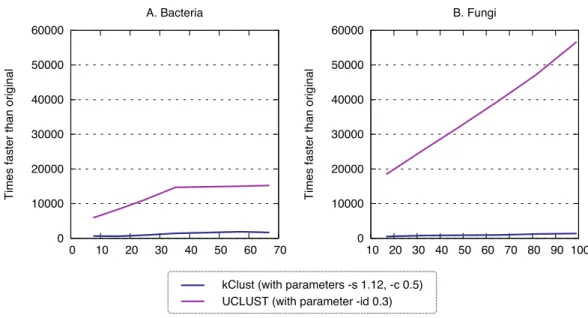
Figure 7 Runtime of typical K-merapproaches.kClust and UCLUST are several orders of magnitude
faster than full all-against-all.
Figure 8 Recall of typical K-merapproaches.kClust and UCLUST only recover 3–14% of the
homolo-gous pairs identified by the full all-against-all procedure, even when they are run with sensitive parameter settings (see Materials and Methods for details).
representative sequences), they provide an interesting point of comparison. As expected, these approaches were orders of magnitude faster (speedup 500–1900×for kClust, over 6000×for UCLUST;Fig. 7), but their recall was typically in the single percentage points
DISCUSSION AND OUTLOOK
The all-against-all phase is at the basis of many orthology inference algorithms but due to its quadratic time complexity in terms of number of sequences, the all-against-all phase can be a bottleneck. This work suggests that the transitivity of homology can be exploited to substantially speedup homology inference while maintaining sensitivity—provided homology is defined in terms of consistent subsequence stretches.
The datasets used in this study are challenging, with median distance of 146 PAM (1.46 substitution per site on average) in the bacteria dataset and 149 PAM in the fungi dataset (Fig. S2). This implies that half of homologous pairs have less than 30% sequence identity. At such high levels of divergence,k-mer based methods perform poorly compared to all-against-all dynamic programming alignment. In contrast, our transitivity clustering approach performed well. It is likely to perform even better on evolutionarily closer sets of taxa, such as vertebrate species or flowering plant species.
The speedup we observed with the new approach is substantial. But because the number of clusters increased roughly linearly with the number of genomes in our datasets of up to 14 genomes, the overall time complexity still grows quadratically in this range. However, as rarefaction curves show (e.g.,Mira et al., 2010), the growth in the number of homologous clusters typically tapers off. Thus, it is possible that the asymptotic complexity of the new procedure is subquadratic in the number of species. This will need to be confirmed in future work.
Apart from the full dynamic programming alignment comparison with cluster representatives and the subsequence-level homology consideration, our approach distinguishes itself from most clustering methods in that it allows sequences to match to several clusters. If homology was always uniform across the whole sequence length and could be perfectly inferred from present-day sequences, each sequence would belong to one and only one homologous cluster. In practice however, these assumptions do not hold: gene fusion can result in sequences that have homologous relationships across multiple clusters; some homologs have diverged too far to be inferred as such, thus resulting in cluster fragmentation. By allowing for sequences to belong to multiple clusters, our method is robust to these complications.
Though the present study focuses on Smith–Waterman dynamic programming alignments, a similar clustering approach would be possible with the faster but less sensitive BLAST (Altschul et al., 1997). One complication with BLAST is however that the sequence database needs to be re-indexed whenever a sequence is added. To mitigate this, one could add new representative sequences in batches, with the additional complication that sequences within each batch would also need to be aligned to one another.
These promising results notwithstanding, the new approach still has much potential for improvement. To further improve the recall, several ideas could be explored. First, the procedure could merge clusters that have a high proportion of members in common. This could recover some of the missed homologous pairs. Second, the choice of cluster representatives could be improved. Indeed, the current strategy of selecting the first sequence (or the first three sequences) added to the cluster is likely to be suboptimal in most instances. Instead, a better choice of representative would be to try to select a sequence with minimal average distance to all cluster members (a “centroid” sequence). Another idea, suggested by Dr. Ikuo Uchiyama in his peer-review, would be to vary the number of representatives depending on the particular needs of each cluster, e.g. by adding a new member as a representative if its similarity score with the existing representative(s) is below a certain threshold. Third, as an alternative to representative sequences, clusters could be represented by Hidden Markov model profiles. Such approach, at the basis of well-established methods such as PSI-Blast (Altschul et al., 1997), HMMER (Eddy, 2011), or HHBlitz (Remmert et al., 2011), is likely be more sensitive than pairwise alignment with a single representative sequence. The profiles could be periodically updated as new sequences are assigned to the cluster.
We also see potential to further improve the speed of the new approach. First, merging homologous clusters can lead to a speed improvement because the cost of assigning sequences to clusters grows linearly in the number of clusters. This needs to be done carefully, because excessive merging—the merging of clusters containing a substantial number of non-homologous pairs—can reduce the efficiency of the within-cluster all-against-all, whose time complexity grows quadratically in the number of sequences. Second, it may be possible to optimise the assignment of sequences to clusters by identifying clusters that are so different to one another that they are practically mutually exclusive and thus inclusion into one implies exclusion from the other. An empirical way of establishing such mutual exclusivity would be to keep track of the number or proportion of sequences belonging to both clusters. Finally, the new approach could be parallelised. One way of parallelising the assignment of sequences to clusters would be to use a Publisher-Subscriber model (Eugster et al., 2003): a “master” process would start the analysis of a new sequence by distributing it to a set of “workers”, each responsible to compare the sequence to a subset of all existing clusters. Each worker would thus align the new sequence to its designated subset of clusters and reports back significant matches and their associate sequence ranges (subsequence-level coverage). Once the master process has received this information from all workers, it would ensure that the new sequence is fully covered by matches to existing clusters, and else it would generate a new cluster with that sequence as representative. As for the within-cluster all-against-all comparisons, they could be straightforwardly parallelised thanks to the lack of dependency among all pairs.
ACKNOWLEDGEMENTS
This article is dedicated to Gaston H. Gonnet on the occasion of his retirement. We thank Kevin Gori, Henning Redestig, Nives ˇSkunca, Bartlomiej Tomiczek for useful feedback on the manuscript, as well as Odile Lecompte, Benjamin Linard, Ikuo Uchiyama, and one anonymous reviewer for useful feedback on the manuscript.
ADDITIONAL INFORMATION AND DECLARATIONS
Funding
AMA is funded by a Swiss Institute of Bioinformatics Infrastructure Grant. IP is jointly funded by a UCL Impact Award and by Bayer CropScience. Open access publication charges are covered by the University College London Library. The funders had no role in study design, data collection and analysis, decision to publish, or preparation of the manuscript.
Grant Disclosures
The following grant information was disclosed by the authors: Swiss Institute of Bioinformatics “Service and Infrastructure Grant”. UCL Impact Award.
Bayer CropScience.
University College London Library.
Competing Interests
CD is an Academic Editor for PeerJ and co-organises the GNOME 2014 symposium for which this submission is a contribution.
Author Contributions
• Lucas D. Wittwer and Ivana Piliˇzota performed the experiments, analyzed the data,
contributed reagents/materials/analysis tools, wrote the paper, prepared figures and/or tables, reviewed drafts of the paper.
• Adrian M. Altenhoffanalyzed the data, contributed reagents/materials/analysis tools, wrote the paper, prepared figures and/or tables, reviewed drafts of the paper.
• Christophe Dessimoz conceived and designed the experiments, analyzed the data, contributed reagents/materials/analysis tools, wrote the paper, prepared figures and/or tables, reviewed drafts of the paper.
Supplemental Information
Supplemental information for this article can be found online athttp://dx.doi.org/ 10.7717/peerj.607#supplemental-information.
REFERENCES
AltenhoffAM, Dessimoz C. 2012.Inferring orthology and paralogy. In: Anisimova M, ed.
Evolutionary genomics, vol. 1. Clifton, NJ: Humana Press, 259–279
AltenhoffAM, Gil M, Gonnet GH, Dessimoz C. 2013.Inferring hierarchical orthologous groups from orthologous gene pairs.PLoS ONE8:e53786DOI 10.1371/journal.pone.0053786. AltenhoffAM, Schneider A, Gonnet GH, Dessimoz C. 2011.OMA 2011: orthology
inference among 1000 complete genomes. Nucleic Acids Research39:D289–D294
DOI 10.1093/nar/gkq1238.
AltenhoffAM, Studer RA, Robinson-Rechavi M, Dessimoz C. 2012.Resolving the ortholog conjecture: orthologs tend to be weakly, but significantly, more similar in function than paralogs.PLoS Computational Biology8:e1002514DOI 10.1371/journal.pcbi.1002514. Altschul SF, Madden TL, Sch¨affer AA, Zhang J, Zhang Z, Miller W, Lipman DJ. 1997.Gapped
BLAST and PSI-BLAST: a new generation of protein database search programs.Nucleic Acids Research25:3389–3402DOI 10.1093/nar/25.17.3389.
DeLuca TF, Cui J, Jung J-Y, St Gabriel KC, Wall DP. 2012.Roundup 2.0: enabling comparative ge-nomics for over 1800 genomes.Bioinformatics28:715–716DOI 10.1093/bioinformatics/bts006. Dessimoz C, Cannarozzi G, Gil M, Margadant D, Roth A, Schneider A, Gonnet G. 2005.OMA,
a comprehensive, automated project for the identification of orthologs from complete genome data: introduction and first achievements. In:RECOMB 2005 workshop on comparative genomics, 61–72.
Dessimoz C, Gabald ´on T, Roos DS, Sonnhammer ELL, Herrero J, Quest for Orthologs Consortium. 2012.Toward community standards in the quest for orthologs.Bioinformatics
28:900–904DOI 10.1093/bioinformatics/bts050.
Eddy SR. 2011.Accelerated profile HMM searches.PLoS Computational Biology7:e1002195
DOI 10.1371/journal.pcbi.1002195.
Edgar RC. 2010.Search and clustering orders of magnitude faster than BLAST.Bioinformatics
26:2460–2461DOI 10.1093/bioinformatics/btq461.
Eugster PT, Felber PA, Guerraoui R, Kermarrec A-M. 2003.The many faces of publish/subscribe.
ACM Computing Surveys35:114–131DOI 10.1145/857076.857078.
Finn RD, Bateman A, Clements J, Coggill P, Eberhardt RY, Eddy SR, Heger A, Hetherington K, Holm L, Mistry J, Sonnhammer ELL, Tate J, Punta M. 2014.Pfam: the protein families database.Nucleic Acids Research42:D222–D230DOI 10.1093/nar/gkt1223.
Fitch WM. 1970.Distinguishing homologous from analogous proteins.Systematic Zoology
19:99–113DOI 10.2307/2412448.
Gabald ´on T, Koonin EV. 2013.Functional and evolutionary implications of gene orthology.
Nature Reviews Genetics14:360–366DOI 10.1038/nrg3456.
Gaudet P, Livstone MS, Lewis SE, Thomas PD. 2011. Phylogenetic-based propagation of functional annotations within the Gene Ontology consortium.Briefings in Bioinformatics
12(5):449–462DOI 10.1093/bib/bbr042.
Gonnet GH, Cohen MA, Benner SA. 1992.Exhaustive matching of the entire protein sequence database.Science256:1443–1445DOI 10.1126/science.1604319.
Hauser M, Mayer CE, S¨oding J. 2013.kClust: fast and sensitive clustering of large protein sequence databases.BMC Bioinformatics14:248DOI 10.1186/1471-2105-14-248.
Li W, Godzik A. 2006.Cd-hit: a fast program for clustering and comparing large sets of protein or nucleotide sequences.Bioinformatics22:1658–1659DOI 10.1093/bioinformatics/btl158. Lynch M. 2000.The evolutionary fate and consequences of duplicate genes.Science290:1151–1155
DOI 10.1126/science.290.5494.1151.
Metzker ML. 2009.Sequencing technologies—the next generation.Nature Reviews Genetics
Mi H, Muruganujan A, Thomas PD. 2013.PANTHER in 2013: modeling the evolution of gene function, and other gene attributes, in the context of phylogenetic trees.Nucleic Acids Research
41:D377–D386DOI 10.1093/nar/gks1118.
Mira A, Mart´ın-Cuadrado AB, D’Auria G, Rodr´ıguez-Valera F. 2010.The bacterial pan-genome: a new paradigm in microbiology.International Microbiology13:45–57.
Pagani I, Liolios K, Jansson J, Chen I-MA, Smirnova T, Nosrat B, Markowitz VM, Kyrpides NC. 2012.The Genomes OnLine Database (GOLD) v.4: status of genomic and metagenomic projects and their associated metadata.Nucleic Acids Research40:D571–D579DOI 10.1093/nar/gkr1100. Patterson C. 1988.Homology in classical and molecular biology.Molecular Biology and Evolution
5:603–625.
Powell S, Forslund K, Szklarczyk D, Trachana K, Roth A, Huerta-Cepas J, Gabald ´on T, Rattei T, Creevey C, Kuhn M, Jensen LJ, Von Mering C, Bork P. 2013.eggNOG v4.0: nested orthology inference across 3686 organisms.Nucleic Acids Research42:D231–D239
DOI 10.1093/nar/gkt1253.
Remmert M, Biegert A, Hauser A, S¨oding J. 2011. HHblits: lightning-fast iterative protein sequence searching by HMM-HMM alignment.Nature Methods 9:173–175
DOI 10.1038/nmeth.1818.
Rentzsch R, Orengo CA. 2009.Protein function prediction–the power of multiplicity.Trends in Biotechnology27:210–219DOI 10.1016/j.tibtech.2009.01.002.
Roth ACJ, Gonnet GH, Dessimoz C. 2008.Algorithm of OMA for large-scale orthology inference.
BMC Bioinformatics9:518DOI 10.1186/1471-2105-9-518.
Schreiber F, Sonnhammer ELL. 2013.Hieranoid: hierarchical orthology inference.Journal of Molecular Biology425:2072–2081DOI 10.1016/j.jmb.2013.02.018.
Smith TF, Waterman MS. 1981.Identification of common molecular subsequences.Journal of Molecular Biology147:195–197DOI 10.1016/0022-2836(81)90087-5.
Sonnhammer ELL, Gabald ´on T, Sousa da Silva AW, Martin M, Robinson-Rechavi M,
Boeckmann B, Thomas PD, Dessimoz C, the Quest for Orthologs consortium. 2014.Big data and other challenges in the quest for orthologs.BioinformaticsAdvance Access published August 25, 2014DOI 10.1093/bioinformatics/btu492.
Szalkowski A, Ledergerber C, Kr¨ahenb¨uhl P, Dessimoz C. 2008.SWPS3—fast multi-threaded vectorized Smith–Waterman for IBM Cell/B.E. and x86/SSE2. BMC Research Notes
1:107DOI 10.1186/1756-0500-1-107.
Tatusov RL. 1997. A Genomic Perspective on Protein Families. Science278:631–637
DOI 10.1126/science.278.5338.631.
Tatusov RL, Fedorova ND, Jackson JD, Jacobs AR, Kiryutin B, Koonin EV, Krylov DM, Mazumder R, Mekhedov SL, Nikolskaya AN, Sridhar Rao B, Smirnov S, Sverdlov AV,
Vasudevan S, Wolf YI, Yin JJ, Natale DA. 2003.The COG database: an updated version includes eukaryotes.BMC Bioinformatics4:41DOI 10.1186/1471-2105-4-41.
Vilella AJ, Severin J, Ureta-Vidal A, Heng L, Durbin R, Birney E. 2008.EnsemblCompara GeneTrees: complete, duplication-aware phylogenetic trees in vertebrates.Genome Research
19:327–335DOI 10.1101/gr.073585.107.
Waterhouse RM, Tegenfeldt F, Li J, Zdobnov EM, Kriventseva EV. 2013.OrthoDB: a hierarchical catalog of animal, fungal and bacterial orthologs.Nucleic Acids Research41:D358–D365