FREE THEMES
1 Universidade Federal do Espírito Santo. Av. Marechal Campos 1468, Maruípe. 29000-000 Vitória ES Brasil. claudias_dourado@ hotmail.com.
2 Universidade Federal de São Paulo. São Paulo SP Brasil.
Association between life events after diagnosis
of breast cancer and metastasis
Abstract The objective was to examine the asso-ciation between life events post diagnosis of breast câncer and metastasis. Cross-sectional study with 300 women attending a reference hospital in on-cology in the Espírito Santo. Was used the instru-ment Life Events Units-LEU/VAS to evaluate life events reported by women. Data were analyzed by using the nonparametric Wilcoxon and chi-square tests. It was performed odds ratio calcula-tion for the variables associated with metastasis. It was found that 21% of the sample reported at least one life event post diagnosis. Of the 46 wom-en who developed metastases, 20 reported one or more life events (p = 0.001). The odds ratio calcu-lated shows that having life events post diagnosis increases by 2.59 (1,37 – 4,91; p = 0,003) times the chance of developing metastasis. When con-sidering the time between diagnosis and the onset of metastasis there was a median of 18.0 months. The study shows a relationship between life events and metastasis, however emphasize the impor-tance of a more complex analysis to better under-stand the impacts of these events on the onset and progression of breast cancer.
Key words Breast neoplasms, Life change events, Stress, Neoplastic metastasis
Cláudia de Souza Dourado1 Camila Brandão de Souza2 Denise Silveira de Castro1 Eliana Zandonade1
D
our
ad
Introduction
Do stressful life events cause breast cancer and/ or its progression? Many studies have tried to an-swer this question in recent decades. Taking into account that the relationship between the mind and the body is complex, the results of investiga-tions have been inconsistent and contradictory.
Authors1-3 suggest that psychosocial factors
have powerful modulatory effects on the course of cancer. Although this conception is the subject of some controversy, it is not unacceptable, since variability in the progression of the neoplasm is determined not only by aspects related to the
tu-mor, but also by particularities of the host4.
Stressful life events can favor growth of can-cer and metastasis, through modulation of the nervous, endocrine and immunological
sys-tems5, and researchers3,6-8 have sought to improve
knowledge of this association.
Further, some researchers9,10 on stress, and the
process of facing it, have shown an action on the immune system intermediated by stress causing a reduction of ‘natural killer’ cells and consequent-ly progression of cancer.
All prolonged exposure to stress causes an ac-tivation of the endocrine system through the Hy-pothalamus-Hypothesis-Adrenal (HHA) system, and as a consequence results in an increase in the production of cortisol. This process of increase in the level of cortisol prejudices the organism in the exercise of its activities over the long term and causes immunosuppression of the body,
leaving it susceptible to a variety of threats3.
The body has been programmed in such a way that moments of stress, followed by a phys-ical reaction of the fight-or-flight type, cause little damage. However, when physiological re-sponse to stress is not discharged, a cumulative effect in the body begins. In the short term, stress
hormones are essential to human survival11,12.
However, a continuously maintained response to stress, that is to say, chronic stress, causes
perma-nent disorders13.
The objective of this study was to examine the association between metastasis and life events after diagnosis of breast cancer in women attend-ed by a reference hospital in the state of Espírito Santo, Brazil.
Methodology
This was a cross-sectional study, made in the Ylza
Bianco outpatient unit of the Santa Rita de Cássia
Hospital (HSRC), maintained by the Feminine Association for Education on and Combating
Cancer (Associação Feminina de Educação e
Com-bate ao Câncer) in the city of Vitória, capital of the Brazilian state of Espírito Santo. HSRC is a philanthropic entity recognized throughout the state as a reference in cancer treatment, which also makes available general specialties.
The Epidat program was used to calculate the size of sample for estimating prevalence of at least one event taking place after diagnosis in women with breast cancer. Considering a target population of 2,000 women, expected preva-lence of 50%, sampling error of 5.5% and level of significance of 5%, the minimum size of the sample was 274 patients. The researcher execut-ed a sampling plan, considering the five working days and the morning and afternoon shifts ran-domly in the period of collection. Women were approached randomly, comprising a total of 300 women in the sample.
The criteria for inclusion were: women, aged 18 or more, with diagnosis of breast cancer. As a criterion for exclusion: patients who presented cognitive deficits preventing them from under-standing the study.
Data were collected during the months of September and December 2014. The question-naire was applied at one single moment. The sample included women with recent diagnosis, women who were in treatment and women who were already cured.
The instrument used was Life Events Units
– LEU/VAS, which is based on Holmes and
Ra-he’s14 Social Readjustment Rating Scale – 1967,
adapted and validated by Vasconcellos et al.15. It
is based on the idea that the difficulty required for the person to readjust to society, after signifi-cant changes in the person’s life, pleasant or oth-erwise, generates a wear-and-tear factor that can lead to illnesses.
aúd
e C
ole
tiv
a,
23(2):471-479,
2018
from 10 to 100); and whether the episode had happened to them or to another person.
Although the LEU/VAS considers the pos-sibility of the event having occurred more than once, this study considered only the first occur-rence of the events, since the majority of the women related occurrence of each event only one time. Further, only events taking place after the cancer diagnosis were used.
Data on the socio-demographic and clin-ical variables were also collected through the SIS-RHC (Health Information System Hospital
Cancer Records [Sistema de Informação em Saúde
– Registro Hospitalar de Câncer]), as a source of secondary data of the hospital. Medical records of some patients were used to complete material information that was not found in the database.
For analysis, the data were organized in the program Microsoft Office Excel 2007 for
Win-dows, and analyzed using the Social Sciences
Statistics Package (Pacote Estatístico para
Ciên-cias Sociais – SPSS), version 20.0. The results were analyzed using calculations of frequency, average, median and standard deviation. The non-parametric Wilcoxon test was also applied for comparison of the data obtained at differ-ent momdiffer-ents (verification was not made of the normality of the data which was constituted on a mark from zero to 10); and the chi-squared test was used to verify the association between the variables of the process and the number of life events. Associations were tested for the variable
metastasis; and odds ratio was calculated for the
variable number of life events. The level of signif-icance adopted was 5%.
The study was submitted to and approved
by the Research Center of the Santa Rita de
Cás-sia-Afecc Unit, and the Research Ethics Commit-tee of the Health Sciences Center of the Federal University of Espírito Santo, as research project
No. 804020.
Results
Table 1 presents the social-demographic, clinical and risk characterization of the women. It is seen that 63% of the sample are aged 50 or more, and
that there is predominance of the non-white race/
color variable (65%), and women with less than eight years’ schooling (64%).
It is noted that 54% of the women were mar-ried or in a stable union (n = 162), 43% had re-munerated activity, 190 reported living on up to two times the minimum wage (63%), 187 lived in
Greater Vitória (62%), 166 lived in a house with three or more other people (55%) and 292 had some religious or spiritual belief (97%).
Table 1. Socio-demographic, clinical and risk characteristics of women with breast cancer attended by the Santa Rita de Cássia Hospital/Afecc, Vitória, 2014.
Variables n %
Age group
Up to 39 27 9.0
40 to 49 84 28.0
50 to 59 104 35.0
60 to 69 65 22.0
70 and over 20 6.0
Race/color
White 105 35.0
Non-white 195 65.0
Years of schooling
Up to 7 193 64.0
8 and more 107 36.0
Marital status
Single 52 17.0
Married/stable union 162 54.0
Divorced/separated 46 15.0
Widowed 40 13.0
Family income
Up to 2 x minimum wage 190 63.0
3 to 4 x minimum wage 81 27.0
Over 4 x minimum wage 29 10.0
Physical activity
None 242 81.0
1 or 2 times per week 16 5.0
3 or more times per week 42 14.0
Consumption of alcoholic beverages
Never 154 51.0
Rarely/socially/weekend 12 4.0
Former consumer 134 45.0
Smoking
Non-smoker 204 68.0
Ex-smoker 84 28.0
Present smoker 12 4.0
Family breast cancer history
Yes 95 32.0
No 205 68.0
Stage of the disease
Initial (I and II) 140 47.0
Advanced (III and IV) 160 53.0
Metastasis
Yes 46 15.3
D
our
ad
As to physical activity, a large part of the sample (81%) were sedentary (n = 242). It was observed that 154 women had never ingested al-coholic beverage (51%), 204 were non-smokers (68%), and 205 (68%) had no family history of breast cancer. Most of them were at a late stage (53%) with absence of metastasis (84.7%).
Figure 1 shows the total of life events expe-rienced by subjects after the diagnosis of breast cancer. It is seen that 21% reported having ex-perienced at least one life event and 79% did not report any event.
As to the time elapsed between diagnosis of breast cancer and the life events, and to whom the event happened, Table 2 shows that the event ‘death in the family’ was the most reported by the subjects (7.7%), with only negative classification. In relation to the time between diagnosis and the event, a median of 4.0 and a standard deviation of 3.0 was observed. We further note that, in all the cases, it was the women themselves who ex-perienced this event.
The event ‘Prison’, also with classification only negative, was reported by 17 women (5.7%). The time elapsed between diagnosis and the event had a median of 3.0 (SD = 3.7) and in all the cases, the event happened to other people.
It is found that the conjugal events ‘death of conjugal partner’ and ‘divorce’ are among those most quoted by the women. ‘Death of partner’ was reported by six women (2%), and all of them classified it as a negative event. The median of the time between diagnosis and the event was 7.0 (SD = 5.5). ‘Divorce’ was cited by five patients (1.7%), all with negative classification, the
me-dian being 1.0 (SD = 1.3) for the time elapsed between diagnosis of the breast cancer and the respective life event.
The event ‘change in financial condition’ was also among the most reported (2%). It present-ed only a negative classification and the mpresent-edian of time elapsed between diagnosis and the event was 1.0 (SD = 1.2), in all cases experienced by the patients themselves.
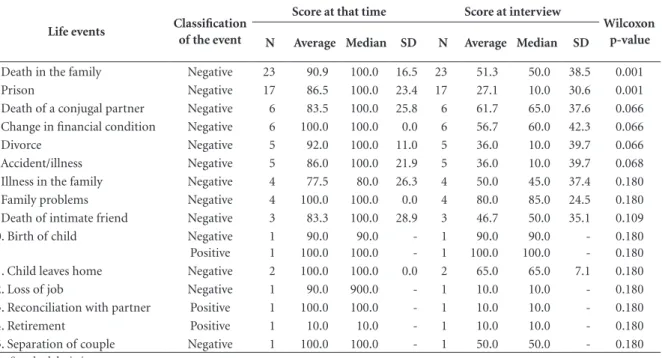
Table 3 examines the impact that the event caused on the life of the woman when it hap-pened and the possible impact that it could still exercise at the moment of the interview. The pa-tients who reported ‘death in the family’, when questioned about the burden of the event on a scale from 10 to 100, presented a median of 100.0 (SD= 16.5) and for the burden that the event could still exercise in their life at the moment of the interview, a median of 50.0 and standard de-viation of 38.5 (p = 0.001).
In relation to ‘prison’ the median of burden at the moment when the event took place in fact was 100.0 (SD= 23.4), and when questioned at the moment of the interview the median was 10.0 (SD= 30.6), showing a considerably signif-icant reduction (p = 0.001).
The event ‘death of conjugal partner’ first presented a median of 100.0 (SD = 25.8), and un-derwent a not very strong reduction to 65.0 (SD = 37.6), there being no statistical significance.
There was a significant reduction of burden in relation to the event ‘Divorce’, in that the me-dian moved from 100.0 (SD =11.0) to 10.0 (SD = 39.7), in spite of not having been significant.
The variables of the profile were associated with the number of life events, but the results were not significant, with the exception of the variable metastasis. It was observed that in the group without events, 26 women (11.0%) pre-sented metastasis, and that this percentage rose to 31.7% (total of 20 women) in the group with one event or more (p = 0.001). The time elapsed between the diagnosis and occurrence of me-tastasis in the 46 women had a median of 18.0 months (SD = 36.9).
On the basis of this result the association of possible factors of confusion for the outcome me-tastasis was calculated. Table 4 shows the associ-ation between profile variables, clinical variables and the number of life events, and the variable metastasis. The results indicate the stage factor of the disease as a possible confusion factor, but all the metastasis occurred in the advanced stage, it not being possible to use multivariate models. Through the calculation of the odds ratio it was
Figure 1. Total of events (%) experienced by women with diagnosis of breast cancer attended
at Santa Rita de Cássia Hospital – Vitória, Brazil, 2014.
0 1 2 3 4
0 10 20 30 40 50 60 70 80 90
79
14 6
0,7 0,3
Number of events
P
er
ce
ntag
aúd
e C
ole
tiv
a,
23(2):471-479,
2018
concluded that having life events after diagnosis of breast cancer increased the chance of
devel-oping metastasis by 2.59 times (1.37 – 4.91; p = 0.003).
Table 2. Time, in years, between diagnosis of breast cancer and life events, and the person to whom the event happened – Vitória, Brazil, 2014.
Life events Classification of the event
Total Time in years from diagnosis to event
To whom event happened
N % Average Median SD You Others
1. Death in the family Negative 23 7,7 4,4 4,0 3,0 23 0
2. Prison Negative 17 5,7 4,5 3,0 3,7 0 17
3. Death of a conjugal partner Negative 6 2,0 7,3 7,0 5,5 6 0
4. Change in financial condition Negative 6 2,0 1,7 1,0 1,2 6 0
5. Divorce Negative 5 1,7 1,8 1,0 1,3 5 0
6. Accident/illness Negative 5 1,7 3,8 4,0 1,9 2 3
7. Illness in the family Negative 4 1,3 8,3 8,5 3,3 4 0
8. Family problems Negative 4 1,3 3,5 3,0 3,0 4 0
9. Death of intimate friend Negative 3 1,0 3,7 5,0 2,3 3 0
10. Birth of child Negative
Positive
1 1
0,3 0,3
4,0 5,0
4,0 5,0
-0 1
1 0
11. Child leaves home Negative 2 0,7 6,0 6,0 1,4 2 0
12. Loss of job Negative 1 0,3 6,0 6,0 - 1 0
13. Reconciliation with partner Positive 1 0,3 1,0 1,0 - 1 0
14. Retirement Positive 1 0,3 2,0 2,0 - 1 0
15. Separation of couple Negative 1 0,3 4,0 4,0 - 1 0
SD = Standard deviation.
Table 3. Comparison of burden caused by life event at the moment when it happened and at moment of interview - Vitória, Brazil, 2014.
Life events Classification of the event
Score at that time Score at interview
Wilcoxon p-value N Average Median SD N Average Median SD
1. Death in the family Negative 23 90.9 100.0 16.5 23 51.3 50.0 38.5 0.001
2. Prison Negative 17 86.5 100.0 23.4 17 27.1 10.0 30.6 0.001
3. Death of a conjugal partner Negative 6 83.5 100.0 25.8 6 61.7 65.0 37.6 0.066
4. Change in financial condition Negative 6 100.0 100.0 0.0 6 56.7 60.0 42.3 0.066
5. Divorce Negative 5 92.0 100.0 11.0 5 36.0 10.0 39.7 0.066
6. Accident/illness Negative 5 86.0 100.0 21.9 5 36.0 10.0 39.7 0.068
7. Illness in the family Negative 4 77.5 80.0 26.3 4 50.0 45.0 37.4 0.180
8. Family problems Negative 4 100.0 100.0 0.0 4 80.0 85.0 24.5 0.180
9. Death of intimate friend Negative 3 83.3 100.0 28.9 3 46.7 50.0 35.1 0.109
10. Birth of child Negative
Positive 1 1
90.0 100.0
90.0 100.0
-1 1
90.0 100.0
90.0 100.0
-0.180 0.180
11. Child leaves home Negative 2 100.0 100.0 0.0 2 65.0 65.0 7.1 0.180
12. Loss of job Negative 1 90.0 900.0 - 1 10.0 10.0 - 0.180
13. Reconciliation with partner Positive 1 100.0 100.0 - 1 10.0 10.0 - 0.180
14. Retirement Positive 1 10.0 10.0 - 1 10.0 10.0 - 0.180
15. Separation of couple Negative 1 100.0 100.0 - 1 50.0 50.0 - 0.180
D
our
ad
Discussion
The results of this study point to an association between life events and metastasis. It is a complex task to establish the exact dimension to which stress, rather than some other factor or combi-nation of factors, is the element responsible for changes observed in the development of the breast cancer.
Breast cancer is the most common cancer in women. In spite of the relationship between psychological aspects and breast cancer being increasingly studied, few studies have dealt with the relationship between life events and relapse or metastasis.
Any cancer diagnosis, but especially breast cancer, is accompanied by great psychological suffering, and the majority of people believe that their psychosocial response, that is to say, the way in which they react to the diagnosis, affects their
prognosis16.
A stressful life event can affect the progno-sis of breast cancer directly through alterations
induced by stress of the immune system and neuroendocrine system, and indirectly through changes in health behavior, such as physical ac-tivity, consumption of alcohol, submission to
treatment, and facing of the illness17.
This study shows that 21% of the sample ex-perienced at least one life event after the diagno-sis of breast cancer. Further, the time elapsed be-tween the diagnosis of the cancer and the occur-rence of metastasis had a median of 18 months.
In one case control study7 with 100 women, the
median time free of illness for the women who had a relapse or metastasis was 30.5 months.
When comparing a group of American
wom-en with breast cancer, some researchers3 found an
interval free of illness significantly greater among those who did not report traumatic or stressful life events (median = 62 months), compared to those who had experienced one or more stressful or traumatic event (median = 31 months).
In the sample of 300 women, 46 of them pre-sented metastasis (15.3%). A result that was dif-ferent, but not so distant, was found in a cohort
Table 4. Association between profile variables, clinical variables and number of life events, and the variable
metastasis – Vitória, Brazil, 2014.
Metastasis
Variable Category sim não
χ2
p-value OR (CI 95%)**
% N %
Age group Up to 39 3 11% 24 89% 0.451
40 to 49 16 19% 68 81%
50 to 59 18 17% 86 83%
60 to 69 8 12% 57 88%
70 and over 1 5% 19 95%
Family income Up to 2 x min. wage* 27 14% 163 86% 0.778
3 to 4 x min. wage 14 17% 67 83%
Over 4 x min. wage 5 17% 24 83%
Years’ schooling Up to 7 years 21 14% 133 86% 0.402
8 years or more 25 17% 121 83%
Race/color White 16 15% 89 85% 0.973
Non-white 30 15% 165 85%
Marital status Single 8 15% 44 85% 0.277
Married/stable union 30 19% 132 81%
Divorced/separated 5 11% 41 89%
Widowed 3 8% 37 93%
Diagnosis stage Initial (I and II) 0 0% 140 100% 0.001
Late (III and IV) 46 29% 114 71%
Life events None 26 11% 211 89% 0.001 2.59
1 or more 20 32% 43 68% (1.37 – 4.91)
aúd
e C
ole
tiv
a,
23(2):471-479,
2018
study18 with 204 women, the objective of which
was to assess whether adverse life events would shorten the time free of illness post-surgery in patients with breast cancer: the result found was
that 23% of them presented metastasis. A cohort8
of 202 women with breast cancer accompanied for five years in London confirmed a relapse of the illness in 54 of them (26.7%).
Another study19, on a population basis, in
which 708 Australian women with breast cancer were accompanied for approximately eight years, showed that 38% of the 638 women studied had a relapse.
The association between the variable
metas-tasisand the number of life events showed that
20 of the women who presented metastasis ex-perienced one or more life events (p = 0.001). In spite of having evaluated only women who had already evolved to metastasis, a
retrospec-tive study3 with 94 women showed that 70.2% of
them reported one or more stressful or traumatic event.
A retrospective study7 with 50 cases and 50
controls, in London, when evaluating the risk of relapse of breast cancer, showed that the relative risk of relapse associated with a serious life event was 5.67 (p = 0.004). A very different result was
found in a cohort8 of five years with 202 women
with breast cancer, where those who had had one or more stressful life events in the five years after the diagnosis had a lower risk of recurrence (p
= 0.03) than those who had not. Another study6,
which aimed to assess the relationship between life events and survival of 665 women after breast cancer, showed no association.
As to the types of life event experienced by the subjects, events involving death, conjugal or family problems and events related to the illness are the most reported. The studies that deal with this theme of life events and metastasis or relapse usually discuss only the presence or absence of events, often comparing the sub-categories (se-vere events, traumatic events, life events, absence of events), which tends to make a comparison of results on this aspect of the types of event more difficult.
A retrospective study referred to above3
showed the types of events that the women with metastatic breast cancer reported: 19% reported rape, aggression or abuse in infancy; 16% sur-vived a potentially fatal accident; 4% underwent a natural catastrophe; 9% were present at a trau-matic event or a death due to the illness; 26% re-ported death of loved ones due to an accident or illness; 3% reported the death of a son; and 14%
reported an event threatening the life of one or more loved ones due to accident or illness.
Isolated occurrence of a stressful event does not cause negative effects for the individual. The result of the effects will depend on how each person reacts to or confronts a given situation. Thus, it is the way of reacting to situations that makes the difference in susceptibility to the
dis-ease20. This endorses the importance of studying
not only the life event, but also the impact caused by it.
As to the impact caused by the event at the moment of its occurrence and possible continu-ing impact at the moment of the interview, a considerable reduction was seen in a good pro-portion of the events, principally ‘death in the family’ and ‘prison’, which were significant (p = 0.001). It is inferred that the subjects, in spite of initially attributing very high scores to the event at the moment of its occurrence, were able to confront the situation experienced, thus reduc-ing the burden over time.
An illness is not only a physical fact, but a problem that relates to the person as a whole, in-cluding not only the body, but also the emotions and the mind. Emotional and mental conditions carry out a fundamental activity both in relation to susceptibility to illness, including cancer, and
in recovery from any illness21. Thus, every event
experienced by an individual leads him/her to disappointments and feelings of loss, but the way in which the person will attribute significance to a given situation will also indicate the circum-stance in which the organism will function. A simulation of the experience seems to be decisive in the emergence of illnesses and, essentially, in their progression.
We highlight that one of the principal lim-itations of this survey is its being cross-section-al, since researchers on this subject have given priority to cohort and case/control studies. Due to memory bias, the ideal situation would be a prospective cohort in which life events were ob-served over time, but this would call for time and funds. Also emphasized as a limitation is the low availability of present-day references on the sub-ject of life events, principally when associated with metastasis.
Final considerations
D
our
ad
events after diagnosis of breast cancer and the ap-pearance of metastasis.
Even though most life events cannot be sim-ply avoided in people’s daily lives, the results help to provide the scientific community with differ-ent possibilities for exploring this subject which still requires so many answers.
The results presented by this study emphasize the need for a more complex analysis, and also a qualitative approach, for better understanding of the impacts caused by life events in the growth and progression of breast cancer, and also the possible risks involved in this relationship.
Collaborations
CS Dourado worked on the design, design, anal-ysis and interpretation of the data, as well as on the writing of the article, on the critical revision and approval of the version to be published. C Brandão de Souza worked on the writing of the article, on the critical revision and approv-al of the version to be published. DS Castro and MHMB Miotto worked on the critical review and approval of the version to be published. E Zandonade worked on the analysis and interpre-tation of data and approval of the version to be published. MHC Amorim worked on designing, designing, analyzing and interpreting the data, as well as writing the article, critically reviewing and approving the version to be published.
Acknowledgments
aúd
e C
ole
tiv
a,
23(2):471-479,
2018
Referências
1. Kiecolt-Glaser JK, Glaser R. Psychoneuroimmunol-ogy and cancer: fact or fiction? Eur J Cancer 1999; 35(11):1603-1607.
2. Kiecolt-Glaser JK, Robles TF, Heffner KL, Loving TJ, Glaser R. Psycho-oncology and cancer: psychoneu-roimmunology and cancer. Ann Oncol 2002; 13(Supl. 4):165-169.
3. Palesh O, Butler LD, Koopman C, Giese-Davis J, Carl-son R, Spiegel D. Stress History and Breast Cancer Re-currence. J Psychosom Res 2007; 63(3):233-239. 4. Sephton S, Spiegel D. Circadian disruption in cancer: a
neuroendocrine-immune pathway from stress to dis-ease? Brain Behav Immun 2003; 17(5):321-328. 5. Sarkar DK, Murugan S, Zhang C, Boyadjieva N.
Reg-ulation of cancer progression by β-endorphin neuron.
Cancer Res 2012; 72(4):836-840.
6. Maunsell E, Brisson J, Mondor M, Verreault R, De-schcnes L. Stressful Life Events and Survival After Breast Cancer. Psychosom Med 2001; 63(2):306-315. 7. Ramirez AJ, Craig TKJ, Watson JP, Fentiman IS, North
WRS, Rubens RD. Stress and relapse of breast câncer.
BMJ 1989; 298(6669):291-293.
8. Graham J, Ramirez A, Love S, Richards M, Burgess C. Stressful life experiences and risk of relapse of breast cancer: observational cohort study. BMJ. 2002; 324(7351):1-4.
9. Andersen BL, Kiecolt-Glaser JK, Glaser R. A biobehav-ioral model of cancer stress and disease course. Am Psy-chol 1994; 49(5):389-404.
10. Fawzy FI, Kemeny ME, Fawzy NW, Elashoff R, Mor-ton D, Cousins N, Fahey JL. A structured psychiatric intervention for cancer patients. II. Changes over time in immunological measures. Arch Gen Psychiatry 1990; 47(8):729-735.
11. McEwen BS. Allostasis and Allostatic Load: Implica-tions for Neuropsychopharmacology. Neuropsycho-pharmacology 2000; 22(2):108-124.
12. McEwen BS. Protective and damaging effects of stress mediators: central role of the brain. Dialogues Clin Neurosci 2006; 8(4):367-381.
13. Nielsen NR, Zhang ZF, Kristensen TS, Netterstrom B, Schnohr P, Gronbaek M. Self reported stress and risk of breast cancer: prospective cohort study. BMJ 2005; 331(7516):1-5.
14. Holmes TH, Rahe RH. The Social Readjustment Rating Scale. J psychosom Res 1967; 11(2):213-218.
15. Vasconcellos EG, Coelho MABC, Behlau M. Da Rela-ção entre Stress e Distúrbio da Voz. In: Marchezan IQ, Zorzi JL, Dias Gomes IC, organizadores. Tópicos em Fo-noaudiologia. São Paulo: Lovise; 1996. v. III, p. 361-388. 16. Stewart DE, Cheung AM, Duff S, Wong F, McQuestion
M, Cheng T, Purdy L, Bunston T. Attributions of cause and recurrence in long-term breast cancer survivors.
Psychooncology 2000; 10(2):179-183.
17. Olsen MH, Bidstrup PE, Frederiksen K, Rod NH, Grøn-baek M, Dalton SO, Johansen C. Loss of partner and breast cancer prognosis - a population-based study, Denmark, 1994–2010. Br J Cancer 2012; 106(9):1560-1563.
18. Barraclough J, Pinder P, Cruddas M, Osmond C, Tay-lor I, Perry M. Life events and breast cancer prognosis.
BMJ 1992; 304(6834):1078-1081.
19. Phillips KA, Osborne RH, Giles GG, Dite GS, Apicel-la C, Hopper JL, Milne RL. Psychosocial Factors and Survival of Young Women With Breast Cancer: A Pop-ulation-Based Prospective Cohort Study. J Clin Oncol
2008; 26(28):4666-4671.
20. Farago PM, Ferreira DB, Reis RPJP, Gomes IP, Reis PED. Minha vida antes do câncer de mama: relatos de estresse emocional. Rev enferm UFPE 2010; 4(3):1432-1440.
21. Simonton OC, Matthews-Simonton S, Creighton JL.
Com a Vida de Novo: Uma abordagem de Auto-Ajuda para pacientes com câncer. 9ª ed. São Paulo: Summus; 1987.
Article submitted 27/07/2015 Approved 13/01/2016
Final version submitted 15/01/2016
This is an Open Access article distributed under the terms of the Creative Commons Attribution License
BY