Incidence of dementia and association
with APOE genotype in older Cubans
Juan J. Llibre Rodríguez1, Adolfo Valhuerdi Cepero2, Isis Y. Sanchez Gil1,
Ana M. López Medina1, Juan C. Llibre-Guerra3, Jorge J. Llibre-Guerra3,
Beatriz Marcheco Teruel4, Cleusa P. Ferri5, Martin Prince6
ABSTRACT. Objective: In an admixed population of older Cubans, the incidence and association of APOE and socio demographic risk factors with dementia incidence was estimated. Methods: A single-phase survey (baseline) of all over 65-year-olds residing in seven catchment areas in Cuba (n=2944) was conducted between 2003 and 2007. Dementia diagnosis was established according to DSM-IV and 10/66 criteria. APOE genotype was determined in 2520 participants. An incidence wave was conducted 4.5 years after cohort inception in order to estimate incidence and associations with sociodemographic risk factors of the APOE ε4 genotype. Results: The incidence rate of DSM IV dementia was 9.0 per 1000 person-years (95% CI 7.2-11.3) and of 10/66 dementia was 20.5 per 1000 person-years (95% CI, 17.6-23.5). Older age, a family history of dementia and APOE ε4 genotype were independent risk factors for incident 10/66 dementia. APOE genotype was associated cross-sectionally with dementia prevalence, but the effect on the incidence of dementia was attenuated, and only apparent among those in the youngest age group. Conclusion: The incidence of dementia in the older Cuban population is relatively high and similar to levels reported in Europe and North-America. The study showed that the relationship between APOE ε4 and incident dementia is stronger in the younger-old than the older-old and that this change must be taken into account in models of dementia.
Key words: dementia, epidemiological studies, incidence study, risk factors, ApoE, Latin America.
INCIDÊNCIA DE DEMÊNCIA E ASSOCIAÇÃO COM O GENÓTIPO APOE EM IDOSOS CUBANOS
RESUMO. Objetivo: Em uma população miscigenada de cubanos idosos, estimamos a incidência de demência e a associação entre o genótipo da APOE e os fatores de risco sociodemográficos na incidência de demência. Métodos: Realizamos uma pesquisa de uma fase (linha de base) de todos os idosos com mais de 65 anos residentes em sete áreas de Cuba (n=2944), de 2003 a 2007. O diagnóstico de demência foi estabelecido de acordo com os critérios do DSM-IV e do 10/66. O genótipo APOE foi determinado em 2520 participantes. Avaliação da incidência foi conduzida 4,5 anos após a linha de base, a fim de estimar a incidência e associações com fatores de risco sociodemográficos e o genótipo APOE ε4. Resultados: A taxa de incidência de demência foi de 9,0 por 1000 pessoas-ano (IC 95% 7,2-11,3) de acordo com o DSM-IV e de 20,5 por 1000 pessoas-ano (IC 95%, 17,6-23,5) de acordo com o 10/66. Idade avançada, história familiar de demência e genótipo APOE ε4 foram fatores de risco independentes para a incidência de demência de acordo com os critérios do 10/66. O genótipo APOE foi associado com a prevalência de demência em estudo transversal, mas o efeito sobre a incidência de demência foi atenuado, e apenas aparente entre aqueles na faixa etária mais jovem. Conclusão: A incidência de demência na população cubana mais velha é relativamente alta, semelhante às relatadas na Europa e América do Norte. O estudo mostra que a relação entre APOE ε4 incidente e demência é mais forte entre os idosos mais jovens e que esta alteração deve de ser considerada em modelos de demência.
Palavras-chave: demência, estudos epidemiológicos, estudo de incidência, fatores de risco, genótipo apolipoproteína E, APOE, América Latina.
INTRODUCTION
B
y 2020, the Americas will have a popula-tion of 200 million older adults, with overhalf living in Latin American and the Carib-bean. Population ageing is the major driver of the growing epidemic of chronic
non-com-¹Medical University of Havana, Cuba; ²Medical University of Matanzas, Cuba; ³Institute of Neurology Havana, Cuba; 4National Centre for Medical Genetics, Havana,
Cuba; 5Universidade Federal de São Paulo – Department of Psychobiology, São Paulo, Brazil; 6Centre for Global Mental Health, Health Service and Population
Research Department, Institute of Psychiatry, King’s College London, UK.
Juan J. Llibre Rodríguez. Head of Alzheimer`s Research Group Medical University of Havana – Ave 68 y 29, Playa Apartado 6648 Habana 6 CP 10600 – Cuba. E-mail: [email protected]
Disclosure: The authors report no conflicts of interest.
Received September 10, 2014. Accepted in final form November 19, 2014.
municable diseases, concentrated in low- and middle-income countries (LMIC).1,2
Studies on the incidence of dementia are much less common than prevalence studies partially because of the considerable resources and time required for the for-mer. Only a few incidence studies have been conducted in LMIC, which, generally, report lower incidence rates compared to high-income countries (HIC).3-5
he ε4 allele of the apolipoprotein-E gene has been the most consistently replicated genetic risk factor for dementia.6,7 In late onset sporadic as well as familial
cas-es, which account for at least 95% of all cascas-es, the apoli-poprotein E (APOE) gene on chromosome 19 has been identiied as a major risk factor.7 Most of the evidence
suggests that this association is less consistent for in-dividuals >80 years of age, may be stronger in women than in men, and also difers between ethnic groups.4,8
So far, however, African-Americans, other populations of west African ancestry, and Hispanics have shown relatively weak and inconsistent associations with AD, despite those with African ancestry tending to have a higher prevalence of the risk-conferring APOE ε4 allele.7,8
Cuba is a middle-income country with a highly ad-mixed and rapidly ageing population of 11.3 million. By the year 2020 Cuba will be the country in Latin America with the highest proportion of older adults (25% aged 60 years and over).9
he main aims of this study were to describe demen-tia incidence and the association between APOE ε4 car-riers and sociodemographic risk factors with dementia incidence among older Cubans.
METHODS
Study design. he Cuban site of the 10/66 study involved a cohort of adults aged ≥65 years in selected areas of the provinces of La Habana and Matanzas. he 10/66 pro-tocol has been published elsewhere.10,11
A cross-sectional study has also been published.12
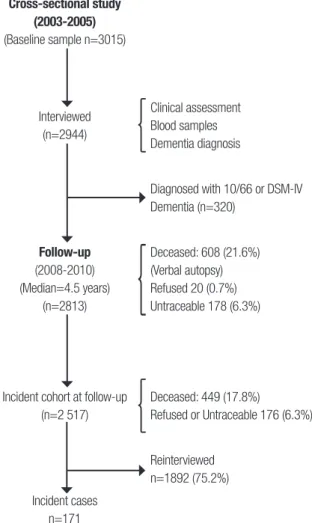
Briely, a single-phase survey (baseline) screening all over 65-year-olds residing in seven catchment areas in Cuba (n=2944) between 2003 and 2007 was performed. A total of 320 cases of dementia were diagnosed, rep-resenting a dementia prevalence of 6.4% according to the DSM-IV criteria and 10.8% according to the 10/66 criteria.
he incidence phase was conducted from 2008 to 2010 with a median follow up of 4.5 years after the baseline interviews. Of the 2,944 baseline sample par-ticipants, 131 from one polyclinic were not followed up because of logistic diiculties; therefore only 2,813 were
eligible for the incidence phase. Of these, 2007 (71.3 %) were successfully re-interviewed. Over the period, there were 608 (20.6%) deaths and 198 (6.7%) subjects were lost to follow-up. he cohort for the analyses of demen-tia incidence was deined as all those who were free of dementia (either DSM-IV or 10/66 dementia) at base-line (n=2517) (see Figure 1).
he 10/66 protocol was applied;10 it included a
struc-tured participant interview covering sociodemographic characteristics, health status, behavioral and other risk factors; a physical and neurologic exam; and interview of a reliable informant. Interviews and instrument ap-plication were carried out by trained medical specialists at participants’ homes, in sessions lasting 2-3 hours on average, which included interviewing of participants, physical examination and phlebotomy, plus an infor-mant interview. Data were collected directly onto laptop computers using computerized Spanish questionnaires driven by Epidata software, including conditional skips and interactive checking.
For the purposes of this study, the following vari-ables were considered:
Outcome - The diagnosis of dementia
Dementia was diagnosed according to the 10/66 criteria and diagnostic algorithm, validated in 26 culturally het-erogeneous countries, including Cuba.11,13 and according
to DSM-IV criteria.14
Main exposures
• Sociodemographic characteristics: age, sex, marital status, education, number of assets in the house-hold, food insecurity were collected with a stan-dardised questionnaire.
• Behavioral risk factors: Smoking status included smoker, ex-smoker and non-smoker. as well as life-time smoking. Alcohol use questions covered maxi-mum number of units per week before and after the age of 65 years. he threshold for hazardous drink-ing was set at 14 units per week for women and 21 units for men.
• Health status.
• Diabetes mellitus diagnosis was reached in two ways: self-report that diabetes had been diagnosed by a physician, and / or fasting blood glucose ≥7mmol / L, conirmed on two diferent days.15
Com-mittee on Prevention, Detection, Evaluation and Treatment of High Blood Pressure.16
• Stroke: self-report that stroke had been diagnosed by a physician.
Laboratory exams Blood samples from 2520 partici-pants were tested for hemoglobin, haematocrit, mean cell hemoglobin, fasting blood glucose, lipid proile, vita-min B12, folic acid and thyroid hormones at the Nation-al Center of MedicNation-al Genetics in Havana. In addition, cell DNA was extracted and ApoE4 genotype determined by PCR, following the standard protocol for determination of the apolipoprotein E genotype and identiication of the three alleles APOE ε2, APOE ε3 and APOE ε4.17
he same protocols for interviews and assessments were employed in both the longitudinal phase of the study and at baseline. Quality control procedures in-cluded repetition of 5% of interviews by a specialist from the research team.
Ethics. Informed written consent was obtained from par-ticipants or, if necessary, their caregivers. All data were
kept conidential. he study protocol was approved by the Research Ethics Committee of the Medical Univer-sity of Havana.
Analysis. Person-years at risk for the onset of the relevant dementia outcome (DSM-IV dementia or 10/66 demen-tia) were calculated as the interval between baseline and follow-up assessment, or the mid-point of this interval for those that were found to have developed dementia. Age-speciic incidence (with Poisson standard errors and 95% conidence intervals) was estimated using the Open Epi online calculator http://www.sph.emory. edu/~cdckms/exact-rate.html) by sex and age in 5-year bands by dividing the number of cases by the number of person-years contributed in each age band. he strength of the association of age, sex, educational level, fam-ily history of dementia and APOE genotype (presence vs absence of an APOE ε4allele) with the prevalence of dementia was examined using Poisson regression. he incidence of dementia was determined using Cox regression models (generating hazard ratios, approxi-mating to incidence rate ratios) in the dementia-free at risk cohort, censoring those who had died at baseline and employing Stata’s stcrreg command to implement a competing-risks regression based on Fine and Gray’s proportional subhazards model.
Given that lipid levels and other cardiovascular risk factors were determined during the cross-sectional study in late-life and close to the clinical onset of de-mentia and that temporality cannot be established, the analysis included only those exposures of possible ae-tiologic signiicance. All models were controlled for the efects of age, gender and education.
RESULTS
General characteristics of the sample. Sociodemographic characteristics are summarized in Table 1. Mean age at baseline was 75.1 (SD 7.0) years; 25.4% of the sample was aged 80 years or older, 64.9% were female and 8.9% were living alone. Levels of education were relatively high, with only 2.5% illiteracy and 16.9% having at-tained tertiary education. here was a high prevalence of cardiovascular risk factors and of chronic non-com-municable disease; more than 40% of participants were current smokers, 73.9% of participants had been told that they were hypertensive, 18.5% had received a diag-nosis of diabetes, and 7.8% reported a stroke diagnosed by a clinician.
here were no substantial diferences in the charac-teristics of those interviewed at baseline and the subset successfully followed-up. However, there were
statisti-Cross-sectional study (2003-2005)
(Baseline sample n=3015)
Interviewed (n=2944)
Clinical assessment Blood samples Dementia diagnosis
Diagnosed with 10/66 or DSM-IV Dementia (n=320)
Follow-up
(2008-2010) (Median=4.5 years)
(n=2813)
Deceased: 608 (21.6%) (Verbal autopsy) Refused 20 (0.7%) Untraceable 178 (6.3%)
Incident cohort at follow-up (n=2 517)
Deceased: 449 (17.8%)
Refused or Untraceable 176 (6.3%)
Reinterviewed n=1892 (75.2%)
Incident cases n=171
Table 1. Baseline characteristics of sample stratified by follow-up status.
Baseline sample (n=2944)
Incidence phase Re-interviewed
(n=2007)
Died (n=608)
Lost to
follow-up (n=198) p Value
Female (MV=0) 1904 (64.9%) 1332 (66.4) 365 (60.0) 139 (70.2) P=0.005
Age (MV=7) 65-69 760 (25.8%) 607 (30.3) 59 (9.7%) 49 (24.7) P<0.0001
70-74 789 (26.8%) 578 (28.9) 114 (18.8) 55 (27.8)
75-79 639 (21.7%) 435 (21.7) 137 (22.6) 46 (23.2)
80+ 749 (25.4%) 381 (19.0) 297 (48.9) 48 (24.2)
Lives alone (MV=8) 261 (8.9%) 174 (8.7) 53 (8.7) 23 (11.6) P=0.597
Marital status (MV=8) Married 1271 (43.3%) 903 (45.1) 216 (35.8) 80 (40.4)
Widowed 928 (31.6%) 586 (29.3) 239 (39.6) 71 (35.9)
Separated/ Divorced 462 (15.7%) 334 (16.7) 78 (12.9) 36 (18.2)
Never married 275 (9.4%) 180 (9.0) 71 (11.7) 11 (5.6)
Education (MV=8) None 75 (2.5%) 42 (2.1) 26 (4.3) 5 (2.5)
Minimal 655 (22.2%) 422 (21.1) 166 (27.5) 31 (15.7)
Completed primary 979 (33.3%) 651 (32.5) 222 (36.8) 64 (32.3)
Completed secondary 728 (24.4%) 540 (27.0) 109 (18.1) 56 (28.30
Tertiary 499 (16.9%) 348 (17.4) 81 (13.4) 42 (21.2)
Socioeconomic indicators
Number of Assets (MV=8) 0-3 78 (2.6) 47 (2.4) 20 (3.3) 10 (5.1) P=0.730
4-5 951 (32.6) 630 (31.5) 232 (38.20 45 (22.7)
6+ 1891 (64.8) 1323 (66.2) 355 (58.5) 143 (72.2)
Food insecurity (MV=8) 140 (4.8%) 90 (4.5) 39 (6.5) 8 (4.0) P=0.084
Life style
Current smoker (MV=9) 563 (42.5%) 369 (40.8) 136 (47.4) 37 (45.7) P=0.218
Hazardous drinker (MV=17) 105 (3.6%) 66 (3.3) 31 (5.1) 6 (3.0) P=0.484
CV diseases and risk factors
Hypertension (MV=4) 2 944 (73.9%) 1488 (74.3) 448 (73.7) 154 (77.8) P= 0.661
Stroke (MV=6) 230 (7.8%) 113 (5.6) 88 (14.6) 15 (7.6) P=0.751
Diabetes (MV=16) 543 (18.5%) 354 (17.7) 129 (21.5) 36 (18.2) P=0.586
MV: missing values
cally signiicant diferences in gender, age and education between those successfully interviewed at follow up, those who died and those who were untraceable. hose who died were older, more likely to be women and have lower education (Table 1).
The incidence of dementia. In total, 2,517 out of the 2,813 participants interviewed at baseline and included in the follow-up phase were free of dementia and hence eli-gible for inclusion in the ‘at risk’ cohort at baseline. Of this cohort, 1892 (75.2%) were successfully traced and re-interviewed at follow-up. hese participants contrib-uted 8,679 person years of follow-up, with an average follow-up period of 4.5 years. Mean age at follow-up
was 78.1 years, two-thirds were female and educational levels were relatively high, but 7.7% of participants re-ported illiteracy.
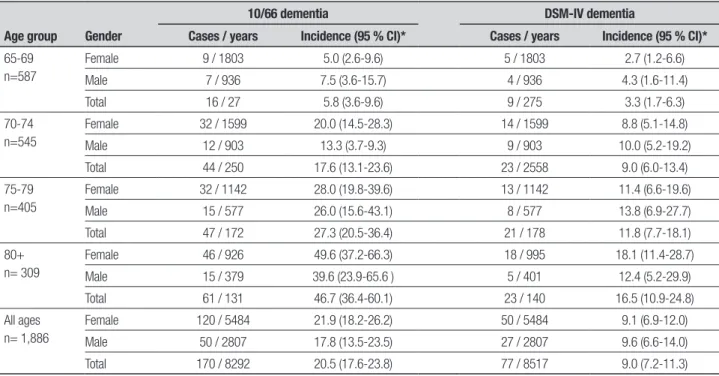
Table 2. Annual incidence rates (per 1000 person-years) for DSM-IV and 10/66 dementia criteria by sex and age.
Age group Gender
10/66 dementia DSM-IV dementia
Cases / years Incidence (95 % CI)* Cases / years Incidence (95 % CI)*
65-69 n=587
Female 9 / 1803 5.0 (2.6-9.6) 5 / 1803 2.7 (1.2-6.6)
Male 7 / 936 7.5 (3.6-15.7) 4 / 936 4.3 (1.6-11.4)
Total 16 / 27 5.8 (3.6-9.6) 9 / 275 3.3 (1.7-6.3)
70-74 n=545
Female 32 / 1599 20.0 (14.5-28.3) 14 / 1599 8.8 (5.1-14.8)
Male 12 / 903 13.3 (3.7-9.3) 9 / 903 10.0 (5.2-19.2)
Total 44 / 250 17.6 (13.1-23.6) 23 / 2558 9.0 (6.0-13.4)
75-79 n=405
Female 32 / 1142 28.0 (19.8-39.6) 13 / 1142 11.4 (6.6-19.6)
Male 15 / 577 26.0 (15.6-43.1) 8 / 577 13.8 (6.9-27.7)
Total 47 / 172 27.3 (20.5-36.4) 21 / 178 11.8 (7.7-18.1)
80+ n= 309
Female 46 / 926 49.6 (37.2-66.3) 18 / 995 18.1 (11.4-28.7)
Male 15 / 379 39.6 (23.9-65.6 ) 5 / 401 12.4 (5.2-29.9)
Total 61 / 131 46.7 (36.4-60.1) 23 / 140 16.5 (10.9-24.8)
All ages n= 1,886
Female 120 / 5484 21.9 (18.2-26.2) 50 / 5484 9.1 (6.9-12.0)
Male 50 / 2807 17.8 (13.5-23.5) 27 / 2807 9.6 (6.6-14.0)
Total 170 / 8292 20.5 (17.6-23.8) 77 / 8517 9.0 (7.2-11.3)
Table 3. Prevalence ratio, Hazard ratio and SubHazard Ratio (competing risk) with 95% confidence intervals for associations between 10/66 dementia and sociodemographic, familial and genetic risk factors, adjusted for age, sex and education.
Exposures
Prevalence Ratio (95% CI) (n=2910)
Hazard Ratio (95% CI) (n= 1852)
Competing risk - SHR (95% CI) (n=2302)
Age (per 5-year band) 1.99 (1.76-2.26)
MV=15
1.80 (1.56-2.09) MV=9
1.56 (1.35-1.79) MV=11
Sex (Male vs. Female) 0.89 (0.72-1.12)
MV=15
0.88 (0.62-1.24) MV=9
0.78 (0.55-1.09) MV=11
Education (per level) 0.80 (0.72-0.89)
MV=15
0.93 (0.81-1.08) MV=9
0.95 (0.83-1.09) MV=11
Family history of dementia 1.61 (1.28-2.04) MV=18
1.45 (1.00-2.11) MV=10
1.49 (1.04-2.14) MV=14 APOE genotype (any APOE ε4 allele vs. none) 2.53 (2.02-3.17)
MV=423
1.48 (1.00-2.24) MV=236
1.57 (1.05-2.37) MV=308
slightly lower in women (9.1, 95 % CI 6.9-12.0) than in men (9.6, 95 % CI 6.6-14.0). Incidence of both dementia outcomes increased exponentially with increasing age (Table 2).
Table 3gives the prevalence ratio (PR), hazard ratio (HR) and competing risk (SHR) estimates for sociode-mographic factors (age, sex and education), familial and genetic factors (family history of dementia and APOE genotype). All analyses were controlled for age, sex, and education.
here was a signiicant association of increasing age (PR=1.99; 95% CI 1.76-2.26), family history of demen-tia (PR=1.61; 95% CI 1.28-2.04) and APOE ε4 genotype
(PR 2.53; 95% CI, 2.02-3.17), with an increased preva-lence of 10/66 dementia. Education level (PR 0.80; 95% CI 0.72-0.89) was inversely associated. Patterns of as-sociation with incident 10/66 dementia were somewhat diferent. he efect of increasing age seemed attenu-ated, particularly when the competing risk of death was accounted for in the analysis. he efect of one or two APOE ε4 alleles was also attenuated, and only statisti-cally signiicant when the competing risk of dementia-free death was accounted for (SHR 1.57, 95% CI 1.05-2.37). Also, the inverse association with education was not apparent with respect to incident 10/66 dementia.
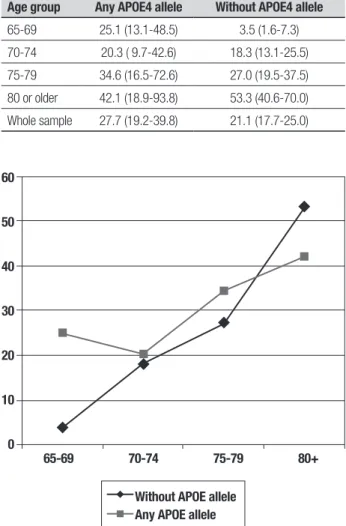
de-mentia according to age group and APOE status. In-cidence increases sharply with age for those with no APOE ε4 allele, but much less steeply for those with one or two APOE ε4 alleles. he efect of APOE genotype on dementia incidence appeared to be principally conined to the youngest age group. For participants aged 65-69 years with one or two APOE ε4 alleles, incidence rates for dementia were seven times higher than for partici-pants without APOE alleles. Among those aged 80 years and over, dementia incidence was actually lower among APOE ε4 carriers than among non-carriers. he pattern is illustrated graphically in Figure 2.
he interaction of age with APOE genotype in the as-sociation with incident 10/66 dementia was conirmed in a model testing for the main efect of APOE genotype (any ε4 allele vs none), the main efect of age (linear efect per ive year increment), and the interaction be-tween the two, again controlling for sex and educational level. he interaction term was statistically signiicant (SHR 0.71, 95% CI 0.53-0.96), indicating a substantial progressive reduction in the efect of APOE ε4 with in-creasing age, from that estimated for the baseline age group (SHR 3.99, 95% CI 1.71-9.31). Likewise, the esti-mated efect of age for those lacking an APOE ε4 allele (SHR 1.47, 95% CI 1.31-1.64) was reduced in the pres-ence of an ε4 allele to a SHR of 1.04.
he clear implication of this pattern of incidence with age, is that the age of onset of incident dementia cases is younger among those with one or more APOE ε4 alleles, compared with those lacking an ε4 allele.
DISCUSSION
his study corroborates that dementia is an important growing health problem for Cuba. he major strength of our study is the standardised design and assessment procedures, in a large representative catchment area sample, with a high response rate: 97.6 % in the cross sectional study and 75.8% in the incidence phase.
he diagnosis of dementia was reached according to a protocol developed by the 10/66 group using a com-puterized algorithm. In a recent publication18 we have
shown that 10/66 dementia corresponded more closely to Cuban clinical dementia diagnoses than did the more restrictive DSM-IV criterion.
he age-speciic incidence of 10/66 dementia in Cuba was consistently higher than that of DSM-IV de-mentia. In a previous study, we have noted that DSM-IV dementia criterion underestimates the true prevalence of dementia in developing countries due to diiculties deining and ascertaining decline in intellectual func-tion and occupafunc-tional impairment.12
Table 4. Incidence rates of dementia (per 1,000 person-years) by age group and APOE status.
Age group
Dementia Incidence rates (95%CI) Any APOE4 allele Without APOE4 allele
65-69 25.1 (13.1-48.5) 3.5 (1.6-7.3)
70-74 20.3 ( 9.7-42.6) 18.3 (13.1-25.5)
75-79 34.6 (16.5-72.6) 27.0 (19.5-37.5)
80 or older 42.1 (18.9-93.8) 53.3 (40.6-70.0)
Whole sample 27.7 (19.2-39.8) 21.1 (17.7-25.0)
Few incidence studies have been conducted in low- and middle-income countries, and the current study is one of the largest conducted to date in a low- or mid-dle-income country; in Ballabgarh, India, nine incident cases were identiied with 1,160 person-years of follow-up;19 in Catanduva, Brazil, 50 incident cases were
detect-ed with 3,623 person-years of follow-up.3 Other studies
were performed in Ibadan, Nigeria (2,459 at risk and 70 incident cases)4 and Beijing, China (825 at risk and
13 incident cases),5 although person-years of follow-up
were not clearly speciied.
he crude annual incidence rate for 10/66 dementia detected in the present study was very similar to that found in the Canadian Health and Aging Study (20), and slightly higher than that reported in the MRC Cog-nitive Function and Ageing Study (MRC CFAS) in Eng-land.21 Nevertheless, according to DSM-IV criteria our
60 50 40 30 20 10 0
65-69 70-74 75-79 80+ Without APOE allele
Any APOE allele
estimates were 9.0 / 1000 person-years, roughly half the rates observed in the Canadian and English studies, both of which used DSM-IV criteria. However, to esti-mate the incidence of DSM-IV dementia, we excluded all subjects with ‘any dementia’, i.e. either DSM-IV or 10/66 dementia, from the baseline ‘at risk’ cohort. his decision is justiiable on the grounds that there is con-siderable accumulated evidence supporting the validity of the 10/66 dementia diagnostic criterion.15 However,
for the purposes of comparison with other studies, it might be appropriate to consider meeting criteria for 10/66 dementia, but not for DSM-IV dementia, as still ‘at risk’ for the latter outcome. In the Cuban sample, the annual incidence rate for DSM-IV dementia among those in this group was 154.6 per 1000 person-years (95% CI 103.9-221.8). After including this group in the ‘at risk’ cohort, the overall incidence rate for DSM-IV dementia increased from 9.0 to 12.0 per 1000 person-years (95% CI, 9.8-14.4)
We found a strong association between APOE geno-type and the prevalence of both 10/66 and DSM-IV de-mentia, with efect sizes very similar to those reported in other settings.22-25
However, the association between APOE genotype and incident dementia was, in comparison, greatly at-tenuated. he reason for this much reduced strength of association with incident as opposed to prevalent de-mentia is not immediately clear, and may be complex. One possible explanation, that APOE ε4 prolongs sur-vival with dementia rather than increasing its incidence, seems unlikely given the weak efect of APOE genotype on overall survival, and the absence of an interaction be-tween dementia status and APOE genotype as risk fac-tors for mortality. A likelier explanation is suggested by the strong interaction observed between age and APOE genotype in risk for onset of 10/66 dementia, where the increased risk conferred by the APOE ε4 allele ap-peared to be conined to individuals in the younger-old age groups . Further analysis revealed a very strong efect of APOE genotype on age of onset, with APOE
ε4 allele carriers having a mean age of onset 4.6 years earlier than those lacking an APOE ε4 allele but who went on to develop dementia. Both the concentration of risk among the younger-old, and the younger age of onset among APOE ε4 carriers were noted 15 years ago in clinical samples by members of the NIMH genetics initiative.26 A similar phenomenon was illustrated in
the US Cache County study, where APOE genotype was found to inluence age of onset, but not lifetime (up to 100 years) cumulative risk of dementia, which proved similar (72%) for those with and without APOE ε4 al-leles.27 It may be the case that our prevalence study had
already captured much of the (earlier) cumulative inci-dence in those who had elevated risk for early inciinci-dence by carrying one or more APOE ε4 allele. Set against this, while there have been very few previous popula-tion-based studies of the efect of APOE genotype on the incidence of dementia, indings from the UK MRC-CFAS study do indicate a robust and sizeable increased relative risk.28
In conclusion, the incidence of dementia in the older Cu-ban population is relatively high and similar to incidenc-es reported in Europe and North-America. Older age, a family history of dementia and APOE ε4 genotype were independent risk factors for incident 10/66 dementia. he study showed that the relationship between APOE ε4 and incident dementia is stronger in the younger-old than the older-old and that this change must be taken into account in models of dementia .
Acknowledgments. his study is part of the 10/66 Demen-tia Research Group population-based research program in Cuba, a collaborative agreement between the London Institute of Psychiatry and the Medical University of Havana, sponsored by the Wellcome Trust Foundation (GR066133 and GR08002) and the Cuban Ministry of Public Health. We thank all the researchers who took part in this population-based study.
REFERENCES
1. Informe ADI / Bupa. La demencia en América: El coste y la prevalencia del Alzheimer y otros tipos de demencia. http://www.alz.co.uk/sites/de-fault/files/pdfs/dementia-in-the-americas-SPANISH.pdf, octubre 2013. 2. Fuster VJ. MDGs: chronic diseases are not on the agenda. Lancet
2005;366:1512-1514.
3. Nitrini R, Caramelli P, Herrera E, et al. Incidence of Dementia in a Community-Dwelling Brazilian Population. Alzheimer Dis Assoc Disord 2004;18:241-246.
4. Hendrie HC, Hall KS, Hui S, et al. Apolipoprotein E genotypes and A.D in a community study of elderly africans americans. Ann Neurol 1995; 37:118-120.
5. Li G, Shen YC, Chen CH, Zhau YW, Li SR, Lu M. A three year follow-up study of age-related dementia in an urban area of Beijing. Acta Psychi-atr Scand 1991;83:99-104.
6. Saunders AM, Strittmatter WJ, Schmechel D, et al. Association of apolipoprotein E allele epsilon 4 with late-onset familial and sporadic Alzheimer’s disease. Neurology 1993;43:1467-1472.
7. Kalaria R, Maestre G, Arizaga R, et al. Alzheimer’s disease and vascular dementia in developing countries: prevalence, management, and risk factors. Lancet Neurol 2008;7:812-826.
preva-lence in an admixed Cuban sample; a cross-sectional population survey and nested case-control study. BMC Med Genet 2011;12:43. 9. Ministerio de Salud Pública. Anuario Estadístico 2013. La Habana:
Cuba; 2013. [Accessed on Marzo 25, 2014]. Available from: http:// www.sld.cu/servicios/estadisticas/
10. Prince M, Ferri CP, Acosta D, et al. The protocols for the 10/66 Demen-tia Research Group population-based research programme. BMC Pub Health 2007;7:165-169.
11. Llibre J, Ferri C, Acosta D, et al. Prevalence of dementia in Latin Ameri-ca, India, and China: a population-based cross-sectional survey. Lancet 2008;372:464-474.
12. Llibre Rodríguez JJ, Valhuerdi A, Sanchez II, et al. The prevalence corre-lates and impact of dementia in Cuba. A 10/66 Group population-based survey. Neuroepidemiology. 2008;31:243-251.
13. Prince M, Acosta D, Chiu H, Scazufca M, Varghese M. Dementia diag-nosis in developing countries: a cross-cultural validation study. Lancet 2003;361:909-917.
14. American Psychiatric Association: Diagnostic and Statistical Manual of Mental Disorders, Ed 4. Washington DC: AMA; 1994.
15. American Diabetes Association. Standards of medical care in diabe-tes---2010. Diabetes Care. 2010;33 Suppl 1:S11- 61
16. Chobanian AV, Bakris GL, Black HR, et al. The seventh report of the Joint National Committee on Prevention, Detection, Evaluation, and Treatment of High Blood Pressure: the JNC 7 report. JAMA 2003;289: 2560-2572. 17. Wenham PR, Price WH, Blandell G. Apolipoprotein E genotyping by
one-stage PCR. Lancet 1991;337:1158-1159.
18. Prince M, Llibre J, Noriega L, et al. The 10/66 Dementia Research Group’s fully operationalised DSM IV dementia computerized diagnostic algorithm, compared with the 10/66 dementia algorithm and a clinician diagnosis: a population validation study. BMC Pub Health. 2008;8:219. 19. Chandra V, Pandav R, Dodge HH, et al. Incidence of Alzheimer’s
dis-ease in a rural community in India: the Indo-US study. Neurology 2001; 57:985-989.
20. The Canadian Study of Health and Aging Working Group. The incidence of dementia in Canada. Neurology 2000;55:66-73.
21. Yip AG, Brayne C, Matthews FE. Risk factors for incident dementia in England and Wales: The Medical Research Council Cognitive Function and Ageing Study. A population-based nested case-control study. Age Ageing 2006;35:154-160.
22. Farrer LA, Cupples LA, Haines JL, et al. Effects of age, sex, and ethnici-ty on the association between apolipoprotein E genoethnici-type and Alzheimer disease. A meta-analysis. APOE and Alzheimer Disease Meta Analysis Consortium. JAMA 1997;278:1349-1356.
23. Bertram L, McQueen MB, Mullin K, Blacker D, Tanzi RE. Systematic meta-analyses of Alzheimer disease genetic association studies: the Alz Gene database. Nat Genet 2007;39:17-23.
24. Molero A, Pino-Ramo G, Maestre G. Modulation by age and gender of risk for Alzheimer’s disease and vascular dementia associated with the apolipoprotein E-4 allele in Latin Americans: findings from the Mara-caibo Aging Study. Neurosci Lett 2001;307:5-8.
25. Sevush S, Peruyera G, Crawford F, Mullan M. Apolipoprotein-E epsilon 4 allele frequency and conferred risk for Cuban Americans with Alzheim-er’s disease. Am J Geriatr Psychiatry 2000;8:254-256.
26. Blacker D, Haines JL, Rodes L, et al. ApoE-4 and age at onset of Alzheim-er’s disease: the NIMH genetics initiative. Neurology 1997;48:139-147. 27. Khachaturian AS, Corcoran CD, Mayer LS, Zandi PP, Breitner JC;
Cache County Study Investigators. Apolipoprotein E epsilon4 count af-fects age at onset of Alzheimer disease, but not lifetime susceptibility: The Cache County Study. Arch Gen Psychiatry 2004;61:518-524. 28. Yip AG, Brayne C, Easton D, Rubinsztein DC. Apolipoprotein E4 is only