Reduction of venous pressure during the resection
of liver metastases compromises enteric blood flow:
IGFBP-1 as a novel biomarker of intestinal barrier injury
Hermes Vieira Barbeiro,IMarcel Autran Ce´sar Machado,IIHeraldo Possolo de Souza,I Fabiano Pinheiro da Silva,IMarcel Cerqueira Ce´sar MachadoI,II,*
IDepartamento de Emergencias Clinicas, Faculdade de Medicina FMUSP, Universidade de Sao Paulo, Sao Paulo, SP, BR.IIHospital Sirio Libanes, Sao Paulo, SP, BR.
OBJECTIVES:Disruption of the intestinal barrier and bacterial translocation commonly occur when intestinal blood flow is compromised. The aim of this study was to determine whether liver resection induces intestinal damage.
METHODS:We investigated intestinal fatty-acid binding protein and insulin-like growth factor binding protein levels in the plasma of patients who underwent liver resection.
RESULTS:We show that liver resection is associated with significant intestinal barrier injury, even if the Pringle maneuver is not performed.
CONCLUSION: We propose the use of insulin-like growth factor binding protein-1 as a novel biomarker of intestinal damage in such situations.
KEYWORDS: Liver; Inflammation; Intestinal Barrier; Bacterial Translocation; IGFBP-1.
Barbeiro HV, Machado MA, de Souza HP, Pinheiro da Silva F, Machado MC. Reduction of venous pressure during the resection of liver metastases compromises enteric blood flow: IGFBP-1 as a novel biomarker of intestinal barrier injury. Clinics. 2017;72(10):645-648
Received for publication onApril 3, 2017;First review completed onMay 25, 2017;Accepted for publication onJuly 12, 2017 *Corresponding author. E-mail: [email protected]
’ INTRODUCTION
Several reports have revealed that in several clinical situa-tions, such as burns (1,2), hemorrhagic shock (3,4), acute pancreatitis (5,6), aortic dissection and aortic surgery (7), sepsis (8) and after a Pringle maneuver during liver resection surgery (9), the intestinal barrier is disrupted when intestinal blood flow is compromised.
Because blood transfusion secondary to intraoperative blood loss is associated with early- and long-term complica-tions in patients subjected to liver reseccomplica-tions, several stra-tegies, such as total (10) or intermittent (9) Pringle maneuvers and the reduction of central venous pressure, have been used to minimize blood loss. During the Pringle maneuver, how-ever, reduction of intestinal perfusion results in intestinal barrier dysfunction and endotoxemia (9). Similarly, we hypo-thesized that reduction of central venous pressure during liver resection followed by reduction of arterial pressure would also reduce intestinal blood flow and damage the intestinal barrier. The aim of this study was to investigate
whether lowering of the central venous pressure is sufficient to promote acute intestinal barrier dysfunction in patients subjected to liver resection without the Pringle maneuver.
’ PATIENTS AND METHODS
Eighteen patients who underwent liver surgery at Hospital Sirio Libanes in São Paulo (Brazil) were eligible for inclusion in this study. All patients had colon cancer. Surgeries were performed to resect one or multiple liver metastases. Only three patients, who required the Pringle maneuver, were excluded. Perioperative profile of the study population is shown in Table 1. Informal consent was obtained from every patient. The protocols employed followed the Hospital Sirio Libanes guidelines, were approved by their ethics committee (protocol number 2013-54) and were performed in accor-dance with the principles of the National Council of Animal Experiment Control (Concea).
Central venous pressure was maintained at a low level (below 10 mmHg) during liver resection to reduce bleeding and to facilitate liver tissue manipulation. Seventeen patients underwent major liver resection (43 segments), and one patient underwent a minor resection (segmentectomy). Dur-ing the procedure, catheters were inserted to monitor the central venous and radial arterial pressures. Parenchymal resection was performed using bipolar cautery, sutures and vascular staples. Blood samples were obtained from the DOI:10.6061/clinics/2017(10)10
Copyright&2017CLINICS–This is an Open Access article distributed under the terms of the Creative Commons License (http://creativecommons.org/licenses/by/ 4.0/) which permits unrestricted use, distribution, and reproduction in any medium or format, provided the original work is properly cited.
No potential conflict of interest was reported.
645
arterial line at the start of the procedure and 8h later. Blood was collected in EDTA-containing vacuum tubes, kept on ice, and centrifuged at 4o
C; the plasma was stored at -70o
C. Intestinal fatty acid binding protein (IFABP), a specific mar-ker of intestinal barrier dysfunction (8), was measured by an enzyme-linked immunosorbent assay (ELISA kit, MyBIO-Source, USA), according to instructions provided in the manual. Insulin-like growth factor binding protein (IGFBP) plasma measurements were performed using Milliplex tech-nology (Merck, Genese Diagnostics, Darmstadt, Germany). Plasma IL-6 levels were determined by an enzyme-linked immunosorbent assay (R&D Biosystems, USA).
Statistical analysis
Data are expressed as the means±SD. The results were compared using Student’s t-test. A p value of o0.05 was considered statistically significant. Statistical analyses were performed using GraphPad Prism 5.0 for Windows.
’ RESULTS AND DISCUSSION
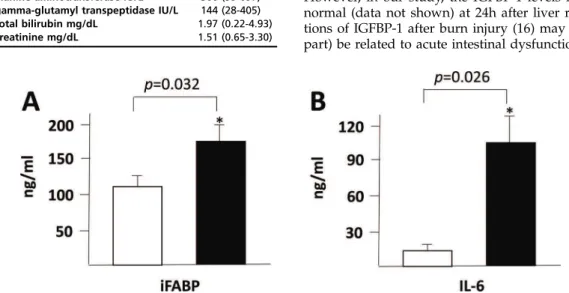
We found a significant increase in the plasma levels of IFABP (Figure 1A), IL-6 (Figure 1B) and IGFBP-1 (Figure 2A) at 8h after the start of the surgeries. In contrast, the IGFBP-3, IGFBP-4, IGFBP-6 and IGFBP-7 plasma levels were decrea-sed after the surgical procedure (Figure 2 C, D, F and G).
Previous studies have shown that, in patients undergoing liver resection, total or intermittent Pringle maneuvers are associated with an increase in IFABP plasma levels due to the loss of enterocyte membrane integrity. In addition to the Pringle maneuver, alternative strategies have been used during hepatic resection to minimize intraoperative blood loss, such as the pharmacological reduction of central
venous pressure. However, we hypothesized that this stra-tegy would reduce the arterial blood pressure, which might also compromise the intestinal blood flow. As previously demonstrated, reduction of intestinal blood flow is fol-lowed by intestinal barrier dysfunction and bacterial tran-slocation (11), and several reports have shown that IFABP is an accurate biomarker of intestinal damage (8,12).
In the present study, we observed a significant increase in IFABP blood levels, at 8h after hepatic resection, with a reduction of the central venous pressure during liver tran-section even without the Pringle maneuver (Figure 1A), and a similar trend was observed for the IL-6 plasma levels. These results indicate that liver resection induces a significant local and systemic inflammatory response, even affecting organs located at sites distant from the surgical procedure, such as the intestines.
IGFBPs are important physiological regulators of the interaction of insulin-like growth factors (IGFs) with their receptors within the gastrointestinal tract and liver (13,14), and thus, we decided to investigate them as novel potential biomarkers of acute intestinal dysfunction. The seven cloned mammalian IGFBPs are implicated in cell proliferation and survival as well as in several other cellular responses. IGFBPs are secreted by human intestinal epithelial cells and may leak into the systemic circulation in situations involving intestinal damage. In the present study, we observed a signi-ficant increase in IGFBP-1 blood levels after liver resection (Figure 2A). However, other IGFBPs presented a postoperative blood level decrease after hepatic resection (Figure 2).
In a previous study, intestinal epithelial cell damage and endotoxemia were demonstrated to occur after the Pringle maneuver during liver resection (9), but patients submitted to liver resection without the Pringle maneuver did not pre-sent intestinal damage. Those patients, however, were more hemodynamically stable and did not require the Pringle maneuver. In our study, all patients were operated on without the Pringle maneuver, independent of their hemo-dynamic conditions. In our patients, central venous pressure was maintained below 10 cm H2O by pharmacological mani-pulation, and intestinal barrier dysfunction was detected. Elevation of IGFBP-1 has also been observed during critical illnesses (15), most likely due to systemic inflammation. However, in our study, the IGFBP-1 levels had returned to normal (data not shown) at 24h after liver resection. Eleva-tions of IGFBP-1 after burn injury (16) may also (at least in part) be related to acute intestinal dysfunction (17).
Table 1-Perioperative profile of the study population (means). Standard deviations are listed in parenthesis.
Age 60.6 (29-77)
Gender male/female 7/9
Blood loss (mL) 515 (100-1500)
Number of resected segments 3 (1-4)
Postoperative aspartate aminotransferase IU/L 503 (76-1306)
Postoperative alanine aminotransferase IU/L 366 (59-697)
Postoperative gamma-glutamyl transpeptidase IU/L 144 (28-405)
Postoperative total bilirubin mg/dL 1.97 (0.22-4.93)
Postoperative creatinine mg/dL 1.51 (0.65-3.30)
Figure 1 -Intestinal fatty-acid binding protein (IFABP, Figure 1A) and IL-6 (Figure 1B) plasma levels at the beginning of liver resection (in white) and 8 h later (in black).
646 IGFBP-1 and intestinal injury
In conclusion, the present study demonstrated that, even without the Pringle maneuver, intestinal barrier dysfunction most likely occurs secondary to the reduction of intestinal blood flow induced by pharmacological manipulation of the central venous and arterial pressure.
In the modern era of liver surgery, the Pringle maneuver has been restricted to situations in which major bleeding occurs. Future investigations are necessary to establish whether intestinal barrier dysfunction plays a role in the etiology of infectious or noninfectious perioperative complications. Intest-inal barrier dysfunction may be an important concern in patients with small liver remnants. In fact, endotoxin transloca-tion, secondary to intestinal barrier dysfunctransloca-tion, may induce liver damage (18) and further jeopardize liver function. An alternative approach would be to perform a selective intrahe-patic Glissonian approach (19) and proceed to liver resection without a central venous pressure reduction, thereby main-taining the intestinal perfusion and epithelial cell integrity. However, this approach still needs to be further investigated.
A previous study in patients with biliary malignancy demonstrated that bacterial translocation can predict the occurrence of postoperative infectious complications after liver resection (20).
Thus, we propose that novel techniques to perform liver resections without the Pringle maneuver and without reduc-tion of the central venous pressure should be explored because both of the latter procedures compromise the intestinal inte-grity. IFAPB is a reliable marker of intestinal injury even before such injury can be detected by histological analysis. The gut is the main producer of IGFBP-1, although other organs can pro-duce it in smaller amounts. We suggest that IGFBP-1 is a novel marker of intestinal damage, but further studies are necessary to confirm this finding.
’ AUTHOR CONTRIBUTIONS
Barbeiro HV performed the experiments. The remaining authors designed the project and wrote the manuscript.
’ REFERENCES
1. Deitch EA. Intestinal permeability is increased in burn patients shortly after injury. Surgery. 1990;107(4):411-6, http://dx.doi.org/10.1002/bjs.1800770541.
2. Costantini TW, Loomis WH, Putnam JG, Drusinsky D, Deree J, Choi S, et al. Burn-induced gut barrier injury is attenuated by phosphodiesterase inhibition: effects on tight junction structural proteins. Shock. 2009;31(4): 416-22, http://dx.doi.org/10.1097/SHK.0b013e3181863080.
3. Rhodes RS, Depalma RG, Robinson AV. Intestinal barrier function in hemorrhagic shock. J Surg Res. 1973;14(4):305-12, http://dx.doi.org/10.1016/ 0022-4804(73)90032-2.
4. Deitch EA, Bridges W, Berg R, Specian RD, Granger DN. Hemorrhagic shock-induced bacterial translocation: the role of neutrophils and hydroxyl radicals. J Trauma. 1990;30(8):942-51; discussion 951-2.
5. Barbeiro DF, Koike MK, Coelho AM, da Silva FP, Machado MC. Intestinal barrier dysfunction and increased COX-2 gene expression in the gut of elderly rats with acute pancreatitis. Pancreatology. 2016;16(1):52-6, http://dx.doi.org/10.1016/j.pan.2015.10.012.
6. Pan L, Wang X, Li W, Li N, Li J. The intestinal fatty acid binding protein diagnosing gut dysfunction in acute pancreatitis: a pilot study. Pancreas. 2010;39(5):633-8, http://dx.doi.org/10.1097/MPA.0b013e3181c79654. 7. Gu J, Hu J, Qian H, Shi Y, Zhang E, Guo Y, et al. Intestinal Barrier
Dys-function: A Novel Therapeutic Target for Inflammatory Response in Acute Stanford Type A Aortic Dissection. J Cardiovasc Pharmacol Ther. 2016;21(1):64-9, http://dx.doi.org/10.1177/1074248415581176.
8. Machado MC, Barbeiro HV, Pinheiro da Silva F, de Souza HP. Circulating fatty acid binding protein as a marker of intestinal failure in septic patients. Crit Care. 2012;16(6):455, http://dx.doi.org/10.1186/cc11653. 9. Dello SA, Reisinger KW, van Dam RM, Bemelmans MH, van Kuppevelt
TH, van den Broek MA, et al. Total intermittent Pringle maneuver during liver resection can induce intestinal epithelial cell damage and endotox-emia. PloS One. 2012;7(1):e30539, http://dx.doi.org/10.1371/journal. pone.0030539.
10. Pringle JH V. Notes on the Arrest of Hepatic Hemorrhage Due to Trauma. Ann Surg. 1908;48(4):541-9, http://dx.doi.org/10.1097/00000658-190810000-00005.
11. Holland J, Carey M, Hughes N, Sweeney K, Byrne PJ, Healy M, et al. Intraoperative splanchnic hypoperfusion, increased intestinal perme-ability, down-regulation of monocyte class II major histocompatibi-lity complex expression, exaggerated acute phase response, and sepsis. Am J Surg. 2005;190(3):393-400, http://dx.doi.org/10.1016/j.amjsurg.2005. 03.038.
12. Derikx JP, van Waardenburg DA, Thuijls G, Willigers HM, Koenraads M, van Bijnen AA, et al. New Insight in Loss of Gut Barrier during Major Non-Abdominal Surgery. PloS One. 2008;3(12):e3954, http://dx.doi.org/ 10.1371/journal.pone.0003954.
13. Kuemmerle JF. Insulin-like growth factors in the gastrointestinal tract and liver. Endocrinol Metab Clin North Am. 2012;41(2):409-23, http://dx.doi. org/10.1016/j.ecl.2012.04.018.
14. Bach LA. Insulin-Like Growth Factor Binding Proteins–an Update.
Pediatr Endocrinol Rev. 2015;13(2):521-30.
15. Baxter RC. Changes in the IGF-IGFBP axis in critical illness. Best Pract Res Clin Endocrinol Metab. 2001;15(4):421-34, http://dx.doi.org/10.1053/ beem.2001.0161.
16. Mendoza AE, Maile LA, Cairns BA, Maile R. Burn injury induces high levels of phosphorylated insulin-like growth factor binding protein-1. Int J Burns Trauma. 2013;3(4):180-9.
17. Costantini TW, Peterson CY, Kroll L, Loomis WH, Putnam JG, Wolf P, et al. Burns, inflammation, and intestinal injury: protective effects of an Figure 2 -Insulin-like growth factors binding proteins (IGFBP) 1 to 7 plasma levels (Figures A to G) at the start of liver resections (in white) and 8 hours later (in black).
647
CLINICS 2017;72(10):645-648 IGFBP-1 and intestinal injury
anti-inflammatory resuscitation strategy. J Trauma. 2009;67(6):1162-8, http://dx.doi.org/10.1097/TA.0b013e3181ba3577.
18. Henao-Mejia J, Elinav E, Thaiss CA, Licona-Limon P, Flavell RA. Role of the intestinal microbiome in liver disease. J Autoimmun. 2013;46:66-73, http://dx.doi.org/10.1016/j.jaut.2013.07.001.
19. Machado MA, Surjan RC, Basseres T, Schadde E, Costa FP, Makdissi FF. The laparoscopic Glissonian approach is safe and efficient when com-pared with standard laparoscopic liver resection: Results of an observational
study over 7 years. Surgery. 2016;160(3):643-51, http://dx.doi.org/10.1016/ j.surg.2016.01.017.
20. Mizuno T, Yokoyama Y, Nishio H, Ebata T, Sugawara G, Asahara T, et al. Intraoperative bacterial translocation detected by bacterium-specific ribosomal rna-targeted reverse-transcriptase polymerase chain reaction for the mesenteric lymph node strongly predicts postoperative infectious complications after major hepatectomy for biliary malignancies. Ann Surg. 2010;252(6):1013-9, http://dx.doi.org/10.1097/SLA.0b013e3181f3f355.
648 IGFBP-1 and intestinal injury