Mortality from Diabetes Mellitus in Jamaica1
SYLVAN I. ALLEYNE,~ J. KENNEDY CRUICKSHANK,~ AMOS
L.
GOLDING,~
& ERROLL
Y. ST. A.
MORRISON~
Mortality data
for
8,799 Jamaican diabetics who died between 1970 and 1979 were collected by reviewing the death certificates of all Jamaicans that were recorded for that period. Diabetes was found to account for 6.5% of all deaths; 62% of these deaths occurredamong
females; and diabetics were found to die earlier thannon-
diabetics. There was also underreporting of diabetes in the official Registrar Gene- ral’s statistics, in that abouta
third of the decedents who had diabetes recorded on their death certificates were not coded as having died of diabetes, because the disease was not recorded as the underlying cause of death. Vascular disease was a prime cause of death among these diabetics.L
ife expectancy of the inhabitants ofthe English-speaking Caribbean
countries has increased in recent decades (1,2) as a result of improved general liv-
ing standards, nutrition, and general
public health care. However, this in-
crease has directed attention to chronic disease problems (3), and it is becoming
evident-in virtually all developing
countries-that an increasing amount of
public health expenditure will go toward caring for the chronically ill.
Diabetes mellitus is one of the more
common chronic diseases in the Carib- bean, and there are already indications that the complications of this disease are
posing increasing problems for health
services (4,5). It is thus essential that data
be obtained to define the magnitude of
these
problems-so that plans can be*This article will also be published in Spanish in the Boletin de la Oficina Saniiaria Panamericka, Vol. 106, No. 4, 1989. The work reported here was sun- ported
in
part bya grant
fro*m the Caribbean Medi- cal Research Council.2Departments of Sociolom and Medicine, Univer- sity of the West Indies, I??ngston 7, Jamaica. Corre- spondence for Dr. Alleyne should be directed to her present address: Department of Human Devel- opment, School of Human Ecology, Howard Uni- versity, Washington, DC 20059, USA.
made for adjusting current services to the actual demands.
Data on the prevalence of diabetes in
the Caribbean are scarce. Poon-King,
Henry, and Rampersad (1968) diagnosed
diabetes in approximately 2% of Trini-
dad’s general population and in 3.5% of
Trinidad’s adults (people over 20 years of
age) (6). Florey, McDonald, McDonald,
and Miall (1972) studied a random sam- ple of rural Jamaicans 25-64 years old and diagnosed diabetes in 3.9% of this popu-
lation (7). Morrison and Alleyne (1980)
determined capillary blood sugar levels
in 1,346 people over 15 years old in four Jamaican parishes and found significant hyperglycemia in 6.1% of the sample (8).
Mortality studies provide another way
of determining the scope of the problem.
McGlashan (1982) collected mortality
data from 10 Caribbean countries includ- ing Jamaica and showed that between 1974 and 1979 Jamaica’s crude annual di- abetes mortality by sex was 28.35 deaths
per 100,000 male inhabitants and 44.43
deaths per 100,000 female inhabitants (9). His data, gleaned from statistics reported by ministries of health, suggested that di-
abetes accounted for 3.8% of all male
deaths and 6.7% of all female deaths.
There is no evidence of his having in-
spected the death certificates, which
must always be considered the primary data sources for studies of this kind.
The study reported here, which was undertaken as a part of wider research on diabetes in Jamaica (ZO), sought to quan-
tify the problem through careful exami-
nation of diabetes mortality reported in
the death certificates.
MAXERIALS AND METHODS
The death certificates of 137,015 people who died during the decade 1970-1979 were examined, and the 8,855 certificates on which diabetes was recorded as an underlying or contributing cause of death were extracted for further analysis. The data recorded about these diabetics were date of death, parish where death oc-
curred, gender, age, occupation, and un-
derlying and contributing causes of
death. (The standard Jamaican death cer-
tificate is shown in Annex 1.) All the
deaths for 1979 were analyzed with re- spect to age and gender.
All deaths recorded for 1977 and 1978 that had been coded officially by the Reg- istrar General, according to the Intema- fional Classification
of
Diseases (Eighfh Revi- sion), were analyzed separately. In these certificates, the first underlying cause of death was officially recorded as the cause of death (a unidimensional classification). The deaths for these two years were ana- lyzed by age, gender, and cause of deathin order to make a comparison with the
data obtained directly from those 1977 and 1978 death certificates that had re- corded diabetes as any one of the causes of death. The purpose of analyzing these data was to estimate the extent to which diabetes was coded officially as the cause of death for those decedents who were
determined (by direct inspection of the
death certificates) to have had diabetes at
the time of death. Comparison of these
two sets of data, i.e., coded versus in- spected, allowed us to evaluate the ex- tent to which diabetes would be underes- timated if only the officially coded data were used.
Jamaica’s live population in 1977 was
estimated, from the most recent (1983)
population census figures, as being
1,007,500 males and 1,033,OOO females. In general, the availability of records was good. The only ones not found were records for one month in one parish (St. Catherine in 1973) and four months in
another (Clarendon, one month in 1973
and three months in 1978). Overall, we estimate that we had access to 99.7% of all the death certificates issued for the decade under study.
RESULTS
The total number of 1970-1979 deaths recorded for diabetics and the general
population, by year, are shown in Table
1. People with diabetes accounted for
6.46% of all deaths in the decade, the per-
centage in individual years ranging from
5.24% in 1970 to 7.16% in 1979.
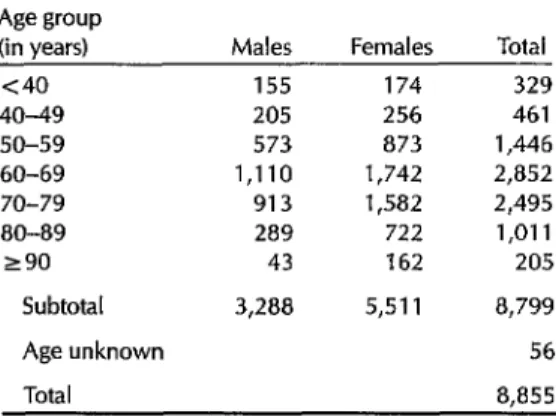
Table 2 groups the deceased diabetics by age at death and gender. As may be seen, over 62% of these diabetics were
Table 1. Recorded deaths in Jamaica among diabetics and the whole population from 1970 through 1979, by year.
Deaths recorded among:
Year Diabetics
The general population
% diabetic deaths 1970 743 14,185 5.24 1971 827 13,904 5.95 1972 947 14,776 6.41 1973 893 14,530 6.15 1974 906 14,143 6.41 1975 917 13,744 6.67 1976 949 13,738 6.91 1977 978 13,895 7.04 1978 832 12,052 6.90 1979 863 12,048 7.16
Total 8,855 137,015 6.46
Table 2. Age at death of diabetics in Jamaica, by sex, in 1970-I 979.
Age group (in years)
<40 40-49 50-59 60-69 70-79 80-89 290
Subtotal
Age unknown
Total
Males Females Total
155 174 329
205 256 461
573 873 1,446 1,110 1,742 2,852 913 1,582 2,495 289 722 1,011
43 162 205
3,288 5,511 8,799 56 8.855
female. The largest number of deaths oc- curred in the 60-69 year age group; how- ever, it is noteworthy that 1,216 of the
deaths occurred among diabetics who
were over 80 years old.
The age distribution of diabetic and
nondiabetic decedents in 1979 is shown
in Table 3. The modal age group at death for diabetic males and females and for nondiabetic males was 60-69 years; how-
ever, the modal age group for non-
diabetic females was 70-79 years.
Table 4 provides a comparison of the
number of diabetics found through ex-
amination of 1977-1978 death certificates and the number of deaths officially coded as being due to diabetes. In all, two- thirds of the decedents whose death cer-
tificates mentioned diabetes were coded
by the Registrar General as dying of
diabetes.
In terms of the leading causes of death listed in Table 5, diabetes ranked fifth among females and ninth among males during 1977-1978.3 As the 1977 data in Table 6 indicate, over 80% more deaths occurred among female diabetics than among male diabetics in that year.
3Table 5 shows 33 more deaths with diabetes as the first underlying cause (769 + 421) than does Table 4 (1,157) because the ages of 33 decedents are unknown.
The first underlying causes to which
the 1970-1979 fatalities of diabetics were
attributed are shown in Table 7. These
data indicate that 90.3% of these deaths
could be attributed to diabetes and its
complications. Hypertension, stroke,
and cardiovascular disease were the un-
derlying causes of death in 30.8% of the decedents. The most common cause of death not related to diabetes was malig-
nant neoplasms, which accounted for
only 1.6% of the fatalities.
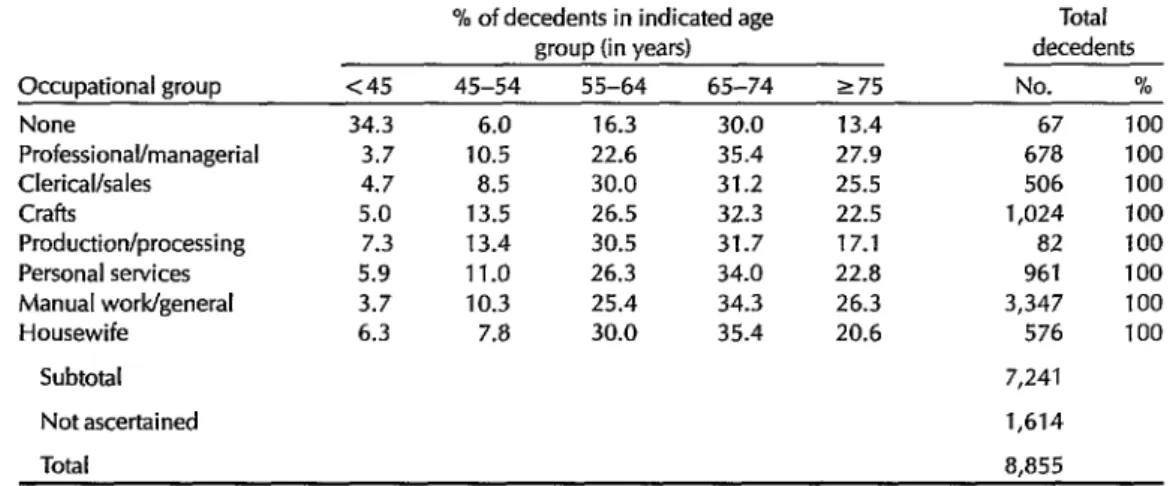
Table 8 shows the age at death of dia-
betics in different occupational groups.
The data reveal statistically significant differences between the ages at death of
the professional/managerial diabetics
and those in processing/production (p < 0.002) and personal services (p < O.OOl),
with the professional/managerial diabet-
ics tending to live longer.
DISCUSSION AND CONCLUSIONS
The data for this study came exclu- sively from death certificates, so it is rele- vant to comment upon them as a source of health research information. The death certificate is a legal as well as a statistical document that constitutes one of the old- est public health information records (II- 25). Despite its recognized lack of preci-
sion in specifying the cause of death,
analysis of gross trends, especially of
well-defined disease entities, can be
usefully accomplished through death
certificates.
Some diseases cannot be studied in this way. Death certificate information is gen- erally useless for tracking a rare disease that will hardly ever be coded as a cause of death. But the certificates can be in-
valuable as a guide for community health
planners as well as those interested in
trends and the relative mortality rankings
of well-defined common diseases (25).
Comstock and Markush (14) have de-
scribed the major problems that may re-
Table 3. A comparison of the ages at which diabetics versus those with no mention of diabetes on their death certificates died in Jamaica in 1979.
Age group at death (in years)
% of decedents in indicated age group
Males Females Total
Diabetics Nondiabetics Diabetics Nondiabetics Diabetics Nondiabetics
<40 5.9 21.0 3.2 18.0 4.1 19.1
40-49 6.4 4.8 2.5 5.1 3.9 4.9
50-59 16.4 a.9 13.2 8.8 14.3 a.9
60-69 33.2 27.1 32.0 14.8 32.4 21.8
70-79 28.5 22.5 30.0 23.0 29.3 22.7
80-89 9.1 11.5 14.1 18.4 12.3 14.5
290 0.7 4.2 5.2 12.0 3.6 7.6
Total (%)
Total no.
100 100 100 100 100 100
of decedents 298 5,973 554 5,095 852= 11,068a “The ages of 11 diabetics and 117 nondiabetics could not be ascertained.
Table 4. A comparison of the number of 1977-1978 death certificates mentioning diabetes and the number of 1977-l 978 deaths coded by the Registrar General according to the International Classification of Diseases, Eighth Revision, as being caused by diabetes.
Age group Diabetics found by Deaths coded as % of deceased at death inspection of being caused diabetics coded as (in years) death certificates by diabetes” dying of diabetes
<5 10 1 10.0
5-9 3 0 0.0
10-14 3 2 66.7
15-24 7 6 85.7
25-34 16 13 al.3
35-44 48 35 72.9
45-54 164 106 64.6
55-64 443 306 69.1
65-74 608 351 57.7
275 478 337 70.5
Total 1,780b 1,157 65.0
%iting diabetes as the first underlying cause of death.
bThis figure of 1,780 is less than that given in Table 1 for diabetics dying in 1977-1978 (1,810), because some of the certificates lacked age data.
Table 5. The 10 leading causes of death in Jamaica during 1977-l 978, by gender.
Females Males
No. of No. of
cause Cause deaths Cause
No. of deaths 1. Cerebrovascular disease 2,087
2. Malignant neoplasms 1,515 3. Other heart disease 962 4. Hypertensive disease 789 5. Diabetes mellitus 769 6. Pneumonia and bronchitis 695 7. lschemic heart disease 639 a. Senility 548 9. Enteritis/diarrhea1 disease 442 10. Diseases of the arteries 350
Malignant neoplasms 1,563 Cerebrovascular disease 1,549 Other heart disease 1,043 Pneumonia and bronchitis 859 Accidents and violence 691 lschemic heart disease 640 Hypertensive disease 612 Enteritis/diarrhea1 disease 551 Diabetes mellitus 421 Diseases of the arteries 365
Table 6. Mortality from diabetes in Jamaica during 1977, by gender.a
Diabetes deaths per No. of deaths 100.000 inhabitants Males 191 18.95 Females 347 33.59
aThe figures are lower than the total in Table 1 because of the difference in the deaths coded with diabetes mellitus as the first underlying cause of death and those listing it as an underlying or contributing cause of death.
duce the accuracy and usefulness of
death certificate information. These
range from lack of physician training for those completing the certificates to insti-
tutional delays in publishing the basic
data. Also, the “multidimensional” ap-
proach, in which multiple causes of
death are registered, tends to produce
more useful data than the “unidimen- sional” approach. This is especially true now that deaths from chronic diseases are on the rise in many countries, since such deaths are usually associated with a number of coexisting conditions (16).
The present study had the advantage of being based upon direct inspection of death certificates and, in the case of the
Table 7. The first underlying causes of death recorded for diabetics dying in Jamaica during 1970-I 979.
Deaths Cause of death No. % Diabetes mellitus
Hyperglycemic coma Hypoglycemic coma Hypertensive, cerebrovascular,
and cardiovascular diseases Severe infections
Renal complications
Other diabetes-related causes Causes unrelated to diabetes
mellitus
Causes not ascertained
2,676 30.2a 956 10.8 133 1.5
2,728 30.8 1,134 12.8
350 4.0 21 0.2
830 9.4 27 0.3 8.855 100 aThe overall percentage of diabetics whose first underlying cause of death was listed as diabetes (30.2%) is far lower than the 65.0% shown in Table 4 because there were more disparities in the earlier years of the decade than toward the end.
diabetic decedents, analysis of the causes of death that were recorded. This permit- ted comparison of complete death certifi- cate data with the mortality data coded in
the traditional manner by the Registrar
General using the unidimensional ap-
proach. The study also depended greatly
upon improvement of Jamaica’s vital
data registration system. In 1885 only
16.1% of the deaths in Jamaica were certi- fied, and by 1925 this share had only
risen to 27.2%; however, in 1955 it
reached 63% (27), and by 1978 nearly all (98.4%) of the country’s deaths were certified.
In Jamaica, we find that diabetics ac- counted for 6.5% of all recorded deaths during the 1970s. In the United States, Harris and Entmacher (18) analyzed the mortality data for 1982; if we combine the
underlying and contributing causes of
death cited by them, we find that diabe- tes affected 6.5% of all the decedents-a share identical to ours. The figures ob- tained by McGlashan for Jamaica in 1975- 1979 are also similar to ours (9).
Other studies have discussed the ten-
dency to underestimate diabetes as a
health problem when a unidimensional
approach is taken in registering death
certificate data (19-22). In our study, 66% of all the diabetics who died in Jamaica in 1977 and 1978 were found to have been coded as having died of diabetes. The sit- uation in Jamaica may be better than in many other countries. For example, one
U.S. study in Rochester, Minnesota (22),
in which diabetes was documented on
selected decedents’ medical records prior to death, found that diabetes was listed as an underlying cause of death on only 32% of the decedents’ death certificates. Fuller et al. (26) found that when analysis of death certificates took account only of the underlying cause of death, mortality
from diabetes was typically underesti-
mated five-fold. This systematic underre-
porting of diabetes was reviewed by
Table 8. Age at death of diabetics in different occupational groups, 1970-l 979. % of decedents in indicated age
group (in years)
Occupational group <45 45-54 55-64 65-74 275 None 34.3 6.0 16.3 30.0 13.4 Professional/managerial 3.7 10.5 22.6 35.4 27.9 Clerical/sales 4.7 8.5 30.0 31.2 25.5 Crafts 5.0 13.5 26.5 32.3 22.5 Production/processing 7.3 13.4 30.5 31.7 17.1 Personal services 5.9 11.0 26.3 34.0 22.8 Manual work/general 3.7 10.3 25.4 34.3 26.3 Housewife 6.3 7.8 30.0 35.4 20.6
Subtotal
Not ascertained
Total
Total decedents No. %
67 100 678 100 506 100 1,024 100 82 100 961 100 3,347 100 576 100
7,241
1,614
8,855
Harris and Entmacher (18), who in- is theoretically possible that some of the
spected data from five studies in the diseases ranked above diabetes may also
United States where the percentage of es- have been underreported. However, any
timated diabetic deaths registered on such underreporting is unlikely to have
death certificates ranged from 32% to been present to the same extent as with a
75% of the total. chronic disease like diabetes.
The reasons for this underreporting are
many, but the most important is that
most countries’ mortality statistics are
based on the underlying cause of death;
other related diseases are ignored. Adop-
tion of the multidimensional approach to
recording cause of death data would con- tribute to correcting this problem (20,23).
Another reason for underreporting is
that diabetes as a chronic illness may be associated with many other conditions,
such as cardiovascular diseases, which
may be more “visible” and therefore
more apt to be recorded as the underly- ing cause of death (26).
The underreporting of diabetes affects
the ranking of the disease as a cause of death in national statistics. If we assume
that the reported number of diabetic
deaths may be increased by 30% to reflect
reality, then diabetes may well rank
higher than the fifth leading cause of
death in Jamaican females and the ninth in Jamaican males. Some caution must be exercised in taking this approach, since it
It is also noteworthy that diabetes has been assuming steadily increasing impor- tance as a cause of death in Jamaica. In 1958 Tulloch (17) found that in most trop- ical countries (except Hawaii, where dia- betes ranked eighth), the disease did not appear among the 10 leading causes of death. In that year diabetes was ranked twelfth among the causes of death in Ja- maica and Trinidad. Its increased impor- tance since then reflects increased life ex-
pectancy, reduced communicable disease
mortality, and increased chronic disease
morbidity and mortality.
Our results show that circulatory sys-
tem disease was the most common asso-
ciated cause related to death from diabe-
tes. This high proportion of vascular
disease deaths could be partly explained by the fact that treatment-primarily with
insulin-has allowed diabetics to live
longer, therefore giving them more time
to develop life-threatening vascular dis-
ease (20,24).
This pattern of death has been ob-
served in most studies (20,24,25). In En- gland and Wales, between 1921 and 1930 diabetes was listed as the underlying cause of death on 91% of the death certifi-
cates mentioning diabetes; however, in
the 1970s this percentage had fallen to 22% for men and 24% for women, and vascular disease had come to be listed as the prime cause of death (20). While part
of this change can be attributed to
changes in death certification reporting practices, most of it appears to have been a genuine reflection of the increasing im-
portance of cardiovascular disease in a
population that is living longer.
In the decade under study, the ratio of male to female diabetics at the time of death was k1.7 (see Table 2). This pre- ponderance of females has been found by other current studies, but the situation was not always thus. Indeed, before 1900 diabetes appeared more comrnon among men in Europe and the United States. Since the 193Os, however, the pattern has been reversed, so that in most countries,
with few exceptions, diabetes is more
prevalent among women (24).
The age distribution of our decedents
also bears comment. Female diabetics
tended to die younger than female non- diabetics, while the modal age of death
was the same for diabetic and non-
diabetic males. When males and females were combined, the modal ages of death were 60-69 years for diabetics and 70-79 years for nondiabetics.
This tendency for diabetics to die youn- ger has been confirmed by another analy- sis in which life tables were constructed for diabetics and nor-diabetics who died in 1977 (20). That analysis of both male
and female mortality found that propor-
tionately more diabetics died before age 75 than did nondiabetics or people with other chronic illnesses.
Few of the diabetic decedents in Ja- maica who were less than 15 years of age had diabetes listed on their death certifi-
cates as the underlying cause of death, whereas it was so listed on 62% of the certificates of diabetic decedents in older age groups. In contrast, studies from En- gland and Wales have indicated that 71% of the diabetic decedents below age 15 had diabetes listed as the underlying cause whereas it was so listed on only 22% of the certificates of those dying at age 65 or more (Table 9).
The Jamaica finding was surprising,
since the common form of diabetes in the
young is the insulin-dependent form,
and so patients are more likely to die from the disease itself; in contrast, diabe- tes in older age groups is predominantly
the noninsulin-dependent form, so that
patients more frequently die from vascu-
lar complications of the disease, as we
have seen. We have no satisfactory expla- nation for this finding in the young; but the relatively frequent listing of diabetes as the underlying cause of death in older patients could reflect poor care and pa- tients dying from diabetes rather than the
complications-a situation that was prev-
alent in the developed countries many
years ago.
The observed differences in the age at death among members of different occu- pational classes (see Table 8) has been found to apply to deaths in general (26).
On the average, members of the
professional/managerial group live
longer, presumably because they are
more educated about health matters, live
in healthier surroundings, and have ac-
cess to better health care.
Acknowledgments.
We wish to thank Professor George Roberts for his assis-tance
in analyzing and interpreting the data; Mrs. Winnifred B. Porteous and the staff of the Registrar General’s Office fortheir cooperation; and Mr. Roy Bailey
and the staff of the University Computer Center for assisting in data analysis.
Table 9. A comparison of Jamaican and English/Welsh death certificates, showing the proportion of certificates issued for diabetic decedents that listed diabetes as the first underlying cause of death, by decedent age group.
Death certificates listing No. of diabetes as the first Age group diabetic underlying cause of death
(in years) decedents No. %a
i
<I5 16 3 18.8
Jamaica 1 S-44 71 54 76.1
(I 977-1978) 45-64 607 412 67.8
265 1,086 688 63.4
Total 1 ,780b 1,157 65.0
( <15 42 30 71.4
England and 15-44 Wales’ 45-64 (1972-1977) 265
Total % of all diabetic decedents surveved.
668 378 56.6
7,045 1,791 25.4 35,581 7,972 22.4
43,336 10,171 23.5
bTotal shown is less than the 1,810 listed in Table 1 because some of the certificates lacked age data. 5ource: Fulleret al. (76).
REFERENCES
1.
2.
3.
4.
5.
6.
7.
Pan American Health Organization. Health Conditions in the Americas, 1981- 1984. PAHO Scientific Publication 500. 8. Washington, DC, 1986.
Roberts, G. W., D. L. Powell, S. Sinclair, B. Boland, and L. Hewitt. Recent Popula- tion Movements in Jamaica. The Herald Ltd., Kingston, 1974.
9.
Litvak, J., L. Ruiz, H. E. Restrepo, and A. McAIister. The growing noncommunica- ble disease burden, a challenge for the 10. countries of the Americas. Bull Pan Am Health Organ 21:156-171, 1987.
Jackman, S., and E. R. WaIrund. The problem of Iimb amputation in Barbados (abstract). 25th Scientific Meeting, Corn- 11. monweaIth Caribbean Medical Research Council, Georgetown, Guyana, 1980.
Morrison, E. Y. St. A., and R. Richards. 12. CIinicaI profile of diabetes meIlitus in Ja- maica (phasic insulin dependence). Wesf Indian Med J 35:94-97,1985. 13. Poon-King, T., M. Henry, and F. Ram- persad. Prevalence and natural history of diabetes in Trinidad. Lancet 1:155-159, 14 1968.
Florey, C. du V, H. McDonald, J. Mc- Donald, and W. E. MiaII. The prevalence
of diabetes in a rural population of Jamai- can adults. Inf J Epidemiol1:157-166, 1972. Morrison, E. Y. St. A., and S. I. AIIeyne. Factors related to the prevalence of hy- perglycaemia in Jamaica. West Indian Med J 39:90-96, 1980.
McGlashan, N. D. Causes of death in ten English-speaking Caribbean countries and territories. Bull Pan Am Health Organ 16:2X2-223, 1982.
AIIeyne, S. I. Social Indicators, Illness and Behaviours and Mortality among Pa- tients with Diabetes MeIIitus in Jamaica, West Indies. Ph.D. Thesis. University of the West Indies, Kingston, 1987.
Glasser, J. H. The quality and utility of death certificate data. Am J Public Health 71:231-233,198l.
Cochrane, A. L., and F. Moore. Death cer- tification from the epidemiologic point of view. Lancet 2:742-743,198l.
Chamblee, R. F., and M. C. Evans. New dimensions in cause of death statistics. Am J Public Healfh 72:1265-1269, 1982. Comstock, G. W., and R. E. Markush. Further comments on problems in death certification. Am J Epidemiol 124:180-181, 1986.
15.
16.
17.
18.
19.
20.
21.
Zemach, R. What the vital statistics sys- tality related to diabetes and blood glu- tem can and cannot do. Am J Public Health cose levels in a community study. Am 1 74:756-758,1984. Epidemiol116:678-684,1982.
Fuller, J. H., J. Elford, l? Goldblatt, and A. 22. M. Adelstein. Diabetes mortality: New light on an underestimated public health problem. Diubetologiu 24:336-341, 1983. Tulloch, J. A. Diabetes Mellitus in the Trop-
ics. E. S. Livingstone, Ltd.; Edinburgh and London, 1962.
23
Harris, M., and I! Entmacher. Mortality from Diabetes. In: M. Harris (ed.). Diube- tes in America. NIH Publication 85-1468. U.S. Government Printing Office, Wash- 24. ington, DC, 1985.
Tokuhata, G. K., W. Miller, E. Digon, and 25. T. Hartman. Diabetes mellitus: An under- estimated public health problem. J Chron Dis 28~23-35‘1975.
Palumbo, l? J., L. R. Elveback, C. l? Chu, D. C. Conolly, and L. T. Kurland. Diabe- tes mellitus: Incidence, prevalence, survi- vorship, and causes of death. Diabetes 25:566-573, 1976.
Israel, R. A., H. M. Rosenberg, and L. R. Curtin. Analytical potential for multiple cause-of-death data. Am J Epidemiol 124: 161-179,1986.
West, K. M. Epidemiology of Diabetes and Its Vizsculu~ Lesions. Elsevier, New York, 1978. Joron, G. E., E. Laryea, D. Jaeger, and L. MacDonald. Causes of death in 1,144 pa- tients with diabetes mellitus: An autopsy study. Can Mea Assoc J 134:759-764, 1986. Fuller, J. H. Causes of death in diabetes 26.
mellitus. Harm Metab Res 15(suppl):3-9, 1985.
O’Sullivan, J. B., and C. M. Mahan. Mor-
Kitagawa, E. M., andl? M. Hauser. Differ- entiul Mortality in the United States: A Study in Socioeconomic Epidemiology. Harvard University Press, Cambridge, 1973.
ANNEX 1. The standard Jamaican death certificate.
DEATH REGISTRATION
FORM
1. DEATH IN THE DISTRICT OF
2. PARISH 3. NO.
4. PLACE OF DEATH USUAL RESIDENCE OF DECEASED
... 12. (a) Residence ...
... (!J) Town or Village ...
(c) Parish ...
PARTICULARS OF DECEASED
5. Date of Death ...
...
13. CAUSE OF DEATH
I (Immediate Cause)
6. FulIName ...
...
7. Sex ... 8. Condition. ...
9. Age ... years ... months ... daysi& * 10. Occupation or calling ... .$ .c p< f
... ‘t3;&
.a, ” :&
.\ .. ...
.%‘-‘-\,, .[ ...
‘+&Q %&4. Certifiedby ... 11. Birthplace ... .&&. 8 ... e$. ‘6.” .... ... y:
# *~~~~p*~ J 93 _( Qualificafion pG
15 (y&ad s,Jl&
g$&
@ ?ggp INFORMANT
... 17. (a) Residence ... -y\
... .,i; ...
s&d (b) Town or Viiage ... 16. Qualification ... (c) Parish ...
... Signature of Informant
REGISTRAR’S CERTIFICATE
18. (a) Signed in my presence by the said informant
(b) Entered by me frosAe particulars on a Certificate received from ...
...
19. Witness ...
20. Date ...
21. Signed ... Registrar