268 Rev Panam Salud Publica/Pan Am J Public Health2(4), 1997
Abnormally wide confidence intervals in
logistic regression: interpretation of
statistical program results
1
Jokin de Irala,
2Rafael Fernandez-Crehuet Navajas,
3and
Amparo Serrano del Castillo
4This study describes the behavior of eight statistical programs (BMDP, EGRET, JMP, SAS, SPSS, STATA, STATISTIXand SYSTAT) when performing a logistic regression with a simulated data set
that contains a numerical problem created by the presence of a cell value equal to zero. The pro-grams respond in different ways to this problem. Most of them give a warning, although many simultaneously present incorrect results, among which are confidence intervals that tend toward infinity. Such results can mislead the user. Various guidelines are offered for detecting these problems in actual analyses, and users are reminded of the importance of critical inter-pretation of the results of statistical programs.
ABSTRACT
Logistic regression is a method of statistical analysis commonly used in epidemiology. It is an attractive tech-nique, since it permits relatively sim-ple prediction of odds ratios (1). An odds ratio (OR) is a measure of associ-ation between categorical responses, something that is important in epi-demiology because it represents a rela-tive estimate of risk when no direct risk estimate is possible (2–5).
For each study subject, logistic regression predicts the probability, , of obtaining the desired outcome, conditioned by the values of the inde-pendent variables for such subjects and following a specific model (6). The formula used for this purpose is as follows:
where 0 is the model’s constant, n are the coefficients of the model’s in-dependent variables, and xn are the independent variables. Currently, sta-tistical software packages can predict the beta coefficients of this model and its corresponding standard errors through iterations that solve probabil-ity equations. Once such values have been obtained, it is possible to estimate different odds ratios (OR) and their
confidence intervals (CI). For a quali-tative variable, such programs can cal-culate the OR of the presence of a response in a category of this variable relative to the reference category, on the condition that the qualitative vari-able is codified using the marginal method (6, 7). With continuous vari-ables, it is possible to estimate the OR for the presence of a response at each level of interest of this variable (for example, for every increment of 10 units of the continuous variable) (6, 7). The complexity of the results avail-able to the user is determined by the statistical program’s level of sophisti-cation; however, programs generally produce beta coefficients and their standard errors as a minimum. With these results, the user can estimate the OR by calculating the exponential function of each coefficient and can obtain the corresponding CI from the standard errors if the program does not produce such data automatically (6, 7).
= +
∏
+ + +
+ + +
e e
x x
x x
n n
n n
β β β
β β β
0 1 1
0 1 1
1
...
...
1 A Spanish version of this article has previously been published in this journal (Vol. 1, No. 3, 1997, pp. 230–234) under the title “Intervalos de confianza anormalmente amplios en regresión logística: inter-pretación de resultados de programas estadísticos.” 2 University of Córdoba, Faculty of Medicine, doba, Spain. Mailing address: Universidad de Cór-doba, Facultad de Medicina, Departamento de Medicina Preventiva y Salud Pública, Córdoba 14004, Spain. Fax: (349) 57-218278.
3 Queen Sofía Hospital (Hospital Reina Sofía), Depart-ment of Preventive Medicine, Córdoba, Spain. 4 University of Córdoba, School of Medicine,
Rev Panam Salud Publica/Pan Am J Public Health2(4), 1997 269
Despite the ease with which these programs produce results, it is essen-tial to properly understand the under-lying logistic regression methods. A relatively important matter which fre-quently confuses the logistic regres-sion user is that of numerical prob-lems. These problems include, inter alia, the instability of the model due to inadequate sample size; the problem of “complete separation” that occurs when all subjects whose outcome vari-able is equal to 1 can be perfectly sep-arated from those whose outcome variable is equal to 0, based on their characteristics; the colinearity prob-lem; and, finally, the problem of pro-files with a frequency equal to 0.
This study focuses on the last case, more specifically on the problem of the presence of a cell with a value equal to 0 in the context of categori-cal independent variables. To better understand this problem, consider the simple case of calculating the OR from a four-cell table for a hypo-thetical case-control study. The val-ues of the four cells would be: a (risk factor present, disease present); b(risk factor present, disease absent); c (risk factor absent, disease present); and
d (risk factor absent, disease absent). If cell b or c has a value equal to 0, the OR cannot be predicted using the ratio of cross-products method (ad/bc), since the resulting value would be infinite.
A similar situation can occur in logistic regressions performed on actual data sets. While statistical pro-grams differ in the way they approach this problem, the programs often yield incorrect results. Therefore, it is impor-tant to draw attention to this fact to prevent such results from being accepted and published.
The goals of the study reported here were to evaluate and describe the per-formance of eight statistical programs when cells with a frequency equal to 0 are present in a data set; to point out the warning signs that could alert the user to the presence of numerical problems; and, on this basis, to note the importance of critical interpreta-tion of results obtained from statistical programs.
MATERIALS AND METHODS
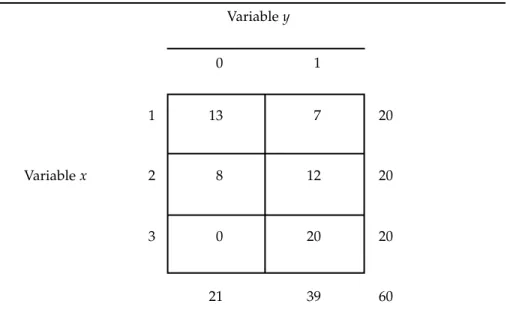
The study was carried out using a simulated data set that is summarized in Table 1. This set comprised 60 sub-jects, had a dependent and dichoto-mous variable coded 0 and 1 to repre-sent the absence and presence of response, respectively, and had a qual-itative independent variable x with three categories. In the logistic regres-sion model, this qualitative variable is represented by two indicator vari-ables, x2and x3, created using the mar-ginal method and representing cate-gories 2 and 3, respectively. The reference category is x1. Group 3 has no subjects with a dichotomous vari-able response of 0, a circumstance cre-ating a cell with a value of 0.
This data set was used by eight sta-tistical programs: BMDP, EGRET, JMP, SAS, SPSS, STATA, STATISTIX, and SYSTAT. A logistic regression of variable y over the qualitative variable x was per-formed by each program. A regression model was obtained from each pro-gram, and an attempt was made to predict the coefficients of the model’s variables as well as the standard errors. In other words, an attempt was made to reach “convergence,” through the process of solving probability equations by iterations.
RESULTS
The presence of a cell with a fre-quency equal to 0 means that an oper-ation must be performed for which there is no definable outcome; where it is impossible to estimate the coeffi-cients and standard errors; and where it makes no sense to estimate the OR for the category of the qualitative vari-able with a frequency equal to 0. Due to the numerical problem introduced, the programs fail; neither convergence nor correct results are obtained. In fact, because of the failure to achieve con-vergence, the calculation process is interrupted (at times the message “estimation terminated” is displayed). Beyond this point, each program responded differently, producing the results indicated in Table 2. With the exception of STATISTIX, all the tested
programs displayed some type of warning message, usually indicating that convergence could not be reached; and the SPSS program indicated that
the process was interrupted because the probability logarithm showed an insignificant decline. However, none of the programs indicated that the dif-ficulty was due to a cell with a fre-quency equal to 0. The SAS program
revealed in greater detail and by the use of the pound sign (#) that the
co-TABLE 1. A simulated data set for 60 subjects; no subject in category 3 of variable xhas variable y’s “0” attribute, so the frequency of subjects in cell (3, 0) is equal to 0
Variabley
0 1
1 13 7 20
Variablex 2 8 12 20
3 0 20 20
270 de Irala et al. • Confidence intervals in logistic regression
efficient estimate of variable x3 was actually an “infinite” or undetermin-able estimate (38.21#). STATA reported that the indicator variable x3had been deleted.
The BMDP and STATISTIX programs yielded the results that are regularly calculated (beta coefficient, standard error, and OR confidence interval), whereas JMP, SPSS, and SYSTAT omitted the OR confidence interval. In con-trast, EGRET, SAS, and STATA did not
yield the standard error of the coeffi-cient or the OR confidence interval; and STATAdid not calculate the coeffi-cient for the x3variable.
Three programs calculated the OR for the constant and one showed its
corresponding CI, although these pre-dictions are not useful.
DISCUSSION
It is important to emphasize that sta-tistical programs which analyze data containing numerical problems, such as the problem involved in this study, do not actually reach convergence. Therefore, the results shown depend entirely on the particular moment at which the program interrupts its itera-tive mathematical process, i.e., the preestablished convergence criterion. This accounts for why the programs produced different values of the x3
coefficient (see Table 2). The more attempts made by the program, the greater will be the value of the x3 coef-ficient and subsequent estimates, with a tendency toward infinity.
Since the warning signs observed in these analyses are not specific, it is possible that their presence and signif-icance could go undetected by an in-experienced program user. Programs that yield results, even though such results are incorrect (BMDP and STATIS -TIX), can be the most misleading for
this type of user. Programs that do not produce OR confidence intervals for the problematic variable but do gener-ate values for its coefficient and stan-dard error (JMP, SPSS, and SYSTAT) are
TABLE 2. Results obtained with the various statistical programs tested by applying logistic regression to the simulated data set shown in Table 1
Programsa 95% confidence Warning
and model variables Coefficient Standard error Odds ratio interval message
BMDP LR (1990, PC)
Constant −0.62 0.469 0.54 (0.20, 1.38) Yes
x2 1.03 0.654 2.79 (0.77, 10.04) “No convergence”
x3 10.82 22.300 0.50E 05 (0.2E −14, 0.1E 25)
EGRET (1992, 0.03, PC)
Constant −0.62 ?c 0.54 Nob Yes
x2 1.03 ? 2.79 No “No convergence”
x3 33.89 ? 0.52E + 15 No
JMP (3.01, MAC)
Constant −0.62 0.469 0.54 (.,.) Yes
x2 1.03 0.654 2.79 (0.79, 10.5) Convergence by objective,
x3 12.80 99.840 3.70E + 05 (.,.) not by gradient
SAS (1987, 6.04, PC)
Constant −0.62 0.469 No No Yes
x2 1.03 0.654 No No “No convergence”
x3 38.21#c .c No No
SPSS (1990, 4.01, PC)
Constant −0.62 0.469 No No Yes
x2 1.03 0.654 2.79 No “Estimation interrupted”
x3 10.82 36.730 0.50E 05 No
STATA (1990, 3.10, MAC)
Constant —d — No No Yes
x2 1.03 0.654 2.79 (0.77, 10.04) Variable x3not utilized
x3 — — — — No results
STATISTIX (4.0, PC)
Constant −0.62 0.469 No No No
x2 1.03 0.654 2.79 (0.77, 10.04)
x3 10.19 16.210 2.65E 04 (0.00, 0.2E 18)
SYSTAT (1991, 2.00, MAC)
Constant −0.62 0.469 No No Yes
x2 1.03 0.654 2.00 (0.77, 10.04) “No convergence”
x3 16.82 447.458 0.20E 08 (0,.)
aProgram (year, version, PC/Macintosh). bNo = not regularly calculated by the program.
Rev Panam Salud Publica/Pan Am J Public Health2(4), 1997 271
less confusing. Nevertheless, the draw-back remains that researchers can calculate the OR, estimating the expo-nential function of the given coeffi-cient, and can also calculate the CI using the standard error, even though both procedures yield meaningless values within this context. Programs such as EGRET, SAS, and STATA would
be the most appropriate for the inex-perienced user, since it is impossible to calculate parameters for variables with numerical problems on these programs.
The differences that exist between these statistical programs would not pose obstacles to the everyday user of logistic regression, who would under-stand any warning sign in the results and would heed written warnings or messages in the outcome. The presen-tation of an abnormally high coefficient (in the tens), followed by a standard error of the same magnitude, could be a valuable clue to detecting a numeri-cal problem. However, such clues are not restricted to problems with null value cells but are also found in
situa-tions involving such things as the pres-ence of colinearity. The abspres-ence of a calculated parameter, such as the OR and its CI, in a program that regularly calculates these values, is also a cause for concern. Program estimates that tend toward infinity must be rejected. In general, it is necessary to insist that such results not be published, and that the underlying problem be resolved before applying the model.
It should also be recalled that numerical problems can arise when two variables have several categories with small frequencies and these vari-ables are introduced together in a model, as in the case of an interaction term. By creating an interaction vari-able, the product of two variables, cells with no frequency can appear, along with subsequent numerical problems. To avoid this problem, it is recom-mended that there be sufficient num-bers of study subjects possessing each attribute of the qualitative variables employed (6, 7).
Some authors have stressed the importance of performing a univariate
data analysis before conducting the multivariate analysis, so as to better understand the quality and nature of the variables used and to get a general idea of the associations existing at the univariate level (8). Moreover, per-forming a descriptive and univariate analysis with all the variables before doing the multivariate analysis per-mits detection of one or more variables or categories rendered invalid by in-sufficient frequencies. In such a case, the variable or a group of its categories should be eliminated, following a bio-logic guideline, in order that there be fewer groups and higher frequencies in each. In any case, one should not be satisfied with models automatically produced by statistical software pack-ages. On the contrary, it is essential to always assess the goodness of fit before accepting the model’s validity (9). It is also preferable to use pro-grams that provide specific warnings, or that do not display values for co-efficient predictions in situations such as those involving numerical problems like the ones cited in this study.
1. Bautista LE. “Razón relativa” y “tasa relativa” como traducciones de odds ratio and hazard ratio [letter]. Bol Oficina Sanit Panam1995;119: 278–280; and Tapia JA. Respuesta. Bol Oficina Sanit Panam1995;119:280–282.
2. Rothman KJ. Modern epidemiology. 6th ed. Boston: Little Brown; 1986.
3. Hanley J. Utilizaciones adecuadas del análisis multivariante. Rev Salud Publica (Barcelona) 1989;1:45–74.
4. Hennekens CH, Buring JE. Epidemiology in med-icine. 6th ed. Boston: Little Brown; 1987.
5. Kleinbaum DG, Kupper LL, Muller KE. Applied regression analysis and other multiva-riate methods. 2nd ed. Boston: PWS-KENT; 1988.
6. Hosmer DW. Computer analysis of health sciences data: PH744 course. Amherst: University of Massachusetts; 1992.
7. Hosmer DW, Lemeshow SA. Applied logistic regression. New York: Wiley; 1989.
8. Concato J, Feinstein AR, Holford TR. The risk of determining risk with multivariable models. Ann Intern Med1993;118:201–210.
9. Hosmer DW, Lemeshow SA, Taber S. The importance of assessing the fit of logistic regression models. Am J Public Health 1991; 81:1630–1635.
Manuscript received on 18 December 1995. Revised ver-sion accepted for publication on 22 April 1996.
REFERENCES
Este estudio describe el comportamiento de ocho programas estadísticos (BMDP, EGRET,
JMP, SAS, SPSS, STATA, STATISTIXy SYSTAT), al realizar una regresión logística con una base
de datos simulados en la cual existe un problema numérico creado por la presencia de una celda con frecuencia igual a 0. Los programas responden de manera heterogénea a este problema. La mayor parte de ellos ofrecen señales de alarma, aunque muchos presentan, simultáneamente, resultados incorrectos entre los cuales destacan los inter-valos de confianza que tienden al infinito. Estos resultados pueden desorientar al usuario. Se describen diferentes criterios orientativos para detectar estos problemas en situaciones de análisis reales y se recuerda la importancia de la interpretación crítica de los resultados de programas estadísticos.
RESUMEN