Arq Bras Cardiol 2001; 76: 115-8.
Mansur et al Prescription and aherence to treatment with statins
115
Instituto do Coração do Hospital das Clínicas – FMUSP
Mailing address: Antonio P. Mansur Av. Dr. Enéas C. Aguiar, 44 05403000 -São Paulo, SP - Brazil
Objective - Statins have proved to be safe and effecti-ve in the secondary preeffecti-vention of coronary artery disease, but the level of prescription and the reasons for nonadhe-rence to treatment in many coronariopathy treatment cen-ters has not been determined. The purpose of this study was to identify reasons for nonadherence to statin therapy.
Methods - We analyzed 207 consecutive patients with coronary artery disease and hypercholesterolemia (total cholesterol ≥200mg/dL or LDL – cholesterol ≥130mg/dL). Patients’ average age was 61.7±10 year; 111 (53.6%) male were and 94 (46.6%) were female. We analyzed the level of prescription and adherence to treatment with statins.
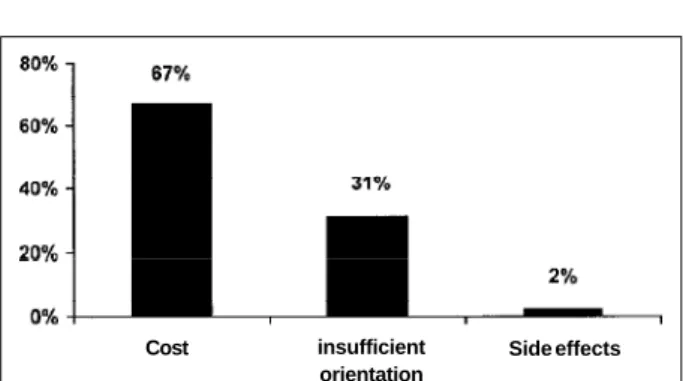
Results - Statins were prescribed for 139 (67%) pa-tients, but only 85 (41%) used the drug. In spite of being indicated, statins were not prescribed in 68 (33%) pati-ents. Of 54 (26%) patients, nonadherent to statins, 67% did not use the drug due to its high cost, 31% due to the la-ck of instruction, and only 2% due to side effects. Total cho-lesterol (260.3±42.2 vs 226.4±51.9; p<0.0001) and LDL cholesterol (174.6±38.1 vs 149.6±36.1; p<0.0001) were lower in patients on medication. HDL–cholesterol increa-sed from 37.6±9.6 to 41.5±12.9mg/dL (p=0.02), and tri-glycerides were not modified in patients using statins.
Conclusion - The prescription of statins in patients with coronary artery disease and dyslipidemia is high; ho-wever, its adherence is far from satisfactory, due to the high cost of the medication. Reduction in total cholesterol and LDL cholesterol levels did not reach the targets recom-mended by the Brazilian Consensus on Dyslipidemia.
Key words: coronary artery disease,
hypercholesterole-mia, statins, adherence.
Arq Bras Cardiol, volume 76 (nº 2), 115-8, 2001
Antonio P. Mansur, André P. L. Mattar, Cristiane E. Tsubo, Danielle T. Simão, Fábio R. Yoshi, Kuang Daci
São Paulo, SP - Brazil
Prescription and Adherence to Statins of Patients with
Coronary Artery Disease and Hypercholesterolemia
Original Article
Chronic diseases, such as arteriosclerosis, dyslipide-mia, systemic arterial hypertension, and diabetes require prolonged clinical treatment, in most cases, for one’s total life span. The patients with these diseases respond very well to nonpharmacological treatment, usually, dietary reo-rientation and adequate physical activity. However, in some patients, the addition of pharmacological treatment is necessary 1,2. The medication is frequently used for a long
period of time, when no side effects are observed. Althou-gh aware of the importance of the prescribed medication, many patients do not use it or use it irregularly 3-6. This
beha-vior is more noticeable in the aforementioned chronic disea-ses, because usually they are not associated with restricting acute symptoms. They are diseases that appear after long periods of exposure to noxious environmental influences. This problem is a fact for coronary heart disease patients as they live with a chronic problem, frequently associated with other known risk factors for coronary heart disease 7,8. As
such, these patients should undergo appropriate pharma-cological treatment, many times taking more than one medi-cation. However, the prescription by physicians and the adherence to medication by coronary heart disease pati-ents, followed up in terciary health care centers are unknown, as are the reasons that lead patients to nonadhe-rence to the proposed treatment. This study chose hyper-cholesterolemia and pharmacological treatment with statins to analyze the level of prescription by physicians and the adherence of patients to this class of medication in a qua-ternary cardiology health care clinic.
Methods
116
Mansur et al
Prescription and aherence to treatment with statins
Arq Bras Cardiol 2001; 76: 115-8.
females. Coronary heart disease diagnosis was obtained by angiography and defined as atherosclerotic lesions with over 50% occlusion in at least 1 epicardial coronary artery.
Tabagism, systemic arterial hypertension (diastolic arterial pressure >90mmHg) 9, and diabetes (glycemia
>126mg/dL) 10 were prevalent. For diagnosis of
hypercho-lesterolemia, total cholesterol values of >200mg/dL or LDL cholesterol of >130mg/dL were used. Hypercholesterolemia was the risk factor selected for this study because 1) it is a chronic disease that in most cases is diagnosed in the laboratory, 2) it rarely causes symptoms that may influence conduct, 3) changes in its conduct are usually verified via blood tests, 4) it responds adequately to treatment that takes a few weeks, 5) it can be treated efficiently and safely with statins, 6) treatment with the regular use of medication is associated with significant lowering of cholesterol levels. The level of prescription and adherence to statins by patients were analyzed according to the Brazilian Consen-sus on Dyslipidemia 11. Nonadherence was classified as 1)
lack of understanding by patients of the physician’s ins-tructions for taking the medication, for example use the sta-tins for only a month, take the stasta-tins on alternate days, stop taking the statin after normalization of the cholesterol levels, among other things, 2) due to side effects, considering all those described for the medication, 3) nonutilization of the medication, in spite of having the prescription. In this case, the motives were questioned.
Serum triglyceride levels, total cholesterol, HDL–cho-lesterol, and LDL –cholesterol were analyzed in all patients, before and after the prescription or nonprescription of sta-tins, average of 6.1±1.4 months.
The statistical analysis was performed with the chi-s-quare test for categorical variables and the Student’s t test
for analysis of fractions that compose the lipid profile. Statistically significant values were p <0.05.
Results
The clinical characteristics of patients are provided in Table I. Statins were prescribed for 139 (67%) patients. Sim-vastatin, atorSim-vastatin, and pravastatin were prescribed, respectively, for 72%, 21%, and 7% of the patients who recei-ved a prescription. Eighty-five (41%) took the medication re-gularly, while the remaining 122 (59%) did not take the medi-cation or took it irregularly. In 68 (33%) patients, in spite of being indicated, statins were not prescribed. Irregular use of the medication was observed in 54 (26%) of patients (fig.1). In these patients, the cost of the medication was ma-inly responsible for nonadherence; in 17 (31%) it was due to lack of proper instruction on the use of the drug, and in 1 (2%) it was due to side effects, in particular myalgia. Total cholesterol was lowered from 260.3±42.2 to 226.4±51.9mg/ dL (p<0.0001) and LDL cholesterol from 174.6±38.1 to 149.6±36.1mg/dL (p<0.0001) in patients who used statins regularly. HDL–cholesterol increased from 37.6±9.6 to 41.5±12.9 mg/dL (p+0.02), and triglycerides were not modified in patients using statins. Serum triglyceride levels,
total cholesterol, HDL–cholesterol, and LDL cholesterol were similar in groups of patients who did not use the medi-cation or who used it irregularly (Table II).
Discussion
Prescription of statins in hypercholesterolemia treat-ment was effective in practically 70% of patients with coro-nary heart disease, which shows the awareness of attending physicians of the need to control this risk factor, selected for analysis of adherence in this study. However, for a signifi-cant number of patients, this knowledge was not transmit-ted adequately. This information should be better explained to the patient by the health worker, not necessarily by the
Table I – Clinical characteristics of patients adherent or nonadherent to statins.
N (207) Adherent(85) Nonadherent (122)
Age (year) 60.4±9.8 61±11
Gender (M/F)* 36 / 33 74 / 64
Tabagism 27 (32%) 43 (35%)
SAH 44 (52%) 61 (50%)
Diabetes mellitus 15 (17%) 13 (16%) Triglyceride(mg/dl) 222.1±58.2 232±64,4 Total cholestero (mg/dl) 260.3±42.2 245.6±55.3 HDL – cholesterol (mg/dl) 37.6±9.6 38.3±8.6 LDL - cholesterol (mg/dl) 174.6±38.1 176.2±31
M- male; F- female; SAH- systemic arterial hypertension.
Table II – Lipid profile of patient adherent or nonadherent to statins
Adherent (N=85)
Initial Final p
Triglyceride(mg/dl) 222.1±58.2 218.2±48.6 0.636 Total cholesterol (mg/dl) 260.3±42.2 226.4±51.9 <0.0001 HDL – cholesterol (mg/dl) 37.6±9.6 41.5±12.9 0.027 LDL-cholesterol (mg/dl) 174.6±38.1 149.6±36.1 <0.0001 Non-adherent (N=122)
Triglyceride(mg/dl) 232±55.3 229±72.5 0.717 Total cholesterol (mg/dl) 245.6±55.3 246.3±49 0.917 HDL cholesterol (mg/dl) 38.3±8.6 38.6±10.1 0.803 LDL cholesterol (mg/dl) 176.2±31 179.4±39.2 0.480 Figure 1 – Motives for patient nonadherence to statins
Cost insufficient orientation
Arq Bras Cardiol 2001; 76: 115-8.
Mansur et al Prescription and aherence to treatment with statins
117
physician. Nurses, nutritionists, and pharmacists are exam-ples of health workers who can also satisfactorily transmit information to improve patient adherence in the control of risk factors12,13. This, because chronic diseases are
associa-ted with more complex variables that interfere with patients’ adherence to treatment, and often patients have doubts about their own understanding of the meaning of “coronary disease”, of risk factors, of the necessity for long-term treatment, of the cost-benefit relation ratio of the treatment, and other things. Lack of information favors nonadherence to treatment and can stimulate the patient to try unconven-tional or nonevidence-based therapeutics. To avoid these problems, information transmitted to patients should be clear and objective, which is not always possible for the physician. Reasons for this situation transcends the scien-tific language and the physician-patient relationship, the latter more and more affected by the physicians’ actual work situation. In this study, patient nonadherence due to side effects was very low and similar to the prevalence ob-served in some multicenter studies. It is known that statins are efficient and safe. The most frequent side effects are the increase of liver enzymes and myalgia 14. However in this
study, the most important factor of patient nonadherence to statins was the cost of statins, a problem also observed in other countries 15-17. This fact is extremely important as it is
known that the use of these medications reduces the preva-lence of new cardiovascular events, as much in primary as in secondary prevention 18. In coronary heart disease patients,
a further reduction in serum levels of LDL cholesterol, to less than 100mg/dL 11 has been proposed. It is also known
that for patients with stable coronary heart disease, besides statins, acetylsalicylic acid and beta-blockers are other me-dications that reduce morbidity and mortality, and these lat-ter 2 medications are more reasonably priced for our popula-tion, thus promote better adherence. So that prescription of this triad of medications becomes a reality, urgent discus-sions regarding the price of statins is are necessary. Becau-se cardiovascular diBecau-seaBecau-ses, ischemia, and stroke are the
main causes of death in the Brazilian population, they are important public health issues.
Adherence to treatment depends on various factors related or not to patients’ wishes. One of these factors of nonadherence is the inadequate communication between health care workers and patients, resulting in the patient’s incapabilit of following medical recommendations, a fact more evident in older or semiilliterate patients 19. However,
the main restricting factor of chronic or long-term use is the cost of the medication.
It is important to note that, in spite of reductions in se-rum cholesterol and sese-rum LDL–cholesterol levels, as an average, the levels recommended by the Brazilian Consen-sus on Dyslipidemia were not reached. To reach these goals in the long-term would signify a decrease in morbidity and mortality due to cardiovascular diseases in the population under study.
Other risk factors, such as arterial hypertension and diabetes, were not selected for this study, as they are po-tentially unstable diseases and could require alterations or changes in medications therefore causing increased side ef-fects and decreased adherence. A global analysis of adhe-rence, from a medical or socioeconomic point of view, would be affected.
In conclusion, the prevalence of the prescription of statins for patients with coronary heart disease and dyslipi-demia is high, suggesting recognition, by the medical com-munity of the drug’s efficiency. In spite of the ample pres-cription of statins, adherence to their use is still far from satisfactory, mainly due to the high cost of the medication. At the same time, the reduction in total cholesterol and LDL-cholesterol did not reach the levels recommended by the Brazilian Consensus on Dyslipidemia.
Acknowledgements
To Drs. Ângela Raineri, Desidério Favarato, José R.M. Martins.
1. Denke MA. Diet and lifestyle modification and its relationship to atherosclero-sis. Med Clin North Am 1994; 78: 197-223.
2. Brown AD, Garber AM. Cost effectiveness of coronary heart disease prevention strategies in adults. Pharmacoeconomics 1998; 14: 27-48.
3. Mansur AP, Gomes EPSG, Favarato D, Raineri A, Martins JRM, Ramires JAF. Tra-tamento medicamentoso da doença arterial coronariana estável em centros de atendimento primário e terciário. Arq Bras Cardiol 1997; 69: 165-8. 4. McDermott MM, Schmitt B, Wallner E. Impact of medication nonadherence on
coro-nary heart disease outcomes. A critical review. Arch Intern Med 1997; 157: 1921-9. 5. Campbell NC, Thain J, Deans HG, Ritchie LD, Rrawles JM. Secondary prevention in coronary heart disease: baseline survey of provision in general practice. Br Med J 1998; 316: 1430-4.
6. Campbell NC, Thain J, Deans HG, Ritchie LD, Rawles JM, Squair J. Secondary prevention clinics for coronary heart disease: randomised trial of effect on health. Br Med J 1998; 316: 1434-7.
7. Mansur AP, Gomes EPSG, Avakian SD, et al. Clustering of traditional risk factors in women with stable coronary artery disease. Cardiovasc Risk Factors (no prelo). 8. EUROASPIRE. A European Society of Cardiology survey of secondary
pre-References
vention of coronary heart disease: principal results. EUROASPIRE Study Group. European Action on Secondary Prevention through Intervention to Reduce Events. Eur Heart J 1997; 18: 1569-82.
9. III Consenso Brasileiro de Hipertensão. Rev Bras Cardiol 1999; 3: 96-100. 10. American Diabetes Association: clinical practice recommendations 1999.
Dia-betes Care 1999; 22(suppl 1): S1-114.
11. Consenso Brasileiro Sobre Dislipidemias: Detecção, Avaliação e Tratamento. Arq Bras Cardiol 1996; 67: 113-28.
12. Smith SC Jr. The challenge of risk reduction therapy for cardiovascular disease. Am Fam Physician 1997; 55: 491-500.
13. Becker DM, Raqueno JV, Yook RM, et al. Nurse-mediated cholesterol ma-nagement compared with enhanced primary care in siblings of indivi-duals with premature coronary disease. Arch Intern Med 1998; 158: 1533-9.
14. Pedersen TR, Berg K, Cook TJ, et al. Safety and tolerability of cholesterol lowe-ring with simvastatin dulowe-ring 5 years in the Scandinavian Simvastatin Survival Study. Arch Intern Med 1996; 156: 2085-92.
118
Mansur et al
Prescription and aherence to treatment with statins
Arq Bras Cardiol 2001; 76: 115-8.
HMG-CoA reductase inhibition for primary and secondary prevention of coro-nary heart disease. JAMA 1991; 265: 1145-51.
16. Troche CJ, Tacke J, Hinzpeter B, Danner M, Lauterbach KW. Cost-effectiveness of primary and secondary prevention in cardiovascular diseases. Eur Heart J 1998; 19(suppl C): 59-65.
17. Pickin DM, McCabe CJ, Ramsay LE, et al. Cost effectiveness of HMG-CoA
re-ductase inhibitor (statin) treatment related to the risk of coronary heart disease and cost of drug treatment. Heart 1999; 82: 325-32.
18. Bucher HC, Griffith LE, Guyatt GH Systematic review on the risk cholesterol-lowering interventions. Arterioscler Thromb Vasc Biol 1999; 19: 187-95. 19. Morrow D, Leirer V, Sheikh J. Adherence and medication instructions. Review