Article
J. Braz. Chem. Soc., Vol. 23, No. 12, 2222-2231, 2012. Printed in Brazil - ©2012 Sociedade Brasileira de Química 0103 - 5053 $6.00+0.00
A
*e-mail: [email protected]
Development of an Amperometric Enzyme Electrode based on
Poly(
o
-Phenylenediamine) for the Determination of Total Cholesterol in Serum
Derya Koyuncu Zeybek,*,a Bülent Zeybek,a Nuran Özçiçek Pekmez,bŞule Pekyardımcıc and Esma Kılıçc
aDepartment of Chemistry, Faculty of Arts and Sciences, Dumlupınar University, Kütahya, Türkiye
bDepartment of Chemistry, Faculty of Science, Hacettepe University, Ankara, Türkiye
cDepartment of Chemistry, Faculty of Science, Ankara University, Ankara, Türkiye
Um eletrodo enzimático amperométrico baseado em polímero foi preparado para detecção amperométrica de colesterol livre. Inicialmente, o filme polimérico poli(o-fenilenodiamina) (PoPD) foi eletropolimerizado no meio acetonitrila-água contendo o monômero o-fenilenodiamina (oPD) e ácido canforsulfônico em eletrodo de Pt através da técnica de voltametria cíclica. A enzima oxidase colesterol foi imobilizada sobre a superfície do eletrodo Pt/PoPD. A determinação de colesterol foi realizada por maio do monitoramento da corrente de oxidação de H2O2 produzido
enzimaticamente a +0,7 V vs. Ag/AgCl. A concentração da solução tampão, o valor de pH e a temperatura de trabalho otimizados foram 0,05 mol L−1, 7,5 and 40 °C, respectivamente. O
intervalo de trabalho do eletrodo de enzima para colesterol foi 9,8 × 10⁻³-11 µmol L−1 e tempo de
resposta 150 s. Os efeitos de possíveis interferências presentes em amostras de soro em resposta ao eletrodo de enzima foram examinados. A determinação do colesterol total em amostras de soro foi realizada usando o eletrodo de enzima Pt/PoPD/ChOx proposto e os resultados foram em bom acordo com os obtidos pelo método espectrofotométrico.
A polymer-based amperometric enzyme electrode (Pt/PoPD/ChOx) was prepared for the amperometric detection of free cholesterol. Firstly, poly(o-phenylenediamine) (PoPD) polymer film was prepared in acetonitrile-water medium containing o-phenylenediamine (oPD) monomer and (±)-10-camphorsulfonic acid (HCSA) on Pt electrode by the use of cyclic
voltammetry technique. Cholesterol oxidase (ChOx) enzyme was immobilized onto Pt/PoPD electrode surface. The determination of cholesterol was performed via monitoring of the oxidation current of enzymatically produced H2O2 at +0.7 V vs. Ag/AgCl. Optimum buffer concentration,
pH and working temperature were found as 0.05 mol L−1, 7.5 and 40 °C, respectively. The
working range of enzyme electrode to cholesterol was 9.8 × 10⁻³-11 µmol L−1 and response time
150 s. The effects of possible interferences present in serum samples on response of enzyme electrode were examined. The determination of total cholesterol in serum samples was performed by using proposed Pt/PoPD/ChOx enzyme electrode and results were in good agreement with those obtained by spectrophotometric method.
Keywords: biosensor, cholesterol, poly(o-phenylenediamine), serum, hydrogen peroxide
Introduction
Cholesterol and its fatty acid esters are structural component of mammalian cell membranes and are also precursors of various biological constituents such as, vitamin D, steroid hormones and bile acids.1,2 Although
cholesterol is a significant and essential molecule, high cholesterol levels in blood are related to hypertension, myocardial infarction, cerebral thrombosis and
arteriosclerosis.3,4 Since the concentration of total cholesterol
in blood is important for diagnosis and prevention of these diseases, various methods such as spectrophotometry and chromotography have been developed for determination of cholesterol.5-11 However, these methods are usually
laborious, expensive, time-consuming and/or complicated. An alternative method of determination of cholesterol is amperometric enzyme electrodes which allow rapid, accurate, low-cost and sensitive analysis.3,12 Various types
Cholesterol oxidase (ChOx), in the presence of molecular oxygen, catalyzes the oxidation and isomerization of cholesterol by forming cholest-4-en-3-one and hydrogen peroxide as shown in equation 1.2
(1)
The oxidation current of hydrogen peroxide can be detected at applied potential and the current is proportional with the concentration of hydrogen peroxide and thus the concentration of cholesterol in the samples.4,15
(2)
Since oxidation of hydrogen peroxide requires high working potential such as +0.7 V (vs. Ag/AgCl), other electroactive substances present in biological samples are also oxidized and interfere the response.24,25 Basically, two
options are available to avoid the effects of interferences. One is to lower the applied potential by using electron transfer mediators26-29 and the other one is to employ
a permselective polymer films in order to decrease the interferences.30
In amperometric enzyme biosensors, polymer films prepared by electropolymerization which used as immobilization matrixes have been frequently employed.31
Electropolymerization is often carried out in aqueous or non-aqueous solution containing monomer by using chronoamperometric or cyclic voltammetric techniques. Unlike various methods that used in development a biosensor, electropolymerization presents many advantages such as reproducibility, thickness control and the uniformity of the polymer film and give permission to simple preparation of polymer film modified electrodes.32
The conducting polymers such as polypyrrole,3,33-35
polyaniline17,36 and polythiophene37 have been widely used
for the biosensors development. These polymers have a high conductivity, stability and also amount of biomaterial can be controlled during electropolymerization process.32 In
addition, nonconducting polymers such as polyphenol and its derivates, polyphenylenediamines and overoxidized polypyrrole also have been used as an immobilization matrix for enzymes. Since nonconducting polymers are very thin because of their self-limited growth, the response of amperometric biosensor based on nonconducting polymer to their substrate can be resembled to that of an unmodified electrode. They also have advantages, including permselectivity and reproducibility, and thus can eliminate possible interferences such as ascorbate, uric acid, acetaminophen, urea, etc. present in real samples. Polyphenylenediamines have been extensively reported
for development a biosensor because of the excellent permselective properties. Since for many oxidase-based amperometric biosensors, detections of substrates are carried out via monitoring enzymatically produced hydrogen peroxide, polymer films should be highly permeable to hydrogen peroxide and efficiently eliminate the interference
species. Ortho isomer poly(o-phenylenediamine) of
polyphenylenediamines is the most studied form, and is the subject of the present study.38 Poly(o-phenylenediamine)
films have been widely used on amperometric glucose,26,30,39-45
phenol,46 L-lysine47,48 and ethanol49 biosensor for elimination
of interference from electroactive species present in real samples. A literature search revealed that there were no reports of biosensor prepared by the polymerization conditions used in this study. In various studies, working electrodes were coated by poly(o-phenylenediamine) film using aqueous solution of monomer as an outer layer for elimination interferences.38,50 In cholesterol biosensors,
poly(o-phenylenediamine) films were also used for
elimination interference and determination of cholesterol in human serum could not be performed by using prepared biosensor.12,51 However, in the present study, poly(o
-phenylenediamine) film is composed both permselective membrane and immobilization matrix for enzyme.
In the present study, amperometric cholesterol enzyme electrode was developed and optimizations of working conditions were carried out. For this purpose, cholesterol oxidase (ChOx) enzyme was immobilized on the electrochemically synthesized poly(o-phenylenediamine) polymer films using glutaraldehyde. It was concluded that polymeric film reduced the effects of interferent substances such as uric acid, L-ascorbic acid, urea, etc. present in serum. The amounts of total cholesterol in serum samples were determined and > 0.998 correlation was obtained between proposed enzyme electrode results and those obtained by spectrophotometric method.
Experimental
Apparatus and reagents
Electrochemical experiments were performed with IVIUMSTAT electrochemical analyzer (Ivium Techonologies, Netherlands) using a three-electrode cell stand (Bioanalytical Systems, Inc., USA). In the electropolymerization studies, working electrode was platinum disk electrode (4 mm diameter). A silver wire in contact with 0.01 mol L−1 AgNO
3 and Pt foil were
used as the reference electrode and counter electrode, respectively. The 0.01 mol L−1 AgNO
3 solution in the
0.1 mol L−1 tetrabutylammonium perchlorate (TBAP)
as the supporting electrolyte. In amperometric detection experiments, polymer film coated Pt disc electrode or enzyme immobilized polymer coated Pt disc electrode were used as working electrode. Reference and counter electrodes were Ag/AgCl electrode (BAS MF 2052) and Pt wire (BAS MW 1034), respectively. The pH values of the buffer solutions were measured with ORION Model 1906 D 720A pH/ion meter (Thermo Scientific, USA). Temperature control was achieved with Grant LTD GG thermostat (Grant Instruments, UK). Scanning electron micrographs were taken with a Jeol JSM-7000F field emission scanning electron microscope (FESEM) (Jeol Ltd., Japan). All solutions were prepared with deionized water of resistivity not less than 18 MΩ cm taken from an Elga Purelab Classic water purification system (Veolia Water Systems Ltd., UK).
Cholesterol oxidase from P s e u d o m o n a s s p. (2.4 U mg-1 EC 1.1.3.6), water soluble cholesterol, ascorbic
acid, urea and uric acid were all purchased from Sigma. Cholesterol esterase from porcine pancreas (44.4 U mg-1
EC 3.1.1.13), TBAP, AgNO3, paracetamol and creatinine
were supplied from Fluka. o-Phenylenediamine monomer, (±)-10-camphorsulfonic acid and Li2CO3 were obtained
from Aldrich. Acetonitrile, hydrogen peroxide, di-sodium monohydrogen phosphate heptahydrate and sodium dihydrogen phosphate dihydrate were purchased from Riedel de Haën.
Electropolymerization process
The working electrodes were polished by alumina particles (sizes 0.05 µm) thoroughly and ultrasonically cleaned in ethanol and double distilled water sequentially. The Pt disk electrode was immersed in acetonitrile (94%)-water (6%) mixture containing 0.1 mol L−1o-phenylenediamine
(o-PD) and 0.2 mol L−1 (±)-10-camphorsulfonic acid
(HCSA). The solution was purged with argon in order to remove the oxygen. The electropolymerization
of o-phenylenediamine was performed by potential
cycling between −0.4 and +2.2 V vs. Ag/Ag+ at a scan
rate 0.025 V s−1 with 50 cycles. The obtained Pt/PoPD
electrode was immersed into acetonitrile and dried at room temperature.
Preparation of enzyme electrode
Pt/PoPD electrode was dipped into 250 µL cholesterol oxidase (ChOx) (2.4 U mL-1) solution containing 5 µL
glutaraldehyde (25%) for 12 h at +4 °C for immobilization of enzyme molecules. The prepared Pt/PoPD/ChOx enzyme
electrode was rinsed with buffer solution in order to remove any unbounded enzyme molecules. The enzyme electrode was kept in refrigerator at +4 °C when it was not in use.
Amperometric measurements
All amperometric measurements were performed in phosphate buffer solution (0.05 mol L−1 pH 7.5). In this
study, the determination of free cholesterol was based on electrooxidation of H2O2 at +0.7 V (vs. Ag/AgCl)
at the surface of polymer film electrode therefore, it was first investigated whether Pt/PoPD electrode was sensitive to H2O2 or not. For this purpose, 5.0 mL of buffer
solution were added to the electrochemical cell and a steady-state background current was allowed to decay at a constant value at +0.7 V (vs. Ag/AgCl). Then aliquots of hydrogen peroxide solution were added to electrochemical cell and the current responses were recorded at +0.7 V (vs. Ag/AgCl). The current values were plotted against hydrogen peroxide concentration in order to the determination of the sensitivity. The amperometric detection of free cholesterol was carried out at +0.7 V vs. Ag/AgCl via electrochemical oxidation, at the Pt/PoPD/ChOx electrode, of hydrogen peroxide generated in enzymatic reaction. First, enzyme electrode was equilibrated in phosphate buffer solution at +0.7 V (vs. Ag/AgCl) until a constant current was obtained. Then aliquots of cholesterol solution were added to electrochemical cell and the current responses were recorded.
Results and Discussion
In this study, a new amperometric cholesterol enzyme electrode based on PoPD was prepared. The hydrogen peroxide sensitivity of Pt/PoPD electrode, surface characterization, optimum working conditions and performance factors of the Pt/PoPD/ChOx electrode and effects of interferences were studied and results were given below. The determination of total cholesterol in serum samples was also performed.
Preparation of PoPD film
The optimization studies of electropolymerization of
o-phenylenediamine (o-PD) were conducted in elsewhere.52
0.025 V s−1 with 50 cycles and the cyclic voltammogram
obtained during electropolymerization is given in Figure 1. In the first scan, the anodic current started increasing at about 0.15 V and reached to maximum value at 1.8 V, which corresponds to the oxidation of protonated oPD monomer. This irreversible peak shifted to negative potential and its intensity decreased regularly during subsequent scans, indicating that the polymeric film was formed and formation of PoPD film blocked further access of monomers to Pt electrode surface.40,47,50
The hydrogen peroxidesensitivity of Pt and Pt/PoPD electrodes
In this study, the determination of free cholesterol was based on electrooxidation of H2O2 at +0.7 V
(vs. Ag/AgCl) at the surface of polymer film electrode therefore, it was first investigated whether Pt/PoPD electrode was sensitive to H2O2 or not. The same
experiment was also performed for Pt disk electrode for comparison. The amperometric responses of Pt and Pt/PoPD electrodes as a function of H2O2 concentration
were shown in Figure 2A. It can conclude that PoPD film has composed a permeable membrane against H2O2 and
sensitivity obtained with Pt/PoPD electrode to H2O2 was
as same as those obtained with Pt electrode. In conclusion, Pt/PoPD electrode can be used as an immobilization matrix for the development of the biosensor based on oxidase enzymes. The response of amperometric electrodes based on non-conducting polymers like PoPD can be equated to that uncovered electrode.53,54
The electrochemical behavior of polymer film in the presence and absence of hydrogen peroxide was examined
by the cyclicvoltammetry. As can be seen in Figure 2B, adding hydrogen peroxide to the PBS caused an increase in the oxidation current.
Characterization of the electrodes with SEM
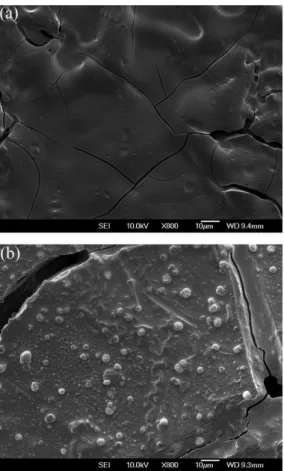
The physical morphology of polymer film has significant role in the immobilization of the enzyme and reflects the performance of the enzyme electrode. The morphologies of PoPD and PoPD/ChOx films were characterized by field emission scanning electron microscopy (FESEM). A typical SEM micrograph of Pt/PoPD (Figure 3a) displays a smooth and uniform morphology. The cracks observed on polymer film surface are resulted from the nature of PoPD polymer film.55,56 As seen in Figure 3b, the SEM
micrograph of the ChOx immobilized onto Pt/PoPD
electrode surface exhibits covered and globular structure indicating immobilization of enzyme.
Pt/PoPD/ChOx enzyme electrode was used for
determination of free cholesterol. Optimization of working condition such as buffer concentration, buffer pH and Figure 1. Cyclicvoltammograms obtained during electropolymerization
of o-PD on Pt electrode in acetonitrile (94%)-water (6%) mixture containing 0.1 mol L−1o-phenylenediamine (o-PD) and 0.2 mol L−1 (±)-10-camphorsulfonic acid (HCSA). Conditions: potential cycling range of −0.4-2.2 V, scan rate of 0.025 V s−1 and 50 cycles.
temperature, performance factors such as response time, reusability and reproducibility were also evaluated. Besides the effects of substrate concentration and interferences on amperometric response were studied. Total cholesterol in serum was analyzed by using proposed enzyme electrode and results were presented below.
Effects of buffer concentration and pH
Current-cholesterol concentration plots of the Pt/PoPD/ChOx enzyme electrode were obtained in four different phosphate buffer concentrations (0.05-0.2 mol L−1)
at a pH value of 7.5. The slopes (sensitivity) of the calibration curves were plotted against the buffer concentration. Sensitivity values diminished while moving towards increased buffer concentration and optimum buffer concentration was found as 0.05 mol L−1. This result is in
good agreement with that of the polymer based cholesterol biosensors.17,19,21,36
The pH value has important effects on enzyme activity and thus enzyme activity should change with the pH of buffer. The sensitivities of Pt/PoPD/ChOx enzyme electrode as function of pH are shown in Figure 4. The sensitivity increased from pH 6.0 to 8.0 and the highest
sensitivity was obtained at pH 8.0. However, sensitivities in the range of pH 7.0-8.0 were not different from each other and at pH 7.5 linear working range was relatively broader than others (not shown). For this reason, pH 7.5 which is close to that of the optimum pH of free cholesterol oxidase is chosen to be used in further experiment. This indicated that the optimum pH value of the enzyme may not be affected by immobilization procedure.57 These
results are compatible with the similar studies in the literature.3,19,21,36,57
Effect of the working temperature
The evaluation of the temperature dependence on the enzyme electrode performance, calibration curves of the Pt/PoPD/ChOx electrode under temperatures varied from 10 to 50 °C were plotted and sensitivities were compared in Figure 5. As seen from figure, the sensitivity increases with the increase of temperature up to 40 °C and beyond this value decrease in the sensitivity is observed. The enzyme is thought to be denatured after this temperature. Although different temperatures were reported as optimum, it was observed that in cholesterol biosensors based on polymer films were carried out at room temperature.21,23 For practical
applications, following experiments were carried out at room temperature (23 ± 2 °C).
Reusability, reproducibility, response time and life time
For the evaluation to reusability of Pt/PoPD/ChOx, five calibration curves were plotted by using same electrode at +0.7 V (vs. Ag/AgCl) sequentially. The relative standard deviation of sensitivities was found to be 4.2%. In addition, the reproducibility of enzyme electrode is investigated to plot calibration curves by using three different enzyme electrodes and the relative standard deviation of sensitivity Figure 3. SEM micrographs of (a) Pt/PoPD electrode and (b) Pt/PoPD/ChOx
enzyme electrode.
values was found as 5.5%. These results indicate that the reusability and reproducibility of the enzyme electrode were highly satisfactory and the electrode can be used for many analyses.
The response time that is defined as the time it takes for the electrode to reach 95% of the steady-state current of the Pt/PoPD/ChOx enzyme electrode was determined at two different cholesterol concentrations. The current differences for 1.0 × 10⁻⁶ mol L−1 and 1.0 × 10⁻⁵ mol L−1 cholesterol
against time were plotted. The response time can be taken as ca. 150 s in which the currents are approximately constant.
To evaluate the life time and stability of Pt/PoPD/ChOx electrode, amperometric response to cholesterol was measured for two weeks and sensitivity values of electrode were compared. Enzyme electrode retained 41% of initial sensitivity after six days.
Effect of the cholesterol concentration
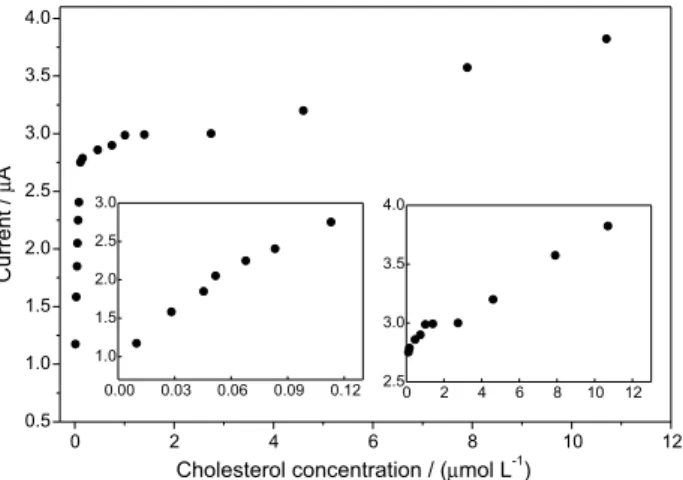
In order to determine the linear working range of the cholesterol enzyme electrode, the amperometric response of the Pt/PoPD/ChOx electrode was recorded as a function of the cholesterol concentration (Figure 6). The two linear working ranges were obtained. The first range was linear from 9.8 × 10⁻³ µmol L−1 to 1.1 × 10⁻¹ µmol L−1 with a
regression equation of y = 15.18x + 1.12 (R2 = 0.9826) and
the second one was linear from 1.1 × 10⁻¹ µmol L−1 to
11 µmol L−1 with a regression equation of y = 0.095x + 2.80
(R2 = 0.9769). The limit of detection of the biosensor
is 9.8 × 10⁻³ µmol L−1 and sensitivities of biosensor
are 15.18 µA µmol−1 L (for the first linear range) and
0.095 µA µmol−1 L (for the second linear range).
Normal human blood plasma contains 130-260 mg dL−1
(3.4-6.7 mmol L−1) cholesterol. This range does not cover
the normal serum total cholesterol level. The response
at lower concentrations is important when working with diluted samples to avoid the interferences.58
Interference study
The effects of various interferences (ascorbic acid, glucose, creatinine, paracetamol, urea, aspartic acid and uric acid) which present in blood on Pt/PoPD/ChOx enzyme electrode response were investigated. The solutions of these substances were added into buffer solution containing 1.0 × 10⁻³ mmol L−1 cholesterol one by one and
current responses at +0.7 V (vs. Ag/AgCl) were recorded. The percentages of interference were determined as the difference in percentage of response between the buffer solution containing cholesterol and interferences and over that of cholesterol. The results were summarized in Table 1 and it can be concluded that uric acid caused 17.6% interference at the highest concentration in serum. It was reported that dilution reduced the effect of interferences.58 Figure 5. Sensitivity of the Pt/PoPD/ChOx enzyme electrode as
function of temperature in 0.05 mol L−1 phosphate buffer (pH 7.5) at +0.7 V vs. Ag/AgCl.
Figure 6. Calibration curve of the Pt/PoPD/ChOx enzyme electrode for cholesterol in 0.05 mol L−1 phosphate buffer (pH 7.5) at +0.7 V vs. Ag/AgCl.
Table 1. Interference study
Interference Concentrationa / (mmol L−1)
Interferenceb / %
Ascorbic acid 0.1 8.7
Glucose 4.0 9.9
Creatinine 0.1 2.8
Paracetamol 0.1 9.0
Urea 0.8 3.9
Aspartic acid 0.01 3.3
Uric acid 0.5 17.6
Analysis of the total cholesterol in blood serum
The determination of total cholesterol in serum samples is important for clinical diagnosis of many disorders. Since the two-third of cholesterol in blood is esterified with fatty acids, for the determination of total cholesterol, both cholesterol esterase (ChEt) and cholesterol oxidase enzymes must be used. Cholesterol esterase catalyzes the hydrolysis of the esters by following reaction (equation 3):
(3)
Therefore, for determination of total cholesterol present in serum samples, first, the samples were incubated with cholesterol esterase enzyme at 37 °C for 10 min to ensure that all esterified cholesterol was hydrolyzed. A dilution was performed to have the cholesterol concentration inside the working range of the response. Thus, the possible interference caused by the electroactive species present in the serum decreased considerably.27 The concentration
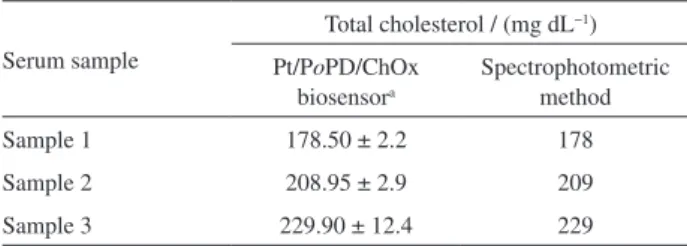
of total cholesterol of three serum samples were analyzed with the proposed Pt/PoPD/ChOx by standard addition method and results were compared with hospital method (Table 2). The total cholesterol concentrations obtained from analyses of serum samples by both methods were plotted and the following equation was obtained:
y = 0.99x – 0.77 (R2 = 0.9997).
It was also checked the accuracy of the method by student’s t-test. The t-value is 1.63 for Pt/PoPD/ChOx at 95% confidence level, for which tcritic is 4.30. It can be concluded that there is no difference between the results of two methods at a confidence level of 95%.
In the literature, various amperometric biosensors have been development for determination of free cholesterol, however in those studies, monitoring of total cholesterol in serum samples has not been performed using above mentioned biosensors.13,17,21,23,36,59 In many studies,
cholesterol contents of synthetic serum samples like Accutrol™ were determined.16,35 Brahim et al.14 reported
a amperometric biosensor to the determination of total cholesterol in serum samples with a correlation coefficient of 0.998. Li et al.57 used carbon nanotubes modified
electrodes for detection of cholesterol in serum samples and correlation coefficient of 0.943 was obtained between proposed enzyme electrode results and those obtained by spectrophotometric method. Basu et al.20 developed
a cholesterol biosensor for analysis of total cholesterol in food samples like egg and meat and concluded that biosensor showed close results as with the colorimetric
method. Our group also demonstrated Pt/PoPD/ChOx
biosensor was used for the determination of total cholesterol in serum samples with correlation coefficient of 0.99.
The characteristics of the some other polymer film based cholesterol biosensors in literature are summarized in Table 3 in order to compare with the proposed poly(o-phenylenediamine) film based cholesterol biosensor. Table 3 clearly shows that the different characteristics of proposed biosensor are better in some cases or comparable with some given cholesterol biosensor. It shown that the limit of detection (9.8 × 10⁻³ µmol L−1) of the
Pt/PoPD/ChOx electrode is lower than that of reported for cholesterol biosensors that include 0.4 mmol L−1 for
Pt/PEDOP-ChOx electrode,23 2.5 mg dL−1 (64.8 µmol L−1)
for PVC/ChOx-ChEt cell containing CPE-HRP electrode,60
0.012 mmol L−1 for Pt/SAM/PB/PPy-ChOx/Nf electrode,24
120 µmol L−1 for Pt/pHEMA/PPy/ChOx electrode,14
14 µmol L−1 for Pt/Pt/PPy-ChOx electrode and 12.6 µmol L−1
for Pt/Pt/PPy-ChOx/PoPD electrode,12 10.9 mmol L−1 for
Pt/Pt/PPy-ChOx+FcMc electrode and 12 mmol L−1 for
Pt/Pt/PPy-ChOx+FMN electrode,27 1.35 µmol L−1 for
Pt/PPy-ChOx electrode and 0.68 µmol L−1 for
Pt/PPy-ChOx/PoPD electrode.51 Also, the working
ranges (9.8 × 10⁻³-1.1 × 10⁻¹ µmol L−1 and 1.1 × 10⁻¹
-11 µmol L−1) of the proposed electrode are wider than
those of some reported for cholesterol biosensors that
contain 0.1-0.5 mmol L−1 for Pt/PVF+ClO
4−-ChOx
electrode,21 50-500 mg dL−1 (1.3-13 mmol L−1) for
ITO/PANI/ChEt/ChOx electrode,17 1-8 mmol L−1 for
Pt/PPy-ChEt-ChOx electrode,33 0.05-0.3 mmol L−1 for
Pt/SAM/PB/PPy-ChOx/Nf electrode,24 0.5-15 mmol L−1
for Pt/pHEMA/PPy/ChOx electrode,14 0.04-0.27 mmol L−1
for PG/TBMPC-ChOx-HRP electrode,13 0.01-0.1 mmol L−1
for Pt/PANI-ChOx (1% Triton X-100) electrode and 0.05-0.2 mmol L−1 for Pt/PANI-ChOx (5% Triton X-100)
electrode,3 0.025-0.3 mmol L−1 for Pt/PPy-ChOx electrode.35
The present biosensor has superiority that it allows to determine in low concentration of cholesterol. Thus, the cholesterol can be analyzed in more dilute samples and the interference effects of the electroactive species present in the serum can be decreased due to the dilution procedure.27 Table 2. Determination of total cholesterol content in serum samples
using the proposed enzyme electrode
Serum sample
Total cholesterol / (mg dL−1)
Pt/PoPD/ChOx biosensora
Spectrophotometric method
Sample 1 178.50 ± 2.2 178
Sample 2 208.95 ± 2.9 209
Sample 3 229.90 ± 12.4 229
Ze
ybek
et al.
2229
Enzyme/Mediator/Working
potential Matrix/Immobilization technique Response time Storage stability Working range/Detection limit/Sensitivity Interference studies Application Reference ChOx/–/ +0.7 V Pt/PEDOP electrode/entrapment during
electropolymerization
150 s 20 days –/0.4 mmol L−1/– – – 23
ChOx-ChEt-HRP/–/−50 mV PVC cell and CPE/ChOx-ChEt covalently immobilized on PVC cell, HRP
incorporated CPE
20 s 50% activity loss after 100
days
–/2.5 mg dL−1/– no important effects of lactate, glucose, ascorbic acid, EDTA
blood serum
y = 1.027x − 2.3611 R2 = 0.9916
60
ChOx/PVF/+700 mV Pt-PVF+ ClO
4− film/entrapment into film – 2 weeks 0.1-0.5 mmol L−1/–/ 140 µA mol−1 L cm−2
– – 21
ChOx-ChEt/–/+ 0.5V ITO coated glass plate-PANI/covalent immobilization with glutaraldehyde
40 s 6 weeks 50-500 mg dL−1/–/ 7.5×10⁻⁴ nA mg−1 dL −1
no important effects of lactate, glucose, ascorbic acid
– 17
ChOx-ChEt/–/+0.5 V ITO-PPy electrode/entrapment into polymer film
– 4 weeks 1-8 mmol L−1 /–/ 0.15 µA mmol−1 L
negligible interference of glucose, uric acid, lactate
– 33
ChOx/PB/−0.05 V Pt/SAM/PB/PPy-ChOx/Nf electrode/ entrapment into polymer film
– 25 days 0.05-0.3 mmol L−1/ 0.012 mmol L−1/ 8572 nA mmol−1 L cm−2
uric acid, ascorbic acid, acetaminophen
synthetic serum Relative error −3.05%
AccutrolTM Relative error −5.05%
24
ChOx/–/0.7 V Pt-pHEMA-PPy electrode/entrapment 30 s 20% activity loss after 12 months
0.5-15 mmol L−1/ 120 µmol L−1/ 19.05 nA mol−1 L
– Serum samples 97-103% recovery
(R2 = 0.998)
14
ChOx/–/+0.5 V Pt-Pt-PPy-PoPD electrode/entrapment into PPy film
Pt/Pt/PPy-ChOx 6.3 s
Pt/Pt/PPy-ChOx /PoPD
7.8 s
1 month Up to 0.4 mmol L−1/14 µ mol L−1/ 77.81 nA mmol−1 L
Up to 0.35 mmol L−1/ 12.6 µmol L−1/62.15 nA mmol−1 L
PoPD film composed a permselective membrane to ascorbic acid and uric acid
AccutrolTM Standard addition 4.77% Calibration 5.24% 12 ChOx-HRP/–/ −0.28 V
Pyrolitic graphite-TBMPC polymer electrode/entrapment into polymer
membrane
30 s 7 days 0.04-0.27 mmol L−1/–/ 1.02 nA mmol−1 L
ascorbic acid interferes the responce at high level
– 13
ChOx-ChEt/–/0.6 V ITO coated glass plate-PSS-PEI/ adsorption with layer-by-layer technique
30-40 s – Up to 1mmol L−1 – – 61
ChOx/ ferrocene derivative or flavin nucleotides / +0.5 V
Pt-Pt-PPy+FcMC or Pt-Pt-PPy+FMN electrode/entrapment into polymer layer
– Pt/Pt/PPy-ChOx+FcMc < 10 days
Pt/Pt/PPy-ChOx+FMN < 30 days
Up to 0.4 mmol L−1/ 10.9 mmol L−1/73.13 nA mmol−1 L
Up to 0.4 mmol L−1/ 12 mmol L−1/42.95 nA mmol−1 L
permabilities of ascorbic acid and uric acid are low
standard serum samples 27
ChOx/–/+0.6 V Pt-PANI/enzyme doped into polymer electrochemically
– 49% activity lose after 11 days
1% Triton X-100 0.01-0.1 mmol L−1 5%Triton X-100 0.05-0.2 mmol L−1/–/–
Ascorbic acid and uric acid interfere the response
– 3
ChOx/–/+0.7 V Pt-overoxide PPy/entrapment into polymer film
7.5 s 15 days 0.025-0.3 mmol L−1/–/ 43.99 nA mmol−1 L
Permabilities of ascorbic acid and uric acid 10% and 1%, respectively
synthetic serum −2.27% Accutrol +3.79%
35
ChOx/–/+0.7 V Pt-overoxide PPy-PoPD electrode/ entrapment into PPy film
Pt-PPY-ChOx 7.5 s
Pt-PPY-ChOx-PoPD 7.0 s
15 days Up to 0.3 mmol L−1 /1.35 µmol L−1/ 43.99 nA mmol−1 L
Up to 0.3 mmol L−1 /0.68 µmol L−1 / 35.78 nA mmol−1 L
PoPD film composed a permselective membrane to ascorbic acid and uric acid
AccutrolTM −2.02%
3.03%
51
ChOx/–/+0.7 V Pt-PoPD/covalent immobilization with glutaraldehyde
150 s 59 % activity lose after 6 days
1. range 9.8 × 10⁻³ µmol L−1 -1.1 × 10⁻¹ µmol L−1
2. range 1.1 × 10⁻¹ µmol L−1 - 11 µmol L−1/ 9.8 × 10⁻³ µmol L−1/ 15.18 µA µmol−1 L and 0.095 µA µmol−1 L
PoPD film composed a permselective membrane to some
interferences species except uric acid
real serum samples
y = 0.99x – 0.77 (R2 = 0.9997)
this study
The determination of cholesterol in real samples has not been carried out in the many biosensor studies based on polymer films due to their high limit of detection and effects of interfering species.3,13,17,21,23,36,59,61
Conclusions
In this study, amperometric cholesterol enzyme electrode based on poly(o-phenylenediamine) film was prepared for the determination of total cholesterol content in serum samples. It can be said that electropolymerized poly(o-phenylenediamine) film reduced the interference and Pt/PoPD/ChOx electrode enabled accurate determination of total cholesterol in serum at +0.7 V vs. Ag/AgCl. Besides, the proposed enzyme electrode showed very low limit of detection which allows total cholesterol determination in diluted serum samples.
Acknowledgement
We gratefully acknowledge the financial support (Project No. 106 T 359) of The Scientific and Research Council of Turkey.
References
1. Waterham, H. R.; FEBS Lett. 2006, 580, 5442.
2. Arya, S. K.; Datta, M.; Malhotra, B. D.; Biosens. Bioelectron. 2008, 23, 1083.
3. Wang, H.; Mu, S.; Sens. Actuators, B 1999, 56, 22.
4. Shih, W.-C.; Yang, M.-C.; Lin, M. S.; Biosens. Bioelectron.
2009, 24, 1679.
5. Manasterski, A. Zak, B.; Microchem. J. 1973, 18, 240. 6. Perlstein, M. T.; Thibert, R. J.; Zak, B.; Microchem. J. 1975,
20, 428.
7. Artiss, J. D.; Thibert, R. J.; Zak, B.; Microchem. J. 1978, 23, 237.
8. Araujo, P.; Couillard, F.; Leirnes, E.; Ask, K.; Bøkevoll, A.; Frøyland, L.; J. Chromatogr., A 2006, 1121, 99.
9. Lin, Y.-T.; Wu, S.-S.; Wu, H.-L.; J. Chromatogr., A 2007, 1156, 280.
10. Hojo, K.; Hakamata, H.; Ito, A.; Kotani, A.; Furukawa, C.; Hosokawa, Y.-Y.; Kusu, F.; J. Chromatogr., A 2007, 1166, 135. 11. Hojo, K.; Hakamata, H.; Kusu, F.; J. Chromatogr., B Anal.
Technol. Biomed. Life Sci. 2011, 879, 751.
12. Vidal, J.-C.; García-Ruiz, E.; Castillo, J.-R.; Electroanalysis 2001, 13, 229.
13. Bongiovanni, C.; Ferri, T.; Poscia, A.; Varalli, M.; Santucci, R.; Desideri, A.; Bioelectrochemistry 2001, 54, 17.
14. Brahim, S.; Narinesingh, D.; Guiseppi-Elie, A.; Anal. Chim. Acta 2001, 448, 27.
15. Shumyantseva, V.; Deluca, G.; Bulko, T.; Carrara, S.; Nicolini, C.; Usanov, S. A.; Archakov, A.; Biosens. Bioelectron. 2004, 19, 971.
16. Vidal, J.-C.; Espuelas, J.; Castillo, J.-R.; Anal. Biochem. 2004, 333, 88.
17. Singh, S.; Solanki, P. R.; Pandey, M. K.; Malhotra, B. D.; Anal. Chim. Acta 2006, 568, 126.
18. Salinas, E.; Rivero, V.; Torriero, A. A. J.; Benuzzi, D.; Sanz, M. I.; Raba, J.; Talanta 2006, 70, 244.
19. Solanki, P. R.; Arya, S. K.; Singh, S. P.; Pandey, M. K.; Malhotra, B. D.; Sens. Actuators, B 2007, 123, 829.
20. Basu, A. K.; Chattopadhyay, P.; Roychoudhuri, U.; Chakraborty, R.; Bioelectrochemistry 2007, 70, 375.
21. Özer, B. C.; Özyörük, H.; Çelebi, S. S.; Yıldız, A.; Enzyme Microb. Technol. 2007, 40, 262.
22. Khan, R.; Kaushik, A.; Mishra, A. P.; Mater. Sci. Eng., C 2009, 29, 1399.
23. Türkarslan, Ö.; Kayahan, S. K.; Toppare, L.; Sens. Actuators, B 2009, 136, 484.
24. Vidal, J.-C.; Espuelas, J.; Garcia-Ruiz, E.; Castillo, J.-R.; Talanta 2004, 64, 655.
25. Yıldırımoğlu, F.; Arslan, F.; Çete, S.; Yaşar, A.; Sensors 2009, 9, 6435.
26. Garjonyte, R.; Malinauskas, A.; Sens. Actuators, B 2000, 63, 122.
27. Vidal, J. C.; Garcia-Ruiz, E.; Castillo, J. R.; J. Pharm. Biomed. Anal. 2000, 24, 51.
28. Yang, M.; Yang, Y. ; Yang, Y.; Shen, G.; Yu, R.; Anal. Biochem. 2004, 334, 127.
29. Wang, K.; Xu, J.-J.; Chen, H.-Y.; Biosens. Bioelectron. 2005, 20, 1388.
30. Garjonyte, R.; Malinauskas, A.; Sens. Actuators, B 1999, 56, 85.
31. Vidal, J.-C.; Garcia-Ruiz, E.; Castillo, J.-R.; Microchim. Acta 2003, 143, 93.
32. Yuqing, M.; Jianrong, C.; Xiaohua, W.; Trends Biotechnol. 2004, 22, 227.
33. Singh, S.; Chaubey, A.; Malhotra, B. D.; Anal. Chim. Acta 2004, 502, 229.
34. Singh, S.; Chaubey, A.; Malhotra, B. D.; J. Appl. Polym. Sci. 2004, 91, 3769.
35. Vidal, J. C.; García, E.; Castillo, J. R.; Anal. Chim. Acta 1999, 385, 213.
36. Singh, S.; Solanki, P. R.; Pandey, M. K.; Malhotra, B. D.; Sens. Actuators, B 2006, 115, 534.
37. Védrine, C.; Fabiano, S.; Tran-Minh, C.; Talanta 2003, 59, 535. 38. Rothwell, S. A.; Killoran, S. J.; Neville, E. M.; Crotty, A. M.;
O’Neill, R. D.; Electrochem. Commun. 2008, 10, 1078. 39. Dumont, J.; Fortier, G.; Biotechnol. Bioeng. 1996, 49, 544. 40. Malitesta, C.; Palmisano, F.; Torsi, L.; Zambonin, P. G.; Anal.
41. Moussy, F.; Harrison, D. J.; O’Brien, D. W.; Rajotte, R. V.; Anal.
Chem. 1993, 65, 2072.
42. Myler, S.; Eaton, S.; Higson, S. P. J.; Anal. Chim. Acta 1997,
357, 55.
43. Yasuzawa, M.; Matsuki, T.; Mitsui, H.; Kunugi, A.; Nakaya, T.; Sens. Actuators, B 2000, 66, 25.
44. De Corcuera, J. I. R.; Cavalieri, R. P.; Powers, J. R.;
J. Electroanal. Chem. 2005, 575, 229.
45. Vidal, J. C.; Méndez, S.; Castillo, J. R.; Anal. Chim. Acta 1999,
385, 203.
46. Cosnier, S.; Fombon, J. J.; Labbé, P.; Limosin, D.; Sens.
Actuators, B 1999, 59, 134.
47. Karalemas, I. D.; Georgiou, C. A.; Papastathopoulos, D. S.;
Talanta 2000, 53, 391.
48. Curulli, A.; Kelly, S.; O’Sullivan, C.; Guilbault, G. G.; Palleschi, G.; Biosens. Bioelectron. 1998, 13, 1245.
49. Castañón, M. J. L.; Miranda Ordieres, A. J.; Blanco, P. T.;
Biosens. Bioelectron. 1997, 12, 511.
50. Dai, Y.-Q.; Zhou, D.-M.; Shiu, K.-K.; Electrochim. Acta 2006,
52, 297.
51. Vidal, J. C.; García, E.; Castillo, J. R.; Sens. Actuators, B 1999,
57, 219.
52. Zeybek, Bülent. Electrochemical synthesis and applications of some conducting polymers. PhD Thesis, Ankara University, Ankara, Turkey, 2010. http://www.yok.gov.tr/content/ view/59/111/lang,tr/
53. Zambonin, C. G.; Losito, I.; Anal. Chem. 1997, 69, 4113. 54. Lukachova, L. V.; Kotel’nikova, E. A.; D’Ottavi, D.; Shkerin,
E. A.; Karyakina, E. E.; Moscone, D.; Palleschi, G.; Curulli, A.; Karyakin, A. A.; Bioelectrochemistry 2002, 55, 145.
55. Hermas, A. A.; Wu, Z. X.; Nakayama, M.; Ogura, K.;
J. Electrochem. Soc. 2006, 153, B199.
56. Levin, O.; Kondratiev, V.; Malev, V.; Russ. J. Electrochem. 2008,
44, 98.
57. Li, G.; Liao, J. M.; Hu, G. Q.; Ma, N. Z.; Wu, P. J.; Biosens.
Bioelectron. 2005, 20, 2140.
58. Çete, S.; Yaşar, A.; Arslan, F.; Artif. Cells Blood Substit. Biotechnol. 2006, 34, 367.
59. Solanki, P. R.; Kaushik, A.; Ansari, A. A.; Tiwari, A.; Malhotra, B. D.; Sens. Actuators, B 2009,137, 727.
60. Hooda, V.; Gahlaut, A.; Kumar, H.; Pundir, C. S.; Sens.
Actuators, B 2009, 136, 235.
61. Ram, M. K.; Bertoncello, P.; Ding, H.; Paddeu, S.; Nicolini, C.;
Biosens. Bioelectron. 2001, 16, 849.
Submitted: May 23, 2012