AR
TIGO ORIGINAL / ORIGINAL AR
TICLE
INTRODUCTION
Gastroesophageal relux is an involuntary pas-sage of gastric contents into the esophagus and can happen several times a day especially after meals(16,19). Most episodes of reluxes are short, asymptomatic and limited to the distal esophagus and happen due to temporary and short-term relaxation of the lower esophageal sphincter(16). Gastroesophageal reflux disease (GERD) is considered if gastroesopha-geal relux causes any symptoms or complication.
COMBINED 24-HOURS ESOPHAGEAL
PH MONITORING AND MULTICHANNEL
INTRALUMINAL IMPEDANCE FOR
COMPARISON OF GASTROESOPHAGEAL
REFLUX IN CHILDREN WITH TYPICAL
VERSUS ATYPICAL SYMPTOMS OF
GASTROESOPHAGEAL REFLUX DISEASE
Seyed Mohsen
DEHGHANI
1,2, Seyed Alireza
TAGHAVI
1, Hazhir
JAVAHERIZADEH
3and
Maryam
NASRI
2Received 10/10/2015 Accepted 29/3/2016
ABSTRACT - Background - Gastroesophageal reflux disease is the most common esophageal disorder in pediatrics. Objective - The aim of this study was to compare relux parameters of typical and atypical symptoms of gastroesophageal reflux disease using 24-hour esophageal pH monitoring and multichannel intraluminal impedance in pediatric population. Methods - In this prospective study, 43 patients aged less than 18 year with suspected gastroesophageal relux disease were enrolled. The patients were divided into two groups based on the main presenting symptoms (typical versus atypical). Twenty four-hour pH monitoring and multichannel intraluminal impedance were performed in all the patients for comparing these two group re-garding association of symptoms and relux. Number of reluxes, pH related relux, total relux time, relux more than 5 minutes, longest time of the relux, lowest pH at relux, relux index were recorded and compared. Data comparison was done using SPSS. Results - The mean age of the patients was 5.7±3.4 years and 65.1% were male. Out of 43 patients 24 cases had typical symptoms and 19 had atypical symptoms. The mean relux events detected by multichannel intraluminal impedance was more than mean relux events detected by pH monitoring (308.4±115.8 vs 69.7±66.6) with P value of 0.037, which is statistically signiicant. The mean
symptom index and symptom association probability were 35.01% ± 20.78% and 86.42% ± 25.79%, respectively in multichannel intraluminal impedance versus 12.73% ± 12.48% and 45.16% ± 42.29% in pH monitoring (P value <0.001). Number of acid relux was 46.26±47.16 and 30.9±22.09 for atypical and typical symptoms respectively. The mean symptom index was 18.12% ± 13.101% and 8.30% ± 10.301% in atypical and typical symptoms respectively (P=0.034). Bolus clearance was longer in atypical symptoms
compared typical symptoms(P<0.05). Conclusion – Symptom index was signiicantly higher in atypical symptoms compared to typical symptoms. Higher number of acid relux was found in children with atypical symptoms of relux. Longer duration of bolus clearance was found in group with atypical symptoms of relux.
HEADINGS - Gastroesophageal relux. Electric impedance. Hydrogen-ion concentration.
Declared conflict of interest of all authors: none Disclosure of funding: no funding received
Limitations: Single center study with small sample size
1 Gastroenterohepatology Research Center, Nemazee Teaching Hospital, School of Medicine, Shiraz University of Medical Sciences, Shiraz, Iran; 2 Department of
Pe-diatrics, Nemazee Teaching Hospital, School of Medicine, Shiraz University of Medical Sciences, Shiraz, Iran; 3 Nursing Care Research Center in Chronic Diseases and
Department of Pediatric Gastroenterology, Ahvaz Jundishapur University of Medical Sciences, Ahvaz, Iran.
Correspondence: Seyed Mohsen Dehghani, Professor of Pediatric Gastroenterology, Gastroenterohepatology Research Center, Nemazee Teaching Hospital, School of
The diagnosis of GERD in adults is mainly based on clinical history but getting the clinical history for children is dificult especially for infants(10).
Until recently, 24-hour pH monitoring had long been considered the gold standard for the diagnosis of GERD. This technique has signiicant limitations as concerns detection of nonacid relux events (NARE), likely involved in postprandial or atypical extra es-ophageal manifestations of GERD(12,13).
the frequent neutralization of the gastric content following milk or formula feeding(22). Multichannel intraluminal imped-ance (MII) has recently been introduced as a pH-independent method to investigate the bolus transport in hollow organs. This technique allows detection of relux events and deini-tion of its chemical (acid, weakly acid, and weakly alkaline) and its physical composition (gas, liquid, or mixed)(17). MII also, deines the proximal extent of the reluxate and the bolus clearance time (BCT) in the esophagus(5).
In adults combined pH-MII monitoring has a sensitivity of at least 90% for the detection of all relux events(14,17); on the other hand, few data are available in children(11, 21). Twenty four-hour pH monitoring speciies the rate and duration of acid relux. While MII speciies all the relux episodes, pH monitoring is the best method to measure the acid relux in the esophagus. It also is useful in assessing the effects of therapeutic intervention to reduce esophageal acid(19).
There is limited published paper that compared typical and atypical symptoms of GERD in children using esopha-geal pH monitoring and MII. The aim of this study was to compare relux parameters of typical and atypical symptoms of GERD using esophageal pH monitoring and MII.
METHODS
All children with suspected GERD, who were referred consecutively to the Pediatric Gastroenterology Clinic afili-ated with Shiraz University of Medical Sciences in 2011, were enrolled to this prospective study. Children aged less than 1 year were not included in our study. Those patients who have taken antacids, H2 receptor blockers, proton pump inhibi-tors, and prokinetics or patients with other chronic diseases in addition to GERD or threatening respiratory episodes caused by GERD were excluded. Finally, 43 eligible patients were studied. The patients were divided into the typical and atypical groups according to their presenting symptoms. The typical symptoms were included heart burn, regurgita-tion, vomiting, epigastric pain and other gastrointestinal symptoms and atypical symptoms were included respiratory symptoms, asthma, pneumonia, chronic cough, chest pain, frequent wheezing, hoarseness and non-respiratory cases including lack of weight gain, sleep problems, Sandifer`s syndrome and anemia. In atypical cases, patients were evaluated by a pediatric specialist for asthma, allergies, and lung diseases for the presence of respiratory problems and patients with immune system disorders and allergic diseases were excluded from the survey.
All of the patients underwent a 24-hour combined MII-pH monitoring (MMS Company). The height-appropriate catheter was used that containing seven impedance elec-trodes representing six bipolar impedance channels and a pH-sensitive electrode that set in the middle of the most distal impedance channel. A catheter was placed transnasally into the esophagus approximately 2.5-3 centimeter above the lower esophageal sphincter using 0.87 (0.25 length+5 centimeter) formula. The patients received a regular diet. The parents recorded the time and duration of meal and
drink, body position as supine or upright and also time of any symptoms suggesting GERD during monitoring. The reports of pH sensor and impedance data were generated and automatically analyzed by Ohmega software (MMS).
Acid exposure is expressed as the relux index (RI, % time of a pH<4 was measured). A relux index more than 10.7% in infants and more than 6% in children is considered pathological(13).
In analysis of impedance data relux episodes were classi-ied on the basis of the lowest pH value as: acid (decreasing pH to less than or equal to 4), weakly acid (pH between 4 and 7), or weakly alkaline (pH nadir did not drop below 7)(17).
The liquid relux episodes are deined when there is more than 50 percent reduction in esophageal impedance from baseline in at least two consecutive channels. Gas or air relux episodes are deined when a simultaneous increase in impedance more than 3000 ohm is happen in any two consecutive impedance channels with one channel having an absolute value more than 7000 ohm. If a relux episode met both the gas and the liquid criteria it deined as mixed relux episode(15). The deinition of BCT (Bolus Clearance Time) is the time elapsing from a drop in impedance to 50% of its baseline value, to its recovery (to 50%) in the most distal impedance channel. Reluxes were deined as proxi-mal (reaching channels 1 and/or 2), intermediate (reaching channel 3 and/or 4) or distal (reaching channel 5). For each relux events, its relation to feeding (postprandial time less than or equal to 2 hours) was reported. A pH-only episode was deined as a pH less than 4 for more than 5 seconds without a retrograde bolus detected by MII monitoring (pH-only relux events). All of the data were analyzed for all of the patients and for the two groups with typical and atypical symptoms and data have been compared between two study groups.
A symptom was considered associated with an relux events if it occurred within a 2-minute time window of its onset(7). The symptom index (SI) is deine as the number of relux-associated symptoms/total number of symptoms during 24 hours multiply by100 and the symptom sensitivity index (SSI) as the number of relux-associated symptoms/ total number of relux events in 24 hours multiply by 100. SI and SSI were calculated for each patient on the basis of the pH probe alone and on the combined MII-pH results. SI more than or equal to 50% and SSI more than or equal to 10% were deined as pathological(1,24).
Symptom association probability (SAP) was deined ac-cording to following formula: Dividing 24-hour pH reac-cording into 2-minute segments.
Written consent was obtained from all of the parents. The study was approved by the local ethics committee of Shiraz University on Medical Sciences.
The data was analyzed by SPSS software version 19.0 and they were compared by Chi-square test, independent t-test and Mann-Whitney test and p-values less than 0.05 is
statistically signiicant.
RESULTS
The mean age of the patients was 5.7±3.4 year (range, 1-15 year). Out of 43 patients 28 (65.1%) were boys and 15 (34.9%) were girls.
The patients were divided to two groups of typical and atypical according to their presenting symptoms.
The typical group consist of 24 (55.8%) patients with mean age of 5.5±3.1 year (66.7% boys), that presented with vomiting (n=11; 45.8%), regurgitation (n=8; 33.4%), and heart burn (n=5; 20.8%). The atypical group (19 cases; 44.2%) had a mean age of 5.9±3.9 year (63.1% boys) and presented with chronic cough (n=8; 42.2%), asthma (n=5; 26.4%), chest pain (n=2; 10.5%), poor weight gain (n=2; 10.5%), recurrent pneumonia (n=1; 5.2%), and Sandifer’s syndrome (n=1; 5.2%). The two groups were age (P=0.38)
and sex (P=0.64) matched. The mean duration of MII-pH
monitoring was 22.26±1.5 hours (range; 19.75-25.85 hour). The mean number of total relux events in typical and atypical groups were 58±43.45 and 84.47±86.77, respectively (P=0.075). Of total 2997 relux events that detected during
pH-monitoring period 1948 (64.9%) relux events were pH related and not associated with a retrograde bolus movement and deined as pH-only relux events.
The mean of all reflux events during the total pH-recording period were 69.69±66.61 (3-380) and the mean of pH-only relux events was 45.3±42.9. In the typical group 67.5% and in the atypical group 62.7% of all relux events were pH-only relux events (P=0.65).
The mean relux index in typical and atypical groups were 6.05% ± 10.42% and 10.42% ± 18.83%, respectively which difference was not signiicant statistically (P=0.06). The
comparison of pH data analysis between two study groups was shown in Table 1.
Overall nine (26.5%) patients had pathologic relux index, four (44.4%) cases in the typical group and ive (55.6%) cases in the atypical group (P=0.13).
Regarding analysis of MII-pH combined data the mean number of total relux events was 308.4±115.8 (range; 124-668) that recorded signiicantly higher relux episodes than pH-monitoring alone (P=0.037).
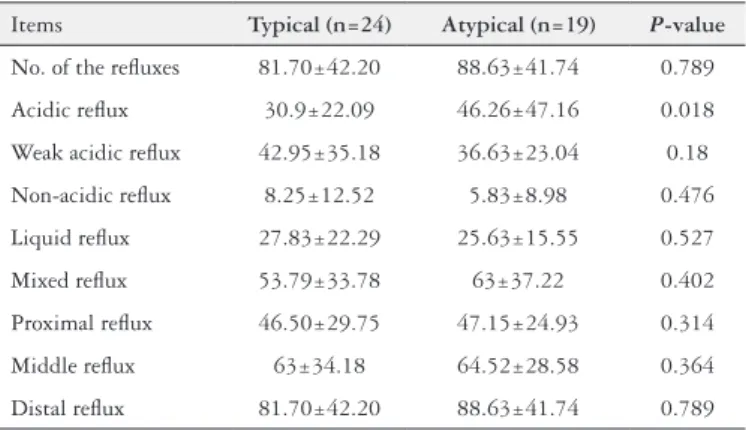
The mean number of relux events were 81.70±42.20 and 88.63±41.74 in typical and atypical groups, respectively (P=0.789). The mean number of acid relux in typical and
atypical groups were 30.9±22.09 and 46.26±47.16 respec-tively, which difference was signiicant statistically (P=0.018).
There was no statistically signiicant difference between two study groups regarding the mean number of weakly acid and alkaline relux events. The comparison between two study groups regarding MII data analysis including weakly acid relux events, alkaline relux events, liquid or mixed relux and extension of relux are presented in Table 2. There was no statistically significant difference between two study groups regarding type of reluxate (liquid or mixed). Also, the proximal extension of reluxate was not signiicantly different between two study groups.
In Table 3, SI, SSI and SAP were compared between two groups, only SI in pH-monitoring was signiicantly different between two groups (8.30% ± 10.30% vs 18.12% ± 13.10%;
P=0.034).
TABLE 3. Symptom index, symptom severity index and symptom asso-ciation probability in different groups and methods
P-value Atypical (19) Typical (n=24) Items
0.034 18.12± 13.10 8.30± 10.30 SI (pH monitoring) (%)
0.667 30.87±17.48 38.41± 23.12 SI (MII) (%)
0.617 6.19± 6.31 8.62± 13.36 SSI (pH monitoring) (%)
0.512 8.07± 9.63 9.55± 8.49 SSI (MII) (%)
0.127 60.48± 36.96 32.54±43.24 SAP (pH monitoring) (%)
0.676 81.30± 34.81 90.64± 14.86 SAP (MII) (%)
SI: symptom index; SSI: symptom severity index; SAP: symptom association probability.
TABLE 2. Data analysis about MII in typical and atypical patients
Items Typical (n=24) Atypical (n=19) P-value
No. of the reluxes 81.70±42.20 88.63±41.74 0.789
Acidic relux 30.9±22.09 46.26±47.16 0.018
Weak acidic relux 42.95±35.18 36.63±23.04 0.18
Non-acidic relux 8.25±12.52 5.83±8.98 0.476
Liquid relux 27.83±22.29 25.63±15.55 0.527
Mixed relux 53.79±33.78 63±37.22 0.402
Proximal relux 46.50±29.75 47.15±24.93 0.314
Middle relux 63±34.18 64.52±28.58 0.364
Distal relux 81.70±42.20 88.63±41.74 0.789
TABLE 1. Data analysis about pH monitoring in typical and atypical patients
P-value Atypical (n=19) Typical (n=24) Items
0.075 84.47± 86.77 58± 43.45 No. of the reluxes
0.076 53± 54.08 39.2± 31.6 pH related relux
0.62 17.8± 28.5 15.5± 24.9 Total relux times
0.32 7.52± 13.32 5.95± 9.21 Relux more than 5 minutes
0.65 43.63± 69.08 48.91± 110.16 Longest time of the relux
0.17 0.72± 0.83 0.47± 0.47 Lowest pH at relux
Regarding comparison of SI, SSI and SAP between two diagnostic techniques, the mean SI in pH and MII monitoring were 12.73% ± 12.48% and 35.01% ± 20.78%, respectively (P=0.001). The mean SAP between two diagnostic methods
were also signiicant statistically (P= 0.001) (Table 4).
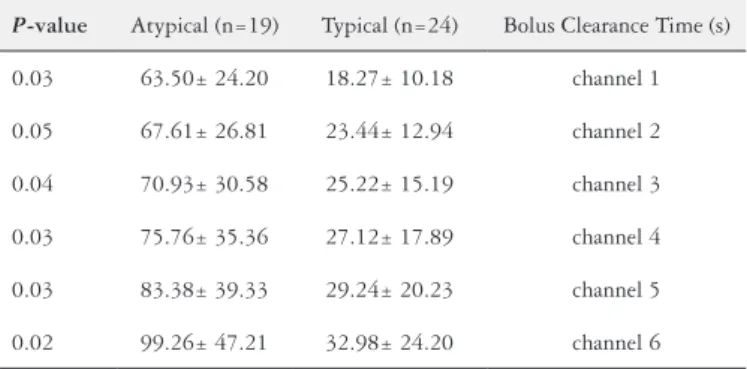
The bolus clearance time was signiicantly different be-tween two study groups (Table 5).
Impedance measures the electrical potential difference within the lumen of the esophagus. Relux detected by MII does not depend on pH but in combination with a 24-hour pH monitoring helps to detect the acid, weakly acid and al-kaline relux. Therefore the combination of impedance and pH monitoring comparing to pH monitoring alone shows more relux episodes(11). About 90% of relux episodes in infants are non-acid, because infants are fed frequently and it causes acidic neutralizing of reluxed substances. If a pH monitoring is done with MII in infants, the sensitivity of test for the diagnosis of relux often goes up(21). The pH moni-toring limitations include inability to detect non-acid relux episodes which often happen after meals. Limited sample size in our study may be the cause for some difference in our study compared to other studies.
Francavilla and colleagues studied children suspected of GERD which aimed to evaluate the two diagnostic methods of MII and pH monitoring for diagnosing of GERD in chil-dren. The diagnostic power of combined MII and 24-hour pH monitoring in detecting all reluxes and acid reluxes in infants were statistically higher than pH monitoring alone in children older than one year. Adding the MII to 24-hour pH monitoring method increased the accuracy of the detection of relux events(4,8). There was a relationship between relux and atypical symptoms, particularly respira-tory ones and also regardless of age and the relationship between relux and atypical symptoms in infants less than one year of age(5).
In a study done by Wenzl et al, the pH monitoring and MII were compared in children with GERD. Fifty infants with GERD were studied which results showed that alone pH monitoring cannot diagnose all relux episodes in infant but it is useful in diagnosing acidic reluxes and time of acid exposure to esophageal. So, the combination of pH monitor-ing method with MII was a valuable diagnostic method in infants with GERD(21).
Another study for evaluation of acid and non-acid relux episodes by pH monitoring and MII tests in infants showed that comparing to pH monitoring, MII shows more relux episodes especially in non-acid cases(3).
Mattioli and colleagues’ were tested pH monitoring and
MII methods on 50 children with GERD(9). According to
their indings, acid and non-acid relux had the same inci-dence and low rate of clinical symptoms in pediatric group is considered as a limitation of the MII. They suggested further studies on accuracy and precision of MII(9).
According to our indings, there were no statistically dif-ferent in terms of demographic characteristics of patients in the two typical and atypical groups. According to the study results, the mean of relux episodes that were speciied by MII methods were more than those speciied by pH monitoring and it can be concluded that adding MII to pH monitoring leads to more accuracy in diagnosis of relux in children that is consistent with most studies(3,5, 21). Average number of relux-related to pH in pH monitoring test in typical group is more than that in non-typical, but it is not statistically signiicant that is consistent with previous studies(5).
TABLE 5. Bolus clearance time in different sensors of both groups
P-value Atypical (n=19) Typical (n=24) Bolus Clearance Time (s)
0.03 63.50± 24.20 18.27± 10.18 channel 1
0.05 67.61± 26.81 23.44± 12.94 channel 2
0.04 70.93± 30.58 25.22± 15.19 channel 3
0.03 75.76± 35.36 27.12± 17.89 channel 4
0.03 83.38± 39.33 29.24± 20.23 channel 5
0.02 99.26± 47.21 32.98± 24.20 channel 6
TABLE 4. The mean of SI, SSI and SAP in two diagnostic methods
P-value MII (n=43) pH monitoring (n=43) Items
0.001 35.01±20.78 12.73±12.48 SI (%)
0.285 8.88±8.9 7.52±10.67 SSI (%)
0.001 86.42±25.79 45.16±42.29 SAP (%)
SI: symptom index; SSI: symptom severity index; SAP: symptom association probability.
DISCUSSION
The results of this study revealed that addition of MII to conventional 24-hour pH monitoring signiicantly increases the ability of test to determine the association between relux events and patients symptoms. As the study showed there was an increasing of at least three folds in SI (35.01 versus 12.73; P=0.001) and 2 folds in SAP (86.42 versus 45.16; P=0.001) comparing between MII and conventional 24-hour
pH monitoring.
Conventional 24-hour pH monitoring has several short-comings, mostly related to its inability to detect non-acid relux events and so underestimating the amount of relux events. This limitation is particularly important in the post-prandial period and in infants, in whom this technique is blind for half the recording time(2,20).
One interesting point which is less proven in previous studies is that the number of acid reluxes detected by MII method in atypical group is greater. It shows two points, the irst one is that the MII can diagnose more reluxes especially independent ones on pH, the second one is that patients with atypical symptoms have more acid reluxes, so children with atypical relux symptoms should be treated stronger with regular follow-up period and more frequently to prevent the complications of GERD.
Bolus clearance time difference in various sensors in MII method is greater in atypical group and it is statisti-cally signiicant that shows the necessity of more attention and treatment in atypical relux patients. Maybe remain-ing of the stomach contents in the esophagus for longer time increases the possibility of atypical symptoms for example; possibility for aspiration was more and causes respiratory symptoms.
One of the most recommended applications of pH moni-toring is to conirm the association between a symptom and an relux event by the calculation of SI, SSI, and SAP(5).
SI and SAP means were compared in both methods that showed a statistical difference. In fact, there was a greater relationship between disease symptoms and relux episodes; therefore MII method is superior in detection of associa-tion between relux events and patients symptoms. In the study by Soyer et al. MII can be considered as a superior diagnostic methods in symptomatic children with normal pH metry indings(18).
This technique has several limitations for routine appli-cation in clinical setting. There is no validated data about normal impedance in children. This technique is expensive and time consuming and require well trained personnel. An-other therapeutic trial for treatment of acid/nonacid relux events is mandatory to validate the association of relux events and symptoms.
As mentioned above SI was significantly higher in atypical symptoms compared to typical symptoms. Higher number of acid relux was found in children with atypical symptoms of relux. Longer duration of bolus clearance was found in group with atypical symptoms of relux. According to these indings, more intense treat-ment may be required for children with atypical symp-toms of GERD. Another study with greater sample size is recommended.
ACKNOWLEDGMENTS
Data was used in this study was from pediatric residency thesis of Dr. Maryam Nasri and inancial support was pro-vided by Shiraz University of Medical Sciences.
Authors’ contributions
Dehghani SM: main idea, data collection and revision of manuscript; Taghavi SA: data collection and writing draft; Nasri M: writing proposal and data collection; Javaherizadeh H: literature search and revision of manuscript.
Dehghani SM, Taghavi SA, Javaherizadeh H, Nasri M. Monitoramento combinado do pH esofágico e impedância intraluminal multicanal 24 horas para com-paração de reluxo gastroesofágico em crianças, com sintomas típicos contra atípicos na doença do reluxo gastroesofágico. Arq Gastroenterol. 2016,53(3):130-5. RESUMO - Contexto - O reluxo gastroesofágico é a doença esofágica mais comum em Pediatria. Objetivo - O objetivo deste estudo foi comparar parâ-metros de reluxo em pacientes com sintomas típicos e atípicos de reluxo gastroesofágico na população pediátrica usando impedância intraluminal multicanal e monitoramento 24 horas do pH esofágico. Métodos - Neste estudo prospectivo, 43 pacientes com idade inferior a 18 anos com suspeita de reluxo gastroesofágico foram observados. Os pacientes foram divididos em dois grupos com base nos principais sintomas de apresentação (típicos versus atípicos). Foram realizados em todos os pacientes, monitoramento de 24 horas do pH e impedância intraluminal multicanal para comparar esses dois grupos em relação a associação de sintomas e reluxo. Número de reluxos, pH relacionados com reluxo, tempo total de reluxo, reluxo maior do que 5 minutos, tempo mais longo de reluxo, pH mais baixo no reluxo, índice de reluxo foram registrados e comparados. Comparação de dados foi feita usando SPSS. Resultados - A idade média dos pacientes foi 5.7±3.4 anos e 65,1% eram do sexo masculino. Dos 43 pacientes, 24 tinham sintomas típicos e 19 atípicos. A média de eventos de reluxo detectados por impedância intraluminal multicanal foi maior do que a detectada pelo monitoramento do pH (308.4±115.8 vs 69.7±66.6) com P=0,037, que é estatisticamente signiicativo. O índice médio de sintoma e a probabilidade de associação do sintoma foram 35.01% ± 20.78% e 86.42% ± 25.79%, respectivamente em impedância intraluminal multicanal contra 12,73% ± 12,48% e 45% ± 42,29% em monitoramento do pH (P valor < 0,001). O número de reluxos ácidos foi 46,26±47,16 e 30,9±22,09
para sintomas típicos e atípicos, respectivamente. O índice médio de sintoma foi de 18,12% ± 13,101% e 8,30% ± 10,301% em sintomas típicos e atípicos em respectivamente P=0,034). A limpeza do bolus foi maior no grupo de sintomas atípicos quando comparados a sintomas típicos. (P<0,05) Conclusão - O Índice de sintoma foi signiicativamente maior nos pacientes com sintomas atípicos em comparação com os de sintomas típicos. Maior número de reluxos ácidos foi encontrado em crianças com sintomas atípicos de reluxo. Maior duração da limpeza do bolus foi encontrada no grupo com sintomas atípicos de reluxo.
REFERENCES
1. Breumelhof R, Smout AJ. The symptom sensitivity index: a valuable additional pa-rameter in 24-hour esophageal pH recording. Am J Gastroenterol. 1991,86:160-4. 2. Condino AA, Sondheimer J, Pan Z, Gralla J, Perry D, O’Connor JA. Evaluation
of gastroesophageal relux in pediatric patients with asthma using impedance-pH monitoring. J Pediatr. 2006,149:216-9.
3. Condino AA, Sondheimer J, Pan Z, Gralla J, Perry D, O’Connor JA. Evaluation of infantile acid and nonacid gastroesophageal relux using combined pH moni-toring and impedance measurement. J Pediatr Gastroenterol Nutr. 2006,42:16-21. 4. Cresi F, Locatelli E, Marinaccio C, Grasso G, Coscia A, Bertino E. Prognostic
values of multichannel intraluminal impedance and pH monitoring in newborns with symptoms of gastroesophageal relux disease. J Pediatr. 2013,162:770-5. 5. Francavilla R, Magista AM, Bucci N, Villirillo A, Boscarelli G, Mappa L, et
al. Comparison of esophageal pH and multichannel intraluminal impedance testing in pediatric patients with suspected gastroesophageal relux. J Pediatr Gastroenterol Nutr. 2010,50:154-60.
6. Hila A, Agrawal A, Castell DO. Combined multichannel intraluminal impedance and pH esophageal testing compared to pH alone for diagnosing both acid and weakly acidic gastroesophageal relux. Clin Gastroenterol Hepatol. 2007,5:172-7. 7. Lam HG, Breumelhof R, Roelofs JM, Van Berge Henegouwen GP, Smout AJ.
What is the optimal time window in symptom analysis of 24-hour esophageal pressure and pH data? Dig Dis Sci. 1994,39:402-9.
8. Masiak W, Wallner G, Wallner J, Pedowski T, Solecki M. Combined esophageal multichannel intraluminal impedance and pH monitoring (MII -pH) in the diag-nostics and treatment of gastroesophageal relux disease and its complications. Pol Przegl Chir. 2011,83:488-96.
9. Mattioli G, Pini-Prato A, Gentilino V, Caponcelli E, Avanzini S, Parodi S, et al. Esophageal impedance/pH monitoring in pediatric patients: preliminary experi-ence with 50 cases. Dig Dis Sci. 2006,51:2341-7.
10. Orenstein SR, Cohn JF, Shalaby TM, Kartan R. Reliability and validity of an infant gastroesophageal relux questionnaire. Clin Pediatr (Phila). 1993,32:472-84. 11. Rosen R, Lord C, Nurko S. The sensitivity of multichannel intraluminal imped-ance and the pH probe in the evaluation of gastroesophageal relux in children. Clin Gastroenterol Hepatol. 2006,4:167-72.
12. Rudolph CD. Supraesophageal complications of gastroesophageal relux in children: challenges in diagnosis and treatment. Am J Med. 2003,115 Suppl 3A:150s-156s. 13. Rudolph CD, Mazur LJ, Liptak GS, Baker RD, Boyle JT, Colletti RB, et al.
Guidelines for evaluation and treatment of gastroesophageal relux in infants and children: recommendations of the North American Society for Pediatric Gastro-enterology and Nutrition. J Pediatr Gastroenterol Nutr. 2001,32 Suppl 2:S1-31.
14. Shay S, Richter J. Direct comparison of impedance, manometry, and pH Probe in detecting relux before and after a meal. Dig Dis Sci. 2005,50:1584-90. 15. Shay S, Tutuian R, Sifrim D, Vela M, Wise J, Balaji N, et al. Twenty-four
hour ambulatory simultaneous impedance and pH monitoring: a multicenter report of normal values from 60 healthy volunteers. Am J Gastroenterol. 2004,99:1037-43.
16. Sherman PM, Hassall E, Fagundes-Neto U, Gold BD, Kato S, Koletzko S, et al. A global, evidence-based consensus on the deinition of gastroesophageal relux dis-ease in the pediatric population. Am J Gastroenterol. 2009,104:1278-95; quiz 1296. 17. Sifrim D, Castell D, Dent J, Kahrilas PJ. Gastro-oesophageal relux monitoring: review and consensus report on detection and deinitions of acid, non-acid, and gas relux. Gut. 2004,53:1024-31.
18. Soyer T, Gulerman F, Boybeyi O, Aslan M, Gunal Y. Results of multichannel intraluminal impedance pH metry in symptomathic children with normal pH metry indings. Eur J Pediatr Surg. 2014,24:514-8.
19. Vandenplas Y, Rudolph CD, Di Lorenzo C, Hassall E, Liptak G, Mazur L, et al. Pediatric gastroesophageal relux clinical practice guidelines: joint recommenda-tions of the North American Society for Pediatric Gastroenterology, Hepatology, and Nutrition (NASPGHAN) and the European Society for Pediatric Gastro-enterology, Hepatology, and Nutrition (ESPGHAN). J Pediatr Gastroenterol Nutr. 2009,49:498-547.
20. Washington N, Spensley PJ, Smith CA, Parker M, Bush D, Jackson SJ, et al. Dual pH probe monitoring versus single pH probe monitoring in infants on milk feeds: the impact on diagnosis. Arch Dis Child. 1999,81:309-12.
21. Wenzl TG, Moroder C, Trachterna M, Thomson M, Silny J, Heimann G, et al. Esophageal pH monitoring and impedance measurement: a comparison of two diagnostic tests for gastroesophageal relux. J Pediatr Gastroenterol Nutr. 2002,34:519-23.
22. Wenzl TG, Silny J, Schenke S, Peschgens T, Heimann G, Skopnik H. Gastroesoph-ageal relux and respiratory phenomena in infants: status of the intraluminal impedance technique. J Pediatr Gastroenterol Nutr. 1999,28:423-8.
23. Weusten BL, Roelofs JM, Akkermans LM, Van Berge-Henegouwen GP, Smout AJ. The symptom-association probability: an improved method for symptom analysis of 24-hour esophageal pH data. Gastroenterology. 1994,107:1741-5.
24. Wiener GJ, Richter JE, Copper JB, Wu WC, Castell DO. The symptom index: a clinically important parameter of ambulatory 24-hour esophageal pH monitoring. Am J Gastroenterol. 1988,83:358-61.