ARTICLE
Quality of life issues and occupational
performance of persons with epilepsy
Qualidade de vida e desempenho ocupacional de pessoas com epilepsia
Renato Nickel¹, Carlos Eduardo Silvado², Francisco Manoel Branco Germiniani3, Luciano de Paola3, Nicolle Lucena
da Silveira4, Joana Rostirolla Batista de Souza4, Cassiano Robert4, Andressa Pereira Lima4, Lauren Machado Pinto4
In spite of the many efforts of the last decades that have tried to control seizures and reduce the adverse ef-fects of antiepileptic drugs (AEDs), epilepsy still remains a disabling disease, affecting a great number of individuals worldwide, with a rather taxing impact on any given sub-ject’s activities of daily living and, ultimately, his own qual-ity of life (QOL)1.
According to the literature, about 70% of individuals with epilepsy have their seizures controlled by the adequate use of AEDs. However, the remaining 30% do not respond in an adequate manner to this type of treatment and, therefore, are deemed medically resistant2.Some of those patients will be
referred to a tertiary centre where they will be further investi-gated and either undergo evaluation for surgical treatment or be ofered a palliative treatment option.
Epilepsy has a great impact in the life of patients regard-less or seizure control, and a comprehensive treatment should encompass other domains, such as improvement of quality of life3. hus, the concept of health-related quality of life (HQOL)
has been developed to assess the perceptions of family mem-bers, social issues, limitations due to having a chronic disease and health-provider/health-assistant issues4.
he aim of this study was to evaluate the limitations of occu-pational performance and how they inluence on the perception
Hospital de Clínicas, Universidade Federal do Paraná (UFPR), Curitiba PR, Brazil.
1Professor Adjunto, Departamento de Terapia Ocupacional, Universidade Federal do Paraná (UFPR), Curitiba PR, Brazil; 2Professor Adjunto, Departamento de Clínica Médica, Disciplina de Neurologia, UFPR, Curitiba PR, Brazil;
3Médico, Departamento de Clínica Médica, Serviços de Neurologia e Centro de Terapia Intensiva Adulto, UFPR, Curitiba PR, Brazil; 4Acadêmicos de Iniciação Científica, Departamento de Terapia Ocupacional, UFPR, Curitiba PR, Brazil.
Correspondence: Renato Nickel; Avenida Lothário Meisner 632 / Bloco Didático II; 80210-170 Curitiba PR - Brasil; E-mail: [email protected]
Conflict of interest: There is no conflict of interest to declare.
Received 11 April 2011; Received in final form 19 September 2011; Accepted 26 September 2011
ABSTRACT
Epilepsy causes restrictions in the performance of various daily activities. The aiming of this study was to investigate whether these restric-tions affect the perceived quality of life. The assessments Quality of Life in Epilepsy-31 (QOLIE-31) and Canadian Occupational Performance Measure (COPM) were applied in a sample that consisted of a single group of 34 subjects with at least two years of uncontrolled seizures. The results indicated that the most affected domains of QOLIE-31 were seizure worry, 29.77 (±21.72), and effects of drugs, 49.75 (±28.58), and for the COPM, the average of performance and satisfaction were respectively 3.10 (±3.07) and 4.45 (±3.29), and performance limitations most frequently cited were maintain employment (18), left home alone (15) and courses (15). The application of the Spearman correlation coef-ficient showed that the three main performance limitations posed by the COPM, especially regarding the level of satisfaction, influence the perception of quality of life. Thus, occupational performance proves to be an important area of intervention with subjects with epilepsy.
Key words: activities of daily living, epilepsy, neurology, occupational therapy, quality of life, task performance and analysis.
RESUMO
A epilepsia causa limitações quanto ao desempenho de várias atividades diárias. Este estudo procurou investigar se essas limitações afe-tam a percepção da qualidade de vida (QV) do sujeito com epilepsia. Foram estudados 34 sujeitos com crises epiléticas não controladas há pelo menos dois anos, para os quais foram aplicadas, dentre outras, as avaliações QOLIE-31 para QV e Medida Canadense de Desempenho Ocupacional (COPM) para análise das limitações no desempenho ocupacional. Os resultados indicaram que os domínios da QOLIE-31 mais afetados foram preocupação com as crises (29,8±21,7) e efeitos dos medicamentos (49,7±28,6). Em relação à COPM, as médias de desem-penho e satisfação foram, respectivamente, 3,10±3,07 e 4,45±3,29, sendo as limitações no desempenho mais frequentes a manutenção do emprego (18), ser capaz de sair de casa sozinho (15) e poder frequentar cursos (15). A aplicação do coeficiente de correlação de Spearman evidenciou que as três principais limitações no desempenho levantadas pela COPM, principalmente em relação ao nível de satisfação, in-fluenciam na percepção da qualidade de vida do sujeito com epilepsia. Dessa forma, o desempenho ocupacional provou ser uma importante área de intervenção com sujeitos epiléticos.
of the quality of life of epileptic patients, particularly those who re-main with their seizures without control despite the use of AEDs.
METHODS
We performed a descriptive, exploratory, transverse analysis of a group of 34 individuals that had been attend-ing regularly the outpatient clinic at the Hospital de Clínicas da Universidade Federal do Paraná (HC-UFPR), or, converse-ly, who had been admitted to the Neurological ward during the period of the study, from 1st November 2008 to 31st March
2009. All of them had medically refractory epilepsy, i.e. sei-zures uncontrolled despite adjustment of AEDs treatment.
Subjects were assessed for quality of life by answer-ing the Quality of Life in Epilepsy-31 (QOLIE-31)5 and for
occupational performance by the Canadian Occupational Performance Measure (COPM)6.
For analysis of the COPM, the results were measured as scores from 0 to 10 both for the level of performance and the individual’s personal satisfaction with his/her performance.
Data speciically related to the seizures were also collect-ed and includcollect-ed the age of the subject at the time of the irst seizure, duration of epilepsy, seizure frequency in the last 180 days and screening for depressive symptoms by answering the Beck Depressive Inventory.
All data was collect through individual interview by one of the investigators. For the subject to be included in the study, he or she should be older than 16 years of age, had to be medi-cally refractory for at least two years and had to have read and sign to the written consent to participate in the study. Patients were excluded if they did not fulill those criteria or if they had any other medical condition that would in itself interfere with their occupational performance. he study was approved by the local Human Research Ethics Committee.
As for the statistical analysis, normal distribution of vari-ables was initially assessed, followed by subsequent correlation studies. In order to measure the relation between the limita-tion in performance found in the COPM and the overall result of the QOLIE-31, three diferent models of regression analysis were created, one for each of the following domains: additive, multiplicative and for individual evaluation of variables.
RESULTS
Out of the 34 subjects, 21 of them were female. Mean age at the time of the study was 32.9±11.9 years of age and education-al level, as measured in years of formeducation-al education, had a mean value of 9.4±4.4 years. As for civil status, 50% of the subjects were married, 44% were single and 6% were formally divorced. Professional occupation/employment status varied broadly, as demonstrated in Table 1.
here were many seizure types, classiied according to the ILAE classiication, but, for the purposes of this study, seizures were either classiied as having a focal onset or as primarily generalized. hus, 21 patients had focal onset zures, whereas 13 subjects had primarily generalized sei-zures. Mean age at seizure onset was 10.6±9.9, and the mean seizure frequency for the last 180 days immediately prior to the study was of 26.6±13.4.
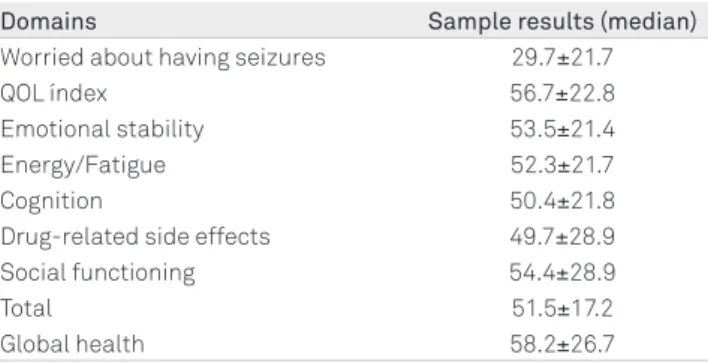
We found that the domain that was mostly afected and that had a greater impact on the subjects’ quality of life was worrying about having a seizure, while the domain that had the least impact on QOL was the measure of QOL (Table 2).
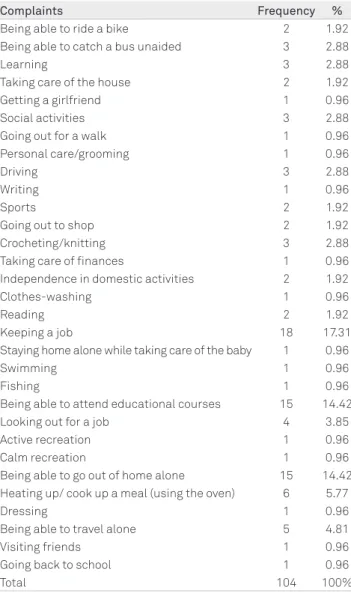
Following application of the COPM, a total of 104 in-stances in which performance was impaired were ob-tained. Conversely, three subjects reported no limitations whatsoever.
Performance levels were assessed by giving a score for each individual domain/activity, ranging from 1 to 10, both for the activity itself and for the satisfaction provided by per-forming it. Mean values were 3.1±3.1 for performance and 4.4±3.3 for satisfaction with performance.
Descriptive analysis showed that the limitations of per-formance were mostly related to being able to remain in a stable job (as reported by 18 subjects), being able to go out of home all by oneself, as well as attending educational courses, as reported by 15 subjects. Other activities were spread over several diferent domains and were less reported individually, as can be seen in Table 3.
Following statistical analysis of normal distribution of nu-merical variables, only frequency of seizures and duration of
Current occupation Frequency %
Formally employed 11 32.4
Autonomous/self-employed 3 8.8
Student 4 11.8
Housewife 5 14.7
Retired 5 14.7
Unemployed (health-related) 3 8.8
Other 3 8.8
Table 1. Subjects’ current occupational status.
Domains Sample results (median)
Worried about having seizures 29.7±21.7
QOL índex 56.7±22.8
Emotional stability 53.5±21.4 Energy/Fatigue 52.3±21.7
Cognition 50.4±21.8
Drug-related side effects 49.7±28.9 Social functioning 54.4±28.9
Total 51.5±17.2
Global health 58.2±26.7
Table 2. Results from the QOLIE-31 evaluation.
and the non-normal variables were assessed with Spearman’s correlation coeicient.
Table 4 illustrates the correlations between the variables that had statistical signiicance.
As for variables with a non-normal distribution, only duration of seizure had a low and negative correlation with the QOLIE-31 following Spearman’s correlation coeicient (p≤0.05).
Spearman’s test was also used to assess the relation be-tween the mean performance and satisfaction levels for the main domains (remaining in a stable job, being able to attend educational courses and being able to go out of home alone) with the total means of the QOLIE-31. he results are dem-onstrated in Table 5.
The use of different statistical models, such as regres-sion tests, additive tests, multiplication and cross-refer-encing the individual variables with the three main per-formance limitations, as expressed by the subjects at the COMP, showed that only being able to go out of home alone had a statistically significant correlation with the subject’s own satisfaction score (p≤0.01). The other two – remain-ing at a stable job and beremain-ing able to attend educational courses – had no statistical significance when compared with the two co-variables (satisfaction and performance scores) in a regression model. As for the mode of distribu-tion, the values obtained in the QOLIE-31 had a normal distribution, whereas those obtained with the COPM had a non-normal distribution.
herefore, we concluded that the satisfaction scores re-lated to individual performance for the domains in which the subjects reported a greater limitation had a greater cor-relation with the results obtained in the QOLIE-31. hus, the greater the limitation of performance, the greater the inlu-ence on the individual’s own perception of quality of life.
DISCUSSION
Limitations in daily activities and social restrictions were found among the studied subjects and were similar to
Complaints Frequency %
Being able to ride a bike 2 1.92 Being able to catch a bus unaided 3 2.88
Learning 3 2.88
Taking care of the house 2 1.92
Getting a girlfriend 1 0.96
Social activities 3 2.88
Going out for a walk 1 0.96
Personal care/grooming 1 0.96
Driving 3 2.88
Writing 1 0.96
Sports 2 1.92
Going out to shop 2 1.92
Crocheting/knitting 3 2.88
Taking care of finances 1 0.96 Independence in domestic activities 2 1.92
Clothes-washing 1 0.96
Reading 2 1.92
Keeping a job 18 17.31
Staying home alone while taking care of the baby 1 0.96
Swimming 1 0.96
Fishing 1 0.96
Being able to attend educational courses 15 14.42
Looking out for a job 4 3.85
Active recreation 1 0.96
Calm recreation 1 0.96
Being able to go out of home alone 15 14.42 Heating up/ cook up a meal (using the oven) 6 5.77
Dressing 1 0.96
Being able to travel alone 5 4.81
Visiting friends 1 0.96
Going back to school 1 0.96
Total 104 100%
Table 3. List of desired activities or complaints identified by the subjects, following evaluation with the COPM.
COPM: Canadian Occupational Performance Measure.
QOLIE 31 Age Formal Education Beck Depression Inventory COPM Satisfaction
Pearson’s Correlation -0.344* 0.352* -0.487** 0.483**
Sig. (2- tailed) 0.046 0.041 0.003 0.004
N 34 34 34 34
*Correlation is significant at the 0.05 level (2-tailed); **Correlation is significant at the 0.01 level (2-tailed); QOLIE-31: Quality of Life in Epilepsy-31; COPM: Canadian Occupational Performance Measure.
Table 4. Pearson’s correlation coefficient and statistical significance between variables with a normal distribution in relation to the QOLIE-31.
Table 5. Results of the Spearman’s Correlation testing.
Remaining at the job Able to leave home alone Able to attend courses
Satisfaction score 0.47 0.50 0.24
Performance score 0.35 0.06 0.35
seizures had a distribution that did not conform to the nor-mal model of distribution.
previous reports, in which, in spite of all the pharmacological advances in the treatment of epilepsy over the last decades, social complaints, especially those related to ADL, are usu-ally reported by patients.However, a single epidemiological, multicentre study by Marinas et al.7 had surprisingly opposite
results. he aim of that study was to analyse the social inclu-sion of 872 adults with epilepsy and it was found that 58% of the subjects had performance scores similar to those found in the general population. It was then put in question how such disparate indings could be justiied. We propose that the International Classiication of Functioning, Disability and Health (ICF)8 shed some light on the possibilities.
he ICF, created by the World Health Organization (WHO), goes beyond the somewhat limited paradigm of taking into account only the health condition of any given individual and its immediate objective/consequences, it also encompasses other factors, such as environmental factors (barriers and fa-cilitators) and personal subjective factors (age, gender, sexual preference, cultural level, etc.), that might inluence on the overall health status of the individual.
According to Salgado and Souza9, it is not the disease itself
that determines the individual’s QOL, but rather the way that the individual lives his/her life while being afected by a chronic disease. Uncontrolled epileptic seizures lead to severe social lim-itations in the daily living of patients, with restrictions in family, educational, vocational and leisure activities, thus having a di-rect negative impact on the QOL of the person with epilepsy.
Other factors may inluence the vulnerability and/or fra-gility status of the person with epilepsy. he report of the III Semana Nacional de Epilepsia (3rd National Epilepsy Week)10
corroborates this as it showed that the paradigm of having a chronic health condition and also the lack of knowledge about epilepsy among the general population were restric-tive factors in the performance of patients with epilepsy and their activities of daily living, including being able to remain in a stable job, being able to attend educational courses and being able to go out of home alone.
Diiculty to keep one’s job (code d8451 of the ICF) was the limitation most frequently reported in our study. In his study, Borges11 reported that epilepsy afects the ability of the
individu-al to perform their job, regardless of trade, and that acceptance in the working community is a major factor in social integration,
economics and individual satisfaction; therefore, limits to job stability will have a negative subjective perception of the individ-ual’s own QOL. Moreover, Parfene et al.12 demonstrated that
stig-ma associated to epilepsy is also a restrictive factor both to job acquisition and maintenance. his is why only a handful of indi-viduals report having epilepsy in job interviews or upon admis-sion. However, once the individual starts having seizures during working hours and is no longer able to hide his health problem, remaining at the job becomes virtually impossible for the ma-jority, with the individuals getting a discharge on terms of low productivity, being unable to achieve established and proposed goals or some other technical justiication.
Attending an educational course was the second most re-ported desired activity in our population (code d825 in the ICF), which has a straight correlation with the individual’s ca-pability of obtaining and keeping a job. Once again, accord-ing to Borges et al.13,the subject’s restrictions to attending a
course may be related to low job qualiication and with the level of education of the individual11, making it even harder
for the person with epilepsy to get a formal job.
Finally, the third most common complaint reported was being unable to go out of home unattended, classiied in the ICF as being able to go to diferent places (code d460). his factor leads to loss of independent mobility and this subse-quently hampers the individual’s capacity of doing daily ac-tivities and further deteriorates their quality of life.
In conclusion, our data, as well as those reported in the literature, show that limitations of activities of daily living and restrictions of social inclusion have a negative impact in the quality of life of persons with epilepsy. hese factors should be carefully considered in the overall, multidisciplinary treat-ment of these patients, in order to cater for all their needs. An ideal multidisciplinary team should include occupational therapists to act as facilitators in the management of the in-dividual patients activities of daily living.
A more comprehensive treatment must go beyond the limits imposed by hospital/oice walls and consider that, even if the patient’s seizures remain uncontrolled, they should be ofered a mean by which they can perform their activities of daily living with suicient independency, being, if possible, reintegrated into society by obtaining a job, attend-ing courses and goattend-ing about unattended.
1. Lám J, Rózsavölgyi M, Soós G, Vincze Z, Rajna P. Quality of life of patients with epilepsy (Hungarian survey). Seizure 2001;10:100-106.
2. Girolinet BMP. A intercambialidade entre equivalentes terapêuticos da lamotrigina: avaliação clínica e laboratorial dos pacientes portadores de epilepsia refratária [Mestrado]. Ribeirão Preto: Faculdades de Ciências Farmacêuticas de Ribeirão Preto, Universidade de São Paulo; 2009.
3. Phabphal K, Geater A, Limapichart K, Satirapunya P,
Setthawatcharawanich S. Quality of life in epileptic patients in Southern Thailand. J Med Assoc Thai 2009;92:762-769.
4. Zanni KP, Bianchin MA, Marques LHN. Qualidade de vida e
desempenho ocupacional de pacientes submetidos à cirurgia de epilepsia. J Epilepsy Clin Neurophysiol 2009;15:114-117.
5. Silva TI, Ciconelli RM, Alonso NB, et al. Validity and reliability of the Portuguese version of the quality of life in epilepsy inventory (QOLIE-31) for Brazil. Epilepsy Behav 2007;10:234-241.
6. Law M, Baptiste S, Carswell A, et al. Medida Canadense de Desempenho Ocupacional (COPM). 1ª ed. Belo Horizonte: UFMG; 2009.
7. Marinas A, Elices E, Gil-Nagel A, et al. Socio-occupational and employment profile of patients with epilepsy. Epilepsy Behav 2011;3:223-227.
8. Organização Mundial da Saúde, CIF: Classificação Internacional de Funcionalidade, Incapacidade e Saúde [Centro colaborador da Organização Mundial da Saúde para Família de Classificações Internacionais, org.; Coordenação de tradução Cassia Maria Buchalla]. São Paulo: Editora da Universidade de São Paulo, 2003.
9. Salgado PCB, Souza EA. Impact of epilepsy at work: evaluation of quality of live. Arq Neuropsiquiatr 2002;60:442-445.
10. Fernandes PT, Souza RJ, Li ML. Relatório da III Semana Nacional de Epilepsia. J Epilepsy Clin Neurophysiol 2005;11:205-207.
11. Borges MA, De Marchi NS, Sato AK, Aleixo FV, Cordeiro JA. [Epileptic syndromes and seizures and their relationship with work: a propective ambulatory study in 412 epileptic patients]. Arq Neuropsiquiatr 2000;58:691-697.
12. Parfene C, Stewart TL, King TZ. Epilepsy stigma and stigma by association in workplace. Epilepsy Behav 2009;15:461-466.