https://doi.org/10.1590/0004-282X20170088
ARTICLE
The relationship between motor function,
cognition, independence and quality of life in
myelomeningocele patients
Relação entre função motora, cognição, independência funcional e qualidade de vida em
pacientes com mielomeningocele
Carolina Lundberg Luz1, Maria Clara Drummond Soares de Moura1,Karine Kyomi Becker1, Rosani Aparecida
Antunes Teixeira2, Mariana Callil Voos1, Renata Hydee Hasue1
Myelomeningocele (MMC) is a form of spinal dysraphism resulting from a defective closure of the neural tube. It results in neuromusculoskeletal complications, including tetra- or parapa-resis, neurogenic bowel and bladder, hydrocephalus, cognitive and behavioral issues. Higher levels of the MMC result in more severe neurological and orthopedic outcomes and are associated with more severe brain lesions, and motor and cognitive impairments1.
Many patients with MMC do not ambulate during infancy. A series of 53 children with MMC ( from three to 11 years)
was studied to see if the children with lower limb paresis
would achieve the expected level of ambulation. hirty-one
of 53 children reached the expected ambulation according to their motor paresis. However, 22 performed worse than
expected. herefore, children with similar muscle paresis may
exhibit distinct ambulatory function2,3.
Musculoskeletal immobility may contribute to social and cognitive delays4 and power mobility devices have been
associated with a better cognitive and social development5.
1Universidade de São Paulo, Faculdade de Medicina, Departamento de Fisioterapia, Fonoaudiologia e Ciências da Comunicação e Terapia Ocupacional, São Paulo SP, Brasil;
2Universidade de São Paulo, Instituto de Psicologia, São Paulo SP, Brasil.
Correspondence: Renata Hydee Hasue; Rua Cipotânea, 51; 05360-160 São Paulo SP, Brasil; E-mail: [email protected] Conflict of interest: There is no conlict of interest to declare.
Received 15 April 2016; Received in inal form 11 September 2016; Accepted 15 April 2017.
ABSTRACT
Motor function, cognition, functional independence and quality of life have been described in myelomeningocele patients, but no study has investigated their relationships. We aimed to investigate the relationships between motor function, cognition, functional independence, quality of life, age, and lesion level in myelomeningocele patients, and investigate the inluence of hydrocephalus on these variables. We assessed 47 patients with the Gross Motor Function Measure (motor function), Raven’s Colored Progressive Matrices (cognition), Pediatric Evaluation of Disability Inventory (functional independence) and the Autoquestionnaire Qualité de vie Enfant Imagé (quality of life). Spearman’s correlation tests determined relationships between the variables. The Friedman ANOVAs determined the inluence of hydrocephalus. Motor function was strongly related to mobility and lesion level, and moderately related to cognition, self-care and social function. Cognition and quality of life were moderately related to functional independence. Age correlated moderately with functional independence and quality of life. Hydrocephalus resulted in poorer motor/cognitive outcomes and lower functional independence.
Keywords: meningomyelocele; quality of life; cognition.
RESUMO
Função motora, cognição, independência funcional e qualidade de vida foram descritos em pacientes com mielomeningocele (MMC), mas sua correlação não foi investigada. Esse estudo investigou correlações entre função motora, cognição, independência funcional, qualidade de vida, idade, nível de lesão em pacientes com MMC e a inluência da hidrocefalia nessas variáveis. Quarenta e sete pacientes foram avaliados com a Medida de Função Motora Grossa, Matrizes Progressivas de Raven, Inventário de Avaliação Pediátrica de Incapacidade e Autoquestionnaire Qualité de vie Enfant Imagé. Testes de Spearman investigaram as correlações. ANOVAS de Friedman investigaram a inluência da hidrocefalia. A função motora correlacionou-se fortemente com mobilidade e nível de lesão e moderadamente com cognição, auto-cuidado e função social. Cognição e qualidade de vida correlacionaram-se moderadamante com independência funcional. Idade correlacionou moderadamente com independência funcional e qualidade de vida. Hidrocefalia associou-se a piores desfechos motores/cognitivos e menor independência funcional.
Roebroeck et al.6 described the relationship between
cogni-tive function and lesion level in MMC. hey found that higher levels were associated with poorer cognitive outcomes. he
presence of Chiari malformation and hydrocephalus was
associated with cognitive deicits7,8. A higher number of
deri-vations inluenced cognitive outcomes negatively9.
he cognitive and behavioral proile of patients with
MMC has been described in a literature review, which
evi-denced deicits in timing, attention and motor processing. hese impairments have been associated with cerebellar and
brainstem lesions and, therefore, associated with brain
mal-formations. Perception, verbal luency, alliteration and math
-ematical reasoning diiculties have been reported10,11.
Motor and cognitive outcomes seem to inluence the acqui -sition of mobility, which impacts development and adulthood independence7,8,10,11. Infants with MMC have diiculty acquir
-ing self-care skills. Trunk control is essential for the acquisition
of sitting, which allows the development of bimanual skills. Sirzai et al. investigated functional performance in children
with diferent MMC levels, using the Pediatric Evaluation of Disability Inventory (PEDI)12. hey considered the functional
performance as low and concluded that low level lesions par-tially preserved muscle strength and independence in mobility, which were important factors for functional independence12.
Non-ambulating children with MMC have greater
neu-rological and orthopedic symptoms and a lower quality of
life than ambulating children. Wang et al. investigated the
health-related quality of life in children with MMC. Scores were compared with a reference sample. he authors inves -tigated the relationships between the lesion level and
asso-ciated medical problems, with the quality of life. Patients
with a MMC had lower scores on physical and psychosocial
aspects. Children with a higher lesion level had poorer physi -cal health, but not poorer psychosocial health13.
Studies have described the capacity, or lack thereof, of ambulation based on the lesion level, cognition, functional
independence and quality of life separately, but no studies
have described, simultaneously, gross motor function,
cogni-tion, functional independence and quality of life, or investi
-gated their relationships in patients with MMC. he present
study aimed to describe these variables and to investigate possible relationships. Also, this study aimed to assess the
efect of hydrocephalus on gross motor function, cognition, functional independence and quality of life.
METHODS
Patients
Patients diagnosed with MMC, aged 6-20 years, who had had corrective neurosurgery at the Clinics Hospital of Faculty of Medicine of University of São Paulo were recruited (n = 60, convenience sample). Arnold-Chiari, hydrocephalus, congen-ital hip and/or knee luxation and/or clubfoot were allowed.
Exclusion criteria included other neurological lesions or
malformations, kyphoscoliosis surgery or other recent sur-gery (less than six months before assessment). Fifty patients met the inclusion criteria and 47 patients and/or parents ( for patients under 18 years old) gave informed consent to
par-ticipate. his study was approved by the Ethics Committee of
the Clinics Hospital.
Procedure
Lesion level assessment
he present study was an observational study. Patients were classiied according to their lesion level as thoracic,
high lumbar, low lumbar or sacral MMC. Patients with a tho-racic level were scored as 1, high lumbar level were scored 2, low lumbar patients were scored as 3 and sacral lesions were
scored as 4. his classiication, with lower scores for more
severe lesions, allowed the investigation whether the lesion
level would inluence other variables.
Gross motor function assessment
he Gross Motor Function Measurement quantiied motor skills. he scale has ive dimensions: A: lying and roll
-ing (17 items); B: sitt-ing (20 items); C: crawl-ing and kneel-ing (14 items); D: standing (13 items); F: walking, running and
jumping (24 items)14.
Each item is scored from 0 (cannot perform) to 3 (nor -mal performance). All items can be performed by a healthy
ive-year-old child. Scores on each dimension are expressed in percentage. he total score is obtained by the sum of the ive dimensions, which allows each part to contribute equally
to the total score, from 0 to 100.
Cognitive function assessment
Cognitive assessment was performed by a neuropsy-chologist. Raven’s Colored Progressive Matrices were used for children aged 5-12 years of age and Raven’s Progressive Matrices were used for patients aged 13 or older15. To allow
the comparison between both scales, the number of correct
answers was divided by the number of questions of each test
and shown as a percentage.
Raven’s Colored Progressive Matrices consist of three series of 12 items and Raven’s Progressive Matrices consist
of ive series of 12 items. In each series, the questions show a progressive increase in the level of diiculty. Each item shows a igure with a part missing. he patient must indicate one of six or eight alternatives to complete the igure15.
Functional independence assessment
Functional independence was evaluated with the PEDI16.
It measures the functional abilities and the caregiver
assis-tance. It has three domains: self-care (PEDI-SC), mobil
-ity (PEDI-M) and social function (PEDI-SF). he PEDI
scaled scores (used in the present study) made it viable for
patients with functional diiculties aged up to 20 years17,18.
Parents/caregivers are interviewed.
Quality of life assessment
Quality of life was measured by the Autoquestionnaire Qualité de vie Enfant Imagé (AUQEI). It has been validated in
Brazil19. It allows the self-evaluation of quality of life using four
images of faces (very unhappy, unhappy, happy, very happy).
It has 26 questions and the child is asked to say how he feels
about daily life situations. Questions include family, social,
activity, body functions and health relations. Each question is scored from 0 (very unhappy) to 3 (very happy). he maxi
-mum possible score is 78 and cutof score is 48. Bellow this score, the quality of life is considered reduced.
Hydrocephalus
Hydrocephalus was assessed by chart review. Patients were subdivided in two groups, according to the presence or absence of hydrocephalus.
Statistical analysis
he software Statistica 12.0 was used to run descriptive analyses of the lesion level, IQ, gross motor function (GMFM),
cognitive performance (Raven matrices), functional
inde-pendence (PEDI) and quality of life (AUQEI). Normality tests
were run and the data showed non-normal distribution. No patient had missing data.
Friedman ANOVAs were run to determine a possible
inluence of hydrocephalus on gross motor function, cogni
-tion, functional independence and quality of life. he sample
was subdivided in two groups (with, and without, hydroceph-alus) and performances on tests were compared.
Spearman’s correlation tests investigated the relation-ships between lesion level, gross motor function, cognition,
functional independence and quality of life. Correlations were classiied as strong when higher than 0.70, moderate
when between 0.40 and 0.70 and weak when lower than 0.40.
For all comparisons, the signiicance level was p < 0.05.
RESULTS
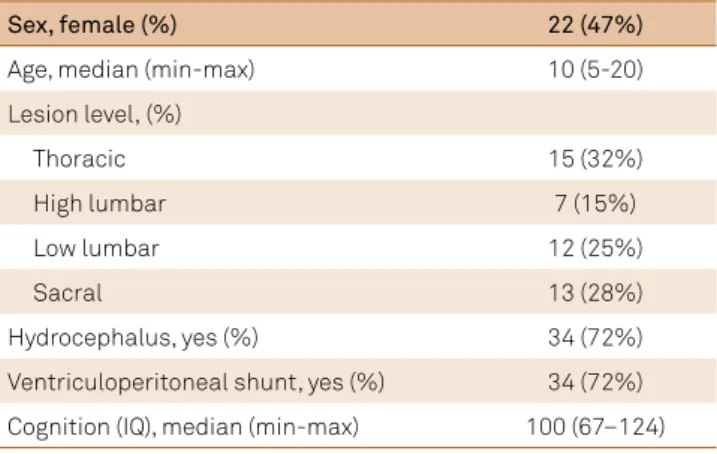
he main patient characteristics are shown in Table 1.
Scores on scales are shown in Table 2.
he median on the GMFM was 64.9%, ranging from 12.7% to 100%. he median on Raven’s tests was 55%, rang
-ing from 14% to 88%. he median on PEDI was 67.6% (44.4% to 100%) in self-care domain; 66.2% (15.2% to 100%) in the mobility domain and 70.8 (43.8% to 100%) for social function. he median on AUQEI was 76 (62 to 91).
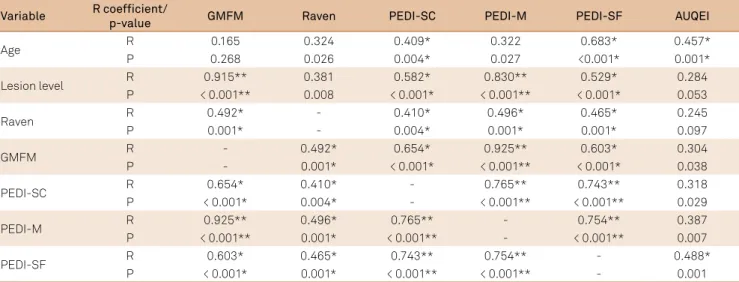
Variables showed signiicant positive correlations with each other (p < 0.05). Table 3 shows the Spearman’s coei
-cients. he GMFM was strongly related to mobility (PEDI-M)
(r = 0.925) and moderately related to self-care (PEDI-SC) (r = 0.654), social function (PEDI-SF) (r = 0.603) and cognition
(Raven’s progressive matrices) (r = 0.493). Lesion level was
strongly correlated with the GMFM (r = 0.915) and mobility
(r = 0.830) and moderately correlated with self-care (r = 0.582) and social function (r = 0.529).
Cognition (Raven’s progressive matrices) was moderately related to self-care (r = 0.410), mobility (r = 0.496) and social function (r = 0.465). Self-care, mobility and social function were strongly related to each other and social function was
moderately related to AUQEI (r = 0.488). Age was moderately
correlated with self-care (r = 0.409), social function (r = 0.683)
and quality of life (r = 0.457).
When the sample was subdivided in two groups (with, and without, hydrocephalus) and performances on tests were compared with the Friedman ANOVAs, hydrocephalus
neg-atively inluenced the gross motor function (p < 0.001) and
cognition (p = 0.04). Patients with hydrocephalus showed
poorer motor and cognitive performance. hey also had lower functional independence. he hydrocephalus group had lower scores on self-care (p = 0.017), mobility (p < 0.001) and social function (p = 0.013) domains of PEDI. he qual
-ity of life did not difer between patients with, and without,
hydrocephalus (p = 0.478).
Table 2. Scores on motor and cognitive functions, functional independence and quality of life (n = 47).
Cognitive and motor scores % (min-max)
Raven’s Matrices ( correct answers) 55 (14–88)
GMFM (motor total score) 64.9 (12.7–100)
PEDI-SC 67.6 (44.6–100)
PEDI-M 66.2 (15.2–100)
PEDI-SF 70.8 (43.8–100)
AUQEI 67 (62–91)
GMFM: Gross Motor Function Measure; PEDI: Pediatric Evaluation of Disability Inventory SC: self-care; M: mobility; SF: social function; AUQEI: Auto questionnaire Qualité de vie Enfant Imagé; min: minimum value observed, max: maximum value observed.
Table 1. Demographic and neurological characteristics (n = 47).
Sex, female (%) 22 (47%)
Age, median (min-max) 10 (5-20)
Lesion level, (%)
Thoracic 15 (32%)
High lumbar 7 (15%)
Low lumbar 12 (25%)
Sacral 13 (28%)
Hydrocephalus, yes (%) 34 (72%)
Ventriculoperitoneal shunt, yes (%) 34 (72%)
Cognition (IQ), median (min-max) 100 (67–124)
DISCUSSION
he present study described many moderate relation -ships between gross motor function, cognition, functional
independence and quality of life in patients with MMC.
Relationship between gross motor function and cognition
A huge variability was observed in the GMFM scores. his
large motor function variability among patients with MMC has been previously documented. Variability was observed even in patients with the same lesion level10,11. In the
pres-ent study, the lesion level was strongly correlated with gross motor function and mobility, which partially contradicts this statement and reinforces that the lesion level is highly related to gross motor function.
Motor deicits seem to emerge not only from spine lesion,
but also from brain areas, such as the cerebellum and
brain-stem. Patients with MMC with a motor level below L3 had bet
-ter physical function compared with those with a higher lesion
level. According to Sibinski et al., the motor level was the only
factor found to afect physical function20. hese indings cor
-roborate our results, because the GMFM was strongly corre
-lated with the lesion level and with the PEDI mobility section. he Raven’s test median was lower than scores expected for
healthy children/adolescents. Previous studies have described
cognitive deicits in patients with MMC8,10,11. However,
no previous studies provided descriptive data about the
per-formance of patients with MMC on Raven’s tests. he inlu -ence of hydrocephalus on cognitive outcomes of patients with MMC is controversial in the literature. Some studies showed
that the association of MMC with hydrocephalus inluenced
cognition negatively. Patients with MMC with hydrocephalus showed lower scores on executive function in some studies7,8.
However, in other studies, this association was not observed6.
We found moderate correlation between gross motor
func-tion and cognifunc-tion. Even the children with discrete clinical
manifestations of MMC tend to have fewer motor resources available to explore the environment. It is harder for them to
ind out the best ways of acquiring sensory information and
selecting motor responses; therefore, they are more likely to
fail when creating/selecting internal models. hey may receive
less stimulation, which disrupts sensorimotor learning10.
he direct association between motor abilities and cogni -tion has scarcely been investigated. No study has applied a gross motor scale so far. Instead, the lesion level, functional independence or ability to ambulate were used as references.
he lesion level was reported as not being associated with
cognitive impairments6,21 and a weak correlation between the
lesion level and cognition was found in the present study.
Vinck et al. found a correlation between ine motor func
-tion and cogni-tion of children with MMC. hey assessed patients with the Movement Assessment Battery – ine skills
subitems22. he present study complements these data with
the GMFM, showing that gross motor function is less related to cognition than ine motor function.
The relationship between gross motor function, functional independence and quality of life
As in the GMFM, a great variability was observed in the PEDI (scaled scores). Motor function was strongly related to
mobility and moderately related to self-care, social function
and cognitive performance. hese indings corroborate pre -vious studies, which have also shown moderate-to-strong relationships between motor functions and functional inde-pendence in children with MMC2,3,19,23.
Self-care, mobility and social function were strongly related to each other and social function was moderately related to
quality of life. Sibinski et al.20 investigated the relationship
between the quality of life and the overall physical function in
Table 3. Spearman’s correlation coeficients between motor and cognitive functions, functional independence and quality of life (n = 47).
Variable R coefficient/
p-value GMFM Raven PEDI-SC PEDI-M PEDI-SF AUQEI
Age R 0.165 0.324 0.409* 0.322 0.683* 0.457*
P 0.268 0.026 0.004* 0.027 <0.001* 0.001*
Lesion level R 0.915** 0.381 0.582* 0.830** 0.529* 0.284
P < 0.001** 0.008 < 0.001* < 0.001** < 0.001* 0.053
Raven R 0.492* - 0.410* 0.496* 0.465* 0.245
P 0.001* - 0.004* 0.001* 0.001* 0.097
GMFM R - 0.492* 0.654* 0.925** 0.603* 0.304
P - 0.001* < 0.001* < 0.001** < 0.001* 0.038
PEDI-SC R 0.654* 0.410* - 0.765** 0.743** 0.318
P < 0.001* 0.004* - < 0.001** < 0.001** 0.029
PEDI-M R 0.925** 0.496* 0.765** - 0.754** 0.387
P < 0.001** 0.001* < 0.001** - < 0.001** 0.007
PEDI-SF R 0.603* 0.465* 0.743** 0.754** - 0.488*
P < 0.001* 0.001* < 0.001** < 0.001** - 0.001
patients with MMC. hey found no association between spinal deformity and self-perception, motivation and physical func
-tion. hey reported that patients with more severe scoliosis had a lower quality of life, which, in turn, was also related to the age of the patients. he present study found moderate rela
-tionships between age and quality of life, self-care and social
function, which agrees with the results of Sibinski et al.20.
The relationship between cognitive performance and functional independence
Cognitive performance was moderately related to all the
domains of the PEDI: self-care, mobility and social function. he PEDI has previously been used in studies with children
with MMC. It was found to be related to the lesion level24,
which was also found in the present study, with moderate relationships between the lesion level and self-care and social function domains and a strong correlation between lesion level and mobility.
he PEDI has also been shown to be related to ambula -tory and cognitive performances23. More functional patients
had better cognitive performance, executive and visuospa-tial skills17. Barf et al.24 showed that cognitive performance
was strongly correlated with all sub items of the Functional
Independence Measure. he same results were obtained in
the present study, because, as mentioned before, the cogni-tive performance, measured by Raven’s matrices, was
moder-ately related to all domains of the PEDI.
Verhoef et al.25 concluded that only hydrocephalus and
the lesion level determined the ambulation capacity, the abil-ity to transfer and self-care. We found that the lesion level was strongly related to the motor function and mobility and we found a moderate relation between motor function and
self-care. Hydrocephalus inluenced motor and cognitive
functions negatively. Also, lower functional outcomes were observed for the hydrocephalus group, which agrees with the study of Verhoef et al.
The relationship between quality of life, cognitive performance and functional independence
he quality of life was moderately correlated with age
and social function. Although the cognitive performance has previously been found to have a higher correlation with the
quality of life than the functional independence in patients
with MMC24, in the present study, the quality of life and the
cognitive performance were weakly correlated. However, it is important to mention that patients with lower cogni-tive performance may have provided less accurate answers
in the quality of life questionnaire, and future studies should address such diiculties in evaluation.
Several studies have investigated functional
inde-pendence and the quality of life in patients with MMC.
Schoenmakers et al.18 observed that the quality of life highly
impacts mobility. Mobility, in turn, is determined by the cogni-tive performance, the muscle strength and the degree of
con-tractures found in the lower limbs. herefore, mobility seems to be more relevant to the quality of life than other functional
skills, such as self-care performance or wheelchair
depen-dence. he present study contradicts this statement, as the quality of life was moderately related to social function and
weakly related to gross motor function, cognitive performance,
self-care and mobility. According to our indings, patients with severe lesions and poor outcomes can have a higher quality of life if they have an adequately-developed social function.
As limitations, the GMFM has not been validated spe
-ciically for patients with MMC, although some studies have
used this instrument with this population with good respon-siveness and usability. Our sample included a broad variety of ages and outcomes, which provides generality to the results.
Gross motor function, cognition, functional indepen
-dence and quality of life showed moderate and strong cor
-relations. hese aspects should further be evaluated to
allow more accurate assessment and better outcomes in patients with MMC.
References
1. Fletcher JM, Copeland K, Frederick JA, Blaser SE, Kramer LA, Northrup H et al. Spinal lesion level in spina biida: a source of neural and cognitive heterogeneity. J Neurosurg. 2005;102(3 Suppl):268-79. https://doi.org/10.3171/ped.2005.102.3.0268
2. Bartonek A, Saraste H, Danielsson A. Health-related quality of life and ambulation in children with myelomeningocele in a Swedish population. Acta Paediatr. 2012;101(9):953-6. https://doi.org/10.1111/j.1651-2227.2012.02742.x
3. Bartoneck A, Saraste H. Factors inluencing ambulation in myelomeningocele: a cross-sectional study. Dev Med Child Neurol. 2001;43(4):253-60. https://doi.org/10.1017/S0012162201000482
4. Christensen C, Lowes, LP. Treadmill training for a child with spina biida without functional ambulation. Pediatr Phys Ther. 2014;26(2):265-73. https://doi.org/10.1097/PEP.0000000000000029
5. Lynch A, Ryu JC, Agrawal S, Galloway JC. Power mobility training for a 7-month-old infant with spina biida. Pediatr Phys Ther. 2009;21(4):362-8. https://doi.org/10.1097/PEP.0b013e3181bfae4c
6. Roebroeck ME, Hempenius L, Baalen B, Hendriksen JG, Berg-Emons HJ, Stam HJ. Cognitive functioning of adolescents and young adults with meningomyelocele and level of everyday physical activity. Disabil Rehabil. 2006;28(20):1237-42. https://doi.org/10.1080/09638280600551716
7. Lindquist B, Uvebrant P, Rehn E, Carlsson G. Cognitive functions in children with myelomeningocele without hydrocephalus. Childs Nerv Syst. 2009;25(8):969-75. https://doi.org/10.1007/s00381-009-0843-5
8. Iddon JL, Morgan DJ, Loveday C, Sahakian BJ, Pickard JD. Neuropsychological proile of young adults with spina biida with or without hydrocephalus. J Neurol Neurosurg Psychiatry. 2004;75(8):1112-8. https://doi.org/10.1136/jnnp.2003.029058
10. Dennis M, Barnes MA. The cognitive phenotype of spina biida meningomyelocele. Dev Disabil Res Rev. 2010;16(1):31-9. https://doi.org/10.1002/ddrr.89
11. Dennis M, Landry SH, Barnes M, Fletcher JM. A model of neurocognitive function in spina biida over the life span. J Int Neuropsychol Soc. 2006;12(2):285-96. https://doi.org/10.1017/S1355617706060371
12. Sirzai H, Dogu B, Demir S, Yilmaz F, Kuran B. Assessment on self-care, mobility and social function in children with spina biida in Turkey. Neural Regen Res. 2014;9(12):1234-40. https://doi.org/10.4103/1673-5374.135332
13. Wang JC, Lai CJ, Wong TT, Liang ML, Chen HH, Chan RC et al. Health-related quality of life in children and adolescents with spinal dysraphism: results from a Taiwanese sample. Childs Nerv Syst. 2013;29(9):1671-9. https://doi.org/10.1007/s00381-013-2117-5
14. Russell DJ, Rosenbaum PL, Cadman DT, Gowland C, Hardy S, Jarvis S. The gross motor function measure: a means to evaluate the effects of physical therapy. Dev Med Child Neurol. 1989;31(3):341-52. https://doi.org/10.1111/j.1469-8749.1989.tb04003.x
15. Raven JC, Raven J, Court JH. Matrizes progressivas coloridas de Raven: manual. São Paulo: Casa do Psicólogo; 1988.
16. Ziviani J, Ottenbacher KJ, Shephard K, Foreman S, Astbury W, Ireland P. Concurrent validity of the Functional Independence Measure for Children (WeeFIM) and the pediatric evaluation of disabilities inventory in children with developmental disabilities and acquired brain injuries. Phys Occup Ther Pediatr. 2001;21(2-3):91-101. https://doi.org/10.1080/J006v21n02_08
17. Norrlin S, Strinnholm M, Carlsson M, Dahl M. Factors of signiicance for mobility in children with myelomeningocele. Acta Paediatr. 2003;92(2):204-10. https://doi.org/10.1111/j.1651-2227.2003.tb00527.x
18. Schoenmakers MA, Gulmans VA, Gooskens RH, Pruijs JE, Helders PJ. Spinal fusion in children with spina biida: inluence on ambulation level and functional abilities. Eur Spine J. 2005;14(4):415-22. https://doi.org/10.1007/s00586-004-0768-3
19. Assumpção Junior FBJ, Kuczynski E, Sprovieri MH, Aranha EMG. [Quality of life evaluation scale (AUQEI): validity and reliability of a quality of life scale for children from 4 to 12 years-old]. Arq Neuro-Psiquiatr. 2000;58(1):119-27. Portuguese. https://doi.org/10.1590/S0004-282X2000000100018
20. Sibinski M, Synder M, Higgs ZC, Kujawa J, Grzegorzewski A. Quality of life and functional disability in skeletally mature patients with myelomeningocele-related spinal deformity. J Pediatr Orthop B. 2013;22(2):106-9. https://doi.org/10.1097/BPB.0b013e32835c2a65
21. Davis BE, Shurtleff DB, Walker WO, Seidel KD, Duguay S. Acquisition of autonomy skills in adolescents with myelomeningocele. Dev Med Child Neurol. 2006;48(4):253-8. https://doi.org/10.1017/S0012162206000569
22. Vinck A, Nijhuis-van der Sanden MW, Roeleveld NJ, Mullaart RA, Rotteveel JJ, Maassen BA. Motor proile and cognitive functioning in children with spina biida. Eur J Paediatr Neurol. 2010;14(1):86-92. https://doi.org/10.1016/j.ejpn.2009.01.003
23. Tsai PY, Yang TF, Chan RC, Huang PH, Wong TT. Functional investigation in children with spina biida, measured by the Pediatric Evaluation of Disability Inventory (PEDI). Childs Nerv Syst. 2002;18(1-2):48-53. https://doi.org/10.1007/s00381-001-0531-6
24. Barf HA, Post MW, Verhoef M, Gooskens RH, Prevo AJ. Is cognitive functioning associated with subjective quality of life in young adults with spina biida and hydrocephalus? J Rehabil Med. 2010;42(1):56-9. https://doi.org/10.2340/16501977-0481