Missing and Declining A
Missing and Declining Afffordances:
fordances:
Are these Appropriate Concepts?
Are these Appropriate Concepts?
Clarisse Sieckenius de Souza
1Raquel Oliveira Prates
1,2Tom Carey
Depto. de Informática
1PUC-Rio
R. Marquês de S. Vicente, 225
22453-900 Rio de Janeiro, RJ
Brazil
[email protected]
Depto. de Informática e Ciência da
Computação, IME UERJ
2R. S. Francisco Xavier, 524
20550-013 Rio de Janeiro,RJ Brazil
[email protected]
Centre for Learning and Teaching
Through Technology
University of Waterloo
Waterloo Canada N2L 3G1
[email protected]
Abstract
The concept of affordance has been brought to HCI by Don Norman, who has recently pro-tested against its misuse by designers. They say they will put affordances in the interface, or afford this or that to the users, but Norman points out that affordances only exist inasmuch as they are perceived by users. Therefore, it doesn’t make sense to use the term as designers do. This paper takes the designers’ phrases as a spontaneous expression of design intent and ex-plores the correspondences between these and two of the phenomena captured by communica-bility evaluation: missing and declining affordances. It highlights some useful distinctions be-tween levels of affordances, and hints at possible links bebe-tween communicative and cognitive perspectives. It suggests that framing affordances within a broader communicative dimension, and taking advantage of the rhetoric that people use to describe what they are doing, can bring interesting insights to design.Keywords: affordances, communicability evaluation, semiotic engineering
1 Introduction
The concept of affordance [6] gained popularity in the HCI community with Don Norman’s books on the objects of the world whose design “communicates
pos-sibilities that are inadequate, or are downright mis-leading” ([3] p.248). In a recent article, Norman
pro-tested against the widespread misuse of his ideas, saying that he “was really talking about perceived affordances,
which are not the same as real ones” ([9] p.39). In his
view, affordances in general define the range of possible activities, but in HCI they are of little use if users cannot perceive them. In this context, speaking about putting
affordances here and there in the interface is entirely
he meant to say, we wish to bring another perspective into the debate, based on our own work on semiotic engineering [2] and communicability evaluation [10, 11]. Because the use of language plays such an impor-tant role in Norman’s protest, it is worth noting that some of the listed meanings of the verb to afford in popular dictionaries of the English language are to give,
to furnish, and to provide [7, 13]. So, what designers
may be expressing by saying they will afford this and
that, is their expectation that users will perceive what
they meant to afford (give or provide) through computer systems interfaces.
thing to users, to the extent that they assign meaning(s) to it. Moreover, communication is a process whereby the possibilities of signification are explored for practical purposes ([5] p.4). Thus, when what users perceive as affordances is what designers meant to communicate as interactive possibilities, we can reinstate the designers’ perspective of affording things.
Having set the context of our paper, we will discuss two of the phenomena captured by the communicability evaluation method [10, 11]: missing and declining af-fordances present in interactive systems interfaces. Our goal is to show how understanding and checking for these phenomena may be beneficial to designers in dif-ferent scenarios. The basis for our argument is a set of empirical studies we have carried out with users of an HTML tag editor – SpiderPad [12]. Although the studies did not (and were not meant to) have statistical significance, they demonstrated the range of new in-sights we can gain by complementing a psychological perspective on interactive affordances with a communi-cative one.
We will briefly explain and illustrate what we mean by the terms missing and declining affordances. Then, we will discriminate among different levels of affor-dances and relate them to communicative phenomena that have been observed in our studies. After that, we will hypothesize three different design scenarios: one in which the user’s perception is in tune with the designer’s expectations; another in which this is partially the case, but some unexpected and/or undesired deviations are observed; and yet another in which users fail to perceive the designers’ intent, or prefer affordances that designers did not mean to be preferential in a given context.
All examples will be given in the context of real use situations, and the conclusions of the paper will show that embracing the fact that designers think of them-selves as affording interactive opportunities to users can be beneficial in a number of cases. In particular, it can give us indications for the possibility of integrating communication and cognition as related phenomena.
2 On missing and Declining
Affordances
Communicability evaluation is a method based on
semiotic engineering that aims at assessing how design-ers communicate to usdesign-ers their design intents and chosen interactive principles. In our semiotic perspective, user interfaces are one-shot higher-order messages sent from designers to users. By evaluating the communicability of interactive software they produce, designers can appre-ciate how well users are getting the intended messages across the interface and identify communicative break-downs that may take place during interaction. This in-formation allows them to spot persistent communication problems with the interface, as well as unexpected usage and rejection of interactive possibilities they meant to provide to users.
In communicability evaluation, evaluators define a set of tasks for users to perform and record their interac-tion using software that is able to capture mouse-pointer movements and other screen events (e.g., Lotus® ScreenCam™). The evaluation method itself comprises three steps (for a detailed description see [10],[11]):
Tagging
A small set of utterances that users are likely to pro-duce as they interact with software, such as “What’s
this?”, “Oops!”, “Why doesn’t it?” or “I can’t do it.”
are tagged (i.e. associated to) portions of recorded inter-action (users waiting for tooltips, stepping back to the previous state of the system, insisting on an interactive step that is clearly not working, or consciously aban-doning the task without achieving the goal, respec-tively). This step may be carried out by experts in semi-otic engineering, designers, or users themselves. When carried out by users, tagging leads to a kind of a
posteri-ori controlled verbal protocol analysis. When done by
designers or experts, tagging is equivalent to putting
words in the user’s mouth.
Interpretation
Figure1 - An example of the “Why doesn’t it?” tagging context
Semiotic Profiling
In the semiotic profiling step, the evaluators proceed to interpret the tabulation in semiotic terms, in an at-tempt to retrieve the original designer’s meta-communication, that is, the meaning of the overall de-signer-to-user message. This step should be performed by a semiotic engineering expert, due to the nature of the analysis.
An example of a “Why doesn’t it?” tagging context is shown in Figure 1. It actually occurred in one of our test situations, where users were asked to change the background color of an HTML page they were editing with SpiderPad. A number of participants expected that the option RECOLOR DOCUMENT in the EDIT menu would refer to the colors that appear in the HTML document. They did not know that it actually refers to the colors of the HTML tags on the editor’s page (blue, for instance, opposed to the color black used for text that is outside the tag brackets). What we see in Figure 1 is
user could interact with. The two others show two se-quential and identical interactive attempts of the user at changing the background color of the page he was about to create. The system apparently responds by doing nothing (since there are no tags to be recolored on the page). One of the participants repeated this very same attempt three times in a row, as though he did not be-lieve his choice was wrong. The utterance we tag to this repetitive pattern of interaction is then “Why doesn’t it
<do what I think it should>?”.
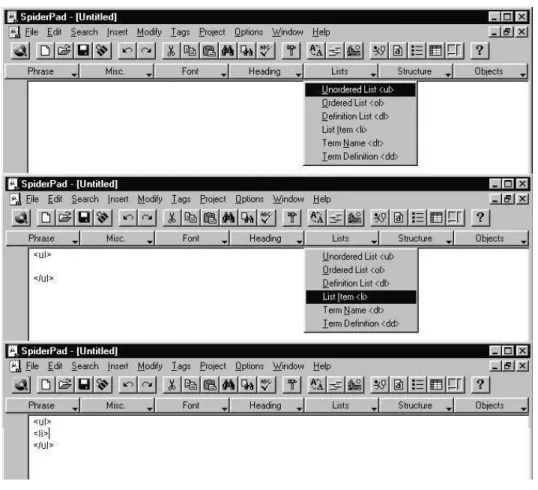
Figure 2 - Affordances of items on the TAG BAR
affords (to experts, designers, or other users) a way to achieve a certain effect. But the user whose current goal is to achieve exactly this effect does not realize the af-fordance (i.e. misses it), and finds another way (often more laborious) to do it. For example, we see in Figure 1 that SpiderPad’s toolbar contains a tool for construct-ing tables rapidly (third button, right-to-left, with a table grid icon). However, when given the task of constructing a table, another participant in our case studies decided to use the TAGS menu to create the whole structure of table rows and columns, step by step. This was a much longer path, of course, and the participant never realized there was an easier way to achieve the goal.
Declining an afforded pattern of interaction, tagged by the expression “Thanks, but no, thanks.” , emerges from a different situation. Now the user is aware of the affordance, but decides not to make use of it. We can tell the user knows that the affordance is there because the recorded movie of his or her interaction with the system shows one or more instances in which the affor-dance was put to use. However, later, when the same goal is to be achieved, the user chooses another pattern
choice. An instance of it was observed when a number of participants, having used the pulldown menus af-forded by what we call the TAG BAR (the secondary menu/toolbar beneath the toolbar, with buttons named Phrase, Misc., Font, Heading, etc.), abandoned this pos-sibility in favor of typing directly the tags, using the keyboard. In Figure 2, we see the options on the TAG BAR.
The participant, in the context of our test, had to cre-ate an unordered list of items. By clicking on the option LISTS on the TAG BAR, he found he had the option Unordered List <ul>, which he immediately chose. The result was opening and closing the <ul> HTML tag on the canvas. The next step was to click on the option List Item <li>, which caused one <li> tag to appear on the canvas. However, the list the user had to create had many items and the user declined the affordance of the TAG BAR1
. For the subsequent items on the list, he
1
typed in the tag.
The relevant aspects of our studies, regarding miss-ing and declinmiss-ing affordances were that:
If taggings like “I can do otherwise” and “Thanks,
but no, thanks.” are systematically observed with
differ-ent users in the same situation, they can tell designers that maybe the communication choices made to carry their message across to the users were not adequate and/or that their assumptions about the users’ profiles were wrong. Although alternative interactive paths may be present in the interface to introduce beneficial redun-dancy in HCI, still these taggings can indicate if the choices for expressing redundancy were good enough. Successive evaluations of redesigned interaction may fine-tune communication to a good match between de-signers intent and users perceptions ([10]).
Over a period of time, the frequency of “Thanks, but
no, thanks.” utterances tends to increase, as users
de-velop their own style of interaction with the application ([11]). This specialization correponds to the linguistic notion of idiolect, the dialect of an individual, the per-sonal way in which he systematically makes use of lan-guage when expressing himself. An interesting opportu-nity for designers is to examine cases where users are declining affordances and to decide whether their pre-ferred patterns point at a more efficient way of per-forming the task, a local interactive obstacle along a wider path of interaction (which is declined as a tactic or strategy for problem-solving), or merely poor design choices.
3 Levels of Affordances
When speaking of affordances we should differenti-ate between levels of affordances. With the exception of affordances that are designed to be an intentional redun-dant component in design, users miss or decline affor-dances such as pushing certain buttons or moving ob-jects on a canvas, as well as they miss or decline entire problem-solving methods anticipated and offered by designers. Thus, we classify affordances into opera-tional, tactical, and strategic affordances.
Operational affordances are those relative to individ-ual actions users perform, such as we saw in the exam-ple where a SpiderPad user declined the use of the TAG BAR to insert the <li> HTML tag in his document.
Tac-be carried out to achieve goals and sub-goals. An exam-ple of users declining tactical affordances was noticed in our studies when participants chose to use the table wizard, in SpiderPad's toolbar (see Figure 1), only to create the HTML structure for the table. They declined facilities embedded in the wizard such as defining at-tributes or filling in table cells. Finally, strategic affor-dances are those relative to the conceptualizations in-volved in problem formulation and problem solving processes. For instance, some of the participants in our studies definitely preferred an alternative HTML editor to SpiderPad. Independently of perceiving, missing, or declining operational and tactical affordances, they said they would rather use a WYSIWYG editor, in which editing web pages is nearly the same as editing any other page.
The most interesting benefit of separating affor-dances into such classes, however, seems to be the pos-sibility to investigate whether some affordances are declined at one level because related affordances are missed at another. This has been verified in some situa-tions that occurred during tests with participants and in our own use of SpiderPad as a tool. The following two examples briefly describe the kind of higher-order tag-ging we would get.
Thanks, but no, thanks. I don't want to create a tem-plate file for my HTML pages
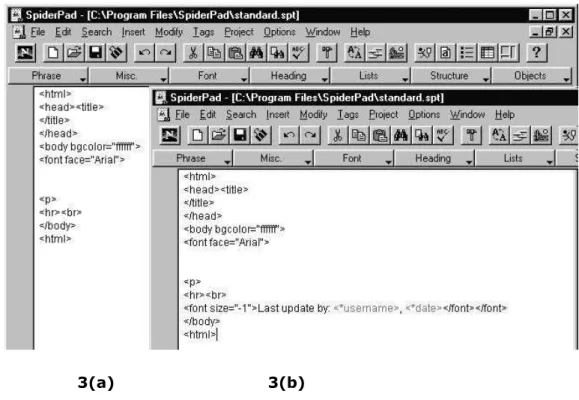
This is a case of declining an operational affordance (SAVE AS SPT) because the user misses the tactical one. He interpreted template files in SpiderPad as a normal HTML file with text that is repeated in most pages. For instance, he thought that a typical template for his pages would be what is seen in Figure 3(a). He missed the affordance that variable tags can be used in such templates to insert values that vary over time (typi-cally date, hour, day of the week, etc), as shown in Fig-ure 3(b). Thus, the cost/benefit to him did not seem attractive and he declined the offer. However, when he found out that variable tags could be used in templates, the whole notion of standardizing pages in a site came to mind, and suddenly the cost/benefit situation became much more attractive.
Thanks, but no, thanks. I'd rather not use SpiderPad.
3(a) 3(b)
Figure 3 - (a) Template containing only constant tags;
(b) Template containing constant and variable tags
However, if he had realized that he could have con-figured SpiderPad’s toolbar and inserted the list wizard button (see toolbar in Figure 2), he might have changed his mind and found SpiderPad to be more usable. That is, because he missed the configuration affordance (at operational and tactical level), he declined solving HTML editing problems with SpiderPad (at the strategic level).
The possibility of distinguishing between these dif-ferent levels of affordances (perceived, missed, or de-clined) is a valuable contribution of communicability evaluation, since it explores a new perspective of HCI design. But designers, who can ultimately provide the appropriate context, must endorse the relevance of such exploration.
4 Benefits of the Approach in
Different Design Scenarios
Communicability evaluation is based upon the inter-pretation of signs. As part of a semiotically-based ap-proach to HCI [2], it explicitly addresses the fact that meaning is in the mind of the beholder but also empha-sizes the ways by which interpretations may be moti-vated by form and context. This section will show how
designers can be beneficial to improve the designer-to-user communication and, consequently, increase the chances of affordances being perceived.
We will present three different situations that come out of communicability evaluation with respect to missing and declining affordances. The first is one in which designers take the evaluation results as good news; the second is one in which the results are partly good news, and partly bad news; and finally the last one is that in which the designer definitely doesn't like the news.
J
J Good news
• Very few, if any, cases of missing affordances
• The designer has evidence that his message is getting across to users.
• Very few, if any, cases of declining affordances
• The designer sees that users’ perceptions are those he expected to be.
However:
users cannot do anything differently (even if they wished to). This latter situation shouldn’t be taken to mean that the users are necessarily happy with the interactive af-fordances. The role of interviews and complementary tests is very important here, because evaluators can explicitly ask users about their degree of satisfaction with the application.
K
K Good News, and Bad News
• Some cases of missing affordances
Communicability evaluation will show that some us-ers are missing a certain set of affordances. This is bad news if the designers did not expect this to happen. In this case, evaluation results may indicate to the designer that there is an opportunity for organizing distinct inter-active patterns for different user profiles.
However:
If the designer has intentionally differentiated com-munication styles for distinct user profiles, then maybe the users who are missing affordances are precisely those who the affordances have not been designed for. So, in fact, this is good news for the designer.
• Some cases of declining affordances
In a way, the news about cases of declining affor-dances is the same as those about missing afforaffor-dances. That is, it could indicate to the designer that more fine-grained distinctions between user profiles could be made. We should point out that the situation might be less critical when users decline affordances (at the op-erational level) than when they miss them.
However:
Designers should be aware of the fact that users may be declining operational affordances because they are actually missing tactical or strategic affordances (as discussed above).
L
L Bad News
• Some or many cases of missing affordances If there are many cases of missing affordances, the designer is not getting his message across to users, and the application is being poorly used because users don’t realize what is there. This is directly related to poor usability scores. An outcome of this evaluation could be to convey the missed affordances in a different packag-ing, possibly as a result of complementary interviews and other usability evaluation experiments. But even if
The users don’t see the advantages of affordances they perceive, and choose secondary patterns of interac-tion, when compared to the ones the designers expected. The benefit of communicability evaluation in this case is that it gives the designer a clue to the actual users' pref-erences. As in the case of missing affordances, a smaller number of declining affordances may be bad news if the declined features are precisely the most valuable in the designer's view.
On the other hand, some cases of declining affor-dances could actually be an indication of users’ creative thinking in action. Although designers may initially predict that affordances will be used in one way or an-other, users learn and adapt applications to evolving contexts. They may, for example, use text editors as a tool to create and exhibit overhead slides. Thus declin-ing may actually point at adaptdeclin-ing, and be good news for designers [1]. In this case, users are actually extending the usability spectrum of the application.
The intensive interpretive processes involved in communicability evaluation suggest that different qualitative payoffs may be reached depending on who does the tagging and who does the subsequent steps of evaluation. The ideal situation would be to have users and one or more experts do the tagging, and designers and one or more experts do the subsequent steps. This would compensate for biases introduced by each party in the process.
The advantage of having users and experts do the taggings is that users will identify genuine cases of communication breakdowns, but they might not be able to capture higher-order meanings embedded in the ap-plication (such as tactical affordances, for example). They might also misinterpret the state of the system in terms of the task to be achieved. The identification of such cases is clearly within the reach of an expert who has defined the task and observes the users’ perform-ance.
onto ontologies of HCI problems or design guidelines. The most crucial problems will certainly be identified, but the more subtle ones may not and, what may be a problem, explanations of the observed phenomena and predictions about communicative strategies may fail to be correct.
5 Conclusion
This paper has presented possibilities of exploring the fact that designers spontaneously see themselves as
affording interactions to users. Whether their statements
are metaphors for other notions or not, we have shown that combining them with communicability evaluation results relative to missing and declining affordances may produce valuable insights into design.
One of these insights is the distinction between dif-ferent levels of affordances. Up to now, communicabil-ity research had only dealt with operational affordances. The gain for designers at this level is to have a sense of how efficient and effective are their choices of interac-tive codes in which to convey affordances. But here we have gone one step beyond operational affordances and discussed the potential gains of investigating missing and declining affordances at the tactical and strategic levels. As far as tactics are concerned, designers can be alerted about the users’ missing or declining sequences of interactive steps, which actually constitute methods for achieving tasks or subtasks. This is a threat to the usability of the application inasmuch as users may not be able to achieve their local goals efficiently. From a developer’s point of view, this may also be very bad news since resources allocated to implement these methods may have been wasted in the process.
The situation with strategic affordances is even more crucial. The designers’ attention can be called to the fact that users may be either not perceiving or misinterpret-ing the value of the technology embedded in the appli-cation. This problem may lead to some undesirable commercial consequences, in that potential clients could choose a competitor’s application. The preferred appli-cation might even provide less technological benefits than the one being rejected, but because
communicabil-ity is better in the preferred one, it is perceived as a
better technology. In our case studies, we have gathered some evidence that this might have been the case.
The relevant point at both the tactical and the strate-gic level is that users may be missing and declining affordances because they actually cannot make sense of
should
be careful to identify cases where missing and declining operational affordances might have relevant implica-tions at the tactical and strategic levels, and could, thus, seriously affect the usability of the application.
Dealing with a wider scope of affordances may en-able us to treat interactive phenomena in an integrated context of communication and cognition. In section 3, we showed cases in which unexpected task-related tac-tics and strategies followed by users may have been caused by poor designer-to-user communication choices.
Last but not least, the fact that along the learning curve users may develop different idiolects to interact with the application points at the benefits of designing configurable and/or extensible applications. In these cases, users will be able to adapt the style of communi-cation to fit their current preferences and needs. At the operational level, users may rearrange signs afforded by the designers, so that they emphasize the affordance of the ones that are most meaningful to them. At the tacti-cal level, users may create customized methods of their own in order to meet their needs. And the ability to do both types of adaptations is expected to have a positive impact at the strategic level, increasing the usability of the application.
The conclusions we have reached suggest that a promising avenue for research is that of investigating the rhetoric of HCI, from a combined designer-and-user perspective, with the support of communicability evaluation. The goal of such research would be to enable designers to view interactive affordances as the result of conscious technical choices of communication, at the operational, tactical and strategic levels, and to contrast their achievements with a cognitive approach to
affor-dances as they are perceived by users.
Acknowledgements
References
[1] P. Adler and T. Winograd Usability. Turning
technology into tools. New York, NY. Oxford University Press, 1992.
[2] C. S. de Souza The Semiotic Engineering of
User Interface Languages. International Journal
of Man-Machine Studies, Vol.39, pp. 753-773, 1993.
[3] L. De Young and T. Winograd The Design of
Everyday Things: Profile. in Wonograd, T. (Ed.)
Bringing Design to Software. New York, NY. ACM Press and Addison-Wesley Publishing, Co. pp. 248-251, 1996.
[4] A. Doubleday, M. Ryan, M. Springett and A.
Sutcliffe, A comparison of usability techniques for evaluating design. Proc. of the conference on Designing interactive systems: processes, prac-tices, methods, and techniques (DIS'97). 1997. pp 101 – 110, 1997.
[5] U. Eco A Theory of Semiotics. Bloomington, In.
Indiana University Press, 1976.
[6] J. J. Gibson The Ecological Approach to Visual
Perception. Boston, Ma. Houghton Mifflin, 1979.
[7] Longman (1987) Dictionary of Contemporary
English. Harlow, Essex. Longman.
[8] D. A. Norman The Psychology of Everyday
Things. New York. Basic Books, 1988.
[9] D. A. Norman Affordance, Convention and
De-sign. Interactions 6 (3): 38-42. New York, NY.
ACM Press, 1999.
[10] R. O. Prates, C. S. de Souza, S. D. J. Barbosa, A
Method for Evaluating the Communicability of User Interfaces. Interactions 7 (1): 31-38. New York, NY. ACM Press, 2000.
[11] R. O. Prates, S. D. J. Barbosa, C. S. de Souza, A
Case Study for Evaluating Interface Design
through Communicability. DIS2000. ACM
Con-ference on Designing Interactive Systems. New York, August, 2000.
[12] Six-Legged Software SpiderPad 1.5.3.
Six-Legged Software. 1996-1997.
[13] WEBSTER Webster’s New World College