1
Cândido Samuel Fonseca de Oliveira
PROCESSING, REPRESENTATION AND
LEARNABILITY OF THE RESULTATIVE
CONSTRUCTION BY BRAZILIAN
PORTUGUESE-ENGLISH BILINGUALS
Cândido Samuel Fonseca de Oliveira
PROCESSING, REPRESENTATION AND
LEARNABILITY OF THE RESULTATIVE
CONSTRUCTION BY BRAZILIAN
PORTUGUESE-ENGLISH BILINGUALS
Ph.D. dissertation presented to the Post-Graduate Program in Linguistics Studies (POSLIN) at the Federal University of Minas Gerais - College of Letters, as a partial requisite to obtain the title of Doctor in Linguistics.
Area: Theoretical and Descriptive Linguistics.
Research Line: Language Processing.
Advisor: Dr. Ricardo Augusto de Souza.
Co-Advisor: Dr. Fernando Luiz Pereira de Oliveira (Federal University of Ouro Preto)
Belo Horizonte, Brazil College of Letters - UFMG
ACKNOWLEDGEMENTS
I am thoroughly grateful to Dr. Ricardo de Souza, whose great expertise, astute criticism
and generous guidance made it possible for me to have an exceptional academic,
professional and personal development by working on topics that were of great interest
to me.
I am hugely indebted to Dr. Fernando Oliveira for finding out time to reply to my e-mails
and calls, for being ever so kind to show interest in my research and for giving his expert
advice regarding the statistic procedures we adopted.
I would like to express my gratitude to the members of my Ph.D. dissertation committee,
Dr. Eva Fernandez (Queens College/ CUNY), Dr. Luiz Amaral (UMass Amherst), Dr.
Maria Luiza Cunha Lima (UFMG) and Dr. Fábio Alves (UFMG), for their
encouragement, insightful comments and hard questions. I would also like to thank Dr.
Eva Fernandez for the fruitful semester I had at the CUNY Graduate Center and Queens
College under her supervision as well as Dr. Luiz Amaral for the enriching experience I
had at the UMass Amherst.
I am also thankful to Dr. Diane Bradley (Graduate Center/ CUNY), Dr. Loraine Obler
(Graduate Center/ CUNY), Dr. Janet Fodor (Graduate Center/ CUNY) and Dr. Jacee Cho
(UW-Madison) for finding time for me in their busy schedule and for their generous
contributions. I am also thankful to Dr. Adele Goldberg (Princeton University), Dr.
Virginia Valian (Hunter College/ CUNY), Dr. Tom Roeper (UMass Amherst) and Dr.
I am grateful to the professors and the students of the Graduate Program in Linguistics
(POSLIN/UFMG), to the Federal University of Minas Gerais (UFMG), to the Federal
Center for Technological Education of Minas Gerais (CEFET-MG) and to the City
University of New York (CUNY).
I am thankful to all the members of the Psycholinguistic Laboratory for sharing their
knowledge. I am especially thankful to Mara and Alexandre for helping me conducting
some experiments.
My sincere thanks to all the volunteers who kindly took part in the experiments that
composed this dissertation.
It gives me immense pleasure to thank Rafaella for her wonderful companionship
throughout my years as a Ph.D. student.
My sincere thanks also goes to Tiago, Kariny and their family for their substantial
contribution that made it possible for me to collect data from immersed bilinguals.
Special thanks are due to my loving cousin Cátia for always being there for me.
I would also like to express my special thanks to my friends and relatives for their support
and encouragement.
Finally, I would like to express a deep sense of gratitude to my parents, Samuel and Zilá,
who always stood by me like a pillar in times of need and to whom I owe my life for their
“The secret of sound education is to
get each pupil to learn for himself,
instead of instructing him by driving
knowledge into him on a stereotyped
system.”
ABSTRACT
This Ph.D. dissertation addresses possible bilingualism effects on speakers’
linguistic processing and representation through a psycholinguistic methodology. Our
primary focus is the analysis of how bilingualism can influence bilinguals’ first language
(L1), but we also investigate possible phenomena present in the acquisition of a second
language (L2)-specific structure. More specifically, the research objectives are (i) to
verify whether bilinguals exhibit reduced processing cost to read an L2-specific
construction in the L1, (ii) to analyze whether these bilinguals accept this construction in
their L1 and (iii) to investigate if bilinguals learn both the licensed and the unlicensed
features of this construction in the L2. The participants are highly proficient Brazilian
Portuguese (BP)-English bilinguals immersed either in the L1 or in the L2. The target
structure is the resultative construction (e.g., Samuel wiped the table clean) and our
control structure is the depictive construction (e.g., Samuel ate the salmon raw). Both
constructions are grammatical in English, but only the depictive is licensed in BP.
Furthermore, we observe how the participants process and perceive some ungrammatical
resultative sentences (e.g., Samuel twisted the toy broken) in English. In order to reach
the research objectives, we conducted a series of experiments using the Maze Task (MT)
and the Acceptability Judgment Task (AJT) paradigms in both BP and English. The
results from the experiments in BP indicate that both immersed and non-immersed
bilinguals process the adjective in the resultative construction significantly faster than BP
monolinguals. However, bilinguals and monolinguals perceived the resultative
construction as less acceptable than the depictive construction. These results suggest that
bilingualism can exert influence on L1 linguistic processing, but such influence does not
under scrutiny. The data from the experiments in English indicates that bilinguals and
monolinguals process the resultative construction as fast as they process the depictive
construction. They also show an additional processing cost when reading the
ungrammatical resultative sentences. Moreover, bilinguals and monolinguals do not
differ significantly from each other in their acceptability judgments of the resultative
sentences in English, but bilinguals give significantly higher acceptability ratings to the
ungrammatical resultative sentences as compared to monolinguals. These results suggest
that bilinguals can learn specific constructions, but they are less sensitive to
L2-specific restrictions than monolinguals are. We discuss all these findings in light of
different theoretical perspectives, among which we highlight the Multi-Competence, the
Multiple-Grammars and the Negative Evidence hypotheses.
KEYWORDS: Resultative Construction; Bilingualism; Language Representation;
RESUMO
Esta tese de doutorado aborda possíveis efeitos de bilinguismo no processamento
e na representação linguística através de uma metodologia psicolinguística. Nosso foco
primário é a análise de como o bilinguismo pode influenciar a primeira língua (L1) dos
bilíngues, mas também investigamos possíveis fenômenos presentes na aquisição de uma
construção específica à segunda língua (L2). Mais especificamente, esta pesquisa tem por
objetivo: (i) verificar se bilíngues apresentam custo de processamento reduzido na L1
para uma construção especifica à L2, (ii) analisar se esses bilíngues aceitam tal construção
na L1 e (iii) investigar se os bilíngues aprendem tanto os traços licenciados quanto aqueles
não licenciados dessa construção na L2. Os participantes são bilíngues do par linguístico
português brasileiro (PB) e inglês com alto nível de proficiência imersos na L1 ou na L2.
A estrutura-alvo é a construção resultativa (e.g., Samuel wiped the table clean/ Samuel
esfregou a mesa limpa/até deixa-la limpa) e a estrutura-controle é construção descritiva
(e.g., he ate the salmon raw/ ele comeu o salmão cru) tanto em PB quanto em inglês.
Ambas as construções são gramaticais em inglês, mas somente a descritiva é licenciada
em PB. Ademais, observamos como os participantes processam e percebem algumas
sentenças resultativas agramaticais (e.g., Samuel twisted the toy broken/ Samuel torceu o
brinquedo quebrado/ até quebra-lo) em inglês. Para alcançar os objetivos da pesquisa
conduzimos uma série de experimentos utilizando os paradigmas tarefa labirinto e a tarefa
de julgamento de aceitabilidade em PB e em inglês. Os resultados obtidos nos
experimentos em PB indicam que bilíngues processam o adjetivo na construção
resultativa de maneira significativamente mais rápida do que os monolíngues. Contudo,
bilíngues e monolíngues percebem a construção resultativa como menos aceitável do que
no processamento em L1, mas tal influência não resulta em mudanças na gramática de
L1, pelo menos em relação as construções sob escrutínio. Os dados dos experimentos em
inglês apontam que bilíngues e monolíngues processam a construção resultativa tão
rapidamente quanto processam a construção descritiva. Eles também se assemelham ao
exibirem um custo processamento adicional quando leem sentenças resultativas
agramaticais. Além disso, bilíngues e monolíngues não se diferem significativamente em
julgamentos de aceitabilidade da construção resultativa em inglês, mas bilíngues exibem
aceitabilidade significativamente mais alta para as sentenças resultativas agramaticais em
comparação com os monolíngues. Esses resultados sugerem que bilíngues podem
aprender uma construção específica à L2, mas eles são menos sensíveis às restrições
específicas à L2 do que os monolíngues. Discutimos todos esses achados à luz de
diferentes perspectivas teóricas, dentre as quais destacamos a Multi-Competência, a
Gramáticas-Múltiplas e a Hipótese da Evidência Negativa.
PALAVRAS-CHAVE: Construção Resultativa; Bilinguismo; Representação
Linguística; Processamento Linguístico; Aprendizibilidade.
LIST OF FIGURES
Figure 1 – Structure of the resultative construction in HPSG ... 30
Figure 2 – Adjectives classification according to their scalar properties. ... 46
Figure 3 – Visual representation of the Language Mode continuum. ... 70
Figure 4 – The Revised Hierarchical Model ... 72
Figure 5 – Bilingual Interactive Activation Plus (BIA+). ... 74
Figure 6 – Pickering & Branigan’s (1998) model of monolingual syntactic representation ... 78
Figure 7 – Salamoura & Williams’ (2007) shared representation model. ... 79
Figure 8 – Hartshuiker et al.’ shared representation model. ... 80
Figure 9 – Adaptation of Hartsuiker et al.’s (2004) model. ... 82
LIST OF TABLES
Table 1 – Frequency of adjectives in the resultative construction and other consutrctions. ... 49
Table 2 – The frequency of different types of adjectives in the resultative construction and in the lexical causatives. ... 50
Table 3 – Standard deviation and mean acceptability ratings given to resultative
construction and the depictive construction. ... 62
Table 4 – Mean and median acceptability ratings given to the depictive constructions with tonic and clitic pronouns. ... 117
Table 5 – Mean RTs and standard deviation for the APs in the resultative constructions and in the depictive constructions. ... 124
Table 6 – Mean and median acceptability ratings given to the resultative, depictive, grammatical and ungrammatical groups in BP. ... 133
Table 7 – Rate of time ceiling violations for the resultative, depictive, grammatical and ungrammatical groups in BP. ... 134
Table 8 – Mean and median acceptability ratings given to the resultative, depictive,
grammatical and ungrammatical groups in BP. ... 143
Table 9 – Rate of time ceiling violations for each construction in the SAJT. ... 143
Table 10 – Mean RTs and standard deviation for the APs in the resultative, depictive and the ungrammatical resultative groups. ... 153
Table 11 – Mean and median acceptability ratings given to the resultative, depictive,
grammatical and ungrammatical groups in English. ... 161
LIST OF GRAPHS
Graph 1 – Mean acceptability ratings given to the tonic (LIST A) and the clitic pronouns (LIST B) as direct objects. ... 118
Graph 2 – Mean RTs for the APs in the resultative and in the depictive constructions. ... 125
Graph 3 – Mean RTs and standard deviation by monolinguals, non-immersed bilinguals and immersed bilinguals. ... 127
Graph 4 – Monolinguals’ mean acceptability ratings given to the resultative, the
depictive, the grammatical and the ungrammatical groups. ... 135
Graph 5 – Non-immersed bilinguals’ mean acceptability ratings given to the resultative, the depictive, the grammatical and the ungrammatical groups. ... 136
Graph 6 – Immersed bilinguals’ mean acceptability ratings given to the resultative, the depictive, the grammatical and the ungrammatical groups. ... 137
Graph 7 – Participants’ mean acceptability ratings given to the resultative, the depictive, the grammatical and the ungrammatical groups. ... 137
Graph 8 – Mean acceptability ratings given by monolinguals, non-immersed bilinguals and immersed bilinguals. ... 139
Graph 9 – Rate of time ceiling violations for each construction in the AJT. ... 140
Graph 10 – Monolinguals’ mean acceptability ratings given to the resultative, the depictive, the grammatical and the ungrammatical groups. ... 145
Graph 11 – Bilinguals’ mean acceptability ratings given to the resultative, the depictive, the grammatical and the ungrammatical group. ... 146
Graph 12 – Participants’ mean acceptability ratings given to the resultative, the depictive, the grammatical and the ungrammatical groups. ... 147
Graph 13 – Mean acceptability ratings given by monolinguals, non-immersed bilinguals and immersed bilinguals. ... 148
Graph 14 – Rate of time ceiling violations for each construction in the AJT. ... 149
Graph 15 – Mean RTs for the APs in the resultative, depictive and ungrammatical resultative groups. ... 155
Graph 17 – Monolinguals’ mean acceptability ratings given to the resultative, the depictive, the grammatical and the ungrammatical groups in English. ... 162
Graph 18 – Non-immersed bilinguals’ mean acceptability ratings given to the resultative, the depictive, the grammatical and the ungrammatical groups in English. ... 163
Graph 19 – Immersed bilinguals’ mean acceptability ratings given to the resultative, the depictive, the grammatical and the ungrammatical groups in English. ... 164
Graph 20 – Participants’ mean acceptability ratings given to the resultative, the depictive, the grammatical and the ungrammatical groups. ... 165
Graph 21 – Participants’ mean acceptability ratings given by monolinguals, non-immersed bilinguals and non-immersed bilinguals. ... 167
LIST OF ABBREVIATIONS
ANOVA – Analysis of Variance AJ – Acceptability Judgment AJT – Acceptability Judgment Task AP – Adjectival Phrase
ARG-ST – Argument Structure
BIA+ – Bilingual Interactive Activation Plus BP – Brazilian Portuguese
DET – Determiner DIM – Diminutive
DOR – Direct object restriction IL – Interlanguage
INF – Infinitive L1 – First language L2 – Second language LM – Language Modes MA – Massachusetts MC – Multi-competence MG – Multiple-Grammars MG – Minas Gerais MS – Milliseconds MT – Maze Task NP – Noun Phrase
NEH – Negative Evidence Hypothesis PP – Prepositional Phrase
PST – Past
POSS – Possessive PRON – Pronoun
ResP – Resultative predicate RHM – Revised Hierachical Model RT – Reaction Time
SAJT – Speeded Acceptability Judgment Task SD – Standard Deviation
SEM – Semantics
SLA – Second Language Acquisition SPR – Self-Paced Reading
SUBJ – Subject SYN – Syntax
UFMG – Federal University of Minas Gerais VLT – Vocabulary Levels Test.
SUMÁRIO
1. INITIAL CONSIDERATIONS ... 20
1.1 Bilingualism-related terms ... 20
1.2 Contextualization and objectives ... 22
1.3 Research objectives and hypothesis ... 25
1.4 Dissertation organization ... 26
2. RESULTATIVE CONSTRUCTION ... 28
2.1 Argument structure constructions ... 28
2.2 The resultative construction in English ... 36
2.3 The resultative predicate ... 43
2.4 The resultative construction in Brazilian Portuguese ... 51
3. THE BILINGUAL MIND ... 63
3.1 The bilingual cognitive system ... 63
3.2 Interlanguage (IL) ... 65
3.3 Multi-Competence (MC) ... 68
3.4 Cross-linguistic influence at the lexical level ... 71
3.5 Cross-linguistic influence at the syntactic level. ... 76
3.6 L2 influence on the L1 ... 84
3.7 Learnability ... 90
4. MATERIALS, METHODS AND RESULTS ... 103
4.1 Methods ... 103
4.1.1 Acceptability judgment task (AJT) ... 103
4.1.2 Maze task (MT) ... 106
4.2 The experiments ... 109
4.3 Experiment one ... 112
4.3.1 Participants ... 112
4.3.2 Materials ... 113
4.3.3 Procedures ... 116
4.3.4 Results ... 117
4.4 Experiment two ... 120
4.4.1 Participants ... 120
4.4.2 Materials ... 121
4.4.3 Procedures ... 123
4.4.4 Results ... 124
4.5 Experiment three ... 128
4.5.1 Participants ... 128
4.5.2 Materials ... 128
4.5.3 Procedures ... 132
4.6 Experiment four ... 140
4.6.1 Participants ... 141
4.6.2 Materials ... 141
4.6.3 Procedures ... 142
4.6.4 Results ... 143
4.7 Experiment five ... 150
4.7.1 Participants ... 150
4.7.2 Materials ... 150
4.7.3 Procedures ... 152
4.7.4 Results ... 153
4.8 Experiment six ... 156
4.8.1 Participants ... 157
4.8.2 Materials ... 157
4.8.3 Procedures ... 159
4.8.4 Results. ... 160
5. DISCUSSION ... 169
6. FINAL CONSIDERATIONS ... 183
REFERENCES ... 186
APPENDIXES ... 199
Appendix A – Vocabulary Levels Test ... 199
20
1.
Initial considerations
This study aims to address possible changes caused by bilingualism in linguistic
representation and in language processing routines. In the research field of bilingualism,
two important goals are (i) the delimitation of the areas (syntax, semantics, phonology,
pragmatics, morphology, etc.) in which the bilinguals’ languages can be integrated and
(ii) the aspects of the second language (L2) that are challenging in terms of learnability.
These strands of research are of paramount importance for the study of bilingualism since
they shed light on relevant questions about language comprehension mechanisms, which
will be discussed in detail in the following chapters.
1.1 Bilingualism-related terms
We understand bilingualism as the regular use of more than one language
(GROSJEAN, 2013). L2 learning can take place simultaneously with the acquisition of
the first language (L1) or later. In this study, we focused on bilingual individuals who are
late L2 learners to observe the possibility of changes in their cognitive system derived
from the acquisition of a new skill.
“Bilingual" and other related terms have different interpretations and definitions
in the literature. Thus, we will briefly define relevant terms that will be used frequently
throughout this study. Different words are used in the literature to describe speakers who
have some sort of knowledge of an L2. Cook (1997) argues in favor of the term "L2 user",
which seems to define well the type of speaker that we intend to address: people who
utilize an L2. According to the author, the term “bilingual” sometimes contributes to the
21
The term “second language learner” has the drawback that it might entail that the speakers
will never reach a certain goal. In this study, we chose to use both the terms “L2 user”
and “bilingual”, assigning to both the meaning given to the former by Cook (op. cit.).
Other terms that generate discussions in the bilingualism field are “acquisition"
and "learning". As argued by Ferrari (2010), “acquisition” usually refers to a more
spontaneous process that occurs in contexts where the L2 is the prevalent language in
social interactions. A common example of this situation is the immersions in countries in
which the bilingual’s L2 is spoken as a native language. In contrast, “learning” usually
refers to a less natural process, as in contexts of formal instruction. In this paper, we will
use the two terms interchangeably, but we will investigate both bilinguals who have
learned the L2 mostly in formal contexts in a country where the L1 was the dominant
language and bilinguals who have learned the L2 in a more natural context in which the
L2 was the dominant language.
To summarize, this study seeks to scrutinize issues related to bilingualism by
investigating L2 users/ bilinguals who are native speakers of Brazilian Portuguese (BP)
and who have learned / acquired English as an L2 later in life. Also, we will compare the
participants who learned English mostly in contexts where the L1 was the dominant
language with those who have learned/ acquired English mostly in contexts where the L2
was the dominant language.
Next, we will present the motivation for our study on bilinguals’ processing,
22
1.2 Contextualization and objectives
The holistic view of bilingualism regards the mind of the L2 user as a whole that
cannot be decomposed into separate parts. According to Grosjean (2008), bilingual
speakers cannot be analyzed as individuals who are monolinguals in two languages.
Rather, one must understand them as speakers who use two linguistic subsystems that
rarely work independently. This proposal is in accord with the theoretical construct of
Multi-Competence, which suggests that the languages present in the bilingual mind
remain always active and interconnected.
Currently, many studies suggest that the cognitive system of bilingual speakers
has significant differences compared to the cognitive system of monolingual speakers
(BIALYSTOK, 2001; 2005; BIALYSTOK et al., 2009; BIALYSTOK; CRAIK, 2010).
Most of these studies show that bilinguals tend to outperform monolinguals in tasks that
involve cognitive control. These findings have been characterized as a possible bilingual
cognitive advantage whose origin is related to the bilinguals’ need of inhibiting one of
their languages to use the other. This class of findings thus also lends support (indirectly,
at least) to models of bilingual cognition where the two languages are represented in a
shared space.
Recent studies on the organization of languages in the bilingual mind, according
to Bialystok (2005), show that each of the two languages remain active while processing
the other language. However, most of these studies focus on L1 activation during the use
of the L2. Furthermore, some of these studies investigate only bilinguals with possible
dominance inversion, i.e., speakers whose L2 is the dominant language. Finally, many of
these studies focus on lexical processing. This study, in contrast, aims to contribute to this
23
influence during and after L1 processing of argument structure by bilinguals whose L1 is
dominant.
To achieve this goal, we will investigate the behavior of BP-English bilinguals
while reading sentences in BP (L1) that include an English (L2)-specific argument
structure: the resultative construction. More specifically, the sentences that will be tested
are instances of the true resultative construction, which has the same syntactic-semantic
features of the sentence in (1). By analyzing how bilinguals with the aforementioned
profile behave in the L1 when they read an argument structure construction licensed only
in the L2, we will seek evidence of possible changes in the L1 caused by bilingualism.
1. Samuel wiped the table clean.
In the Psycholinguistics Laboratory of the Federal University of Minas Gerais
(UFMG), where this research was mostly conducted, other studies have been carried out
to address similar issues. There are studies on the behavior of BP-English bilinguals
towards the induced movement alternation (2) (SOUZA; OLIVEIRA, 2011; SOUZA,
2012; SOUZA, 2014a; SOUZA et al., 2014); the ditransitive construction (3) (ZARA,
2009; ZARA et al., 2013) and the resultative construction (OLIVEIRA; SOUZA, 2012;
OLIVEIRA, 2013; 2014; 2015; SOUZA et al. 2014.). These studies suggest the
possibility of cross-linguistic influences from the L1 to the L2 and from the L2 to the L1.
The data further suggests that the intensity of this influence depends on its direction
(L1→L2 or L1←L2), on the construction involved and on the type of task performed by
24
2. The trainer jumped the lion through the hoop
(SOUZA, 2012, p. 231)
3. Joe told Mary a story.
(ZARA, 2009, p. 41)
4. John hammered the metal flat.
(OLIVEIRA, 2013, p. 15)
The results concerning the resultative construction suggest that BP-English
bilinguals differ from both BP monolinguals and English monolinguals. In BP,
BP-English bilinguals with high proficiency give significantly higher acceptability ratings to
sentences that force the resultative construction in comparison to BP monolinguals.
Notwithstanding the significant difference, both bilingual and BP monolingual groups
gave low acceptability ratings to the resultative construction in BP. In English,
BP-English bilinguals with low proficiency gave significantly lower acceptability ratings to
the resultative construction as compared to English monolinguals and to bilinguals with
high proficiency. The latter two groups did not show significant differences compared to
each other. In sum, it seems that bilinguals exhibit more learnability problems in the L2
in lower levels of proficiency and more changes in the L1 in higher levels or proficiency.
All the previous results on how BP-English bilinguals behave when reading the
resultative construction were obtained through non-speeded Acceptability Judgment
Tasks (AJTs). Souza & Oliveira (2014) highlight the importance of conducting (i) AJTs
in which participants have limited exposition to each item and (ii) tasks that focus on the
online processing in order to have a better comprehension of the bilinguals’ behavior
towards the resultative construction. As asserted by Carneiro & Souza (2012),
25
speed and fluidity of access to representations during language processing have an
important role in defining the degree of skill in a second language.
In order to further examine the behavior of BP-English bilingual speakers in
relation to the resultative construction, we will conduct experiments using Speeded
Acceptability Judgment Task (SAJTs) and Maze-Task (MT) paradigms in both BP and
English. The first task seeks to gauge the acceptability of the resultative construction
while using time pressure to increase the influence of speakers’ implicit knowledge. The
second task yields data on the behavior of speakers during language processing. We will
discuss both tasks in more detail in Chapter 4.
1.3 Research objectives and hypothesis
To achieve the research objectives, we formulated the following research
questions:
a. Compared to BP monolinguals, do highly proficient BP-English bilinguals exhibit
lower processing costs in the L1 for sentences that force the resultative
construction?
b. Compared to BP monolinguals, do highly proficient BP-English bilinguals give
higher acceptability ratings to sentences in the L1 that force the resultative
construction?
c. Compared to English monolinguals, do highly proficient BP-English bilinguals
exhibit extra processing cost for the resultative construction (grammatical and
26
d. Compared to English monolinguals, do highly proficient BP-English bilinguals
give lower acceptability ratings to the resultative construction (grammatical and
ungrammatical) in the L2?
To answer these questions, we proposed the following hypotheses:
a. Compared to BP monolinguals, BP-English bilinguals with high proficiency will
exhibit a lower processing cost in the L1 for sentences that force the resultative
construction.
b. Compared to BP monolinguals, BP-English bilinguals with high proficiency will
give higher acceptability ratings to sentences in the L1 that force the resultative
construction in comparison to BP monolinguals.
c. Compared to English monolinguals, BP-English bilinguals with high proficiency
will not exhibit a different processing cost in the L2 for the resultative construction
(grammatical or ungrammatical).
d. Compared to English monolinguals, BP-English bilinguals with high levels of
proficiency will not give different acceptability ratings to the resultative
construction, except when it is ungrammatical.
1.4 Dissertation organization
This Ph.D. dissertation is organized into five chapters in addition to the initial
considerations and the final considerations. In chapter 2, we present the target structure
of our study: the resultative construction. In Chapter 3, we discuss theoretical models and
27
bilingual mind. In Chapter 4, we present the materials and methods used in each of the
experiments, as well as their results. In chapter 5, we interpret and discuss the results
28
2.
Resultative construction
2.1 Argument structure constructions
This study aims to shed light on issues of bilingualism by making an analysis of
the representation and processing of certain argument structure constructions. The term
“argument structure” refers to the subcategorization of one or more phrases by a
predicator in order to fully realize its semantic properties (SALAMOURA; WILLIAMS,
2007). In other words, the argument structure is understood as the selection of specific
syntactic elements by a predicator in order to fulfill its thematic roles. In theories of
formal syntax, such an operation is usually called c-selection1. In (5), for example, the
verb phrase (VP) <run> subcategorizes only an agent as an external argument, which is
realized by a noun phrase (NP). The verb <give>, differently, subcategorizes an agent as
an external argument, a recipient and a theme as internal arguments, which are also
realized by NPs.
5. [Samuel]NP ran.
6. [Samuel]NP gave [his friend]NP [the ball]NP.
The term “construction” refers to form-meaning pairings that are not strictly
predictable from their component parts (GOLDBERG, 2003). According to Goldberg &
Casenhiser (2006), constructions usually do not completely follow the general principles
of a given language and, as a result, speakers must learn their patterns separately.
However, they are not simple idioms that are learned individually. Rather, they are
1
29
patterns whose rules can be identified and defined. By way of illustration, the authors
show the verb <slice> being used in different argument structure constructions:
7. He sliced the bread.
(transitive)
8. Pat sliced the carrots into the salad.
(caused motion)
9. Pat sliced Chris a piece of pie.
(ditransitive)
10. Emeril sliced and diced his way to stardom.
(way construction)
11. Pat sliced the box open.
(resultative)
(GOLDBERG; CASENHIER, 2006, p. 6)
The sentences above demonstrate that the same verb may appear with different
argument structures. While in (7) <slice> selects an internal argument and an external
argument, in the other sentences it seems to select more arguments. In (11), for example,
<slice> has a second argument, an adjective phrase (AP) indicating the result of the
action. The constructional approach, according to Goldberg (1995), assumes that the
structural differences in the sentences above are due to the variation in the constructions’
argument structure and not in the verb <slice> itself. This approach assumes that the
constructions are the basic units of language and exist independently of specific words
30
Thus, in all these sentences <slice> has only two arguments, which are those
present in (7). The other arguments observable in the other sentences are subcategorized
by the construction itself. That means that the AP <open> in (11) is an argument of the
resultative construction, but not an argument of the verb <slice>. In sum, according to the
constructional approach, the argument structure of the verb <slice> will always be X
SLICE Y. However, <slice> can be inserted in a construction, such as the resultative
construction, which has its own argument structure to realize its semantics (X CAUSES
[Y BECOME Z]) and, therefore, sentences with the same VP may vary in amount and
type of arguments.
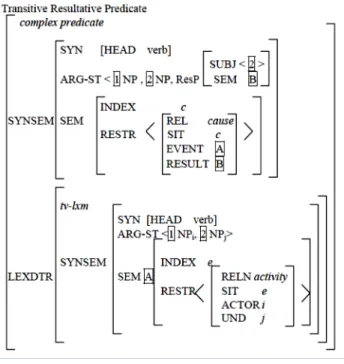
According to lexicalist approaches, such differences are specified in the verb
itself, as illustrated in FIG. 1, extracted from Boas (2000). Note that the description of the
argument structure (ARG-ST) includes three arguments: two NPs and one resultative
predicate (ResP), which is the argument that indicates the result of the action.
Figure 1 – Structure of the resultative construction in HPSG2
Source: Boas (2000, p. 9)
2
31
Regardless of the approach – lexicalist or constructional – it is interesting to note
the human mind’s ability to deal with the challenges posed by natural languages. The
language comprehension system, for example, has compositional operations that are
capable of joining the lexical knowledge and grammatical knowledge to allow a speaker
to correctly map the same syntactic structure to different meanings. The sequence
NP-VP-NP-AP, for example, can be mapped to at least four different constructions: (12) small
clause, (13) depictive construction, (14) pseudo-resultative construction and (15) true
resultative construction. Notice how the APs are interpreted differently in each of the
following sentences:
12. My father considers my hair long.
(small clause)
13. My grandmother brushed my hair wet.
(depictive)
14. The barber cut my hair short.
(pseudo-resultative)
15. The breeze blew my hair dry.
(resultative)
The small clause (ROTHSTEIN, 1995; GOMES; FOLTRAN, 2009) is a
construction that relates the subject and the predicate, but it does not have verb tense.
Such construction is a primary predicate and the subject is not thematically licensed
outside the predication relation in which it occurs. According to Pylkkännen & Mcelree
(2006), this construction does not have a causal relationship and it is not assertive. In (12),
32
the hair’s state and there is no certainty about the existence of such state. Thus, in
NP-VP-NP-AP sentences that instantiate a small clause, the AP describes only a possible state
of the object NP.
As well as the small clause, the depictive construction also has no causal
relationship. However, the depictive construction has assertiveness since its AP describes
the state of the object NP3 during the verbal action. In (13), for example, the AP <wet>
describes the state of the NP <my hair> during the action described by the VP <brushed>.
As a result, in depictive constructions formed by sentences with the pattern
NP-VP-NP-AP, the AP is the modifier of an argument.
The pseudo-resultative construction or adverbial resultative construction is
characterized mainly by the use of an AP with an adverbial function. Marcelino (2014)
demonstrates with a series of tests that in this type of construction the AP modifies the
result of the verbal action. For sentences such as (14), the result of the action expressed
by the VP <cut> is "being cut" and the AP <short> changes that result. The How-Test
(RECH, 2007; KNÖPFLE, 2010; OLIVEIRA; MARCELINO, 2014; BERTUCCI, 2014;
MARCELINO, 2014) can be used to test such a proposal: the AP in (14) can be used as
an answer for the question "How did your mom cut your hair?”. Furthermore, the
pseudo-resultative construction is formed by accomplishment verbs, i.e., verbs that describe
actions that have an inherent endpoint, such as <cut>.
The pseudo-resultative construction has a resultant state, but it does not have
resultativity. According to Bertucci (2014), the resultant state is present in the events that
lexically entail a change of state. Resultativity, conversely, is present in events that do not
entail such a change lexically and, hence, they need an additional element to indicate it.
3
33
Therefore, the AP in a pseudo-resultative construction with the pattern NP-VP-NP-AP
describes the manner of the verbal action.
Finally, the true resultative construction has as its main characteristic the fact that
it has resultativity. This construction is usually formed by an atelic activity verb, but it
becomes telic due to the presence of an AP indicating the result/ endpoint of the verbal
action. Thus, in (11), the subject NP <the breeze> performed the action described by the
VP <blew> until the object NP <my hair> acquired/ reached the property described by
the AP <dry>. In this way, the AP of a true resultative construction functions as a limit
of the verbal action and it indicates the property acquired by the NP object due to the
verbal action and such a change is not entailed lexically.
In a plethora of studies, the pseudo-resultative construction is introduced as a
resultative construction (BOAS, 2000; 2002; LOBATO, 2004; GOLDBERG;
JACKENDOFF, 2004; ETTLINGER, 2005; LEITE, 2006). In Leite (2006), for example,
those constructions are discussed as subsets of the resultative construction and receive
different nomenclatures. The resultative construction, on the one hand, is termed
“complex event” in which, according to the author, we have a second event that follows
the first. The pseudo-resultative construction, on the other hand, is denominated
co-identification event, in which the two processes occur in tandem and in a proportional
manner.
Although these two structures share significant structural similarities, they differ
in some respects and, hence, should be treated separately. Unlike the resultative
construction, the pseudo-resultative construction not only responds positively to the
How-Test, but it also cannot be paraphrased by "until it was", as pointed out by Levinson
(2007). The sentences below illustrate this difference: (16a) is equivalent to (16b) and
34
the fact that the pseudo-resultative construction does not exhibit event-argument
homomorphism, an aspect that will be discussed in more detail in section 2.3. Also, the
two constructions differ in relation to their productivity in some languages. In Romance
languages, the pseudo-resultative construction, as opposed to the resultative construction,
tends to be productive. These differences illustrate why these constructions deserve to be
approached differently.
16. a. I hammered the metal flat.
b. I hammered until the metal was flat.
17. a. I braided her hair tight.
b. I braided until her hair was tight.
The variations in the syntactic-semantic mapping of apparently identical
structures, like we observe in the sentences presented and discussed above, seem to be
easily and naturally acquired by monolingual speakers. However, argument structure
varies cross-linguistically and, hence, bilinguals may acquire it in a less smooth manner.
As argued by Juffs (1998), the cross-linguistic variations in argument structure can subtly
affect parsing decisions and, consequently, performance in comprehension activities.
Accordingly, some argument structure constructions can be considered important tools
for studies on bilingualism because they can shed light on phenomena peculiar to L2
learning, such as cross-linguistic influence. Below we describe how the syntactic pattern
discussed above, in (12) - (15), is mapped to the semantic level in BP.
35
19. Minha avó escovou o meu cabelo molhado.
My grandmother brush(PST) DET my hair wet. ‘My grandmother brushed my hair wet’
20. O barbeiro cortou o meu cabelo curto. DET barber cut(PST) DET my hair short. ‘The barber cut my hair short.’
21. A brisa soprou o meu cabelo seco. DET breeze blew DET my hair dry. ‘The breeze blew my dry hair.’
Notice that the syntactic-semantic mapping in sentences (18), (19) and (20) is
similar to their English counterparts. In (18) we have a small clause whose AP
<longo/long> is interpreted as a possible state of the object NP <cabelo/hair>. The
sentence in (19) is an instance of the depictive construction, i.e., its AP <molhado/wet>
modifies the object NP <cabelo/hair>. In (20) we have a pseudo-resultative construction,
which means that the AP <curto/short> modifies the resulting state of the verbal action
described by the VP <cortar/cut>. As a result, we can say that these three constructions
– small clause, depictive and pseudo-resultative - are similar in English and BP in relation
to their structure and meaning.
The sentence in (21), however, is not similar to the sentence in (15) with respect
to syntactic-semantic mapping. In (15), as mentioned earlier, the AP <dry> refers to the
state acquired by the object NP <hair> as a result of the verbal action. In (21), differently,
the AP <seco/dry> refers to the state of the object NP <cabelo/hair> during the verbal
action. In other words, the sentence in (15) has a resultative interpretation whereas its
structural counterpart in BP has a depictive reading, as in (13). This makes the resultative
construction a tool with considerable potential for the investigation of L2 acquisition
36
and the L2, it is possible to understand possible effects of inhibition and cross-linguistic
influence.
In the following section, we will present the target construction of this study – the
resultative construction – and the peculiarities that make it interesting for our study.
2.2 The resultative construction in English
In English, it is possible to express resultativity with a considerable range of
syntactic patterns. As pointed out by Wechsler & Noh (2001), one possibility is to express
causativity (22) and resultativity (23) with different clauses. Another possibility is to use
only a sentence consisting of a compound predicate, as in (24). Usually, only the latter
possibility is denominated resultative construction. This is in accordance with the
definition of construction proposed by Goldberg & Casenhiser (2006), who states that the
meaning of a construction is not strictly predictable from its component parts. As one can
observe, the meaning of (22) + (23) can be fully predicted from their component parts,
but the meaning of (24) cannot. The resultative construction has very specific rules that
do not apply to other patterns of sentences that also express resultativity.
22. John hammered the metal,
23. a. consequently, the metal became flat.
b. resulting in the metal becoming flat.
c. thereby flattening it.
d. until it was flat.
37
24. John hammered the metal flat.
(WECHSLER; NOH, 2001, p. 394)
Since the 90's, the English resultative construction has received special attention
in researches on argument structure and syntax-semantics interface both by minimalist
approaches (ROTHSTEIN, 2001; FOLLI; RAMCHAND, 2001; EMBICK, 2004) and by
constructional approaches (GOLDBERG, 1995; GOLDBERG; JACKENDOFF, 2004;
ETTLINGER, 2005). For Boas (2000), the reason for this interest lies in the fact that the
syntax and the semantics distribution of this construction poses a challenge to some
theories. In this study, our interest in the resultative construction lies in the differences
between BP and English, briefly illustrated above, that make the acquisition of this
construction potentially harder for BP-English bilinguals. As will be shown below, the
resultative construction has a complex syntactic-semantic structure because its licensing
depends on subtle event structure configurations and also because its surface structure to
is mapped to a different reading in BP; more specifically, the same order of constituents
receives a depictive reading.
The resultative construction is characterized by the fact that it creates, through a
complex predication, a causativity relation between two events and a changing relation
between an event and a resultant state (BERTUCCI, 2014). In (24), for example, the first
event is [JOHN HAMMER THE METAL], the second event is [JOHN FLATTEN THE
METAL] and the resultant state is [THE METAL BECOME FLAT]. As shown by
Bertucci (2014), the first event causes the second event or, in other words, John
hammering the metal cause John flattening the metal. Furthermore, the second event
carries the result of the action, that is to say, John flattening the metal causes the metal to
38
From a constructional approach point of view, the first event is the verbal event,
since it is determined by the verb of the sentence, whereas the second event is the
constructional event, since it is determined by the construction itself. Note that the
distribution of arguments occurs harmoniously: <John> is the subject of both events, <the
metal> is the object of both events and <flat> is the resultant property of the
constructional event. Thus, the verbal event has two arguments, whereas the
constructional event has the same two arguments plus one, namely the AP that indicates
property.
This harmony among the arguments of both events is named Full Argument
Realization (GOLDBERG; JACKENDOFF, 2004, p. 547). It states that, for the sentences
to be well-formed, all the arguments that are obligatorily licensed by the verb and all the
arguments that are obligatorily licensed by the construction should be realized
simultaneously in the syntax, sharing syntactical positions if necessary.
The resultative construction is formed by a compound predicate: the primary
predicate whose nucleus is the verb and the secondary predicate or resultative predicate,
whose nucleus is an AP4. The resultative predicate not only expresses the result of the
verbal action, but it also defines the action’s endpoint, which generates telicity. This
aspect is often attested in the literature with prepositional phrases that indicate the telicity
of the event. Note that the sentence (25) does not license the durational adverbial <for X
time> in (26a), but it licenses the frame adverbial <in X time> in (26b). The opposite
effect can be seen in (27) when the resultative predicate is omitted from the sentence (27a)
and (27b). Therefore, these examples demonstrate that the resultative predicate turns
activity events into accomplishment events.
4
39
25. a.*John hammered the metal flat for an hour.
b. John hammered the metal flat in an hour.
26. a. John hammered the metal for an hour.
b. *John hammered the metal in an hour.
(LOBATO, 2004, p. 145)
One characteristic of the true resultative construction is the fact that it predicates
only on the direct object NP. In other words, contrary to what happens with the depictive
construction, the resultative construction is not able to predicate on the subject of the
sentence. Levin & Rappaport-Hovav (1995) call such a restriction the direct object
restriction or (DOR). According to the authors, the DOR predicts that if a verb has no
object, it cannot be used with a resultative predicate.
To illustrate this fact, based on Simpson (1983, p. 145), the authors mention an
example that demonstrates the necessity of using the fake reflexive pronouns in the object
position in order to predicate on the entity in the subject position. In (27), in order to
create a secondary/ resultative predication on the entity described by the NP in the subject
position, it is necessary to have a reflexive pronoun in the object position, even though
both the resultative predicate (28) and the reflexive pronoun (29) are not licensed one
without the other.
27.Dora shouted herself hoarse.
28.*Dora shouted hoarse.
29.*Dora shouted herself.
40
The authors relate the DOR to a semantic notion called The Change of State
Linking Rule (LEVIN; RAPPAPORT-HOVAV, 1995, p. 51). According to this rule, the
NP that undergoes a change of state due to the event described by the VP should be the
direct object of the verb that forms the core of VP.
The resultative construction also appears to have morpho-phonological
restrictions. Marcelino (2007) shows that the resultative structures have a strong tendency
to be formed by verbs that are not originated from Romance languages and that are either
monosyllabic or disyllabic with initial stress, as illustrated in the examples given by the
author5.
Goldberg & Jackendoff (2004) point out that the resultative construction should
be treated as a family of subconstructions due to the large syntactic and semantic variation
encountered in it. Considering all the syntactic-semantic patterns indicated by the authors,
it can be said that the resultative construction shows variation in regards to transitivity,
causativity, resultative predicate phrase and, inter alia, resultative predicate semantics. To
exemplify this variability, we introduce the four main sub-constructions of the resultative
construction family:
30. Causative Property Resultative:
Example: Bill watered the tulips flat. Syntax: NP1 V NP2 AP/PP3.
Semantics: X1 CAUSE [Y2 BECOME Z3]. Means: [verbal subevent].
5 The examples mentioned by Marcelino (2007, p. 112) are: a. cook the lamb dry; b. wipe the table clean;
41
31.Non-Causative Property Resultative:
Example: The pond froze solid. Syntax: NP1 V AP/PP2. Semantics: X1 BECOME Y2. Means: [verbal subevent].
32.Non-Causative Path Resultative:
Example: The ball rolled down the hill.
Syntax: NP1 V PP2. Semantics: X1 GO Path2. Means: [verbal subevent].
33.Causative Path Resultative:
Example: Bill rolled the ball down the hill. Syntax: NP1 V NP2 AP/PP3.
Semantics: X1 CAUSE [Y2 BECOME Z3]. Means: [verbal subevent].
(GOLDBERG; JACKENDOFF, 2004, p. 563)
The causative property resultative sub-construction (30) is formed by a transitive
verb and its resultative predicate is represented by an adjective phrase (AP) or a
prepositional phrase (PP) indicating a property achieved by the object NP due to the
verbal action whose agent is the subject NP. The non-causative property resultative
sub-construction (31) is formed by an intransitive verb and its resultative predicate is
represented by an AP or a PP indicating a property achieved by the subject NP due to the
verbal action. The non-causative path resultative sub-construction (32) is formed by an
intransitive verb and its resultative predicate commonly represented by a PP that indicates
the path taken by the subject NP due to the verbal action. Finally, the causative path
resultative sub-construction (33) is formed by a transitive verb and its resultative
predicate is usually represented by a PP that indicates the path taken by an NP object due
42
Goldberg & Jackendoff (2004) also accentuate that the resultative construction
with transitive verbs can be subdivided into two groups: selected transitive resultative and
unselected transitive resultative. The selected transitive resultative (34) refers to those
sentences in which the object is independently selected by the verb, i.e., the object can be
selected by the verb even if they are not within a resultative construction (35). The
unselected transitive resultative (36), on the contrary, refers to those sentences in which
the object is not independently selected by the verb. Accordingly, if the resultative
predicate is omitted from this structure, the sentence will become ungrammatical (37). In
the literature, these constructions can also be referred to as lexically transitive (selected)
and lexically intransitive (unselected) (BOAS, 2000).
34.The gardener watered the flowers flat.
35.The gardener watered the flowers.
36.They drank the pub dry.
37.*They drank the pub.
The focus of this study will be the causative property resultative construction with
an AP whose object is independently selected by the verb, as in (34). This substructure is
also denominated true resultative construction (LEVINSON, 2007). According to the
proposal of Wechsler (2005a), this construction fits into the type 1 resultative, whose
sentences are formed by durative verbs that become accomplishment with the presence
of the resultative predicate. Therefore, we excluded from our analysis sentences that,
according to the author, constitute type 2 resultatives, whose sentences are formed by
43
38.Firing a single bullet to the heart, Billy Bob shot him dead.
(GOLDBERG; JACKENDOFF, 2004, p. 561)
Notice that in the case of true resultative construction, the difference between the
argument structure of the verb and the argument structure of the construction is only the
resultative predicate. This argument of the resultative construction is intriguing not only
because of its richness in meaning but also because of the complexities in its formation.
The section below aims to address the resultative predicate features, focusing mostly in
those encountered in the true resultative construction.
2.3 The resultative predicate
The resultative predicate seems to be permeated by very specific rules. Some of
them are still seen as idiosyncratic by some authors, such as the rules that make (39) and
(40) have different grammaticality status (GOLDBERG; JACKENDOFF, 2004; 2005).
Other rules, particularly those involved in the formation of the true resultative
construction, appear to be clearer, as shown below.
39. She ate herself sick.
40. *She ate herself ill.
Ettlinger (2005) states that there is still little information apropos the syntactic
behavior of the resultative predicate. According to the author, the information is limited
to the constituency of the resultative predicate and of the verb (41) and the positional
44
construction does not allow the resultative predicate to be topicalized (43) or to appear in
the form of it-cleft construction (44).
41. a.*Samuel wiped the table happily dry.
b. Samuel wiped the table dry happily.
42. a. *Samuel wiped dry the table.
b. Samuel wiped the table dry.
43. *Clean Samuel wiped the table.
44. *It was clean that Samuel wiped the table.
The true resultative construction can be considered rigorous as regards the
selection of the AP that forms the resultative predicate. In the depictive construction (45),
as Ettlinger (2005) contends, there are no selectional criteria between VP and AP, which
means that any adjective can be used with any verb. Furthermore, there are not any
semantic aspects that are introduced by the construction which are not predictable from
its components. With the resultative construction (46), on the contrary, the AP must be
semantically adequate for the rest of the sentence (ETTLINGER, op. cit.). More
specifically the AP in the resultative construction must be able to express (i) causativity,
(ii) the direct result of the verbal action and (iii) the endpoint of the verbal action. These
properties make the construction itself incorporate meanings that are not part of its word
components.
45. a. I cooked the carrots drunk.
b. I chopped my carrots raw.
45
b. *I chopped my carrots soft.
(ETTLINGER, 2005, p.9)
Green (1972), Carrier & Randall (1992) and Goldberg & Jackendoff (2004) note
that the resultative predicate does not license past participle adjectives (47). This
restriction draws attention because it is not present in considerably similar contexts, such
as the PP resultative construction with similar expressions (48) and constructions with
verbs that express resultativity (49).
47. *He sang himself exhausted/bored/exhilarated.
48. He sang himself to exhaustion/ to boredom/ to exhilaration.
49. He made himself exhausted/ bored/ exhilarated.
(GOLDBERG; JACKENDOFF, 2004, p. 561)
The strong tendency of verbs in resultative constructions not being originated
from Romance languages and being monosyllabic or disyllabic with initial stress, as
pointed out by Marcelino (2007), also seems to apply to the resultative predicate. In other
words, it is conjectured here that the resultative predicate tends to be formed by APs with
such characteristics. This fact concerning words with Romance language origin is
interesting because it can be linked to the unproductivity of the resultative construction
in Romance languages.
The restrictions present in resultative predicate of true resultative constructions
have already been noted and discussed (GREEN, 1972; GOLDBERG, 1995; BOAS,
46
ETTLINGER, 2005). Such restrictions are commonly exemplified by sentences such as
(50):
50.He wiped the table clean/ dry/ *dirty/ *wet.
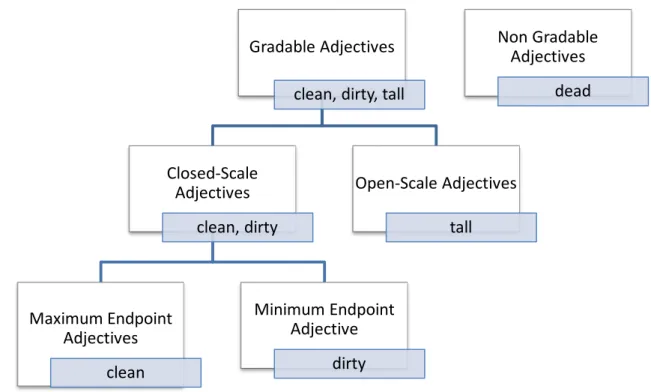
Goldberg (1995) and Wechsler (2001; 2005a; 2005b; 2012) noticed that the
licensing of the adjectives in the resultative construction was related to their scalar
properties. Adjectives can be classified as gradable and non-gradable. Gradable adjectives
can be subdivided as scale adjectives or open-scale adjectives. Finally, the
closed-scales adjectives can be subdivided into maximum endpoint adjectives and minimal
endpoint adjectives. This classification is illustrated in the table below:
Figure 2 – Adjectives classification according to their scalar properties.
Wechsler (2005) presents some tests that can be used to make the classification
illustrated above. Gradable adjectives differ from non-gradable adjectives because they
Gradable Adjectives
clean, dirty, tall
Closed-Scale Adjectives
clean, dirty
Maximum Endpoint Adjectives
clean
Minimum Endpoint Adjective
dirty
Open-Scale Adjectives
tall
Non Gradable Adjectives
47
represent properties that may have different intensities. Accordingly, gradable adjectives
can be properly modified by adverbs expressing intensity. The adjectives in (51), for
example, can be modified by the adverb <very>, whereas the adjective in (52), interpreted
in its literal sense, does not accept such combination.
51.Samuel is very tall/ clean/ dirty.
52.*Samuel is very dead.
The licensing of an adverb modifier is also used to classify gradable adjectives
into open-scale adjectives and closed-scale adjectives, according to Wechsler (2005).
Open-scale adjectives are understood as those that describe a property whose intensity
pattern is associated with the context and so it has no defined boundaries. Closed-scale
adjectives, on the other hand, suit better the notion of boundaries. The adjective <high>,
for instance, does not have a limit or, in other words, it does not have minimum or
maximum value for height (0% height or 100% height). Hence, this adjective cannot be
modified by adverbs expressing completeness such as <totally>, as illustrated in (53).
Closed-scale adjectives, in contrast, are able to convey the idea of limit of its properties
(54). When something is described as totally clean, for example, it is understood that the
dirt scale reached its minimum (0% of dirt). Therefore, <clean> is a maximum value
semantically set for the dirt scale, whereas its antonym, <dirty> represents any value
above zero on the same scale.
53.*Samuel is totally tall.
48
As exemplified above, the closed-scale adjectives can represent the limit of their
scale – as <clean> represents 0% of the dirt scale – or any positive value of their scale –
as <dirty>, which represent any value above zero in the dirt scale. Closed-scale adjectives
that represent the limit of a scale are called maximum endpoint adjectives and the
closed-scale adjectives that represent any positive value of their closed-scale are classified as minimum
endpoint adjectives. Wechsler (2005) points out that minimum endpoint adjectives differ
from the maximum endpoint adjectives when modified by the adverb <almost>. Taking
into consideration that <almost> means "about to reach a certain point", it seems to best
suit maximum endpoint adjectives, as they clearly represent a point to be reached.
Consequently, when the sentence (55) is uttered, it is understood that the dirt scale is
reaching values close to zero. However, when using a minimum endpoint adjective, as in
(56), the interpretation does not seem to be as clear. If sentences like (56) are accepted,
the author argues that they would have different implications in comparison to sentences
like (56). Whereas (55) does not imply "not dirty", (56) implies "not clean".
55.Samuel is almost clean.
56.?? Samuel is almost dirty.
Based on this analysis of gradable adjectives properties, Wechlser (2012)
proposes the Maximal Endpoint Hypothesis and an explanation for it. According to the
author, there is a strong correlation between the maximum endpoint property and the
ability of the adjective to be licensed in a resultative construction. The rationale is that
the relation between verbs and adjectives in the resultative construction involves a
49
and the scalar property described by the adjective. Therefore, the resultative construction
favors the use of maximum endpoint adjectives.
Wechsler (2012) analyzes the corpus from Boas (2000) to test its proposal. This
study shows the frequency with which open-scale adjectives, closed-scale adjectives with
maximum endpoint and closed-scale adjectives with minimal endpoint occur in the
corpus in the resultative constructions, in ECM (Exceptional Case Marking) constructions
and in lexical causatives. After analyzing individually each type of adjective, Wechsler
(2012) observes the frequency of closed-scale adjectives with a maximum endpoint in
resultative constructions compared to all other types of adjectives. The results are shown
in Table 1. The data suggests that there is an extremely strong correlation between
closed-scale adjectives with maximum endpoint and the resultative construction.
Table 1 – Frequency of adjectives in the resultative construction and other consutrctions.
Adjective Total Resultative non-Resultative %Resultative
Maximum Endpoint 97.985 938 97.047 0,957%
Non-Maximum Endpoint 53.905 20 53.885 0,037%
Source: Wechsler (2012, p. 126)
Furthermore, the author also compares the frequency of these adjectives
constructions expressing the cause of the state denoted by the adjective. The author
compared the frequency of closed-scale adjectives with a maximum endpoint, such as
<dry>, with the frequency of other adjectives in resultative constructions (57) and lexical
causative (58). The results indicate that the closed-scale adjectives with a maximum
endpoint are highly frequent in instances of the resultative construction, whereas other
adjectives tend to be more frequently used in lexical causative. The statistical analyses
50
causativity when the adjective is closed-scale with a maximum endpoint. The results are
shown in TAB 2.
57. Mary wiped the table dry.
58. Mary got her hair dry.
(WECHLSER, 2012, p. 128)
Table 2 – The frequency of different types of adjectives in the resultative construction and in the lexical causatives.
Adjective Total Resultative Lexical Causative %Resultative
Maximum Endpoint 976 938 38 96,1%
Non-Maximum Endpoint 625 20 605 3,2%
Source: Wechsler (2012, p. 129)
The lack of empirical data in Wechsler’s previous work (2001; 2005a; 2005b)
gave rise to criticism concerning the author's proposals mainly due to the fact that the
critics have found sentences that do not seem to fit his proposal (BOAS, 2003;
BROCCIAS, 2003; IWATA, 2008). However, the analysis of Wechsler (2012) made it
clear that there is a strong tendency of resultative constructions to be formed by
closed-scale adjective with a maximum endpoint. This fact does not exclude the possibility that
some sentences may not follow this tendency. The existence of counterexamples,
however, does not diminish the importance of grammatical rules that are causal factors
statistically significant. This proposal has already been influential to other studies
(BEAVERS, 20026 apud WECHSLER, 2012; UEGAKI, 20097 apud WECHSLER, 2012;
OLIVEIRA; SOUZA, 2012; OLIVEIRA, 2014).
6
BEAVERS, John. Aspect and Distribution of Prepositional Resultative Phrases in English. LinGO Working Paper #2002-7. Stanford CA: CSLI, Stanford University. 2002
7