Performance of children with reading difficulties after
auditory training
Desempenho de crianças com distúrbio de leitura após o treino
auditivo
Tatiana Yoshie Vatanabe¹, Ana Luiza Gomes Pinto Navas², Stefanie Paula Barbosa Mariano³, Cristina Borges
Murphy4, Alessandra Spada Durante²
ABSTRACT
Purpose: To evaluate reading performance and auditory temporal resolution in children with reading difficulties after auditory training.
Methods: Twenty 8 year- old children, 10 with reading difficulties (Study Group) and 10 without reading difficulties (Control Group) were assessed. All subjects participated in an initial assessment and reassess-ment of auditory temporal resolution (Frequency Pattern, Duration Pat-tern, and Gap in Noise (GIN) Tests) and reading performance (Clinical Reading Protocol and Phonological Awareness Test - CONFIAS). The Study Group was submitted to eight auditory training sessions. Results:
The Control Group showed superior performance on all tests compared to the Study Group at both assessment and reassessment. The difference in performance before and after training was statistically significant for almost all tasks in the Study Group, except for phonological awareness.
Conclusion: The auditory training proved effective for improving performance on auditory temporal and reading tasks in children with reading difficulties.
Keywords: Dyslexia; Auditory perception; Reaction time; Child; Reading
RESUMO
Objetivo: Verificar o desempenho de leitura e da habilidade auditiva de resolução temporal em crianças com dificuldades de leitura, após o treino auditivo. Métodos: Participaram deste estudo 20 crianças na faixa etária de 8 anos, sendo dez escolares com dificuldades de leitura (Grupo Estu-do), e dez escolares sem dificuldades escolares (Grupo Controle). Todos os indivíduos foram submetidos à avaliação inicial e reavaliação da resolução temporal auditiva (Padrão de Frequência, Padrão de Duração e Gap in noise (GIN) e de leitura (Protocolo de Leitura Clínica e Teste de Consciência Fonológica - CONFIAS). O Grupo Estudo foi submetido a oito sessões de treinamento auditivo. Resultados: Verificou-se que o Grupo Controle obteve maior desempenho em todos os testes aplicados, quando comparado ao Grupo Estudo, na avaliação inicial e na reavalia-ção. A diferença do desempenho antes e depois do treinamento auditivo foi significativa para quase todas as tarefas no Grupo Estudo, exceto para a consciência fonológica. Conclusão: O treino auditivo foi efetivo para a melhora de desempenho nas habilidades auditivas temporais e de leitura em crianças que apresentam dificuldades de leitura.
Descritores: Dislexia; Percepção auditiva; Tempo de reação; Criança; Leitura
Study conducted at the Faculdade de Ciências Médicas da Santa Casa de São Paulo – FCMSCSP – São Paulo (SP), Brazil, funded by an honors research Fel-lowship (PIBIC/CNPq), project no. 179/09.
(1) Universidade de São Paulo – USP, School of Medicine, Post-Graduate Program in Neuro-Geriatrics in Speech Pathology, São Paulo (SP), Brazil. (2) Faculdade de Ciências Médicas da Santa Casa de São Paulo – FCMSCSP, Speech Pathology Course, São Paulo (SP), Brazil.
(3) Speech Therapist, São Paulo (SP), Brazil.
(4) Universidade de São Paulo – USP, Post-Graduate Program (Post-doctorate) in Health Sciences, São Paulo (SP), Brazil.
Conflicts of interests: No
Author’s contribution: TYV principal investigator; ALGPN data analysis, correction of written article; SPBM data collection; CBM devising of study protocol;
ASD supervisor.
Correspondence address: Tatiana Yoshie Vatanabe. R. Doutor Cesário Mota Júnior, 61, 8º andar, Vila Buarque, São Paulo (SP), Brazil, CEP: 01221-020. E-mail: [email protected]
INTRODUCTION
Auditory temporal resolution is one of the aspects involved in auditory temporal processing(1). Temporal resolution is
de-fined as the ability to detect time gaps between sound stimuli, or identification of the shortest time interval between sound stimuli that an individual can discriminate(2).
Although the relationships among deficits in auditory pro-cessing, language impairments and learning disabilities are complex, comorbidity is common. More specifically, many children with learning disabilities exhibit temporal processing deficits(3,4). This association can be explained by the fact that
some individuals with auditory temporal processing problems have deficits in the maturation of auditory abilities, leading to learning, reading and speech difficulties(5)..
There is evidence in the literature that children with audi-tory temporal disorders are more susceptible to language and learning disabilities, suggesting that temporal resolution is fundamental to both speech perception(6) and normal
develop-ment of language(7). The correlation between deficits in auditory
abilities and metaphonological skills impairs the mechanism of analysis, synthesis, segmentation and manipulation of sounds and syllables necessary during speech and reading(8,9).
The perception of sound information to decode and code phonemes is fundamental for acquiring the ability to read. Consequently, children with difficulties in processing sound stimuli of speech may exhibit deficits in segmentation and manipulation of the phonological structure of language which in term leads to reading and writing difficulties(9,10).
Some studies advocate auditory training of these impaired auditory temporal processing abilities for rehabilitation(11,12).The
main focus of the use of auditory training is to promote plasticity of the central auditory system, since both plasticity and matu-ration are dependent, in part, on stimulation. With experience, the specific neural pathways are activated while compensatory strategies also become enhanced. Auditory stimulation through auditory training, in combination with other behavioral inter-ventions, can augment synaptic activity, optimizing the neural circuits promoting an increase in the number of neurons and a shift in neural synchrony time, favoring behavioral changes(13).
When auditory processing disorders and learning difficulties are detected early, there is a greater possibility of providing parents with good orientation, and also of facilitating the con-duct of teachers in the learning process and allowing referral of the student for speech pathology and audiology assessment where required(14,15).
Thus, the objective of this study was to evaluate reading performance and auditory temporal resolution in children with reading difficulties after auditory training.
METHODS
This study was approved by the Research Ethics Committee
(CEP) of the Irmandade da Santa Casa de Misericórdia de São Paulo and by the Faculdade de Ciências Médicas da Santa Casa de São Paulo (FCMSCSP), under protocol 179/09. All subjects took part voluntarily after their legal guardians had received explanation about the study and signed the respective Free and Informed Consent Form (TCLE).
The following study inclusion criteria were adopted: to be a resident in Greater São Paulo; attend a public school; and to have pure-tone and speech audiometry within normal limits for the pediatric population, as established by previous studies(16).
Twenty subjects took part in the present study, comprising 11 girls and nine boys, all of whom were 8-year-old, students of a public Primary school in São Paulo city.
The Control Group consisted of ten children with no lear-ning difficulties randomly selected by the teachers, whereas the Study Group included ten children with learning difficulties, including reading difficulties, also randomly selected by the teachers.
The equipment employed for the audiological assessment was: an otoscope, sound-proof booth, audiometer (Itera mo-del by Madsen®), ear phones, lists of tri-syllable and mono--syllable words, and a middle ear analyzer (Octoflex model by Madsen®). The equipment conformed to the following standards: ANSI S3,6-1989; ANSI S3,43-1992; IEC 645-1 (1992); and IEC 645-2 (1993). A CD player (Philips®) coupled to an audiometer (Itera-Madsen®), was used for the auditory processing tests.
All subjects were submitted to the following tests and asses-sments: a basic audiological evaluation (Pure-tone Audiometry, Speech Audiometry and Immittance screening), three Auditory Processing Tests (Frequency Pattern - Auditec(17), Duration
Pattern - Auditec(17) and Gap in Noise - GIN)(18), a Reading
Abilities Assessment (Reading and Writing Protocol)(19) and
the Phonological Awareness Test (CONFIAS)(20). All tests
were conducted at the Speech Pathology Clinic of the Santa Casa de São Paulo.
The study was divided into three stages: (a) assessment of both groups, performed during two consecutive weeks; (b) auditory training (AT) involving the Study Group only, which received weekly 40-minute sessions over a period of eight weeks; (c) reassessment of both groups after the eight-weeks of AT, during two consecutive weeks.
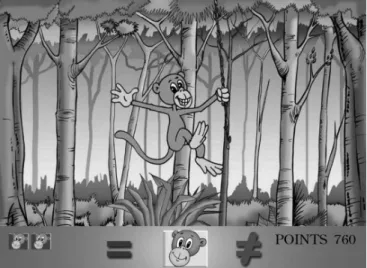
Auditory training was conducted using a notebook computer (Acer) running the “Auditory temporal training with non-verbal and verbal stimuli with expanded speech®” software program, which contains verbal and non-verbal games, based on the “Fast Forward Language” auditory training program(21). In each
training session, 20 minutes were dedicated to the non-verbal game (“Monkey Game”) and 20 minutes to the verbal game (“Parrot Game”).
corresponding sound stimulus. The symbols = or ≠, were used for discrimination of the stimuli; ↑ or ↓, for sequencing, where
↑ represented a rising stimulus, of frequencies in the 500 Hz to
2000 Hz range and ↓ represented a falling stimulus, of frequen-cies in the 2000 Hz to 500 Hz range (Figures 1 and 2). The verbal game (“Parrot Game”) was used to train phoneme discrimination skills. The auditory stimuli were syllables consisting of an initial consonant, with expanded and amplified production duration. Upon hearing two similar-sounding syllables, the player had to discriminate and order the pair of sounds, matching them to the first syllable of the corresponding cartoon illustration displayed on the screen (Figure 3). Both games incorporated automatic adaptation of variables such as duration of sound stimuli, size of gap between stimuli and production duration of the phonemes, according to player performance. In addition, each player had their own area for accessing the system allowing each session to be personalized, i.e. carrying on from the last phase reached by the player in the previous session.
The following variables were analyzed for each study par-ticipant: group (comparison between Study Group and Control Group), Gap-in-Noise detection threshold (GIN), by ear, (initial
assessment and reassessment); percentage correct responses in frequency and duration tests (initial assessment and reassess-ment); points scored on the reading protocol (initial assessment and reassessment); points scored on phonological awareness test (CONFIAS) (initial assessment and reassessment).
The data were submitted to descriptive and inferential statistical analyses using the following statistical tests: Mann-Whitney test; Confidence Interval for Mean; and repeated--measures Analysis of Variance (ANOVA). The descriptive level was focused in all tests, with a significance level of 0.05 (or 5%) for rejection of the null hypothesis.
RESULTS
A statistically significant difference (p<0.05) in performan-ce of the Study group between assessment and reassessment on the Frequency Pattern and Duration Pattern tests was detected (Table 1).
A statistically significant difference in performance of the Study Group, between assessment and reassessment, on the threshold of the left ear was observed (p<0.016) (Table 2). Comparison of the two groups during assessment and reasses-sment revealed a statistical difference only for the threshold of the left ear (p<0.003).
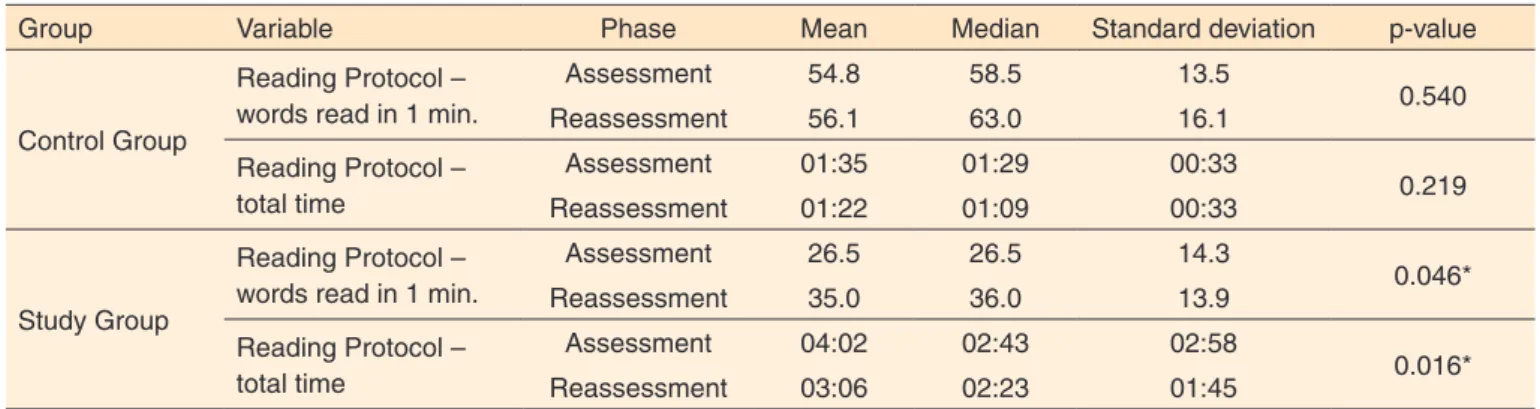
On the comparison of Study Group and Control Group for performance at assessment and reassessment on the Word Reading test for words read in one minute and on the Total Time of Word Reading, only Total Time of Reading exhibited a significant difference between the groups (p<0.009) (Table 3). With regard to the performance at assessment and reas-sessment of the Study Group versus Control Group on the CONFIAS test, statistically significant differences were ob-served (p<0.006; p<0.001 and p<0.001) at the Syllable Level, Phoneme Level and Total scores, respectively, on comparison of the total sample for all items of the CONFIAS (Table 4).
DISCUSSION
Based on the results obtained, it was evident that the Control Group had superior performance on the Frequency Pattern
Figure 1. Frequency discrimination
Figure 3. Verbal discrimination and sequencing
and Duration Pattern test compared to the Study Group. One explanation for these findings is that to perform well on these tests the child must have normal auditory temporal sequencing and inter-hemispheric transfer abilities(22).
Some studies drawing on qualitative data collected at the time of application of the auditory processing tests have shown difficulties among individuals with impaired auditory proces-sing in understanding the instructions to perform each test, typical of Central Auditory Processing Disorder (CAPD). This raises two questions: (i) it is unclear whether the differentiated results of the Study Group can be attributed to difficulties in
understanding the instructions given or to performing the skill itself; and (ii) whether a high level of attention was required on each task, given that the auditory stimuli were delivered at a fast rate(23).
A previous study, which sought to determine the auditory learning characteristics in 86 typically developing children using various different modalities of auditory and linguistic stimuli(24), found that improvements after auditory training in
the Control Group were attributable to the test-retest effect, rendering it impossible to determine the extent to which the post-training improvement in the study group had stemmed
Table 3. Performance on word and pseudoword reading tests by group at assessment and reassessment phases
Group Variable Phase Mean Median Standard deviation p-value
Control Group
Reading Protocol – words read in 1 min.
Assessment 54.8 58.5 13.5
0.540
Reassessment 56.1 63.0 16.1
Reading Protocol – total time
Assessment 01:35 01:29 00:33
0.219
Reassessment 01:22 01:09 00:33
Study Group
Reading Protocol – words read in 1 min.
Assessment 26.5 26.5 14.3
0.046*
Reassessment 35.0 36.0 13.9
Reading Protocol – total time
Assessment 04:02 02:43 02:58
0.016*
Reassessment 03:06 02:23 01:45
*Significant values (p<0.05) - Wilcoxon’s test
Table 2. Performance on Gap-in-Noise (GIN) test by group and ear at assessment and reassessment phases
Group Ear Phase Mean
(ms)
Median (ms)
Standard deviation
(ms) p-value
Control Group
Right Assessment 5.1 5.5 1.1 0.851
Reassessment 5.0 5.0 0.7
Left Assessment 4.8 4.5 0.9 0.059
Reassessment 4.3 4.0 0.7
Study Group
Right Assessment 6.9 6.0 2.2 0.093
Reassessment 5.4 5.5 0.7
Left Assessment 6.8 7.0 1.9 0.016*
Reassessment 5.1 5.0 0.6
*Significant values (p<0.05) - Wilcoxon’s test
Table 1. Performance on Pitch Pattern and Duration Pattern tests by group at assessment and reassessment phases
Group Variable Phase Mean
%
Median %
Standard deviation
% p-value
Control Group
Frequency pattern Assessment 81.5 82.5 14.0 0.015*
Reassessment 86.5 87.5 11.1
Duration pattern Assessment 56.9 55.0 12.2 0.035*
Reassessment 70.0 70.0 13.7
Study Group
Frequency pattern Assessment 69.9 72.5 11.9 0.528
Reassessment 87.0 90.0 7.9
Duration pattern Assessment 30.6 30.0 17.2 0.005*
Reassessment 73.5 75.0 13.8
exclusively from the training or from the effect of repeating the same test.
The results of the Gap-in-Noise (GIN) test for both groups showed that thresholds in left and right ears were greater in the Control Group than in the Study Group. Furthermore, no significant difference between ears was found. These results corroborate the findings of other studies(25,26). The GIN test
as-sesses temporal resolution(26,27) where some studies employing
this test to assess the gap detection threshold in individuals with normal hearing have reported values ranging from 3.98 to 6.07 ms(28). These threshold values were consistent with those found
in the Control Group of the present study (6 ms).
Some studies(27-29) have sought to associate speech and writing
impairments with temporal resolution deficits. The results of these studies showed that individuals with phonological deficits and dyslexia can exhibit auditory temporal processing deficit and that more time is required to detect the gaps between sound stimuli(29). The findings of the present study are in agreement
with reports in the literature, since the group of reading-impaired children had greater gap thresholds in both ears than the group of children without auditory processing or reading impairments.
The poor performance attained by the Study Group on the auditory temporal processing tests may point to a possible rela-tionship between reading and temporal auditory processing, in line with a number of studies in the literature(29,30). Concerning
the worse performance of dyslexic children on auditory tempo-ral processing tests, some authors have pointed out that other factors may affect phonological performance such as cognitive skills, particularly attentional ability and working memory(30).
All these skills are essential to learning, especially in situations involving reading. The neural networks were stimulated by the training and may have improved attention and memory as well as perception of speech, thereby enhancing reading accuracy.
Another noteworthy question centers on whether the per-formance improvement seen in the Study Group after auditory
training was attributable to the test-retest effect. Further studies investigating this possibility in a larger sample are needed. In addition, the inclusion of assessments using electrophysio-logical tests may attenuate some of the effects present in the behavioral tests. Future studies should include a group of indi-viduals with the same characteristics as the other test subjects, submitted to a passive auditory stimulation in order to better assess the true benefits of an active auditory stimulation for enhancing reading performance post intervention.
CONCLUSION
The auditory training proved effective for improving per-formance on auditory temporal and reading tasks in children with learning difficulties.
ACKNOWLEDGEMENTS
The authors would like to thank for the support of PIBIC/ CNPq which granted a honors research fellowship to the main author for conducting this study (project no. 179/09).
REFERENCES
1. American Speech-Language-Hearing Association (ASHA). Central auditory processing: current status of research and implication for clinical practice. Am J Audiol. 1996;5(2):41-52.
2. Shinn JB. Temporal processing: the basics. Hear J. 2003;56(7):52. 3. Breir JI, Fletcher JM, Foorman BR, Klaas P, Gray LC. Auditory temporal processing in children with specific reading disability with and without attention deficit/hyperactivity disorder. J Speech Lang Hear Res. 2003;46(1):31-42.
4. Neves IF, Schochat E. Maturação do processamento auditivo em crianças com e sem dificuldades escolares. Pró-Fono R Atual Cient. 2005;17(3):311-20.
Table 4. Performance on Phonological Awareness test (CONFIAS) by group at assessment and reassessment phases
Group Variable Phase Mean Median Standard deviation p-value
Control Group
CONFIAS Syllable Assessment 36.5 37.0 2.9 0.159
Reassessment 37.6 39.0 3.9
CONFIAS Phoneme Assessment 21.6 22.5 4.3 0.008*
Reassessment 26.2 26.0 1.8
CONFIAS Total Assessment 58.1 57.0 5.8 0.022*
Reassessment 63.8 65.5 4.6
Study Group
CONFIAS Syllable Assessment 33.4 35.5 5.5 0.017*
Reassessment 35.8 38.0 5.4
CONFIAS Phoneme Assessment 15.0 17.0 7.1 0.007*
Reassessment 21.1 22.0 4.6
CONFIAS Total Assessment 48.4 52.0 12.1 0.007*
Reassessment 56.9 60.0 9.3
5. Nicholas JG, Geers AE. Effects of early auditory experience on the spoken language of deaf children at 3 years of age. Ear Hear. 2006;27(3):286-98.
6. Olivares-García MR, Peñaloza-López YR, García-Pedroza F, Jesús-Pérez S, Uribe-Escamilla R, Jiménez-de la Sancha S. Identificación de la lateralidad auditiva mediante una prueba dicótica nueva con dígitos en español, y de la lateralidad corporal y orientación espacial en niños con dislexia y en controles. Rev Neurol. 2005;41(4):198-205.
7. Idiazábal-Alexta MA, Saperas- Rodrígues M. Procesamiento auditivo en el trastorno específico del lenguaje. Rev Neurol. 2008;46(Supl 1):S91-5.
8. Mann V, Foy J. Speech development patterns and phonological awareness in preschool children. Ann of Dyslexia. 2007;57(1):51-74. 9. Samelli AG, Mecca FFDN. Treinamento auditivo para transtorno do processamento auditivo: uma proposta de intervenção terapêutica. Rev CEFAC. 2010;12(2):235-41.
10. Pinheiro FH, Capellini SA. Treinamento auditivo em escolares com distúrbios de aprendizagem. Pró-Fono R Atual Cient. 2010;22(1):49-54. 11. Chermak GD, Musiek FE, editors. Handbook of (Central) auditory processing disorder. San Diego: Plural; 2007. Vol. 2, Comprehensive intervention.
12. Tallal P. Improving language and literacy is a matter of time. Nat Rev Neurosci. 2004;5(9):721-8.
13. Zalcman TE, Schochat E. A eficácia do treinamento auditivo formal em indivíduos com transtorno de processamento auditivo. Rev Soc Bras Fonoaudiol. 2007;12(4):310-4.
14. Northen JL, Downs MP. Hearing in children. 3rd. ed. Baltimore:
Williams & Wilkins; 1984. p. 89.
15. Moore DR, Rosenberg JF, Coleman JS. Discrimination training of phonemic contrasts enhances phonological processing in mainstream school children. Brain Lang. 2005;94(1):72-85.
16. Balen SA, Liebel G, Boeno MR, Mottecy CM. Resolução temporal de crianças escolares. Rev CEFAC. 2009;11(supl.1):52-61.
17. Auditec. Evaluation manual of pitch pattern sequence and duration pattern sequence. St. Louis; 1999.
18. Musiek FE, Shinn JB, Jirsa R, Bamiou DE, Baran JA, Zaida E. GIN
(Gaps-In-Noise) test performance in subjects with confirmed central auditory nervous system involvement. Ear Hear. 2005;26(6):608-18. 19. Capellini SA, Smythe I. Protocolo de avaliação de habilidades cognitivo-linguística: livro do profissional e do professor. Marília: Fundepe; 2008.
20. Moojen S, coordenator. Confias: Consciência fonológica: instrumento de avaliação sequencial. São Paulo: Casa do Psicólogo; 2007.
21. Merzenich MM, Jenkins WM, Jonhston P, Schreiner C, Miller SL, Tallal P. Temporal processing deficits of language-learning impaired children ameliorated by training. Science. 1996;271(5245):77-81. 22. Halliday LF, Taylor JL, Millward KE, Moore DR. Lack of generation of auditory learning in typically developing children. J Speech Lang Hear Res. 2012;55(1):168-81.
23. Zaidan E, Garcia AP, Tedesco MLF, Baran JA. Desempenho de adultos jovens normais em dois testes de resolução temporal. Pró-Fono R Atual Cient. 2008;20(1):19-24.
24. Garcia VL. Processamento auditivo em crianças com e sem distúrbios de aprendizagem [thesis]. São Paulo: Universidade Federal de São Paulo; 2001.
25. Hautus MJ, Setchell GJ, Waldie KE, Kirk IJ. Age-related improvements in auditory temporal resolution in reading-impaired children dyslexia. Dyslexia. 2003;9(1):37-45.
26. Perez AP, Pereira LD. O Teste Gap in Noise em crianças de 11 e 12 anos. Pró-Fono R Atual Cient. 2010;22(1):7-12.
27. Schochat E. Desenvolvimento e maturação do sistema nervoso auditivo central em indivíduos de 7 a 16 anos de idade [thesis]. São Paulo: Universidade de São Paulo; 2001.
28. Van Ingelghem M, Wieringen A, Wouters J, Vandenbussche E, Onghena P, Ghesquière P. Psychophysical evidence for a general temporal processing deficit in children with dyslexia. Neuroreport. 2001;12(16):3603-6.
29. Share DL, Jorm AF, MacLean R, Matthews R. Temporal processing and reading disabilities. Read Writ. 2002;15(1-2):151-78.