Neonatal hearing screening with automated auditory
brainstem response: using different technologies
Triagem auditiva neonatal com potencial evocado auditivo de tronco
encefálico automático: a utilização de diferentes tecnologias
Taise Argolo Sena-Yoshinaga1, Mabel Gonçalves Almeida2, Isabela Freixo Côrtes-Andrade3, Doris Ruthi Lewis3
ABSTRACT
Purpose: To analyze the results of Neonatal Hearing Screening with Automated Auditory Brainstem Response conducted using different technologies, by studying the sensitivity, specificity, and time taken in the assessment. Methods: Two hundred newborns were assessed with the Automated Auditory Brainstem Response using detection method in the frequency domain and stimulus repetition rate at 93 Hz. All subjects were submitted to the diagnostic Auditory Brainstem Response, which was considered the gold standard for the results found. During scree-ning, newborns were classified according to the Neonatal Behavioral Assessment Scale (Brazelton Scale), in order to analyze the time taken in the assessment. Results: Two of the 200 newborns screened failed both the Automated Auditory Brainstem Response and the diagnostic Auditory Brainstem Response, and 198 passed both tests. Sensitivity and specificity were of 100%. The mean assessment time was 32.9 seconds. The newborns were divided into three groups according to the Brazelton Scale. The assessment took a mean of 18.94 seconds for Group 1, 33.43 seconds for Group 2, and 49.24 seconds for Group 3. Conclusion: The Automated Auditory Brainstem Response with different technologies presents high sensitivity and specificity with a considerably short time to determine the presence or absence of response, and the newborn’s state of consciousness influences the time taken in the assessment.
Keywords: Infant, Newborn; Hearing tests; Neonatal screening; Evoked potentials, Auditory; Consciousness
RESUMO
Objetivo: Analisar os resultados da Triagem Auditiva Neonatal com Potencial Evocado Auditivo de Tronco Encefálico Automático, com dife-rentes tecnologias, estudando a sensibilidade, a especificidade e o tempo de exame. Métodos: Foram avaliados 200 neonatos, por meio do Potencial Evocado Auditivo de Tronco Encefálico Automático utilizando método de detecção no domínio da frequência e taxa de repetição do estímulo a 93 Hz. Todos os neonatos foram submetidos ao Potencial Evocado Auditivo de Tronco Encefálico como padrão ouro, para garantir os resultados encon-trados. Durante a realização da triagem, os neonatos foram classificados de acordo com a Escala Neonatal de Avaliação Comportamental, conhecida como Escala de Brazelton, como variável para análise do tempo de exame.
Resultados: Dois dos 200 neonatos triados falharam no Potencial Evocado Auditivo de Tronco Encefálico Automático e no Potencial Evocado Au-ditivo de Tronco Encefálico Diagnóstico e 198 passaram nos dois exames realizados. A sensibilidade encontrada foi de 100% e a especificidade, de 100%. O tempo médio de exame foi de 32,9 segundos. Os neonatos foram dividido em três grupos, de acordo com o estado de consciência, segundo a Escala de Brazelton. O Grupo 1 apresentou média de exame de 18,94 segundos, o Grupo 2, de 33,43 segundos e o Grupo 3, de 49,24 segundos. Conclusão: O Potencial Evocado Auditivo de Tronco Encefá-lico Automático com diferentes tecnologias apresenta alta sensibilidade e especificidade, com tempo consideravelmente curto para a determinação da presença ou ausência de resposta e o estado de consciência do neonato influencia no tempo de detecção da resposta auditiva.
Descritores: Recém-nascido; Testes auditivos; Triagem neonatal; Poten-ciais evocados auditivos; Estado de consciência
This study was conducted at the Hospital Amparo Maternal in São Paulo (SP), Brazil, which is linked to the Pontifícia Universidade Católica de São Paulo – PUC – São Paulo (SP), Brazil.
(1) Universidade de São Paulo – USP, School of Medicine, Department of Speech-Language Pathology and Audiology, Physical Therapy, and Occupational Therapy, São Paulo (SP), Brazil.
(2) Universidade Federal do Espírito Santo – UFES, Department of Speech-Language Pathology and Audiology, Vitória (ES), Brazil. (3) Pontifícia Universidade Católica de São Paulo – PUC – São Paulo (SP), Brazil.
Conflict of interests: No
Authors’ contribution: TASY: data collection, writing and discussion of the results; MGA data collection, writing and discussion of the results; IFCA data col-lection, writing and discussion of the results; DRL advisor, writing and discussion of the results.
Correspondence address: Taise Argolo Sena-Yoshinaga. R. Bernardo dos Santos 10/241 Alpha, Vila Sônia, São Paulo (SP), Brazil, CEP: 05542-000. E-mail: [email protected]
INTRODUCTION
The Neonatal Hearing Screening (NHS) programs have the purpose to early identify hearing loss, reducing the age of audiological diagnosis and therapeutic intervention. Two physiological procedures are currently recommended: the Evoked Otoacoustic Emissions (EOAE) and the Auditory Brainstem Response (ABR). Different protocols that combine both procedures may be used. It is suggested that all newborns are submitted to EOAE, and those with failed results and/or risk indicators for hearing impairment are immediately retested with ABR(1,2).
Since the aim of NHS programs is to identify all newborns with hearing impairments in a quick and reliable manner, the performance of the procedures must be based in evidence, such as sensitivity (which refers to the test’s ability to correctly identify hearing loss in the population tested), specificity (which refers to the accuracy in correctly identifying normal hearing newborns), and time taken in the screening procedure, whether in the presence or absence of responses(1,3-6).
Technological advances allowed the elaboration of auto-mated ABR equipment (AABR), which have preset algorithms with pass/fail criteria automatically analyzed by statistical tests, reducing the duration of the test and exempting the examiner’s participation in the interpretation of results, thus making it the most appropriate test for NHS(7-10). Results from recent studies
that used AABR presented sensitivity around 90 to 100% and specificity between 93 and 100%, proving that this is, in fact, an appropriate screening procedure to be used in NHS programs(4,11-15).
The AABR results may be analyzed using statistical tests in the domains of time or frequency. The detection methods in the domain of time provide information regarding wave mor-phology, delays, and temporal correlations. They represent the electric potential variation in several anatomical structures of the auditory pathway, in function of time. The detection me-thods in the domain of frequency use the fast Fourier transform (FFT) of the ABR collected. The FFT is one of the manners to make the change from the time domain to the frequency domain, in which a signal is evidenced by its frequency com-ponents without losing its initial characteristics. Hence, with this change, it is possible to observe the same phenomenon in different manners(8,10,16).
The frequency components are represented by several harmonics. The carrier frequency presents greater amount of energy in the cochlea, that is, the location that concentrate the greater number of harmonics. The modulating frequency corresponds to the stimulus repetition rate, and is represented by the position of the first harmonic in the frequency spectrum. This fixed relation between these frequencies provides the basis for the objective detection of responses(17).
Recent studies have shown that the best stimulus repetition rate for the AABR used in NHS is around 90 Hz, and indicate
that these high repetition rates result is steady-state respon-ses, which may be easily analyzed in the frequency domain, besides reducing the time taken in the screening procedu-re(8,10,14,18). Thus, the detection method in the frequency domain
is more indicated for NHS, because it fastens the detection of responses(4,8-10,19,20).
Part of the AABR equipment use the response detection method in the frequency domain, mostly with statistical tests called one-sample test, which consider only the spectral component of the stimulus presentation rate (first harmonic)
(21-23). Recently, the use of statistical tests called q-sample tests,
which include other harmonics besides the first in response detection, have shown better performance regarding time and reliability(7,9,10,19,21).
In a preliminary investigation, researchers have observed that the use of more than one harmonic creates benefits in the detection. They have reported that q-sample tests are better than one-sample tests to evaluate the responses in the frequency domain, as it improves the detection condition, which influences the response reliability and the time taken in the screening procedure(7,9,19).
The mean screening time found in the studies that used the detection method in the frequency domain and q-sample tests
was lower than 60 seconds, and in the studies that did not use these technologies, up to 10.7 minutes(4,10,12,24,25). Due to the fact
that ABR are collected along with other electrical activities from the brain, adjacent muscles, and breathing, for example, the signal must be identified in noise, with accurate detection techniques. Therefore, the state of the newborn is an important factor to be considered when the time needed for the screening procedure is assessed.
In general, the studies that have used AABR in the last de-cade have shown some concern in determining these aspects, thus improving the technique used for NHS implementation. Within this perspective, this study had the aim to investigate the results from AABR using click stimulus with 100 µs duration, presented in high repetition rate and with the detection method in the frequency domain, assessing the aspects of sensitivity, specificity, and time taken in the screening procedure.
METHODS
This study was approved by the Research Ethics Committee of the Pontifícia Universidade Católica de São Paulo (PUC), under protocol 199/2010.
This is a prospective quantitative descriptive study, con-ducted at the Hospital Amparo Maternal and at the Centro de Audição na Criança (CeAC – Child Hearing Center), from December 2010 to April 2011. Participants were 200 newborns (93 female and 107 male), summing up 400 ears. The following inclusion criteria were considered:
- To have at least 37 weeks gestational age at birth; - To have more than 24 hours of life;
- To have the Free and Informed Consent previously signed by the mother or legal guardians.
A short interview was conducted with the mother, and then the newborn was submitted to the electrophysiological proce-dures of AABR and diagnostic ABR. Both proceproce-dures were conducted on the same day, in a single session.
Surface electrodes were used for both electrophysiological procedures. Reference electrodes were placed on the right (M2) and left (M1) mastoids. The active (Fz) and the ground (Fpz) electrodes were placed on the front(26). The impedances
of the interface skin-electrodes were verified using the preamp meter, in order to guarantee values equal to or lower than 3 kΩ. Insert phones EAR-phones 3A were used for conduction of the sound stimulus.
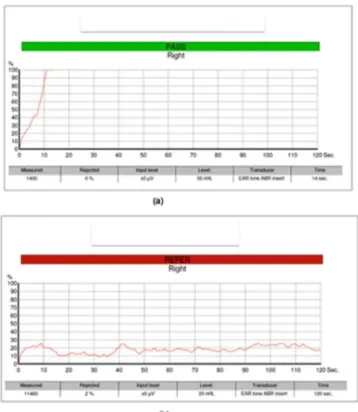
To obtain the AABR findings, the equipment Eclipse Black Box – softwareABRIS from Interacoustics® MedPC was used. This equipment analyzes the responses using the frequency domain with q-sample tests. The maximum time established to determine the presence or absence of response was 120 sec-onds. When response was obtained, the equipment presented a green “pass” sign on the computer screen, showing that the response had achieved 100% of the software’s illustrative graph (Figure 1). In the absence of response, the equipment contin-ued to present the stimulus until 120 ms and, if the response did not obtain 100% of the software’s illustrative graph, a red “fail” sign appeared (Figure 1). The NHS using AABR was conducted using the intensity of 35 dBnHL bilaterally. The parameters were automatically adjusted by the equipment manufacturer (Chart 1).
The duration of the screening procedure was automatically registered by the software on the computer screen. If any sudden body movement or electric artifact interfered in the test, the software interrupted the timing and resumed when the newborn was in ideal condition.
To evaluate the state of consciousness of the newborn during the AABR, the criteria of the Brazelton Scale(27) were used.
The scale describes six consciousness states: State 1 = deep sleep, no movement, regular breathing; State 2 = light sleep, closed eyes, some body movement; State 3 = sleepy, opening and closing eyes; State 4 = awake, eyes opened, minimal body movement; State 5 = totally awake, vigorous body movement; State 6 = crying. The equipment recorded the responses only when the newborns were in states 1, 2 or 3.
The Eclipse Black Box –softwareEP25 from Interacoustics® MedPC was used to obtain the air-conduction diagnostic ABR. The test was used as gold standard to verify the sensitivity and specificity of the AABR. The threshold was obtained for all newborns, considering the intensity of 20 dBnHL as standard reference for normality. The parameters considered are pre-sented in Chart 1.
In the cases were wave V was absent at the intensity of 20 dBnHL by air conduction, the mothers were invited to bring their newborns for audiological evaluation at CeAC in an in-terval of approximately 30 days.
Data were tabulated in Excel and later analyzed by a sta-tistician. Descriptive statistic tests were conducted; the Fisher Exact Test was used to analyze sensitivity and specificity, and the ANOVA test, to analyze the variable time, using the Brazelton Scale.
RESULTS
The AABR results found at 35 dBnHL were analyzed. Table 1 presents the frequency distribution of the results correlating the AABR with the diagnostic ABR findings from all 200 newborn subjects (400 ears).
Chart 1. Characteristics of the protocol used for AABR and diagnostic ABR recording
Parameters
AABR Diagnostic ABR Repetition rate 90 Hz 27.7 Hz Stimulus Click- 100µs Click- 100µs Polarity Alternate Alternate
Filters _ 100-3000
Note: Hz = Hertz; µs = microssegundos; AABR = Automated Auditory Brainstem Response; ABR = Auditory Brainstem Response
Note: AABR = Automated Auditory Brainstem Response
It was observed that three ears (two newborns) failed both the AABR and the diagnostic ABR. These subjects were re-ferred to audiological evaluation, which confirmed the results obtained in the screening.
Sensitivity and specificity were calculated considering the results from the diagnostic ABR. The Fisher Exact Test showed strong correlation between both tests (p=0.0000001). The AABR at 35 dBnHL presented sensitivity and specificity of 100%.
To analyze the screening time, descriptive statistics was conducted, also considering the 400 ears (Table 2).
The newborns that passed the AABR were divided into three groups, according to the state of consciousness assessed by the Brazelton Scale. Group 1 corresponded to State 1, Group 2 to State 2, and Group 3 to State 3. The descriptive data regarding the time taken in the screening procedure, in seconds, for the three groups are presented in Table 3.
The mean screening time from the three groups were compared. The ANOVA test showed significant differences between groups (p=0.000). The mean time from Group 1 was shorter than from Group 2, which was shorter than the mean time from Group 3.
DISCUSSION
Because it is a sensory deprivation with important conse-quences for the child, the family, and society in general, hearing
impairment have been subject of concern and studies, in the se-arch for alternatives that might minimize its deleterious effects on individuals’ social, emotional and cognitive development.
In has been recently reported in literature that the AABR carried out in NHS is strongly correlated to the results found in diagnostic ABR. In this research, the Fisher Exact Test indicated strong correlation between both tests, corroborating previous studies(13-15) that have reported high sensitivity (98 to 100%) and
specificity (97 to 100%) for the AABR, allowing the conclusion that the prevalence of fail results in hearing screening may be considered as possible hearing loss(4,11,12,14,15).
Although it is an automated ABR equipment, the strong correlation found with diagnostic ABR secures that this type of equipment allow a reliable and safe evaluation. Therefore, it can be stated that AABR may be used as the first NHS procedure, as it is less influenced by middle ear alterations, considerably reducing the number of referrals to audiological evaluation.
Besides the high sensitivity and specificity, however, the time taken in the screening procedure is an important issue to be considered, as NHS must be universal. Studies that, similarly to this, used detection method in the frequency domain, with
q-sample tests and repetition rate around 90 Hz, have presented better results regarding the variable time(4,10,12,15,18,25). On the
other hand, the studies that did not use these technologies, choosing one-sample tests, presented screening times varying between 4 and 15 minutes(11-13,24).
In fact, as one-sample tests cling only to the first harmonic to carry out the automatic analysis of responses, different sta-tistical tests are separately applied to the different frequency components to be evaluated. Hence, in order to finally deter-mine the presence or absence of response, the results must be safely and adequately combined, which demands some time(21).
Also considering that the amplitude of the response is shorter when it is closer to the threshold and, thus, it is more difficult to be detected, a high number of averaging is necessary when one--sample tests are used, further increasing the screening time(22,23).
On the other hand, when q-sample tests – that analyze more than one harmonic – are used, the response is more easily
Table 1. Frequency distribution of AABR results at 35 dBnHL with diagnostic ABR, considering the total of 400 ears
AABR
Diagnostic ABR
Absence Presence All
Fail 3 0 3
Pass 0 397 397
All 3 397 400
Note: ABR = Auditory Brainstem Response; AABR = Automated Auditory Brain-stem Response
Table 2. Screening time, in seconds, for the AABR, considering 400 ears
AABR n Mean Standard deviation Median Maximum Minimum
Pass 397 28.3 17.4 22.0 105 14
Fail 3 120 120 120 120 120
Note: AABR = Automated Auditory Brainstem Response
Table 3. Descriptive and inferential statistics of the screening time, in seconds, for Groups 1, 2 and 3 in the AABR, considering the 397 ears
Brazelton n Mean Standard deviation Minimum Median Maximum
Group 1 1 180 18.94 8.04 14 15 55
Group 2 2 180 33.43 17.94 14 29 105
Group 3 3 37 49.24 19.63 19 47 104
ANOVA test (p=0.000)
detected. Therefore, the conclusion of whether the response is present or absent does not demand a high number of scans or the combination of rules. Hence, these tests are better than one--sample tests when screening time and reliability of responses are taken into consideration(9).
Although no false-positive results were found in this study, because of the influence of the state of consciousness, they may occur due to absence of ideal conditions for screening. It was noted that, the more unquiet the newborn, the more time was necessary to perform the procedure. For some subjects, the screening took practically the full time of 120 seconds to be completed.
Another important aspect to be emphasized regards the false-positive and false-negative rates, since NHS has the aim to identify the newborns that actually have hearing impairment. Hence, the use of tests that reduce these rates increases the re-liability of NHS programs, decreases the time and the costs of further evaluation, and has less emotional impact on parents(18).
This study did not have false-positive and false-negative results. As shown in this study, a good statistical test presents satis-factory results for the use of AABR in NHS programs. However, this aspect alone may not be enough, since an important prere-quisite to detect the response closer to the threshold is also the low noise spontaneously caused by the electroencephalogram (EEG). Therefore, screening time was analyzed considering the state of consciousness of the newborn at testing.
The AABR is the safer test to be used in NHS because it has lower rates of false-positive and false-negative results when compared to Transient Evoked Otoacoustic Emissions (TEOAE). However, its increased duration time and cost hinders its use in all newborns(8,18). This study showed AABR
screening time close to that of TEOAE, reducing the impact of the time issue.
It was noticed that, the quieter the newborn, the quicker the response recording (Table 3). Thus, it is recommended that the patient is comfortably accommodated, relaxed, and sleeping. Since the amplitude of responses in the frequency domain are shorter when closer to the threshold, the more relaxed the sub-ject, the better the conditions to detect the response, reducing the time taken in the screening procedure(9).
Although many authors have mentioned state of consciou-sness as one of the factors that may influence ABR, we did not find any studies that compared it to screening time. However, the statistical analyses showed that the time taken in the NHS procedure is influenced by the newborn’s state of conscious-ness. This may be due to the high EEG, which causes noise that might interfere in response detection, since the amplitude is shorter closer to the threshold(9,16).
This study have shown that different technologies have been developed to maximize the results and guarantee the effecti-veness of NHS procedures, especially after the introduction of new stimuli, new detection methods, and new statistical analyses methods. However, there are still few clinical studies
on the theme, as well as on the influence of the state of cons-ciousness on screening results and time, emphasizing the need for further studies regarding these aspects.
CONCLUSION
The AABR in the frequency domain, which uses q-sample tests and repetition rate at 93 Hz, presents high sensitivity and specificity, with a relatively short time to determine the presence or absence of response. The state of consciousness influences the time taken in the screening procedure. Thus, the more relaxed the newborn, the shorter the screening time.
ACKNOWLEDGEMENTS
We thank the Conselho Nacional de Pesquisa (CNPq), for the grant provided under process number 131790/2011-0. To Bue Kristensen and Interacoustics®.
REFERENCES
1. American Academy of Pediatrics, Joint Committee on Infant Hearing. Year 2007 position statement: Principles and guidelines for early hearing detection and intervention programs. Pediatrics. 2007;120(4):898-921. 2. Lewis DR, Marone SAM, Mendes BCA, Cruz OLM, Nóbrega M. Comitê multiprofissional em saúde auditiva – COMUSA. Braz J Otorhinolarygol. 2010;76(1):121-8.
3. Bess FH, Humes LE. Fundamentos de audiologia. 2nd. ed. Porto Alegre: Artmed; 1998.
4. Keohane BM, Mason SM, Baguley DM. Clinical evaluation of the vector algorithm for neonatal hearing screening using automated auditory brainstem response. J Laryngol Otol. 2004;118(2):112-6.
5. Freitas VS, Alvarenga KF, Bevilacqua MC, Martinez MAN, Costa OA. Análise crítica de três protocolos de triagem auditiva neonatal. Pró-Fono R Atual Cient. 2009;21(3):201-6.
6. Wolff R, Hommerich J, Riemsma G, Antes G, Lange S, Kleijnen J. Hearing screening in newborns: systematic review of accuracy, effectiveness, and effects of interventions after screening. Arch Dis Child. 2010;95(2):130-5.
7. Stürzebecher E, Cebulla M, Wernecke K. Objective response detection in the frequency domain: comparison of several q-sample tests. Audiol Neurootol. 1999;4(1):2-11.
8. Stürzebecher E, Cebulla M, Neumann K. Click-evoked ABR at high stimulus repetition rates for neoatal hearing screening. Int J Audiol. 2003;42(2):59-70.
9. Cebulla M, Stürzebecher E, Elberling C. Objective detection of auditory steady-state responses - comparison of one-sample and q-sample tests. J Am Acad Audiol. 2006;17(2):93-103.
12. Straaten HLM. Automated auditory brainstem response in hearing screening. Acta Paediatrl. 1999;88(supp 432):76-9.
13. Clarke P, Iqbal M, Mitchell S. A comparison of transient-evoked otoacoustic emissions and automated auditory brainstem responses for pre-discharge neonatal hearing screening. Int J Audiol. 2003;42(8):443-7. 14. Melagrana A, Casale A, Calevo MG, Tarantino V. MB11 BERAphone and auditory brainstem response in newborns at audiologic risk: comparison of results. Int J Pediatr Otorhinolaryngol. 2007;71(8):1175-80.
15. Berg E, Deiman C, Straaten HL. MB11 BERAphone) hearing screening compared to ALGOportable in a Dutch NICU: a pilot study. Int J Pediatr Otorhinolaryngol. 2010;74(10):1189-92.
16. Menezes PL. Desenvolvimento de um dispositivo capaz de registrar e analisar potenciais evocados auditivos nos domínios do tempo e das frequências [thesis]. Ribeirão Preto: Faculdade de Filosofia, Ciências e Letras de Ribeirão Preto; 2008.
17. Lins OG. Audiometria fisiológica tonal utilizando respostas de estado estável auditivas de tronco cerebral [thesis]. São Paulo: Escola Paulista de Medicina, Universidade Federal de São Paulo; 2002.
18. Guastini L, Mora R, Dellepiane M, Santomauro V, Mora M, Rocca A, Salami A. Evaluation of an automated auditory brainstem response in a multi-stage infant hearing screening. Eur Arch Otorhinolaryngol. 2010;267(8):1199-205.
19. Cebulla M, Stürzebecher E, Wernecke KD. Objective detection of auditory brainstem potentials: comparison of statistical tests in the time and frequency domains. Scand Audiol. 2000;29(1):44-51.
20. Cebulla M, Stürzebecher E, Wernecke KD. Objetive detection of the amplitude modulation following response (AMFR). Audiology. 2001;40(5):245-52.
21. Dolbie RA, Wilson MJ. Objective response detection in the frequency domain. Eletroencephalogr Clin Neurophysiol. 1993;88(6):516-24. 22. Cebulla M, Stürzebecher E, Wernecke KD. Objective detection of auditory evoked potentials. Comparison of several statistical tests in the frequency domain by means of Monte Carlo simulations. Scand Audiol. 1996;25(3):201-6.
23. Stürzebercker E, Cebulla M. Objective detection of auditory evoked potentials. Comparison of several statistical tests in the frequency domain on the basis of near-threshold ABR data. Scand Audiol. 1997;26(1):7-14. 24. Iwasaki S, Hayashi Y, Seki A, Nagura M, Hashimoto Y, Oshima G, Hoshino T. A model of two-stage newborn hearing screening with automated auditory brainstem response. Int J Pediatr Otorhinolaryngol. 2003;67(10):1099-104.
25. Sena TA, Ramos N, Rodrigues GRI, Lewis DR. Comparação do tempo de dois procedimentos com novas tecnologias de Potencial Evocado Auditivo de Tronco Encefálico Automático (PEATE-A). CoDAS. 2013;25(1):34-8.
26. Jasper HH. The ten-twenty system of the International Federation. In: Report of the committee on methods of clinical examination in electroencephalography; 1957. [Electroencephologr Clin Neurophysiol. 1958;10(2):371-5].