http://periodicos.uem.br/ojs/acta ISSN on-line: 1807-8656
Doi: 10.4025/actascihumansoc .v40i2.40220 CIÊNCIAS SOCIAIS
The Confederations Cup in the coverage by Folha de São Paulo:
power relationships, conflicts and interests in the media
Ivan Daniel Muller1, Janaina Andretta Dieder2 and Gustavo Roese Sanfelice2*
1Programa de Pós-graduação em Sociologia, Universidade Federal do Rio Grande do Sul, Porto Alegre, Rio Grande do Sul, Brazil. 2Programa de
Pós graduação em Diversidade Cultual e inclusão Social, Universidade Feevale, ERS-239, 2755, 93525-075, Novo Hamburgo, Rio Grande do Sul, Brazil. *Author for correspondence. E-mail: [email protected]
ABSTRACT. The present article aims at analyzing and interpreting the coverage by Folha de São Paulo
concerning the social demonstrations which took place in Brazil in June, 2013, related to the Confederations Cup/Brazil/2013. The qualitative/descriptive corpus-based research focused on the articles posted on the newspaper Folha de São Paulo from June 7th, 2013 to July 2nd, 2013, a period of time which was followed by and included the 2013 FIFA Confederations Cup, comprising the Social Demonstrations that occurred in June, 2013, in Brazil. By applying Goffman’s frame analysis (2004), we have chosen the following categories: ‘Folha de São Paulo’s vandals!?’; ‘Violence and police abuse making the headlines’; ‘Redefining the frames: highlights in the political domain’. We have come to the conclusion the Folha de
São Paulo was concise when highlighting in its frames the public expenditure on non-priority projects,
actual legacies and the intransigencies placed on the requirements that FIFA imposed to Brazil.
Keywords: social demonstrations; media; sport.
A Copa das Confederações na cobertura da Folha de São Paulo: conflitos, interesses e
relações de poder no campo midiático
RESUMO. Este artigo tem por objetivo analisar e interpretar a cobertura da Folha de São Paulo sobre as
manifestações sociais no Brasil em junho de 2013, relacionado com a Copa das Confederações/Brasil/2013. A pesquisa do tipo qualitativa/descritiva teve como corpus as edições do jornal Folha de São Paulo de 07 de Junho de 2013 a 02 de Julho de 2013, período que antecedeu e compreendeu a Copa das Confederações FIFA 2013 e que engloba também as Manifestações Sociais de Junho de 2013 no Brasil. Aplicando a noção de Enquadramento (Frame) de Goffman (2004), elegemos as seguintes categorias: ‘Os vândalos da Folha de São Paulo!?’; ‘A violência e o abuso policial em destaque’; ‘Ressignificando os enquadramentos: destaques do campo político’. Concluímos que a Folha de São Paulo foi concisa em destacar nos seus enquadramentos os gastos públicos em projetos não prioritários, os legados não efetivados e as intransigências dispostas nas obrigações que a FIFA destinou ao país; tudo isso, derivados da escolha do país em sediar a Copa das Confederações/2013 e a Copa do Mundo de Futebol/2014.
Palavras-chave: manifestações sociais; mídia; esporte. Introduction1*
Considering the recently finished sport decade in our country, it is up to us Brazilians to look back at that time and evaluate, especially by asking ourselves, if it was really worth it to have hosted this big number of sporting events here, where the Rio 2016 Olympic Games, 2014 FIFA World Cup and Mega-Sporting Events were the most important ones.
It is exactly in that sense that this article is released, being presented as the result of academic and empiric research, providing data which helps and broadens the possibilities to follow this evaluative
1 Tradutora Cristine Gisele Hess
path. Possibly, such data will not be enough to find the answer to the question presented, but they will undoubtedly help and enable a clearer vision of some of the several powerful relationships, structures and interests which are placed before Mega-Events in the country. The empiric example which is going to be addressed here is directly associated with the print media, and is supported by the analysis of the coverage by the newspaper Folha de São Paulo concerning the Social Demonstrations of June, 2013 and their potential relationship with the 2013 FIFA Confederations Cup, an event which took place one year prior to the 2014 FIFA World Cup.
It is important to emphasize that the entire Confederations Cup was taken by a ‘crazy environment’, excessively encouraged by the
Demonstrations of June, 2013, which began days before the games started. Such demonstrations, which were against the bus ticket prices going up, had as their main flag the fight for free public transport and complained about the service precariousness as well as the bad use conditions. Also in the month of June, in São Paulo, after the city and state governments announced the fare increase, those demonstrations became even more powerful (Viana, 2013).
Considering the demonstrations’ early history, it should be pointed out that they were not connected or intended to the Mega-Events and, in general, were not that different from the other demonstrations which took the streets of the country year after year, such as the one called ‘Abril
Vermelho2’ (Red April), which didn’t even get the
proper media coverage (Viana, 2013). However, it is undeniable that the upcoming Confederations Cup, an event prior to the FIFA World Cup, the rising number of demonstrators, the use of social networks and several other intrinsic characteristics of network movements, as well as the mediatized society made the demonstrations, which used to aim at problems concerning urban mobility, emerge and transform themselves. Also beginning were complaints about other symbols of neoliberal reasoning, far beyond the public transport matter (Perruso, 2014), among which the FIFA events in the country became the main attraction. Such events entered the demonstrators’ list of complaints, especially because once they are taken into account an astronomical public expenditure is seen in areas which are not critical to the population, such as the soccer stadiums (Vainer, 2013).
The field of media, in turn, especially derived from the economic and marketing interests, was only interested in the dates and times of the sporting events as well as in the sporting events themselves which, as a result, led to the criticism related to the demonstrations and demonstrators regarding the coverage of the Social Demonstrations of June, 2013, which were initially seen as illegitimate and the demonstrators considered to be vandals (Dowbor & Szwako, 2013). Nevertheless, a large number of people, a significant part of it being comprised of middle-class citizens, the abusive police violence, and mainly the social networks, made the field of media redefine the demonstrations. When it comes to the field of
2 One of the most important and significant social movements in Brazil – the
Movement of Rural Workers Without Land (MST)- annually organizes in every April’s month in the country, countless mobilizations and settlements that together are called Red April. The acronym is referred to the popular massacre that occurred in April 1996, in Eldorado dos Carajás in Pará, where 21 landless people were murdered by policemen who claimed they wanted to unclog an occupied highway.
sports, it was up to the field of media to highlight the political aspects throughout the 2013 FIFA Confederations Cup, linking an overall alert related to the 2013 FIFA Confederations Cup and the possible demonstrations which could stop this mega-event from happening.
This way, the Confederations Cup mediatic scheduling, as well as its mediatic coverage, changed. Influenced by that ‘barmy environment’, the field of media, directly responsible for the facilitation between the field of sports and individuals, when building its coverage around the Games ‘suffered’ different influences coming from the social and political fields, considering that when we check the coverage provided by the newspaper Folha de São
Paulo regarding the Social Demonstrations of June,
2013 and their relation to the 2013 FIFA Confederations Cup, we will be deflagrating the power relationships and interests available, which are sometimes hidden and impossible to be seen clearly, but surface exceptionally during certain moments like these. From the aforementioned highlighted elements, the present article aims at analyzing and interpreting the coverage by Folha de
São Paulo regarding the social demonstrations in
Brazil in June, 2013, related to the Confederations Cup/Brazil/2013.
The question that a priori will be answered by the present analysis undertaken is: why the Folha de
São Paulo, in a certain opportune moment during
the coverage of FIFA Confederations Cup 2013, stopped criticizing FIFA and the non-priority public spending accomplished in charge of the requirements of this entity?
Analysis methodology of the newspaper coverage by Folha concerning the social demonstrations of June, 2013 and their relationship with the 2013 FIFA Confederations Cup
Based on Goffman’s frame analysis (1986, 2004), we have outlined the coverage by the newspaper
Folha de São Paulo regarding the event, mostly
described by the Cultural Maps of Meaning by Hall, Chritcher, Jefferson, Clarke, and Roberts (1993). That analysis allows to clarify the field of media which is essential to the mediatized society, considering its scope and relationship with the other fields, social, cultural, sports, economic and political ones (Véron, 1997).
The corpus of this research comprises the articles posted by the newspaper Folha de São Paulo from June 7th, 2013 to July 2nd, 2013, period of time which
was followed by and included the 2013 FIFA Confederations Cup and includes the Social
Demonstrations that occurred in June, 2013, in the country.
The cover, pictures, keys, headlines, editorial and reports (news extracts) posted on those days in the newspaper Folha de São Paulo were analyzed, all of which make general reference to the June, 2013 Social Demonstrations, besides potential relationships with the FIFA events in the country. It is about a selection based on the inductive procedure, which surfaces aspects of different social fields, and therefore, subject to unpredictable rates. So the intention is to try to find in the respective editions every element needed to analyze the coverage regarding the Social Demonstrations which occurred in a period of time followed by and comprising the 2013 FIFA Confederations Cup.
We tried to describe the frames each day based on the production of the piece of news that belonged to this newspaper. According to Tuchman apud Sousa (2004), the best metaphor for the idea of frames would be one of a window, considering that the window gives us a view of the world, conditioned by how big this window is, by how close one is to it, by how transparent or opaque the glass is, by where the observer is standing, etc. Therefore, according to Sousa (2004), the incidence of the speech and the topics which define the ‘macro-frames’ and ‘micro-frames’ must be determined, whether or not it is possible to determine who the main players are in the articles and place them into a hierarchical system.
Still according to the author, it is also possible to evidence the arguments which serve as the foundation to a certain position taking. It is also in this sense that the pieces written by Carvalho (2000), which point to three different types of frames done by distinct authors, were taken as reference analysis.
According to the author, the first (macro-frame) emphasizes the way the frames are seen based on patterns that will organize our cognition and, according to her, studies on cognitive psychology and artificial intelligence claim that the objects or events are never seen as working through their individual components for the whole, but as assigning a familiar, structural whole to those objects or events, that is, people resort to schemes or structures to provide a recognizable meaning and explain that complex reality (Carvalho, 2000) right towards the Cultural Maps of Meaning (Hall et al., 1993).
In Carvalho’s second concept (2000), the frames would be connected to the structuring of the speech (micro-frame). In that sense, certain highlighted elements in the text organize the structure and
interpretation of the facts. According to the author herself, this second concept by Carvalho (2000) aims at Entman’s definition (1993) of frames, which is choosing some aspects of a reality and highlighting them in the text, obviously having the intention to do that, which can go from a simple specific definition of a problem to a casual interpretation or even to trying to provide a moral evaluation and/or a treatment recommended to the aforementioned item.
The third concept of frames, according to Carvalho (2000), has been extended as a ‘higher level’ of cultural productions. Frames are, in this sense, the common ways used to understand the world. They can be compared to ‘social representations’, and Moscovici (1984 apud Carvalho, 2000) says that those social representations are specific to each culture, conventionalized into each society and in line with their values, and are about to be a prescriptive saying as they are imposed onto us with an irresistible strength. In that case, something complex or unknown and unusual can also be easily understood through definitions which are already known and familiar to us.
It is also worth mentioning that, among the news production theories, according to Sanfelice (2007), nowadays the pieces of news are seen as the result of social interaction processes within the newspaper industry. A journalist knows that their work will be reviewed by their superiors in the hierarchy, people who have the power as well as controlling and coercive means. In that sense, publicity starts interfering directly with the journalistic outcome. Berger (2002), as well as Bourdieu (1997), emphasizes the prevailing trend which is enhanced by capitalism in the form of marketing, and its loss of dominance before the political and economic power.
This way, news extracts will be analyzed through the reasoning applied to the production of the news presented by the newspaper Folha de São Paulo, which concern to the entire period of the piece. With that in mind, the frames adopted by Folha de
São Paulo and applied to its posts regarding the
Social Demonstrations in June, 2013 and their relationship with the 2013 FIFA Confederations Cup will be outlined.
Analysis – The three different frame stages ‘Folha de São Paulo’s vandals!?’
The first frame stage entitled: ‘Folha de São Paulo’s vandals!?’, was extended from June 7 to 13th, 2013.
Here, Folha’s frames were massively pejorative concerning the demonstrations and demonstrators. The ‘Movimento Passe Livre’ (MPL) (Free Pass Movement) which led the first protests in the city of São Paulo was maculated, the demonstrators being deliberately categorized as vandals and the demonstrations being delegitimized. Obviously, Folha promoted a particular definition of reality, possibility derived from the frames as there was, according to the newspaper, a bad side of the story, and that bad side was undoubtedly the demonstrators’.
Regarding the field of sports and the upcoming Confederations Cup, it is visible that within the period of time herein entitled ‘Folha’s vandals’ (from June 7 to 13th), the newspaper denoted a critical
attitude in its frames, both concerning the federal government with their public expenditure due to the event (page D3, June 8th) and FIFA with their
requirements (page D3, June 7th, page D8, June 9th).
On the editorial page (A2), on June 12th, an
interesting text by the journalist Ruy Castro entitled ‘Fight for sovereignty’ also calls the attention to the fact that FIFA, when making Brazilian territory their own, managed to ignore our laws, such as the law which prohibits alcohol beverages from being sold in Brazilian stadiums. Concerning the economy in the world of sports, as of June 8th, different
advertisements start to be seen, especially those by major brands, directly related to the 2013 FIFA Confederations Cup.
The coverage highlighted the historical issues which outline the field of media, the social field, the political field, the economic field as well as the way the ‘individual or Brazilian citizen’ behaves when it comes to exercising their non-citizenship (Fedozzi, 1999). Therefore, that whole exposure allows us to better verify the way the newspaper coverage by Folha de São Paulo, within that mediatized society, concerning the Demonstrations or Journeys of June, 2013 (Figure 1).
The thing is that, as the aforementioned reports concerning the beginning of the protests show, on the first week coverage concerning the demonstrations, the newspaper Folha de São Paulo chose to, almost exclusively, disqualify them, producing a similar frame towards the demonstrators. Several different factors point to that choice and some of them are discussed here.
It is not difficult to see that such social demonstrations are not common as media agenda, see the many demonstrations that take place in the country every year by different social movements (Via Campesina, MST, MPL, MNLM, and MTST, among others) which have their space guaranteed in the agenda of traditional media. Therefore, it might not even be interesting for the mediatic field, especially driven by marketing reasoning, giving too much space or voice to those demonstrations, a fact that may be changing if we take into account the democratic possibilities of producing the news in the mediatized society (Véron, 1997), that excessively derive from the wide use of social networks (Castells, 2013). Based on the aforementioned assumptions concerning the theoretical-methodological aspects of the traditional Brazilian media, in accordance with a neopatrimonialism (Schwartzman, 2007) seen in the State-society relationship, it is understood how and why the major means of communication in the country, including Folha de São Paulo, did not prioritize reports concerning social movements or their question at issue.
The ‘Movimento Passe Livre’ (MPL) (Free Pass Movement), according to the above, was the social movement responsible for the organization of many protests which took place throughout a long period of time in the country (2005-2013), notably in several capital cities, claiming a number of things connected to public transport and urban mobility.
However, it was the increased number of attendees in the demonstrations, the strategies taken by the Movement such as blocking the streets in the city of São Paulo or the handouts, the influence of other demonstrations around the world, the social networks themselves, the upcoming Confederations Cup, among other factors, that attracted the media to those demonstrations in the month of June, 2013.
‘Violence and police abuse making the headlines’
The second stage was entitled: ‘Police violence making the headlines’. Such frames were seen in the
June 14th issue, where Folha started to deliberately
see the other side of the story. After an excessive action by the military police and shock troops in São
Paulo, the newspaper changed its frames significantly
(Figure 2). It is worth remembering that the military police and the shock troops used ‘moral-effect bombs’, pepper spray and, especially, rounds of rubber bullets in order to contain demonstrators. There was a number of injured people, some of them severely injured, including Folha de São Paulo’s own journalist.
As it is about a frame which only took place on June 14th, 2013, just one report on page C7 of
Everyday Life Section presented the relationship between the demonstrations and the social and political field, the mega-events and the field of sports. According to the article which, for reasons that seem to have not been considered by the newspaper’s editor-in-chief, next to them there is the picture of a boy’s burial who was killed in a bus accident in Rio de Janeiro, the National Congress discusses terrorism in Brazil. The main question is to try and punish the acts of terrorism that may take place during the mega-events that the country will be hosting. According to the project’s reporter, however, several complaints point to the intention of punishing social movements and demonstrations, seeking to inhibit potential demonstrations during those events in the country. According to the reporter, Senator Romero Jucá (PMDB-RR), the possibility of changing the text of the project to one which doesn’t support the idea of punishing the demonstrators exists.
So it becomes clear that in the particular case concerning the Demonstrations of June, 2013, the demonstrators’ strategic change, combined with the support given by the public opinion, caused the traditional media to change its frames. Given the change in the mediatic frames, what also changed were the demonstrations, which ceased to belong to MPL only from then on. It is worth mentioning Gómez’s warning here (2006), which tries to understand the mediations of the communicative process as something surrounded by cultural processes, mostly as structuring processes which come from many different sources, where the technological mediation gains an immense amount of power. Such statement corresponds to what has been seen, where social networks started to give a new meaning to what was being said by traditional media, also in line with the complementarity process between senders and recipients, and the feedback process mentioned by Véron (1997).
Figure 2. Examples of the frames ‘Violence and police abuse making the headlines’ (Folha de São Paulo – June 14th, 2013). Such concern towards the frame change on the
part of mediatic means was mainly marketing-wise, because, as Gómez (2006) highlights, that increasing dependence on technology in everyday life is guided by that bias and is not for human development purposes. The end of the last mediatic speech in the mediatized society, as it is also mentioned by Sodré (2006) in an ethos, it is for marketing purposes. It is worth remembering that the big mass which supports the demonstrations at this moment and one which is more present now than never before, as Singer (2013) warns through research analysis conducted by some institutes which took part in the demonstrations, was comprised of middle-class youngsters and also counted on the support of a big number of people who were not in the streets. This way, it is interesting, marketing-wise, that the major traditional Brazilian media, does not counteract such opinion.
‘Redefining the frames: highlights in the political domain’ The third frame stage was called: ‘Redefining the frames: highlights in the political domain’. This
stage included the period which goes from June 15th
to July 2nd, where there is a new redefinition of the
newspaper’s frame, and what is seen is Folha being careful when writing about social field categories (demonstrators and demonstrations) and a bigger promotion of news in the political domain, especially regarding the political campaigns which were being created for the presidential elections in the following year. It is worth noting that in this third moment of frames, the Demonstrations had changed their direction and shape, they were excessively mediatic, assuming several demands and ceasing to have the MPL as their only complaint. The attendees’ profile also changed.
In the highlights of the field of sports and its connection with the political domain it is possible to analyze Folha’s frames. When it comes to the Confederations Cup and the World Cup, Folha takes a critical tone, as it had been happening since June 7th, concerning public expenditure connected with
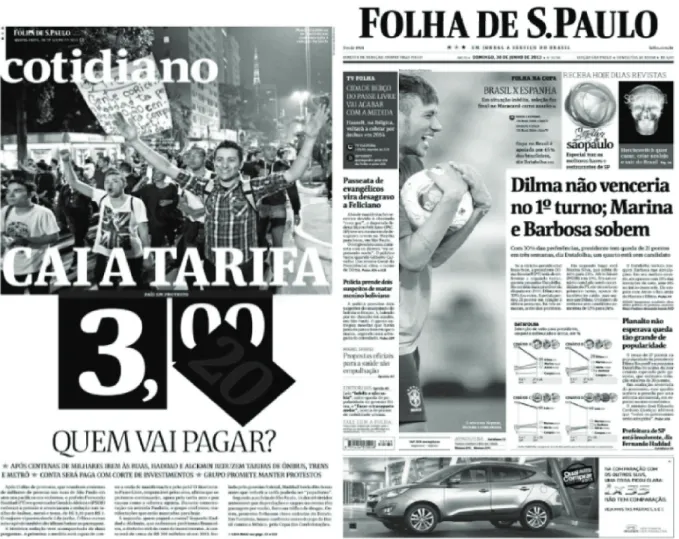
Figure 3. Examples of ‘Redefining the frames: highlights in the political domain’ (Folha de São Paulo – June 20 and 30th, 2013, respectively).
In the relation between the demonstrations and the field of sports, in a few days Folha portrays the protests which are taking place around the Confederations Cup stadiums, and that happens on June 16, 17, 18 and 20th. There is also a concerned
and ambiguous tone seen in Folha’s frames regarding the demonstrations, such as on June 16 and 20th. On
the 16th, the report points to the national team and
Neymar as the good and calm side of the country, which makes us think that the demonstrations would be the bad side. On the 20th, together with
the winning team, the word ‘exception’ can be seen (page D1), where it can also be interpreted that the country loses with the demonstrations (Figure 3).
The curious fact, but not a strange one concerning Folha’s frames towards the field of sports, is seen on June 21st and 22nd. If up to this
point Folha used to show the connection between the field of sports and the political domain, often with a critical frame, it started avoiding them after those days, thus ceasing to give emphasis to its
opinions, including about FIFA and the public expenditure. What happened?
What happened was that on June 21st, FIFA
announced to be concerned with how the Confederations Cup was going due to the protests around the stadiums (page D2). On June 22nd, the
Sports Section published a ‘Warning’: Brazil could lose the Cup. According to the report, the entity’s partners were claiming that FIFA could find a way out for the country, due to the mess the demonstrations were causing and could still be caused during the games. After that, both significant reports about the connection between the field of sports and the political and social fields are only seen on July 1st and 2nd. On the 1st, the picture of
Neymar, after winning the Confederations Cup, with the sentence ‘Imagine in the Cup’, gives the idea that the national team may win the next mega-event. Yet on the 2nd, it is published that the 2014
Championship in Brazil would have discount tickets, which would make this the World Cup with the cheapest tickets in history, according to FIFA.
Once again we can see Folha being driven by marketing reasoning, also towards the field of sports, that is, it was playing the role of a snitch and trying to make citizens aware of the situation, but only until its financial interests are at stake. Of course there are more factors involved in it, as losing the Cup was not an option for Folha and for most Brazilian fans, so it was up to Folha to try and recreate its frames the same way as it did in the field of sports, stating after the national team winning the Confederations Cup: We will win the Cup.
Given that, it is obvious that the traditional Brazilian media can’t have a serious dialogue about social movements. Such movements are essential for the citizens, considering that they are about a country which does not take its rights seriously and that going out into the streets in order to claim those rights goes beyond people’s right, it is a necessity, given the structure imposed concerning the political system and the way it works. Therefore, the democratic and citizen weaknesses existing in the country also come from that mediatic means’ uncommitted praxis.
Considering the mediatization flows that comprise the current society as well as the potential journalistic crisis seen, it may be necessary to change the journalistic praxis, whether due to the external restraints (economic pressure and obsession with audience rates) or internal restraints (journalists being recognized by their colleagues, by meeting deadlines and looking for that perfect report) which would be, according to Bourdieu (1997), the main factors that cause politics not to be mentioned as much in the media.
Final considerations
We emphasize that Folha de São Paulo covered the 2013 Confederations Cup in Brazil as a whole, thus allowing an analysis of the relationship between the Social Demonstrations of June, 2013 and the field of sports. Folha has profited from several ads which featured Confederation Cup logos; besides the ads, several pieces of news brought by the newspaper were offered by the field of sports. In spite of that, considering that the event comes from a state initiative, Folha has proven to be concise when highlighting in its frames the public expenditure on non-priority projects, actual legacies and the intransigence placed on the requirements that FIFA imposed to Brazil; all that deriving from the country’s choice to host the 2013 Confederations Cup and the 2014 World Cup.
It is noteworthy that the initial frameworks (‘Folha de São Paulo’s vandals!?’) concerning the
social field and the coverage of the social demonstrations in June 2013 are significant to denote an estrangement and a dismissal of the mediatic field towards the social movements (Viana, 2013), based on the economic and market logic present in the media speech of a mediatic society (Sodré, 2006).
Several factors, among them the own acting of the social movements and social networks (Dowbor & Szwako, 2013) forced the Folha de São Paulo to remake its initial framework concerning the social field. From countless objections and derogatory frameworks based on patterns and in social representations denoted in images and expressions such as ‘vandalism’, ‘vandals’, ‘war’, the newspaper began to highlight, from one day to the next, police violence (it should be remembered that it was so huge, on the night of June 13th, to the point of
leaving even several journalists wounded).
However, the critical tone in the frames came to an end after the country’s risk of losing the right to host the mega-sporting event, that is, the 2014 World Cup, was announced. Due to a number of demonstrations and inconveniences that were taking place around the Confederations Cup stadiums, on June 22nd there was a ‘warning’ about the possibility
of the country losing the Cup. From that point on, with a notably marketing concern, Folha hasn’t brought any other criticism related to the FIFA events. If not otherwise, after the Brazilian team won the competition, the newspaper uses this fact to mention the country possibly winning the World Cup, which is right around the corner (Imagine in the Cup).
It is actually verified how this communications world, although a big one, works customer- and political-wise, in accordance with neopatrimonialism (Schwartzman, 2007) which is seen in the State-society relationship as well. This reading can be easily taken from Folha’s early frames concerning the Demonstrations of June, 2013. It is seen that the demonstrations which claim the neopatrimonialism transformation, mainly through social movements, in their majority are not part of the articles, reports and questions at issue of those traditional means of communication in the country, but when they do become part of them they are unwanted.
So it is noticeable that the traditional Brazilian media can’t have a serious dialogue about social movements, which obviously took advantage of a single moment of mediatic visibility in order to be noticed again. It is worth mentioning again that social movements are also essential for the citizens, considering that they are about a country which
does not take its rights seriously and that going out into the streets in order to claim those rights goes beyond people’s right, it is a necessity, given the structure imposed concerning the political system and the way it works.
In that sense, the way the newspaper Folha de São
Paulo covered the news on the Social
Demonstrations of June, 2013 shows that it wasn’t serving the major purpose which journalism should be serving, that is, it didn’t do its best for journalism which goes beyond the fact of simply keeping the population informed, based on ethical values as well as on the search for a better world, for some social transformation where the possibility of civil constitution is taken from.
References
Berger, C. (2002). Do jornalismo: toda notícia que couber, o leitor apreciar e o anunciante aprovar, a gente publica. In: S. D. Porto (Org.), O jornal: da forma ao
sentido (2a ed., p. 715-726). Brasília, DF: UnB.
Bourdieu, P. (1997). Sobre a televisão. Oeiras, PT: Celta. Carvalho, A. (2000). Discourse analysis and media texts: a
critical reading of analytical tools. In International
Conference on Logic and Methodology - International Sociology Association (p. 1-40). Köln, DE.
Castells, M. (2013). Redes de indignação e esperança:
movimentos sociais na era da internet. Rio de Janeiro, RJ:
Zahar.
Dowbor, M., & Szwako, J. (2013). Respeitável público...: performance e organização dos movimentos antes dos protestos de 2013. Novos Estudos - CEBRAP, (97), 43-55. doi: 10.1590/S0101-33002013000300004 Entman, R. M. (1993). Framing: toward clarification of a
fractured paradigm. Journal of Communication, 43(4), 51-58. doi: 10.1111/j.1460-2466.1993.tb01304.x Fedozzi, L. (1999). Estado e cidadania no Brasil. In L.
Fedozzi (Org.), Orçamento participativo: reflexões sobre a
experiência de Porto Alegre (p. 65-103). Porto Alegre, RS:
Tomo Editorial.
Goffman, E. (1986). Frame analysis: an essay on the
organization of experience. Boston, MA: Northeastern
University.
Goffman, E. (2004). A representação do eu na vida cotidiana (12a ed., Maria Célia Santos Raposo, trad.). Petrópolis, RJ: Vozes.
Gómez, G. O. (2006). Comunicação social e mudança tecnológica: um cenário de múltiplos desordenamentos. In D. Moraes (Org.), Sociedade
Midiatizada (p. 81-98). Rio de Janeiro, RJ: Mauad.
Hall, S., Chritcher, C., Jefferson, T., Clarke, J., & Roberts, B. (1993). A produção social das notícias: o Mugging nos media. In N. Traquina (Org.), Jornalismo: questões,
teorias e “estórias” (p. 224-248). Lisbon, PT: Veja. Jornal Folha de São Paulo. (2013, 7 de junho). Ano 93,
n. 30.746, D3, Esporte.
Jornal Folha de São Paulo. (2013, 8 de junho). Ano 93,
n. 30.747, D3, Esporte.
Jornal Folha de São Paulo. (2013, 9 de junho). Ano 93,
n. 30.748, D8, Folha na Copa.
Jornal Folha de São Paulo. (2013, 10 de junho). Ano 93,
n. 30.749.
Jornal Folha de São Paulo. (2013, 11 de junho). Ano 93,
n. 30.750.
Jornal Folha de São Paulo. (2013, 12 de junho). Ano 93,
n. 30.751, A1, Capa. A2, Opinião. C4, Cotidiano.
Jornal Folha de São Paulo. (2013, 13 de junho). Ano 93,
n. 30.752.
Jornal Folha de São Paulo. (2013, 14 de junho). Ano 93,
n. 30.753. Capa, A1. C2, C7, Cotidiano.
Jornal Folha de São Paulo. (2013, 15 de junho). Ano 93,
n. 30.754.
Jornal Folha de São Paulo. (2013, 16 de junho). Ano 93,
n. 30.755.
Jornal Folha de São Paulo. (2013, 17 de junho). Ano 93,
n. 30.756.
Jornal Folha de São Paulo. (2013, 18 de junho). Ano 93,
n. 30.757.
Jornal Folha de São Paulo. (2013, 19 de junho). Ano 93,
n. 30.758.
Jornal Folha de São Paulo. (2013, 20 de junho). Ano 93,
n. 30.759. C1, Cotidiano.
Jornal Folha de São Paulo. (2013, 21 de junho). Ano 93,
n. 30.760, D2, Folha na Copa.
Jornal Folha de São Paulo. (2013, 22 de junho). Ano 93,
n. 30.761.
Jornal Folha de São Paulo. (2013, 23 de junho). Ano 93,
n. 30.762.
Jornal Folha de São Paulo. (2013, 24 de junho). Ano 93,
n. 30.763.
Jornal Folha de São Paulo. (2013, 25 de junho). Ano 93,
n. 30.764.
Jornal Folha de São Paulo. (2013, 26 de junho). Ano 93,
n. 30.765.
Jornal Folha de São Paulo. (2013, 27 de junho). Ano 93,
n. 30.766.
Jornal Folha de São Paulo. (2013, 28 de junho). Ano 93,
n. 30.767.
Jornal Folha de São Paulo. (2013, 29 de junho). Ano 93,
n. 30.768.
Jornal Folha de São Paulo. (2013, 30 de junho). Ano 93,
n. 30.769. Capa, A1.
Jornal Folha de São Paulo. (2013, 1º de julho). Ano 93,
n. 30.770.
Jornal Folha de São Paulo. (2013, 2 de julho). Ano 93,
n. 30.771.
Perruso, M. A. (2014). As jornadas de(sde) Junho de 2013. In Anais do 38º Encontro anual da AMPOCS. Caxambú, MG.
Sanfelice, G. (2007). Os enquadramentos dos Jornais Zero
Hora e Folha de São Paulo na cobertura de Daiane dos Santos nos Jogos Olímpicos de Atenas/2004: A midiatização
do resultado esportivo (Tese de Doutorado).
Universidade do Vale do Rio dos Sinos, São Leopoldo. Schwartzman, S. (2007). Bases do autoritarismo brasileiro (4a
ed.). Rio de Janeiro, RJ: Publit Soluções Editoriais. Singer, A. (2013). Brasil, junho de 2013, classes e
ideologias cruzadas. Novos estudos, CEBRAP, (97), 23-40. doi: 10.1590/S0101-33002013000300003 Sodré, M. (2006). Eticidade, campo comunicacional e
midiatização. In D. Moraes (Org.), Sociedade
midiatizada (p. 19-31). Rio de Janeiro, RJ: Mauad.
Sousa, J. P. (2004). Introdução à análise do discurso jornalístico
impresso: um guia para estudantes de graduação.
Florianópolis, SC: Letras Contemporâneas.
Vainer, C. (2013). Quando a cidade vai às ruas. In C. Vainer, D. Harvey, E. Maricato, F. Brito, A. Peschanski, J. L. S. Maior, … V. A. Lima. Cidades
rebeldes: Passe Livre e as manifestações que tomaram as
ruas do Brasil (p. 35-40). São Paulo, SP: Boitempo
Editorial.
Verón, E. (1997). Esquema para el análisis de la mediatización. Magazine Diálogos de la Comunicación, 48, 9-16.
Viana, S. (2013). Será que formulamos mal a pergunta? In C. Vainer, D. Harvey, E. Maricato, F. Brito, A. Peschanski, J. L. S. Maior, … V. A. Lima. Cidades
rebeldes: Passe Livre e as manifestações que tomaram as ruas do Brasil (p. 53-58). São Paulo, SP: Boitempo Editorial.
Received on October 27, 2017. Accepted on May 30, 2018.
License information: This is an open-access article distributed under the terms of the Creative Commons Attribution License, which permits unrestricted use, distribution, and reproduction in any medium, provided the original work is properly cited.