M
ESTRADO EM
C
IÊNCIAS
E
MPRESARIAIS
T
RABALHO
F
INAL DE
M
ESTRADO
D
ISSERTAÇÃO
E
XPLORING
D
IGITAL
M
USIC
O
NLINE
:
U
SER
A
CCEPTANCE AND
A
DOPTION OF
O
NLINE
M
USIC
S
ERVICES
C
AROLINAI
GLÉSIASM
ARTINSM
ESTRADO EM
C
IÊNCIAS
E
MPRESARIAIS
T
RABALHO
F
INAL DE
M
ESTRADO
D
ISSERTAÇÃO
E
XPLORING
D
IGITAL
M
USIC
O
NLINE
:
U
SER
A
CCEPTANCE AND
A
DOPTION OF
O
NLINE
M
USIC
S
ERVICES
C
AROLINAI
GLÉSIASM
ARTINSO
RIENTAÇÃO:
P
ROFESSORAD
OUTORAW
INNIEP
ICOTOi
Acknowledgments
ii
Abstract
Online digital music has changed dramatically since the emergence of Napster (in 1999), as a file-sharing system, and the establishment of electronic commerce. The transformation of the music industry value chain enabled Online Music Services (OMS)
to serve as reintermediaries in the way the music product is delivered to consumers.
However, a need to understand OMS user-end behavior has been recognized and suggested by academic authors. To explore this aspect, we extended the UTAUT2 framework (an IT/IS User Acceptance Model) to study OMS through individual Behavioral Intention and Use. UTAUT2 model was applied with the main purposes of
validating its applicability in this environment, and identifying additional determinants in OMS acceptance and adoption. A quantitative approach was undertaken and data was collected from a sample of 329 individuals. Partial Least Squares (PLS) path modeling was proposed to assess the relationships within our model. With our findings, we verified the suitability of UTAUT2 constructs on an OMS background, as well as the
significance of Ideology of Consumer Rights and File-Sharing Expertise in the
formation of Behavioral Intention and Use, respectively. Moreover, File-Sharing
Judgment revealed to have a statistically non-significant impact on Behavioral
Intention. Several theoretical and practical implications are provided in order to enhance
the comprehension of consumer behavior for OMS providers.
iii
Resumo
A música digital online sofreu alterações profundas desde o aparecimento do Napster
(em 1999), como sistema de partilha de ficheiros, e com o desenvolvimento do comércio electrónico. A transformação da cadeia de valor da indústria musical permitiu
aos Serviços de Música Online (SMO) desempenharem um papel de “
re-intermediação” na forma como o produto pode ser entregue aos consumidores. Contudo, é reconhecida e sugerida por autores académicos a necessidade de compreender o comportamento destes utilizadores. Com o intuito de explorar esta necessidade, estendemos o Modelo de Aceitação Tecnológica UTAUT2, por forma a analisar a Intenção de Comportamento e Uso individual dos SMO. O modelo UTAUT2 foi empregue com os principais objectivos de validar a sua aplicabilidade no contexto musical, com particular incidência nos SMO, e identificar constructos adicionais que levem à sua aceitação e adopção pelos utilizadores. Para este estudo, foi aplicada uma abordagem quantitativa com uma amostra de 329 indivíduos. A utilização de uma
análise baseada nos Mínimos Quadrados Parciais (Partial Least Squares – PLS) foi
utilizada para avaliar as relações entre os constructos do modelo teórico proposto. Os nossos resultados evidenciam a adequação do UTAUT2 no contexto analisado, assim
como a importância da Ideologia dos Direitos do Consumidor e a Perícia da Partilha
de Ficheiros na formação da Intenção de Comportamento e no Uso, respectivamente.
Adicionalmente, o Julgamento sobre a Partilha de Ficheiros revelou não ser
estatisticamente significativo no nosso modelo. Várias implicações teóricas e práticas são propostas, auxiliando os fornecedores de SMO na compreensão do comportamento dos consumidores.
iv
Table of Contents
1. Introduction ... 1
1.1 Digital Music Overview ... 1
2. Literature Review ... 4
2.1 (Re)intermediation in Digital Music ... 4
2.2 Online Music Services ... 7
2.2.1 As B2C e-commerce ... 7
2.3 User Acceptance Models and Online Music Services ... 8
2.3.1 Overview of Theories ... 8
2.4 Empirical Findings in the Online Music Services context ... 10
3. Research Model ... 10
3.1 Performance Expectancy ... 12
3.2 Effort Expectancy ... 13
3.3 Social Influence ... 13
3.4 Facilitating Conditions ... 14
3.5 Habit ... 15
3.6 Hedonic Motivation ... 16
3.7 Price Value ... 16
3.8 Ideology of Consumer Rights ... 17
3.9 File-Sharing Judgment and Expertise ... 18
3.10 Behavioral Intention ... 20
4. Research Methods ... 20
4.1 Operationalization of Constructs ... 21
4.2 Participants and Data Collection Procedures ... 22
5. Data and Results ... 23
5.1 Measurement Model ... 24
5.2 Structural Model ... 26
6. Discussion ... 28
7. Final Remarks ... 34
7.1 Conclusion and Theoretical Implications ... 34
7.2 Practical Implications ... 34
7.3 Limitations and Suggestion for Future Investigation ... 35
References... 36
v
List of Figures
Figure 1-1 – Music Industry’s Traditional Value Chain ……….. 1
Figure 2-1 – Basic Concept Underlying User Acceptance Models ………. 8
Figure 3-1 – Research Model ……… 10
vi
List of Tables
Table 2-1 – Digital Music Characteristics and affected players ……….. 5
Table 2-2 – Music Content Intermediation: additional allocation of functions ……. 5
Table 2-3 – Selected studies related to OMS acceptance and adoption ……… 11
Table 4-1 – Information regarding the conducted interviews ……… 21
Table 5-1 – Respondent descriptive statistics……….. 23
Table 5-2 – Reliability measurement of reflective variables .………. 24
Table 5-3 – AVE and Fornell-Larcker criterion ……….. 25
vii
List of Abbreviations
AVE – Average Extracted Variance
B2C – Business-to-Consumer
BI – Behavioral Intention
CD – Compact Disc
CRM – Customer Relationship Management
C-TAM-TPB – Combined Technology Acceptance Model and Theory of Planned
Behavior
DRM – Digital Rights Management
DTPB – Decomposed Theory of Planned Behavior
EC – Electronic Commerce
EE – Effort Expectancy
FC – Facilitating Conditions
FS – File-sharing
FSE – File-sharing Expertise
FSJ – File-sharing Judgment
HM – Hedonic Motivation
HT – Habit
ICR – Ideology of Consumer Rights
IDT – Innovation Diffusion Theory
IFPI – International Federation of the Phonographic Industry
INE – Instituto Nacional de Estatística (Statistics Portugal)
IS – Information System(s)
ISPs – Internet Service Providers
IT – Information Technologies
MP3 – ISO-MPEG-1 Audio Layer 3
MPCU – Model of PC Utilization
OMS – Online Music Services
P2P – Peer-to-peer
PBC – Perceived Behavioral Control
PC – Personal Computer
PE – Performance Expectancy
PLS – Partial Least Squares
PV – Price Value
SCT – Social Cognitive Theory
SI – Social Influence
SMO – Serviços de Música Online
TAM – Technology Acceptance Model
TAM 2 – Technology Acceptance Model 2
TPB – Theory of Planned Behavior
TRA – Theory of Reasoned Action
UTAUT – Unified Theory of Acceptance and Use of Technology
UTAUT2 – Unified Theory of Acceptance and Use of Technology 2
VIF – Variance Inflation Factor
1
1. Introduction
1.1 Digital Music Overview
The outburst of one of the most prominent Internet peer-to-peer1 file-sharing (FS)
systems (Napster), in 1999, brought dramatic changes to the music industry2, music
product and, consequently its consumption. The transition to digital online technologies created a substantial impact on the music industry’s traditional value chain (Figure 1-1), altering the creation and distribution of music (Brousseau, 2008), and shaping it to
become a part of a total experience (Bhattacharjee, Gopal, Marsden, &
Sankaranarayanan, 2009).
Firstly, the music product is a type of hedonic product3, which is perceived as an
experience product. That is, it cannot be valued by the consumer prior to its
consumption (Bhattacharjee, Gopal, Lertwachara, & Marsden, 2006; Lacher, 1989).
With digitization, the music product progressed from a physical to a digital good4,
creating new challenges (Bhattacharjee et al., 2006, 2009; Zhu & MacQuarrie, 2003). The music industry is a high risk/low profitability market, but it is increasingly expanding its existing number of players as electronic manufacturers, mobile operators, Internet Service Providers (ISPs) and digital service providers enter the market in order to gain higher profits by selling traffic and/or electronic devices (Brousseau, 2008). This creates a competitive environment that leads to the development of new strategies that involve the retention of customers through exclusivity in contracts, to reduce portability (Garon, 2009), or technological (in)compatibility (Amberg & Schröder, 2007).
1
Peer-to-peer systems are defined by Slater, Smith, Bambauer, Gasser, & Palfrey (2005) as “online distribution mechanisms, (that) enable individuals to find, acquire, and share content with great
efficiency” (p. 7). 2
The music industry can be defined as “the whole social, regulatory, technological and economic system that brings an original musical supply within the reach of consumers who want to listen to it” (Bourreau, Gensollen, & Moreau, 2008, p. 2).
3
Hedonic products tend to be emotionally involving and require a considerable mental activity by the consumer. Their evaluation is based on their symbolic features rather than on their tangible characteristics (Hirschman & Holbrook, 1982).
4
A digital good can be defined as a product “capable of being stored and distributed in digital form” (Zhu & MacQuarrie, 2003, p. 264). The term ‘information good’ can also be considered, since the concept indicates products that can be digitized (Mortimer, Nosko, & Sorensen, 2012).
Figure 1-1 –Music Industry’s Traditional Value Chain (Graham, Burnes, Lewis, & Langer, 2004, p. 1092)
2
Specially with the ‘Napster advent’, issues of illegal downloading, Intellectual Property rights, emergence of niche-specific markets, and adjustment of existing pricing/distribution models emerged alongside with changes in Internet connectivity and digital compression technologies (Bhattacharjee et al., 2009; Zhu & MacQuarrie, 2003; Makkonen, Halttunen, & Frank, 2011; Peitz & Waelbroeck, 2004). Uncertainty dominated the industry and by the year of 2000, a downturn in CD sales was felt (Liebowitz, 2006). Peitz & Waelbroeck (2004) identified the potential causes for this decline as being related with the substitution between music formats, others forms of leisure, negative economic environments and FS. However, the debate still remains. The
web’s proliferation of unpaid and free content lead several legal mechanisms to rise, in
order to provide legal protection as an attempt to try to contain profit losses5 (see Peitz
& Waelbroeck (2004) and Merante (2009) for a detailed explanation).
At the same time, not only in the music industry, the Internet and electronic commerce (e-commerce or EC) transformed the distribution of information goods (Mortimer et al.,
2012) and opened new channels for online retailing (Bhattacharjee et al., 2006). The
paradigm shifted to a digital economy, enabling retailers to better reach their customers with constrains in accessing brick-and-mortar stores and supplying broader markets (Weeds, 2012). However, for the music industry, the disintermediation of traditional value chain activities gave opportunity for new players and strategies to arise.
As a result, Online Music Services (OMS) emerged on the Internet and are a form of EC. OMS are online services that allow legal distribution and sale of online digital music (e.g., iTunes, Musicbox, Spotify and Rhapsody). According to the International Federation of the Phonographic Industry (IFPI, 2012) and Wikström (2012), three main
consumption models can be employed6: through ownership (where one is in possession
of the digital music file); and/or access (e.g., using cloud technology where one can
access music without possessing it); and/or contextually (music for a particular
‘context’).
One of the most important milestones in OMS was the launch of iTunes Music Store, in
2003, which changed individuals’ music consumption alternatives, since it provided a
legal way to acquire digital songs online (Aguiar & Martens, 2013). In 2012, there were
5
E.g., Digital Millennium Copyright Act or Digital Rights Management technology. 6
3 around 500 legitimate OMS worldwide offering a total of 30 million tracks (IFPI, 2013). In 2011, the proportion of revenues coming from digital sales represented 32% of global sales, highlighting a growth of 65% in subscription services (boosted by cloud-based services (IFPI, 2013)), and additionally, reaching an estimated 20 million subscribers in 2012 (IFPI, 2012, 2013). In early 2013, IFPI (2013) stated a residual recovery, for 2012, of the global trade value for the recorded music industry in +0.3%, representing the best result since 1998. In Portugal, for example, on the first week of implementation of Spotify, 3 million music tracks were accessed (SOL, 19 Feb. 2013). To allow these services to operate and to be profitable, OMS - being pure-play services
- have to develop partnerships with record labels and pay royalties to the tracks’
copyright owners (Peitz & Waelbroeck, 2004; Slater et al., 2005). IFPI (2013) reports that 62% of Internet users adopt this type of e-services, reveling that the music consumption pattern is changing. With the decline of physical sales in -8.7% to $10.4 billion in 2011 (Music Ally, 27 Mar. 2012), and the rise of digital music sales (estimation of a 9% growth in the 2011-2012 period and revenues of $5.6 billion (IFPI, 2013)), there is a viable prospect for the expansion of OMS.
Taking into account that EC is an Information Systems (IS) phenomenon (Koufaris, 2002), and OMS are a form of EC (Fox, 2004), OMS can be considered as a form of IS. As there is a need to understand OMS end-user behavior in order to maximize their potential growth (Chu & Lu, 2007; Walsh, Mitchell, Tobias, & Wiedmann, 2003), this
leads to the question: “Which are the determining factors that influence the users’
acceptance and adoption of OMS?”. Since a free alternative in accessing music illegally
exists, understanding the individual adoption of legal mechanisms, by the consumer, becomes fundamental to allow a possible and specific orientation to be taken by OMS
providers. Following Chu & Lu (2007) and Walsh et al. (2003) observation, and to
answer this question, Behavioral Intention and Usage of OMS can be studied using
User Acceptance Models applied in IS.
Overall, IS can be divided in two groups, according to their primary function, which can be: 1) Utilitarian, if used for work-related tasks (Koster, 2007) or; 2) Hedonic, if pleasure-orientated (van der Heijden, 2004). Specifically, we will use Venkatesh,
Thong, & Xu’s (2012) User Acceptance Model: the Unified Theory of Acceptance and
4 as a baseline model and has been applied to the study of a variety of technologies in
both organizational and non-organizational settings” (Venkatesh et al., 2012, p. 158),
supporting, according to the authors, its generalization capability. Additionally, this theory integrates previous ones on user acceptance of IS or other innovations.
The present investigation proposes to accomplish three main goals: 1) validate the applicability of the UTAUT2 model in the OMS-context; 2) enhance the understanding of legal music consumption through OMS and; 3) identify additional determinants that could affect Behavioral Intention and Usage of these EC services.
Hereafter, the study is structured as follows: section II presents the literature review discussing OMS and User Acceptance Models. Section III describes the research model and hypotheses development, while section IV refers to the used methodology. Results are reported in Section V. Sections VI and VII discuss the most important findings, study limitations and potential trails for future research.
2. Literature Review
2.1 (Re)intermediation in Digital Music
To better understand the contemporary music industry dynamics, Leyshon’s (2001)
concept of musical network shows that the music industry is composed by four distinctive interrelated and overlapping networks: 1) a creativity network, which is composed by links of composition and representation; 2) a reproduction network, which centers on mass production based on economies of scale; 3) a network of distribution, to ensure that the music product is delivered to consumers and; 4) a consumption network, which includes retail organizations. For the purpose of our study, we focus on the consumption network and the role of OMS.
Although the support for music consumption has changed, leading to a less important physical distribution chain, the traditional business model remains relatively stable with artists creating music, record labels promoting and distributing it, and with fans consuming it (Graham et al., 2004). With the introduction of the first digital technology
(CD) in the early 80’s and software format ISO-MPEG-1 Audio Layer 3 (MP3) in the
90’s, the music industry has transformed itself on the reproduction, distribution and
5 and consumers could access music in new ways (Hess & Walter, 2006; Graham et al., 2004). This enforced the disappearance/downsizing of music retailers within the consumption network (Knopper, 2009; Leyshon, 2001), but given the characteristics of
digital music (Table 2-1) and new opportunities, the music industry experienced a
re-intermediation effect.
Characteristics Players Affected How they are affected Record Label Low manufacturing costs.
Artist, Record Label High cost to make 'master'; Low break-even. Record Label Low distribution costs.
Consumer Cheap, high quality product.
Digital Music Retailer Low inventory costs; Low menu costs.
Consumer
Easy pre-purchase sampling; Likes high-portability; Values high compatibility; Demands additional product features: artwork, lyrics.
Consumer More product options. Physical Retailer New entrants can compete. Separability Artist, Record Label Song 'single' is the product. Equivalent Quality
Effective Electronic format Easily Transferred Easily Reproduced
Table 2-1 - Digital Music Characteristics and affected players (Bockstedt, Kauffman, & Riggins, 2005, p.5)
Content intermediation can only be efficient when there are imperfections between supply and demand, requiring an additional allocation of functions (as reported in Table 2-2) mainly on the Internet, PC and User actors (Hess & Walter, 2006). This is consistent with the establishment of OMS as legitimate channels to access music. Since music selling moved from a physical platform to an essentially digital platform, OMS can assume a role in the consumers music demand. However, given that record labels lack technological infrastructures to engage in OMS-development, technology and Internet Service Providers, traditional retailers and/or intermediaries, pure players, and labels and/or record companies, in collaboration, are often the initiators on these services (Swatman, Krueger, & van der Beek, 2006). This leads to the end of major record labels dominance, with the virtualization of structures and creation of joint-ventures with potential partners, along with endless combinations of customers, suppliers and business partners (Graham et al., 2004).
Function Artist Record
Label Studio Press
Logistics/
Distributor Retail Internet PC User
Identification Selection Aggregation Transformation Reproduction Distribution Presentation
Legend Traditional allocation of a function Additional allocation of a function
Actor
6
With shifts on the value chain (Bockstedt et al., 2005), the opportunity of supplying
music - in digital content - directly to consumers, allowed the development of OMS as reintermediaries in media content markets (Hess & Walter, 2006). In fact,
reintermediation focuses on specific values which are appreciated by consumers: (i)
exclusivity (an effective way to improve affinity), (ii) affinity (building a strong long-term relationship) and (iii) relevance (recognition and satisfaction of needs and tastes) (Garon, 2009). As companies are engaging in increasingly diversified business strategies and markets, aiming to expand their audience and possible revenues
(Bockstedt et al., 2005), new business models have been developed to suit the online
context (Slater et al., 2005). These models (v. Appendix I for the most distinctive ones found on literature review) are a form of combating FS. They can range from small differences to a complete restructuration of offline models, in which relationships
between content creators, intermediaries and consumers are redesigned (Slater et al.,
2005).
As digital music can be obtained through legal or illegal music downloading services, the decline of CD sales has been associated with the spreading of FS through peer-to-peer (P2P) networks (e.g. Zentner, 2006; Liebowitz, 2006). However, this fact has been challenged by Oberholzer-Gee & Strumpf (2007) in their econometric study, indicating that sales displacement is “statistically indistinguishable from zero” (p. 26). A recent study from Aguiar & Martens (2013) found that consumers do not view illegal downloading as a substitute for legal music, existing a complementary effect between illegal and legal downloading, which positively affects copyright owners. Nevertheless, the (possible) impact of FS is an unavoidable topic within the music industry. While consumers are demanding higher interactivity and involvement with the music content (Slater et al., 2005) and as CD sales diminishes (Bhattacharjee et al., 2009), Slater et al. (2005) observed how the music industry is answering to FS. In addition to the development of new business models, the music industry makes use of the legal system
in: 1) implementation of Digital Rights Management (DRM)7 technologies; 2) civil
lawsuits against infracting consumer providers; and 3) technical obstruction and accountability of P2P services.
7
Bourreau et al. (2008) define DRM as “an umbrella term covering all technologies used by publishers or
copyright holders to control access to and use of digital content or computer material, as well as the
7
2.2 Online Music Services
2.2.1 As B2C e-commerce
Although there is no universal definition of EC (Ngai & Wat, 2002), business-to-consumer (B2C) EC is generally accepted as the online activity that enables business-to-consumers to acquire products and services (Olson & Olson, 2000). This includes pre-sale and post-sale activities, customer support and complementary business services (Zwass, 1996; Bakos, 1998). For Riggins & Rhee (1998), EC should not function merely as another marketing tool for sales, but as a channel to support the total delivery of goods/services to the customer, taking into account that EC consumers are both buyers and computer users (Koufaris, 2002).
Considering that the majority of the transactions between subjects occur with a temporal
and spatial separation (Grabner-Kraeuter, 2002), EC’s structure and products differ
from traditional commerce in several ways (Zwass, 1996; Koufaris, 2002). With the benefits brought by the development of EC (e.g., Bakos, 1998; Ngai & Wat, 2002), the online environment provides a way for users to quickly examine and compare a wider assortment of products and offerings, along with time and space convenience (Childers, Carr, Peck, & Carson, 2001). These aspects enable lower search costs for consumers, rise competition between sellers, reduce monopolistic capacity, and enable the development of customized services (Bakos, 1997, 1998).
Bearing in mind Olson & Olson’s (2000) definition of B2C EC, OMS fit that
description. Since digital online music doesn’t require a physical support, OMS can sell
8 be digitalized, all processes related to it can be fully digital (from search, to purchase, to delivery).
2.3 User Acceptance Models and Online Music Services
EC adoption is viewed as a topic in IT acceptance that takes into account a combination of marketing and technology adoption elements (Pavlou & Fygenson, 2006). Furthermore, Koufaris (2002) argues that EC should be viewed as an IS phenomenon where an IT user interacts with a complex IT system. Additionally, the basic concept of IT User Acceptance (Figure 2-1) is the result of individual reactions, intentions and actual use (Venkatesh, Morris, Davis, & Davis, 2003).
Two main concerns for B2C EC adoption are trust and uncertainty, since there are potential technological problems (system-dependent uncertainty) and information asymmetry (transaction-specific uncertainty), that make it difficult to convert web-surfers into consumers and impeding customer loyalty (Zwass, 1996; Grabner-Kraeuter, 2002; Reichheld & Schefter, 2000). In the OMS-context, in order to be successful, OMS must increase the value of their offering, persuading consumers to pay for music that
they could attain freely through P2P networks (Slater et al., 2005; Brousseau, 2008),
while reducing possible uncertainty. In this sense, Kwong & Park (2008) discuss that the existence of a free alternative inhibits the replication of traditional studies on EC
adoption and consumers’ attitude. Being the nature of the website determining if a utilitarian/hedonic motive is precedent for its use (van der Heijden, 2004), OMS present goal-orientated (utilitarian) characteristics, as well as pleasure-orientated (hedonic) (Chu & Lu, 2007).
2.3.1 Overview of Theories
User Acceptance Models have been developed in order to better understand the aspects
that influence technology adoption, regarding Behavioral Intention (BI) and Usage.
9 Cognitive Theory (SCT), developed by Bandura (1986) for general human behavior
(Venkatesh et al., 2003), but was applied to computer use context by Compeau &
Higgins (1995); c) Theory of Planned Behavior (TPB) (Ajzen, 1991), that emerged as
an extension of TRA (Venkatesh et al., 2003); d) Technology Acceptance Model
(TAM) (Davis, Bagozzi, & Warshaw, 1989), that was developed to fit the IS context
and to predict information technology acceptance and usage (Venkatesh et al., 2003)8
and; e) TAM2 (Venkatesh & Davis, 2000), which emerged with the purpose of identifying additional key elements (in TAM) that affect Behavioral Intention and Use. The constructs applied in these models can be found on Appendix II.
In 2003, Venkatesh et al. (2003) developed the Unified Theory of Acceptance and Use of Technology (UTAUT) to review the existing literature of User Acceptance Models (on organizational contexts) and to develop a theory based on the similarities of eight models: TRA, TAM, TPB, SCT, Motivational Model, Combined TAM and TPB (C-TAM-TPB), Model of PC Utilization (MPCU) and Innovation Diffusion Theory (IDT). The authors identified the core-constructs of each model, and their significance, in order to function as root-constructs in the development of new variables in UTAUT (v. Appendix III for a summary of the root-constructs and their inclusion in the new UTAUT variables). UTAUT empirical findings were capable of justifying up to 70% of
the variance of Intention, indicating that: 1) Performance Expectancy (PE), Effort
Expectancy (EE), and Social Influence (SI) impact directly Behavioral Intention; 2)
Facilitating Conditions (FC) and Behavioral Intention are direct determinants of Use
and; 3) Experience, Gender, Age and Voluntariness have significant moderating effects in almost all variables (Venkatesh et al., 2003).
UTAUT was subsequently extended to UTAUT2 (Venkatesh et al., 2012), in order to
better suit a consumer use context (v. Appendix IV for a visual figure of the UTAUT2 framework). Through an extensive literature research, the authors identified three new
significant constructs (Hedonic Motivation (HM), Price Value (PV) and Habit (HT))
and found that one of the main differences between UTAUT and UTAUT2 was the role of Experience, which moderates the Behavioral Intention-Use path. Voluntariness was
dropped in this framework, being advocated that in a consumer use context most
8
An extended TAM was developed by van der Heijden (2004) to better suit hedonic IS, considering that users can be more or less hedonic in their disposition to use the system. The author argues that, for
10 consumer behaviors are voluntary. UTAUT2 offered several important new findings,
summarized as follows: a) Hedonic Motivation is considered as a critical element in
Behavioral Intention; b) Price Value is an important determinant in consumer
decision-making concerning technology use; c) Facilitating Conditions, moderated by age and
gender, have a significant impact on Behavioral Intention; d) Habit has an important
role in forecasting continued use of IT; and e) utilitarian and hedonic benefits play
important roles in technology use (Venkatesh et al., 2012). To our knowledge, in the
OMS case, there is a lack of research from the IT/IS area that focuses this particular point.
2.4 Empirical Findings in the Online Music Services context
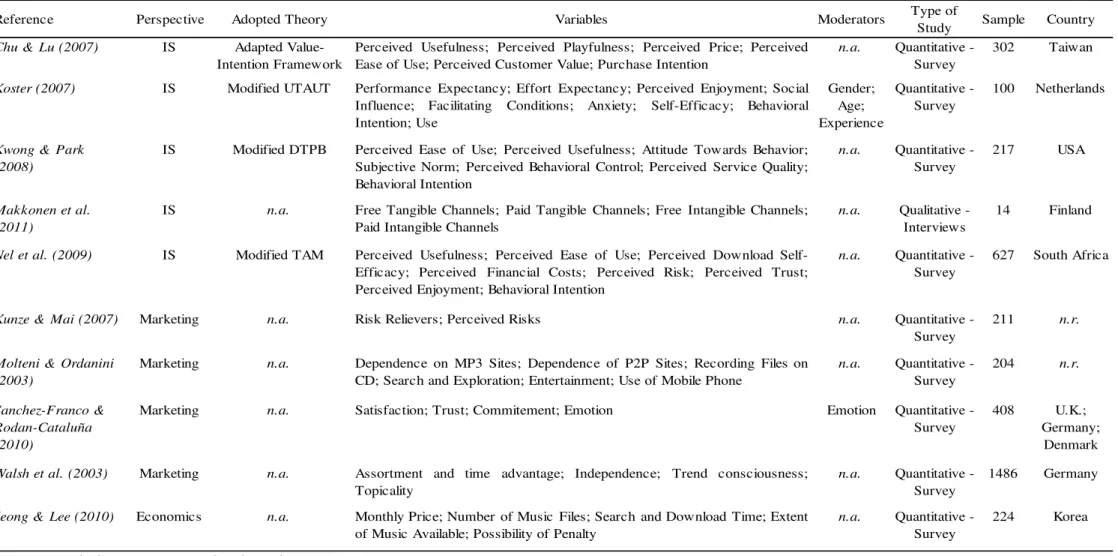
There are only a few studies that analyze the adoption and use of OMS through an IS perspective. Considering that the music product and consumption are complex, it reveals quite difficult to analyze this issue with only one perspective and/or theory. Taking into account the complexity associated with this topic, Table 2-3 summarizes the most relevant studies identified in academic literature.
3. Research Model and Hypotheses Development
11
Reference Perspective Adopted Theory Variables Moderators Type of
Study Sample Country
Chu & Lu (2007) IS Adapted
Value-Intention Framework
Perceived Usefulness; Perceived Playfulness; Perceived Price; Perceived Ease of Use; Perceived Customer Value; Purchase Intention
n.a. Quantitative - Survey
302 Taiwan
Koster (2007) IS Modified UTAUT Performance Expectancy; Effort Expectancy; Perceived Enjoyment; Social
Influence; Facilitating Conditions; Anxiety; Self-Efficacy; Behavioral Intention; Use Gender; Age; Experience Quantitative - Survey 100 Netherlands
Kwong & Park (2008)
IS Modified DTPB Perceived Ease of Use; Perceived Usefulness; Attitude Towards Behavior; Subjective Norm; Perceived Behavioral Control; Perceived Service Quality; Behavioral Intention
n.a. Quantitative - Survey
217 USA
Makkonen et al. (2011)
IS n.a. Free Tangible Channels; Paid Tangible Channels; Free Intangible Channels; Paid Intangible Channels
n.a. Qualitative - Interviews
14 Finland
Nel et al. (2009) IS Modified TAM Perceived Usefulness; Perceived Ease of Use; Perceived Download
Self-Efficacy; Perceived Financial Costs; Perceived Risk; Perceived Trust; Perceived Enjoyment; Behavioral Intention
n.a. Quantitative - Survey
627 South Africa
Kunze & Mai (2007) Marketing n.a. Risk Relievers; Perceived Risks n.a. Quantitative -
Survey
211 n.r.
Molteni & Ordanini (2003)
Marketing n.a. Dependence on MP3 Sites; Dependence of P2P Sites; Recording Files on CD; Search and Exploration; Entertainment; Use of Mobile Phone
n.a. Quantitative - Survey
204 n.r.
Sanchez-Franco & Rodan-Cataluña (2010)
Marketing n.a. Satisfaction; Trust; Commitement; Emotion Emotion Quantitative - Survey
408 U.K.; Germany;
Denmark
Walsh et al. (2003) Marketing n.a. Assortment and time advantage; Independence; Trend consciousness;
Topicality
n.a. Quantitative - Survey
1486 Germany
Jeong & Lee (2010) Economics n.a. Monthly Price; Number of Music Files; Search and Download Time; Extent of Music Available; Possibility of Penalty
n.a. Quantitative - Survey
224 Korea
n.a. - not applied; n.r. - not reported in the study
UTAUT - Unified Theory of Acceptance and Use of Technology; DTPB - Decomposed Theory of Planned Behavior; TAM - Technology Acceptance Model.
12
3.1 Performance Expectancy
In UTAUT2, Performance Expectancy (PE) is an important determinant for Behavioral Intention. It refers to the individual perception concerning the benefits provided by
using a technology in executing specific activities (Venkatesh et al., 2012). Although, it
has been referred that Performance Expectancy has a greater predictive value to
Behavioral Intention (Venkatesh et al., 2003, Davis, Bagozzi, & Warshaw, 1992), van
der Heijden (2004) observed that, in hedonic systems, usefulness9 loses its predictive
value.
When using OMS, consumers expect the service to have the capability to deliver functional benefits, as well as an entertaining experience (Chu & Lu, 2007). As OMS perform a specific function to access music (highlighting its utilitarian features), in our
study, Performance Expectancy relates to Nel, Raubenheimer, & Bounagui’s (2009)
Perceived Usefulness definition10. Performance Expectancy specifically refers the consumer's perception that his/her music-accessing experience is enriched by using OMS.
Chu & Lu (2007) argue that the effectiveness in accessing music and pertinent information are the most important benefits desired by consumers. In Dufft, Stiehler,
Vogeley, & Wichmann’s (2005) survey results, the authors found that consumers who
simultaneously use OMS and P2P, consider that OMS, in general, have a superior service when compared to P2P networks (e.g., in playing songs and quality of tracks). However, the main issues pointed to OMS are the high rate of track unavailability (opposed to P2P networks) and the lack of information in the acquired track permissions
(referring to DRM-protected tracks) (Dufft et al., 2005), leading to a decrease of the
services’ Performance Expectancy.
Several studies mention that the consumers’ expectation regarding OMS is affected by
several performance factors, such as: available music catalog, content sampling, trial
services, unbundling possibilities, up-to-date information about the song/artist and
download-time (Makkonen et al., 2011; Amberg & Schröder, 2007; Kunze & Mai,
9
Perceived Usefulness is a variable from TAM, functioning as a root-construct in Performance Expectancy (Venkatesh et al., 2003).
10 Nel et al.’s
13 2007; Walsh et al., 2003; Jeong & Lee, 2010; McCorkle, Reardon, Dalenberg, Pryor, & Wicks, 2012). Hence, we formulate the following hypothesis:
H1: Consumers’ perceived Performance Expectancy is positively related to Behavioral
Intention to use OMS.
3.2 Effort Expectancy
According to UTAUT, Effort Expectancy (EE) is the “degree of ease associated with the
use of the system” (Venkatesh et al., 2003, p. 450). In other words, as the system is perceived to be easier to use, the probability of being accepted by users is higher (Davis, 1989). For Chu & Lu (2007), effort can diminish Behavioral Intention since it can be
considered a “non-monetary sacrifice” (p. 144), although Koufaris (2002) argues that it
depends on the task being undertaken by the consumer. Effort Expectancy was proven
to be a substantial variable in predicting intention to use IS (Venkatesh et al., 2012; van der Heijden, 2004).
For this study, we adapt Nel et al.’s (2009) definition of Perceived Ease of Use11.
Therefore, Effort Expectancy represents the consumer's belief that accessing music
(through OMS) should be effortless, enhancing overall service quality (Kwong & Park, 2008). In order to compete against P2P, several studies emphasize that OMS should have mechanisms that reduce effort in using the system, such as an user-friendly
interface, which improve the consumers’ experience, facilitating the discovery of new
music and reducing possible perceived risks (Kwong & Park, 2008; McCorkle et al.,
2012; Molteni & Ordanini, 2003; Kunze & Mai, 2007; Sanchez-Franco & Rodan-Cataluña, 2010). Consequently, we propose the following hypothesis:
H2: Consumers’ perceived Effort Expectancy is positively related to Behavioral
Intention to use OMS.
3.3 Social Influence
According to UTAUT, Social Influence (SI) is partially rooted on Subjective Norm from TAM2, TPB and TRA, dealing with the impact that social environment and pressure has on the individual to perform (or not) a behavior (Fishbein & Ajzen, 1975; Ajzen, 1991). Social Influence can be defined as the amount of individual perception that is given to
11
Perceived Ease of Use is a variable from TAM, functioning as a root-construct in Effort Expectancy
14
important others’ regarding their belief that the system should be used (Venkatesh et al.,
2003).
The role of Social Influence is complex, shaping individual perception about a particular
technology (Venkatesh et al., 2003). The impact of Social Influence on Behavioral
Intention was verified in UTAUT and UTAUT2, concluding that Social Influence functions as a direct determinant on the formation of Behavioral Intention in mandatory and/or voluntary contexts (Venkatesh et al., 2003, 2012).
In the musical context, Molteni & Ordanini (2003) found a social-contagion process on this type of cultural consumption, being the purchasing/downloading behavior
influenced by the behavior that the individual’s peers engage (Kwong & Park, 2008; Lacher, 1989; McCorkle et al., 2012). However, Kunze & Mai (2007) found that, while
friends and family opinions weren’t important to the individuals’ online music
download decisions, they are important on decisions regarding the choice of which OMS to use. Consequently, the following hypothesis is proposed:
H3: Consumers’ Social Influence is positively related to Behavioral Intention to use
OMS.
3.4 Facilitating Conditions
In UTAUT, Facilitating Conditions (FC) are defined as the extent in which the
individual believes he/she has the necessary resources (and support) to use the system
(Venkatesh et al., 2003), in this case, OMS. Although with different
designations/constructs, resource-based facilitating conditions have been studied in the
context of technology acceptance (Venkatesh et al., 2003), but with contradicting
results. On one hand, several studies support a significant effect on Behavioral Intention (Mathieson, Peacock, & Chin, 2001; Venkatesh et al., 2012; Ajzen, 1991; Limayem & Hirt, 2003), while others do not (Venkatesh et al., 2003). A possible explanation for this
discrepancy in results may be assigned to the fact that part of the Facilitating
Conditions construct is captured by Performance Expectancy and Effort Expectancy,
making it non-significant in predicting intention (Venkatesh et al., 2003). However,
Venkatesh et al. (2012) consider that intention to use a system is likely to be higher if
the individual has access to a “favorable set of Facilitating Conditions” (p. 162).
15 absences of Facilitating Conditions make the behavior impossible. In line with Triandis
(1980), Ajzen (1991) found that, in the TPB conceptual model, Behavioral Intention
combined with Perceived Behavioral Control (PBC)12, explained a significant
proportion of Usage behavior.
In the OMS-context, specific Facilitating Conditions are mentioned as relevant aspects
for digital music acceptance, emphasizing its possible role in explaining users’
OMS-technology acceptance. Accordingly, Facilitating Conditions for the present study (and in line with UTAUT2), refer to the availability and characteristics of Internet infrastructures (e.g., downloading speed) (Bhattacharjee, Gopal, & Sanders, 2003; Kunze & Mai, 2007), knowledge to get online (Kwong & Park, 2008; Dufft et al., 2005), compatibility between file formats (Makkonen et al., 2011) and support of others (Dufft et al., 2005). Kwong & Park (2008) argue that a more confident behavior could develop if individuals have the necessary skills and resources to use OMS. Considering the previous discussion, we suggest the following hypotheses:
H4a: Consumers’ Facilitating Conditions are positively related to Behavioral Intention
to use OMS.
H4b: Consumers’ Facilitating Conditions are positively related to actual Usage of
OMS.
3.5 Habit
In UTAUT2, Habit (HT) is discussed on two opposing perspectives (habit/automaticity perspective and instant activation perspective), being the main distinction the existence (or absence) of an aware cognitive process between stimulus and action on the
formation of intentions (see Venkatesh et al., 2012; Kim, Malhotra, & Narasimhan,
2005).
Accordingly, Habit can be operationalized in two different ways: for Kim et al. (2005) Habit is matched with automaticity, while for Limayem, Hirt, & Cheung (2007) Habit
derives from prior experiences, becoming automatic through learning. Venkatesh et al.
(2012) argue that, although there are rival perspectives in how Habit affects behavior,
its development (through cue processing and association) becomes relevant in
establishing consequent effects on the Habit-Intentions link. The authors also denote
that Habit can weaken or strengthen the Intention-Usage relationship.
12
16 The effect on behavior (i.e., Use) results from automatic association, whereas before, Habit exerts its influence through Behavioral Intentions (Triandis, 1980; Venkatesh et
al., 2012; Kim et al., 2005). Several studies verified the impact of Habit on either intention and/or behavior (Limayem & Hirt, 2003; Limayem et al., 2007; Venkatesh et
al., 2012; Kim et al., 2005), enhancing its effect on technology acceptance. Hence,
applying the same reasoning to OMS, we put forward the following hypotheses: H5a: Consumers’ Habit is positively related to Behavioral Intention to use OMS.
H5b: Consumers’ Habit is positively related to actual Usage of OMS.
3.6 Hedonic Motivation
According to UTAUT2, Hedonic Motivation (HM) is “the fun or pleasure derived from
using a technology” (Venkatesh et al., 2012, p. 161). Being theoretically conceptualized as Perceived Enjoyment (Venkatesh et al., 2012), it has been found that it influences
technology acceptance and shapes online consumer behavior (Childers et al., 2001;
Venkatesh et al., 2012). Van der Heijden (2004) verified that for hedonic systems,
Perceived Enjoyment was a stronger determinant of intention than Perceived Usefulness
(i.e., Performance Expectancy). This finding is consistent with findings of UTAUT2 in non-organizational contexts (Venkatesh et al., 2012).
Considering that music consumption is repetitive (Lacher, 1989), and that an individual acquires music to reexperience it and to seek emotional stimulation (Lacher & Mizerski, 1994; Lacher, 1989), Chu & Lu (2007) imply that individuals are willing to purchase music through OMS when online music sites are committed to meet their emotional and
affective demands. This conclusion meets Nel et al. (2009) and Sanchez-Franco &
Rodan-Cataluña’s (2010) empirical evidence, enhancing the role of enjoyment-based
motives in Behavioral Intention. Therefore, we propose the following hypothesis: H6: Consumers’ Hedonic Motivation is positively related to Behavioral Intention to use
OMS.
3.7 Price Value
Price Value (PV) was included in UTAUT2 due to existent monetary costs for
consumers, which are inexistent in organizational contexts (Venkatesh et al., 2012).
17 Grewal (1991), referring (in UTAUT2) to the cognitive tradeoff between monetary costs and benefits of a particular technological application (Venkatesh et al., 2012).
Although digitization has reduced production, distribution and storage costs13 (Weeds,
2012), the charged price for music still has a significant impact on the individuals’
choice to buy or engage in piracy (McCorkle et al., 2012). Several studies emphasize
the effect of price on intention to use OMS, functioning as a key motivational driver
(e.g., Molteni & Ordanini, 2003; Dufft et al., 2005; Bhattacharjee et al., 2003). Since OMS compete with free-alternative services (P2P), it is expected that a similar effect of Price Value can be exerted on Behavioral Intention. For instance, Nel et al. (2009)
argue that in P2P, one can download music without monetary costs and with almost the
same sound quality than in offline retailers. Additionally, Makkonen et al. (2011)
substantiate that one of the disadvantages of OMS is the necessity to pay for music content, especially because individuals perceived it as overpriced. However, if OMS offer a set of benefits jointly with price savings and/or different pricing models/policies, they might achieve commercial success (Walsh et al., 2003; Amberg & Schröder, 2007; Molteni & Ordanini, 2003; Fox, 2004; Brousseau, 2008).
An important aspect, pointed by Bhattarcharjee et al. (2003), is the impact of perceived value of music on willingness to pay (WTP). This reflects in users having a higher WTP for a known song than an unknown one (Bhattarcharjee et al., 2003), which hints that a bigger music catalogue can induce in higher perceived benefits. Therefore, and by adding that increased value in legal music purchasing could increase OMS adoption
since it raises the Price Value of online music (Chu & Lu, 2007), we suggest the
following hypothesis:
H7: Consumers’ perceived Price Value is positively related to Behavioral Intention to
use OMS.
3.8 Ideology of Consumer Rights
As discussed earlier, music can only be experienced after its consumption, leading to revenues for the record labels through legal purchase. Considering that legal purchasing
involves a form of transaction, the Ideology of Consumer Rights (ICR) refers to
13
18 elementary requisites that must be fulfilled in order to have a fair trade between the service provider/consumer (Shang, Chen, & Chen, 2008; Chen, Shang, & Lin, 2008). In a P2P context, Kwong & Lee (2002) argue that Internet piracy emerged due to a
consumers’ awareness of the excessive prices charged by record labels, having a
significant impact on consumers’ individual attitude towards music copyright owners.
Shang et al. (2008) also verified that consumers’ deontological evaluation (in what they
perceive to be their rights) significantly impact Behavioral Intention in P2P usage, since digital technology increases consumers’ expectations. Hence, unsatisfied consumers (in the legal context) will try to attain music through other means (i.e., P2P networks). Considering that Behavioral Intention to use OMS (versus the physical product or P2P)
can be boosted through specific features that have the ability to meet the consumers’
perception of their rights when purchasing online music, such as sampling, lower prices and flexibility in sharing features (Hu, Liu, Bose, & Shen, 2010; Walsh et al., 2003; Makkonnen et al., 2011; Dufft et al., 2005), we propose that:
H8: Individuals’ perception of their Ideology of Consumer Rights is positively related to
Behavioral Intention to use OMS.
3.9 File-Sharing Judgment and Expertise
As previously discussed, music can be acquired digitally through legal or illegal means. In that sense, FS and piracy behavior can be taken into account to understand how they may affect legal consumption (McCorkle et al., 2012; Coyle, Gould, Gupta, & Gupta, 2009).
Since a moral issue consists on a decision that has consequences for others and implicates a choice by individuals (Jones, 1991), we can infer that the existence of different options to access music (OMS vs. P2P) meet the requirements to be considered as a moral issue. Nonetheless, a previous recognition of its existence is required to
enable an engagement on ethical decision-making14 (Jones, 1991). Accordingly, ethical
judgment would affect behavior through intention (Hunt & Vitell, 1986; Jones, 1991). Even though Gopal, Sanders, Bhattacharjee, Agrawal, & Wagner (2004) evidenced a relationship between ethical predisposition and piracy behavior, suggesting that individuals with higher ethical index have fewer predispositions to take part in illegal
14
19 downloading of online music, Huang (2005), Lysonski & Durvasula (2008) and Dufft et al. (2005) reveal that digital piracy/FS may not be perceived by individuals as a serious
ethical matter, being distinct from physical theft (Logsdon, Thompson, & Reid, 1994). In studies about piracy, the dissemination of FS and sales-displacement reveal a higher
engagement on this illicit activity (Liebowitz, 2006; Bhattacharjee et al., 2006).
Although with different results, there are several possible factors that influence individuals to engage in piracy, such as ideology of freeware, personal belief that they are contributing towards a wider acknowledgment of a musicians work, social influence
and monetary reasons (e.g., Shang et al., 2008; Makkonen et al., 2011; d’Astous,
Colbert, & Montpetit, 2005). In fact, considering that the individuals’ perceived
probability of being caught is low (Shang et al., 2008; d’Astous et al., 2005), empirical
evidence leads to the perception that FS is ethically acceptable (Lysonski & Durvasula,
2008; Coyle et al., 2009). Therefore, we may expect that individuals who perceive FS
as a correct behavior (i.e., higher File-Sharing Judgment – FSJ) will have lower
intention to use legal services (i.e., OMS).
Huang (2005) considers that the moral judgment of FS (FSJ) affects the development of File-Sharing Expertise (FSE), being File-Sharing Judgment a direct determinant in the
development of File-Sharing Expertise. Specifically, the more correct an individual
perceives FS, the greater his/her File-Sharing Expertise. Accordingly, the author
advocates that an inexperienced user in FS has a lower probability of seeking,
downloading and hearing a particular song. The empirical evidence in Huang’s study
(2005) positively relates File-Sharing Judgment to File-Sharing Expertise, and
File-Sharing Expertise to a greater musical consumption through FS.
20 Consequently, and following the previous discussion, we propose the following hypotheses:
H9a: File-Sharing Judgment is negatively related to Behavioral Intention to use OMS.
H9b: File-Sharing Judgment is positively related to the development of File-Sharing
Expertise.
H10: File-Sharing Expertise is positively related to actual Usage of OMS.
3.10 Behavioral Intention
Behavioral Intention (BI) is a measure of strength of an individual’s intention to fulfill a
specific behavior (Fishbein & Ajzen, 1975) and that can predict actual usage (Davis et
al., 1989). Since TAM and TPB state Behavioral Intention as the key factor in Usage
behavior (Davis et al., 1989), the link Intention-Usage has been extensively verified in general technology acceptance studies. In this sense, it is expected that as an
individuals’ intention to perform a specific behavior is higher, greater is the probability
that his/her intention will be reflected in actual behavior (Ajzen, 1991). However,
Behavioral Intention can only express itself in actual behavior if it is under individual
voluntary control (Ajzen, 1991).
Considering the evident positive interaction previously mentioned, the same reasoning may be applied in a music-specific context (in this case OMS). In line with
UTAUT/UTAUT2, and according to the hypothesis formulated by Venkatesh et al.
(2003), the following hypothesis is suggested:
H11: Behavioral Intention has a significant positive influence in actual Usage of OMS.
4. Research Methods
The present study proposes to explain and predict the relationships between determinant factors that could influence OMS acceptance and adoption. Following UTAUT2 (Venkatesh et al., 2012) approach to study mobile technology acceptance, a deductive, positivist and quantitative methodology was chosen. It allows the researcher to explore relationships between theory and research, while observing social reality as an external reality (Bryman, 2012).
21 so it would be possible to extend the theoretical model to fit into the OMS context. The developed theoretical model was therefore presented to four music industry professionals (two producers/composers/music teachers and two managers/booking agents) through four individual semi-structured exploratory interviews. The interviews
(summarized in Table 4-1) were held between the 18th and 23rd of October of 2012,
having the average length of an hour and ten minutes.
Interviewees Date Length Topics addressed
- Professional career - Music Industry:
- Role of digital music in the industry - Digital sales vs. physical sales - OMS role in today's industry - Prevailing business models in OMS - File-sharing and OMS
- Biggest challanges in the music industry nowadays
- How to motivate legal sales
- Theoretical Model:
- Variable and relationship analysis Table 4-1 - Information regarding the conducted interviews
00h53m October 23rd,
2012
Manager/book ing agent B
01h03m October 18th,
2012
Manager/book ing agent A
October 19th, 2012 October 19th,
2012
Producer/composer /music teacher B Producer/composer
/music teacher A
01h20m 01h34m
In order to gain a better insight of the feedback provided by the interviewees, each interview was composed by two sections. Firstly, generic questions about the music industry were asked, aiming for a personal opinion of the interviewees about the actual
state and trends in the industry. The second part consisted in the analysis of the model’s
existing variables and respective relationships. All interviews were recorded, enabling a verification and comparison of each interview in detail. After a meticulous analysis of the interviews, we were able to confirm the face validity of the research model and that it is well suited to the OMS context.
4.1 Operationalization of Constructs
Construct items were adapted from prior research (v. Appendix V). The original items
from UTAUT2 (i.e., Performance Expectancy, Effort Expectancy, Social Influence,
Facilitating Conditions, Price Value, Habit and Behavioral Intention) were respected in
its entirety from Venkatesh et al. (2012), with exception of Hedonic Motivation. In this
case, the scale from van der Heijden’s (2004) study was used, considering that
22 Perceived Enjoyment (p. 161). Thus, van der Heijden (2004) construct was more
suitable to our study. For Ideology of Consumer Rights and File-sharing Judgment/File-sharing Expertise, Shang et al.’s (2008) and Huang’s (2005) scales were, respectively, used. All of the items were slightly adapted to suit the OMS-context, when the original
context was on a different subject (UTAUT2 constructs and Ideology of Consumer
Rights). All items were measured with a seven-point Likert scale, ranging from
‘strongly disagree’ and ‘strongly agree’.
Considering that Use represents the only formative variable in the study, Venkatesh et
al’s. (2012) measurement model and scale was used, being a formative composite index
of both variety and frequency. The necessary adaptations for the music-context were
considered. In order to enhance the variable’s formative measurement, several other
items were included, reaching the composite index its best with the inclusion of a Molteni & Ordanini (2003) item (referred in Appendix V).
In order to validate the questionnaire translation from English to Portuguese, the back-translation approach suggested by Sekaran (2003) was applied. In this sense, the questionnaire was translated to Portuguese by the authors and then translated back to English by a native speaker. The original English version of the questionnaire was compared to the translated one, by a third person, to evaluate its reliability. No significant differences were found, so we concluded that the questionnaire was correctly translated. The questionnaire comprised six sections: 1) Introduction, where was explained the research purpose and presented the OMS definition; 2) Profile of the participants, referring to the demographic characteristics; 3) Interaction with OMS, to categorize the relation of the individuals with the services; 4) Perception of OMS, analyzing the influence of peers and price perception; 5) Intention and Usage of OMS; 6) Music file-sharing behavior.
4.2 Participants and Data Collection Procedures
Considering the quantitative approach used, a self-completion questionnaire was developed in order to meet the research question, while respecting the proposed model. Thereby, a purposive sampling approach was entailed because participants needed to be music listeners and/or consumers, but could (or could not) be active users of OMS. As
23 The questionnaire was administered online using the Limesurvey platform (www.limesurvey.org). To ensure it was perceptible to respondents, a pre-test was conducted with four individuals, where grammar suggestions were considered. Subsequently, a pilot test was performed to a group of 27 individuals for statistical analysis, through SmartPLS 2.0 (Ringle, Wende, & Will, 2005), to verify the quality (in terms of reliability and validity) of the proposed constructs. After a preliminary
validation of our constructs, the final questionnaire was launched on 11th of December
of 2012, running until the 3rd of January of 2013. The questionnaire was placed on
Facebook, leading to a non-probabilistic sampling, but reaching a snowball effect. A total of 514 responses were gathered. From these, 329 were acceptable.
5. Data and Results
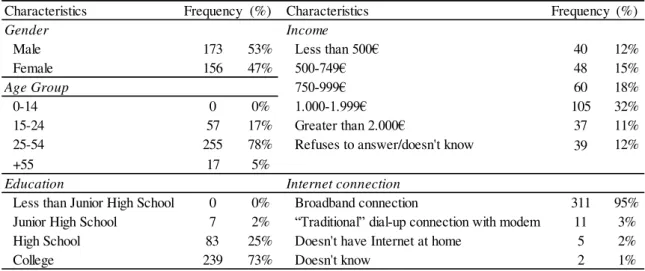
In this section, we analyze the collected data and test the previous developed hypotheses, in order to verify our extended UTAUT2 model and its adaptation to OMS. Partial Least Squares (PLS) Path Modeling was adopted in this study (with SmartPLS 2.0 software (Ringle et al., 2005)), since: a) PLS allows the inclusion of both reflective and formative measurement models; b) is recommended in early stages of theoretical development to test and validate exploratory models with the purpose of prediction and/or theory building and; c) has the capability of working with small samples (Henseler, Ringle, & Sinkovics, 2009). Regarding our sample (n=329), the following Table 5-1 reports the distribution of demographic characteristics.
Characteristics Frequency (%) Characteristics Frequency (%)
Gender Income
Male 173 53% Less than 500€ 40 12%
Female 156 47% 500-749€ 48 15%
Age Group 750-999€ 60 18%
0-14 0 0% 1.000-1.999€ 105 32%
15-24 57 17% Greater than 2.000€ 37 11%
25-54 255 78% 39 12%
+55 17 5%
Education Internet connection
Less than Junior High School 0 0% Broadband connection 311 95% Junior High School 7 2% “Traditional” dial-up connection with modem 11 3%
High School 83 25% Doesn't have Internet at home 5 2%
College 239 73% Doesn't know 2 1%
Table 5-1 - Respondents descriptive statistics (n=329)
24 For gender, distribution is almost equal, with a slightly higher number of male respondents (52.6%). Almost 95% of the respondents have access to a broadband
Internet connection, and have a level of education at the ‘College’ level (72.6%). The
vast majority lies in the age group of 24-55 years (77.5%), which could be justified with the fact that, according to Instituto Nacional de Estatística15 (INE, 2012), in Portugal, the majority of Internet users (53.2%) are between 24-55 years-old.
5.1 Measurement Model
To assess the measurement model, Henseler et al. (2009) proposed process was
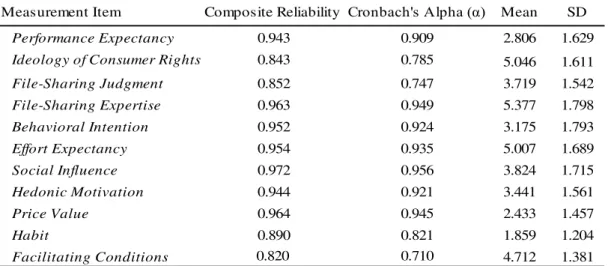
followed. In order to assess reflective constructs, indicators for reliability (Composite Reliabity and Cronbach’s Alpha, for internal consistency) and, convergent and
discriminant validity were evaluated. All value-indicators are mentioned on Tables 5-2, 5-3 and on Appendices IV and V.
Measurement Item Composite Reliability Cronbach's Alpha (α) Mean SD
Performance Expectancy 0.943 0.909 2.806 1.629
Ideology of Consumer Rights 0.843 0.785 5.046 1.611
File-Sharing Judgment 0.852 0.747 3.719 1.542
File-Sharing Expertise 0.963 0.949 5.377 1.798
Behavioral Intention 0.952 0.924 3.175 1.793
Effort Expectancy 0.954 0.935 5.007 1.689
Social Influence 0.972 0.956 3.824 1.715
Hedonic Motivation 0.944 0.921 3.441 1.561
Price Value 0.964 0.945 2.433 1.457
Habit 0.890 0.821 1.859 1.204
Facilitating Conditions 0.820 0.710 4.712 1.381 Table 5-2 - Reliability measurement of reflective variables (n=329)
According to Henseler et al. (2009), Composite Reliability (measure of internal
consistency that take into consideration that indicators have various loadings) and
Cronbach’s Alpha (based on the correlations of indicators) should have values higher than 0.6 and 0.7 (respectively) to guarantee a good reliabity and internal consistency.
All indicators have higher values than 0.8 for Composite Reliability and 0.7 for
Cronbach’s Alpha, satisfying all requirements. Henseler et al. (2009) also emphasize that the absolute standardized outer loadings of each indicator and its construct should be higher than 0.7. For our study, all values are acceptable (v. Appendix VII).
15
25 Average Extracted Variance (AVE) is used to measure convergent validity, demonstrating the unidimensionality of a given construct based on its group of indicators (Henseler et al., 2009). Since all constructs exhibit values higher than 0.5 (as represented in Table 5-3), this reveals the capability of the latent variables to explain, at least, 50% of the variance of its indicators (Henseler et al., 2009).
PE ICR FSJ FSE BI EE SI HM PV HT FC
PE 0.846
ICR 0.053 0.644
FSJ 0.034 0.009 0.658
FSE 0.000 0.078 0.137 0.868
BI 0.385 0.100 0.045 0.005 0.868
EE 0.100 0.181 0.000 0.164 0.181 0.837
SI 0.070 0.000 0.059 0.003 0.149 0.060 0.920
HM 0.429 0.135 0.053 0.003 0.413 0.235 0.128 0.810
PV 0.186 0.019 0.045 0.001 0.240 0.028 0.053 0.139 0.900
HT 0.423 0.025 0.021 0.002 0.391 0.067 0.064 0.286 0.175 0.730
FC 0.066 0.159 0.000 0.154 0.153 0.564 0.068 0.185 0.030 0.057 0.534
Note: Values in diagonal represent AVE, while off-diagonal refer to the squared correlation.
PE Performance Expectancy; ICR Ideology of Consumer Rights; FSJ FileSharing Judgment; FSE FileSharing Expertise; BI Behavioral Intention; EE Effort Expectancy; SI Social Influence; HM -Hedonic Motivation; PV - Price Value; HT - Habit; FC - Facilitating Conditions
Table 5-3 - AVE and Fornell–Larcker criterion (n=329)
Finally, discriminant validity is also assessed. Henseler et al. (2009) argues that it can be measured through: a) Fornell-Larcker criterion, where each latent variable shares more variance with its own set of indicators then with any other and; b) Cross-loadings, by evaluating discriminant validity on the indicator level.
Regarding the former (Table 5-3), all values are according to requirements (the AVE of each variable is higher than the squared correlation with other variables), with exception of Facilitating Conditions, which interferes with Effort Expectancy. As for the latter, as it can be observed in Appendix VI, intra-constructs items have a high correlation, while inter-construct items present low correlation, with exception of Facilitating Conditions, interfering with the same previous latent variable (Effort Expectancy). As a result, the construct was dropped from the model, although it is present in UTAUT2. A possible
explanation could be due to the respondents’ understanding of both construct items,
which could be interpreted as similar. By dropping Facilitating Conditions from the