i
Ricardo Miguel Tomás do Couto
Mestre em Biotecnologia
Development of Integrated Separation
Processes with Green Solvents
Dissertação para obtenção do Grau de Doutor em Química Sustentável
Orientador: Pedro Calado Simões, Professor Auxiliar,
Universidade Nova de Lisboa
Co-orientador: Susana Barreiros, Professora Associada,
Universidade Nova de Lisboa
Co-orientador: Rui Ruivo, Investigador Doutorado,
Universidade Nova de Lisboa
Júri:
Presidente: Prof. Doutora Ana Isabel Aguiar-Ricardo Arguentes: Prof. Doutor Haiko Hense
Prof. Doutor Henrique Aníbal Santos de Matos Prof. Doutor Carlos Alberto Mateus Afonso
Vogais: Prof. Doutor Pedro Miguel Calado Simões Prof. Doutora Susana Filipe Barreiros
Doutor Rui Manuel Ruivo
ii
Development of Integrated Separation
Processes with Green Solvents
Copyright: Ricardo Miguel Tomás do Couto, Faculdade de Ciências e Tecnologia da Universidade Nova de Lisboa, e Universidade Nova de Lisboa para todos os capítulos, excepto o Capítulo 3 –“Ionic Liquids Screening”, que foi publicado previamente e é reproduzido aqui sob permissão do editor original e sujeito às restrições de cópia impostas pelo mesmo
iii
Agradecimentos
Chegada a hora dos agradecimentos, tenho obrigatoriamente de começar por agradecer aos meus orientadores, que sempre me apoiaram e acreditaram em mim, Prof. Pedro Simões, Profª. Susana Barreiros e Dr. Rui Ruivo. Um muito obrigado muito especial por tudo o que me ensinaram.
Ao Dr. Luís Branco, por toda a ajuda nas medições de polaridades de líquidos iónicos e pela colaboração que conseguimos estabelecer, que continua ainda a dar frutos e se estende para lá do âmbito desta tese.
À Tânia Carvalho, que foi uma ajuda preciosa na preparação das primeiras membranas de Ion-Jelly®, e a quem devo um grande agradecimento.
Ao João Fernandes, meu colega de gabinete que me passou o testemunho de aluno de doutoramento do Prof. Pedro Simões, e com quem tive também oportunidade de aprender muitos conceitos de engenharia química.
E ao Pedro Lisboa, a quem passo agora o testemunho de aluno de doutoramento do Prof. Pedro Simões com muito gosto. Foi com muito prazer que no início ensinei e mais tarde partilhei todas as ideias malucas que fomos tendo. Parabéns pela instalação da unidade piloto! (Quando é que começamos a produção de cerveja?).
A todos os alunos que foram passando pelo laboratório e foram deixando contributos valiosos para os diversos trabalhos: Beatriz Afonso, Anabela Santos, Filipe Calixto, Tiago Reis, Murilo Nascimento, Elvis Ramos.
Ao Pedro Vidinha, que me iniciou no mundo dos supercríticos e me contagiou com o entusiasmo pela ciência.
Ao Alexandre Paiva, companheiro de laboratório e de aventuras. Temos de inventar uma nova aventura em breve!
Aos “colegas do lado”, presentes e passados, com quem vamos partilhando espaço e ferramentas: Teresa Casimiro, Márcio Temtem, Mara, Eunice, Telma, Rita Restani, Vanessa, Raquel, Ana Paninho, Anita, etc… de certeza que me estou a esquecer de alguém!
A todas as pessoas do 427 que ainda não mencionei: Sílvia Rebocho, Rita Rodrigues, Rita Craveiro, Diana Garcia, Andreia Pimenta, Carmen Montoya e vários outros que por lá foram passando.
À Catarina Pereira e Ana Pereira pelas pausas para café nos últimos tempos.
À Fundação para a Ciência e Tecnologia, pela bolsa de doutoramento SFRH/BD/36618/2007.
Ao meu agrupamento de escuteiros, Agrupamento 337 – Caldas da Rainha, com quem muito aprendi, e que é sempre um prazer acompanhar ao longo de todos estes anos a dar pontapés no im do impossível.
Aos meus amigos de sempre, Filipe Ramires, João Pedro Gomes, André Pontes, Ricardo Barata, Vanessa Nascimento, João Lopes, Ana Lucena, Leonardo Mendes, Diana Fernandes, Vítor Silva, etc., etc.
v
Resumo
Esta tese explora o fraccionamento de misturas com solventes não convencionais, como dióxido de carbono supercrítico (scCO2) e líquidos iónicos à temperatura ambiente (RTILs), e desenvolve novos processos integrados que acoplam estes solventes com membranas.
Explorou-se a possibilidade de usar membranas de osmose reversa para fraccionamentos em scCO2 com uma mistura modelo de ácido oleico e esqualeno. Todas as membranas testadas foram selectivas para o ácido oleico. Testou-se o efeito de acoplar a membrana a um processo de extracção supercrítica tendo-se atingido um enriquecimento combinado de 1.6 vezes.
Os RTILs foram usados para fraccionar a mistura modelo de ácido oleico e esqualeno. Escolhendo adequadamente o anião e catião do RTIL é possível modelar o fraccionamento. Com [EMIM][MDEGSO4] a selectividade para ácido oleico foi 2.96 e com [BMIM][NTf2] foi de 0.86. Desenvolveu-se um método indirecto de sondar as polaridades dos RTILs usando solventes orgânicos comuns e o corante de Reichardt, permitindo a construção de uma escala de polaridades. Mostrou-se que os RTILs mais polares têm menores selectividades para o ácido oleico.
Desenvolveram-se membranas suportadas de líquidos iónicos e aplicaram-se no fraccionamento de misturas modelo. Estas membranas apresentaram selectividades negligenciáveis no fracionamento da mistura modelo de ácido oleico e esqualeno, mas apresentaram bons resultados no fraccionamento dos produtos e reagentes de uma reacção de transesterificação, retendo completamente o glicerol e produzindo um permeado com uma fracção mássica de ésteres metílicos de 0.85.
Desenvolveu-se um novo tipo de membranas de gel, usando gelatina como polímero de suporte para RTILs. Apesar de estas membranas não serem capazes de fraccionar a mistura modelo de ácido oleico e esqualeno, foram capazes de atingir um factor de separação de ésteres metílicos em relação ao glicerol numa reacção de transesterificação de 166. Estas membranas foram também testadas na separação de gases, mas as selectividades obtidas foram muito baixas.
vii
Abstract
This thesis explores the fractionation of mixtures with unconventional solvents, like supercritical carbon dioxide (scCO2) and room temperature ionic liquids (RTILs), and develops new integrated processes which couple these solvents with membranes.
It was explored the feasibility of using reverse osmosis membranes for fractionations in scCO2 with a model mixture of oleic acid and squalene, and it was found that all membranes tested were selective towards oleic acid. The effect of coupling the membrane to a supercritical fluid extraction (SFE) process was also tested, achieving a combined enrichment in squalene of 1.6 times.
RTILs were used to fractionate the model mixture oleic acid and squalene. By appropriately choosing the anion and cation of the RTIL it was possible to model the fractionation. With [EMIM][MDEGSO4] a selectivity towards oleic acid of 2.96 was achieved, and with [BMIM][NTF2] the selectivity was 0.86.
An indirect method of probing the polarities of RTILs is developed using common organic solvents and Reichardt’s dye and a polarity scale is built. It was found that the most polar RTILs have lower selectivities towards oleic acid.
Supported ionic liquid membranes were developed and applied in the fractionation of model mixtures. These membranes had negligible selectivities for fractionating the model mixture of oleic acid and squalene, but presented good results when fractionating the products and reactants of a transesterification reaction, retaining completely glycerol and producing a permeate with 0.85 mass fraction of methyl esters.
A new type of gel membranes was developed, using gelatine as a support polymer for RTILs. Although these membranes were not able to fractionate the model mixture of oleic acid and squalene, they were able to achieve a separation factor of methyl esters in detriment of glycerol of 166. These membranes were also tested for the separation of gases, but the selectivities obtained were very low.
Keywords: Supercritical CO2, Ionic Liquids, Membranes, Green Processes, Process Integration,
ix
Table of Contents
Agradecimentos ... iii
Resumo ... v
Abstract ... vii
Table of Contents... ix
Figures Index ... xiii
Tables Index ... xvii
Abbreviations List ... xix
Chapter 1 - Introduction...1
1.1 - Thesis Outline ... 3
1.2
- Supercritical Fluids ... 4
1.2.1 – Fractionations with Supercritical Carbon Dioxide ... 5
1.3 - Membranes ... 5
1.3.1 - Applications in Supercritical Carbon Dioxide ... 7
1.4
–
Room Temperature Ionic Liquids ... 8
1.5
–
Supported Ionic Liquid Membranes and Gel Membranes ... 10
1.6
–
References ... 13
Chapter 2 - Reverse Osmosis Membranes...19
2.1 - Introduction ... 21
2.2
–
Materials and Methods ... 22
2.2.1 - scCO2 Fractionation Experiments ... 22
2.2.3 - Sample analysis ... 25
2.3 - Results ... 26
2.3.1 - scCO2 Permeabilities ... 26
2.3.2 - Fractionation Experiments ... 30
2.3.3 - Membrane Separation coupled with Supercritical Fluid Extraction ... 35
2.3.4 - Fractionation of Raffinate Model Mixture with Membranes ... 37
2.4 - Conclusions ... 38
2.5 - References ... 39
Chapter 3 - Ionic Liquids Screening...41
3.1 - Introduction ... 43
3.2 - Materials and Methods ... 45
x
3.3 - Results and Discussion ... 47
3.4 - Conclusions ... 52
3.5 - References ... 52
Chapter 4 - Ionic Liquids Polarities Measurements...55
4.1 - Introduction ... 57
4.2 - Materials and Methods ... 59
4.2.1 - UV/Visible Spectroscopy ... 59
4.3 - Results ... 61
4.4 - Conclusions ... 75
4.5 - References ... 75
Chapter 5 - Supported Ionic Liquids Membranes...79
5.1 - Introduction ... 81
5.2 - Materials and Methods ... 83
5.2.1 - Oleic Acid and Squalene Analysis by Gas Chromatography ... 84
5.2.2 - Methyl Esters Analysis by Gas Chromatography ... 85
5.2.3 - Preparation of Supported Ionic Liquid Membranes ... 85
5.2.4 - Preparation of Ion-Jelly Membranes by evaporative casting-knife method ... 85
5.2.5 - Preparation of Ion-Jelly Membranes by glass plates pressed method ... 86
5.2.6 - Characterization of Ion-Jelly Membranes ... 86
5.2.6.1 - Traction ... 86
5.2.6.2 - Contact Angles ... 86
5.2.6.3 - SEM Images ... 87
5.2.7 - scCO2 Fractionation Experiments ... 87
5.2.7.1 - Elemental Analysis ... 87
5.2.8- Single Gas Permeabilities ... 87
5.3 - Results ... 89
5.3.1 - Supported Ionic Liquids Membranes ... 89
5.3.2 - Development of Ion-Jelly® Membranes prepared by evaporative casting-knife method ... 93
5.3.2.1 - Traction ... 93
5.3.2.2 - Contact Angles ... 95
5.3.2.3 - scCO2 Permeability Measurements ... 96
5.3.2.4 - SEM images ... 97
5.3.3 - scCO2 Fractionation Experiments ... 99
5.3.3.1 - Elemental Analysis ... 101
5.3.4 - Development of Ion-Jelly® Membranes prepared by glass plates pressed method ... 102
5.3.4.1 - Traction ... 102
5.3.4.2 - Contact Angles ... 103
xi
5.3.4.4 - SEM images ... 105
5.3.5 - scCO2 Fractionation Experiments ... 1075
5.3.5.1 - Elemental Analysis ... 108
5.3.6 - Single Gas Permeabilities of Ion-Jelly® Membranes Prepared by the Glass Plates Pressed Method. ... 109
5.4 - Conclusions ... 111
5.5 - References ... 112
Chapter 6
–
Conclusions and Future W
ork………..115
xiii
Figures Index
Figure 1.1 – Generic phase diagram of a common pure substance, including the supercritical region. CP: critical point, TP: triple point, Tc: critical temperature, Pc:
critical pressure. 4
Figure 1.2 – Schematic representation of a membrane process. 5
Figure 1.3 – Schematic representation of a two-phase system separated by a membrane. 6 Figure 1.4 – Structures of some common ionic liquids cations and anions. 9
Figure 2.1 – Molecular structures of squalene and oleic acid. 22
Figure 2.2 – Flow scheme of the high pressure apparatus for the fractionation experiments
with scCO2. 23
Figure 2.3 – Stainless steel flat sheet membrane test cell. a) Scheme of the module; b)
Picture of the module assembled in the apparatus. 24
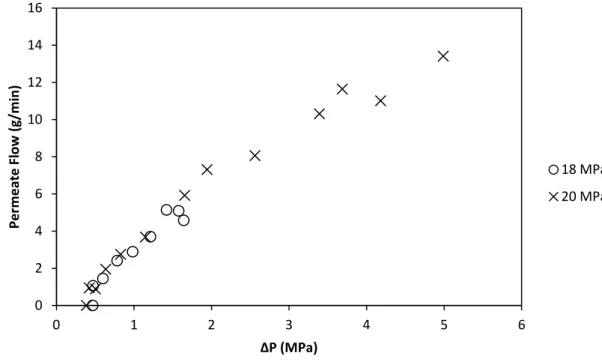
Figure 2.4 – scCO2 permeabilities for Polyamide AD membrane at 313 K and two
pressures. 26
Figure 2.5 – scCO2 permeabilities for Polyamide AG membrane at 313 K and several
pressures. 27
Figure 2.6 – scCO2 permeabilities for Teflon Af 2400 membrane at 313 K and two
pressures. 27
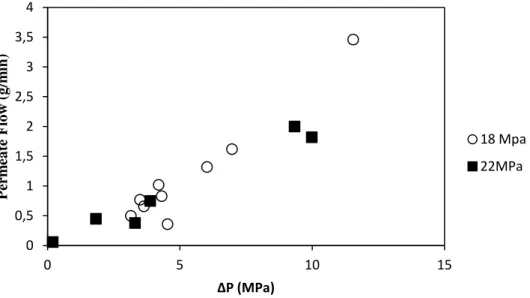
Figure 2.7 – scCO2 permeabilities for Cellulose Acetate membrane at 313 K and two
pressures. 28
Figure 2.8 – scCO2 permeabilities for Thin-Film SG membrane at 313 K and two
pressures. 28
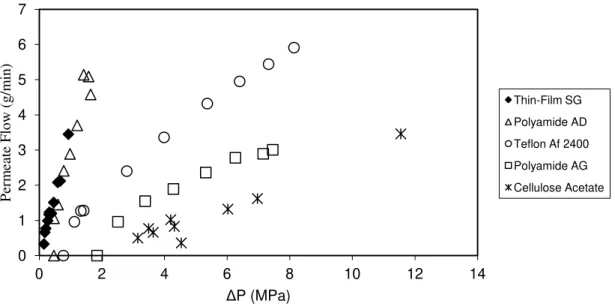
Figure 2.9 – scCO2 permeabilities for Polyamide AD, Polyamide AG, Teflon Af 2400 and
Cellulose Acetate membranes at 313 K and 18 MPa. 29
Figure 2.10 – scCO2 permeabilities for Polyamide AD and Thin-Film SG membranes at 313 K and 18 MPa, obtained in this work (open symbols) and obtained at TUHH (closed
symbols). 30
Figure 2.11 – scCO2 permeabilities for Teflon Af, Polyamide AG and Cellulose Acetate membranes at 313 K and 18 MPa, obtained in this work (open symbols) and obtained at
TUHH (closed symbols). 30
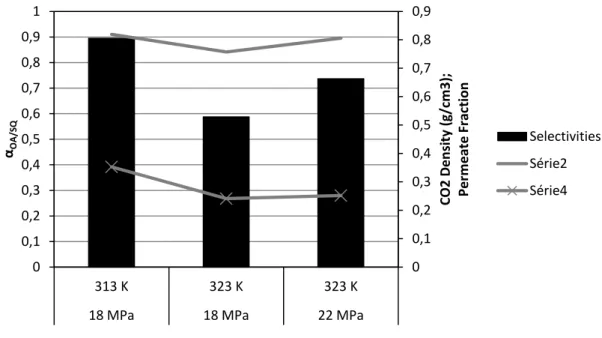
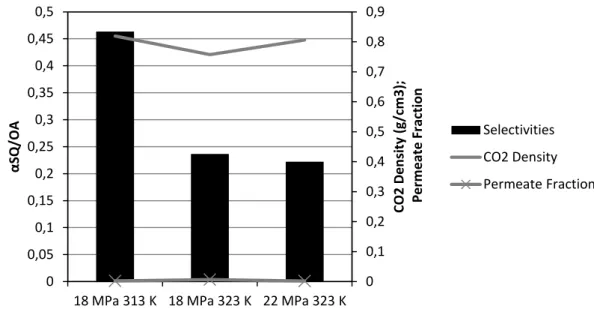
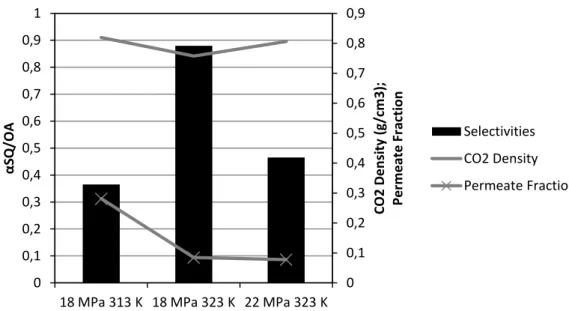
Figure 2.12 – Squalene selectivities and corresponding CO2 densities for Polyamide AD
membrane. 31
Figure 2.13 – Squalene selectivities and corresponding CO2 densities for Cellulose
xiv
Figure 2.14 – Squalene selectivities and corresponding CO2 densities for Thin-Film SG
membrane. 33
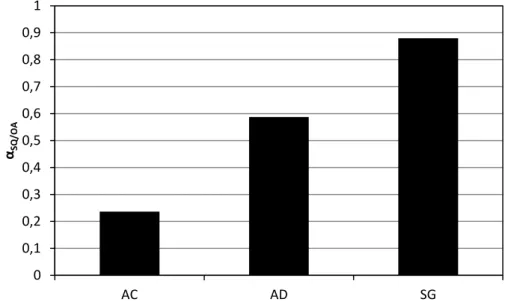
Figure 2.15 – Squalene selectivities at 18 MPa and 313 K for three membranes. AC:
Cellulose Acetate; AD: Polyamide AD; SG: Thin-film SG 33
Figure 2.16 – Squalene selectivities at 18 MPa and 323 K for three membranes. AC:
Cellulose Acetate; AD: Polyamide AD; SG: Thin-film SG 34
Figure 2.17 – Squalene selectivities at 22 MPa and 323 K for three membranes. AC:
Cellulose Acetate; AD: Polyamide AD; SG: Thin-film SG 34
Figure 2.18 – Squalene mass fractions obtained with the coupling of Polyamide AD membrane with SFE column, at 313 K, 18 MPa, CO2 flow of 40 g/min and feed flow of
1.2 g/min. 36
Figure 2.19 – Squalene mass fractions obtained with the coupling of Polyamide AD membrane with SFE column, at 313 K, 18 MPa, CO2 flow of 90 g/min and feed flow of
4.5 g/min. 37
Figure 3.1 - Molecular structures of the ionic liquids cations and anions studied in this
work. 44
Figure 3.2 - High pressure apparatus for the extraction of solutes from the ionic liquid and
oil phases. 46
Figure 3.3 - Partition coefficient of oleic acid with A+ [BF4]- ionic liquids.
48 Figure 3.4 - Partition coefficient of oleic acid with [BMIM]+ X- ionic liquids.
49 Figure 3.5 – Partition coefficient of oleic acid with different proportions of model mixture
and [(C6)3C14P][NTf2]. 49
Figure 4.1 – Molecular structures of solvents and probe (betaine) used in this work. 59 Figure 4.2 – Molecular structures of ionic liquids cations and anions used in this work. 60
Figure 4.3 - Anion effect in ETN values of acetonitrile. 63
Figure 4.4 - Cation effect in ETN values of acetonitrile. 64
Figure 4.5 – Range of effects in acetonitrile polarity for individual anions and cations, in
ETN values. 66
Figure 4.6 – Effect in ETN values of acetonitrile by the continuous addition of ionic liquid
to acetonitrile. 67
Figure 4.7 - Anion effect in ETN values of ethanol. 68
Figure 4.8 - Cation effect in ETN values of ethanol. 69
Figure 4.9 - Effect in ETN values of the addition of RTILs to tetrahydrofuran, pre-dried
tetrahydrofuran, chloroform and isopropanol. 71
Figure 4.10 – Effect in ETN values of continuous addition of [BMIM][BF4] to solvents. 72
xv
Figure 5.2 – Structure of ionic liquids cations and anions used in this work. 84 Figure 5.3 – Experimental set-up for measuring the permeability of the SILMs for a single
gas. 88
Figure 5.4 - scCO2 permeability in commercial reverse osmosis membranes (see Chapter
2) and supported ionic liquids membranes at 18 MPa and 313 K. 90
Figure 5.5 – Squalene selectivities with reverse osmosis membranes and their corresponding supported ionic liquid membranes at 18 MPa and 313 K. 91 Figure 5.6 - Fractionation of effluent stream of enzymatic transesterification of sunflower oil to biodiesel with [BMIM][DCA] supported in cellulose acetate membrane. Operating
conditions were 20 MPa and 323 K. 92
Figure 5.7 – Stress-strain curves of Ion-Jelly® membranes prepared by evaporative casting-knife method.
94 Figure 5.8 – Pictures of a) Ion-Jelly® based in [BMIM][DCA] membrane and b) gelatine
membrane. 95
Figure 5.9 – Contact angles of [BMIM][DCA] Ion-Jelly® membranes prepared according
to evaporative casting-knife method. 95
Figure 5.10 – scCO2 permeability in commercial reverse osmosis membranes and
Ion-Jelly
®membranes without thickness control.96 Figure 5.11 – scCO2 permeability in [BMIM][DCA]
Ion-Jelly
® membranes with andwithout thickness control. 97
Figure 5.12 – SEM images of Ion-Jelly® membranes prepared by evaporative
casting-knife method. 98
Figure 5.13 – Squalene selectivities with
Ion-Jelly
® membranes prepared according toevaporative casting-knife method at 18 MPa and 313 K. 99
Figure 5.14 – Squalene selectivities with Ion-Jelly® membranes prepared by the
evaporative casting-knife method at 18 MPa and 313 K. 100
Figure 5.15 – SEM image of the surface of a [BMIM][DCA] membrane 0.5 mm in thickness. The red circle indicates two air bubbles which remained during the jellification
process. 100
Figure 5.16 – Stress-strain curves of Ion-Jelly® membranes prepared by glass plates
pressed method. 102
Figure 5.17 – Water contact angles in Ion-Jelly® membranes prepared by glass plates
pressed method. 103
Figure 5.18 – Triglycerides contact angles in Ion-Jelly® membranes prepared by glass
plates pressed method. 104
xvi
2) and Ion-Jelly® membranes prepared by glass plates pressed method.
Figure 5.20 – SEM images of Ion-Jelly® membranes prepared by glass plates pressed
method. 106
Figure 5.21 – Selectivity of squalene with [BMIM][DCA] Ion-Jelly® membranes prepared
by the glass plates pressed method at 18 MPa and 313 K. 107
Figure 5.22 – Fractionation of effluent stream of enzymatic transesterification of sunflower oil to biodiesel with [BMIM][DCA]
Ion-Jelly
® membrane. Operatingconditions were 20 MPa and 323 K. 108
Figure 5.23 – Gas permeabilities of the
Ion-Jelly
® membranes as a function of the gasxvii
Tables Index
Table 1.1 – Range of permeations possible to obtain according to particle size, for different
membranes. 7
Table 2.1 – Geometric characteristics of Sulzer EX gauze packing used in this work 25 Table 2.2 – Selectivity of squalene towards oleic acid, CO2 densities and permeate fractions for Cellulose Acetate, Polyamide AD and Thin-Film SG at different pressure and temperature
conditions. 35
Table 2.3 – Results obtained in the fractionation of raffinate model mixture with membranes. 38 Table 3.1 - Partition coefficients of oleic acid for the ionic liquids studied in this work. 47 Table 3.2 - Solvent polarity of RTIL determined by solvatochromism (Reichardt’s method). 51 Table 4.1 – Wavelength values obtained and calculated ET(30) and , from literature and this work, for pure [BMIM][BF4] with addition of Reichardt’s dye. 61 Table 4.2–Effects in polarity of the addition of ionic liquids to acetonitrile. 62 Table 4.3–Effects in polarity of the addition of ionic liquids to ethanol. 68 Table 4.4–Effects in polarity of the addition of ionic liquids to tetrahydrofuran, chloroform
and isopropanol. 70
Table 4.5 - Effects in polarity of the addition of [BMIM][BF4] to different solvents. 72 Table 4.6 – Ordered ETN values of common RTILs tested in acetonitrile and ethanol. 73 Table 4.7 – Partition coefficients of oleic acid for the ionic liquids studied in this chapter and
corresponding ETN value in ethanol. 73
Table 4.8 - Solvent polarity of pure RTILs determined by solvatochromism (Reichardt’s
method) as found in published literature. 74
Table 5.1 – Amounts of ionic liquids impregnated in respective membranes and solubilities of CO2 in ionic liquids reported in the literature at pressure and temperature conditions used
in this work (18 MPa, 313 K). 89
Table 5.2 – Values obtained for diverse membranes in the fractionation of a model mixture
of oleic acid and squalene. 92
Table 5.3 – Young modulus of Ion-Jelly® membranes. 94
Table 5.4 – Values obtained for diverse membranes in the fractionation of a model mixture
of oleic acid and squalene and a model mixture of methyl oleate and squalene. 99 Table 5.5 – Nitrogen detected by elemental analysis in several streams. 101
Table 5.6 – Young modulus of Ion-Jelly® membranes prepared by glass plates pressed
method. 103
xviii
Table 5.8 – Permeabilities of pure gases and calculated ideal selectivities. 111
Table A.1 – ETN values for acetonitrile. 123
Table A.2 - ETN values for Ethanol. 124
Table A.3 - ETN values for Tetrahydrofuran. 124
Table A.4 – ETN values for Pre-dried Tetrahydrofuran. 124
Table A.5 – ETN values for Chloroform. 125
xix
Abbreviations List
αi/j – Selectivity of component i over component j β– Geometric parameter
Δl – Change in length ΔP – Pressure drop ε - Strain
µi/j– Number of moles of component i per number of moles of component j
µL - Microliter µm – Micrometer
λmax - Wavelength of the maximum of the long-wavelength
max– Wavenumber
σ – Stress
A – Cross-sectional area A – Membrane area A+ - Generic cation Å - Angstrom
AC – Cellulose acetate membrane ACN - Acetonitrile
AD – Polyamide AD membrane
[ALIQUAT] – Tri-octyl-methyl-ammonium [BDMIM] - 1-butyl-2,3-dimethyl-imidazolium
BES - 2-[N,N-bis(2-hydroxyethyl)amino]ethanesulfonate [BF4] – Tetrafluroborate
[BMIM] - 1-butyl-3-methyl-imidazolium [BMPyr] - 1-butyl-3-methylpyrrolidinium BPR - Back Pressure Regulator
c (page 50) – Speed of Light C (page 47) - Concentration ºC – Celsius Degree
[C2] - (2-hydroxyethyl)-ethyl-dimethyl-ammonium [C2OHMIM] - 1-(2-hydroxyethyl)-3-methyl-imidazolium [C3OMIM] – 1-(2-Methoxyethyl)-3-methyl-imidazolium
[C5O2MIM] - 1-[2-(2-Methoxyethoxy)-ethyl]-3-methyl-imidazolium [(C6)3C14P] - Trihexyl-tetradecyl-phosphonium
xx C14:0 – Myristic acid
C16:0 – Palmitic acid C16:1 – Palmitoleic acid C18:0 – Stearic acid C18:2 – Linoleic acid
ca.– circa
CH4 - Methane CHCl3– Chloroform
CHES - 2-(Cyclohexylamino)-ethanesulfonate [Cl] - Chloride
cm – Centimeter
cm2– Square centimeter cm3 – Cubic centimeter CO2– Carbon dioxide CT – Charge transfer CVi - Check-Valves
Da – Dalton
[DCA] – Dicyanamide
[DMG] - Dimethylguanidinium
[EMIM] - 1-ethyl-3-methyl-imidazolium
ET(30) –Reichardt’s empirical scale of solvent polarity
ETN – Normalized scale of solvent polarity EtOH - Ethanol
[EtSO4] - Ethylsulfate
EPV - Electro-Pneumatic Valve. F – Applied force
FID – Flame ionization detector g - Gram
GC – Gas chromatography h – Planck’s constant H2 - Hydrogen
HPLC – High performance liquid chromatography I.D. – Internal diameter
i.e. – id est; in other words IJ – Ion-jelly
xxi
IUPAC – International Union of Pure and Applied Chemistry K –Kelvin Degree
KD– Partition coefficient KPa – Kilopascal
l – Membrane thickness L - Length
m – Meter
m2– Square meter m3 – Cubic meter
[MDEGSO4] - 2-(2-methoxyethoxy)-ethylsulfate MFM - Mass flow meter
mg - Milligram min - Minute mL - Milliliter mm – Millimeter mM – Millimolar MO – Methyl oleate mol – Moles
MOPSO - 2-hydroxy-3-(4-morpholino)propanesulfonate MPa – Megapascal
[MSO4] – Methanesulfonate N – Newton
N2 - Nitrogen
NA – Avogadro’s constant nm - nanometer
[NTf2] - Bis(trifluoromethylsulfonyl)-imide O2 - Oxygen
OA – Oleic acid
[OMIM] - 1-octyl-3-methyl-imidazolium P – Membrane permeability
Pa - Pascal
[PF6] – Hexafluorophosphate
pfeed – Pressure in the feed compartment
PI - Pressure Indicator
Pperm – Pressure in the permeate compartment
xxii R – Generic substituent
Ref. - Reference RO – Reverse Osmosis
RTIL – Room temperature ionic liquid s - Second
scCO2 - Supercritical carbon dioxide SEM – Scanning electron microscopy S/F – Solvent-to-feed mass flow ratio SFE – Supercritical fluid extraction SG – Thin-Film SG membrane
SILM – Supported ionic liquid membrane SQ – Squalene
t - Time
THF - Tetrahydrofuran TMS - Tetramethylsilane
TUHH - Technische Universität Hamburg-Harbug UV/Vis – Ultraviolet/Visible
Vi - Valves
Vfeed – Volume of the feed compartment
Vol. – Volume
Vperm– Volume of the permeate compartment
vs. - Versus
wt% - Weight percent w/w – Weight per weight X- - Generic anion
1
Chapter 1
3 1.1 Thesis Outline
This thesis explores the fractionation of mixtures with unconventional solvents, like supercritical carbon dioxide (scCO2) and room temperature ionic liquids (RTILs), and develops new integrated processes which couple these solvents with membranes.
In Chapter 1 is given a general introduction to the main themes discussed in this thesis. It starts with the characteristics of one of the main solvents, scCO2, and a brief state of the art of applications of scCO2 is also given. The main separation process, membrane separation, is also explained, and the previous applications of membranes in scCO2 are explored. It follows with the other main class of solvents, RTILs. Their characteristics and applications are reviewed, as well as a brief overview of some of the applications in scCO2. And finally, the Introduction ends with a state of the art of the recent developments in supported ionic liquids membranes (SILMs) and gel membranes.
In Chapter 2 is explored the feasibility of using reverse osmosis membranes for fractionations in scCO2. The influence of pressure, temperature and pressure drop across the membranes in the permeability of the membranes is tested. Next, these are tested for the fractionation of a model mixture of oleic acid and squalene in scCO2. The effect of coupling the membrane to a supercritical fluid extraction (SFE) process is also tested.
Chapter 3 and 4 explore the characteristics of RTILs and their ability to fractionate mixtures, which would otherwise be difficult to separate. In Chapter 3 RTILs are used to fractionate the same model mixture used in Chapter 2, and in Chapter 4 an attempt to build a polarity scale of RTILs is made as a way of rationalising and explaining the results obtained in Chapter 3.
Finally, the knowledge obtained in the previous Chapters is used in Chapter 5 to develop SILMs and apply them in scCO2 in the fractionation of the model mixture tested in Chapters 2 and 3. Due to the poor results obtained in this attempt, a new type of gel membranes was developed, using gelatine as a support polymer for RTILs. These new membranes are tested in scCO2 for the fractionation of the model mixture of oleic acid and squalene and for the fractionation of products and reagents of a transesterification reaction. Furthermore, these membranes are also tested for the separation of gases.
4 1.2 - Supercritical Fluids
In August 12, 1822, Baron Cagniard de la Tour described for the first time an experiment where he would heat a fluid far beyond its boiling point, inside a closed vessel. He introduced alcohol at 36º in a cannon barrel and a silex sphere, and sealed it. By gradually heating it, and making the sphere roll back and forth inside the barrel, he could listen to the sound the sphere would make at different temperatures. At first, he would hear the splashing sound that the sphere would make when traversing the liquid-vapour interface, but when the temperature would rise enough, that sound would disappear. And thus, the critical point of a substance was for the first time acknowledged [1].
A pure component is considered to be in a supercritical state if its temperature and its pressure are higher than the critical values, which for carbon dioxide, the supercritical fluid used in this work, are 304.15 K and 7.38 MPa, respectively [2].
At critical conditions for pressure and temperature, there is no sudden change of component properties. This is depicted in Figure 1.1 by the broken line. The variation of properties with conditions of state is monotonous, when crossing the broken line, with the exception of the critical point itself [2].
Figure 1.1– Generic phase diagram of a common pure substance, including the supercritical
region. CP: critical point, TP: triple point, Tc: critical temperature, Pc: critical pressure [2].
5
1.2.1 – Fractionations with Supercritical Carbon Dioxide
Extraction of compounds from natural sources is the most widely studied application of supercritical fluids (SCFs) with several hundreds of published scientific papers. Indeed, SFE has immediate advantages over traditional extraction techniques: it is a flexible process due to the possibility of continuous modulation of the solvent power/selectivity of the SCF, allows the elimination of polluting organic solvents and of the expensive post-processing of the extracts for solvent elimination. Carbon dioxide is the most popular SFE solvent because it is safe, readily available and has a low cost. It allows supercritical operations at relatively low pressures and near-room temperatures. The only serious drawback of SFE is the higher investment costs if compared to traditional atmospheric pressure extraction techniques. However, the base process scheme (extraction plus separation) is relatively cheap and very simple to be scaled up to industrial scale [3].
SFE of solids is the most studied application since the most frequently required separation process is the extraction/elimination of one or more compound families from a solid natural matrix [3]. Some examples include the extraction of lipids from cyanobacteria [7], extraction of essential oils from plants [8], [9], extraction of lycopene from tomatoes [10] and the decaffeination of coffee [11]. It has been carried out in a commercial scale for more than three decades, in processes like the decaffeination of coffee beans and black tea leaves and the production of hop extracts [3].
1.3 - Membranes
In a membrane process, a stream is fed into the membrane, where it is divided into a retentate and a permeate stream (Figure 1.2). In this process, either retentate or permeate streams could be the product of interest, depending on the objective of the separation. If the objective is to concentrate a product, then the retentate is the stream of interest, but if the objective is to purify one of the components of the mixture, then both retentate or permeate streams could yield the product of interest [12].
6
A membrane process can also be seen as a barrier (the membrane) separating two phases, where transference of some compounds can occur from one phase to the other (Figure 1.3).
Figure 1.3 – Schematic representation of a two-phase system separated by a membrane
(adapted from [12]).
The performance or efficiency of a membrane is defined by two parameters, the selectivity and the flow through the membrane. The latter is defined as the volume flowing through the membrane per unit of time. Volume flow can also be easily converted to mass or mole flow. The selectivity of the membrane can be represented by the retention factor (R) or the separation factor (α). The retention factor is given by:
(1.1)
Where Cf is the concentration of the solute in the feed phase and Cp is the concentration of the solute in the permeate phase. R is a dimensionless factor, and varies from 0% (no retention) to 100% (full retention). The separation factor is given by:
(1.2)
with yi,j and xi,j the mass fraction of component i, j in the permeate and retentate streams,
respectively. When the separation factor is greater than 1, the selectivity is towards component
i, and when it is lower than 1, the selectivity is towards component j. If , then there is no
separation [12].
7
(porous). If they are asymmetric, then they are generally made from a very dense and thin top layer, supported by a porous and thicker layer. This combination allows to achieve the high selectivity of the dense layer with the high permeability of the porous layer [12].
The range of particle sizes that can permeate the different kinds of membranes are summarized in Table 1.1.
Table 1.1 – Range of permeations possible to obtain according to particle size, for different
membranes. (Adapted from [13]).
Membrane Particle Size Range Particle Filtration > 1 µm Microfiltration 0.1 – 10 µm Ultrafiltration < 0.1 µm – 5 nm
Nanofiltration ≈ 1 nm
Reverse Osmosis < 1 nm Electrodialysis < 5 nm
Dialysis < 5 nm
1.3.1 - Applications in Supercritical Carbon Dioxide
One of the greatest advantages of using membranes with supercritical fluids is that separations can be made without pressure loss. Otherwise, CO2 would have to be decompressed in order for solutes to precipitate, with major energy losses associated.
The association of a membrane to the supercritical fluid extraction process was already suggested by several authors. Three kinds of potential applications have been studied: (i) solvent recovery after SFE extraction step; (ii) carbon dioxide extraction coupled with cross-flow or countercurrent-cross-flow filtration; (iii) fractionation of solutes. Semenova et al. [14] studied
8
Regeneration of scCO2 from caffeine loaded gas phases was achieved by commercial nanofiltration membranes, with a ZrO2-TiO2 thin layer [18], and later with silica and microporous silicalite membrane filters, obtaining a retention factor of 98% [19]. But a caffeine retention factor of 100% was possible to observe at a temperature of 308 K and a pressure equal to or lower than 12 MPa, with a microporous silicalite membrane [19]. Carlson et al. applied
reverse osmosis membranes (thin layer SC membrane) to separate efficiently limonene (94 % retention factor) from scCO2 extracts [20]. Reverse osmosis membranes have also been used to separate lemongrass essential oil from scCO2 with a retention factor up to 90% [21], or polyphenols from scCO2 after extraction from cocoa seeds with retention factors higher than 90% [22].
The use of hollow fiber microporous membrane contactors in supercritical fluid extraction processes has been reported in the literature [23]-[25]; improved mass transfer efficiency due to a reduced shell-side fiber bypassing is claimed by the authors. Sarrade et al. [26] proposed the coupling of scCO2 extraction with nanofiltration separation to extract and purify low molecular weight compounds (up to 1500 Da). A nanofiltration tubular membrane resistant enough to endure supercritical conditions was applied to two different processes: (i) the fractionation of triglycerides from fish oil and (ii), the purification of -carotene issued from either carrot oils or carrot seeds. The coupled process led to good quality extracts.
Goetheer et al. proposed to use an inorganic microporous membrane for the separation of catalyst from products in homogeneous catalysis in scCO2, for the hydrogenation of 1-butene to n-butane, with a derivative of Wilkinson’s catalyst [27]. And finally, two nanofiltration and one reverse osmosis membrane were studied for the purification of modified triglycerides, by retention of triglycerides and permeation of reaction subproducts (fatty acid esters and/or fatty acid lipids), achieving retention factors of triglycerides up to 100% [28].
1.4 – Room Temperature Ionic Liquids
9
Figure 1.4– Structures of some common ionic liquids cations and anions.
10
Many studies have been made with ionic liquids and scCO2. The phase equilibria for many systems has been determined, and it was found that, as a general rule, CO2 has high solubility in RTILs, but RTILs are not soluble in scCO2. This behavior renders it viable to use scCO2 to extract solutes from RTILs [43]. It is also possible to purify RTILs by using scCO2 extraction, which can remove water and organic impurities [44]. Other applications have also been explored, for example, RTILs have been used as effective solvents in extractive distillation for the separation of an azeotropic mixture containing tetrafluoroethylene and carbon dioxide [45]. Still another example is the combination of RTILs with scCO2 as reaction mediums. This was accomplished for lipase catalysis, with RTILs stabilizing the enzyme and scCO2 extracting the products of the reaction [46] and for continuous-flow rhodium-catalysed hydroformylation of long chain alkenes, achieving selectivities to the desired linear aldehyde of 92% and minimum rhodium loss, using a xantphos-derived ligand attached to an imidazolium salt [47].
1.5 – Supported Ionic Liquid Membranes and Gel Membranes
It has been recognized for a long time that RTILs have the potential to recover solutes or fractionate mixtures which are not easy to separate/fractionate with conventional solvents. The immobilization of RTILs in membranes, creating supported ionic liquid membranes (SILMs), has been developed as a way to facilitate the application of RTILs in industrial environments. SILMs have several advantages, allowing to operate with an extremely large specific membrane area (membrane area per unit volume) without dispersing the extractant in the feed phase; extraction and re-extraction take place simultaneously, involving a minimal amount of extractant, which is constantly regenerated and with the additional possibility of tuning the selectivity of the extractant phase to a defined solute by adequate selection of the solid supporting membrane [48].
11
RTILs supported in polyvinylidene fluoride porous membrane were used to separate CO2 from N2, being possible to achieve a separation factor of 86.5 with [BMIM][BF4] at 303.15 K [53]. With imidazolium RTILs immobilized in polyethersulfone membranes, the best selectivities were found for the RTIL 1-ethyl-3-methylimidazolium trifluoromethanesulfone ([EMIM][CF3SO3]) (CO2/N2: 28; CO2/CH4: 16; SO2/N2: 337; SO2/CH4: 196) [53]. Also for imidazolium RTILs immobilized in polyethersulfone membranes, but now with fluoroalkyl substituents, the best selectivity it was possible to achieve was of 27 for the pair CO2/N2 [54]. The influence of anions trifluoromethanesulfone ([CF3SO3]), dicyanamide ([DCA]) and [NTf2], in the separation of gases was studied with the cation [EMIM], and the best selectivities were obtained with [DCA] (CO2/N2: 61; CO2/CH4: 20) [55]. With ILs based in pyridinium and ammonium immobilized in α-alumina inorganic supports, the best selectivity was for the pair CO2/CH4 with a value of 30 for [BMPy][BF4] [56].
The effect of increasing the alkyl chain length in 1-alkyl-3-methylimidazolium RTILs supported in polymeric membranes was investigated and it was found out that the permeability increases with increasing alkyl chain length, and also that permeability decreases with increasing viscosity. In this same study it was possible to obtain selectivities for the pairs CO2/N2 and CO2/CH4 of 32 and 161, respectively [57].
Camper et al. in 2006 developed a model to predict solubility of gases in imidazolium RTILs
based on the molar volume of the RTILs and estimated gas permeability and gas pair separation selectivity for ideal CO2/N2 and CO2/CH4 separations. At the time, they concluded that there appears to be more potential for RTIL-based membranes in CO2/N2 separations than in CO2/CH4 [58]. In a later paper, Scovazzo summarized literature data and some new data for SILM permeabilities and selectivities for the gas pairs CO2/N2, CO2/CH4, O2/N2, ethylene/ethane, propylene/propane, 1-butene/butane, and 1,3-butadiene/butane, finding little room for improving the reported permeabilities, but some space for increasing the selectivities [59].
Other applications of SILMs include applications as diverse as separation of arsenate and arsenite from aqueous media [60], enzymatic synthesis in an active membrane using ionic liquids as catalyst support [61], removal of phenol from wastewater [62], vapor permeation of benzene/cyclohexane [63], transport of salicylic acid [64], or the removal of butan-1-ol from fermentation broths of Clostridium acetobutylicum in order to avoid the decrease of the
12
SILMs have also been used for the fractionation of organic compounds, for example, a porous polyvinylidene fluoride film membrane was used with a feed solution of heptanes and a receiving solution of hexadecane for the transport of aromatic hydrocarbons, benzene, toluene and p-xylene, with the best selectivity being obtained for benzene [66]. Víllora et al., in a series of papers, started by showing that it was possible to fractionate the substrates and products of a transesterification reaction (vinyl butyrate, 1-butanol, butyl butyrate and butyric acid) through SILMs based on 1-n-alkyl-3-methylimidazolium cations combined with [BF4], [PF6] and [NTf2] anions [67]. From this study, they found that the hydrophilic nature of ILs was a key parameter for the selective separation of those compounds, and thus developed new membranes based on a hydrophilic anion, dicyanamide, concluding that both the permeability of the compounds and the permselectivity of the membrane were enhanced with the use of dicyanamide based ionic liquids [68]. Then, they went on to study the permeability of sixteen different organic compounds (vinyl esters, aliphatic esters, alcohols and carboxylic acids) through SILMs containing [BF4] based ionic liquids ([BMIM][BF4] and [OMIM][BF4]). It was found that permeability increased as the alkyl chain length decreased for the same organic functional group. In addition, significant permeability differences were found between the different organic functional groups [69].
Despite the fact that gel polymers with RTILs have been studied for some time to prepare electrolytes for lithium batteries [70], [71], it was only recently that they have been proposed as membranes for the separation of gases. The efforts in the development of gel membranes have been triggered by limitations of SILMs on the trans-membranes pressures that are possible to apply. In fact, it was demonstrated that trans-membrane pressures as low as 0.2 MPa can result in displacement of RTIL from SILMs [57].
oxide-block-13
styrene)) was synthesized and used with three RTILs based in the 1-n-hexyl-3-methylimidazolium ([HMIM]) cation and [NTf2], [BF4], and [PF6] anions. The ideal CO2/CH4 separation factors were studied and ranged from 9.0 to 9.9 [74].
To the best of our knowledge, this work proposes for the first time the application of either SILMs or gel membranes in scCO2.
1.6 – References
[1] C. de la Tour; Exposé de quelques résultats obtenus par l’action combinée de la chaleur et de la compression sur certains liquides, tels que l’eau, l’alcool, l’éther sulfurique et l’essence de pétrole rectifiée; Ann. Chim. Phys. 21, (1822) 127-132.
[2] G. Brunner, Gas Extraction, Springer, Berlin, 1994.
[3] E. Reverchon, I. De Marco; Supercritical Fluid Extraction and Fractionation of Natural Matter; J. of Supercritical Fluids 38 (2006) 146-166.
[4] H. Taher, S. Al-Zuhair, A. Al-Marzouqi, Y. Haik, M. Farid; A Review of Enzymatic Transesterification of Microalgal Oil-Based Biodiesel Using Supercritical Technology; Enzyme Research Volume 2011, Article ID 468292, doi:10.4061/2011/468292
[5] R. Couto, P. Vidinha, C. Peres, A. Ribeiro, O. Ferreira, M. Oliveira, E. Macedo, J. Loureiro, S. Barreiros; Geranyl Acetate Synthesis in a Packed-Bed Reactor Catalyzed by Novozym in Supercritical Carbon Dioxide and in Supercritical Ethane; Ind. Eng. Chem. Res. 2011, 50, 1938–1946.
[6] V. Bonifácio, V. Correia, M. Pinho, J. Lima, A. Aguiar-Ricardo; Blue emission of carbamic acid oligooxazoline biotags; Materials Letters 81 (2012) 205–208.
[7] Mendes, R. L.; Reis, A. D.; Palavra, A. F.; Supercritical CO2 extraction of c-linolenic acid and other lipids from Arthrospira (Spirulina)maxima: Comparison with organic solvent extraction; Food Chemistry 99 (2006) 57–63.
[8] Simões, P.C.; Nunes da Ponte, M.; Matos, H.; Gomes de Azevedo, E.; in Proceedings of
the Second International Symposium on High Pressure Chemical Engineering, Erlangen, 1990, p. 401.
[9] Della Porta, G.; Porcedda, S.; Marongiu, B.; Reverchon, E.; Isolation of eucalyptus oil by supercritical fluid extraction, Flavour Fragr. J. 14 (1999) 214–218.
[10]Cadoni, E.; De Giorgi, M.R.; Medda, E.; Poma, G.; Supercritical CO2 extraction of Lycopene and β-carotene from ripe tomatoes; Dyes Pigments 44 (2000) 27–32.
[11]Zosel, K.; Separation with Supercritical Gases: Practical Applications; Angew. Chem. Int.
Ed. Eng. 17 (10) (1978) 702 – 709.
14
[13]J. Coulson and J. Richardson; Chemical Engineering, Volume 2 – Particle Technology and Separation Processes; 5th edition; Oxford; 2002.
[14]S.I. Semenova, H. Ohya, T. Higashijima, Y. Negishi, Separation of supercritical CO2 and ethanol mixtures with an asymmetric polyimide membrane, J. Membr. Sci. 74 (1992) 131-139.
[15]H. Ohya, T. Higashijima, Y. Tsuchiya, H. Tokunaga, Y. Negishi, Separation of supercritical CO2 and iso-octane mixtures with an asymmetric polyimide membrane, J. Membr. Sci. 84 (1993) 185-189.
[16]L. Sartorelli, G. Brunner, Membrane separation of extracts from supercritical carbon dioxide, in: Proceedings of the 5th International Symposium on Supercritical Fluids, Atlanta, USA, 2000, 22.
[17]A. Pietsch, W. Hilgendorff, O. Thom, R. Eggers; Basic investigation of integrating a membrane unit into high-pressure decaffeination processing; Separation and Purification Technology 14 (1998) 107–115.
[18]C. Tan, Y. Chiu, Regeneration of supercritical carbon dioxide by membrane at near critical conditions, J. Supercrit. Fluids 21 (2001) 81-89.
[19]C. Tan, H. Lien, S. Lin, H. Cheng, K. Chao; Separation of supercritical carbon dioxide and caffeine with mesoporous silica and microporous silicalite membranes, J. of Supercritical Fluids 26 (2003) 55-62.
[20]L.H.C. Carlson, A. Bolzan, R.A.F. Machado, Separation of d-limonene from supercritical CO2 by means of membranes, J. of Supercritical Fluids 34 (2005) 143-147.
[21]L. Sarmento, R. Machado, A. Bolzan, C. Spricigo, J. Petrus; Use Of Reverse Osmosis Membranes For The Separation Of Lemongrass Essential Oil And Supercritical CO2; Brazilian Journal of Chemical Engineering; 21 (02) (2004) 285–291.
[22]L. Sarmento, R. Machado, J. Petrus, T. Tamanini, A. Bolzan; Extraction of polyphenols from cocoa seeds and concentration through polymeric membranes; J. of Supercritical Fluids 45 (2008) 64–69.
[23]J.R. Robinson, M.J. Sims, Method and System for Extracting a Solute from a Fluid Using Dense Gas and a Porous Membrane, US Patent 5490884 (13 February 1996).
[24]G.D. Bothun, B.L. Knutson, H.J. Strobel, S.E. Nokes, Mass transfer in hollow fiber membrane contactor extraction using compressed solvents, J. Membr. Sci. 227 (2003) 183– 196.
[25]A. Gabelman, S.-T. Hwang, W.B. Krantz, Dense gas extraction using a hollow fiber membrane contactor: experimental results vs. model predictions, J. Membr. Sci. 257 (2005) 11-36.
15
[27]E. Goetheer, A. Verkerk, L. van den Broeke, E. de Wolf, B. Deelman, G. van Koten, J. Keurentjes; Membrane reactor for homogeneous catalysis in supercritical carbon dioxide; Journal of Catalysis 219 (2003) 126–133.
[28]J. de Moura, L. Gonçalves, L. Sarmento, J. Petrus; Purification of structured lipids using SCCO2 and membrane process; Journal of Membrane Science 299 (2007) 138–145. [29]C. Angell, Y. Ansari, Z. Zhao; Ionic Liquids: Past, present and future; Faraday Discuss.,
154 (2012) 9–27.
[30]G. Belluomini, J. Pendergast, C. Domke, B. Ussing; Performance of Several Ionic Liquids for the Separation of 1-Octene from n-Octane; Ind. Eng. Chem. Res. 2009, 48, 11168– 11174.
[31]A.B. Pereiro, J.M.M. Araújo, J.M.S.S. Esperança, I.M. Marrucho, L.P.N. Rebelo; Ionic Liquids in Separations of Azeotropic Systems A Review, J. Chem. Thermodynamics 46 (2012) 2–28.
[32]K. Tonova; Separation of poly- and disaccharides by biphasic systems based on ionic liquids; Separation and Purification Technology 89 (2012) 57–65.
[33]C. Hawkins, S. Garvey, M. Dietz; Structural variations in room-temperature ionic liquids: Influence on metal ion partitioning modes and extraction selectivity; Separation and Purification Technology 89 (2012) 31–38
[34]M.B. Shiflett, A. Yokozeki, Separation of CO2 and H2S using Room-Temperature Ionic Liquid [bmim][PF6], Fluid Phase Equilibria 294 (2010) 105–113.
[35]S.M. Mahurin, J.S. Lee, G.A. Baker, H. Luo, S. Dai, Performance of Nitrile-Containing Anions in Task-Specific Ionic Liquids for Improved CO2/N2 Separation, Journal of Membrane Science 353 (2010) 177–183
[36]S.M. Mahurin, J.S. Yeary, S. Baker, D.-e. Jiang, S. Dai, G.A. Baker, Ring Opened Heterocycles: Promising Ionic Liquids for Gas Separation and Capture, Journal of Membrane Science 401– 402 (2012) 61– 67
[37]M. Manic, V. Najdanovic–Visak, Z. Visak, M. Nunes da Ponte; Extraction of Free Fatty Acids from Soybean Oil using Ionic Liquids or Poly(ethyleneglycol)s; AIChE Journal 57 (5) (2011) 1344–1355.
[38]L. Simoni, A. Chapeaux, J. Brennecke, M. Stadtherr; Extraction of Biofuels and Biofeedstocks from Aqueous Solutions Using Ionic Liquids; Computers and Chemical Engineering 34 (2010) 1406–1412.
16
[40]L. Yang, H. Wang, Y. Zu, C. Zhao, L. Zhang, X. Chen, Z. Zhang; Ultrasound-assisted extraction of the three terpenoid indole alkaloids vindoline, catharanthine and vinblastine from Catharanthus roseus using ionic liquid aqueous solutions; Chemical Engineering Journal 172 (2011) 705– 712.
[41]J. van Spronsen, M. Tavares Cardoso, G. Witkamp, W. de Jong, M. Kroon; Separation and Recovery of the Constituents from Lignocellulosic Biomass by using Ionic Liquids and Acetic Acid as Co-Solvents for Mild Hydrolysis; Chemical Engineering and Processing 50 (2011) 196–199.
[42]J. Kim, A. Matic, J. Ahn, P. Jacobsson; An imidazolium based ionic liquid electrolyte for lithium batteries; Journal of Power Sources 195 (2010) 7639–7643.
[43]S. Keskin, D. Kayrak-Talay, U. Akman, O. Hortaçsu; A review of ionic liquids towards supercritical fluid applications; J. of Supercritical Fluids 43 (2007) 150–180.
[44]J. Andanson, F. Jutz, A. Baiker; Purification of ionic liquids by supercritical CO2 monitored by infrared spectroscopy; J. of Supercritical Fluids 55 (2010) 395–400.
[45]M. Shifletta, A. Shiflett, A. Yokozeki; Separation of tetrafluoroethylene and carbon dioxide using ionic liquids; Separation and Purification Technology 79 (2011) 357– 364. [46]Y. Fan, J. Qian; Lipase catalysis in ionic liquids/supercritical carbon dioxide and its
applications; Journal of Molecular Catalysis B: Enzymatic 66 (2010) 1–7
[47]T. Kunene, P. Webb, D. Cole-Hamilton; Highly selective hydroformylation of long-chain alkenes in a supercritical fluid ionic liquid biphasic system; Green Chem., 2011, 13, 1476-1481.
[48]L. C. Branco, J. G. Crespo and C. A. M. Afonso; Studies on the Selective transport of Organic Compounds by Using Ionic Liquids as Novel Supported Liquid Membranes; Chem. Eur. J. 2002, 8,No . 17, 3865-3871.
[49]P. Uchytil, J. Schauer, R. Petrychkovych, K. Setnickova, S.Y. Suen; Ionic liquid membranes for carbon dioxide-methane separation; Journal of Membrane Science 383 (2011) 262– 271.
[50]S. Yoo, J. Won, S. Kang, Y. Kang, S. Nagase; CO2 separation membranes using ionic liquids in a Nafion matrix; Journal of Membrane Science 363 (2010) 72–79.
[51]Q. Gan, D. Rooney, M. Xue, G. Thompson, Y. Zou; An experimental study of gas transport and separation properties of ionic liquids supported on nanofiltration membranes; Journal of Membrane Science 280 (2006) 948–956.
17
[53]J. Yingying, W. Youting, W. Wenting, L. Lei, Z. Zheng, Z. Zhibing; Permeability and Selectivity of Sulfur Dioxide and Carbon Dioxide in Supported Ionic Liquid Membranes; Chinese Journal of Chemical Engineering, 17(4) (2009) 594-601.
[54]J. Bara, C. Gabriel, T. Carlisle, D. Camper, A. Finotello, D. Gin, R. Noble; Gas separations in fluoroalkyl-functionalized room-temperature ionic liquids using supported liquid membranes; Chemical Engineering Journal 147 (2009) 43–50.
[55]P. Scovazzo, J. Kieft, D. Finan, C. Koval, D. DuBois, R. Noble; Gas separations using non-hexafluorophosphate [PF6]− anion supported ionic liquid membranes; Journal of Membrane Science 238 (2004) 57–63.
[56]D.D. Iarikov, P. Hacarlioglu, S.T. Oyama, Supported Room Temperature Ionic Liquid Membranes for CO2/CH4 Separation; Chemical Engineering Journal 166 (2011) 401–406. [57]L. Neves, J. Crespo, I. Coelhoso; Gas permeation studies in supported ionic liquid
membranes; Journal of Membrane Science 357 (2010) 160–170.
[58]D. Camper, J. Bara, C. Koval, R. Noble; Bulk-Fluid Solubility and Membrane Feasibility of Rmim-Based Room-Temperature Ionic Liquids; Ind. Eng. Chem. Res. 2006, 45, 6279-6283.
[59]P. Scovazzo; Determination of the upper limits, benchmarks, and critical properties for gas separations using stabilized room temperature ionic liquid membranes (SILMs) for the purpose of guiding future research; Journal of Membrane Science 343 (2009) 199–211. [60]R. Güell, C. Fontàs, E. Anticó, V. Salvadó, J. Crespo, S. Velizarov; Transport and
separation of arsenate and arsenite from aqueous media by supported liquid and anion-exchange membranes; Separation and Purification Technology 80 (2011) 428–434.
[61]M. Mori, R. Gomez Garcia, M.P. Belleville, D. Paolucci-Jeanjean, J. Sanchez, P. Lozano, M. Vaultier, G. Rios; A new way to conduct enzymatic synthesis in an active membrane using ionic liquids as catalyst support; Catalysis Today 104 (2005) 313–317.
[62]S. Nosrati, N.S. Jayakumar, M.A. Hashim; Performance evaluation of supported ionic liquid membrane for removal of phenol; Journal of Hazardous Materials 192 (2011) 1283– 1290.
[63]M. Matsumoto, K. Ueba, K. Kondo; Vapor permeation of hydrocarbons through supported liquid membranes based on ionic liquids; Desalination 241 (2009) 365-371.
[64]N. Kouki, R. Tayeb, R. Zarrougui, M. Dhahbi; Transport of salicylic acid through supported liquid membrane based on ionic liquids; Separation and Purification Technology 76 (2010) 8–14.
[65]M. Kohoutova, A. Sikora, Š. Hovorka, A. Randova, J. Schauer, M. Tišma, K. Setnickova,
18
[66]M. Matsumoto, Y. Inomoto, K. Kondo; Selective separation of aromatic hydrocarbons through supported liquid membranes based on ionic liquids; Journal of Membrane Science 246 (2005) 77–81.
[67]A.P. de los Ríos, F.J. Hernández-Fernández, F. Tomás-Alonso, M. Rubio, D. Gómez, G. Víllora, On the importance of the nature of the ionic liquids in the selective simultaneous separation of the substrates and products of a transesterification reaction through supported ionic liquid membranes, J. Membr. Sci., 307 (2008) 233–238.
[68]F. Hernández-Fernández, A. de los Ríos, F. Tomás-Alonso, D. Gómez, G. Víllora; Improvement in the separation efficiency of transesterification reaction compounds by the use of supported ionic liquid membranes based on the dicyanamide anion; Desalination 244 (2009) 122–129.
[69]A. de los Ríos, F. Hernández-Fernández, M. Rubio, D. Gómez, G. Víllora; Highly selective transport of transesterification reaction compounds through supported liquid membranes containing ionic liquids based on the tetrafluoroborate anion; Desalination 250 (2010) 101– 104.
[70]M. Rao, X. Geng, Y. Liao, S. Hu, W. Li; Preparation and performance of gel polymer electrolyte based on electrospun polymer membrane and ionic liquid for lithium ion battery; Journal of Membrane Science 399– 400 (2012) 37– 42.
[71]C. Sirisopanaporn, A. Fernicola, B. Scrosati; New, Ionic Liquid-Based Membranes For Lithium Battery Application; Journal of Power Sources 186 (2009) 490–495.
[72]P. Bernardo, J. C. Jansen, F. Bazzarelli, F. Tasselli, A. Fuoco, K. Friess, P. Izak, V. Jarmarova, M. Kacirkova, G. Clarizia; Gas transport properties of Pebax®/room temperature ionic liquid gel membranes; Separation and Purification Technology 97 (2012) 73–82.
[73]T. Carlisle, G. Nicodemus, D. Gin, R. Noble; CO2/Light Gas Separation Performance of Cross-linked Poly(vinylimidazolium) Gel Membranes as a Function of Ionic Liquid Loading and Cross-linker Content; Journal of Membrane Science 397– 398 (2012) 24– 37. [74]I. Yoon, S. Yoo, S. Park, J. Won; CO2 separation membranes using ion gels by
19
Chapter 2
21 2.1 - Introduction
Supercritical fluid extraction (SFE), using supercritical carbon dioxide (scCO2), can substitute traditional organic solvent extraction processes due to several advantages: contamination of the product does not occur; mass transport is highly facilitated owing to favourable transport properties (high mass and thermal diffusivities coupled with low viscosities); and the solvent parameters are tuneable by the operating conditions employed. One of the most promising applications of supercritical fluids is the extraction of high value natural compounds from residues of the food industry [1]. Squalene (Figure 2.1) is one of these compounds, used as a health-food or refined to squalane, a product used in pharmaceuticals and cosmetics. It has also been identified as a possible adjunctive in cancer therapy and during vaccination [2]. For the past decades the main source of squalene has been the liver oil of deep-sea sharks, where it is present in concentrations of 40 to 80% by weight. Strong environmental concerns with regard to the protection of the marine life, however, have focused the attention onto other sources, in particular to the residues from olive oil processing industries. Such residues, stemming from the olive oil deodorizer distillation, can contain up to 40% by weight of squalene and 30 to 40% by weight of free fatty acids. Supercritical carbon dioxide processing of such residues can be of
interest to recover “vegetal” squalene [3]. However, this process poses technical difficulties that
22
Figure 2.1 – Molecular structures of squalene and oleic acid.
SFE of olive oil residues can be an interesting alternative to the recovery of “vegetal” squalene, and has also been previously investigated [5]. One of the main drawbacks of this process is the relatively similarity of solubilities of squalene and free fatty acids in scCO2. Despite that, it was possible to extract 88% of the mass of squalene fed to the column by CO2 at 18 MPa and 313 K and a solvent-to-feed mass flow ratio (S/F) of ca. 40. The squalene content of raffinate and extract streams was 10 and 63.5 wt%, respectively. Although both processes (SFE in a countercurrent packed column and membrane separation) have so far presented satisfactory results, it had never been tried to couple both processes. As it is foreseeable that the coupling of both processes would result in a better enrichment than any of the processes taken separately, it is also explored that hypothesis in this chapter.
2.2 – Materials and Methods
Carbon dioxide was supplied with a purity of 99.995% by Air Liquide. Squalene was supplied by Sigma (98% by weight). Oleic Acid, supplied by Riedel-de Haën, was of technical grade (79.9 % by mass); other major fatty acids present included myristic acid (C14:0) at 2.0 %, palmitoleic acid (C16:1) at 5.2 %, palmitic acid (C16:0) at 5.6 %, stearic acid (C18:0) at 1.0 %, and linoleic acid (C18:2) at 6.4 %.
2.2.1 - scCO2 Fractionation Experiments
The flow scheme of the high pressure apparatus for the membrane separations and fractionations experiments with scCO2 is presented in Figure 2.2. In the membrane separations experiments, gaseous CO2 flows from a storage vessel into a gas compressor (model 5542121, Nova Swiss, Switzerland), where the working pressure is attained, and then into a Kenics static mixer (Chemineer, USA, model 37-04-065) with an internal diameter of 4.928 mm, length of 178 mm, and 21 helical mixing elements. The liquid feed is introduced in the apparatus by
C
H3 CH3
CH3 H3C CH
3
CH3 CH3 CH3
C
H3 OH
O Squalene
23
means of a liquid pump (Minipump, LDC Analytical, FL, U.S.A.). The carbon dioxide and the oil mixture are put in contact in a “tee” joint just prior to the static mixer entrance. The gas and liquid phase flows pass co-currently through the static mixer where mixing of the two phases occur. At the liquid to gas flow ratios used in this work the static mixer is equivalent to one equilibrium stage of separation due to the co-current operation. Thus, in this way it is ensured that the gas phase leaving the static mixer ensemble and flowing to the membrane cell is saturated in oil at pressure and temperature operating conditions. The remaining liquid that is not solubilised in the CO2 phase is collected after the static-mixer in a separation vessel.
Figure 2.2 – Flow scheme of the high pressure apparatus for the fractionation experiments with
scCO2. MFM: Mass Flow Meter; Vi: Valves; PI: Pressure Indicator; PTI: Pressure and Temperature Indicator; CVi: Check-Valves; BPR: Back Pressure Regulator; EPV:
Electro-Pneumatic Valve.
For the experiments with the membrane coupled to the countercurrent packed column, instead of the CO2 flowing into the static mixer, it flows to the bottom of the column, leaving by the top with the extract solubilised, flowing then through valves V10 and V11 to the mass flow meter placed before the membrane test cell (MFM2). Liquid feed, on the other hand, is pumped directly to the top of the column, and trickles to the bottom, where the raffinate is collected.
24
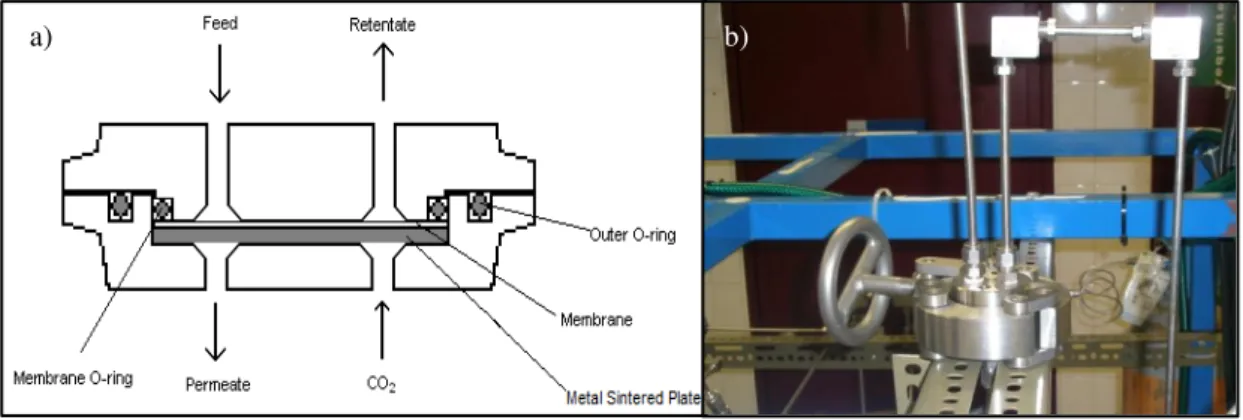
ports in the retentate side are assembled with a 90º rotation relatively to the permeate ports. The retentate and the permeate sides are both connected via a bypass valve (V12) which is kept open before starting the experiments to prevent undesired pressure differences across the membrane, which could damage it. On the retentate side, the pressure is controlled by a back-pressure regulator valve (model 27-1700, Tescom Europe GmbH & Co., Germany) and the outlet stream is depressurized into a collection vessel where the retentate liquid precipitates. On the permeate side, the pressure is controlled by a micrometric valve (V14) (60-11HF4V, HiP, USA) and the outlet stream is depressurized into a collection vessel where the permeate liquid precipitates. Gaseous CO2 is then collected from both retentate and permeate collection vessels and further recirculated. The working temperature in the entire installation is maintained by heating cables (HSS - 450ºC, Horst GmbH, Germany) and respective temperature controllers. The working temperature is maintained by a flange heating jacket (HFH10, Horst GmbH, Germany).
Figure 2.3– Stainless steel flat sheet membrane test cell. a) Scheme of the module; b) Picture
of the module assembled in the apparatus.
Membranes used in this work were reverse osmosis membranes made of Cellulose Acetate (YMCFSP3001), Polyamide AD (YMADSP3001), Thin-Film SG (YMSGSP3001) and Polyamide AG (YMAGSP3001) from GE Osmonics, USA. Teflon AF 2400 PEI was gently offered by the Technische Universität Hamburg-Harbug (TUHH).
The continuous countercurrent packed column is a high-pressure column (2.4 cm of internal diameter and 2 m high) filled with Sulzer EX structured gauze packing. The general characteristics of the packing elements are listed in Table 2.1.
25
Table 2.1 – Geometric characteristics of Sulzer EX gauze packing used in this work
Packing Type Sulzer EX
Packing Material Stainless Steel
Height (mm) 54
Diameter (mm) 24
Surface Area (m2/m3) 1710
Void Fraction 0.86
Crimp Height (mm) 1.6
Channel Base (mm) 4
Side of Corrugation (mm) 2.9
Channel Flow Angle from the Horizontal (degrees) 45
It operates as a stripping column with the pre-heated liquid feed introduced above the packing section at the top of the column by means of a liquid metering pump. Fresh carbon dioxide is introduced at the bottom of the column with the help of a compressor and heated to the desired temperature by heating cables. An expansion valve located downstream from the gas outlet flow automatically controls the pressure inside the column. Carbon dioxide and dissolved solutes after exiting the extraction column by the top (the so-called extract stream) are separated in a vessel by pressure expansion. The carbon dioxide is then recycled back to the extraction column.
The liquid level inside the extraction column is maintained at a constant position by manually opening a valve at the bottom of the column. The column is thus operated with the carbon dioxide stream as the continuous phase and the oil as the dispersed phase. During an extraction run samples of the raffinate and extract streams are collected at precise time intervals. These samples are subsequently weighed, and then analyzed to determine their squalene content.
2.2.3 - Sample analysis