Plant Protection | Article
Relative competitiveness of irrigated rice cultivars
and
Aeschynomene denticulata
Leandro Galon (1); Sérgio Guimarães (2); André Luiz Radünz (1*); Andreson Moraes de Lima (2); Giovani Matias Burg (2); Renan Ricardo Zandoná; (2) Marlon Ouriques Bastiani (2);
Juliana Gomes Belarmino (2); Gismael Francisco Perin (1)
(1) Universidade Federal da Fronteira Sul (UFFS), Estrada ERS 135, km 72, Interior do Município de Erechim, 99700-000 Erechim (RS),
Brasil.
(2) Universidade Federal do Pampa (UNIPAMPA), Departamento de Fitotecnia, Rua Joaquim de Sá Brito, s/n, 97650-000 Itaqui (RS),
Brasil.
(*) Corresponding author: [email protected]
Received: May 12, 2014; Accepted: Oct. 8, 2014
Abstract
This study evaluated the relative competitive ability of rice cultivars in the presence of a joint-vetch (Aeschynomene denticulata)
biotype, at different replacement levels of plants in the association. The experiments were conducted in a randomized complete block design with four replications. First, it was determined the population of plants in which the final dry mass remains constant, both for the rice and for the joint-vetch (24 plants per pot). Later, two experiments were carried out to evaluate the competitiveness of the rice cultivars BRS Querência and BRS Sinuelo CL with joint-vetch plants, both conducted in replacement series, in different crop and weed combinations, varying the relative proportions of plants per pot (24:0, 18:6, 12:12, 6:18 and 0:24). Competitiveness of each species was analyzed by diagrams applied to replacement experiments and by the relative competitiveness indices. Fifty days after the emergence, tillering or number of leaves, height, leaf area and shoot dry mass were determined. Competition occurred between the rice cultivars and the joint-vetch, both were adversely affected, irrespective of the plant proportion. This resulted in reductions in all evaluated variables. Different competitive abilities were observed between rice cultivars in the presence of joint-vetch. The ‘BRS Querência’ was more competitive than the ‘BRS Sinuelo CL’ for all plant proportions and variables tested.
Key words: Oryza sativa, plant ecology, interference.
1. INTRODUCTION
The Brazilian production of rice (Oryza sativa L.) is about 12 million tonnes (Silva et al., 2013), representing a source of income and job in many farms in the country, besides being one of the staple cereal foods most consumed by the population. However, rice cultivation productivity in Brazil is still greatly affected by biotic and abiotic factors.
Among the biotic factors that contribute most to the damage to rice crops stand out weeds, by competing with the crop for resources available in the environment such as water, light and nutrients. Negative effects caused by weed interference are observed in the growth, development of crops, production and grain quality for the industry (Agostinetto et al., 2010, 2013; Fleck et al., 2008; Galon et al., 2011). It is noteworthy that weeds can be hosts for pests and diseases and produce allelopathic effects, even causing losses of 52% to 100% in rice crops if no control measures are adopted, increasing the cost of production and negatively influencing the efficiency of crop irrigation (Fleck et al., 2008; Silva & Durigan, 2009).
Aeschynomene is a genus of weed infesting rice, containing
many species, also commonly called joint-vetch in rice producing areas in southern Brazil (Fleck et al., 2008). It is present in almost 30% of the area cultivated with rice in Rio Grande do Sul State, causing great losses in productivity and quality of the harvested grain, especially for the regions of the South Coast, Central Depression and West Border, which have the highest infestation of the weed (Andres & Theisen, 2009). Given the poor control of weeds in these regions and also considering the annual cycle, dispersal and propagation by seeds and the difficulty of crop rotation makes joint-vetch the most problematic weed in rice cultivation (Lazaroto et al., 2008). Another factor that enhances the negative effects of competition of weeds and rice is the low competitive ability of this cereal (Velho et al., 2012).
under competition with joint-vetch at a density between 25 and 31 plants m–2.
In crops, the population of cultivated plants is usually constant whereas the population of weeds varies according to the soil seed bank and the environmental conditions that change the infestation level (Agostinetto et al., 2008, 2013; Galon et al., 2011). Thus, in studies on competition, it is necessary to evaluate not only the plant population in the competitive process, but also the influence of the variation in the proportion between the species (Christoffoleti & Victória, 1996).
Determination of competitive interactions between crops and weeds requires appropriate experimental designs and methods of analysis, and the conventional replacement series experiments are the most used to clarify these relationships (Agostinetto et al., 2013; Cralle et al., 2003; Crotser & Witt, 2000; Estorninos et al., 2002; Roush et al., 1989; Vida et al., 2006). In these experiments, the crops generally achieve greater competitive ability than weeds. In the field, the effect of weed on culture is mainly related to the level of infestation and not to its individual competitive ability (Vilà et al., 2004). However, when there is competition between individuals of the same genus and/or species, the competitive advantage of the crop can be changed, once both exploit the same ecological niche.
In this context, considering the wide distribution, infestation and losses caused by joint-vetch to irrigated rice fields in Rio Grande do Sul State, associated with lack of studies on the interference of this plant on the irrigated rice, this study evaluated the competitive ability between irrigated rice cultivars and a biotype of joint-vetch
(Aeschynomene denticulata), at different proportions of plants
in the association.
2. MATERIAL AND METHOD
The experiments were conducted at the Federal University of Pampa (UNIPAMPA), municipality of Itaqui (RS), in a greenhouse, between September and December 2011. The experimental units were plastic pots with a capacity of 8 dm3,
filled with soil from a paddy field, classified as haplic plinthosol. The amendment of soil fertility was performed according to the technical recommendations for irrigated rice (SOSBAI, 2010). The physical and chemical characteristics of the soil were: pH 4.8 in water; OM = 4.7 dag kg–1; P = 6.8 mg dm–3;
K = 48 mg dm–3; Al3+ = 0.5 cmol c dm
–3; Ca2+ = 4.76 cmol c
dm–3; Mg2+ = 1.03 cmol
c dm–3; CEC (t) = 6.4 cmolc
dm–3; CEC (T) = 15.6 cmol
c dm–3; H+Al = 9.7 cmolc dm–3;
SB = 60.59 cmolc dm–3; V = 38%; and clay = 20%.
In all experiments, we adopted the randomized complete block with four replications. Competitors tested included the rice cultivars recommended for cultivation in the Rio Grande do Sul State, namely BRS Sinuelo CL (Clearfield®)
of mid-cycle (121-135 days), with modern type plants, good tolerance to lodging and diseases, smooth leaves, thin long grain with smooth hulls (SOSBAI, 2010) and the BRS Querência early cycle (106-120 days) with “modern American”, smooth leaves and grain strong stems, high tillering capacity, large number of fertile spikelets, with moderate resistance to diseases (SOSBAI, 2010). These cultivars competed with a biotype of joint-vetch (Aeschynomene denticulata).
Preliminarily, both for the rice and the joint-vetch in monoculture, we performed an experiment to estimate the plant population in which the dry mass production remains constant. To this end, we used populations of 1, 2, 4, 8, 16, 24, 32, 40, 48, 56 and 64 plants per pot (equivalent to 25, 49, 98, 196, 392, 587, 784, 980, 1,176, 1,372 and 1,568 plants m–2). The constant final production was achieved with
a population of 24 plants per pot, for all cultivars tested under competition with joint-vetch, which amounted to 587 plants m–2 (data not shown).
Two other replacement series experiments were conducted to evaluate the competitiveness of rice cultivars BRS Querência and BRS Sinuelo CL with joint-vetch plants, with different combinations of cultivars and the weed biotype, varying the relative proportions of plants per pot (24:0, 18:6, 24:12, 6:18, 0:24), maintaining a constant total number of plants (24 plants per pot). To establish the desired populations for each treatment and achieve uniformity of seedlings, seeds were previously allocated on trays, and later transplanted to pots.
Fifty days after the emergence, we performed the measurement of rice tillering or the number of composite leaves of joint-vetch, height, leaf area (LA) and shoot dry mass (DM) of the rice and of the joint-vetch. The number of tillers (rice) or composite from the soil surface to the last fully expanded leaf. Leaf area was determined with the aid of an electronic integrator (Licor 3100), by collecting all the plants in each treatment. After quantification of LA, shoots were placed in paper bags and dried in a forced air circulation oven at 60 ± 5 °C to constant mass.
Indices of relative competitiveness (CR), relative clustering coefficient (K) and aggressiveness (A) were calculated, in which CR is the comparative growth of rice cultivars (X) in relation to joint-vetch (Y); K indicates the relative dominance of one species over another, and A indicates the most aggressive species. Thus, CR, K and A indices indicate the most competitive species and their joint interpretation indicates with greater precision the competitiveness of species (Cousens, 1991). The rice cultivars X are more competitive than the joint-vetch Y when CR> 1, Kx > Ky and A> 0; in turn, the joint-vetch Y is more competitive than rice cultivars X when CR <1, Kx < Ky and A <0 (Hoffman & Buhler, 2002). To calculate these indices, we used 50:50 proportions of the species involved in the experiment (joint-vetch and rice), or populations of 12:12 plants per pot, using the equations: CR= PRx/PRy; Kx= PRx/(1-PRx); Ky= PRy/(1-PRy); A= PRx
– PRy, according to Cousens & O’Neill (1993).
The statistical analysis of yield or relative variation included the calculation of the differences in the RP values (DPR) obtained in the proportions 25%, 50% and 75%, relative to values belonging to the hypothetical straight line at the respective proportions, namely 0.25; 0.50 and 0.75 for PR (Bianchi et al., 2006; Fleck et al., 2008). We used the t-test to test the differences in the indices DPR, PRT, CR, K and A (Hoffman & Buhler, 2002; Roush et al., 1989). The null hypothesis to test the differences in DPR and A is that mean values are equal to zero (Ho = 0); for PRT and CR, mean values are equal to 1 (Ho = 1); and for K, the mean differences between Kx and Ky are equal to zero [Ho= (Kx – Ky) = 0]. The criterion for considering the curves PR and PRT different from hypothetical lines was the occurrence of significant differences by the t-test in at least two proportions (Bianchi et al., 2006; Fleck et al., 2008). Similarly, for the indices CR, K and A, there are differences in competitiveness when at least two of them showa significant difference by the t-test.
The results obtained for rice tillering or number of composite leaves of joint-vetch, plant height, leaf area and dry mass, expressed as mean values per treatment, were subjected to analysis of variance by F-test and, whenever significant, means were compared by Dunnett’s test, considering monocultures as controls in such comparisons. For all statistical analysis we adopted p≤0.05.
3. RESULTS AND DISCUSSION
The graphical results of the lines of relative yield (PR) in relation to the expected lines, showed that rice cultivars BRS Querência and BRS Sinuelo CL when combined with the joint-vetch (competitor) have similar competitive ability for all the variables studied and at the different proportions tested (Figure 1). Total relative yield (PRT) was less than one, with significant differences for all combinations
tested, evidencing a mutual impairment in all variables and proportions analyzed (Figure 1; Table 1).
Among the variables, the tillering or the relative number of leaves, the leaf area (LA) and the relative dry mass (DM) showed greater reductions in the PR curve than the relative plant height (Figure 1). The same was observed by Fleck et al. (2008), who reported that the height of rice plants was slightly reduced when in competition with red rice. This trend in relation to height is probably associated with the plant strategy to capture more light, thereby forming stems with longer internodes in the case of rice and more etiolated stems in the case of joint-vetch, with lower investment of energy for growth and development. This is because light is the main limiting resource in the community (Almeida & Mundstock, 2001), with a key role in the initial response of a plant with higher competitive potential (Galon et al., 2011; Page et al., 2010). In wheat, Agostinetto et al. (2008) and Rigoli et al. (2008) registered an increase in the height of the plants when in competition with ryegrass or radish. Moreover, Wandscheer et al. (2013) evaluated the competitive ability of corn intercropped with goosegrass (Eleusine indica) and reported that the weed exhibited better competitive results than the crop.
In general, the differences relating to rice tillering and joint-vetch leaf number, plant height (EP), AF and MS (Table 1) showed a greater loss of PR in the competitor in comparison with rice cultivars, except for the number of leaves and the EP, in which the joint-vetch was more competitive than the cultivar BRS Sinuelo CL at the proportion 75:25. The competitive ability of rice cultivars, in the presence of the weed, varied depending on the variable (Table 1). There were major differences in tillering and AF, with superiority of the cultivar BRS Querência to BRS Sinuelo CL, especially with a higher proportion of the species in relation to the competitor, with a reduction in this difference as the proportion of competitor was increased. According to SOSBAI (2010), the cultivar BRS Querência stands out compared to other rice cultivars given the high tillering capacity, which corroborates the results found herein. Similar results were verified by Agostinetto et al. (2008), Bianchi et al. (2006), Galon et al. (2011) and Wandscheer et al. (2013), which also observed, when working with many species, the existence of competitive variability according to the development cycle and the intrinsic characteristics of each cultivar when in competition with weeds.
crops, while for the weed, prevailed interspecific competition as the most harmful.
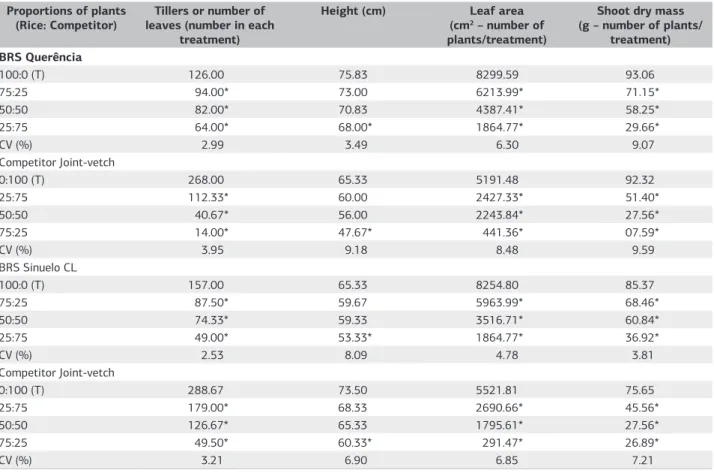
Tillering, EP, AF and MS of rice cultivars BRS Querência and BRS Sinuelo CL were reduced when competed with joint-vetch in all tested proportions (Table 2). There was increasing loss to the crop, for the variables evaluated, with increasing proportion of the competitor. The higher the proportion of plants in the association (competitor or crop), the greater the losses in variables of rice or even weed; this demonstrates again the competition of species for the same resources. The results of this study are similar to several others in the literature, such as Cerqueira et al. (2013) when analyzed Spermacoce verticillata competing with rice cultivars Jatobá and Catetão; Agostinetto et al. (2008) evaluated rice competing with barnyardgrass; and Galon et al. (2011) who studied barley in competition with ryegrass. All the above authors found greater reductions in morphological variables with increasing proportion of competitor plants in the association.
The BRS Querência, in the presence of different proportions of joint-vetch, experienced minor losses compared to BRS Sinuelo CL. At the proportion 75:25 (rice: competitor), as
to the number of tillers, the BRS Querência was reduced by 26%, while the BRS Sinuelo CL, by 44% (Table 2).
Likewise, joint-vetch showed the greatest suppression in the number of leaves when competing with the BRS Querência (95%) than with BRS Sinuelo CL (83%) at 75:25 (rice: competitor), demonstrating the higher competitiveness of BRS Querência compared to BRS Sinuelo CL. Nevertheless, for the other variables, the superiority of BRS Querência over BRS Sinuelo CL is not so evident. Importantly, the competition was detrimental to both rice cultivars, because according to Bianchi et al., (2006) competition quantitatively and qualitatively affects production, because it changes the use efficiency of environmental resources, such as water, light, CO2 and nutrients. Also, in a plant community, benefit in competition for resources is given for species that establish first or by intrinsic characteristics on the competitive ability of each cultivar (height, growth rate, number of tillers, among others).
Besides that, when evaluating the relative competitiveness index (CR), we found higher growth in both rice cultivars compared with joint-vetch, in all variables (Table 3). Among the cultivars, BRS Querência presented greater competitive Table 1. Relative differences for the variables tillering (rice) or number of leaves (joint-vetch), height, leaf area and shoot dry mass of the rice cultivars BRS Querência and BRS Sinuelo CL and of the joint-vetch, at 50 days after emergence. UNIPAMPA, Itaqui (RS), 2011/2012
Variables Proportion of plants associated (rice: competitor)
75:25 50:50 25:75
Tillers (rice) or number of leaves (joint-vetch)
BRS Querência –0.19 (±0.01)* –0.17 (±0.001)* –0.12 (±0.001)*
Joint-vetch –0.24 (±0.001)* –0.42 (±0.001)* –0.44 (±0.001)*
Total 0.57 (±0.01)* 0.40 (±0.001)* 0.44 (±0.001)*
BRS Sinuelo CL –0.33 (±0.01)* –0.26 (±0.001)* –0.17 (±0.001)*
Joint-vetch –0.21 (±0.001)* –0.28 (±0.001)* –0.28 (±0.01)*
Total 0.46 (±0.01)* 0.46 (±0.001)* 0.54 (±0.01)*
Height
BRS Querência –0.03 (±0.02) –0.03 (±0.01) –0.03 (±0.001)*
Joint-vetch –0.09 (±0.03) –0.07 (±0.02) –0.06 (±0.04)
Total 0.88 (±0.04) 0.90 (±0.01)* 0.91 (±0.04)
BRS Sinuelo CL –0.07 (±0.001)* –0.05 (±0.04) –0.05 (±0.01)*
Joint-vetch –0.04 (±0.01)* –0.06 (±0.03) –0.05 (±0.03)
Total 0.89 (±0.01)* 0.90 (±0.04) 0.90 (±0.04)
Leaf area
BRS Querência –0.16 (±0.06) –0.26 (±0.02)* –0.20 (±0.01)*
Joint-vetch –0.23 (±0.001)* –0.33 (±0.02)* –0.44 (±0.03)*
Total 0.61 (±0.06)* 0.41 (±0.03)* 0.36 (±0.03)*
BRS Sinuelo CL –0.21 (±0.02)* –0.29 (±0.01)* –0.19 (±0.001)*
Joint-vetch –0.24 (±0.001)* –0.34 (±0.01)* –0.38 (±0.02)*
Total 0.56 (±0.02)* 0.38 (±0.02)* 0.42 (±0.03)*
Shoot dry mass
BRS Querência –0.18 (±0.01)* –0.19 (±0.01)* –0.17 (±0.01)*
Joint-vetch –0.23 (±0.001)* –0.35 (±0.01)* –0.33 (±0.03)*
Total 0.59 (±0.01)* 0.46 (±0.01)* 0.50 (±0.04)*
BRS Sinuelo CL –0.15 (±0.02)* –0.14 (±0.001)* –0.14 (±0.001)*
Joint-vetch –0.18 (±0.001)* –0.26 (±0.01)* –0.15 (±0.02)*
Total 0.67 (±0.02)* 0.60 (±0.01)* 0.71 (±0.02)*
ability than BRS Sinuelo CL for all variables tested, under competition with joint-vetch. The same was observed for the coefficients of competitiveness (K); in all cases, rice showed higher values for this coefficient (Table 3). Regarding aggressiveness (A), rice was more competitive in all cases. For this index (A), the BRS Querência was more aggressive than BRS Sinuelo CL in the presence of the competitor joint-vetch (Table 3).
In the joint interpretation of graphical analysis on the relative variables and their significance in relation to the equivalent values (Figure 1 and Table 1), morphological variables (Table 2) and the competitiveness indices (Table 3), in general, there was a negative interaction between the species, affecting both rice cultivars and the competitor (joint-vetch). Nonetheless, in this case, the competitor suffered greater losses than rice, especially when associated Table 2. Differences between plants associated or not of the rice cultivars BRS Querência and BRS Sinuelo CL and joint-vetch for variables tillering (rice) or number of leaves (joint-vetch), height, leaf area and shoot dry mass, at 50 days after the emergence. UNIPAMPA, Itaqui (RS), 2011/2012
Proportions of plants (Rice: Competitor)
Tillers or number of leaves (number in each
treatment)
Height (cm) Leaf area
(cm2 – number of
plants/treatment)
Shoot dry mass (g – number of plants/
treatment) BRS Querência
100:0 (T) 126.00 75.83 8299.59 93.06
75:25 94.00* 73.00 6213.99* 71.15*
50:50 82.00* 70.83 4387.41* 58.25*
25:75 64.00* 68.00* 1864.77* 29.66*
CV (%) 2.99 3.49 6.30 9.07
Competitor Joint-vetch
0:100 (T) 268.00 65.33 5191.48 92.32
25:75 112.33* 60.00 2427.33* 51.40*
50:50 40.67* 56.00 2243.84* 27.56*
75:25 14.00* 47.67* 441.36* 07.59*
CV (%) 3.95 9.18 8.48 9.59
BRS Sinuelo CL
100:0 (T) 157.00 65.33 8254.80 85.37
75:25 87.50* 59.67 5963.99* 68.46*
50:50 74.33* 59.33 3516.71* 60.84*
25:75 49.00* 53.33* 1864.77* 36.92*
CV (%) 2.53 8.09 4.78 3.81
Competitor Joint-vetch
0:100 (T) 288.67 73.50 5521.81 75.65
25:75 179.00* 68.33 2690.66* 45.56*
50:50 126.67* 65.33 1795.61* 27.56*
75:25 49.50* 60.33* 291.47* 26.89*
CV (%) 3.21 6.90 6.85 7.21
* Means differ from the control (T) by the Dunnett’s test (p≤0.05).
Table 3. Indices of competitiveness between rice cultivars and competitor, expressed by relative competitiveness (CR), relative clustering coefficient (K) and aggressivity (A), obtained in experiments conducted in replacement series
Variables CR Kx (rice) Ky (competitor) A
Leaf área
BRS Querência × Competitor joint-vetch 1.48 (±0.25) 0.31 (±0.03) 0.20 (±0.03) 0.07 (±0.03)* BRS Sinuelo × Competitor joint-vetch 1.31 (±0.06)* 0.27 (±0.02)* 0.19 (±0.01)* 0.05 (±0.01)* Shoot dry mass
BRS Querência × Competitor joint-vetch 2.21 (±0.12)* 0.46 (±0.01)* 0.18 (±0.09)* 0.16 (±0.01)* BRS Sinuelo × Competitor joint-vetch 1.49 (±0.09)* 0.55 (±0.01)* 0.31 (±0.02)* 0.12 (±0.02)* Tillering (rice) or number of leaves (joint-vetch)
BRS Querência × Competitor joint-vetch 4.29 (±0.11)* 0.48 (±0.05)* 0.08 (±0.002)* 0.25 (±0.001)* BRS Sinuelo × Competitor joint-vetch 1.08 (±0.03) 0.31 (±0.05)* 0.28 (±0.007)* 0.02 (±0.01) Plant height
BRS Querência × Competitor joint-vetch 1.10 (±0.10) 0.88 (±0.05) 0.76 (±0.07)* 0.04 (±0.04) BRS Sinuelo × Competitor joint-vetch 1.03 (±0.11)* 0.85 (±0.14) 0.81 (±0.09) 0.01 (±0.05)
* Significant difference by t-test (p≤0.05). Values in brackets represent the standard error of the mean. Kx and Ky are the relative clustering coefficients of rice cultivars and
with BRS Querência, which was more competitive than BRS Sinuelo CL in the presence of joint-vetch.
4. CONCLUSION
There was competition between the rice cultivars BRS Querência and BRS Sinuelo CL and the joint-vetch, both were affected, regardless of the proportion of plants. In all cases, there was a reduction in tillering or number of composite leaves, in plant height in leaf area and in dry mass of the species.
The competitive ability of the BRS Querência is higher than the BRS Sinuelo CL in the presence of joint-vetch.
Rice cultivars BRS Querência and BRS Sinuelo CL have a higher competitive ability than joint-vetch.
ACKNOWLEDGEMENTS
The authors thank the National Council for Scientific and Technological Development (CNPq) for providing financial assistance, process number 483564/2010-9.
REFERENCES
Agostinetto, D., Fontana, L. C., Vargas, L., Markus, C., & Oliveira, E. (2013). Habilidade competitiva relativa de milhã em convivência com arroz irrigado e soja. Pesquisa Agropecuária Brasileira, 48, 1315-1322. http://dx.doi.org/10.1590/S0100-204X2013001000002.
Agostinetto, D., Galon, L., Silva, J. M. B. V., Tironi, S. P., & Andres, A. (2010). Interferência e nível de dano econômico de capim-arroz sobre o arroz em função do arranjo de plantas da cultura. Planta Daninha, 28, 993-1003. http://dx.doi.org/10.1590/S0100-83582010000500007.
Agostinetto, D., Rigoli, R. P., Schaedler, C. E., Tironi, S. P., & Santos, L. D. (2008). Período crítico de competição de plantas daninhas com a cultura do trigo. Planta Daninha, 26, 271-278. http://dx.doi. org/10.1590/S0100-83582008000200003.
Almeida, L. A., & Mundstock, C. M. (2001). A qualidade da luz afeta o Perfilhamento em plantas de trigo, quando cultivadas sob competição. Ciência Rural, 31, 401-408. http://dx.doi.org/10.1590/ S0103-84782001000300006.
Andres, A., & Theisen, G. (2009). Épocas de controle de angiquinho e prejuízos em arroz irrigado cv. BRS QUERÊNCIA (Boletim de Pesquisa e Desenvolvimento, Vol. 93). Pelotas: Embrapa Clima Temperado.
Bianchi, M. A., Fleck, N. G., & Lamego, F. P. (2006). Proporção entre plantas de soja e plantas competidoras e as relações de interferência mútua. Ciência Rural, 36, 1380-1387. http://dx.doi.org/10.1590/ S0103-84782006000500006.
Cerqueira, F. B., Erasmo, E. A. L., Silva, J. I. C., Nunes, T. V., Carvalho, G. P., & Silva, A. A. (2013). Competition between drought-tolerant upland rice cultivars and weeds under water stress
condition. Planta Daninha, 31, 291-302. http://dx.doi.org/10.1590/ S0100-83582013000200006.
Christoffoleti, P. J., & Victória, R., Fo. (1996). Efeitos da densidade e proporção de plantas de milho (Zea mays L.) e caruru (Amaranthus
retroflexus L.) em competição. Planta Daninha, 14, 42-47.
Cousens, R. (1991). Aspects of the design and interpretation of competition (interference) experiments. Weed Technology, 5, 664-673.
Cousens, R., & O’Neill, M. (1993). Density dependence of replacement series experiments. Oikos, 66, 347-352. http://dx.doi. org/10.2307/3544824.
Cralle, H. T., Fojtasek, T. B. F., Carson, K. H., Chandler, J. M., Miller, T. D., Senseman, S. A., Bovey, R. W., & Stone, M. J. (2003). Wheat and Italian ryegrass (Lolium multiflorum) competition as affected by phosphorus nutrition. Weed Science, 51, 425-429. http://dx.doi. org/10.1614/0043-1745(2003)051[0425:WAIRLM]2.0.CO;2.
Crotser, M. P., & Witt, W. W. (2000). Effect of Glycine max canopy characteristics, G. max interference, and weed-free period on
Solanum ptycanthum growth. Weed Science, 48, 20-26. http://dx.doi.
org/10.1614/0043-1745(2000)048[0020:EOGMCC]2.0.CO;2.
Estorninos, L. E., Jr., Gealy, D. R., & Talbet, R. E. (2002). Growth response of rice (Oryza sativa) and red rice (O. sativa) in replacement series study. Weed Technology, 16, 401-406. http://dx.doi.org/10.1614/0890-037X(2002)016[0401:GROROS]2.0.CO;2.
Fleck, N. G., Lazaroto, C. A., Schaedler, C. E., & Ferreira, F. B. (2008). Suscetibilidade de três espécies de angiquinho (Aeschynomene
spp.) a herbicidas de utilização em pós-emergência em arroz irrigado. Revista Brasileira de Agrociência, 14, 462-470.
Galon, L., Tironi, S. P., Rocha, P. R. R., Concenço, G., Silva, A. F., Vargas, L., Silva, A. A., Ferreira, E. A., Minella, E., Soares, E. R., & Ferreira, F. A. (2011). Habilidade competitiva de cultivares de cevada convivendo com azevém. Planta Daninha, 29, 771-781. http://dx.doi. org/10.1590/S0100-83582011000400007.
Hoffman, M. L., & Buhler, D. D. (2002). Utilizing Sorghum as a functional model of crop weed competition. I. Establishing a competitive hierarchy. Weed Science, 50, 466-472. http://dx.doi. org/10.1614/0043-1745(2002)050[0466:USAAFM]2.0.CO;2.
Lazaroto, C. A., Fleck, N. G., Ferreira, F. B., & Schaedler, C. E. (2008). Suscetibilidade de três espécies de angiquinho (Aeschynomene spp.) ao herbicida Only. Revista Brasileira de Agrociência, 14, 117-120.
Page, E. R., Tollenaar, M., Lee, E. A., Lukens, L., & Swanton, C. J. (2010). Shade avoidance: an integral component of cropweed competition. Weed Research, 50, 281-288.
Radosevich, S. R. (1987). Methods to study interactions among crops and weeds. Weed Technology, 1, 190-198.
Rigoli, R. P., Agostinetto, D., Schaedler, C. E., Dal Magro, T., & Tironi, S. (2008). Habilidade competitiva relativa do trigo (Triticum
aestivum) em convivência com azevém (Lolium multiflorum) ou nabo
(Raphanus raphanistrum). Planta Daninha, 26, 93-100. http://dx.doi.
org/10.1590/S0100-83582008000100010.
Silva, L. P., Alves, B. M., Silva, L. S., Pocojeski, E., Kaminski, T. A., & Roberto, B. S. (2013). Adubação nitrogenada sobre rendimento industrial e composição dos grãos de arroz irrigado. Ciência Rural, 43, 1128-1133. http://dx.doi.org/10.1590/S0103-84782013005000055.
Silva, M. R. M., & Durigan, J. C. (2009). Períodos de interferência das plantas daninhas na cultura do arroz de terras altas. II – cultivar Caiapó. Bragantia, 68, 373-379. http://dx.doi.org/10.1590/S0006-87052009000200011.
Sociedade Sul-Brasileira de Arroz Irrigado – SOSBAI. (2010). Arroz irrigado: recomendações técnicas da pesquisa para o Sul do Brasil. Porto Alegre: SOSBAI.
Velho, G. F., Crusciol, C. A. C., Velini, E. D., Castro, G. S. A., & Borghi, E. (2012). Interferência de Brachiaria plantaginea com a
cultura do arroz, cv. Primavera. Planta Daninha, 30, 17-26. http:// dx.doi.org/10.1590/S0100-83582012000100003.
Vida, F. B. P., Laca, E. A., Mackill, D. J., Fernández, G. M., & Fischer, A. J. (2006). Relating rice traits to weed competitiveness and yield: A path analysis. Weed Science, 54, 1122-1131. http://dx.doi. org/10.1614/WS-06-042R.1.
Vilà, M., Williamson, M., & Lonsdale, M. (2004). Competition experiments on alien weeds with crops: Lessons for measuring plant invasion impact? Biological Invasions, 6, 59-69. http://dx.doi. org/10.1023/B:BINV.0000010122.77024.8a.