An integrative review of associations between polymorphic
variants and the metabolic syndrome
Associação de variantes polimórficas com síndrome metabólica:
uma revisão integrativa
Jamille Silva Oliveira1
*
, Rita Narriman Silva de Oliveira Boery1
Abstract
The pathogenesis of metabolic syndrome, i.e. of each of its components, is complex and has not been entirely elucidated. As a result, it is very difficult to establish a definition of which clinical factors are the most important determinants of its development. The objective of this review is to describe Brazilian scientific research investigating associations between the metabolic syndrome and genetic factors. We selected fifteen studies that met the inclusion and exclusion criteria. Our analysis revealed that there is a modest volume of Brazilian studies investigating relationships between genes, their polymorphic variants and the metabolic syndrome and its risk factors. Therefore, more studies are needed to better understand the biological roles played by genetic polymorphisms and their relationships with metabolic syndrome or its risk factors.
Keywords: genetic polymorphism; metabolic syndrome; hypertension; obesity; insulin resistance; dyslipidemias.
Resumo
A patogênese da síndrome metabólica, ou seja, de cada um de seus componentes, é complexa e não totalmente elucidada. Por isso, há grande dificuldade em se estabelecer uma definição de quais fatores clínicos e biológicos seriam os principais determinantes no seu desenvolvimento. Esta revisão tem como objetivo caracterizar a produção científica brasileira que aborda o estudo da síndrome metabólica associada aos fatores genéticos. Foram incluídos 15 estudos, levando em consideração os critérios de inclusão e exclusão. Nossa análise revela uma razoável quantidade de trabalhos brasileiros que investigam a relação de genes e suas variantes polimórficas com a síndrome metabólica e seus fatores de risco. Dessa forma, ressalta-se a necessidade de mais trabalhos que examinem melhor o papel biológico ou a relação dos polimorfismos genéticos em pacientes com síndrome metabólica ou com seus fatores de risco.
Palavras-chave: polimorfismo genético; síndrome metabólica; hipertensão; obesidade; resistência à insulina; dislipidemia.
1 Universidade Estadual do Sudoeste da Bahia – UESB, Programa de Pós-graduação em Enfermagem e Saúde – PPGES, Jequié, BA, Brasil.
Financial support: None.
Conflicts of interest: No conflicts of interest declared concerning the publication of this article. Submitted: August 27, 2017. Accepted: December 29, 2017.
INTRODUCTION
Metabolic syndrome (MS) is used as a clinical
tool for identifying patients with metabolic risk
of cardiovascular diseases.
1In general, MS can be
classified as a group of metabolically interrelated
pathophysiologic cardiovascular risk factors that have
origins in complex disorders and are subject to both
environmental and genetic influences.
2,3The pathogenesis
of MS, i.e., of each of its components, is complex
and has not been entirely elucidated. As a result, it is
very difficult to establish a definition of which clinical
factors are the most important determinants of its
development. Nevertheless, there is consensus on the
principal components of MS that are associated with
increased cardiovascular morbidity and mortality:
excess weight, elevated arterial blood pressure, and
disorders of sugar and lipid metabolism.
2,4-7Since it is a multifactorial disorder, both the genetic
factor and the environmental factor are important
to understanding the interactions between all of the
components of risk of development of MS. Moreover,
many different gene loci are involved in expression of
the components of energy metabolism, which makes
it a very complex task to determine the influence of
gene-environment and gene-gene interactions on each
of the different cardiovascular risk factors.
8The most common class of markers in the human
genome are small variations in DNA sequences caused
by localized substitution mutations, known as single
nucleotide polymorphisms (SNPs) and accounting for
around 90% of sequence differences.
9There will be
3 million differences between any two people in their
roughly 10,0000 different amino acids.
10However,
the great majority of single nucleotide mutations are
rare in the population, and a polymorphism must
have a frequency of at least 1% of the population to
be considered an SNP.
One of the principal objectives of research into SNP
is to understand the genetics of human phenotypical
variations and particularly the genetic bases of complex
human diseases.
11,12Genetic factors can explain part
of the increase in cardiovascular risk,
13because many
different genes are involved in controlling the different
metabolic pathways. The mechanisms controlled by
gene alleles include inflammatory processes, platelet
activity, neurohormonal activity (renin-angiotensin
system), lipid metabolism, and oxidative stress.
14Genome studies have led to identification of many
genetic markers of cardiovascular risk/protection
in different populations around the world, notably
the genes IL1RA, CD14, PON1, ALOX5AP,
loci 9p 21.3, and PON1 (Met55Leu and Gln192Arg).
15-18Furthermore, studies suggest that the roles played by
these cardiovascular risk factors may vary between
ethnic groups.
19-22These studies indicate that genetic
polymorphisms distributed differently in populations
of different ethnicities play a fundamental role in the
presence of the ethnic/racial differences observed in MS.
Against this background, the objective of this study
is to profile Brazilian scientific output describing studies
of the associations between MS and its genetic factors.
METHODOLOGY
This is an integrative review of the literature,
of a descriptive and exploratory character, based
on the results of electronic searches for academic
publications on the subject of current genetic research
into MS in Brazil.
The choice of databases to be searched took into
consideration the fact that each has its own peculiarities,
area of concentration, and focus. The databases
chosen were those considered relevant to the subject
investigated: SciELO
(Scientific Electronic Library
Online
)
, PubMed Central
(developed and maintained
by the National Center for Biotechnology Information,
NCBI), and the Biblioteca Virtual em Saude (BVS)
Brazil. In addition to these databases, Google Scholar
was also consulted to give a wider overview of
publications and provide a basis for comparison with
the results from the other databases.
The electronic searches were conducted during
June of 2017 and the search strategies were defined
after selection of the databases. The keywords
“polymorphism”, “metabolic syndrome”, and “Brazil”
were used, combined using Boolean logical operators
to refine and specify the searches. The keywords
were used in Portuguese and English, depending on
the requirements of each database.
Studies were selected according to the following
inclusion criteria: 1) publications in magazines or
journals; 2) publications that discussed the main
subject (polymorphisms and MS); and 3) work
published during the preceding 5 years (2013 to 2017).
The criterion for exclusion was title, keywords, and
abstract that did not cover the subject and did not
meet the inclusion criteria.
reference, category, objective, methodology, results,
and conclusions.
RESULTS
Fifteen studies were selected for the review. All of
them were conducted with the general objective of
investigating relationships between genes and their
polymorphic variations and MS and its risk factors
(obesity, insulin resistance, hypertension, and lipid
profile abnormalities). The genes investigated to test
for associations were NOS, MMP-2, IL6R, VDR,
UCP1, ADRB3, ApoE, IRS-1, PPARG, APOA5,
LEP, LEPR, NR3C1, GR, IL1B, IL2, IL4, IL8, IL10,
IFNγ, TNFa and ACE.
The first search was run on all four databases
using just the keywords with Boolean operators:
“polymorphism” AND “metabolic syndrome” AND
“Brazil”. The database that returned the fewest results
was SciELO, with just one article, followed by BVS
with 17, PubMed with 38, and Google Scholar with
4,430. In order to adapt and refine the analysis, searches
were run again with a filter to restrict results to the
preceding 5 years (2013-2017). It will be observed
that Google Scholar
returned the highest number of
studies, which is because its search metric is different
to those used by the other databases. This database
was therefore used to identify possible differences
between the results generated by the others, since
each has its own metric, which can lead to different
results, as can articles contained in one database but
not in another.
After filtering by availability and reading, consisting
of reading the title, abstract, and keywords of each
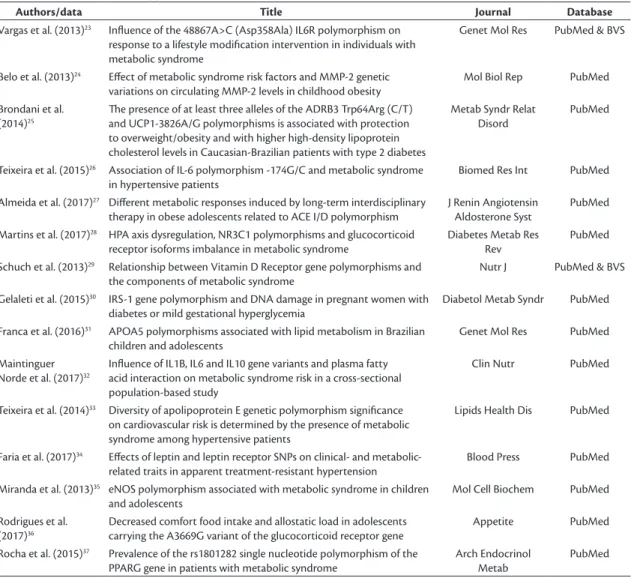
study, 15 articles were selected (Table 1).
23-37the
remainder were excluded from the analysis, because
they were not aligned with the subject of the review
or with the inclusion parameters.
The periodicals’ fields of knowledge revealed an
interesting variety of journals from different subject
areas, as follows: three on nutrition, two on genetics,
two on biology, and eight specifically focused on areas
of medicine (hypertension, diabetes, metabolism, and
endocrinology). This diversity of fields of knowledge
was also observed in the qualifications of the study
authors, who were qualified in the following areas:
biophysics, nutrition, psychology, psychiatry, medicine,
cardiovascular pharmacology, human and molecular
genetics, gynecology and obstetrics, toxicogenomics
and nutrigenomics, nephrology, endocrinology, cellular
and molecular biology, and pharmacology.
With relation to the types of study, all publications
were the result of cross-sectional, prospective studies
with population samples. Eight of these were case-control
studies comparing results for a given condition in
carriers against “normal” subjects. The samples used
in the studies varied in terms of age group: six with
adults, five with adolescents, and three with children.
The majority of the studies were conducted in the
state of São Paulo (10), followed by Rio Grande do Sul
(4) and the Distrito Federal (1). None of the studies
were conducted in states in the North or Northeast
regions of Brazil (
Figure 1).
REVIEW
The foci of identification of the studies selected
were investigations of associations between a given
genetic polymorphism of a gene involved in the
process of a metabolic pathway and risk factors for
MS, such as obesity, dyslipidemia, insulin resistance,
and hypertension (Table 2).
23-37The relationship between differences in the
polymorphic frequency of genes involved in obesity
and MS was analyzed in five studies with samples
of adults and adolescents with different population
profiles. One of them found that nutritional control
and exercise may be more effective at preventing risks
associated with MS in individuals with the A allele
for polymorphism 48867A> C (Asp358Ala) IL6R
(rs2228145).
23A study by Belo et al.
24investigated
polymorphisms of the MMP-2 gene and their
relationship with metabolic risk factors in obese
children and adolescents. The study showed that
arterial blood pressure is related to concentrations of
MMP-2 in circulation, that the CC genotype of the C
polymorphism was more common in both controls and
in obese subjects, and that the CT genotype and the T
allele for polymorphism C (-735) T are less common
in the obese. Brondani et al.
25evaluated associations
between the -3826A/G polymorphism of the UCP1 gene
and the Trp64Arg polymorphism of the ADRB3 gene
with type 2 Diabetes mellitus and MS characteristics.
In this study these polymorphisms were not associated
with diabetes, but they may have a combined effect
on modulation of excess weight/obesity and on
HDL-C levels in Brazilian Caucasian patients with
type 2 Diabetes mellitus. Another study stressed the
importance of the relationship between the C allele
at locus -174 of the IL-6 gene, which was found to be
involved in the inflammatory process with occurrence
of MS and pathogenesis of visceral obesity.
26Finally,
another study demonstrated that genotypes of the
ACE I/D gene can influence regulation of insulin
Three studies with different populations analyzed
links between insulin resistance, diabetes mellitus, and
MS. One study analyzed the NR3C1 polymorphism,
expression of glucocorticoid receptor (GR) isoforms
and cytokines, demonstrating that patients with MS
exhibited reduced hypothalamus-pituitary-adrenal
axis (HPA) sensitivity to glucocorticoid feedback
and that dysregulation of this axis could contribute
to pathogenesis of MS.
28An investigation of
the relationships between the 2228570 C>T and
1544410 A>G polymorphisms of the VDR gene
and MS in adults suggests that they could influence
insulin release and insulin resistance, but was unable
to determine their influence on components of MS.
29A study by Gelaleti et al.
30evaluated presence of
the Arg972 polymorphism of the IRS-1 gene in
pregnant women with diabetes or mild gestational
hyperglycemia and their newborn infants. The results
showed that this polymorphism was more prevalent
in the newborn infants of women with diabetes and
mild gestational hyperglycemia.
Table 1. Studies selected after application of selection criteria.
Authors/data Title Journal Database
Vargas et al. (2013)23 Influence of the 48867A>C (Asp358Ala) IL6R polymorphism on
response to a lifestyle modification intervention in individuals with metabolic syndrome
Genet Mol Res PubMed & BVS
Belo et al. (2013)24 Effect of metabolic syndrome risk factors and MMP-2 genetic
variations on circulating MMP-2 levels in childhood obesity
Mol Biol Rep PubMed
Brondani et al. (2014)25
The presence of at least three alleles of the ADRB3 Trp64Arg (C/T) and UCP1-3826A/G polymorphisms is associated with protection to overweight/obesity and with higher high-density lipoprotein cholesterol levels in Caucasian-Brazilian patients with type 2 diabetes
Metab Syndr Relat Disord
PubMed
Teixeira et al. (2015)26 Association of IL-6 polymorphism -174G/C and metabolic syndrome
in hypertensive patients
Biomed Res Int PubMed
Almeida et al. (2017)27 Different metabolic responses induced by long-term interdisciplinary
therapy in obese adolescents related to ACE I/D polymorphism
J Renin Angiotensin Aldosterone Syst
PubMed
Martins et al. (2017)28 HPA axis dysregulation, NR3C1 polymorphisms and glucocorticoid
receptor isoforms imbalance in metabolic syndrome
Diabetes Metab Res Rev
PubMed
Schuch et al. (2013)29 Relationship between Vitamin D Receptor gene polymorphisms and
the components of metabolic syndrome
Nutr J PubMed & BVS
Gelaleti et al. (2015)30 IRS-1 gene polymorphism and DNA damage in pregnant women with
diabetes or mild gestational hyperglycemia
Diabetol Metab Syndr PubMed
Franca et al. (2016)31 APOA5 polymorphisms associated with lipid metabolism in Brazilian
children and adolescents
Genet Mol Res PubMed
Maintinguer Norde et al. (2017)32
Influence of IL1B, IL6 and IL10 gene variants and plasma fatty acid interaction on metabolic syndrome risk in a cross-sectional population-based study
Clin Nutr PubMed
Teixeira et al. (2014)33 Diversity of apolipoprotein E genetic polymorphism significance
on cardiovascular risk is determined by the presence of metabolic syndrome among hypertensive patients
Lipids Health Dis PubMed
Faria et al. (2017)34 Effects of leptin and leptin receptor SNPs on clinical- and
metabolic-related traits in apparent treatment-resistant hypertension
Blood Press PubMed
Miranda et al. (2013)35 eNOS polymorphism associated with metabolic syndrome in children
and adolescents
Mol Cell Biochem PubMed
Rodrigues et al. (2017)36
Decreased comfort food intake and allostatic load in adolescents carrying the A3669G variant of the glucocorticoid receptor gene
Appetite PubMed
Rocha et al. (2015)37 Prevalence of the rs1801282 single nucleotide polymorphism of the
PPARG gene in patients with metabolic syndrome
Arch Endocrinol Metab
PubMed
Associations between genes, lipid metabolism, and
MS were investigated in three studies. One of these
investigated polymorphism of the APOA5 gene and
lipid metabolism, demonstrating that this is a genetic
risk factor for MS in children and adolescents.
31Another investigation noted that the G allele of the
IL6 SNP rs1800795 gene was associated with increased
probability of MS and that the plasma fatty acid profile
interacts with variants of the IL1B and IL10 genes to
modulate manifestation of MS.
32Another study with
the ApoE polymorphism, involved in regulation of
cholesterol and triglycerides metabolism found an
association between the ApoE gene and the syndrome.
33De Faria et al. studied relationships between genes
and hypertension,
34but their analyses did not detect
direct associations between patients with apparently
treatment resistant hypertension and the leptin gene
(LEP) or the leptin receptor gene (LEPR). Miranda et al.
35examined interactions between the eNOS gene and
cardiovascular risk and their results suggested that
while eNOS haplotypes were not relevant, the CC
genotype of the T (786) C polymorphism is associated
with MS in obese children and adolescents.
A study by Rodrigues et al.
36tested whether
presence of the G variant of SNP A3669G of the
GR gene would affect preference for palatable foods
and alter metabolic, behavioral, and neural results.
Their results showed that the GC allele is associated
with reduced sensitivity which, on the cognitive and
behavioral levels, results in altered ingestion of foods
and response to emotional stress. Additionally, they
found that this genetic variant can play an important
role in reduction of risk of metabolic and psychiatric
diseases.
Another study tested for interactions between the
PPARG gene and anthropometric, biochemical, and
hemodynamic variables in patients with MS. Their results
suggested that the rs1801282 polymorphism of this
gene is not correlated with predisposition to MS.
37Table 2. Parameters investigated in the studies selected.
Authors/data Location of research Sample studied Parameters associated with MS Vargas et al. (2013)23 Rio Grande do Sul Adults Lifestyle changes and SNP 48867A> C (Asp358Ala) of the
IL6R gene Belo et al. (2013)24 São Paulo Children and
adolescents
Polymorphisms of the MMP-2 gene and MS
Brondani et al. (2014)25 Rio Grande do Sul Adults Polymorphism -3826A / G of the UCP1e gene, polymorphism
Trp64Arg of the ADRB3 gene and type 2 Diabetes mellitus and MS
Teixeira et al. (2015)26 São Paulo Adults MS with polymorphism 174G/C of the IL-6 gene in
hypertensive patients
Almeida et al. (2017)27 São Paulo Adolescents Obesity, insulin resistance and the I/D polymorphism of the
ACE gene
Martins et al. (2017)28 Ribeirão Preto Adults SNPs of the GR gene, cytokines, and the
hypothalamus-pituitary-adrenal axis
Schuch et al. (2013)29 São Paulo Adults VDR polymorphism, insulin release, insulin resistance, and
HDL cholesterol
Gelaleti et al. (2015)30 São Paulo Adults and children Polymorphism Arg972 of the IRS-1 gene, diabetes, and
hyperglycemia Franca et al. (2016)31 São Paulo Children and
adolescents
Polymorphisms of the APOA5 gene and lipid metabolism
Maintinguer Norde et al. (2017)32
São Paulo Adults SNP of genes IL-6, IL-1β, and IL-10 and plasma fatty acids
Teixeira et al. (2014)33 São Paulo Adults Polymorphism of the ApoE gene and MS in hypertensive
patients
Faria et al. (2017)34 São Paulo Adults SNPs rs7799039 and rs1137101 in the LEP and LEPR genes
and hypertension Miranda et al. (2013)35 São Paulo Children and
adolescents
Polymorphisms of the eNOS gene and MS
Rodrigues et al. (2017)36 Rio Grande do Sul Adolescents SNP A3669G of the GR gene and preferences for palatable
foods and metabolic, behavioral, and neural results Rocha et al. (2015)37 Brasília Adults Anthropometric, biochemical, and hemodynamic variables
DISCUSSION
Our analysis shows that despite the reasonable
number of Brazilian studies investigating the
relationship between genes and their polymorphic
variants and MS and its risk factors, these studies
are published in periodicals and written by authors
from a range of areas of knowledge. This diversity is
evidence of the importance of increasing knowledge
of this subject in several different areas of healthcare.
Additionally, the diversity of the subjects who made
up the study samples demonstrates the relevance of
metabolic abnormalities and cardiovascular diseases at
all phases of human development and in groups with
distinct populational genetic structures. Nevertheless,
it can be concluded that there is a need to increase
the number of studies in order to better examine the
biological role played by genetic polymorphisms in
patients with MS or with its risk factors.
With regard to the locations where research is
conducted, our searches show that there research
is highly concentrated, primarily in the state of São
Paulo. This state has the majority of the country’s
state universities and, consequently, of the more
traditional and most consolidated research centers,
which are also those with better infrastructure and
finance. It can be observed that Brazil needs more
research of this type, considering the importance of
the subject, the huge scale of the country, and its
highly diverse population structure.
FINAL COMMENTS
In summary, this integrative review has demonstrated
that there are insufficient studies investigating the
genetic polymorphisms involved in development
of MS and its risk factors in samples from the
Brazilian population. As a consequence, the results
are insufficient to provide an understanding of the
complex genetic structure of the county’s racially
diverse population. Finally, it is very important that
more studies be conducted to attempt to identify the
roles and relationships of genetic polymorphisms in
manifestations of MS and its risk factors.
REFERENCES
1. Simmons RK, Alberti KG, Gale EA, et al. The metabolic syndrome: useful concept or clinical tool? Report of a WHO Expert Consultation. Diabetologia. 2010;53(4):600-5. http://dx.doi.org/10.1007/s00125-009-1620-4. PMid:20012011.
2. Alberti KG, Zimmet P, Shaw J. Metabolic syndrome--a new world-wide definition. A Consensus Statement from the International Diabetes Federation. Diabet Med. 2006;23(5):469-80. http://dx.doi. org/10.1111/j.1464-5491.2006.01858.x. PMid:16681555.
3. Alberti KG, Zimmet PZ. Definition, diagnosis and classification of diabetes mellitus and its complications. Part 1: diagnosis and classification of diabetes mellitus. Provisional report of a WHO Consultation. Diabet Med. 1998;15(7):539-53. http:// dx.doi.org/10.1002/(SICI)1096-9136(199807)15:7<539::AID-DIA668>3.0.CO;2-S. PMid:9686693.
4. Zimmet P, Alberti KGMM, Serrano Ríos M. A new international diabetes federation worldwide definition of the metabolic syndrome: the rationale and the results. Rev Esp Cardiol. 2005;58(12):1371-6. http://dx.doi.org/10.1016/S0300-8932(05)74065-3. PMid:16371194. 5. Expert Panel on Detection, Evaluation, and Treatment of High
Blood Cholesterol in Adults. Executive Summary of The Third Report of The National Cholesterol Education Program (NCEP) Expert Panel on Detection, Evaluation, And Treatment of High Blood Cholesterol In Adults (Adult Treatment Panel III). JAMA. 2001;285(19):2486-97. http://dx.doi.org/10.1001/jama.285.19.2486. PMid:11368702.
6. Ford ES, Giles WH, Dietz WH. Prevalence of the metabolic syndrome among us adults: Findings from the third national health and nutrition examination survey. JAMA. 2002;287(3):356-9. http:// dx.doi.org/10.1001/jama.287.3.356. PMid:11790215.
7. Sociedade Brasileira de Cardiologia. I Diretriz Brasileira de Diagnóstico e Tratamento da Síndrome Metabólica. Arq Bras Cardiol. 2005:3-28.
8. Tureck LV. Síndrome metabólica: investigação da associação entre seus fatores de risco isolados e polimorfismos genéticos [tese]. Curitiba: Universidade Federal do Paraná; 2015.
9. Collins FS, Brooks LD, Chakravarti A. A DNA polymorphism discovery resource for research on human genetic variation. Genome. 1998;8(12):1229-31. http://dx.doi.org/10.1101/gr.8.12.1229. PMid:9872978.
10. Micklos DA, Freyer GA, Crotty DA. A ciência do DNA. 2ª ed. Porto Alegre: Artmed; 2005.
11. Palmer IM, Schutte AE, Huisman HW. Ethnic and gender differences regarding the insulin-blood pressure relationship. Diabetes Res Clin Pract. 2009;85(1):102-10. http://dx.doi.org/10.1016/j. diabres.2009.04.014. PMid:19443068.
12. Abu-Amero KK, González AM, Osman EA, Larruga JM, Cabrera VM, Al-Obeidan SA. Susceptibility to primary angle closure glaucoma in Saudi Arabia: the possible role of mitochondrial DNA ancestry informative haplogroups. Mol Vis. 2011;17:2171-6. PMid:21850192. 13. Pereira MW, Arruda AL, Lima MS, et al. Indicadores antropométricos associados a fatores de risco cardiovasculares em idosos. Rev Eletron Gestão & Saúde. 2014:3115-31.
14. Rywik TM, Szperl M, Ploski R, et al. Is evaluation of complex polymorphism helpful in the assessment of prognosis after percutaneous coronary intervention. A prospective study. Kardiol Pol. 2011;69(9):881-8. PMid:21928191.
15. Scherrer DZ, Zago VH, Vieira IC, et al. p.Q192R SNP of PON1 seems not to be Associated with Carotid Atherosclerosis Risk Factors in an Asymptomatic and Normolipidemic Brazilian Population Sample. Arq Bras Cardiol. 2015;105(1):45-52. PMid:26039660. 16. Rios DL, D’Onofrio LO, Cerqueira CC, et al. Paraoxonase 1 gene
polymorphisms in angiographically assessed coronary artery disease: evidence for gender interaction among Brazilians. Clin Chem Lab Med. 2007;45(7):874-8. http://dx.doi.org/10.1515/ CCLM.2007.136. PMid:17617030.
18. Yang D, Huang X, Cui C, et al. Genetic Variants in the Transcriptional Regulatory Region of the ALOX5AP gene and Susceptibility to Ischemic Stroke in Chinese Populations. Sci Rep. 2016;6(1):29513. http://dx.doi.org/10.1038/srep29513. PMid:27416969. 19. Joseph JJ, Echouffo-Tcheugui JB, Carnethon MR, et al. The
association of ideal cardiovascular health with incident type 2 diabetes mellitus: the Multi-Ethnic Study of Atherosclerosis. Diabetologia. 2016;59(9):1893-903. http://dx.doi.org/10.1007/ s00125-016-4003-7. PMid:27272340.
20. Bahrami H, Kronmal R, Bluemke DA, et al. Differences in the incidence of congestive heart failure by ethnicity: The multi-ethnic study of atherosclerosis. Arch Intern Med. 2008;168(19):2138-45. http://dx.doi.org/10.1001/archinte.168.19.2138. PMid:18955644. 21. Saad MF, Lillioja S, Nyomba BL, et al. Racial Differences in the
Relation between Blood Pressure and Insulin Resistance. N Engl J Med. 1991;324(11):733-9. http://dx.doi.org/10.1056/ NEJM199103143241105. PMid:1997839.
22. Walker SE, Gurka MJ, Oliver MN, Johns DW, DeBoer MD. Racial/ ethnic discrepancies in the metabolic syndrome begin in childhood and persist after adjustment for environmental factors. Nutr Metab Cardiovasc Dis. 2012;22(2):141-8. http://dx.doi.org/10.1016/j. numecd.2010.05.006. PMid:20708390.
23. Vargas VR, Bonatto SL, Macagnan FE, et al. Influence of the 48867A>C (Asp358Ala) IL6R polymorphism on response to a lifestyle modification intervention in individuals with metabolic syndrome. Genet Mol Res. 2013;12(3):3983-91. http://dx.doi. org/10.4238/2013.February.28.8. PMid:23479153.
24. Belo VA, Luizon MR, Carneiro PC, et al. Effect of metabolic syndrome risk factors and MMP-2 genetic variations on circulating MMP-2 levels in childhood obesity. Mol Biol Rep. 2013;40(3):2697-704. http://dx.doi.org/10.1007/s11033-012-2356-7. PMid:23242659. 25. Brondani LA, Duarte GC, Canani LH, Crispim D. The presence
of at least three alleles of the ADRB3 Trp64Arg (C/T) and UCP1 -3826A/G polymorphisms is associated with protection to overweight/obesity and with higher high-density lipoprotein cholesterol levels in Caucasian-Brazilian patients with type 2 diabetes. Metab Syndr Relat Disord. 2014;12(1):16-24. http:// dx.doi.org/10.1089/met.2013.0077. PMid:24138564.
26. Teixeira AA, Quinto BM, Dalboni MA, Rodrigues CJ, Batista MC. Association of IL-6 polymorphism -174G/C and metabolic syndrome in hypertensive patients. BioMed Res Int. 2015;2015:927589. http:// dx.doi.org/10.1155/2015/927589. PMid:25815341.
27. Almeida SS, Corgosinho FC, Amorim CE, et al. Different metabolic responses induced by long-term interdisciplinary therapy in obese adolescents related to ACE I/D polymorphism. J Renin Angiotensin Aldosterone Syst. 2017;18(2):1470320317703451. http://dx.doi. org/10.1177/1470320317703451. PMid:28504003.
28. Martins CS, Elias D, Colli LM, et al. HPA axis dysregulation, NR3C1 polymorphisms and glucocorticoid receptor isoforms imbalance in metabolic syndrome. Diabetes Metab Res Rev. 2017;33(3):e2842. http://dx.doi.org/10.1002/dmrr.2842. PMid:27507764. 29. Schuch NJ, Garcia VC, Vivolo SR, Martini LA. Relationship between
Vitamin D Receptor gene polymorphisms and the components of metabolic syndrome. Nutr J. 2013;12(1):96. http://dx.doi. org/10.1186/1475-2891-12-96. PMid:23855914.
30. Gelaleti RB, Damasceno DC, Salvadori DM, et al. IRS-1 gene polymorphism and DNA damage in pregnant women with diabetes or mild gestational hyperglycemia. Diabetol Metab Syndr. 2015;7(30):15-26.
31. Franca E, Silva DS, Silva TF, Dornelles CL, Alves JG, Alho CS. APOA5 polymorphisms associated with lipid metabolism in Brazilian children and adolescents. Genet Mol Res. 2016;15(1). http:// dx.doi.org/10.4238/gmr.15017809. PMid:27051036.
32. Maintinguer Norde M, Oki E, Ferreira Carioca AA, et al. Influence of IL1B, IL6 and IL10 gene variants and plasma fatty acid interaction on metabolic syndrome risk in a cross-sectional population-based study. Clin Nutr. 2018;37(2):659-66. PMid:28268030.
33. Teixeira AA, Marrocos MS, Quinto BM, et al. Diversity of apolipoprotein E genetic polymorphism significance on cardiovascular risk is determined by the presence of metabolic syndrome among hypertensive patients. Lipids Health Dis. 2014;13(1):174. http:// dx.doi.org/10.1186/1476-511X-13-174. PMid:25413697. 34. Faria AP, Ritter AM, Sabbatini AR, Modolo R, Moreno H. Effects of
leptin and leptin receptor SNPs on clinical- and metabolic-related traits in apparent treatment-resistant hypertension. Blood Press. 2017;26(2):74-80. http://dx.doi.org/10.1080/08037051.2016.1192 945. PMid:27310420.
35. Miranda JA, Belo VA, Souza-Costa DC, Lanna CM, Tanus-Santos JE. eNOS polymorphism associated with metabolic syndrome in children and adolescents. Mol Cell Biochem. 2013;372(1-2):155-60. http://dx.doi.org/10.1007/s11010-012-1456-y. PMid:22983816. 36. Rodrigues DM, Reis RS, Dalle Molle R, et al. Decreased comfort
food intake and allostatic load in adolescents carrying the A3669G variant of the glucocorticoid receptor gene. Appetite. 2017;116:21-8. http://dx.doi.org/10.1016/j.appet.2017.04.004. PMid:28400302. 37. Rocha RM, Barra GB, Rosa EC, Garcia ÉC, Amato AA, Azevedo MF. Prevalence of the rs1801282 single nucleotide polymorphism of the PPARG gene in patients with metabolic syndrome. Arch Endocrinol Metab. 2015;59(4):297-302. http://dx.doi.org/10.1590/2359-3997000000086. PMid:26331316.
*
Correspondence Jamille Silva Oliveira Rua José Moreira Sobrinho, s/n - Jequiezinho CEP 45206-190 - Jequié (BA), Brasil Tel.: +55 (73) 3528-9744 E-mail: [email protected]
Author information JSO - MSc in Genetics and Molecular Biology from Universidade Estadual de Santa Cruz (UESC); PhD candidate, Programa de Pós-graduação em Enfermagem e Saúde, Universidade Estadual do Sudoeste da Bahia (UESB). RNSOB - PhD in Nursing from Universidade Federal de São Paulo (UNIFESP); Professor at Programa de Pós Graduação em Enfermagem e Saúde, Universidade Estadual do Sudoeste da Bahia (UESB).
Author contributions Conception and design: JSO Analysis and interpretation: JSO, RNSOB Data collection: JSO Writing the article: JSO, RNSOB Critical revision of the article: RNSOB Final approval of the article*: JSO, RNSOB Statistical analysis: N/A. Overall responsibility: JSO