Exposed to Thermal Stress
ABSTRACT
Thirty-tw o Hubbard broilers w ere raised under commercial husbandry to evaluate the effect of temperature exposure (26 and 35ºC) on the activity of digestive enzymes at different ages (23 and 46 days) and different diet energy levels (2,900 and 3,200 kcal M E/kg). Data w ere analyzed in a 2x2x2 factorial arrangement (energy/temperature/age) in a completely randomized design. Animals w ere slaughtered after four hours of heat exposure for sampling of an intestinal segment, to extract alkaline phosphat ase, and pancreas, t o ext ract amylase, lipase and trypsin. The activity of intestinal alkaline phosphatase w as influenced by energy level and animal age. Energy level of diet and environmental t emperat ure int erf ered on t he act ivit y of pancreat ic amylase. Lipase act ivit y w as af f ect ed only by broiler age. There w as no ef f ect of t reat ment s on pancreat ic t rypsin act ivit y. It w as concluded t hat t he act ivit y of t he pancreat ic enzym es can be regulat ed by dif f erent mechanisms under stress conditions induced by heat.
INTRODUCTION
At high temperatures, birds tend to lose appetite; and feed intake, grow th rate, muscle and egg production are reduced (Dale & Fuller, 1980; Cow ans & M ichie, 1980; Temim et al. 1999, 2000; Geraert et al., 1996) and visceral fat increases in relation to carcass w eight (Temim et al., 2000; Geraert et al., 1996). Feed intake and utilization are closely related to digestion and absorption, w hich are in turn affected by environmental temperature changes (Ow en & W iggs, 1971; Kitchin & M orris, 1971; Temim et al., 2000; Bonnet et al., 1997; Itoh et al., 2001). According to Bonnett et al. (1997), w hen environmental temperature increased from 22ºC to 32ºC there w as a decrease in feed efficiency from 0.485 to 0.340 in poultry, indicating that the functional digestive tract adaptation could be related to compensatory adjustment on production rate and enzymatic contents of digestive secretions (Osman & Tanios, 1983). How ever, both the synthesis and the levels of pancreatic amylase, trypsin and lipase w ere show n to change due to diet modifications, induced by the presence of their respective substrates in gastrointestinal lumen (Brannon, 1990). Nevertheless, very few studies w ere related to putative thermal stress effects on the activity of digestive enzymes of poultry. The aim of this w ork w as to evaluate alterations in the activity of intestinal alkaline phosphatase, pancreatic trypsin, amylase and lipase in birds fed diets containing tw o energy levels and submitted to thermal stress (35ºC/4h). João M artins Pizauro Júnior
Depto. de Tecnologia - FCAV / UNESP Via de Acesso Prof. Paulo Donato Castellane, s/n 14884-900 - Jaboticabal - SP - Brasil
E-mail: [email protected] M ail Address
Keyw ords
broilers, digestive enzymes, thermal stress Routman KS1
Yoshida L1
Frizzas de Lima AC1
M acari M2
Pizauro Jr. JM1
1 -Dep t o . d e Tecn o lo g ia - FCAV / UNESP, Jaboticabal - SP
2Depto. de M orfologia e Fisiologia Animal -FCAV / UNESP, Jaboticabal - SP
Aut hor(s)
Acknow ledgm ent s
We thank Fátima A. R. Harnich for technical support during field trial and laboratorial analysis and Conselho Nacional de Desenvolviment o Científico (CNPq) for research support granted to JM PJ and M M ; and for scholarship (PIBIC) granted to KSR and LY.
M ATERIAL AND M ETHODS
The t rial w as conduct ed using 32 m ale Hubbard broilers, raised according t o st andard com m ercial husbandry t echniques. Enzyme act ivit y means w ere analyzed in a com plet ely random ized design and a f act orial schem e 2x2x2 (energy level x t herm al st ress x age).
Tw o cor n and soybean-based diet s w ere f ed
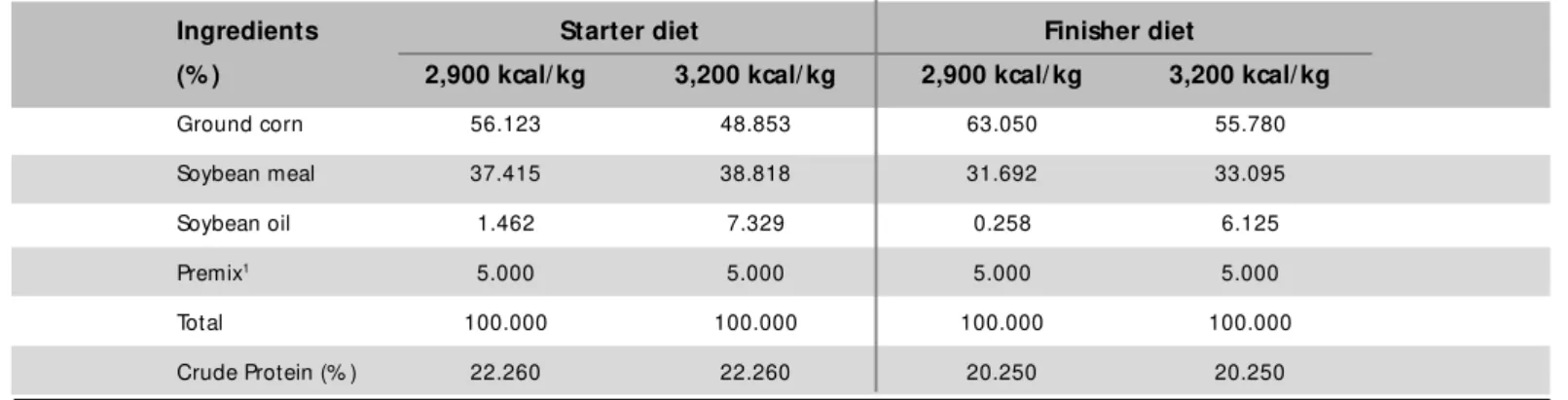
ad libit um, containing energy levels of 2,900 and 3,200 kcal M E/kg. Starter (0-28 days) and finisher (29-42 days) diet s w ere f orm ulat ed according t o t he appropriate nutritional requirements for birds in each phase and composition of diets is show n in Table 1.
At 23 and 46 days, four animals per treatment w ere subm it t ed t o t herm al st ress in a t herm ost at ically co n t ro lled clim at e ch am b er (ad ju st ed t o k eep environmental temperature at 35°C and a relative air humidity of 60% ), during four hours, w ithout food and w ater. Control animals w ere kept in cages at room temperature of 26ºC, w ithout food and w ater during the same period of time.
Immediately after heat stress, control and stressed animals w ere slaughtered and pancreas and intestine (duodenum , jejunum and ileum ) w ere collect ed. Tissues w ere immediately frozen in liquid nitrogen and stored at – 70ºC freezer for further analysis.
Pancreas w as homogenized w ith an Ultra-Turrax in 500 mM Tris-HCl buffer (1:20 w /v) containing 50 mM CaCl2, pH 8.0, at 4 °C. The homogenate w as centrifuged at 14,000 x g for 30 min, at 4ºC. An aliquot of the supernatant w as used for immediate lipase determination and the remaining supernatant w as
frozen in liquid nitrogen and stored at –70 °C freezer until the activity of the other enzymes w as determined.
Pan creas α-am ylase act ivit y w as m easu red b y hydrolysis of starch follow ed by determination of the amount of maltose produced, in accordance to Bernfeld (1955). One unit of enzyme activity w as defined and expressed as the amount of enzyme that produced one
µmol of maltose/min, at 37°C.
Pancreas lipase activity w as assessed by titration (Tietz & Fiereck, 1966), using as substrate the olive oil emulsion (SIGM A) and the colipase excess extracted from poultry pancreas. One unit of enzymatic activity w as defined and expressed as the quantity of enzyme that released one
µmol of fatty acid per minute.
Activation of pancreas trypsinogen w as accomplished b y a p r e- i n cu b at i o n p er i o d w i t h 0 . 0 8 u n i t s o f En t ero k in ase (SIGM A) f o r 3 0 m in u t es. A f t er t h e activation, trypsin activity w as determined at 37°C in accordance to Kakade et al. (1974) using N-α -benzoyl-L- ar g i n i n e- p - n i t r o an i l i d e (-benzoyl-L- BA p NA , SIGM A) as substrate. One unit of enzyme activity w as defined and expressed as the amount of enzyme that released one mmol of p-nitroanilide/min, at 37°C.
The int est inal m ucosa w as hom ogenized in 500 m M Tris-HCl buf f er cont aining 50 m M CaCl2 (1:10 w /v), pH 8.0, at 4°C. Hom ogenat e w as cent rif uged u n d er r ef r i g er at i o n (4 º C) at 1 4 , 0 0 0 x g f o r 1 5 m in u t es. p- PNPPase (p- n it r o p h en yl- p h o sp h at ase) act i vi t y o f i n t est i n al al k al i n e p h o sp h at ase w as discont inuously det erm ined at 37°C, m easuring t he liberation of p-nitrophenolate ion (ε=17,600 M-1. cm-1, pH 13) at 410 nm (Pizauro et al., 1995). One unit of enzym e act ivit y w as def ined and expressed as t he
Table 1 – Composition of starter (1-28 d) and finisher (29-42 d) experimental diets.
Ingredients Starter diet Finisher diet
(% ) 2,900 kcal/ kg 3,200 kcal/ kg 2,900 kcal/ kg 3,200 kcal/ kg
Ground corn 56.123 48.853 63.050 55.780
Soybean meal 37.415 38.818 31.692 33.095
Soybean oil 1.462 7.329 0.258 6.125
Premix1 5.000 5.000 5.000 5.000
Total 100.000 100.000 100.000 100.000
Crude Protein (% ) 22.260 22.260 20.250 20.250
am ount of enzym e t hat released one µmol of p -nit rophenolat e/min, at 37°C.
Protein content (mg/g pancreas) w as determined according to Hartree (1972), using bovine soroalbumin as a standard.
RESULTS AND DISCUSSION
There w as no significant interaction among the factors (energy, thermal stress and age) on the activity of the pancreas enzymes amylase, lipase and trypsin and the intestinal enzyme phosphatase alkaline. As show n in Table 2, pancreas am ylase act ivit y w as affected (p<0.05) by energy level of the diet and by thermal stress. Stressed birds had a higher enzymatic activity than control birds.
Det ails ab o u t ch em ical an d p h ysio lo g ical mechanisms involved in the regulation of pancreatic amylase level under normal or thermal stress conditions are still unknow n. Thus, Slaughter et al. (2001) studied amylase activity in order to determine the kinetics and catalytic efficiency in relation to starch from different feedstuffs, and to establish how the enzymatic levels in gastrointestinal tract are related w ith glucose and insulin levels in blood. According to these authors, high levels of amylase in the gastrointestinal tract indicate that the enzymatic hydrolysis of starch could be the limiting factor in carbohydrate digestion, mainly due t o f act o rs relat ed t o it s p h ysical an d ch em ical properties. On the other hand, Osman & Tanios (1983) report ed t hat t herm al st ress causes a consist ent increase in amylase activity in broilers, w hich could result in a significant increase in starch hydrolysis and, consequently, in the supply of glucose for internal oxidation and posterior metabolic heat production.
Thus, high pancreatic amylase activity indicates that pancreas plays an important role in the regulation of the levels of intestinal amylase and glucose supplied to achieve energet ic requirement s under heat st ress condit ions. Furt herm ore, higher pancreat ic am ylase act ivit y in response to an increase in environmental temperature suggests that the levels of pancreatic amylase could be regulated by a complex interaction among paracrine and endocrine pancreat ic secret ions and neuroendocrine stimuli that could explain the abdominal fat deposition in animals exposed to chronic heat stress.
Pinchasov et al. (1990) studied digestive enzymes in birds aged 14 to 83 days and fed ad libitum or intermittently. Pancreas amylase levels w ere reported to increase w ith age. These authors did not find an age effect on lipase and trypsin activities w hen these enzymes w ere expressed in units/g pancreas. Nevertheless, w hen the results w ere expressed in units/g body w eight, a difference w as seen betw een 20 and 33 days of age in the birds fed intermittently.
According to Table 2, different treatments (diet energy level, heat stress and age) did not result in different trypsin act ivit ies. Similar result s w ere observed by Pinchasov
et al. (1990) for trypsin activity in poultry from 14 to 83 days of age.
In relat ion t o lipase act ivit y, t he result s suggest ed t hat energy levels of 2,900 and 3,200kcal M E/kg w ere not enough t o det ect ef f ect s of added f at in diet . It has been suggest ed t hat t he am ount and t ype of t riglycerides in t he diet regulat e pancreat ic lipase act ivit y but t he mechanism is st ill unclear (Ricket t s & Bran n o n , 1 9 9 4 ). Ot h er st u d ies h ave sh o w n t h at dif f erent f at levels added t o t he diet rapidly result ed in adapt ive changes t hat reached a plat eau in f ive days (Deschodt -Lanckman et al., 1971).
Alkaline phosphatase activity w as affected by diet
Table 2 – Effect of thermal stress and dietary energy level on intestinal alkaline phosphatase (AP), pancreatic lipase (L), trypsin (T) and amylase (A) extracted from poultry.
Sources of Energy (kcal M E/ kg) Stress Age (days)
variation 2,900 3,200 P value Yes No P value 23 46 P value
AP(U/mg protein)1 477.90 391.15 * 419.03 450.02 NS 508.91 360.14 * *
L(U/mg protein) 14.56 12.48 NS 13.53 13.51 NS 16.85 10.19 * *
T(U/mg protein) 35.83 34.71 NS 37.90 32.63 NS 38.54 31.99 NS
A(U/mg protein) 217.65 146.16 * * 200.38 163.43 * 184.73 179.08 NS
1- Statistical difference betw een means in the lines for each treatment NS – non significant, p > 0.05;
energy and animal age; it w as higher (p<0.05) in animals fed the diet containing 2,900kcal M E/kg and at 23 days of age. There w as no effect of environmental temperature (p>0.05) on alkaline phosphatase activity. Considering that alkaline phosphatase activity could be modified by several factors (Komada et al., 1989), the results obtained in the current w ork suggest that alkaline phosphatase activity extracted from broiler gut is influenced by dietary energy level. In rats, contrasting result s w ere f ound; alkaline phosphat ase act ivit y increased immediately after the rats w ere fed a meal rich in f at (A lpers et al., 1995). Thus, it seem s reasonable t o accept t hat t hese dif f erences w ere originated by species characteristics, tissues and/or diff erent met hods used t o prepare t he enzymat ic substrate, besides other unknow n factors.
CONCLUSIONS
Pancreas amylase activity w as affected by dietary energy level and thermal stress conditioning. There w as no difference among treatments on pancreatic trypsin and lipase activity. Dietary energy level and animal age affected intestinal phosphatase alkaline activity and there w as no effect of thermal stress on this enzyme.
The findings of this study suggest that the activity of pancreas amylase, lipase and trypsin, in animals under thermal stress, could be regulated by different mechanisms. How ever, it is still unclear if these changes are essential for poultry to better use carbohydrates, lipids and proteins under thermal stress conditions.
REFERENCES
Alpers DH, Zhang Y, Ahnen J. Synthesis and parallel secretion of rat intestinal alkaline phosphatase and surfactant-like particle protein. American Journal of Physiology 1995; 268(E): 1205-14.
Bernfeld P. Amylases a and b. In: M ethods in Enzymology. ed. by Colow ick SB and Kaplan NO. New York: Academic Press, 1955. Vol.1,pp. 49-53.
Bonnet S, Geraert PA, Lessire M , Carre B, Guillaumin S. Effect of high ambient temperature on feed digestibility in broiler. Poultry Science 1997; 76(6): 857-63.
Brannon PM . Adaptation of the exocrine pancreas to diet. Annual Review of Nutrition 1990; 10: 88-105.
Cow ans PJ, M ichie W. Increasing the environmental temperature later in lay and performance of the fow l. British Poultry Science 1980; 21: 339-43.
Dale NM , Fuller HL. Effect of diet composition on feed intake and grow t h of chicks under heat st ress. II. Const ant vs. cycling
temperatures. Poultry Science 1980;59: 1434-41.
Deschodt-Lanckman M , Robberecht P, Camus J, Christophe J. Short-t erm ad ap Short-t aShort-t io n o f p an creaShort-t ic h yd ro lases Short-t o n u Short-t riShort-t io n al an d physiological stimuli in adult rats. Biochimie (Paris) 1971; 53: 789-96.
Geraert PA, Padilha JC, Guillaumin S. M etabolic and endocrine changes induced by chronic heat exposure in broiler chickens: grow t h performance, body composition and energy retention. British Journal of Nutrition 1996; 75(2): 195-204.
Hartree EF. Determination of protein: a modification of the Low ry m et h o d t h at g ives a lin ear p h o t o m et ric resp o n se. A n alyt ical Biochemistry 1972; 48: 422-27.
It oh F, Hodat e K, Koyama S, Rose M T, M at sumot o M , Ozaw a A, Obara Y. Eff ect s of heat exposure on adrenergic modulat ion of insulin and glucagon secret ion in sheep. Endocrinology Journal 2001; 48(2): 193-98.
Kakade M L, Rackis JJ, M cGhee JG. Determination of trypsin inhibitor act ivit y of soy product s. A collaborat ive analysis of on improved procedure. Cereal Chemistry 1974; 51: 376-82.
Kitchin SE, M orris D. The effect of acclimation temperature on amino acid transport in the goldfish intestine. Comparative Biochemistry and Physiology 1971; 40A: 431-43.
Komada T, Koyama I, Arai Y, Sekine T, Sakagishi Y, Kumegaw a M , Alpers DH. Rat ileal phosphatase activity and secretion is stimulated by alterations in calcium metabolism. Biochemistry Biophysic Acta 1989; 90: 165-74.
Osman AM , Tanios NI. The ef f ect of heat on t he int est inal and pancreatic levels of amylase and maltase of laying hens and broilers. Comparative Biochemistry and Physiology 1983; 75A: 563-7.
Ow en TG, W iggs AJ. Thermal compensation in the stomach of the brook trout. Comparative Biochemistry and Physiology 1971;40A: 465-73.
Pinchasov Y, Nir I, Nitsan Z. M etabolic and anatomical adaptations of heavy-bodied chicks to intermitent feeding. 2. Pancreatic digestive enzymes. British Poultry Science 1990;31: 769-77.
Pizauro Jr JM , Ciancaglini P, Leone FA. Charact erizat ion of t he phosphatidylinositol-specific phospholipase C-released form of rat osseous plate alkaline phosphatase and its possible significance on endochondral ossification. M olecular and Cellular Biochemistry 1995; 152: 121-29.
Ricketts J, Brannon PM . Amount and type of dietary fat regulate pancreatic lipase gene expression in rats. Journal of Nutrition 1994; 124: 1166-71.
Slaughter SL, Ellis PR, Butterw orth PJ. An investigation of the action of porcine pancreatic alpha-amylase on native and gelatinised starches. Biochimic et Biophysica Acta 2001; 1525(1-2): 29-36.
o n g ro w t h p erf o rm an ce, n it ro g en ret en t io n an d m u scle d evelo p m en t in b ro iler ch ick en s. Rep ro d u ct io n Nu t rit io n Development 1999; 39(1): 145-156.
Temim S, Chagneau AM , Guillaumin S, M ichel J, Peresson R, Tesserau d S. Do es excess d iet ary p ro t ein im p ro ve g ro w t h performance and carcass characteristics in heat-exposed chickens? Poultry Science 2000; 79(3): 312-17.