Total alcoholic acidity and pH tests
as quality parameters in stored soybean grains
1Maicon Marinho Vieira Araujo2, Maria Aparecida Braga Caneppele2, Maria das Graças Assis Bianchini2
INTRODUCTION
Soybean [Glycine max (L.) Merrill] is the most important oilseed cultivated in the world. Global production is estimated at 317.3 million tons for the 2015/2016 harvest. Brazil joins the United States as one of the major producers, with 30 % of this total. The average productivity of soybean in Brazil is 2,999 kg ha-1 (Conab 2015a).
Despite all the technology available in the Brazilian agriculture, qualitative and quantitative losses occurring during the post-harvest process are still not well controlled, and, during this stage, soybean may undergo changes caused by the storage environment (Faroni et al. 2009).
ABSTRACT
RESUMO
In the oilseed industry, beans are stored for a relatively long time, compensating the seasonality between crops, in order to avoid a lack of raw material for oil extraction (Bordignon 2009). Oil quality is influenced by the raw material used in extraction (Faroni et al. 2009). Thus, suitable storage may guarantee safe foods with higher added value by identifying, monitoring and correctly managing contaminants (insects, fungi, rodents and microtoxins) at all post-harvest stages (Queiroz et al. 2009).
Beans and derivatives stored under unsuitable conditions are subject to hydrolytic rancidity, evident in the percent increase in free fatty acids, greater sensitivity of fatty acids to oxidation and
1. Manuscript received in Nov./2015 and accepted for publication in Jun./2016 (http://dx.doi.org/10.1590/1983-40632016v4638707). 2. Universidade Federal de Mato Grosso, Cuiabá, MT, Brazil. E-mails: [email protected], [email protected],
Despite the technology available to agriculture, qualitative and quantitative losses occurring during post-harvest are still not controlled, and stored grains may undergo changes in their composition, due to storage conditions. This study aimed at determining the sensitivity of the alcoholic acidity and pH tests in soybean (GB 874RR cultivar) grains with different quality standards obtained during storage. A completely randomized design, in a 3 x 6 x 5 (3 storage conditions x 6 storage times x 5 methods) factorial scheme, was used. A correlation was observed among pH, total acidity content (r = 0.888) and grain quality parameters. Deterioration was identified based on the total acidity content, showing a high correlation with fungal incidence (r = 0.864), ether extract (r = -0.781) and electrical conductivity (r = 0.923). The use of phenolphthalein as indicator is more sensitive than pH 8.8. Among the pH determination methods, AOAC was the most suitable for assessing the quality loss during storage.
KEY-WORDS: Glycine max L.; fatty acid; storage conditions.
Testes de acidez alcoólica total e pH como parâmetros de qualidade em grãos de soja armazenados
Apesar da tecnologia disponível à agricultura, as perdas qualitativas e quantitativas, originadas durante a pós-colheita, ainda não são controladas, e os grãos armazenados podem sofrer alterações em sua composição, em razão da condição de estocagem.
Objetivou-se verificar a sensibilidade do teste de teor de acidez
alcoólico e pH, em grãos de soja (cultivar GB 874RR) com diferentes padrões de qualidade obtidos durante o armazenamento. Utilizou-se delineamento inteiramente casualizado, em esquema fatorial 3 x 6 x 5 (3 condições de armazenamento x 6 tempos de armazenamento x 5 métodos). Observou-se correlação entre o pH, teor de acidez total
(r = 0,888) e parâmetros de qualidade dos grãos. Identificou-se
change in functional properties (Araújo 2004). The longer the storage time in silos, the higher the acidity index, because of enzyme action or oxidative processes. Thus, the higher the acidity index of crude degummed oil, the greater the cost of the
refining process, causing the increased addition of
aqueous alkali, such as sodium hydroxide or sodium carbonate, and raw material loss (Bordignon 2009).
Soybean producing areas in the country are located in tropical and subtropical regions, making
it more difficult to conserve beans and seeds during
storage (Senem 2011). The major advantage of using the total acidity test as a method to assess deterioration in stored beans is its sensitivity (Soares et al. 2005). Given that the formation on free fatty acids in beans results from the hydrolysis of fats
(one of the first reactions triggered under adverse
post-harvest handling conditions), this analysis makes it possible to quantify (volumetric method) the deterioration process in early stages. The good predictive power of this method, associated with its rapid and low-cost execution, suggests more applied investigations aimed at a better use of the test in the post-harvest and processing of beans and seeds (Biaggioni & Barros 2006).
This study aimed at determining the sensitivity of the alcoholic acidity and pH tests in soybean, with different quality standards obtained during storage.
MATERIAL AND METHODS
The study was conducted at the Universidade Federal de Mato Grosso, in 2013/2014, using GB 874RR soybean cultivar beans obtained from the 2012/2013 crop season, from a producing area in Querência, Mato Grosso State, Brazil. The pre-sample soybeans were collected before storage, forming a 50-kg batch. They were cleaned, dried at a temperature of 25-29 ºC and relative humidity of 50-60 %, and homogenized (Conab 2015b). The batch of beans was subdivided into 1.0 kg subsamples, which were stored in cotton packages under different conditions, varying temperature and relative humidity, as it follows:
- Stress condition: a BOD incubator, with controlled temperature (30 ºC) and relative humidity (80 %), was used. Relative humidity inside the structure was controlled using a saturated solution of potassium chloride (KCl). A psychrometer installed inside the BOD was used to determine the relative
humidity and the water was replenished to maintain a saturated saline solution. Relative humidity was monitored and water replenished daily, with salt replaced every 60 days;
- Favorable condition: a refrigerated chamber, with temperature of 17-19 ºC and relative humidity of 60-68 %, was used. Ambient temperature was controlled by an air conditioner and relative humidity
inside the structure with an ARSEC 160 dehumidifier;
- Natural environment condition: samples were kept in the laboratory, under temperature of 25-29 ºC and relative humidity of 50-84 %.
Assessments, which occurred initially and every 60 days, up to 300 days, considered physical, chemical, nutritional and sanitary attributes, as well as the methodologies tested to obtain total soybean acidity and pH. A completely randomized design, with a 3 x 6 x 5 factorial, was used, involving three
storage conditions, six storage times and five methods
(three to determine pH and two for alcoholic acidity), with four repetitions. In each condition, 12 kg of beans were stored and, at each assessment, 2 kg of beans were stored for the tests.
Water content and apparent specific gravity
tests (Brasil 2009) were used to assess the soybean physical quality, and chemical properties were evaluated by electrical conductivity (Krzyzanowski et al. 1999). In order to assess sanitary quality, fungal detection, established by the percent of infected seeds and fungal genera present in seed mass, was
determined using the filter paper infiltration method
(Neergaard 1977) modified by Machado et al. (2003), with water restriction. Nutritional quality was evaluated by near infrared spectrophotometry, obtaining ether extract content and total protein.
The total alcoholic acidity and pH values of the samples were determined using different
methodologies during storage. Three pH quantification
techniques were tested:
- AOAC method: pH is measured in solution, according to the 943.02 method (Lane 1995). A total of 10 g of ground soybeans were weighed and placed
in an Erlenmeyer flask, added with 100 mL of distilled
water at 25 ºC. After the water was added, the content was mixed in an electronic agitator, for 30 min. The contents were placed in a beaker, left to rest for 10 min, and pH was measured;
distilled water and agitated for 1 h, at 150 rpm. The pH was measured after the solution rested for 5 min (Mendonça et al. 2005);
- Decantation method for soybeans: 5 g of ground soybeans were added to 50 mL of distilled water and homogenized for 2 min. The sample was left to decant for 3 min and then the pH was measured (Liu et al. 1992).
To measure pH, an electrode from a Digimed®
DM 22 pH meter, adjusted for pH solutions with pH 4.01 and 9.18, and an accuracy of 0.01 % pH, was used.
Two total acidity quantification methods were
applied to obtain total acidity, where the indicator factor in the titration procedure varied:
- Total acidity method using pH 8.8 as indicator (Osawa & Gonçalves 2006): 5 g of ground soybeans were placed in a beaker to which 80 mL of 95 % ethanol were added. The solution was then mixed and left to rest for 24 h. Next, the volume was topped up to 100 mL, with 95 % ethanol, and
the solution was filtered in filter paper. Then, 20 mL were separated from the filtered solution and titrated
with 0.01 N of sodium hydroxide, until a pH 8.8 was reached (Osawa & Gonçalves 2006), using the same pH meter aforementioned;
- Total acidity method using phenolphthalein as indicator: the same procedure was applied to
obtain the volume of solution to be titrated in the first
method, but the titration indicator differed. Two drops of phenolphthalein (0.01 N) were used as indicator,
and 20 mL of the filtered solution were titrated with
0.01 N sodium hydroxide, until it turned pink. The amount (in mL) of 0.01 N NaOH used to neutralize the acids contained in the samples, in both methods, was calculated according to the analytical guidelines of the Instituto Adolfo Lutz (IAL 2008) and the results were expressed in g 100 g-1 of dry
matter.
The data were submitted to analyses of variance and linear regression to determine the effect of storage time, and the Tukey test at 5 % for qualitative parameters (storage condition and quality assessment method).
RESULTS AND DISCUSSION
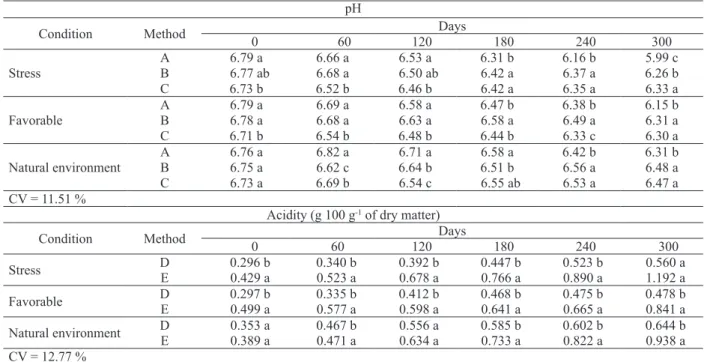
Irrespective of the method applied or storage condition, there was a decrease in pH and an increase in acidity during storage. The acidity increase was more intense under stress and natural environment conditions (Table 1). This occurs because, at high
The same lower case letter, in the columns, do not differ by the Tukey test at 5 %. A= AOAC method; B = method used for coffee; C = method used for soybeans; D = total acidity method using pH 8.8 as indicator; E = total acidity method using phenolphthalein as indicator.
pH
Condition Method Days
0 60 120 180 240 300
Stress
A 6.79 a 6.66 a 6.53 a 6.31 b 6.16 b 5.99 c
B 6.77 ab 6.68 a 6.50 ab 6.42 a 6.37 a 6.26 b
C 6.73 b 6.52 b 6.46 b 6.42 a 6.35 a 6.33 a
Favorable
A 6.79 a 6.69 a 6.58 a 6.47 b 6.38 b 6.15 b
B 6.78 a 6.68 a 6.63 a 6.58 a 6.49 a 6.31 a
C 6.71 b 6.54 b 6.48 b 6.44 b 6.33 c 6.30 a
Natural environment
A 6.76 a 6.82 a 6.71 a 6.58 a 6.42 b 6.31 b
B 6.75 a 6.62 c 6.64 b 6.51 b 6.56 a 6.48 a
C 6.73 a 6.69 b 6.54 c 6.55 ab 6.53 a 6.47 a
CV = 11.51 %
Acidity (g 100 g-1 of dry matter)
Condition Method Days
0 60 120 180 240 300
Stress D 0.296 b 0.340 b 0.392 b 0.447 b 0.523 b 0.560 a
E 0.429 a 0.523 a 0.678 a 0.766 a 0.890 a 1.192 a
Favorable D 0.297 b 0.335 b 0.412 b 0.468 b 0.475 b 0.478 b
E 0.499 a 0.577 a 0.598 a 0.641 a 0.665 a 0.841 a
Natural environment D 0.353 a 0.467 b 0.556 a 0.585 b 0.602 b 0.644 b
E 0.389 a 0.471 a 0.634 a 0.733 a 0.822 a 0.938 a
CV = 12.77 %
temperatures and relative humidity, lipid degrades via chemical and enzymatic mechanisms, such as self-oxidation, photooxidation and lipoxygenase (Araújo 2004). Lipid oxidation may destroy linoleic and linolenic acids, leading to increased acidity (Kirk 1984, Oliveira & Arce 2004).
Silva et al. (2012) conducted physicochemical and technological characterization of whole soybean
flour fermented with Aspergillus oruzae. They
observed that the pH value can vary up to 3.65 %, over a period of 120 days. These authors explain that the decrease in pH values, during storage time, is due to the increase in the H+ ion concentration caused by moisture
and the presence of fungi. This may explain the decrease in pH found under the conditions assessed, whose relative humidity remained above 50 %.
For total alcoholic acidity, irrespective of the method tested, it was observed that, under stress and natural environment storage conditions, the soybean deterioration process was greater. The highest pH variations were recorded for the alcoholic acidity method, using phenolphthalein as indicator.
A comparison between the methods assessed in each storage condition shows different results among the methods applied. The methods differed
significantly from 60 days onwards, though without
demonstrating standard behavior. With respect to the differences observed, regardless of storage condition, there was a tendency to greater variation in pH in the AOAC method, which may be linked to its greater
sensitivity in recording small changes caused by soybean quality.
For acidity, significant differences were found
between the methods at the beginning of assessments, in all periods and storage conditions. In this respect, acidity obtained using phenolphthalein as indicator exhibited a much higher variation than with pH 8.8 as indicator. The variation in pH near the point of equivalence is important, since it allows selecting the indicator that provides the lowest titration error. In general, the pH interval of titration occurs between 8 and 10, making it possible to use phenolphthalein as indicator (Vogel 2011). Thus, the greater the sensitivity of the method in recording pH variations in the sample, the greater the variations in acidity (Table 1).
Several authors have reported that soybean
quality can influence the quality parameters of its
derivatives, such as pH, total solids, hydrosoluble extract color and total acidity in soybeans (Liu 1997, Hou & Chang 2004). In this respect, it was possible to
establish a significant correlation among quality, acid
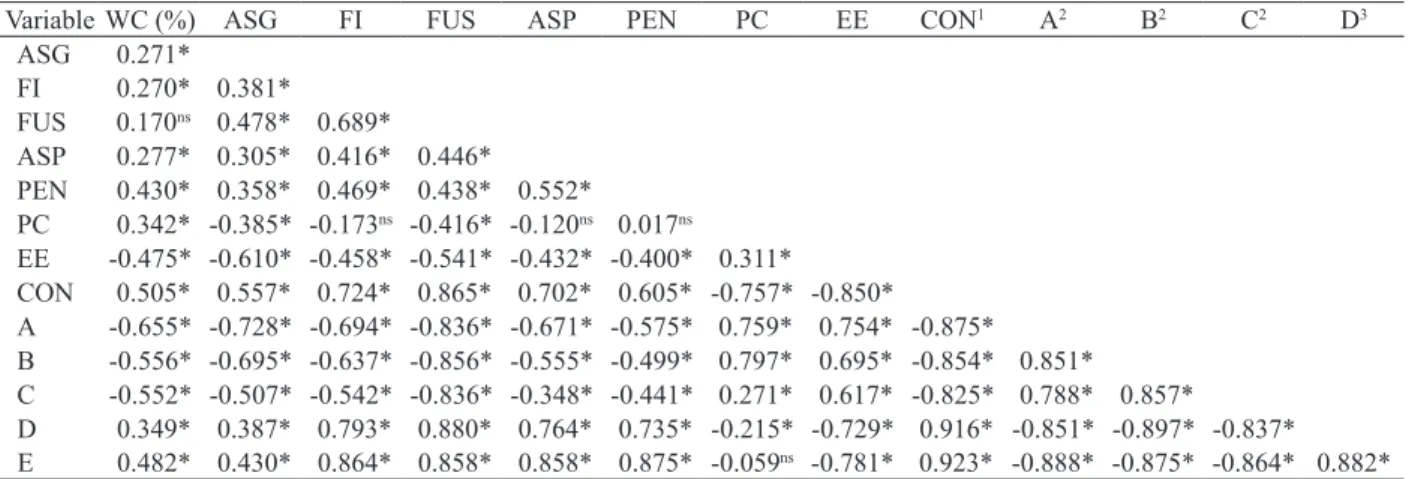
content and pH of soybeans stored under different conditions, according to the Pearson’s correlation matrix (Table 2).
The highest correlations between acid content and soybean quality were observed using the total acidity method and phenolphthalein as indicator, and the highest correlations between pH and soybean quality parameters for the AOAC method.
WC - water content; ASG - apparent specific gravity; FI - fungal incidence; FUS - Fusarium spp. incidence (%); ASP - Aspergillus spp. incidence (%); PEN - Penicillium
spp. incidence (%); EE - ether extract content (%); PC - protein content (%); CON - electrical conductivity; A - AOAC method; B - method used for coffee; C - method used for soybeans; D - total acidity method using pH 8.8 as indicator; E - total acidity method using phenolphthalein as indicator. 1 Expressed as µS cm-1 g-1; 2 expressed
on a pH scale; 3 expressed as g 100 g-1 of dry matter. * Significant at 5 %; ns not significant at 5 %.
Variable WC (%) ASG FI FUS ASP PEN PC EE CON1 A2 B2 C2 D3
ASG 0.271* FI 0.270* 0.381* FUS 0.170ns 0.478* 0.689*
ASP 0.277* 0.305* 0.416* 0.446* PEN 0.430* 0.358* 0.469* 0.438* 0.552* PC 0.342* -0.385* -0.173ns -0.416* -0.120ns 0.017ns
EE -0.475* -0.610* -0.458* -0.541* -0.432* -0.400* 0.311*
CON 0.505* 0.557* 0.724* 0.865* 0.702* 0.605* -0.757* -0.850* A -0.655* -0.728* -0.694* -0.836* -0.671* -0.575* 0.759* 0.754* -0.875* B -0.556* -0.695* -0.637* -0.856* -0.555* -0.499* 0.797* 0.695* -0.854* 0.851* C -0.552* -0.507* -0.542* -0.836* -0.348* -0.441* 0.271* 0.617* -0.825* 0.788* 0.857*
D 0.349* 0.387* 0.793* 0.880* 0.764* 0.735* -0.215* -0.729* 0.916* -0.851* -0.897* -0.837* E 0.482* 0.430* 0.864* 0.858* 0.858* 0.875* -0.059ns -0.781* 0.923* -0.888* -0.875* -0.864* 0.882*
Table 2. Pearson’s correlation matrix between water content, apparent specific gravity, fungal incidence, protein content, ether
As expected, increases in the acidity content result in a decline in pH values, as shown by the high correlation between total acidity, using phenolphthalein as indicador, and all the three soybean
pH quantification methods (r = -0.864* to -0.888*).
It was also found that, as soybean acidity increases, the ether extract content decreases, as per the high correlation recorded (r = -0.781*). There was a positive correlation between electrical conductivity and alcoholic acidity content, using both phenolphthalein (r = 0.916*) and pH 8.8 (r = 0.923*) as indicators.
The correlation among physical quality, sanitary and electrical conductivity with pH parameters of soybeans was negative, indicating a soybean
deterioration process. This may be influenced by the
acid pH resulting from microbial development, since pH is inversely proportional to the fungal incidence and, consequently, to the loss of soybean membrane
integrity, reflected in increased electrical conductivity.
Nutritional quality parameters (ether extract and protein content) exhibited a positive correlation with pH. Silva et al. (2012) observed that autoclaved
whole soybean flour samples and those fermented
with Aspergillus oryzae showed declines in water
absorption indices, nitrogen solubility and urease activity, as well as an increase in total acidity, ether extract and protein content. It is known that pH exerts
a strong influence on protein functionality, given that
several of these functional properties depend on the ionization state of ionizable groups, in the protein molecule (Torrezan & Cristianini 2005).
Significant correlations were observed between
both pH and acid content and fungal incidence and electrical conductivity. Studies have suggested that, during storage, lipids are hydrolyzed by lipases in free fatty acids and glycerol, decreasing pH, primarily when temperature and water content are high, a favorable condition found in this experiment (Kirk 1984, Araújo 2004, Oliveira & Arce 2004). This change is accelerated by fungal development, due to the high lipolytic activity in these microorganisms (Athié et al. 1998). Moreover, optimal temperature and relative humidity conditions for microorganism development are respectively 30 ºC and 75 % (Hansen et al. 2004), practically the same temperature and relative humidity condition in which the soybean was stored. Favorable conditions for microorganism growth may have caused the increase in free fatty acid content and decline in pH.
Furthermore, there are correlations between electrical conductivity and pH determination methods. This is sensitive to ionic strength, which is altered by variations in the ion content in the solution (Van Raij et al. 2001). The greater the ionic strength, the lower the pH (Lindsay 1979). This same phenomenon leads to an increase in electrical conductivity, since the higher ion presence in the solution facilitates the electron transfer (Novais et al. 2007). This may explain the high correlations between these two parameters.
The free fatty acid test showed the highest variation in results, differently from the remaining tests, since it is more sensitive in assessing soybean quality. As with pH, it can be used as an indication of quality loss and to select samples whose quality needs to be investigated.
CONCLUSIONS
1. The method to determine total alcoholic acidity by titration, using phenolphthalein as indicator, is sensitive to soybean quality.
2. The AOAC pH determination method is the most indicated for assessing quality loss in stored soybean.
3. There is a correlation between pH and total acidity with fungal incidence and electrical conductivity of soybean.
REFERENCES
ARAÚJO, J. M. A. Química de alimentos: teoria e prática. Viçosa: Ed. UFV, 2004.
ATHIÉ, I. et al. Conservação de grãos. Campinas: Fundação Cargill, 1998.
BIAGGIONI, M. A. M.; BARROS, R. E. Teste de acidez graxa como índice de qualidade em arroz. Ciência e Agrotecnologia, v. 30, n. 4, p. 679-684, 2006.
BORDIGNON, B. C. S. Relação das condições de armazenamento com a qualidade fisiológica de sementes e composição do óleo extraído de cultivares de soja. 2009. 90 f. Dissertação (Mestrado em Agricultura) - Centro de Ciências Rurais, Universidade de Santa Maria, Santa Maria, 2009.
COMPANHIA NACIONAL DE ABASTECIMENTO (Conab). Acompanhamento de safra brasileira: grãos, décimo segundo levantamento. 2015a. Available at: <http://www.conab.gov.br/OlalaCMS/uploads/ a r q u i v o s / 1 5 _ 0 9 _ 11 _ 1 0 _ 4 2 _ 0 3 _ b o l e t i m _ g r a o s _ setembro_2015.pdf>. Acess on: 20 Sep. 2015.
COMPANHIA NACIONAL DE ABASTECIMENTO (Conab). Boletim técnico: série armazenagem. Brasília, DF: Conab, 2015b.
FARONI, L. R. A. et al. Qualidade dos grãos de soja armazenados em diferentes condições. Revista Brasileira de Engenharia Agrícola e Ambiental, v. 13, n. 5, p. 606-613, 2009.
HANSEN, L. S.; SKOVGARD, H.; HELL, K. Life table study of Sitotroga cerealella (Lepidoptera: Gelichiidae), a strain from West Africa. Journal of Economic Entomology, v. 97, n. 4, p. 1484-1490, 2004.
HOU, H. J.; CHANG, K. C. Storage conditions affect soybean color, chemical composition and tofu qualities.
Journal of Food Processing and Preservation, v. 28, n. 6, p. 473-488, 2004.
INSTITUTO ADOLFO LUTZ (IAL). Métodos físico-químicos para análise de alimentos. São Paulo: IAL, 2008.
KIRK, J. R. Biological availability of nutrients in processed foods. Journal of Chemical Education, v. 61, n. 4, p. 364-367, 1984.
KRZYZANOWSKI, F. C.; VIEIRA, R. D.; FRANÇA NETO, J. B. Vigor de sementes: conceitos e testes. Londrina: Associação Brasileira de Tecnologia de Sementes, 1999.
LANE, R. H. Cereal foods. In: ASSOCIATION OF OFFICIAL AGRICULTURAL CHEMISTIS. Methods of analysis of AOAC International. 16. ed. Arlington: AOAC, 1995. p. 777-801.
LINDSAY, W. L. Chemical equilibria in soils. New York: John Wiley & Sons, 1979.
LIU, K. Soybeans: chemistry, technology and utilization. New York: Chapman & Hall, 1997.
LIU, K.; MCWATTERS, K. H.; PHILLIPS, R. D. Protein insolubilization and thermal destabilization during storage as related to hard-to-cook defect in cowpeas. Journal of Agricultural and Food Chemistry, v. 40, n. 12, p. 2483-2487, 1992.
MACHADO, J. C. et al. Controle da germinação de sementes de soja em testes de sanidade pelo uso da restrição hídrica. Revista Brasileira de Sementes, v. 25, n. 2, p. 77-81, 2003.
MENDONÇA, L. M. V. L.; PEREIRA, R. G. F. A.; MENDES, A. N. G. Parâmetros bromatológicos de grãos crus e torrados de cultivares de café (Coffea arabica L.).
Ciência e Tecnologia de Alimentos, v. 25, n. 2, p. 239-243, 2005.
NEERGAARD, P. Seed pathology. London: MacMillan Press, 1977.
NOVAIS, R. F. et al. Fertilidade do solo. Viçosa: SBCS, 2007.
O L I V E I R A , J . G . S . B . ; A R C E , M . A . B . R . Determining economical TBHQ doses for corn oil stability. Ciência e Tecnologia de Alimentos, v. 24, n. 3, p. 413-418, 2004.
OSAWA, C. C.; GONÇALVES, L. A. G. Titulação potenciométrica aplicada na determinação de ácidos graxos livres de óleos e gorduras comestíveis. Química Nova, v. 29, n. 3, p. 593-599, 2006.
QUEIROZ, V. A. V. et al. Boas práticas e sistema APPCC na fase de pós-colheita de milho. Sete Lagoas: Embrapa Milho e Sorgo, 2009.
S E N E M , J . Qualidade de sementes de soja
convencional e transgênica após colheita e durante armazenamento em condições ambientes e em resfriamento. 2011. 70 f. Dissertação (Mestrado em Engenharia Agrícola) - Centro de Ciências Exatas e Tecnológicas, Universidade Estadual do Oeste do Paraná, Cascável, 2011.
SILVA, L. H. et al. Caracterização físico-química e tecnológica da farinha de soja integral fermentada com
Aspergillus oryzae. Food Technology, v. 15, n. 4, p. 300-306, 2012.
SOARES, T. A.; BIAGGIONI, M. A.; FRANÇA-NETO, J. B. Análise de acidez graxa como índice de qualidade em grãos de soja. Energia na Agricultura, v. 20, n. 1, p. 91-102, 2005.
TORREZAN, R.; CRISTIANINI, M. Revisão: efeito do tratamento sob alta pressão sobre as propriedades funcionais da proteína de soja e interação proteína-polissacarídeos. Boletim do Centro de Pesquisa de Processamento de Alimentos, v. 23, n. 2, p. 201-220, 2005.
VAN RAIJ, B. et al. Análise química para avaliação de fertilidade de solos tropicais. Campinas: Instituto Agronômico, 2001.