Resear
ch
Epidemiological and deontological aspects of traffic
mortality in Roraima
Antonio Alberto de Medeiros Ferreira 1, Luciane Zanin de Souza 2, Flávia Martão Flório 3
Abstract
This is a longitudinal and descriptive study evaluating epidemiological and deontological aspects of traffic mortality in Roraima by comparing data from the Legal Medical Institute of Roraima, the Violence and Accident Surveillance System and the Mortality Information System. Most of the victims were men (85.2%), brown-skinned (81.5%), living in an urban area (81.5%), single (66.7%), between 15 and 34 years old (54.9%). The most common injuries were contusion (96.2%) and fracture (75.5%). The body parts most affected were the head (69.8%), lower limbs (66%) and face (54.7%). The main cause of death was head trauma (43.4%). The comparison of data evidenced underreporting of traffic mortality in Roraima. Constant reflection is essential to establish ethical parameters for the professionals involved, and the integration between health agencies and the Legal Medical Institute is recommended to create a database to support policies adapted to the local reality.
Keywords: Traffic accidents. Epidemiology. Ethic. Resumo
Aspectos epidemiológicos e deontológicos da mortalidade no trânsito em Roraima
Este estudo avalia a mortalidade no trânsito em Roraima sob os aspectos da epidemiologia e da deontologia. Trata-se de pesquisa longitudinal e descritiva, que comparou dados do Instituto Médico Legal de Roraima, do Sistema de Vigilância de Violências e Acidentes e do Sistema de Informações sobre Mortalidade. A maioria das vítimas era homens (85,2%), pardos (81,5%), residentes em área urbana (81,5%), solteiros (66,7%), com entre 15 e 34 anos (54,9%). As lesões mais comuns foram contusão (96,2%) e fratura (75,5%). As partes mais atingidas foram cabeça (69,8%), membros inferiores (66%) e face (54,7%). A principal causa mortis foi trauma na cabeça (43,4%). Comparando os dados, constatou-se subnotificação da mortalidade no trânsito em Roraima. A reflexão constante é fundamental para estabelecer parâmetros éticos para os profissionais envolvidos, e recomenda-se integrar órgãos da saúde com o Instituto Médico Legal para criar banco de dados que subsidie políticas adaptadas à realidade local. Palavras-chave: Acidentes de trânsito. Epidemiologia. Ética.
Resumen
Aspectos epidemiológicos y deontológicos de la mortalidad en el tránsito en Roraima
Este estudio objetivó evaluar la mortalidad en el tránsito en Roraima bajo los aspectos de la epidemiología y deontología. La investigación longitudinal y descriptiva comparó datos del Instituto Médico Legal de Roraima, del Sistema de Vigilancia de Violencias y de Accidentes y del Sistema de Información sobre Mortalidad. La mayoría de las víctimas fueron hombres (85,2%), pardos (81,5%), residentes en área urbana (81,5%), solteros (66,7%), en el grupo de edad 15-34 años (54,9%). Las lesiones más frecuentes fueron contusión (96,2%) y fractura (75,5%). Las partes afectadas fueron cabeza (69,8%), miembros inferiores (66%) y cara (54,7%). La principal mortis causa fue trauma en la cabeza (43,4%). La comparación entre los datos obtenidos permitió cuantificar la subnotificación de mortalidad en el tránsito en Roraima. Es fundamental la reflexión constante con el fin de establecer parámetros éticos a los profesionales, y se recomienda integrar organismos de la salud pública con el Instituto Médico Legal, para crear un banco de datos orientado a subsidiar políticas adaptadas a la realidad local.
Palabras clave: Accidentes de tránsito. Epidemiología. Ética. Approval CEP-SLM 1.570.471
1. PhD [email protected] – Faculdade São Leopoldo Mandic 2. PhD [email protected] – Faculdade São Leopoldo
Mandic 3. PhD [email protected] – Faculdade São Leopoldo Mandic, Campinas/SP, Brasil.
Correspondence
Antonio Alberto de Medeiros Ferreira – Instituto Médico Legal de Roraima. Av. Venezuela, 2.083, Liberdade CEP 69309-005. Boa Vista/RR, Brasil. The authors declare no conflict of interest.
Traffic accidents are a serious public health problem, with high morbidity and mortality rates. Data indicate that 50 million people suffer injuries – many of them with sequelae – and 1.2 million die every year in the world due to traffic accidents, which causes social and humanitarian problems, in addition to significant damage to the economy 1-6.
Global projections of mortality from traffic accidents indicate an increase from 1.2 million in 2002 to 2.1 million in 2030 7, which represents an
increase of 75% in the number of lives violently taken. Considering 178 countries, 90% of traffic-related morbidity and mortality occurs in low- and middle-income countries, which hold only 48% of vehicles in the world 8. Although preventable, these early deaths
reach alarming levels in these countries 9.
In the Americas, Brazil is the third country with the highest traffic mortality, second only to Belize and the Dominican Republic, while Canada is the one with the lowest prevalence of this aggravation 10.
Worldwide, Brazil ranks fifth in road accidents 11.
In fact, the number of injuries and deaths from this cause in the country is alarming, accounting for more than 40 thousand deaths per year 12, a
higher number than the victims of recent wars and AIDS 13. The Second Global High Level Conference on
Road Safety pointed to data deficiency and lack of inspection and coordination between federal and state programs as explanations for the problem 14.
The Violence and Accident Surveillance System (Viva) was implemented in 2006 in the Unified Health System (SUS) to enable knowledge of the epidemiological profile of violence and accidents, including traffic-related ones. However, traffic victims not attended by SUS are invisible in Viva, so the magnitude of deaths and injuries is still underestimated 15.
The databases of the Ministry of Health (MH) report limitations for the North and Northeast regions of the country, which have unsatisfactory coverage and significant underreporting of deaths 16,17. The Pan American Health Organization
(PAHO) ratifies that many countries suffer from underreporting problems, with traffic deaths recorded as “other or unspecified” 10.
Studies on the profile of victims hospitalized for injuries resulting from land transport accidents (LTA) in Brazil between 2000 and 2013 show 1,747,191 hospitalizations, of which 410,448 were people with physical sequelae (23.5%). Of these, 77.7% were male; 26.5% in the 20–29 years age
group; 46.4% residing in the Southeast region; 32.5% pedestrians and 31.1% motorcyclists. With a diagnosis of probable physical sequelae, there were 359,259 hospitalizations, 43.3% of motorcyclists 1.
In a survey with three different sources of information about traffic accidents in Belo Horizonte, Minas Gerais, Brazil, inadequate filling was found in all of them, highlighting the lack of data on safety equipment use and driver alcohol consumption. A comparison of the three sources showed the same profile of those involved in accidents: men, young, motorcyclists and motorcycle passengers or pedestrians. In addition to the high mortality rate in Belo Horizonte in the period (19.4 per 100 thousand inhabitants), there was an increase in accidents and non-fatal victims, with an increase in the hospitalization rate (34%) and hospital costs (53%) and greater involvement of motorcycles in proportion to the fleet. Despite the gaps in the records, it is possible to point out some recurrences: older pedestrians, motorcyclists, alcohol use and speeding 4.
As for bicycles, a study based on data from the Mortality Information System (MIS) found that the majority of cyclist deaths in traffic accidents in Brazil, from 2000 to 2010, occurred due to head injuries. Most victims were male (85.4%). The survey also pointed out an increase in these deaths in the North and Northeast, and a reduction in the South and Southeast 5.
Data from 2000 indicated Boa Vista, Roraima, Brazil, as the capital with the highest mortality in this context, with 47.9 deaths per 100 thousand inhabitants 13. And according to the MH, from 2000
to 2004 the municipality had an increase of 43% in traffic mortality, reaching 111.6 deaths per 100 thousand inhabitants 18. Even with the so-called
“Dry Law”, mortality from land transport accidents did not decrease in Roraima, since MIS numbers allow us to conclude that deaths increased in the biennia of 2008 and 2009, 2011 and 2012, and 2014 and 2015 19. These statistics are of great relevance, as
they help to develop and improve public policies 20-22.
The present study describes traffic mortality in Roraima, in the Brazilian Legal Amazon, based on dental and medical reports of forensic examinations and autopsies of the Legal Medical Institute of Roraima (IML/RR) – the only one in the state – 23-25,
thus providing an epidemiological profile in order to relate it to official data from Viva Survey and MIS, both of the MS. In addition, this study seeks to reflect on traffic mortality by considering the ethical norms of the professional councils of medicine 26 and
Resear
dentistry 27 (since the specialty takes part in expert
work) and the current legislation. Methods
The research project was approved by the Research Ethics Committee of Faculdade São Leopoldo Mandic, in Campinas, São Paulo, Brazil, and submitted to Plataforma Brasil of the MH. The IML/RR 28
management authorized, by means of a document, researchers’ access to medical and dental reports of forensic examinations related to traffic accidents.
With a quantitative, transversal, descriptive and exploratory design, the study covers the state of Roraima, which belongs to the Brazilian Legal Amazon 29,30. The criteria of the Viva Survey 2011 31
were adopted , which used a probabilistic sample of September 2011 as a national parameter. In the present study, however, the 2011-2015 period was considered. In the analysis of the reports, the variables (detailed in the Appendix) were: 1) general data from the forensic examination; 2) data of the person examined; 3) residence of the person examined; 4) information about injuries. The source of the survey was the archives of IML/RR, which exclusively carries out the forensic examinations provided for in §§ 3 and 5 of article 5 of Law 6.194/1974 32,
which deals with personal injuries caused by motor vehicles on land. Data from the Viva Survey 2011 33
and MIS (2011-2015) 34 were also consulted.
It should be clarified that in order to have a legal interment (burial), a declaration and, consequently, a death certificate is required 35. The
declaration, also known as “death declaration”, is issued by the doctor – when present on the spot – or by two qualified persons who have witnessed or verified the death. The certificate, on the other hand, is issued by a civil registry office 36.
The study compared said IML/RR forensic reports with the sources of the MH in order to verify if there is in fact the underreporting of mortality described in the literature 10,16,17. Through absolute
and relative frequencies, an exploratory analysis of all the data obtained was carried out 37.
Results
In the period considered, IML/RR recorded 859 deaths related to traffic accidents, 66% of which
occurred in the state capital. Most of the victims were male (85.2%), brown-skinned (81.5%), living in urban areas (81.5%), and single (66.7%). As for age group, in 18.5% of the cases the victims were between 30 and 34 years old, in 16.6% between 20 and 24, and in 10.4% between 15 and 19. The most common cause of death was traumatic brain injury (28.3%), followed by polytrauma (16.9%) and intracranial hemorrhage (9.4%).
Table 1 shows data on the nature of the injuries, considering the diagnosis and the affected body part. It is important to note that the same victim can present with several injuries, of different types and in different body parts. Contusion was the most common, followed by fracture, excoriation and traumatic brain injury. The most affected body part is the head, followed by the lower limbs, face, chest, multiple organs/regions, abdomen/hips and upper limbs.
Table 1. Epidemiological profile of traffic mortality, nature of injury and body part affected
Feature n % Nature of injury Amputation 33 3.8% Contusion 826 96.2% Cutting/laceration 308 35.9% Sprain/dislocation 33 3.8% Excoriation 632 73.6% Fracture 649 75.5% Polytrauma 297 34.6% Abdominal trauma 347 40.4% Traumatic brain injury 519 60.4%
Dental trauma 16 1.9%
Thoracic trauma 373 43.4%
Body part affected
Abdomen/hip 389 45.3% Mouth/teeth 65 7.6% Head 600 69.8% Spine/cord 132 15.4% Back 194 22.6% Face 470 54.7% Genitals/anus 17 2% Lower limbs 567 66% Upper limbs 389 45.3% Multiple organs/regions 413 48.1% Neck 146 17% Chest 438 51%
Source: Medical and dental reports of forensic examinations of IML/RR autopsies, 2011-2015.
Resear
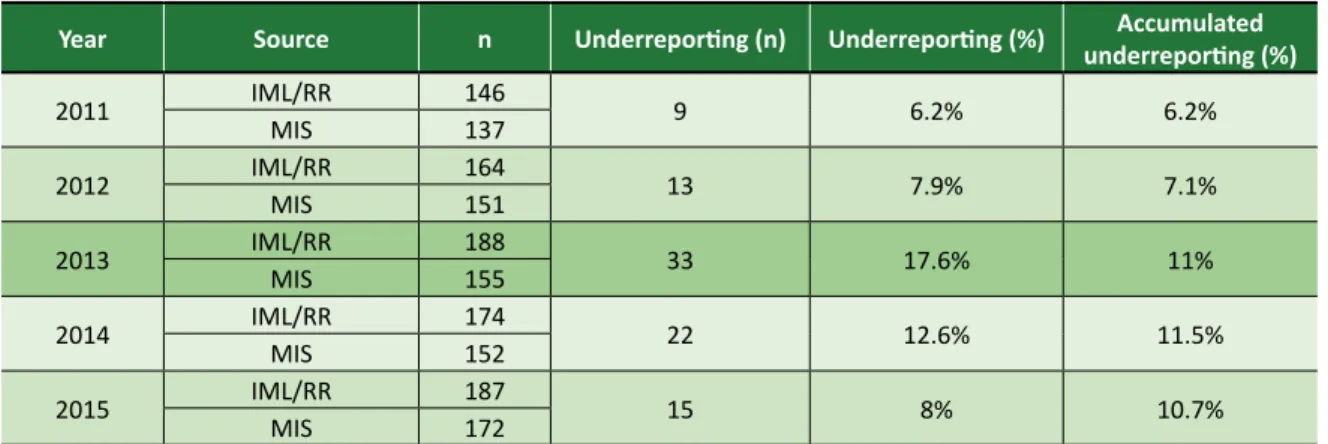
Tables 2 and 3 compare the results of IML/RR surveys with data from the MH, Viva Survey and MIS. It should be noted that Viva used a probabilistic sample of September 2011 as a national parameter and, until the writing of this article, it only made available mortality data for that year, even
with Ordinance MS 708/2014 38, which released
financial resources for a new survey – already carried out, according to the MH 39. The comparison
between IML/RR reports and Viva Survey and MIS data provide evidence of underreporting of traffic mortality in Roraima.
Table 2. Traffic mortality in Roraima (comparison between IML/RR and Viva Survey data)
Month/year Source n Underreporting (n) Underreporting (%) underreporting (%)Accumulated
September/2011 IML/RR 14 8 57.1% 57.1%
Viva 6
September/2014 IML/RR 12 - -
-Viva UN
IML/RR: Legal Medical Institute of Roraima; UN: unavailable; Viva: Violence and Accident Surveillance System Source: Medical and dental reports of forensic examinations of IML/RR and Viva Survey autopsies
Table 3. Traffic mortality in Roraima (comparison between IML/RR and MIS data)
Year Source n Underreporting (n) Underreporting (%) underreporting (%)Accumulated
2011 IML/RRMIS 146137 9 6.2% 6.2% 2012 IML/RRMIS 164151 13 7.9% 7.1% 2013 IML/RR 188 33 17.6% 11% MIS 155 2014 IML/RR 174 22 12.6% 11.5% MIS 152 2015 IML/RRMIS 187172 15 8% 10.7%
IML/RR: Legal Medical Institute of Roraima; MIS: Mortality Information System
Source: Medical and dental reports of forensic examinations of IML/RR and Viva Survey autopsies Discussion
Age and gender
According to IML/RR data, traffic mortality mainly affects males (85.2%) between 15 and 34 years of age (54.9%). The age group is consistent with that of other studies, but the percentage of male victims is high 1,5,6,40. The difference can be explained
by the fact that, in the state of Roraima, unlike the rest of the country, men outnumber women 41.
Skin color
Brown-skinned people are the most affected by traffic mortality (81.5%), considering that individuals who claim to be of mixed-race (mulatos,
caboclos, cafuzos or mamelucos) all fall into the
classification. In Roraima, most of the population is brown-skinned (65.6%) 42. The state has the highest
percentage of indigenous people in the country 43,
with more than half of its schools geared to this population segment (53%) 44. This demographic
profile contributes to interbreeding.
Profile for planning
In addition to age and gender, the study found that the majority of traffic victims are single (66.7%) and residents of the capital (66%), in urban areas (81.5%). These findings favor the planning of targeted preventive actions.
Cause of death
The most common cause of death in IML/RR reports were head trauma (traumatic brain injury, intracranial hemorrhage, cranial hemorrhage trauma and cerebral edema) (43.4%), coinciding with the
Resear
results of other studies 6,45. The sources, however,
are incomplete, including regarding information about safety equipment use 4.
For example, cyclists are not required to wear a helmet in Brazil, although there has been a significant reduction in mortality and head and face trauma in countries that oblige the use of this equipment 5. In order to change this scenario, the
Bicycle Brazil Program, which encourages cycling to improve urban mobility conditions, recommends governmental and non-governmental actions to develop and disseminate educational campaigns on the safe use of bicycles and its benefits 46.
A survey mapped the body regions most affected in traffic accidents, concluding that motorcyclists usually injure upper and lower limbs and pelvic girdle, while victims of being run over and drivers and passengers of other types of car are more often injured in the head, neck and face 47.
In a study with motorcycle taxi drivers in Feira de Santana, Bahia, Brazil, the most affected parts were the lower and upper limbs 6.
Time to start autopsy
The Federal Council of Medicine 48 and the
Brazilian criminal law 49 determine that the autopsy
must be started six hours after death, unless the experts, finding that the death is evident, consider that the procedure can be done before this period. The planning to perform the autopsy for a traffic accident can be changed due to logistical contingencies and human resource allocation. In any case, the coroner must record in the report the exact date of death and post-mortem examination.
Invisibility of cases not attended by SUS
The comparison of IML/RR autopsy reports with Viva Survey numbers showed underreporting of traffic mortality in Roraima, with 57.1% of deaths not registered by the MH survey 31. Therefore, cases
of lethal outcome that go to IML/RR without going through health services remain invisible.
In comparison with MIS data from 2011 to 2015, unreported cases reached 10.37%, considering the entire period. The Mortality Qualification Sheets of the MH 16,17 themselves have limitations, with
significant underreporting of deaths in the North and Northeast of the country. Declarations of deaths from traffic accidents, classified as “external cause”, are always issued by IML after the autopsy, even if death occurs in an emergency room 20-22.
Underreporting of deaths
It is estimated that 21% of traffic deaths in the Americas are underreported 10. In the case of
Roraima, as seen, the percentage reaches 57.1% when considering Viva Survey (Table 2), and 10.7% when considering MIS (Table 3).
Measuring underreporting is important to design and improve public policy programs and strategies, since the lack of accurate information on the mortality rate prevents knowledge of the local epidemiological reality, limiting the system’s actions and decreasing the effectiveness of health surveillance 50.
Epidemiological integration strategy
It is important to establish partnerships in the planning of health surveys, integrating epidemiological agencies with other institutions – such as the IML, which belongs to the Public Security porfolio – in order to obtain a unified, complete and reliable database 4. This collaboration
would help to comply with the guidelines of the National Policy for the Reduction of Morbidity and Mortality due to Accidents and Violence, producing reliable data to support managers in the creation of public policies aimed at the local reality, with actions for the prevention, promotion and protection of health, as well as health rehabilitation of injured people 2,3,14.
Ethics
The essence of medical ethics is action on behalf of the patient, taken as an end – not as a means – of professional performance, always through free and informed consent 51. By
establishing a relationship of mutual trust, the doctor must seek beneficence and avoid harm, respecting patient autonomy and treating him/ her with fairness and respect, according to the principles of principlist bioethics.
As regards autopsy – since patient autonomy and beneficence is not at issue –, professionals must correctly apply the relevant legislation 52.
However, in addition to complying with the law, Costa Filho and Abdalla-Filho 53 draw attention to
the need for establishing specific ethical references for criminal forensics, especially for dealing with the body of the deceased and the relationship with family members.
The starting point for this effort should be the 1988 Constitution 54 and the Universal Declaration on
Resear
Bioethics and Human Rights (DUBDH) 55, documents
that guide the pursuit of a more egalitarian, fraternal, just and solidary society 56-58. Based on these
fundamental texts, one can start with the more specific problem of ensuring scientific and functional autonomy in the exercise of forensic examination, respecting the different areas of expertise involved 23,52,53,59,60.
Collective health and environment
Safe spaces should be provided for pedestrians and cyclists, so as to encourage walking and cycling and favor the coexistence of different types of transport, transforming the city into a health-promoting environment. In short, mobility must be safe and sustainable.
For this, it is necessary to adjust the speed limits of each road and way – reaching, at the most, 50 kilometers per hour –, as well as ensure ample and adequate road signs and adopt 3D zebra crossings. Together with an emphasis on safety education, measures like these can reduce traffic morbidity and mortality. In addition, by encouraging walking and cycling, one can motivate the practice of physical activity and increase general well being, reducing obesity and non-communicable diseases. The benefits would even extend to the environment, as the reduction of vehicles powered by fossil fuels would attenuate fine particles pollution, associated with a higher risk of mortality from respiratory and cardiovascular problems 61.
Final considerations
The study described traffic mortality in Roraima from ethical, legal and epidemiological considerations, comparing IML/RR reports with data of the Ministry of Health (Viva Survey and MIS). This comparison evidenced underreporting of deaths caused by traffic accidents.
To solve the problem, health agencies should be integrated with institutions like the IML, linked to public security, in order to form a unified, complete and reliable database that supports policies geared to the local reality. This will allow to implement actions of health prevention, promotion and protection, as well as rehabilitation of accident victims.
As measures to minimize the impact of traffic morbidity and mortality, safe spaces for pedestrians and cyclists are also recommended; adaptation of the speed limit to the different roads, respecting the speed limit of 50 kilometers per hour; emphasis on education for traffic safety, with broad mobilization of society; adequate signaling and adoption of 3D zebra crossings.
Finally, with regard to deontology, the survey highlights the importance of constant reflection to guide behaviors that guarantee respect for the dignity of the human person.
We are grateful to Faculdade São Leopoldo Mandic, Campinas, São Paulo, Brazil, and to the Instituto Médico Legal of Roraima for their invaluable support for this research.
References
1. Andrade SSCA, Jorge MHPM. Estimativa de sequelas físicas em vítimas de acidentes de transporte terrestre internadas em hospitais do Sistema Único de Saúde. Rev Bras Epidemiol [Internet]. 2016 [acesso 22 dez 2011];19(1):100-11. DOI: 10.1590/1980-5497201600010009
2. United Nations. Secretary-General’s message for 2016. The World Day of Remembrance for Road Traffic Victims 20 November [Internet]. 2016 [acesso 5 mar 2017]. Disponível: https://bit.ly/3616pB3 3. Road traffic injuries. World Health Organization [Internet]. 2018 [acesso 2 out 2018]. Disponível:
https://bit.ly/3ajfSH4
4. Paixão LMMM, Gontijo ED, Drumond EF, Friche AAL, Caiaffa WT. Traffic accidents in Belo Horizonte: the view from three different sources, 2008 to 2010. Rev Bras Epidemiol [Internet]. 2015 [acesso 20 maio 2017];18(1):108-22. DOI: 10.1590/1980-5497201500010009
5. Garcia LP, Freitas LRS, Duarte EC. Deaths of bicycle riders in Brazil: characteristics and trends during the period of 2000-2010. Rev Bras Epidemiol [Internet]. 2013 [acesso 21 maio 2017];16(4):918-29. DOI: 10.1590/S1415-790X2013000400012
6. Amorim CR, Araújo EM, Araújo TM, Oliveira NF. Occupational accidents among mototaxi drivers. Rev Bras Epidemiol [Internet]. 2012 [acesso 22 maio 2017];15(1):25-37. DOI: 10.1590/S1415-790X2012000100003
7. Mathers CD, Loncar D. Projections of global mortality and burden of disease from 2002 to 2030. PLoS Med [Internet]. 2006 [acesso 15 maio 2017];3(11):e442. DOI: 10.1371/journal.pmed.0030442 8. World Health Organization. Global status report on road safety: time for action [Internet].
Genebra: WHO; 2009 [acesso 2 mar 2017]. Disponível: https://bit.ly/2RiJWtW
Resear
9. Tauil PL, Lima DD. Aspectos éticos da mortalidade no Brasil. Bioética [Internet]. 1996 [acesso 11 jun 2017];4(2):1-4. Disponível: https://bit.ly/2RpFjOG
10. Pan American Health Organization. Road safety in the Americas [Internet]. Washington: Paho; 2016 [acesso 15 mar 2017]. Disponível: https://bit.ly/3aaNtmN
11. Brazil targets drink driving on the road to fewer deaths. Bull World Health Organ [Internet]. 2011 [acesso 11 mar 2017];89(7):474-5. DOI: 10.2471/BLT.11.020711
12. Acidentes de trânsito causam mais de 40 mil mortes no Brasil. Portal Brasil [Internet]. 28 jul 2014 [acesso 14 fev 2017]. Disponível: https://bit.ly/2uNaGuT
13. Souza ER, Minayo MCS, Malaquias JV. Violência no trânsito: expressão da violência social. In: Brasil. Ministério da Saúde. Impacto da violência na saúde dos brasileiros [Internet]. Brasília: Ministério da Saúde; 2005 [acesso 11 fev 2017]. p. 279-312. Disponível: https://bit.ly/2NwX7WS 14. Ruas e estradas do Brasil estão entre as mais perigosas do mundo, alerta Banco Mundial. Nações
Unidas Brasil [Internet]. 30 nov 2015 [acesso 10 fev 2017]. Disponível: https://bit.ly/2uTezhX 15. Loffredo M, Arruda C, Loffredo LCM. Mortality rate in children caused by traffic accidents
according to geographical regions: Brazil, 1997-2005. Rev Bras Epidemiol [Internet]. 2012 [acesso 22 maio 2017];15(2):308-14. DOI: 10.1590/S1415-790X2012000200008
16. Brasil. Ministério da Saúde. Indicadores de mortalidade: C.12 taxa da mortalidade por causas externas: ficha de qualificação. Rede Interagencial de Informações para a Saúde [Internet]. 2000 [acesso 22 fev 2017]. Disponível: https://bit.ly/3aiBlQI
17. Brasil. Ministério da Saúde. Características dos indicadores: fichas de qualificação: taxa de mortalidade específica por causas externas: C.9: 2012. Rede Interagencial de Informações para a Saúde [Internet]. 2012 [acesso 11 fev 2017]. Disponível: https://bit.ly/2FYf64B
18. Brasil. Ministério da Saúde. Mortalidade por acidentes de transporte terrestre no Brasil [Internet]. Brasília: Ministério da Saúde; 2007 [acesso 13 fev 2017]. Disponível: https://bit.ly/2tfk3Dt 19. Ferreira AAM, Flório FM. Direito fundamental à vida, à saúde e à segurança do trânsito × elevada
mortalidade no trânsito em Roraima [apresentação oral]. In: X Congresso Jurídico do Estado de Roraima; 10-12 abr 2018; Boa Vista: UFRR; 2018.
20. Lucena L, Cagliari GHB, Tanaka J, Bonamigo EL. Declaração de óbito: preenchimento pelo corpo clínico de um hospital universitário. Rev. bioét. (Impr.) [Internet]. 2014 [acesso 22 jun 2017];22(2):318-24. DOI: 10.1590/1983-80422014222013
21. Lopes JCN. Aspectos éticos e jurídicos da declaração de óbito. Rev. bioét. (Impr.) [Internet]. 2011 [acesso 20 jun 2017];19(2):367-82. Disponível: https://bit.ly/2tgm7uW
22. Brasil. Lei nº 11.976, de 7 de julho de 2009. Dispõe sobre a Declaração de Óbito e a realização de estatísticas de óbitos em hospitais públicos e privados. Diário Oficial da União [Internet]. Brasília, p. 1, 8 jul 2009 [acesso 20 jun 2018]. Disponível: https://bit.ly/2TqrPVE
23. Brasil. Lei nº 12.030, de 17 de setembro de 2009. Dispõe sobre as perícias oficiais e dá outras providências. Diário Oficial da União [Internet]. Brasília, p. 1, 18 set 2009 [acesso 21 jun 2017]. Disponível: https://bit.ly/2NyN3wO
24. Roraima. Lei Complementar nº 55, de 31 de dezembro de 2001. Dispõe sobre a Lei Orgânica da Polícia Civil do Estado de Roraima e dá outras providências. Diário Oficial do Estado de Roraima [Internet]. Boa Vista, p. 44-50, 31 dez 2001 [acesso 20 jun 2017]. Disponível: https://bit.ly/374Nois 25. Ferreira AAM. Programa para elaboração de laudo da perícia oficial de integridade física
[dissertação]. Campinas: Centro de Pesquisas Odontológicas São Leopoldo Mandic; 2013. 26. Conselho Federal de Medicina. Resolução nº 1.931, de 17 de setembro de 2009. Aprova o Código
de Ética Médica. Diário Oficial da União [Internet]. Brasília, p. 90, 24 set 2009 [acesso 22 jun 2017]. Seção 1. Disponível: https://bit.ly/2tooHPp
27. Conselho Federal de Odontologia. Código de Ética Odontológica: aprovado pela Resolução CFO-118/2012 [Internet]. Brasília: CFO; 2012 [acesso 21 jun 2017]. Disponível: https://bit.ly/365PI7K 28. Instituto Médico Legal de Roraima. Ofício 152/2016/GAB-DIR/IML/PC/SESP/RR: autorização de
acesso para coleta de dados em laudos periciais médico-odontolegais sobre acidentes de trânsito arquivados no IML/RR. [S.l.]: IML/RR; [s.d.].
29. Brasil. A Amazônia legal brasileira. Portal Brasil [Internet]. 2014 [acesso 13 jan 2017]. Disponível: https://bit.ly/3ak2x1t
30. Ferreira AMM, Salati E. Forças de transformação do ecossistema amazônico. Estud Av [Internet]. 2005 [acesso 5 jan 2017];19(54):25-44. Disponível: https://bit.ly/2u6fmMi
31. Brasil. Ministério da Saúde. Secretaria de Vigilância em Saúde. Sistema de Vigilância de Violências e Acidentes (Viva): 2009, 2010 e 2011 [Internet]. Brasília: Ministério da Saúde; 2013 [acesso 13 fev 2017]. Disponível: https://bit.ly/3alJT9q
32. Brasil. Lei nº 6.194, de 19 de dezembro de 1974. Dispõe sobre Seguro Obrigatório de Danos Pessoais causados por veículos automotores de via terrestre, ou por sua carga, a pessoas transportadas ou não. Diário Oficial da União [Internet]. Brasília, p. 14765, 20 dez 1974 [acesso 13 fev 2017]. Disponível: https://bit.ly/2uRBcTV
33. Brasil. Ministério da Saúde. Vigilância de Violências e Acidentes Viva (Inquérito): 2011. Datasus [Internet]. 2011 [acesso 5 jun 2017]. Disponível: https://bit.ly/2G0bLSz
34. Brasil. Ministério da Saúde. Óbitos por causas externas: Brasil. Datasus [Internet]. 2015 [acesso 5 jun 2017]. Disponível: https://bit.ly/365C2cJ
35. Brasil. Lei nº 6.015, de 31 de dezembro de 1973. Dispõe sobre os registros públicos, e dá outras providências. Diário Oficial da União [Internet]. Brasília, p. 13528, 31 dez 1973 [acesso 5 jun 2017]. Disponível: https://bit.ly/2RqToeW
Resear
36. Conselho Nacional de Justiça. Entenda a diferença entre certidão de óbito e atestado de óbito [Internet]. Brasília: Conselho Nacional de Justiça; 2015 [acesso 6 jun 2017]. Disponível: https://bit.ly/2u8V1FZ 37. Jácome MQD, Araújo TCCF, Garrafa V. Comitês de ética em pesquisa no Brasil: estudo
com coordenadores. Rev. bioét. (Impr.) [Internet]. 2017 [acesso 22 jun 2017];25(1):61-71. DOI: 10.1590/1983-80422017251167
38. Brasil. Ministério da Saúde. Portaria nº 708, de 2 de maio de 2014. Autoriza o repasse de recursos financeiros ao Distrito Federal, às capitais e aos municípios selecionados para a realização do Inquérito de Vigilância de Violências e Acidentes (Viva Inquérito 2014). Diário Oficial da União [Internet]. Brasília, p. 23, 5 maio 2014 [acesso 5 jun 2017]. Seção 1. Disponível: https://bit.ly/2NRD0mP
39. Brasil. Ministério da Saúde. Vigilância e acidentes em serviços sentinelas de urgência e emergência: Viva Inquérito: componente II. Ministério da Saúde [Internet]. Viva Inquérito; 6 set 2017 [acesso 20 jan 2020]. Disponível: https://bit.ly/2NKpGAx
40. Mascarenhas MDM, Barros MBA. Characterization of hospitalizations due to external causes in the public health system, Brazil, 2011. Rev Bras Epidemiol [Internet]. 2015 [acesso 22 maio 2017];18(4):771-84. DOI: 10.1590/1980-5497201500040008
41. Instituto Brasileiro de Geografia e Estatística. Projeção da população do Brasil e das unidades da federação por sexo e idade: 2000-2030. IBGE [Internet]. 2013 [acesso 3 mar 2017]. Disponível: https://bit.ly/2RbPJ5N
42. Instituto Brasileiro de Geografia e Estatística. Síntese de indicadores sociais: uma análise das condições de vida da população brasileira: 2010 [Internet]. Rio de Janeiro: IBGE; 2010 [acesso 20 jan 2020]. Disponível: https://bit.ly/30AmaOm
43. Instituto Brasileiro de Geografia e Estatística. Os indígenas no Censo Demográfico 2010: primeiras considerações com base no quesito cor ou raça [Internet]. Rio de Janeiro: IBGE; 2012 [acesso 11 mar 2017]. Disponível: https://bit.ly/2ufV035
44. Ferreira ALMCM. Os sentidos da docência para alunos do magistério indígena: o papel da língua como mediação [tese] [Internet]. Campinas: Pontifícia Universidade Católica de Campinas; 2014 [acesso 20 jan 2020]. Disponível: https://bit.ly/2RbRAY5
45. Silva ACC, Pereira TCL. Characteristics and current direct costs of hospital admissions due to occupational accidents in the southwest of Bahia from 2005 to 2007. Rev Bras Epidemiol [Internet]. 2014 [acesso 15 maio 2017];17(2):381-94. DOI: 10.1590/1809-4503201400020008ENG 46. Brasil. Lei nº 13.724, de 4 de outubro de 2018. Institui o Programa Bicicleta Brasil (PBB) para
incentivar o uso da bicicleta visando à melhoria das condições de mobilidade urbana. Diário Oficial da União [Internet]. Brasília, nº 193, p. 3, 5 out 2018 [acesso 15 maio 2017]. Seção 1. Disponível: https://bit.ly/2TDSVIO
47. Calil AM, Sallum EA, Domingues CA, Nogueira LS. Mapping injuries in traffic accident victims: a literature review. Rev Latinoam Enferm [Internet]. 2009 [acesso 15 maio 2017];17(1):120-5. DOI: 10.1590/S0104-11692009000100019
48. Conselho Federal de Medicina. Parecer CFM nº 39, de 7 de outubro de 2011. A necropsia nos casos de morte natural, em SVO, deverá ser iniciada após 6h da constatação do óbito, quando pela evidência dos sinais de morte presentes se possa firmar o diagnóstico de morte real [Internet]. Brasília; 2011 [acesso 18 jun 2017]. Disponível: https://bit.ly/37dsKgf
49. Brasil. Decreto-Lei nº 3.689, de 3 de outubro de 1941. Código de Processo Penal. Diário Oficial da União [Internet]. Rio de Janeiro, p. 19699, 13 out 1941 [acesso 15 maio 2017]. Disponível: https://bit.ly/2G6OjmD
50. Malta DC, Szwarcwald CL. National Health Survey and public health in Brazil. Rev Bras Epidemiol [Internet]. 2015 [acesso 22 maio 2017];18(Supl 2):1-2. DOI: 10.1590/1980-5497201500060001 51. Miziara ID, Miziara CSMG. Edmund Pellegrino: moralidade médica e a teoria do consenso moral. Rev.
bioét. (Impr.) [Internet]. 2018 [acesso 1º out 2018];26(2):183-8. DOI: 10.1590/1983-80422018262238 52. Almeida EHR. Aspectos bioéticos da perícia médica previdenciária. Rev. bioét. (Impr.) [Internet].
2011 [acesso 1º jul 2017];19(1):277-98. Disponível: https://bit.ly/2uazWuH
53. Costa Filho PEG, Abdalla-Filho E. Diretrizes éticas na prática pericial criminal. Rev. bioét. (Impr.) [Internet]. 2010 [acesso 2 jul 2017];18(2):421-37. Disponível: https://bit.ly/371W5tM
54. Brasil. Constituição da República Federativa do Brasil de 1988. Diário Oficial da União [Internet]. Brasília, nº 191-A, p. 1, 5 out 1988 [acesso 21 jun 2017]. Disponível: https://bit.ly/38eH2xe 55. Organização das Nações Unidas para a Educação, a Ciência e a Cultura. Declaração universal sobre
bioética e direitos humanos [Internet]. Paris: Unesco; 2006 [acesso 20 jun 2017]. Disponível: https://bit.ly/2tnvSas
56. Porto D, Ferreira S. Editorial. Rev. bioét. (Impr.) [Internet]. 2017 [acesso 22 jun 2017];25(1):7-10. DOI: 10.1590/1983-80422017251000
57. Pessini L. Ética do cuidado e humanização no mundo da saúde: questões de fim da vida. In: Porto D, Garrafa V, Martins GZ, Barbosa SN, organizadores. Bioéticas, poderes e injustiças: 10 anos depois [Internet]. Brasília: Conselho Federal de Medicina; 2012 [acesso 20 jun 2017]. p. 375-94. Disponível: https://bit.ly/361aHZh
58. Carvalho RRP, Albuquerque A. Desigualdade, bioética e direitos humanos. Rev. bioét. (Impr.) [Internet]. 2015 [acesso 19 jun 2017];23(2):227-37. DOI: 10.1590/1983-80422015232061 59. Ferreira AAM, Flório FM, Ferreira FFF Jr, Rodrigues LF. Laudos da perícia oficial no IML/RR
[apresentação oral]. In: Anais da II Jornada de Odontologia Forense da Faculdade de Odontologia da Universidade de São Paulo; 19-20 ago 2011; São Paulo. São Paulo: Fousp; 2011.
Resear
60. Lise MLZ, El Jundi SARJ, Silveira JUG, Coelho RS, Ziulkoski LM. Isenção e autonomia na perícia médica previdenciária no Brasil. Rev. bioét. (Impr.) [Internet]. 2013 [acesso 1º jul 2017];21(1):67-74. Disponível: https://bit.ly/2FVdvMP
61. Ferreira AAM. Aspectos éticos, legais e epidemiológicos da mortalidade no trânsito em Roraima [tese]. Campinas: Centro de Pesquisas Odontológicas São Leopoldo Mandic; 2018.
Participation of the authors
Antonio Alberto de Medeiros Ferreira undertook the research and prepared the article, which is part of his doctoral thesis. Flávia Martão Flório guided the conception, design and development of the research and reviewed the article. Luciane Zanin de Souza participated in the design, development and review of the article.
Antonio Alberto de Medeiros Ferreira 0000-0001-5703-0735
Luciane Zanin de Souza 0000-0003-0218-9313 Flávia Martão Flório
0000-0001-7742-0255 Received: 8. 7. 2017 Revised: 12.19.2019 Approved: 1.14.2020
Resear
ch
Appendix
Variables distributed in blocks to collect information:
1. General data of IML/RR traffic accident forensic autopsy: month, year and day of the week.
2. Profile of the person examined: age (under 1, 1-4, 5-9, 10-14, 15-19, 20-24, 25-29, 30-34, 35-39, 40-44, 45 -49, 50-54, 55-59, 60-64, 70-74, 75-79, 80-84 and unknown), sex (male, female or unknown); skin color or race (white, black, yellow, brown, indigenous or unknown), marital status (married, divorced or separated, divorced, single, common-law marriage, widowed or unknown), education (no education, 1st to incomplete 4th grade of elementary school, 4th grade of elementary school, 5th to incomplete 8th grade of elementary school, complete elementary school, incomplete high school, complete high school, incomplete higher education, complete higher education or unknown).
3. Residence data of the person examined: country, federation unit, municipality, neighborhood, and area of residence (urban, rural, peri-urban or unknown).
4. Injury data: nature of injury (contusion; cut/laceration; sprain/dislocation; fracture; amputation; dental trauma; brain trauma; polytrauma; other, which one?); affected body part (mouth/teeth; head; face; neck; spine/spine; chest/back; abdomen/hip; upper limbs; lower limbs; genitals/anus; multiple organs/regions; other, which one?); and cause of death described in the report (hypovolemic shock; hypovolemic shock from abdominal vascular injury; hypovolemic shock from thoracoabdominal trauma; mixed hemorrhagic and cardiogenic shock from trauma; cerebral edema; cervical spine fracture; intracranial hemorrhage; multiple organ failure due to multiple trauma; respiratory failure; polytraumatism; septicemia as a result of polytraumatism; posttraumatic septicemia; cranioencephalic trauma; cranial hemorrhage trauma; spinal cord injury; impaired).