Programa Doutoral em Sistemas de Transportes
Doctoral Program in Transport Systems
An integrated approach to urban parking
modeling and pricing
Farzam Salimi
Thesis submitted to the Faculty of Engineering, University of Porto
in partial fulfillment of the requirements for the degree of Doctor
in Transport Systems
Supervisors
Professor Jorge Pinho de Sousa
(Faculdade de Engenharia da Universidade do Porto)
Professor António Pais Antunes
(Faculdade de Ciências e Tecnologia da Universidade de Coimbra)
i This research was supported by the PhD Grant SFRH/BD/51129/2010 awarded by the Portuguese Foundation for Science and Technology – Fundação para a Ciência e Tecnologia (FCT), in the framework of the MIT Portugal Program.
This research was also partially supported by INESC TEC – Instituto de Engenharia de Sistemas e Computadores, Tecnologia e Ciência.
ii
Abstract
This thesis aims at developing a general framework for supporting decision-making and
planning, to deal with parking problems in a systematic way. For this purpose, comprehensive
studies were done on the demand and supply dimensions of the parking problem. The problem
was fully characterized, with the definition of decision variables, parameters and constraints,
and an optimization model was proposed, to maximize the revenue. This model is integrated
with a mode choice procedure.
The thesis first analyzes the parking problem, by a comprehensive and critical literature review
and by a discussion and classification of the papers in the area.
Then a framework is developed to tackle general parking problems in both the demand and the
supply dimensions. This model includes a pre-processing stage and an optimization model with
the objective of maximizing revenue. The pre-processing stage includes a binary logit model,
and two types of decision variables are used to integrate these stages.
The flexible framework developed in this research for the parking problem is capable of
handling two main practical aspects: budget management and environmental concerns. The
integrated approach was tested and validated in a small problem instance and in a real case
study (developed for the San Francisco county in California).
In summary, the main contribution of this work was the development and implementation of a
comprehensive integrated framework, expected to have a significant impact on improving the
design of parking policies in urban areas. Accordingly, different, complementary methods and
tools were used in estimating optimized parking prices, taking into account both demand and
supply, for different zones of metropolitan areas, under various conditions and different
perspectives.
iv
Resumo
Esta tese tem como objetivo principal desenvolver um quadro conceptual geral, para apoiar a
tomada de decisão e o planeamento, no tratamento sistemático de problemas de
estacionamento. Neste sentido, foram realizados estudos abrangentes nas dimensões da procura
e da oferta, no que respeita ao estacionamento. O problema foi caraterizado em pormenor, com
a definição de variáveis de decisão, parâmetros e restrições, tendo sido proposto um modelo de
otimização, para maximizar as receitas. Este modelo é, no sistema proposto, integrado com o
procedimento de escolha de modo.
A tese começa por analisar os problemas de estacionamento, com uma revisão abrangente e
crítica da literatura, e com uma discussão e classificação dos artigos na área.
É, depois, desenvolvido um quadro conceptual para tratar os problemas de estacionamento em
ambas as dimensões da procura e oferta. Este modelo inclui uma etapa de pré-processamento
e um modelo de otimização para maximizar as receitas.
A etapa de pré-processamento inclui um modelo binário logit, com dois tipos de variáveis de
decisões são utilizados a permitir integrar estas duas etapas.
O quadro conceptual flexível desenvolvido nesta investigação permite tratar dois aspetos
principais do problema: a gestão dos orçamentos e as preocupações ambientais. Esta
abordagem integrada foi testada e validada numa pequena instância ilustrativa e no contexto
de um caso de estudo (desenvolvido a partir de São Francisco, na Califórnia).
Em resumo, a principal contribuição deste trabalho foi o desenvolvimento e implementação de
um quadro conceptual integrado e abrangente que se espera possa ter um impacto significativo
no desenho e melhoria de politicas de estacionamento em áreas urbanas. Nesse sentido, foram
utilizados diversos métodos e ferramentas, para o cálculo dos preços de estacionamento, tendo
em atenção tanto a dimensão da procura como a dimensão da oferta, para diferentes zonas de
uma área metropolitana e para diferentes perspetivas e condições de operação.
vi
Acknowledgements
It has been a long journey. I would like to express my thanks of gratitude to my supervisors,
professor Jorge Pinho de Sousa and professor Antonio José Pais Antunes.
I specially thank professor Joseph M. Sussman who welcomed me to his research group at the
Massachusetts Institute of Technology – MIT, for challenging my assumptions and models. I
was one of the luckiest persons who had the opportunity to work under his supervision.
My other thanks belong to Maite Pena-Alcaraz (MIT) and Hamid Reza Asgari (FIU), who
discussed with me about my models and their outcomes.
vii
Contents
1 Introduction ... 1
1.1 Importance of parking pricing and of setting parking policies ... 1
1.2 Problem statement... 6
1.2.1 Stakeholders ... 7
1.2.2 Controllable variables ... 8
1.2.3 Flexibility issues ... 9
1.2.4 Expected results of the thesis ... 10
1.3 Main objective of the work and research questions ... 11
1.3.1 Research Question 1 [RQ 1] ... 13
1.3.2 Research Question 2 [RQ 2] ... 13
1.4 Methodological approach ... 13
1.5 Structure of the dissertation ... 15
2 Related works ... 17
2.1 Optimization ... 17
2.2 Demand modeling ... 39
2.3 Flexibility ... 61
2.4 Environmental issues ... 65
2.5 Integrated demand optimization ... 66
2.6 A summary of the literature review ... 70
3 Methodology ... 78
3.1 Introduction ... 78
3.2 A demand-supply approach ... 80
3.2.1 The demand side problem ... 81
3.2.2 The supply side problem ... 83
3.3 Main adopted techniques ... 84
3.3.1 Travel demand modeling ... 85
viii
3.4 An integrated model ... 90
4 Optimization ... 96
4.1 Introduction ... 96
4.2 The basic model ... 97
4.2.1 Model structure ... 97
4.2.2 Algorithms and mathematical details ... 99
4.3 The model ... 105
4.4 Test problem instance ... 106
4.4.1 Total demand... 107
4.4.2 Travel costs ... 108
4.4.3 Mode choice ... 109
4.4.4 Effects on the demand of changes in parking prices ... 111
4.4.5 Current capacity of on-street parking ... 111
4.4.6 Current capacity of off-street parking ... 112
4.4.7 Construction costs of an off-street park ... 112
4.4.8 Results for the case study ... 113
4.4.9 Sensitivity analysis ... 115
4.5 Model extensions ... 117
4.5.1 Environmental concerns ... 118
4.5.2 Independent off-street parking prices ... 119
4.6 Conclusion ... 121 5 Case study ... 123 5.1 Introduction ... 123 5.2 Model ... 124 5.2.1 Data collection ... 125 5.2.2 Mode choice ... 128 5.2.3 Optimization model ... 131
ix
5.3.1 First scenario (with no additional constraints) ... 133
5.3.2 Second scenario (with a budget constraint) ... 134
5.3.3 Third scenario (with budget and environmental constraints) ... 137
5.4 Conclusion ... 140
6 CONCLUSION ... 142
6.1 CONCLUSIONS AND MAIN CONTRIBUTIONS ... 142
6.2 FUTURE DEVELOPMENTS ... 143
1
1 Introduction
Mobility of people and goods is a vital need of modern societies. Transport is an important economic driver in the world and it creates millions of direct and indirect jobs. However, there are still some important challenges that need to be addressed. Transportation systems need to be improved especially in the areas of congestion avoidance, sustainability and safety.
Academic research on transportation planning has been of particular interest to engineers, managers and mathematicians for so many years. In this area, benefits and costs (associated, e.g., to mobility, goods movement, productivity and congestion) are, in most cases, explained by mathematical models. These models can be effectively applied to large scale infrastructure projects. However, there is still a knowledge gap in modeling transportation systems for the case of individual travel patterns. These travel patterns and behaviors are affected by many variables, such as the characteristics of individuals and households, opportunities in the destinations, and specific aspects associated with the individuality of the travelers.
In this regard, one interesting aspect of urban mobility is related to the deployment of parks for cars and their role in transportation policies. This doctoral thesis aims at understanding and modeling some issues related to the optimization and the design of parking policies and environmental studies.
1.1 Importance of parking pricing and of setting parking policies
In general, there might be three important areas of concern for the future of transportation planning: environmental impacts, space congestion and population growth.
The first area is related to environmental detriments due to transportation systems. Every year tons of CO2 are produced by vehicles, this significantly increasing air pollution. Noise pollution and ground water poisoning through runoffs are two other environmental impacts of transportation systems. The second area of concern is related to space congestion. Space congestion refers to the concept that every area of a city has a specific physical limit to build the new structures or roads. It means that in a small area with several buildings, there are not so many choices when new structures are considered, and with time passing and with the construction of new buildings and roads in the area, the limitation becomes even more critical.
The third area of concern is the increasing population and economic growth which tends to intensify the congestion. When population and income increase, affordability for the usage of private vehicles
2 grows. This obviously tends to increase congestion. Currently there are several studies on urban traffic congestion. Some researchers try to find the nature of the traffic congestion such as Taylor (1992); some including Maitra (1999) work on the models and the simulation of the traffic congestion; some concentrate on analyzing the causes of traffic congestion (Huang et al., 2007); and other researchers such as Li (2004) summarize the regular pattern of traffic congestion, or study the relation of land use with traffic congestion (Wang et al., 2011).
The first concern – environmental harms due to transportation systems - can be mollified by technological innovations, but measuring the intensity of damages is a discussable issue. The second – space congestion – and third – increasing population and economic growth – areas of concern must be mitigated with local, state, and federal policies. These aspects will in general be addressed by integrated transportation policies and land use planning (Banister, 2005; Handy, 2008; Straatemeier, 2008). Regarding space congestion, and in order to evaluate major infra-structure projects, some relevant public policy concerns are in general taken into account. These public policy concerns are different from the private ones. For instance, the private sector will always expect significant financial rewards from the projects. Building a road or a parking will be considered a good thing if the expected tolls are larger than the construction costs. Financial matters are the main focus of these types of analysis. What are the costs and revenues in this project? Am I financially secured in this project?
A broader economic framework, which can answer our questions, includes the short and long term impacts of a project on the local economy. Since any big scale project will need some kind of public acceptance, the nature and magnitude of these economic impacts will be reflected in the level of comfort of public officials to support or grant approvals for the project. However, in general, the main concern of the private sector are the financial returns of the owners and not the broader effects on the economy. On the other hand, the public sector, which is in general responsible for different kinds of infrastructure systems, has a completely diverse standpoint in identifying needs and evaluating possible projects. The motivation in the public sector is not to get more money, but to fulfill public needs and to help growth in the economy. It does not mean that in the public sector the financial benefits are not important, but they are surely not necessarily dominant.
There are several approaches to support urban growth with higher transit densities. Planning and controlling transit development and parking management are some of the most used methods. However, this growth cannot be predicted in detail. Instead, urban growth is mostly a result of reactions from the population to the application of some incentives. Incentives normally take the form of policies such as regulations, taxes, and economic activities. In this regard, planners and policy makers should concern themselves with the improvement of current systems and the with the way in which individuals react to different policies.
3 Instruments or tools for handling these problems can be considered to be of one of two types: supply side tools and demand side tools. In the supply side, we have for instance new structures, infra-structure improvement, and new transportation services. On the demand side tools, we have for example the pricing methods such as road pricing and parking pricing.
Road pricing is normally a more expensive solution than parking pricing, and it faces several difficulties. One of the main problems is political opposition to road pricing (politicians consider it as a kind of political poison…), because road pricing entails the price of a service (travel on city streets) that previously was free to use. Moreover, people in general view free traveling in the streets of a city as their own right or, at least, they think that they have earned this right by paying taxes. And people are pessimist about the politicians’ motivations, and normally see a proposal on congestion pricing as another tax grab, while the benefits cannot be seen easily. Road pricing would decrease congestion but the reduction might not be obvious. For example, professionals can change their travel schedules to escape paying peak tolls but factory workers and clericals cannot do it easily, this obviously creating some inequity situations. Moreover, congestion pricing requires paying with money rather than time. A good parking management system can be a good global economic solution for these problems. Parking management comprises a wide range of strategies to support a more efficient use of existing parking facilities, to increase the quality of service provided to parking facility users, and to improve parking facility design. Parking management can help address a large number of transportation problems, and achieve a variety of transportation, land use development, economic, and environmental objectives.
Parking management generates several types of benefits. It may for example lead to a decrease of parking requirements, inducing cost savings and consumer affordability. A comprehensive parking management program can often decrease parking requirements by 30% to 50%. Management policies and guidelines can also include un-priced parking, and the assignment of each parking space to an individual driver.
In addition, parking management is an effective way to reduce traffic. It can reduce automobile trips by more than 20%, as a part of a more comprehensive transport demand program. This may also cause a decrease in the road and parking facility costs, air pollution, traffic congestion, and an improvement of the diversity in transport modes. It also allows a higher level of flexibility in terms of facility location, site design, and site building. It helps building managers and building developers by proposing more choices to deal with parking scenarios.
Land use, capacity of higher density, and walkable urban areas become more controllable by this type of management. Parking management can also facilitate the protection of historic buildings and districts and allow designers to flexibly place buildings in specific areas in order to fulfill access, aesthetic and
4 environmental requirements. This design flexibility is mainly important for infill development and in high land cost areas, allowing the re-growth of CBD (Central Business Districts) and urban communities.
Furthermore, parking pricing and parking limitations can decrease business activities in a given area and make people travel to more suburban locations. However, these impacts depend on how prices are structured and on the quality of travel and location alternatives. If parking revenues are used to improve street conditions and transportation alternatives in a specific zone, they will increase business activities in that zone.
In terms of environmental impacts, parking consumes a significant part of urban land. Paving of this land has several environmental impacts such as ground water recharge reduction, difficulty in storm-water control, heat island effects, and green space reduction.
To have a more detailed perspective about environmental impacts, it is necessary to mention that there are complex relationships between what can be considered as the natural world and what can be considered as the manmade world, and any project can change those relationships. For instance, construction activities transform natural spaces into manmade spaces. Every construction needs materials such as wood, concrete and steel, their utilization meaning changes in the environment and changes in the natural world. Some of the key environmental concerns in this regards are ecosystems, pollution, wetlands, aquifers, and drainage, wildlife habitat, renewable versus nonrenewable resources and climate change.
Ecosystems can be damaged in several ways such as with pollution. Pollution – that can be defined as the introduction of foreign elements into the water, air or soil – can provoke the death of some species of insects or of specific plants or animals. Toxic chemicals are another type of pollution poisonous for some types of species, and they can make the water quality unsustainable for some types of fishes. There are several levels of concern in the environmental impacts of projects, that are relevant in the case of our research:
1. usage of different materials in operation and construction; 2. pollution and impacts on air, water and soil quality;
3. loss of habitat, ecosystems damaging, impacts on plants and wild life; 4. effects in local environment such as noise, shade and aesthetics: 5. sustainability.
One of the most important concerns in the environmental impacts of projects (especially in parking studies) is air and noise pollution. The health risks of traffic related noise and air pollution have been widely acknowledged by plentiful epidemiological studies. Increasing risks of heart attacks, the exacerbation of asthma among children, and reduction in life expectancy are some examples of these
5 risks. These health risks generate huge external costs for society and they are not reflected in the market price of transportation or counted in the distribution of economic resources.
In addition, air pollution and greenhouse gas emissions vary between different means of commuting. Graphs 1.1 and 1.2 show amount of emissions in different modes of transportation (Hybrid Automobile, 2-Person Carpool in Hybrid, Gasoline Automobile, 2-Person Carpool in Gasoline Automobile, Gasoline Light Truck or SUV, Diesel Light Truck or SUV, Diesel Transit Bus with 10 Passengers, Diesel Transit Bus with 40 Passengers) (Song et al. 2014).
Graph 1. 1. Smog-forming P ollution (NOx and VOCs) from different means of commuting
6
Graph 1. 3. Particulate Matter (PM2 . 5) emissions from different means of commuting
In these graphs, the unit of emissions is “grams per passenger kilometer” and we are assuming 100 percent city driving. Moreover, the parking grounds are often located in commercial and high density residential areas; so by proper management, urban sprawl and environmental impacts can be controlled. On the other hand, parking management involves several types of costs. Parking pricing and their physical limitations normally tend to create congestion in neighboring zones. This congestion leads often to increased management control costs, and to conflicts between neighbors when trying to find an empty space to park. Additional responsibilities for drivers, public officials and facility managers are the other types of costs with which parking management is often faced (Litman, 2006; Kuzmyak et al. 2003; Rye, 2010).
1.2 Problem statement
Finding a vacant parking space in rush hours is a significant problem in all major cities. However, very little formal economic analysis has been done about the most obvious issues in this area, and a large amount of questions are not yet fully answered:
- If traffic congestion is correctly characterized and priced, how should parking fees be computed? - Instead, what are the second best parking fees, when traffic congestion has not been priced? - Based on the pricing of automobile congestion and public parking, should on-street parking fees be
taxed or regulated?
- For different pricing patterns, how much land should be allocated to on-street parking?
- People normally use on-street parking for their short-time activities such as shopping. Should there be any difference between short-time and long time on-street parking pricing?
7 - On the other hand, if prices for on-street parking increase to the point that traffic flow decreases,
what will happen to local businesses?
- Can CBDs (Central Business Districts) be affected by increasing parking pricing and become less popular?
Off-street parking is a costly solution to decrease traffic congestion and parking problems. But, if there is no more on-street parking available in a part of a city, and demand for more empty space to park still exists, building off-street parking seems inevitable. So, an integrated model of on-street and off-street parking is required:
- What happens to the price of on-street parking when new off-street parking is offered close to it? - What happens to businesses near a new off-street parking?
Until now, all the studies have been focused on on-street parking separately, and we have not yet found any comprehensive and integrated study on the relationships between on-street and off-street parking. It should also be noted that there is yet a significant political resistance to pricing road usage in many jurisdictions and consequently, road pricing remains scarcely used in an urban context. In the absence of road pricing, efficient pricing of parking may probably be an effective toll policy for combating congestion on the streets. In practical applications, parking pricing strategies are more commonly used than road pricing, as their deployment needs lower investment costs and can be made without using advanced technologies. The policies that can be used by an integrated system are of different types and grades, implying a changes in the land-use, or increasing the attraction of people to public transport systems, as well as their level of satisfaction.
The effects of parking fees go beyond the boundaries of transportation systems and can affect the urban environment, directly or indirectly, and in many aspects. For example, applying parking fees can greatly reduce the accessibility of some zones. Thus, a precise study of parking pricing strategies and their effects on urban mobility is necessary to optimize transport systems performance and to limit undesirable effects on the accessibility of fared zones. Furthermore, effects of an integrated system for parking pricing are unavoidable on other modes of transportation.
1.2.1 Stakeholders
Table 1.1 lists the main stakeholders of this complex system and their wishes and needs. This table results from compiling information from several sources (Litman, 2006; Kuzmyak et al. 2003; Rye, 2010) and from a personal reflection on the problem.
8
Table 1. 1. Stakeholders and their wishes and needs
Level Stakeholders Needs and wishes
Supplier
Private garage owners
They wish to have the maximum revenue from their garages based on the availability of parking spaces and parking fees. In addition, increasing attraction of the zone and the number of businesses helps them to increase their revenue.
They need minimum revenue to continue their work and compensate their amortization costs.
Local traffic authorities
They wish to maximize revenue from on-street and off-street parking spaces. They should prepare enough parking spaces to control traffic flow.
They need to minimize construction costs of new off-street parking.
Receiver
Shoppers
They wish to find vacant places for short time parking as near as possible to their destinations.
They expect to be charged an affordable price.
Workers
They wish to find empty spaces for long time parking as near as possible to their work places.
They need to be charged an affordable price.
Residence
They wish to travel with minimum traffic on the streets close to them.
They need to park their private vehicles in a safe place with minimum charge.
This multitude of stakeholders clearly makes the problem more challenging and, in order to take into account their different perspectives, requires the adoption of multi-criteria approaches.
1.2.2 Controllable variables
There are of course, several variables that can be controlled by some of the problem stakeholders (these are our decision makers). One of these items is the price of parking. By increasing the parking prices, willingness to pay for it decreases, and travelers are persuaded to use public transportation more than
9 their private vehicles. In addition, it is possible to develop some businesses by decreasing the parking costs in the area. Low parking costs will lead travelers to go to those areas more than the others with the higher parking prices.
The number of on-street parking facilities existing on the streets is also controllable. By making restrictions to on-street parking, traffic flow decreases. But, we need to consider that this item also affects the land-use policies and businesses in the specific areas under study.
Another controllable item is the construction of off-street parking facilities in specific areas of a city. Construction costs are high and may vary a lot. On the other hand, there could be considerable revenues from charging private vehicles. However, in some areas with serious traffic problems this might be the only available solution.
1.2.3 Flexibility issues
Despite the fact that flexibility is more and more an important component of the daily life of people and organizations, it is extremely hard to precisely clarify its definition in specific applications, particularly in the area of transportation engineering and management in the construction industry. Generally, a large part of the literature on flexibility concentrates either on strategic management in organizations or flexible manufacturing systems. The main differences between these typical areas and the area of our study are the orientation of the flexibility concept, and the consideration of different objects.
In our context, some definitions of flexibility should be presented. Flexibility is defined as a collection of physical possibilities corresponding to technological options (De Groote, 1994). Another definition of flexibility is the capacity to change or respond to changes in time, costs, or results, with a small deterioration of effectiveness (Upton, 1994). Bucki and Pesqueux point the fact that flexibility is the capability to adapt to the current situation in a reversible way (Bucki and Pesqueux, 2000). Wadhwa and Rao mention that the most important aspect of flexibility is the ability to implement many scenarios, which helps making the right decision (Wadhwa and Rao, 2004). Wiltbank highlights the change of accent from improvement of planning to efforts to improve the forecasting ability and the speed in changing environment (Wiltbank et al. 2006). Another definition of flexibility views flexibility as the ability to respond or readapt in a reversible manner to the changing competitive environment, from the point of view of time and methods (Lim et al. 2007).
Current parking systems are rather inflexible and often deployed with little concern to detailed geographic and demographic factors that can affect parking demand at a specific location or time. They are constructed based on studies that are mostly done for new, suburban sites with un-priced parking in situations that are not adequate for urban areas with better public transportation systems. So, it is necessary to study the types and degrees of flexibility for parking systems designed to be integrated
10 with other modes of transportation, and estimate the reaction of individuals (on the demand side) for all transportation modes.
As it was mentioned before, this suggests a given understanding of flexibility, but there are other possible definitions of flexibility. This definition is associated with parking conditions that can change not only with demand, but also along the time. Specifically, in terms of off-street parking, with very high construction costs, the deployed systems should be flexible in terms of demand and time. In this regard, “flexibility” policies are necessary to minimize costs and maximize traffic flow.
For instance, a flexible design will help the investments in an off-street parking. In this regard, two alternatives can be considered. A first alternative is investing a considerable amount of money in the first year of the planning horizon, assuming that the demand for that parking will not change for many years. A second alternative is investing a part of the money to build a small park, then invest the rest of the budget every five years to expand the current parking capacity, considering that the demand for that park is probably not high now, but it may increase along time. So the flexibility in design has to be considered and there are differences between the typical approaches and a flexible approach to the infrastructure design in this case.
We believe that the first important difference is would be to minimize the negative attitude towards risk. Flexibility decreases the possibility of negative events (losses) and at the same time it increases the possibility of positive events (opportunities). Another important difference is an active attitude, this meaning to be prepared for the possible changes instead of just waiting for them and acting in response to a given situation. This is very important to deal with the long lifecycles of transport infrastructure elements, and with the unavoidable changes in systems of this type, due to internal and external uncertainties. The third difference is related with the two previous differences, and is the possibility of implying the changes. This simple example about parking investment shows the importance of flexibility in terms of managing demand in time.
1.2.4 Expected results of the thesis
The first main expected achievement of this doctoral thesis is an integrated framework to model car parking in connection with other transport modes, and covering both on-street and off-street parking. We will start with a first simplified model. Then other characteristics will be added to that model, if they are applicable. This framework should be as much comprehensive as possible, and should be applicable to most parking problems.
The second main result of the thesis is a set of tools (models and algorithm) for optimization. Optimizing construction costs and revenues for off-street parking, and finding an economic way to add these costly
11 structures to current parking models, is the main purpose of these tools. These tools will put together travel demand models with optimization models, thus leading to a single integrated parking model. The third important outcome of this document is to include environmental concerns into the parking studies and to understand the importance of environmental impacts and externalities due to changes in parking policies.
The last main result will be the definition and design of a set of concepts or models to assess flexibility of parking systems and to help improve flexibility. This integrated model will cover uncertainty in the demand and in the dynamics of the model.
1.3 Main objective of the work and research questions
In spite of the importance of parking policies, just a few studies in this area have been done in recent years. Graph 1.4 shows the number of articles published from 1995 to 2017 (as referenced by the “Web of Science”) with the word “parking” in their title. This search was refined in the following four specific areas: engineering, urban studies, transportation, and operations research / management science. Graph 1.5 shows the number of citations of those articles in the same search. These two graphs make it clear that the number of publications and citations is growing in this area of research.
Graph 1. 4. Number of published articles on WOS including the word “parking” in the title 0 50 100 150 200 250 300 1995 1996 1997 1998 1999 2000 2001 2002 2003 2004 2005 2006 2007 2008 2009 2010 2011 2012 2013 2014 2015 2016 2017 A rti cl es Year
12
Graph 1. 5. Number of citation s to articles based on WOS including the word “parking” in title
In recent years, research on parking has increased a lot and became quite broad in scope. The studies in the area of parking done in recent years cover many different aspects, but typically, each study concentrates on a very specific subject, and it is not easily applicable to other cases. There is therefore, among several approaches and tools, a need for a framework to support the design of adequate city parking prices.
In addition, another reason why these studies have not been applied properly yet is the lack of integration with travel demand models. Travel demand and parking policies are two major areas of study which should be integrated with each other, as this integration seems to have a big potential.
Furthermore, in previous years the “flexibility” concept in parking studies was simply viewed as the integration between transportation policies and land-use planning. But flexibility is a very wide concept, with many diverse interpretations and a considerable potential. Applying some ideas on flexibility to the development of parking policies and to parking pricing is another main objective of this dissertation. This research project was defined to adequately address the relevant gaps which have been identified in the literature. There are three main goals to have been achieved by the end of the dissertation:
- to develop an integrated and comprehensive framework for addressing the parking problem and applying it to a real case study – this framework integrates public transportation, to evaluate the effects of different parking strategies and help decision making and the definition of policies; 0 500 1000 1500 2000 2500 3000 3500 4000 1995 1996 1997 1998 1999 2000 2001 2002 2003 2004 2005 2006 2007 2008 2009 2010 2011 2012 2013 2014 2015 2016 2017 C ita ti o n Year
13 - to integrate the “off-street parking” problem into the proposed basic framework and optimize construction costs and revenues, as a way to provide authorities with economic solutions to solve these problems in specific geographical areas;
- to introduce flexibility issues into the current models, by addressing both the demand and time dimensions.
The results or deliverables of this dissertation will be an integrated framework to support problem structuring and decision-making, a decision support tool for that framework, and a methodology to increase the flexibility of policies for car parking.
Based on these objectives and on the gaps identified in previous works, we have formulated two main research questions, as presented below.
1.3.1 Research Question 1 [RQ 1]
The first research question is about the importance of parking policies and how much helpful can be a framework to support decision making in this domain. Previous works obviously lack this type of comprehensive framework. Therefore, the main question here is:
Can an integrated framework significantly impact on improving design of parking policies in urban areas?
To answer this question, we obviously need to develop the referred framework and test it in a set of representative situations.
1.3.2 Research Question 2 [RQ 2]
The second research question is related to the huge costs of building off-street parks. Normally building an off-street park has considerable investment costs, but these costs and the net cost revenues can be optimized. The question is:
Can a flexible design substantially optimize off-street parking costs in an urban area?
To answer this question, a set of new concepts will be designed, and a simulation approach is going to be used.
1.4 Methodological approach
A set of general concepts, principles and techniques, such as a demand-supply based approach and mathematical programming models, are used as the methodology. Different techniques are put together
14 and two innovative models are proposed to tackle the parking problem. The main model is an optimization model, with an objective function designed to maximize the revenue. A demand-supply based approach is used as an input for this optimization model. The demand-supply approach will allow the control of the demand side by controlling the supply side.
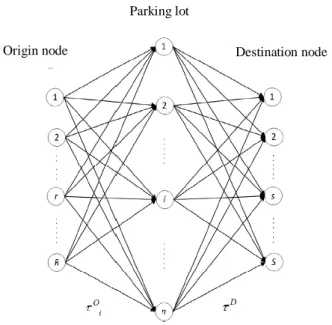
In general, we consider that drivers need to park their car in their destination zones. If they find an empty place, they will park there, and if they cannot find an empty place (because of some restrictions), they will park their vehicle in other zones, or they will not travel by car, using another transportation mode.
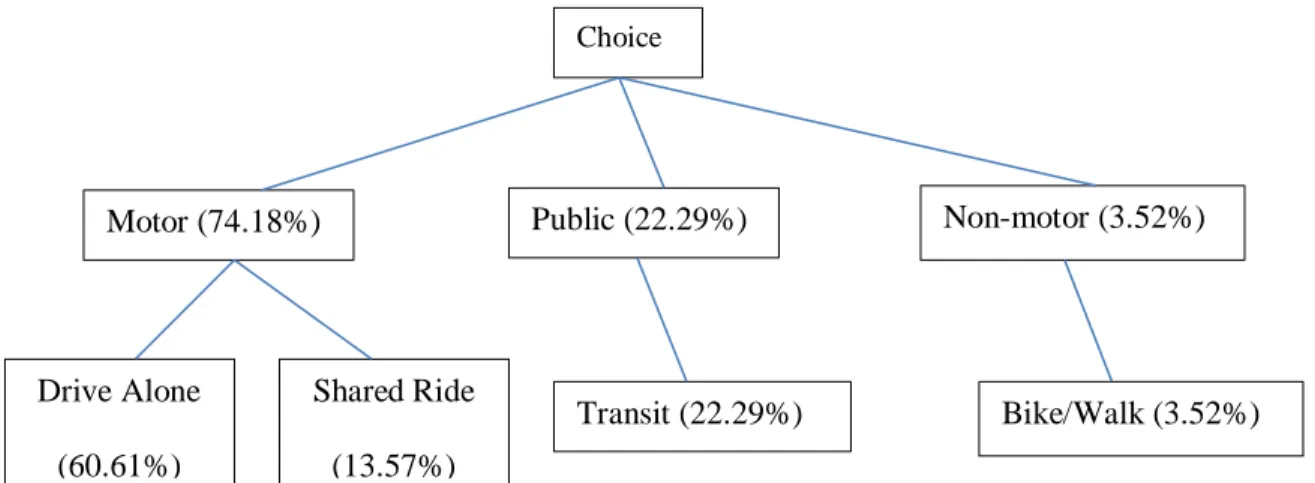
In the demand-supply approach, we try to cover the demand with some facilities (we call them supplies) and try to find the proper solutions related to the parking problem. The demand for parking happens when a traveler finds something attractive to do in a destination and he chooses to travel by his private vehicle. We assume a rational traveler selects the private vehicle over the public transportation based on the cost of the trip, which includes monetary cost and time cost. We have chosen the logit models for the problem of selecting between public transportation and private vehicles.
One important component of the travel cost by private vehicle is the parking cost. In general parking is a complementary part of a trip and the parking tariffs have an important role in the decision of traveling by car. We assign a separate role for parking price in the trip costand we will study the effects of this cost in the mode choice by logit models.
The next step of this methodology is related to the parking spaces. The parking spaces are divided into two main categories of on-street parking (curbside parking) and off-street parking (garages). These two types are normally being managed by government (or some public, municipal authority) and private companies, respectively. In the perspective of this dissertation, we believe there should be a uniform supervision on both of these parking types, in terms of facilities and pricing – we therefore analyze these two types of parking together.
The pricing strategy that we use in this thesis is based on the maximization of the total revenue, in order to find a solution for the expensive structure of off-street parking. This means we enter the choice of building or expanding an off-street parking into account, to answer the overload of demand, while we are also using other tools such as increasing the parking price. So, in this methodology we use both mechanisms (changes in parking prices and new off-street parks) to prevent excessive demand and decrease cruising for parking.
In this work, parking price has two opposite effects. First, in the demand side: by increasing the parking price, the number of travelers who uses their private vehicle decreases. This drop in number of travelers tends to reduce the total profit that we will get from the parking spots (this profit includes all parking revenues minus costs). On the other hand, increasing parking prices has a direct positive effect in the
15 revenues. So, we face a direct positive and an indirect negative effect of parking prices in total revenue. The optimization model is designed to find the optimum price for parking spaces, with respect to the expensive cost of the off-street parking structure.
In addition, underpriced parking spaces can create several externalities such as congestion of cruising for parking and harmful environmental impacts. After designing a flexible base model for the parking problem, we will try to cope with these externalities by considering them into different parts of the analysis process. The methodology will be comprehensively described in chapter 3.
1.5 Structure of the dissertation
This dissertation includes five main chapters.After a comprehensive introduction of the problem and the research scope and objectives in chapter 1, we continue with the literature review in chapter 2. Thirty-nine articles in the area of parking studies will be briefly presented and a summary of them will be presented in a table. These papers are mostly gathered based on the way they relate to parking problems and studies. In addition, we categorized parking related research activities into demand and optimization approaches. This literature review hopefully shows the diversity of perspectives related to parking problems (from 1965 to 2015). In chapter 3 we describe the adopted methodology and define the supply-demand relationship in the parking problem. In this chapter a comprehensive method related to the estimation of the demand is presented. This method starts from the concept of utility and generalized cost for a trip, and uses logit models to perform the mode choice. In addition to the demand component, the optimization model and its objectives and variables will be described in chapter 3, and the developed integrated framework will be presented in detail. The objective of this optimization model is to maximize the revenue, by considering changes in the parking tariffs and in the construction costs of the new parking garages. Chapter 4 contains the optimization approach and it will fully describe the developed mathematical models. In this chapter we will present this mathematical formulation in detail, and we will define all the variables and parameters. Another part of this chapter is devoted to the formulation of the additional parking externalities (that complemented the base model) such as cruising time and environmental issues. At the end of the chapter, a numerical example is presented to show the capabilities of of the models and to assess the results.
Finally, in chapter 5, we apply the models to a real size case study (San Francisco county) and fully test, validate and assess the whole developed approach.. In this chapter we used the accessible online travel survey related to this area, and gathered other geographical information to calibrate and run our models.
16 This dissertation is completed with the literature references, and with annexes that present all the details and figures used in this dissertation.
17
2 Related works
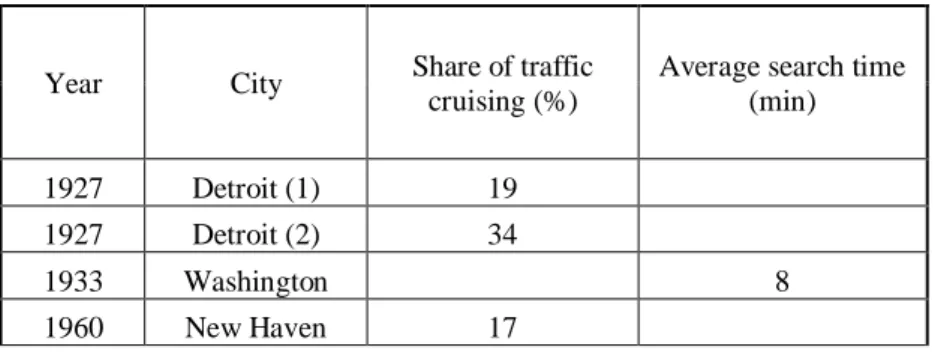
Theoretical works on parking policies and on the design of parking facilities are scarce. But, as it was shown in the previous section, the interest on this subject has increased in recent years. In particular, no comprehensive study has been done related to off-street parking. In general parking studies till now have mostly concentrated on the cruising time for parking, normally trying to study and decrease the cruising time for parking, aiming at avoiding congestion.
Among the main research projects in this topic, we would highlight the work by Donald Shoup and Richard Arnott (Arnott, 2005; Shoup, 2005), who have achieved outstanding results in the economy and in the externalities of the parking problem. In his studies Shoup (Shoup, 2005) is mostly concentrated on cruising for parking, while Arnott (Arnott, 2005) has an economic approach to this problem. They have looked at the problem in different perspectives, and have proposed practical models to address it (in this chapter, we also review some of their important works).
The parking problem itself includes a variety of subjects and, to have a comprehensive knowledge about this problem, it is necessary to investigate different types of approaches. The diversity in the research subjects is vast, covering different topics such as economic issues, demand and supply perspectives, optimization methods, cruising times, etc.
In this chapter, the reviewed papers are classified based on their specific approach, focusing on optimization, demand modeling, flexibility and environment. However, these works often have some overlaps, this meaning it is possible that we categorize an article, for instance in the demand section, and there are some contributions for other sections, such as flexibility or optimization. However, the majority of works is based on demand and supply studies. This categorization on topics such as demand, optimization, etc. allows a better understanding of the parking problem, and is used to highlight the importance of its different variables.
Finally, we will close the chapter with a comprehensive table, summarizing the findings and learnings from the reviewed works.
2.1 Optimization
The articles related to optimization are numerous. Especially in recent years researchers became more interested in using these techniques in parking studies. These works have different focus such as parking space management as it is the case of the work by Mackowski (Mackowski et al., 2015) who formulate
18 a dynamic non-cooperative bi-level model to fix parking prices in real time, for effective parking access and space utilization. Qian (Qian and Rajgopal, 2014) showed that any ideal flow pattern can be attained by charging parking prices in each area that only depend on the time or occupancy, regardless of origin and destination of users of this area. Another recent example is the paper by Inci (Inci and Lindsey, 2015) that study the downtown parking markets in which the spatial competition among the garage and curbside parking, nonlinear pricing and curbside parking search congestion are concurrently at play. Caicedo (Caicedo et al. 2012) propose a methodology for predicting real-time parking space availability, by allocating simulated parking requests and estimation of future departures. It should be mentioned that in some cases, the reviewed papers include both the demand and the optimization sides, but they may be considered in only one of these categories, because the emphasis is on one of these aspects in that specific paper.
Roth, G.J. (1965). ‘Paying for parking’. London institute of economic affairs, series of Hobart paper, 0073-2818.
Maybe “Paying for parking” by Roth (Roth, 1965) is one of the earliest attempts to present parking pricing as a problem, in a comprehensive way. Basic principles, willingness to pay for a parking space and methods for allocating the available space are just a glimpse of numerous aspects that Roth discussed in his book.
To deal with the parking problem, he mentions two fundamental principles. First, the current parking space in towns should be made available to people who needs it more. Second, since the space in town is scarce, the demand for it must compete with the demand for other land uses. These two basic principles directly or indirectly have been used in most of the parking related articles till now.
In terms of willingness to pay, two methods have been presented by Roth to allocate limited resources when the demand is unlimited. The first method is to allocate resources to people who are considered by a public authority to be in greatest need, and the second strategy is to put services and goods for rent or on sale, and allocate them to those willing to pay more.
Another important issue discussed in this work is the adverse effects of parking subsidies in public transportation. Parking subsidies encourage long term parkers, such as people who want to go to work. With regard to congestion, it is not desirable to encourage them, because they are the people who normally travel during the peak hours, and at the same time they have the alternative of using public transportation for all or part of their journeys. Moreover, cars that park on the road with no payment increase traffic congestion and, thereby, increase the cost of public transport, by decreasing the regularity of its service. Also parking spaces with artificially low prices hide the true cost of drivers’ journeys and feed the natural resistance to paying the economic public transportation fares. So, even if
19 increasing the parking fares would not alter the number of spaces in use, it would lead people to perceive public transportation fares in a better way.
Three methods are proposed for decision making for available on-street parking spaces: first come first served; time limitation; and pricing. In the “first come first served” scenario the available parking spaces go to the drivers who get them earliest. This approach is in the favor of people who travel earlier in the morning and discriminates individuals, such as shoppers, who have later arrivals.
The “time limitation” method is used to guarantee a high turnover of cars in the available parking spaces. One of the benefits of this method is fairness. “It is better for eight vehicles to be able to use a street parking space in a day, than for one to occupy it all day” (Roth, 1963). Another benefit of this approach is that it gives priority to short term parking. Normally short term parks are meant for social and business activities, that are considered to be more appropriate for private cars.
In the “pricing” method, high prices tend to decrease the demand and low prices to stimulate it. The pattern of prices suggested by this method should lead to the following situation: if the total number of parking spaces in an area is fixed, a small portion of spaces in every area should be vacant at most of the times, so that parkers could find those spots easily.
The book also presents several different charging methods for parking spaces, such as parking meters, ticket-issuing machines, personal parking meters in the vehicle, and road pricing meters. According to the author, the road pricing meter used as a personal parking meter was (at least at that time) the most interesting, with the payment for parking then being performed together with the payment for the use of road space for moving.
The following general stages to deal with the parking problem are proposed:
1. introduction of a parking system for street parking, such as parking meters, ticket issuing machines or road pricing;
2. estimation of the cost of off-street parking, given in the different zones of the area; 3. assessment of the demand for parking spaces in different zones of the area.
4. building the car parks where the demand for space is high enough to cover the costs, taking into account the effects of car parks in terms of amenity, traffic flows and other considerations.
Figure 2.1. Stages to deal with parking problem
Introduce Parking System Estimating off-street Parking Costs Evaluating the demand Building Car parks
20 In terms of the system suppliers, three possibilities exist: a private enterprise; local authorities; and the central government. For private suppliers, this business is normally unfavorable, as they mostly provide the goods in which there is the demand at prices that cover the costs. Even when charges can cover costs, hostile opinions against the payment for free parking is a big preventing point for private parties. This hostility and the existence of low parking alternatives such as on-street parking often tend to make private enterprises reluctant to invest money and effort in providing car parks.
In conclusion, “Paying for Parking” is one of the first comprehensive theoretical works on the parking problem, and the proposed framework still provides (after all these years) quite good guidelines for the design of practical, implementable solutions. However, works based on this framework have mostly concentrated on micro-simulation approaches, not adequately considering the critical role of demand.
Arnott, R., Palma, A.D., Lindsey, R. (1990). ‘A temporal and spatial equilibrium analysis of commuter parking’. Journal of Public Economics, vol. 45, pp. 301-335.
Another important theoretical work is a discussion paper (Arnott et al., 1990), examining the effects of parking spaces on the congestion of morning rush hours, and measuring the advantages of road tolls and parking fees, as tools for decreasing that congestion. In this paper, three pricing methods are considered: an optimal time varying road toll; competitively set parking fees; and optimal location dependent parking fees.
The “congestion” model that the author used in this paper was basically structured by Vickery (1969) and developed by Hendrickson and Kocur (1981), Fargier (1983), Arnott (1985) and Cohen (1987). Previous theoretical work on the dynamics of rush hour traffic congestion disregarded parking as an important aspect of urban transportation. In this paper the authors take a first step to correct this view, by testing the effects of time and costs of parking on morning travelers’ departure time and parking location decisions.
In fact he shows that when parking and road use are mostly free, travelers occupy parking spaces in order of reduced accessibility. This reaction increases the period of individuals’ arrivals at work and consequently the aggregate schedule delay costs grow. On the other hand, competitive pricing of parking tends to decrease the schedule delay costs, but cannot decrease congestion.
This work also considers time-varying road tolls and location dependent parking fees, for optimal pricing schemes. The road toll can be planned to remove congestion but it does not change the order in which parking spaces are occupied. On the contrary, the optimal location dependent parking fee considers queueing, and motivates travelers to park at the most distant spots first, so the schedule delay costs decrease significantly. It is also shown that for most practical parameter values the parking fee is
21 more effective than the road toll. Gathering tolls and road pricing has some logistical drawbacks and political oppositions – the paper therefore recommends that parking fees deserve more attention than they have had received until then.
In this paper, several features of real world parking have not been considered. First of all the authors assume that it is not necessary to search for parking spots, and that all of those spots are positioned along radial commuting routes. However, both the drivers who park the whole day or those using parking residential and commercial areas for shorter periods, are not “organized” systematically to use space by accessibility. They need to search to find an empty space to park. Search adds a random element to traveler’s arrival time, and some of the travelers do not know that they will arrive early or late for work.
Second, some differences between on-street and off-street parking may be quite important for drivers. These differences include entry and exit delays, inappropriate ramp geometry and poor visibility for some vacant spaces (Hunt. J. D. 1988). In fact, both of these parking types have their specific kinds of delays. On-street parkers interrupt traffic when they are entering or exiting a spot or by double parking. Users of off-street parking make congestion when queues grow outside parking garages. Also both of these parkers increase congestion while they are cruising for parking spaces.
“Time-of-day” or “length-of-stay” parking fees are two other important strategies that can be applied to encourage shoppers or businessmen to travel during off-pick hours. It should also be noted that some travelers use employer provided or subsidized parking – according to Shoup (1982) this will normally increase congestion.
In addition, these authors consider that the total number of travelers is fixed, but it is always possible that some of the travelers have access to carpooling or public transportation. Moreover, road tolls and parking fees can reduce congestion, by affecting the parking location decisions and the travel time, possibly decreasing the total amount of traffic.
Finally, the most important limitation of this work is possibly that the CBD is considered as a point, not as a zone. It would be more realistic and useful to model the CBD as a zone inside which employment and parking are geographically distributed. It should also be noted that drivers travel different distances on downtown roads, based on where they live. Road tolls could possibly count the traveled distances, and charge travelers based on those distances, but parking fees cannot.
22
Glazer, A. and Niskanen, E. (1992). ‘Parking fees and congestion’. Regional science and urban economics, vol. 22, pp. 123-132.
This paper tries to show that if the road usage is priced lower than optimal, the sum of the parking fees along time can induce welfare, but a parking fee per time unit cannot. In fact, increasing the parking price motivates travelers to park for a shorter time, and normally leads more drivers to park in the same spot during each day, therefore increasing traffic. Indeed the authors try to investigate the relationship between parking and congestion, proposing a model with three main characteristics.
The first characteristic is taking into account both parkers and through drivers. Travelers can park in downtown or pass by downtown while their destination is somewhere else. An optimization model is designed to maximize the social welfare per time unit, by using socially optimal parking fees, road usage fees, and a number of parking spaces. The authors conclude that when the elasticity of demand for the drivers who pass downtown is finite, an optimal sum of parking fees is positive.
In a second step they test the effect of a parking fee on the consumer welfare when profits are not returned to consumers. Basically by increasing road prices, the consumers’ welfare decreases. However, increasing the parking fees reduces the length of time each driver parks in a place, and it allows more consumers to park. This can increase the overall consumers’ welfare. So, an increase in the parking fee per time unit inevitably reduces the consumer surplus of the original parkers. But then more persons can park as each of the original drivers parks for a shorter time, and the new parkers, by some assumptions, have positive consumer surplus. If the marginal utility of each parkeris a diminishing function of the length of time he/she parks, then the losses of the original parkers can be covered by the gain of new parkers.
In a third model search costs are included. The model considers the cruising time of a driver varies with the number of other drivers who are searching for parking space, and with their cruising time. In this model all travel costs except the cruising cost are assumed to be zero. Multiple parking places are considered in the model.
In conclusion, policy makers normally view parking pricing as a substitute for road pricing, as a way to reduce congestion. But, according to this paper, the desired effects may not occur. Counting on assumptions such as “an increase in the cost of parking is equal to the increase in the travel costs” may just hold for the travelers who park for a fixed amount of time. But this assumption fails for through drivers or for the drivers who can vary their parking time. So, when a large amount of traffic is due to these types of drivers, an increase in parking fees may have no or even negative effect on congestion.
23 This paper is one of the most comprehensive sources about cruising for parking. It presents a model of drivers’ behavior about the decisions related to cruising for parking or paying for it, and it suggests it is more likely to cruise for parking when on-street parking and fuel are cheap, the driver is alone, off-street parking is expensive, the driver is willing to park for a longer time, and the driver estimates a low value for saving time. Also this model shows that changing the on-street parking prices to at least the price of nearby off-street parking can eliminate cruising. Somehow the decision of the drivers for cruising and parking is mostly in the hands of authorities who set the on-street parking prices. Their wrong decisions may lead to traffic congestion, air pollution, accidents and waste of fuel.
There are different factors that affect the drivers’ decision about cruising or paying for the parking, with several variables explaining theses decisions: hourly price of on-street parking (p); hourly price of off-street parking (m); parking duration (t); time spent for searching on-off-street parking (c); fuel cost of cruising (f); number of people in the car (n); and value of time spent on cruising (v). The saved money by parking at the curband the cruising cost for on-street parking can be computed as follow.
t(m-p) - amount of money that is saved by parking at the curb; fc - money cost of cruising for on-street parking;
nvc - monetary cost of time spent on cruising for on-street parking; fc+nvc - monetary and time cost of cruising for on-street parking.
The search time for which drivers become indifferent between cruising and paying is given by 𝑐∗ – at 𝑐∗ drivers understand that after that time, there is no net saving for them when compared to the off-street parking.
𝑐∗= 𝑡(𝑚−𝑝)
𝑓+𝑛𝑣 (1)
Analyzing the elasticity for the cruising time, five main results can be derived. First, the elasticity of cruising time with respect to the on-street parking price depends only on the on-street and off-street parking price. When the on-street parking is low, the elasticity of cruising time is also low, this meaning that an increase in the parking price has a small effect on the amount of on-street parking spaces. The on-street parking price is inelastic, and by increasing the on-street parking price there will not be more empty spaces. But, if the price of on-street parking is close to the off-street parking price, then by any small changes in the price, big changes will happen to congestion, i.e. the demand for on-street parking can be considered totally inelastic till the point that its price surpasses the off street parking price (it is in this point that the demand for on-street parking becomes very elastic).
Second, when the on-street parking is free, the elasticity of cruising time with respect to the off-street parking price is always equal to one. So, reducing a specific percentage of the off-street parking price will result in decreasing the same percentage in the willingness to spend time cruising.
24 Third, the elasticity of cruising time with respect to the parking time is also equal to one. This means that increasing the parking duration tends to correspondingly increase the cruising time. For instance, if a driver is planning to park twice longer than another driver, he/she will be willing to cruise twice longer than to find an empty on-street parking space. On-street parking is the best choice for the drivers who want to park for a short time, but the drivers who are planning to park for longer time, have higher desire to search and find an empty on-street parking space.
Fourth, the elasticity of cruising time with respect to the fuel cost depends on the number of people in the car, on the value of their time, and on the value of fuel. If the value of time of people in the car is much higher than the fuel price, then increasing in the fuel value will not have a considerable effect on cruising time. Fifth, the elasticity of cruising time with respect to the number of people in the car and their value of time is the same. This means that if there are more people in the car, or if their value of time is higher, there will be the same effect on the willingness to cruise.
Figure 2.2 describes the underpriced on-street parking case. As shown, the entire empty spaces are occupied and cars are searching along the block, to find an empty space to park. The data used in this example is from a commercial district in Los Angeles – there are 8 on-street parking spaces in each side of an average size block, with the average cruising time of 3.3 minutes before finding an empty parking space, and two drivers who are searching for a space.
Figure 2.2. Under -priced on-street parking case
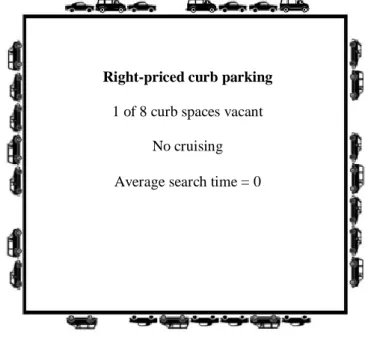
Figure 2.3 shows that situation in which the on-street parking price is set high enough, and that in each side of the block we can find an empty space between those eight spaces. It is obvious that there is no need to cruise for the drivers because they can find an empty space in each side or, if they prefer, they can park in an off-street park. So, if the parking price changes during the day in such a way that we can
Underpriced curb parking
All curb spaces are occupied
Cruising for parking Average search time = 3.3 minutes
25 see the empty spaces during the day, there will be no cruising time. The figure suggests the effects of parking prices in demand, and how correctly priced parking can help to avoid cruising.
Figure 2.3. Right -priced curb parking
However, Shoup’s paper identifies six main complications related to cruising for on-street parking. First, the value of saving time is not the same for all drivers. They may have quite different values of time for different trips, at different hours, or on different days. Even the value of time for each driver is not constant for a given trip, because as they cruise more, the possibility of arriving late to the destination increases, and after not finding a vacant space for a while, the drivers prefer to pay for off-street parking.
The second complication is that the drivers do not know how long it takes to find an empty space to park. In a regular queue, they can see how many people is in front of them, and consequently they can estimate how long it will take to pass the queue, but cruising for parking is like to be in a queue with unknown length and unknown service time. It is possible that they find a vacant space in a minute or in half an hour. The third issue is that on-street parking and off-street parking are not perfect substitutes for each other, and considering their differences just in terms of price is not sufficient. There are other important considerations such as walking time to the destination or the way back to the car. Off-street parking is less convenient in this case, because normally aboveground garages are time consuming to walk and underground garages maybe seem unsafe.
Fourth, the cost of parking spaces is not known to the drivers at the beginning of their trip, as they do not know how long they should cruise and how far they should park. Fifth, in some areas of the city, the time you can stay in an on-street parking is limited, and so the drivers who plan to stay for long may
Right-priced curb parking
1 of 8 curb spaces vacant No cruising Average search time = 0