Repositório ISCTE-IUL
Deposited in Repositório ISCTE-IUL: 2019-04-02
Deposited version: Post-print
Peer-review status of attached file: Peer-reviewed
Citation for published item:
Ferreira, M. A. M. (2017). An infinite servers queue systems simulation applied to the respective busy period time length distribution and parameters study . Acta Scientiae et Intellectus. 3 (3), 36-51
Further information on publisher's website: https://www.actaint.com
Publisher's copyright statement:
This is the peer reviewed version of the following article: Ferreira, M. A. M. (2017). An infinite servers queue systems simulation applied to the respective busy period time length distribution and
parameters study . Acta Scientiae et Intellectus. 3 (3), 36-51. This article may be used for non-commercial purposes in accordance with the Publisher's Terms and Conditions for self-archiving.
Use policy
Creative Commons CC BY 4.0
The full-text may be used and/or reproduced, and given to third parties in any format or medium, without prior permission or charge, for personal research or study, educational, or not-for-profit purposes provided that:
• a full bibliographic reference is made to the original source • a link is made to the metadata record in the Repository • the full-text is not changed in any way
The full-text must not be sold in any format or medium without the formal permission of the copyright holders.
Serviços de Informação e Documentação, Instituto Universitário de Lisboa (ISCTE-IUL) Av. das Forças Armadas, Edifício II, 1649-026 Lisboa Portugal
Phone: +(351) 217 903 024 | e-mail: [email protected] https://repositorio.iscte-iul.pt
An Infinite Servers Queue Systems Simulation Applied to the Respective
Busy Period Time Length Distribution and Parameters Study
Manuel Alberto M. Ferreira
Instituto Universitário de Lisboa (ISCTE-IUL), BRU-IUL), ISTAR-IUL, Lisboa PORTUGAL
ABSTRACT
A FORTRAN program to simulate the operation of infinite servers’ queues is presented in this work. Poisson arrivals processes are considered but not only. For many parameters of interest in queuing systems study or application, either there are not theoretical results or, existing, they are mathematically intractable what makes their utility doubtful. In this case a possible issue is to use simulation methods in order to get more useful results. In fact, using simulation, some experiences may be performed and the respective results used to conjecture about certain queue systems interesting quantities. In this paper this procedure is followed to learn something more about quantities of interest for those infinite servers queue systems, in particular about busy period parameters and probability distributions.
Key words. Infinite servers, queue, Poisson arrivals, simulation, busy period.
MSC 2010: 60G99.
INTRODUCTION
The lack of theoretical results, often difficult to obtain, or its extreme complexity that makes its utility doubtful, leads to the search for numerical methods, in particular simulation methods, in the study of queue systems.
In this work this is done for queue systems with infinite servers. The most famous and studied of these systems is the M / G / ∞ queue. For it a lot of results are known and result very clear and simple to use, see for instance (Carrillo, 1981), (Ferreira, 2002) and (Ferreira and Andrade, 2009, 2010, 2010a, 2010b, 2011, 2012).
One of the situations simulated here is related to the consideration of non-Poisson arrivals that is: with inter-arrival times not exponential for which there are no analytical results.
Other results collected are about the busy period1, for Poisson and non-Poisson arrivals. In fact any queue system has a sequence of busy periods and idle periods. A busy period followed by an idle period is a busy cycle. In the study of infinite servers systems busy periods very useful information is, for instance, about the maximum number of customers served simultaneously in a busy period. If something is known about this quantity the system may be dimensioned as a finite servers queue. As there are not analytical results the simulation is one of the issues to study it.
In the next section, details about the FORTRAN program designed to perform the simulations and the experiences performed are presented. The following section consists in the presentation of the results and the respective comments. The paper ends with a conclusions section.
THE SIMULATIONS PROCEEDING
The simulations were executed using a FORTRAN program, see Appendix, composed of:
i) A main program, in FORTRAN language, called FILAESP, ii) A subroutine GERASER,
iii) A package SSPLIB, iv) A system function RAN. The proceedings are as follows:
i) The sequential random generation of 25 000 arrivals instants, being the inter- arrivals mean time 𝜆−1= 0.99600 (a number very close to 1but not exactly 1 because of computational reasons),
ii) The generation of 25 000 service times that is added to the arrivals instants so obtaining the departure instants,
iii) The ordering of the arrivals and departure instants, through an ordering algorithm making to correspond to each arrival 1 and to each departure -1, iv) The generation, in fact, of the queue adding by order those values 1 and -1, in correspondence with the instants at which they occur,
v) The processing of the information, in iv), in order to obtain a) Data related to the state of the system2:
• Number of the visits to the assumed states, • Mean sojourn time in each one of those states. b) Data related to the busy period:
• The maximum number of customers served simultaneously in a busy period,
1 A busy period begins with the arrival of a customer to the system, being it empty, ends when a customer
abandons the system, letting it empty, there being always at least one customer in the system.
• The total number of customers served in the busy period, • The length of the busy period.
The arrivals instant generation is performed in the program FILAESP. The service times in the GERASER subroutine. The arrivals and departures instants ordering are performed in the program FILAESP through the SSPLIB package. The queue building and the processing of the information occur also in FILAESP.
In the generation of the arrivals and the departures are used sequences of pseudo-random numbers supplied by the system function RAN. In general it is made RAN (E*J), being E constant in each experience and assuming J the values from 1 to 25 000. E was chosen to be an integer with four digits.
- To the arrivals process one or two sequences of pseudo-random numbers are needed as considering M, exponential inter-arrival times, or E2, Erlang with parameter 2 inter-arrival times. In the first case it must be made an option for an integer with four digits, E, and in the second for two integers with four digits that will be designated by E and by F. The same happens with the service distribution, considering so G or G and H, as working with M or E2.
The experiences performed are described below, being 𝜇−1 the mean service time and 𝜌 = 𝜆𝜇−1 the traffic intensity.
- M / M / ∞ E = 7 528 F = 7 548 𝜇−1= 4 𝜌 = 4.016
Number of observed busy periods: 208 - M / M / ∞
E = 7 529 F = 7 549 𝜇−1= 5 𝜌 = 5.020
Number of observed busy periods: 28 - M / E2 / ∞ E = 7 528 G = 7 552 H = 6 666 𝜇−1= 4 𝜌 = 4.016
Number of observed busy periods: 337 - M / E2 / ∞
G = 6 552 H = 6 667 𝜇−1= 5 𝜌 = 5.020
Number of observed busy periods: 69 - E2 / E2 / ∞ E = 4 536 F = 4 537 G = 5 224 H = 6 225 𝜇−1= 4 𝜌 = 4.016
Number of observed busy periods: 804
- E2 / E2 / ∞ E = 4 538 F = 4 539 G = 5 228 H = 6 229 𝜇−1= 5 𝜌 = 5.020
Number of observed busy periods: 208
The mean service times considered, 4 and 5, were those for which a reasonable number of busy periods was obtained, among the highest. In fact, increasing the mean service time the observed busy periods decrease very quickly.
Note that for the systems M / M / ∞ and M / E2 / ∞, for the same values of 𝜌 the
arrivals instants generated are identical.
RESULTS PRESENTATION AND REMARKS
In Figure 1 and Figure 2 the graphics that represent the mean sojourn times in the various states3, for the M / M / ∞ system, considering ρ = 4.016 and ρ = 5.020, respectively, are presented. Beyond the observed mean values the theoretical values are also presented, see (Ramalhoto, 1983), given by
𝑇𝑀𝑖 = 𝜇 −1
𝑖 + 𝜌, 𝑖 = 0, 1, 2, … (1).
In correspondence with the various states are also indicated the number of times that they were visited, in the right columns.
state visits 0 247 1 2018 2 5970 3 9624 4 10339 5 8809 6 6106 7 3581 8 2132 9 961 10 205 11 7 Figure 1: Mean Sojourn Times, in seconds, theoretical and observed, for the M / M / ∞ queue system in states i = 0, 1,…, 11, with ρ = 4.016.
state visits 0 27 1 441 2 2190 3 5700 4 9267 5 10517 6 9042 7 6207 8 3742 9 2043 10 731 11 92 Figure 2: Mean Sojourn Times, in seconds, theoretical and observed, for the M / M / ∞ queue system in states i = 0, 1,…, 11, with ρ = 5.020.
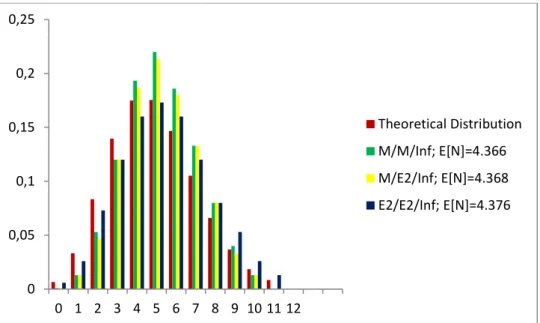
In Figure 3 and Figure 4 are shown the distributions obtained for the number of customers in the systems M / M / ∞, M / E2 / ∞ and E2 / E2 / ∞ with ρ = 4.016 and ρ = 5.020, respectively. Together is also presented the theoretical distribution, in equilibrium, for the systems M / M / ∞ and M / E2 / ∞, see (Tackács, 1962):
𝑝𝑛 = 𝑒−𝜌𝜌 𝑛 𝑛!, 𝑛 = 0, 1, 2, … (2), 0 0,2 0,4 0,6 0,8 1 1,2 0 1 2 3 4 5 6 7 8 9 10 11 12
Theoretical Mean Sojourn Times in state i=0,1, 2,3,4,5,6,7,8,9,10,11 Observed Mean Sojourn Times in state i=0,1,2,3,4,5,6,7,8,9,10,11 0 0,2 0,4 0,6 0,8 1 1,2 0 1 2 3 4 5 6 7 8 9 10 11 12
Theoretical Mean Sojourn Times in state
i=0,1,2,3,4,5,6,7,8,9,10,11 Observed Mean Sojourn Times in state
obtained performing the direct computations for ρ = 4.016 and ρ = 5.020. E [N] is the mean number of customers in the system.
Figure 3: Distribution of the Number of Customers in the System and Theoretical Distribution for the Systems M / M / ∞, M / E2 / ∞ and E2 / E2 / ∞ with ρ = 4.016.
Figure 4: Distribution of the Number of Customers in the System and Theoretical Distribution for the Systems M / M / ∞, M / E2 / ∞ and E2 / E2 / ∞ with ρ = 5.020.
These Figures suggest some similarity of behaviour among the empirical distributions and the theoretical distribution. Particularly, in the whole of them the mode
0 0,05 0,1 0,15 0,2 0,25 0 1 2 3 4 5 6 7 8 9 10 11 12 Theoretical Distribution M/M/Inf; E[N]=4.366 M/E2/Inf; E[N]=4.368 E2/E2/Inf; E[N]=4.376 0 0,05 0,1 0,15 0,2 0,25 0 1 2 3 4 5 6 7 8 9 10 11 12 Theoretical Distribution M/M/Inf; E[N]=5.269 M/E2/Inf; E[N]=5.273 E2/E2/Inf; E[N]=5.316
is identical to the one of the theoretical distribution. But although for the systems M / M / ∞ and M / E2 / ∞ the empirical distributions are more concentrated around the mode, in comparison with the theoretical distribution, the opposite happens to the system E2 / E2 / ∞. And, surprisingly because for this system it is not known the theoretical distribution, the empirical distributions obtained for E2 / E2 / ∞ seems closer to the theoretical distribution than the ones of the other systems.
As for the differences observed between the systems M / M / ∞ and M / E2 / ∞, for the number of the customers in the system, the adequate interpretation may be as follows: although the systems reach certainly the equilibrium, since the number of the simulated arrivals is quite large there is a strong presence of an initial transitory trend that must last a long time. Note, observing Figure 1 and Figure 2, that the mean sojourn times observed and theoretical, given by (1), for the system M / M / ∞ are quite close. This closeness is better for the states to which corresponds greater frequency.
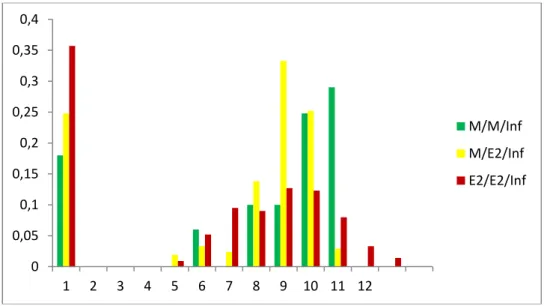
In Figure 5 and Figure 6, about the maximum number of customers served simultaneously in the busy period, it is remarked great diversity in the distributions form. It is always observed a great frequency for the state 1. In the E2 / E2 / ∞ infinite systems it is always the mode. Curiously, these systems being able to serve any number of customers, present, in these simulations, few customers being served simultaneously: never above the number 14, only assumed by E2 / E2 / ∞ infinite systems. This fact is acceptable, in terms of the theoretical distribution, since in the Poisson distribution the values greater than the mode, far away from it, are little probable. Note still that, excluding from this analysis the state 1, the distributions of maximum number of customers served simultaneously in the E2 / E2 / ∞ infinite systems busy period are more scattered than those of the others. This is in accordance with the fact that, for the same number of arrivals, much more busy periods are observed for the E2 / E2 / ∞ infinite systems.
Figure 5: Distribution of the Maximum Number of Customers Served Simultaneously in a Busy Period for the Systems M / M / ∞, M / E2 / ∞ and E2 / E2 / ∞ with ρ = 4.016. 0 0,05 0,1 0,15 0,2 0,25 0,3 0,35 0,4 1 2 3 4 5 6 7 8 9 10 11 12 M/M/Inf M/E2/Inf E2/E2/Inf
Figure 6: Distribution of the Maximum Number of Customers Served Simultaneously in a Busy Period for the Systems M / M / ∞, M / E2 / ∞ and E2 / E2 / ∞ with ρ = 5.020.
Figure 7 suggests a more and more smooth behaviour of the busy period lengths distribution frequency curve when going from M / M / ∞ system for the M / E2 / ∞ system and then for the E2 / E2 / ∞ system. The whole of them present a great frequency concentration for the lowest values of the busy period lengths but, in the case of M / M / ∞ system, the interval along which the observations spread has more than the double of the length of the other systems. Remember, again, that for the M / M / ∞ system much
ρ = 4.016
Figure 7: Distribution of Observed Busy Period Lengths, in seconds, for the Systems M / M / ∞, M / E2 / ∞ and E2 / E2 / ∞ with ρ = 4.016. 0 0,05 0,1 0,15 0,2 0,25 0,3 0,35 0,4 1 2 3 4 5 6 7 8 9 10 11 12 M/M/Inf M/E2/Inf E2/E2/Inf 0 0,1 0,2 0,3 0,4 0,5 0,6 0,7 0,8 51 251 451 651 851 M/M/Inf 0 0,1 0,2 0,3 0,4 0,5 0,6 25 125 225 325 425 M/E2/inf 0 0,1 0,2 0,3 0,4 0,5 0,6 0,7 0,8 53 123 193 263 333 E2/E2/Inf
less busy periods are observed than for the M / E2 / ∞ system and, for this one less than for the E2 / E2 / ∞ system. Then the curve of frequencies for the M / M / ∞ system spreads along that interval with two deep valleys. The one of the M / E2 / ∞ system presents also two valleys, but less deep, and in E2 / E2 / ∞ system practically they are not observed. Note, also that those valleys occur for different values in the M / M / ∞ and M / E2 / ∞ systems.
Figure 8 suggests a greater similarity among the busy period lengths distributions of the various systems. Again it is observed a great concentration in the lowest values,
ρ = 5.020
Figure 8: Distribution of Observed Busy Period Lengths, in seconds, for the Systems M / M / ∞, M / E2 / ∞ and E2 / E2 / ∞ with ρ = 5.020.
although lesser than in Figure 7. But now the whole of them present one valley, ocurring for different values. Still goes on observing a great disparity among the maximum values assumed by the busy period lengths.
It seems obvious, either in Figure 7 or in Figure 8, a sharp observations lack in the intermediate values zone for the busy period lengths.
Note also that the Figures 7 and 8 are in accordance with the studies that point in order that the busy period length distribution of the M / G / ∞ system is right asymmetric and leptokurtic see (Ferreira and Ramalhoto, 1994).
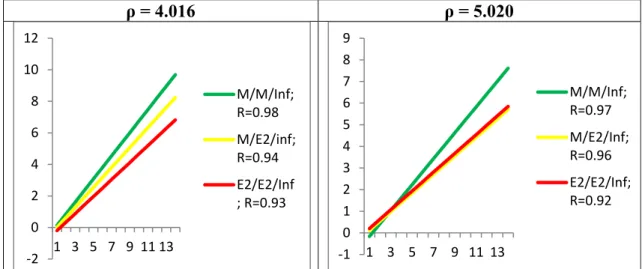
Call X and Y the maximum number of customers served simultaneously and the total number of served customers, respectively, in the busy period. Performing the regression of Z = lnY on X, the results obtained are presented graphically in Figure 9 and the most interesting fact is, maybe, the similarity of the lines behaviour, for the various
0 0,1 0,2 0,3 0,4 0,5 0,6 310 2170 4030 M/M/Inf 0 0,05 0,1 0,15 0,2 0,25 0,3 0,35 0,4 0,45 0,5 105 525 945 1365 M/E2/inf 0 0,1 0,2 0,3 0,4 0,5 0,6 0,7 0,8 0,9 1 40 200 360 520 E2/E2/Inf
systems, for the two values of ρ considered. In fact, among the whole considered systems there is a great resemblance of the values of 𝛼̂ (the intercept) and 𝛽̂(the slope) for the
ρ = 4.016 ρ = 5.020
Figure 9: Regression of Z over X, for the Systems M / M / ∞, M / E2 / ∞ and E2 / E2 / ∞ with ρ = 4.016 and ρ = 5.020. R is the Linear Correlation Coefficient.
two values of ρ considered. Actually, it seems natural that the relation between Z and X does not depend on ρ. The values of ρ will only influence the values of Z and X that may occur and not the relation between them. Otherwise, will it be true that the differences observed in the values of 𝛼̂ and 𝛽̂ , for the various systems, not being too great, allows facing the hypothesis that the relation between Z and X is identical for those systems? Maybe yes if it is paid attention to the similarities observed in its behaviour, namely the ones related with the distribution of the number of customers in the various systems.
CONCLUDING REMARKS
It is manifest the great waste of these systems when looking to the maximum number of customers present simultaneously in the system.
It is uncontroversial, also, that there is a strong exponential relation between the maximum number of customers served simultaneously in a busy period and the total number of served customers. The question is if either it is always the same or how will it change either with the values of ρ or from system to system.
On the busy period it is important to note also:
i) The great occurrence of busy periods with only one served customer,
ii) The great amplitude of the interval at which occur the values of the lengths of the busy periods, although with a great irregularity, and a great occurrence of low values.
The results of these simulations seem to suggest also that the systems GI /G / ∞ may be quite well approximated by systems M / G / ∞, at least when the GI process possesses a regularity not very far from the one of the Poisson process.
-2 0 2 4 6 8 10 12 1 3 5 7 9 11 13 M/M/Inf; R=0.98 M/E2/inf; R=0.94 E2/E2/Inf ; R=0.93 -1 0 1 2 3 4 5 6 7 8 9 1 3 5 7 9 11 13 M/M/Inf; R=0.97 M/E2/Inf; R=0.96 E2/E2/Inf; R=0.92
REFERENCES
1) Andrade, M. (2010). A Note on Foundations of Probability. Journal of Mathematics and Technology, vol.. 1, No 1, pp 96-98.
2) Carrillo, M. J. (1991). Extensions of Palm’s Theorem: A Review. Management Science, Vol. 37, No 6, pp. 739-744.
3) Ferreira, M. A. M. (1994). Simulação de variáveis aleatórias – Método de Monte Carlo. Revista Portuguesa de Gestão, I (III/IV), pp. 119-127.
4) Ferreira, M. A. M. (1998). Application of Ricatti Equation to the Busy Period Study of the MG System. Statistical Review, 1st Quadrimester, INE, pp. 23-28.
5) Ferreira, M. A. M. (1998a). Computational Simulation of Infinite Servers Systems. Statistical Review, 3rd Quadrimester, INE, pp. 5-28.
6) Ferreira, M. A. M. (2001). MG Queue Heavy-Traffic Situation Busy Period Distribution (Power and Pareto Service Distributions). Statistical Review, 1st Quadrimester, INE, pp. 27-36.
7) Ferreira, M. A. M. (2002). The Exponentiality of the MG Queue Busy Period. Actas das XII Jornadas Luso-Espanholas de Gestão Científica, Volume VIII- Economia da Empresa e Matemática Aplicada. UBI, Covilhã, Portugal, pp. 267-272.
8) Ferreira, M. A. M. and Andrade, M. (2009). The Ties Between the M/G/ Queue System Transient Behaviour and the Busy Period. International Journal of Academic Research Vol. 1, No 1, pp. 84-92.
9) Ferreira, M. A. M. and Andrade, M. (2010). Looking to a M/G/ system
occupation through a Ricatti equation. Journal of Mathematics and Technology, Vol. 1, No 2, pp. 58-62.
10) Ferreira, M. A. M. and Andrade, M. (2010a): M/G/ System Transient Behavior with Time Origin at the Beginning of a Busy Period Mean and
Variance. Aplimat- Journal of Applied Mathematics, Vol. 3, No 3, pp. 213-221. 11) Ferreira, M. A. M. and Andrade, M. (2010b). M/G/ Queue Busy Period Tail.
Journal of Mathematics and Technology, Vol. 1, No 3, 11-16.
12) Ferreira, M. A. M. and Andrade, M. (2011). Fundaments of Theory of Queues. International Journal of Academic Research, Vol. 3, No 1, part II, pp. 427-429. 13) Ferreira, M. A. M. and Andrade, M. (2012). Busy Period and Busy Cycle
Distributions and Parameters for a Particular M/G/oo queue system. American Journal of Mathematics and Statistics, Vol. 2, No 2, pp. 10-15.
14) Ferreira, M. A. M. and Andrade, M. (2013). Infinite Servers Queue Systems Computational Simulation. 12th Conference on Applied Mathematics, APLIMAT 2013, Proceedings. Bratislava 5th-7th February.
15) Ferreira, M. A. M. and Ramalhoto M. F. (1994). Estudo dos parâmetros básicos do Período de Ocupação da Fila de Espera MG. A Estatística e o Futuro da Estatística. Actas do I Congresso Anual da S.P.E.. Edições Salamandra, Lisboa
.
16) Ferreira, M. A. M., Andrade, M. and Filipe, J. A. (2008). The Ricatti Equation in the MG Busy Cycle Study. Journal of Mathematics, Statistics and Allied Fields Vol. 2, No 1.
17) Ferreira, M. A. M., Andrade, M. and Filipe, J. A. (2009). Networks of Queues with Infinite Servers in Each Node Applied to the Management of a Two Echelons Repair System. China-USA Business Review Vol. 8, No 8, pp. 39-45 and 62.
18) Figueira, J. and Ferreira, M. A. M. (1999). Representation of a Pensions Fund by a Stochastic Network with Two Nodes: An Exercise. Portuguese Revue of Financial Markets, Vol. I, No 3.
19) Hershey, J. C., Weiss, E. N. and Morris, A. C. (1981). A Stochastic Service Network Model with Application to Hospital Facilities. Operations Research, Vol. 29, No 1, pp. 1-22.
20) Kelly, F. P. (1979). Reversibility and Stochastic Networks. New York: John Wiley and Sons.
21) Kendall and Stuart (1979). The Advanced Theory of Statistics. Distributions Theory. London. Charles Griffin and Co., Ltd. 4th Edition.
22) Kleinrock, L. (1985). Queueing Systems. Vol. I and Vol. II. Wiley- New York, 1985.
23) Metropolis, N. and Ulan, S. (1949). The Monte Carlo Method. Journal of American Statistical Association, Vol. 44, No 247, pp. 335-341.
24) Murteira, B. (1979). Probabilidades e Estatística,. Vol. I. Editora McGraw-Hill de Portugal, Lda. Lisboa.
25) Ramalhoto, M. F. (1983). A Note on the Variance of the Busy Period of the MG Systems. Centro de Estatística e Aplicações, CEAUL, do INIC e IST. 26) Stadje, W. (1985):.The Busy Period of the Queueing System MG. Journal
of Applied Probability, Vol. 22, pp. 697-704.
27) Syski, R. (1960). Introduction to Congestion Theory in Telephone Systems, Oliver and Boyd- London.
28) Syski, R. (1986). Introduction to Congestion Theory in Telephone Systems. North Holland. Amsterdam.
29) Tackács, L. (1962). An Introduction to Queueing Theory. Oxford University Press. New York.
APPENDIX
PROGRAM FILAESP
C APAGUE 666 OU 555 CONFORME QUEIRA TEMPO INTERCHEGADAS C EXPONENCIAL OU ERLANG DE PARAMETRO 2
DIMENSION V(25000),Y1(25000),Y2(25000),TEPSER(25000) DIMENSION C(25000),AUX(50000),P(25000),N(50000),F(50000) DIMENSION Z(50000),VAL(50000),ARG(50000) DIMENSION NO(0:50000),T(0:25000),TM(0:25000) DIMENSION TTR(0:25000),TMR(0:25000) DIMENSION BUPE(0:25000),NA(0:25000)
WRITE(*,*)’O CODIGO DOS SERVICOS E: 0 PARA A PARETO, 1 PARA A’ WRITE(*,*)’EXPONENCIAL, 2 PARA A ERLANG, 3 PARA A LOGNORMAL,’ WRITE(*,*)’4 PARA A MISTURA DE EXPONENCIAIS COM RPARAMETRO,’ WRITE(*,*)’5 PARA A MISTURA DE ERLANG.’
WRITE(*,*)’ ’
WRITE(*,*)’ QUAL E O CODIGO DA DISTRIBUICAO DE SERVICO?’ READ(*,*) ICOD
WRITE(*,*)’ ’
WRITE(*,*)’ BOA SORTE NA VIAGEM AO MUNDO DA SIMULACAO ’ WRITE(*,*)’ ’ WRITE(*,*)’ ’ U=0.99600 DO 100 I=1,25000 555 V(I)=ALOG(RAN(E*I))*(-U/2.0) 666 V(I)=ALOG(RAN(E*I))*(-U/2.0)+ALOG(RAN(F*I))*(-U/2.0) 100 CONTINUE CALL GERASER(TEPSER) C(1)=V(1) Z(1)=C(1) F(1)=1 Z(25001)=V(1)+TEPSER(1) F(25001)=-1 DO 500 I=2,25000 C(I)=C(I-1)+V(I) P(I)=C(I)+TEPSER(I) Z(I)=C(I) F(I)=1 Z(I+25000)=P(I) F(I+25000)=-1 500 CONTINUE X=0.0 ICOL=1 IROW=50000 NDIM=50000 CALL ATSG(X,Z,F,AUX,IROW,ICOL,ARG,VAL,NDIM) N(1)=1 DO 600 I=2,50000 N(I)=N(I-1)+VAL(I) 600 CONTINUE MAX=1 DO 650 I=2,50000ESTRE DE 1998 IF (N(I).GE.MAX)MAX=N(I) 650 CONTINUE
WRITE(10,*)’ SIMULACAO FILA DE ESPERA M|G| ‘ DO 700 K=0,MAX
WRITE(10,*)’ TEMPOS DE RECORRENCIA DO ESTADO ‘,K J=1
NO(K)=0 T(K)=0.0 TM(K)=0.0 DO 660 I=1,49999
IF(N(I).EQ.K) THEN NO(K)=NO(K)+1 T(K)=T(K)+(ARG(I+1)-ARG(I)) J=J+1 ENDIF 660 CONTINUE DO 1000 J=1,NO(K)-1 TTR(K)=TTR(K) 1000 CONTINUE IF(NO(K).NE.0)TM(K)=T(K)/NO(K) IF(NO(K).GT.1)TMR(K)=TTR(K)/(NO(K)-1) IF(NO(K).EQ.1)TMR(K)=0 WRITE(10,*)’ESTADO’,K
WRITE(10,*)’NUMERO DE VISITAS =’,NO(K) WRITE(10,*)’TEMPO DE PERMANENCIA =’,T(K)
WRITE(10,*)’TEMPO MEDIO DE PERMANENCIA =’,TM(K) WRITE(10,*)’TEMPO TOTAL DE RECORRENCIA =’,TTR(K) WRITE(10,*)’TEMPO MEDIO DE RECORRENCIA =’,TMR(K) 700 CONTINUE TTBUPE=ARG(50000)-ARG(1)-T(0) NTBUPE=1+N0(0) TMBUPE=TTBUPE/NTBUPE TTIDP=T(0) NTIDP=NO(0) TMIDP=TM(0)
WRITE(10,*)’NO TOTAL DE PERIODOS DE OCUPACAO =’,NTBUPE WRITE(10,*)’TEMPO TOTAL DE BUSY PERIOD =’,TTBUPE WRITE(10,*)’TEMPO MEDIO DE BUSY PERIOD =’,TMBUPE
WRITE(10,*)’NO TOTAL DE PERIODOS DE DESOCUPACAO =’,NTIDP WRITE(10,*)’TEMPO TOTAL DE IDLE PERIOD =’,TTIDP
WRITE(10,*)’TEMPO MEDIO DE IDLE PERIOD =’,TMIDP BUPE(0)=0 NA(0)=1 NP=0 DO 5000 I=1,49999 IF(N(I).EQ.0) THEN NP=NP+1
WRITE(10,*)’BUSY PERIOD NUMERO’,NP NA(NP)=I NB=0 DO 4000 J=NA(NP-1),NA(NP)-1 IF(N(J+1).GT.N(J))NB=NB+1 4000 CONTINUE IF(NP.EQ.1)NB=NB+1
WRITE(10,*)’NUMERO DE CLIENTES ATENDIDOS=’,NB MAXI=1
DO 3900 J=NA(NP-1),NA(NP)
I IF(N(J).GE.MAXI) MAXI=N(J) 3900 CONTINUE
WRITE(10,*)’NUMERO MAXIMO DE CLIENTES ATENDIDOS SIMULTANEAMENTE=’,MAXI BUPE(NP)=ARG(I+1) RBUPE=BUPE(NP)-BUPE(NP-1)-ARG(I+1)+ARG(I) IF(NP.EQ.1)RBUPE=BUPE(1)-ARG(I+1)+ARG(I)-ARG(1) WRITE(10,*)’COMPRIMENTO=’,RBUPE ENDIF 5000 CONTINUE NP=NP+1
WRITE(10,*)’BUSY PERIOD NUMERO=’,NP NB=0
DO 4001 J=NA(NP-1),49999
IF(N(J+1).GT.N(J))NB=NB+1 4001 CONTINUE
IF(NP.EQ.1)NB=NB+1
WRITE(10,*)’NUMERO DE CLIENTES ATENDIDOS=’NB MA=1
DO 4002 J=NA(NP-1),50000 IF(N(J).GE.MA)MA=N(J) 4002 CONTINUE
WRITE(10,*)’NUMERO MAXIMO DE CLIENTES ATENDIDOS SIMULTANEAMENTE=’MA RBUPE=ARG(50000)-BUPE(NP-1)
IF(NP.EQ.1)RBUPE=ARG(50000)-ARG(1) WRITE(10,*)’COMPRIMENTO= ’,RBUPE END
DIMENSION T(25000) ICOD=2 IF (ICOD.EQ.0) THEN
PRINT*, ‘INTRODUZA O VALOR DO COEFICINTE DE VARIACAO’ READ*,GAMA
ALFA=2*GAMA/(GAMA-1.0) RK=E*(GAMA+1.0)/(2*GAMA) ELSEIF (ICOD.EQ.4) THEN
PRINT*,’INTRODUZA O VALOR DO PARAMETRO DA MISTURA’ READ(*,*)RPARAMETRO ENDIF IX=35 IY=43 IIX=9 IJX=5 IKX=11 ILX=13 DO 10 I=1,250000 CALL RANDU(IX,IY,FL) IF(ICOD.EQ.O) THEN T(I)=RK/(1-FL)**(1.0/ALFA) ELSE IF (ICOD.EQ.1) THEN T(I)=-7.0*ALOG(RAN(G*I)) ELSE IF (ICOD.EQ.2) THEN
T(I)=-(4.0/2.0)*ALOG(RAN(G*I))-(4.0/2.0)*ALOG(RAN(H*I)) ELSE IF (ICOD.EQ.3) THEN
CALL RANDU(JX,IJY,YFFL) IJX=IJY
T(I)=EXP((-2*ALOG(YFFL))**(0.5)*COS(8*ATAN(1.0)*FL)) ELSE IF (ICOD.EQ.4) THEN
CALL RANDU (IKX,IKY,RFL) IKX=IKY
CALL RANDU (ILX,ILY,SFL) ILX=ILY IF (FL.LE.RPARAMETRO) THEN T(I)=-(3.45/2.0)*(1.0/RPARAMETRO)*LOG(RFL) ELSE T(I)=-(3.45/2.0)*(1.0/1.0-RPARAMETRO)*LOG(SFL) ENDIF
ELSE IF (ICOD.EQ.5) THEN CALL RANDU (IKX,IKY,RFL) IKX=IKY
CALL RANDU (ILX,ILY,SFL) ILX=ILY
CALL RANDU (IMX,IMY,TFL) IMX=IMY
CALL RANDU (INX,INY,UFL) INX=INY
CALL RANDU (IPX,IPY,VFL) IPX=IPY
CALL RANDU (IQX,IQY,WFL) IQX=IQY
IF(RFL.LT.0.400) THEN
T(I)=-((10.0/2.7)/4.0)*(LOG(UFL)+LOG(SFL)+LOG(TFL)+LOG(WFL)) ELSE IF ((RFL.GT.0.4000).AND.(RFL.LT.0.75)) THEN T(I)=-((10.0/4.2)/2.0)*(LOG(VFL)+LOG(WFL)) ELSE IF (RFL.GT.0.75) THEN T(I)=-((10.0/3.6)/3.0)*(LOG(VFL)+LOG(WFL)+LOG(SFL)) ENDIF ENDIF 10 CONTINUE END