A Multi-Agent expert SySteM
Shell for ShApe grAMMArS
FIlIpe SANToS, JoAquIm ReIS, peDRo lopeS, AleXANDRA pAIo, SARA eloy AND VASCo RAToInstituto Universitário de Lisboa (ISCTE-IUL), Lisbon, Portugal [email protected]
Abstract. This paper proposes a multi-agent rule based architecture of a computational system for supporting generic work with shape gram-mars. The key ideas and technologies involved are presented. This computational system is being developed and will give support to an urban and architecture research based on shape grammar theories. Keywords. Shape grammars; rule based systems; multi agent systems. 1. introduction
During almost 40 years research in Shape Grammars has been focused in con-ceptual and theoretical aspects (Stiny and Gips 1972, (Stiny 1980a, 1990, 1992, 2001, Knight 1993) and in analysis (Stiny 1977, Stiny and mitchell 1978, 1980, Knight 1989, Koning and eisenberg 1981). Work has also been done in synthesis (Stiny 1980b, Heisserman 1994, Agarwal and Cagan 1998, Duarte 2005) and in developing algorithms for shape manipulation in the rule appli-cation processes (Krishnamurti 1980, 1981, 1992, Krishnamurti and Stouffs 1997). only more recently investigation has been oriented to more practical aspects of computer implementation including interfaces and generic inter-preters of shape grammars (Tapia 1999, liew 2004, mcGill and Knight 2004, li et al. 2009). For an historic and panoramic perspective on shape grammars see (Chau 2004) or (Chase 2010). However, as far as we understand, shape knowledge within these specific design applications is represented in a proce-dural ad hoc way and is therefore too rigid for further improvements.
We believe that a declarative knowledge-based approach would offer more flexibility to face new design situations and improve shape reasoning capabilities.
This paper proposes Generic Shape Grammars (GSG), a multi-agent rule based expert system shell to computationally support generic work with Shape Grammars. We start by describing the GSG project, with its key ideas and technologies involved and then propose a computational architecture. Finally we mention the emerg.cities4all project, an on-going research on urbanism and architecture based in shape grammar theories that will have the compu-tational support of GSG and which will also offer an opportunity to test GSG in a practical scope.
2. the gSg project
Within this project we are developing a configurable and extensible computa-tional system tool to support generic work with shape grammars (applicable to different fields, e.g., design, architecture, creative composition, education). This system will provide support to analysis and synthesis of languages of designs, including style extraction and representation into shape grammars, automatic spatial relation driven, parsing/analysis and computer supported generation/synthesis. The main objective is to provide an expert system shell for developing shape grammars based systems, i.e., a tool providing the minimum software machinery to develop such systems and also with a con-figurable computational architecture allowing application based extensions according to different domain subjects, specialists and users.
our actual research in GSG is centred on a generic shape grammar inter-preter for shape computing, with reasoning capabilities about shapes and shape spatial relations and shape emergence, with an intuitive visual and symbolic interface and with advanced options for more complex work. Of course, the declarative and symbolic representation of shapes plays a key role.
3. technologies involved and system architecture
The system relies heavily on Artificial Intelligence and Distributed Artificial Intelligence techniques and tools: heuristics and heuristic search, symbolic programming, symbolic knowledge representation and reasoning, logic, Rule Based Systems (RBS; both forward and backward reasoning) (Russell and Norvig 2003) and agents and multi-Agent Systems (mAS) (Weiss 1999). Human-computer interaction will also be relevant since there are three types of users:
system specialist: builds and expands the
• shell;
shape grammar specialist: with the
• shell builds a system applied to a specific
area;
common user: applies the system to create solutions in the specific area. •
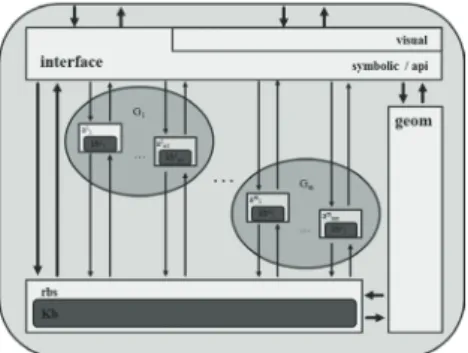
The computational system archi-tecture is depicted in figure 1. There are two core modules, the geom and the rbs module, and an additional
interface module. Basically, the geom
and rbs modules together provide the shape computing and reasoning capa-bilities. The interface module provides communication with the user, includ-ing facilities for shape and rule input/ output and edition, a shape grammar interpreter, and system customisation and extension.
The interface has a visual component (a user interface) and a symbolic/ programmatic component. The former is built on the latter, which is also avail-able, as an ApI (Application programmer’s Interface), for the user, mainly for the system specialist or the shape grammar specialist, in order to allow for system customisation and extension, and to develop specific shape grammar systems tailored to specific needs/applications.
The geom module provides operations on shapes (sub-shape and shape sum, difference and intersection and reduction to maximal shape) and shape trans-formations (translation, rotation, reflection, scale). The rbs module provides knowledge based representation and reasoning with shapes, shape spatial rela-tions and shape emergence, and is built on a rule based expert system shell, with its inference engine and a global Knowledge Base. As shape grammars systems are essentially (forward reasoning) rule based production systems (dealing additionally with shape computation and emergence) it seems natural to use the rule based system paradigm here. Within an option for the shape grammar specialist and for complex problems, the GSG architecture borrows also concepts and practice from the mAS paradigm. The mAS paradigm views the problem solving effort as distributed amongst interacting autono-mous, intelligent/proactive and/or reactive program modules, or agents. These agents can collaborate with each other in multiple coordinated ways ranging from purely cooperative to purely competitive.
In the GSG computational architecture there are (optionally) groups Gi of agents ai
j, as shown in figure 1. Basically, these agents are RBSs through which complex shape grammar design problem data, computation and rea-soning processes can be distributed. Which groups Gi will exist, or which specialist agents ai
j will compose each group, in the system will depend on the application. For instance, in figure 2 we depict a possible instantiation
Figure 1. GSG architecture as a multi-agent rule-based system shell.
of the architecture just described for the Emerg.cities4all case, described in the next section. This multi-agent rule based archi-tecture has already been sketched in some previous work (Reis 2008).
There are two main advantages of using the mAS paradigm here. First, a kind of emergence can happen where unexpected design solutions are generated when auton-omous agent interaction in exploring parts of solutions in huge solution spaces comes into play. Second, in practical applications, huge and complex problem data,
computa-tions and reasoning processes may be conveniently distributed and modular-ised by using agents as the main module units. Different agents may be used with different specific roles and expert knowledge in a natural way for differ-ent practical aspects, such as: differdiffer-ent drawing views (as in compound and parallel grammars), different stages of building a design, different levels of complexity of the language of designs (as in the hierarchy urbanism/architec-ture/construction), different tasks (as in drawing and colouring in painting), different styles, different roles in a design task (e.g., generating, evaluating and criticising, analysing), different parts of the computational system (e.g., interface and presentation, interpreter and rule execution, shape operations, reasoning with shapes and spatial relations).
4. emerg.cities4all
The emerg.Cities4all is a research project being developed to generate urban and architecture designs. The project aims to produce a generative computer-aided planning system for cities in portuguese-speaking countries in Africa and South America for low-income housing. It uses shape grammars as a descriptive method using GSG as a tool. emerg.Cities4all will encompass several scales of intervention, ranging from the physical level of the city to the level of building construction. modular, scalable, adaptable, customisable and affordable urban and housing unit solutions are the design goals. The proposed solutions must be environmentally sustainable and energy efficient, while respecting certain social and cultural qualities in the context of new portuguese-speaking emerging urbanities. Several studies have been devel-oped considering Architecture and urbanism design but only few have been translated to a real computerised implementation using a shape grammar interpreter: on an architectural and construction level, the grammar of queen
Figure 2. GSG architecture instanti-ated for the case of the Emerg.Citie-s4all project.
Anne houses (Flemming 1987), the malagueira grammar (Duarte 2005), the yingzao fashi grammar (li 2002) and, on an urban level, the marrakech medina grammar (Duarte et al. 2007), CityZoom (Grazziotin et al. 2007) and City Induction (Beirão et al. 2010). These are some notable exceptions, which, nevertheless, present approaches different from ours. The main challenges of our approach are the ability to integrate flexibility and adaptability, supporting a larger number of conditions and constraints and being able to evaluate and control the results. In the emerg.Cities4all project we are currently developing a declarative language that would be used to represent shape grammars and also agents, their behavior and interaction.
5. Conclusion
We described the key ideas, technologies and system architecture involved in the multi‑agent rule‑based expert system shell for shape grammars that we are developing. Symbolic knowledge representation and reasoning, Rule Based Systems and multi-Agent Systems are the core in this system. These are important features, especially in applications where huge and complex problem data, computations and reasoning processes are involved.
references
Agarwal, m. and Cagan, J.: 1998, A blend of different tastes: the language of coffeemakers,
Environment and Planning B, 25(2), 205–226.
Beirão, J., mendes, G., Duarte, J. and Stouffs, R.: 2010, Implementing a generative urban design model. Grammar-based patterns for urban design, in Schmitt, G. et al. (eds.), Proc.
28th eCAADe Conference, Zürich, 265–274.
Chase, S. C.: 2010, Shape grammar implementations: the last 36 years (Shape grammar imple-mentation: from theory to useable software), Design Computing and Cognition Workshop, Stuttgart, July 2010.
Chau, H. H.: 2004, evaluation of a 3D shape grammar implementation, in Gero, J. S. (ed.),
Proc. Design Computation and Cognition ’04, 357–376.
Duarte, J. p.: 2005, A discursive grammar for customizing mass housing: the case of Siza’s houses at malagueira, Automation in Construction, 14(2), 265–275.
Duarte, J. p., Rocha, J. m. and Soares, G. D.: 2007, unveiling the structure of the marrakech medina: a shape grammar and an interpreter for generating urban form, Artificial
Intelli-gence for Engineering Design, Analysis and Manufacturing, 21(4), 317–349.
Flemming, u.: 1987, more than the sum of its parts: the grammar of queen Anne houses,
Envi-ronment and Planning B, 14(3), 323–350.
Grazziotin, p., Turkienicz, T. and Bellaver, B.: 2007, CityZoom – a visualization tool for the assessment of planning regulation, in Kieferle, J. and ehlers, K. (eds.), Proc. 25th eCAADe
Conference, Frankfurt am main, 79–95.
Heisserman, J.: 1994, Generative geometric design, IEEE Computer Graphics and
Applica-tions, 14(2), 37–45.
Knight, T. W.: 1989, Transformations of De Stijl art: the paintings of Georges Vantongerloo and Fritz Glarner, Environment and Planning B, 16(1), 51–98.
Knight, T.W.: 1993, Color grammars: the representation of form and color in design, Leonardo,
Koning, G. and eisenberg, J.: 1981, The language of the prairie: Frank lloyd Wright’s prairie houses, Environment and Planning B, 8(3), 295–323.
Krishnamurti, R.: 1980, The arithmetic of shapes, Environment and Planning B, 7(4), 463–484.
Krishnamurti, R.: 1981, The construction of shapes, Environment and Planning B, 8(1), 5–40. Krishnamurti, R.: 1992, The maximal representation of a shape, Environment and Planning B,
19(3), 267–288.
Krishnamurti, R. and Stouffs, R.: 1997, Spatial change: continuity, reversibility, and emergent shapes, Environment and Planning B, 24(3), 359–384.
li, A. I.: 2002, A prototype interactive simulated shape grammar, in Koszewski, K. and Wrona, S. (eds.), Proc. 20th eCAADe Conference, Warshaw, 314–317.
li, A. I., Chen, l., Wang, y. and Chau, H. H.: 2009, editing shapes in a prototype two- and three-dimensional shape grammar environment, in Çagdas, G. and Çolakoglu, B. (eds.),
Proc. 27th eCAADe Conference, Istanbul, 243–250.
liew, H.: 2004, SGml: A Meta-Language for Shape Grammars, phD thesis, mIT, Cambridge.
mcGill, m. and Knight, T.: 2004, Designing design-mediating software: the development of Shaper2D, in Rüdiger, B., Tournay, B. and Ærbaek, H. (eds.), Proc. 22nd eCAADe
Confer-ence, Copenhagen, 119–127.
Reis, J.: 2008, using rules for creativity in visual composition, in o’Neill, H. et al. (eds.), Proc.
26th ACM International Conference on Design in Communication, 207–214.
Russell, S. and Norvig, p.: 2003, Artificial Intelligence: A Modern Approach, prentice Hall. Stiny, G.: 1977, Ice-ray: a note on Chinese lattice designs, Environment and Planning B, 4(1),
89–98.
Stiny, G.: 1980a, Introduction to shape and shape grammars, Environment and Planning B,
7(3), 343–351.
Stiny, G.: 1980b, Kindergarten grammars: designing with Froebel’s building gifts, Environment
and Planning B, 7(4), 409–462.
Stiny, G.: 1990, What is a design? Environment and Planning B, 17(1), 97–103. Stiny, G.: 1992, Weights, Environment and Planning B, 19(4), 413–430.
Stiny, G.: 2001, How to calculate with shapes, in Antonsson e. K. and Cagan, J. (eds.), Formal
Engineering Design Synthesis, Cambridge university press, New york, 20–64.
Stiny, G. and Gips, J.: 1972, Shape grammars and the generative specification of painting and sculpture, in Freiman, C. V. (ed.), Information Processing 71, Amsterdam, North- Holland, 1460–1465.
Stiny, G. and mitchell, W. J.: 1978, The palladian grammar, Environment and Planning B, 5(1), 5–18.
Stiny, G. and mitchell, W. J.: 1980, The grammar of paradise: on the generation of mughul gardens, Environment and Planning B, 7(2), 209–226.
Tapia, m.: 1999, A visual implementation of a shape grammar system, Environment and
Plan-ning B, 26(1), 59–73.
Weiss, G. (ed.): 1999, Multiagent Systems: A Modern Approach to Distributed Artificial