A Double-Blind Comparative Study between Generic
Sevoflurane and Sevorane
TM
Alfredo Augusto Vieira Portella, TSA
1, Solange Maria Laurencel, TSA
2, Deise Martins Rosa, TSA
2,
Maria Isabel Moscote Rivera
3, Santiago Osorno Quintero
4Summary: Portella AAV, Laurencel SM, Rosa DM, Rivera MIM, Quintero SO – A Double-Blind Comparative Study between Generic Sevoflurane and SevoraneTM.
Background and objectives: Sevoflurane is presented in three types of vials. The differences in physical-chemical properties of those products are due to different manufacturing processes, although they are essentially identical regarding chemical comparison tests. It has been hypoth-esized that the Sevoflurane molecule could present chemical instability due to the formation of Lewis acids as a consequence of the materials used in the fabrication of the vials and the water content. The objective of this study was to analyze the clinical efficacy of Sevoflurane conditioned in different vials.
Methods: Sixty-four adult patients were randomly divided into two groups. Two Datex-Ohmeda vaporizers, one with only Generic Sevoflurane and the other with SevoraneTM, were used. The study coordinator was responsible for supplying the vaporizers and he did not participated in none anesthetic procedures. The same anesthetic technique and monitoring (ECG, HR, SpO2, PETCO2, BIS, SEF, TOF, % INSP, % EXP, SBP, and DBP) were used in both groups.
Results: During anesthesia, differences were not observed between both groups. A statistically significant difference was observed in the time between the interruption of Sevoflurane and spontaneous eye opening (13,91 ± 6.39 min in Group II, and 10.34 ± 6.05 min in Group I) and the interruption of Sevoflurane and handgrip on verbal command (15.38 ± 6.47 min in Group II, and 11.88 ± 6.60 in Group I). A statisti-cally significance difference was not observed between the interruption of Sevoflurane and the moment that patients achieved an Aldrete-Kroulik index equal or above 8.
Conclusions: during anesthesia a significant difference between both groups was not observed. Although awakening was 3,5 minutes faster in Group I (Generic Sevoflurane), anesthesiologists did not observe any difference in the clinical behavior of patients.
Keywords: ANESTHESICS, Volatile: sevoflurane.
Financial support: Instituto BioChimico Indústria Farmacêutica Ltda. Rodovia Pres. Dutra, km 310 – Itatiaia – RJ. Zip code 27580-000.
[Rev Bras Anestesiol 2010;60(5): 466-474] ©Elsevier Editora Ltda.
Sevoflurane used in Latin America, including Brazil, is commercialized by three pharmaceutical industries (Abbott, Cristália, and BioChimico), and its use is authorized by natio-nal supervising and regulatory organs.
After launched by Abbott, two other products were licensed and commercialized in Brazil: the first one in 2002, by Labo-ratório Cristália (SevocrisTM); the second in 2007 by Instituto Biochimico as a generic drug. Baxter laboratory also commer-cializes sevoflurane; however, this product is not available in Brazil.
Sevoflurane is conditioned in three different vials and uses wa-ter (in different concentrations) or propylene glycol as stabilizer:
1. Abbott (SevoraneTM, UltaneTM): conditioned in plastic vials of polyethylene naphthtalate (PEN) containing a high wa-ter content (at least 300 ppm).
2. BioChimico (Generic Sevoflurane): conditioned in amber glass vials USP type III containing low water content (65 ppm).
3. Cristália (SevocrisTM): conditioned in amber glass vials USP type III containing 0.026% of propylene glycol. 4. Baxter (SvofastTM, not available in Brazil): conditioned in
epoxy phenol-coated aluminum vials containing medium water content (130 ppm).
Received from Hospital Universitário Pedro Ernesto, UERJ.
1. Professor, Chief of the Anesthesiology Department of Hospital Universitário Pedro Er-nesto
2. Anesthesiologist of Hospital Universitário Pedro Ernesto – UERJ, Co-responsible for the CET/SBA of Hospital Universitário Pedro Ernesto – UERJ
3. Physician, R3 in Anesthesiology of the Programa de Especialidade Médica para Es-trangeiros do Hospital Universitário Pedro Ernesto – UERJ
4. Physician, R2 in Anesthesiology of the Programa de Especialidade Médica para Es-trangeiros do Hospital Universitário Pedro Ernesto – UERJ
Submitted on February 2, 2010. Approved on May 10, 2010.
Correspondence to: Dr. Alfredo Augusto V. Portella Rua Almirante Tamandaré, 53/402 Flamengo
CEP: 22210-060 – Rio de Janeiro, RJ, Brazil E-mail: [email protected]
INRODUCTION
In 1990, the Maruishi Pharmaceutical Company (Japan) obtained registration for the commercialization and clinical use of sevoflu-rane, initially in Japan. In 1992, Abbott Laboratory obtained the license and in 1995 it was commercialized in the United States.
A DOUBLE-BLIND COMPARATIVE STUDY BETWEEN GENERIC SEVOFLURANE AND SEVORANETM
Revista Brasileira de Anestesiologia 467
Vol. 60, No 5, September-October, 2010
When the physical-chemical properties of those products are analyzed, subtle differences can be identified especially regarding type and content of impurities, which are due to the different manufacture processes used. However, chemical comparison testing demonstrates that the products are es-sentially identical.
Currently, there is an intense disagreement involving the hy-pothesis that the sevoflurane molecule could present chemical instability due to the formation of Lewis acids, which would be a consequence of the characteristics of the vials used and water content of its compositions. In order to prove of rebut the presen-ce of this instability several studies have been published 1-7.
Although this controversy has not been fully cleared, ano-ther question has risen: could the type of vial used to carry sevoflurane alter it pharmacological properties and conse-quently interfere with its clinical effects?
In an attempt to find the answer to this question, the pre-sent clinical study was designed to analyze the clinical efficacy of sevoflurane conditioned in different vials and with different water contents as seen with Generic Sevoflurane (BioChimi-co) and SevoraneTM (Abbott).
METHODS
After approval by the Ethics on Research Commission of the Hospital Universitário Pedro Ernesto of the Universidade do Es-tado do Rio de Janeiro, 64 adult patients of both genders, phy-sical status ASA I or II, scheduled for elective surgeries under general anesthesia were randomly divided into two groups.
All patients signed a standardized informed consent at the Hospital Universitário Pedro Ernesto da Universidade do Es-tado do Rio de Janeiro where the study was undertaken.
The statistician considered the number of patients enough for analysis of the data presented.
Two Datex-Ohmeda vaporizers that had never been used calibrated for Sevoflurane were set up for this study, one of them to be used only for Generic Sevoflurane (vaporizer #I) and the other only with SevoraneTM (vaporizer #II).
During the study the anesthesiologists who were responsible for anesthesia were unaware of the origin of the sevoflurane in the vaporizers. The study coordinator was the only one responsi-ble for supplying the vaporizers and he was not in charge of any anesthesia. Only after the conclusion of the cases it was revea-led which sevoflurane was used in each vaporizer.
Patients were pre-medicated with 7.5 mg of oral midazolam 60 minutes before anesthetic induction. In the operating room, after venipuncture of a peripheral vein in the upper limb, sedation was complemented if necessary with 1 mg of midazolam IV every 2 minutes until the patient fell asleep, but could be easily awaken by small sound or tactile stimuli (Ramsay 3 – BIS 75 to 80).
During the study the following parameters were monitored continuously: cardiac electric activity (ECG), heart rate (HR), peripheral oxygen saturation (SpO2), expired fraction of CO2 (PETCO2), bispectral index (BIS), spectral edge frequency (SEF), intensity of the neuromuscular blockade (TOF), and the inspired (% INSP) and expired (% EXP) concentrations
of sevoflurane. Intermittently, non-invasive systolic (SBP) and diastolic (DBP) were also recorded.
Anesthesia was induced with the intravenous administration of 40 mg of 1% lidocaine, 0.7 mg.kg-1 of propofol, 0.2 mg.kg-1 of atracurium, and 5 µg.kg-1 of fentanyl. Afterwards, 10 mg of dexamethasone was administered IV and the patient was ven-tilated for 4 minutes with 100% oxygen via face mask in a CO2 absorber system. If 4 minutes after the administration of fentanyl BIS remained above 60, 4% sevoflurane was administered via a face mask until the BIS reached 40 to 45, at which time tracheal intubation under direct laryngoscopy was performed. Mechanical controlled ventilation was initiated and the respirator was adjus-ted to maintain PETCO2 between 30 and 35 mmHg.
Anesthesia maintenance was achieved with variable con-centrations of sevoflurane, enough to maintain BIS between 40 and 45. Supplemental doses of 0.1 µg.kg-1 of fentanyl were administered when SEF was above 15 Hz.
Subsequent doses of 10 mg of atracurium IV were admi-nistered to maintain TOF below 20% and the last dose was programmed to be administered approximately 30 minutes before the end of the procedure.
In order to normalize the PETCO2 and stimulate sponta-neous ventilation, the tidal volume was reduced to 50% ap-proximately 15 minutes before the end of the surgery, and 40 mg of parecoxib and 2 g of dypirone and distilled water 20 mL q.s.p. were administered at this moment.
Sevoflurane was discontinued at the end of the suture. At this moment, 0.2 mg of flumazenil IV were administered to antagoni-ze any residual effect of midazolam that might interfere with the evaluation of awakening (spontaneous eye opening).
If at the end of anesthesia the TOF were below 75%, 2 mg of neostigmine associated with 1 mg of atropine IV were administered. If after 3 minutes a complete reversion of the neuromuscular blockade was not observed, half of the dose of neostigmine and atropine was administered. The objective of this conduct was to reverse any residual effect of the neu-romuscular blockade that might interfere in the evaluation of hand squeeze on verbal command.
After aspiration of the oropharynx, the patient was extubated when he/she presented effective spontaneous ventilation, which was defined by the maintenance of normal levels of tidal volume (VT), respiratory rate (RR), SpO2, and PETCO2 in room air.
Data for statistical analysis were collected at the following moments:
1. SBP, DBP, HR, SpO2, SEF, and BIS – before induction; 3 mi-nutes after propofol; every minute after the beginning of sevoflu-rane until before intubation; 1 minute after intubation; every 15 minutes during anesthesia until immediately before extubation; and every minute (for 5 minutes) after extubation.
2. TOF – 3 minutes after propofol; before intubation; every 15 mi-nutes during anesthesia; and before and after decurarization. 3. PETCO2 – 1 minute after intubation and every 15 minutes
during anesthesia until immediately before extubation. 4. % INSP and % EXP – every minute after the onset of its
5. After interruption of sevoflurane – time of awakening (spontaneous opening of the eyes); time to follow verbal commands (hand squeezing, every 2 minutes after spon-taneous eye opening); time to achieve an Aldrete-Kroulik index equal or greater than 8.
6. Every 15 minutes during the first 2 hours, in the post-anes-thetic care unit (PACU) – SBP; DBP; HR; SpO2; pain seve-rity evaluated by the visual analogue scale (VAS); and the incidence of postoperative nausea and vomiting (PONV). In cases of severe pain or frequent episodes of nausea or vomiting, 40 mg of parecoxib or 4 mg of ondansetron were administered IV respectively.
7. Changes in cardiac rhythm – recorded on the item “OBS”, and the type of arrhythmia when it appeared, and treat-ment instituted should be recorded.
Statistical analysis
Initially all parameters were analyzed descriptively. For quan-titative parameters this analysis was done through the obser-vation of minimum and maximum values and calculation of means, standard deviation, and median. Absolute and relative frequencies were calculated for qualitative parameters.
The Student t test was used to compare means of two groups and when the supposition of normalcy of the data was refused the non-parametric Mann-Whitney test was used 8.
The Chi-square test was used to test the homogeneity among proportions 8. To verify the behavior of the groups, considering the conditions of the study, Analysis of Variance for repeated measurements was used 9. A level of significan-ce of 5% was used for the tests.
RESULTS
The age of the patients ranged from 17 to 87 years (mean 49.21, SD ± 18.13), of which 50 (78.1%) were females.
Both groups were homogenous and did not show significant differences regarding demographic characteristics (Table I).
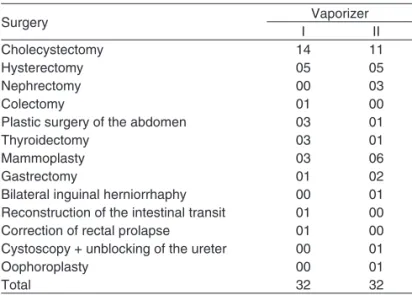
Table II shows the surgeries performed on 64 patients by group of vaporizer.
Analysis of the data collected during the surgery
During the surgery, the following parameters were observed: SBP, DBP, SpO2, BIS, TOF, PETCO2, % INSP, % EXP, and SEF.
For each of those parameters, the moments that best re-presented their evolution along the surgery were selected.
Analysis of Variance for repeated measurements demons-trated that vaporizers did not present significant differences in the means in the moments analyzed.
Therefore, both vaporizers had similar behavior during surgery for the following parameters: SBP (p = 0.813); DBP (p = 0.520); HR (p = 0.692); SpO2 (p = 0.720); BIS (p = 0.270); TOF during the procedure (p = 0.118) and before neostigmine
(p = 0.327); PETCO2 during surgery (p = 0.620) and before ne-ostigmine (p = 0.330); % INSP (p = 0.240); % EXP (p = 0.188); and SEF (p = 0.439).
Study of anesthesia regression
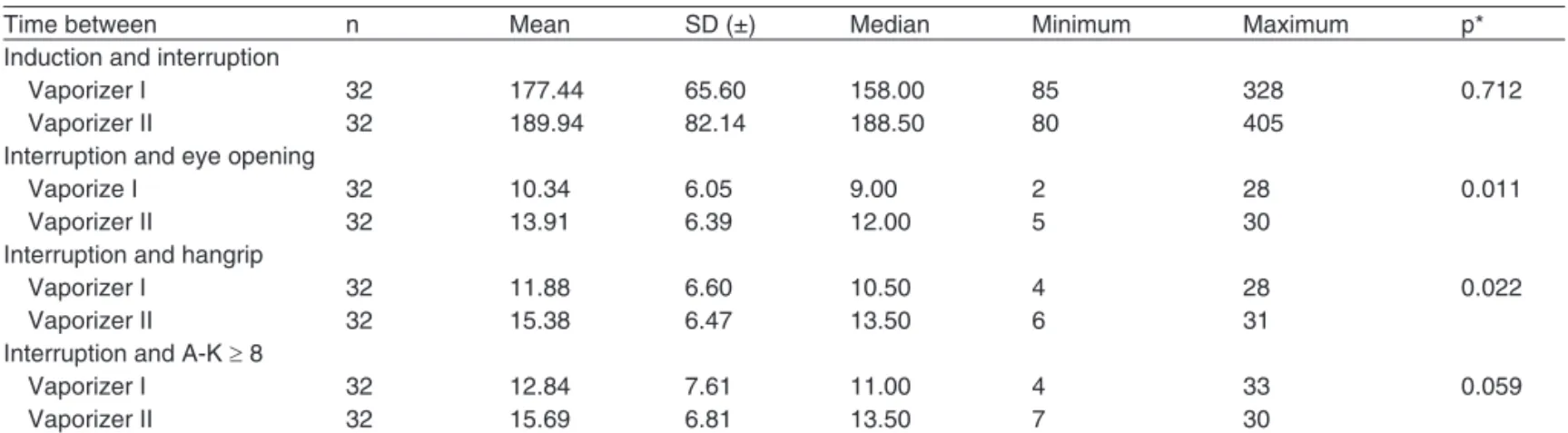
The following periods of time were analyzed: between the be-ginning and end of the administration of sevoflurane; between the interruption of sevoflurane and spontaneous eye opening; between the interruption of sevoflurane and handgrip to verbal command (every 2 minutes after spontaneous eye opening); and from the interruption of sevoflurane until an Aldrete-Krou-lik equal to or higher than 8 was achieved. Table III shows those times for both vaporizers.
On this table we can observe that vaporizers showed sig-nificant differences regarding the delta times between the in-terruption of sevoflurane and spontaneous eye opening, and between the interruption of sevoflurane and handgrip to verbal command.
Patients in the group of vaporizer II had significant higher values when compared to vaporizer I.
Therefore, patients in the group of vaporizer II (Sevora-neTM) had a mean time of spontaneous eye opening 34.5% greater and 29.5% greater for hand squeeze to verbal com-mand when compared to vaporizer I (Generic Sevoflurane).
A significant difference was not observed between both groups regarding induction and interruption of sevoflurane,
Table II – Surgeries Performed According to Each Vaporizer
Surgery Vaporizer
I II
Cholecystectomy 14 11
Hysterectomy 05 05
Nephrectomy 00 03
Colectomy 01 00
Plastic surgery of the abdomen 03 01
Thyroidectomy 03 01
Mammoplasty 03 06
Gastrectomy 01 02
Bilateral inguinal herniorrhaphy 00 01 Reconstruction of the intestinal transit 01 00
Correction of rectal prolapse 01 00
Cystoscopy + unblocking of the ureter 00 01
Oophoroplasty 00 01
Total 32 32
Table I – Demographic Characteristics of the Patients According to the Group of Vaporizer (mean ± SD)
Parameter
Vaporizer
p
I II
Age (years) 51.47 ± 15.57 46.87 ± 20.44 0.321(1) Weight (kg) 68.84 ± 16.64 65.66 ± 11.69 0.379(1) Height (m) 1.62 ± 0.08 1.64 ± 0.07 0.151(1) BMI (kg.m-2) 26.48 ± 5.71 24.31 ± 3.59 0.079(1) Gender (fem) 28 (87.5%) 22 (67.8%) 0.070(2)
Results expressed as Mean ± Standard Deviation.
A DOUBLE-BLIND COMPARATIVE STUDY BETWEEN GENERIC SEVOFLURANE AND SEVORANETM
Revista Brasileira de Anestesiologia 469
Vol. 60, No 5, September-October, 2010
Table III – Delta of the Times Evaluated According to Vaporizer Groups
Time between n Mean SD (±) Median Minimum Maximum p*
Induction and interruption
Vaporizer I 32 177.44 65.60 158.00 85 328 0.712
Vaporizer II 32 189.94 82.14 188.50 80 405
Interruption and eye opening
Vaporize I 32 10.34 6.05 9.00 2 28 0.011
Vaporizer II 32 13.91 6.39 12.00 5 30
Interruption and hangrip
Vaporizer I 32 11.88 6.60 10.50 4 28 0.022
Vaporizer II 32 15.38 6.47 13.50 6 31
Interruption and A-K ≥ 8
Vaporizer I 32 12.84 7.61 11.00 4 33 0.059
Vaporizer II 32 15.69 6.81 13.50 7 30
(*) Descriptive probability level of the non-parametric Mann-Whitney test. A-K: Aldrete-Kroulik.
Table IV – Absolute and Relative Frequencies of Additional Drug per Group of Vaporizer
Vaporizer
p*
I II
Midazolam 7 (21.9%) 4 (12.5) 0.320
Fentanyl 12 (37.5%) 14 (43.8) 0.611 Atracurium 7 (21.9%) 8 (25.0%) 0.768
Results expressed in number of patients and percentages (*) Descriptive probability level of the Chi-square test.
and between the interruption of sevoflurane and the moment patients achieved an Aldrete-Kroulik index equal or above 8.
Study of variables in the PACU
During the period the patient remained in the PACU, the following parameters were observed: SBP, DBP, HR, SpO2, and VAS.
Through Analysis of Variance for repeated measurements, a significant difference in the means at the moments of evalu-ation was not observed.
Therefore, both vaporizers had similar behavior in the PACU regarding the following parameters: SBP (p = 0.582), DBP (p = 0.719), HR (p = 0.358), and SpO2 (0.325).
Study of the VAS
The non-parametric Mann-Whitney test demonstrated that both groups of vaporizers did not show differences at the mo-ments evaluated: 0 min (p = 0.120), 15 min (p = 0.058), 30 min (p = 0.054), 45 min (p = 0.100), 60 min (p = 0.582), 75 min (p = 0.458), 90 min (p = 0.712), 105 min (p = 0.428), and 120 min (p = 0.279).
Additional use of agents during the study
In Table IV, additional drugs administered to patients in both groups of vaporizers are described.
Therefore, both groups of vaporizers did not show significant difference regarding the additional administration of drugs.
DISCUSSION
The monitoring used, especially BIS, SEF, TOF, ECG, HR, SBP, DBP, PETCO2, and SpO2 allowed the institution of an effective regimen of ventilation and the administration of ade-quate doses of sevoflurane, fentanyl, and atracurium to each patient regardless of the patient age and surgical procedure.
During the procedures, both agents showed similar beha-vior. However, after the interruption of the administration, a
statistically significant difference was observed in the data re-garding awakening from anesthesia. Patients in the Generic Sevoflurane group showed earlier spontaneous eye opening (3.57 min) than those in the SevoraneTM group (means of 10.34 and 13.91 min, respectively).
Similarly, a statistically significant difference in the time be-tween the interruption of sevoflurane and hand squeeze on verbal command was observed. Patients in the Generic Sevo-flurane group showed statistically lower means (3,5 min) than those in the SevoraneTM group (means of 11.88 min and 15.38 min, respectively).
The differences in the times of “interruption of sevoflura-ne-spontaneous eye opening” and “interruption of sevoflu-rane-handgrip to verbal command” allow the conclusion that awakening was faster (3.5 min) in patients anesthetized with Generic Sevoflurane (Biochimico) than in those anesthetized with SevoraneTM (Abbott).
Despite those times having presented statistically signifi-cant differences, the values observed are within those men-tioned by other studies 10-12.
However, although awakening was statistically faster with Generic Sevoflurane, the anesthesiologists responsible for the cases, and who were not aware of which agent was admi-nistered did not observe and did not record at any moment of the study any difference in the clinical behavior of patients.
REFERÊNCIAS / REFERENCES
01. Baker MT – Sevoflurane: are there differences in products? Anesth Analg, 2007;104:1447-1451.
02. Kharasch ED – Sevoflurane: the challenges of safe formulation. APSF Newsletter, 2007;48:55.
03. O’Neill B, Hafiz MA, DeBeer DAH – Corrosion of Penlon sevoflurane vaporisers. Anaesthesia, 2007;62:421.
04. Kharasch ED, Subbarao GN, Stephens DA et al. – Influence of sevo-flurane formulation water conten on degradation to hydrogen fluoride in vaporizers. Anesthesiology, 2007;107:A1591.
05. Stephens DA, Kharasch ED, Cromack KR et al. – Sevoflurane va-porizers contain Lewis acid metal oxides that can potentially degrade sevoflurane. Anesthesiology, 2007;107:A1597.
06. Cromack KR, Kharasch ED, Stephens DA et al. – Influence of for-mulation water content on sevoflurane degradation in vitro by Lewis acids. Anesthesiology, 2007;107:A1593.
07. Grupa A, Ely J – Faulty sevoflurane vaporizer. Anesthesia, 2007; 62:412.
08. Rosner B – Fundamentals of Biostatistics, 2nd. Boston, PWS Publish-ers, 1986;584.
09. Timm NH – Multivariate Analysis with Applications in Educations and Psychology. Monterrey, CA, Brooks/Cole, 1975;687.
10. Malviya S, Lerman J – The blood/gas solubilities of sevoflurane, iso-flurane, halothane and serum constituent concentrations in neonates and adults. Anesthesiology, 1990;72:793-796.
11. Yasuda N, Targ AG, Eger EI II – Solubility of I-653, sevoflurane, isoflu-rane and halothane in human tissues. Anesth Analg, 1989;69 :370-373. 12. Katoh T, Suguro Y, Nakajima R et al. – Blood concentrations of
sevo-flurane and isosevo-flurane on recovery from anesthesia. Br J Anaesth, 1992;69:259-262.
Resumen: Portella AAV, Laurencel SM, Rosa DM, Rivera MIM,
Quin-tero SO – Estudio Comparativo Doblemente Encubierto entre Sevo-flurano Genérico y Sevorane®.
Justificativa y objetivos: El Sevoflurano se coloca en tres tipos de
recipientes. Las diferencias de propiedades físico-químicas de esos productos se deben a los diversos procesos de fabricación, aunque sean esencialmente idénticos en cuanto a las pruebas de compara-ción química. Existe la hipótesis de que la molécula del Sevoflurano pueda presentar una inestabilidad química debido a la formación de ácidos Lewis, como consecuencia del material utilizado para la fabri-cación de los pomos y del contenido de agua.
El objetivo de este trabajo fue analizar la eficacia clínica del Sevoflu-rano cuando fue acondicionado en pomos diferentes.
Método: Se estudiaron 64 pacientes adultos distribuidos
aleatoria-mente en dos grupos. Fueron utilizados dos vaporizadores Datex-Ohmeda, siendo uno de ellos abastecido apenas con Sevoflurano Genérico y el otro con Sevorane®. El coordinador del estudio fue el responsable por el abastecimiento de los vaporizadores y no realizó la anestesia. En los dos grupos, se usó la misma técnica anestésica y la misma monitorización (ECG, FC, SpO2, PETCO2, BIS, SEF, TOF,
% INSP, % EXP, PAS, PAD).
Resultados: No hubo diferencia entre los grupos durante la
aneste-sia. Pero sí que hubo una diferencia estadística entre la interrupción del Sevoflurano y la abertura espontánea de los ojos (13,91 ± 6,39 min Grupo II, y 10,34 ± 6,05 min Grupo I), y la interrupción del Sevo-flurano y el apretón de la mano al comando verbal (15,38 ± 6,47 min Grupo II, y 11,88 ± 6,60 min Grupo I). No hubo diferencia estadística entre la interrupción del Sevoflurano y el momento en que los pacien-tes alcanzaron el Índice de Aldrete-Kroulik igual o superior a 8.
Conclusiones: Durante la anestesia, no se registró diferencia entre