Repositório ISCTE-IUL
Deposited in Repositório ISCTE-IUL: 2019-03-06
Deposited version: Post-print
Peer-review status of attached file: Peer-reviewed
Citation for published item:
Bento, N., Gianfrate, G. & Groppo, S. V. (2019). Do crowdfunding returns reward risk? Evidences from clean-tech projects. Technological Forecasting and Social Change. 141, 107-116
Further information on publisher's website: 10.1016/j.techfore.2018.07.007
Publisher's copyright statement:
This is the peer reviewed version of the following article: Bento, N., Gianfrate, G. & Groppo, S. V. (2019). Do crowdfunding returns reward risk? Evidences from clean-tech projects. Technological Forecasting and Social Change. 141, 107-116, which has been published in final form at
https://dx.doi.org/10.1016/j.techfore.2018.07.007. This article may be used for non-commercial purposes in accordance with the Publisher's Terms and Conditions for self-archiving.
Use policy
Creative Commons CC BY 4.0
The full-text may be used and/or reproduced, and given to third parties in any format or medium, without prior permission or charge, for personal research or study, educational, or not-for-profit purposes provided that:
• a full bibliographic reference is made to the original source • a link is made to the metadata record in the Repository • the full-text is not changed in any way
The full-text must not be sold in any format or medium without the formal permission of the copyright holders. Serviços de Informação e Documentação, Instituto Universitário de Lisboa (ISCTE-IUL)
Av. das Forças Armadas, Edifício II, 1649-026 Lisboa Portugal Phone: +(351) 217 903 024 | e-mail: [email protected]
Do Crowdfunding Returns Reward Risk?
Evidences from Clean-tech Projects
Nuno Bento1, Gianfranco Gianfrate2, Sara Virginia Groppo3
1 Instituto Universitário de Lisboa (ISCTE-IUL), DINAMIA’CET, Av.das Forças Armadas, 1649-026
Lisboa, Portugal. Phone: (+351) 91 641 60 87, Fax: (+351) 21794 00 42.
Universidade Católica Portuguesa, Department of Economics, Management and Social Sciences, 3504-505 Viseu, Portugal. [email protected]
2 EDHEC Business School, 393 Promenade des Anglais 393, BP3116
06202 Nice Cedex 3, France. [email protected]
3 Graduate Student, Bocconi University, Via Roberto Sarfatti 25, 20136 Milan, Italy. Phone: (+39)
3407647867, [email protected] Version of June 20, 2018
Abstract
The growing literature on crowdfunding has mostly focused on the determinants of campaigns success, as well as on the legal and macroeconomic drivers of the crowdfunding diffusion as a mean to finance innovative projects. Still there are scant evidences on whether the returns for crowdfunders are consistent with the risk profile of crowdfunded projects. By studying 365 European clean-tech projects which raised capital via crowdfunding, we show that once the country risk has been accounted for, the returns are not consistent with the risks related to the technology adopted by the projects. Behavioral factors like bounded rationality or the cultural dimension of investors may explain this apparent mispricing of risks. While projects’ returns are, on average, negatively related to risks, we find that projects offering better risk-adjusted returns attract relatively larger average contributions. Our results have important implications for understanding the drivers of crowdfunding returns and its sustainability, and particularly for its diffusion as an instrument to foster the transition to a low-carbon economy.
Keywords: crowdfunding; clean-tech; technology risks; innovation financing; learning; renewable energy.
2
1. Introduction
Recently emerging as an effective alternative to traditional entrepreneurial finance, crowdfunding has the potential to transform the financial landscape for young innovative ventures (Ralcheva & Roosenboom, 2016). Crowdfunding refers to a model in which crowdfunders invest their money in a (crowdfunding) project against a financial compensation (e.g. revenue, equity, profit-share scheme) or a nonfinancial benefit (e.g. new product acquisition, credit on an album). Crowdfunding allows entrepreneurial individuals and groups of primarily early stage initiatives and start-up to collect funding through the internet from a large crowd of investors and donators, often in exchange for future products, debt repayments or equity shares. However, because of its riskier nature, the supply of this type of financing is often insufficient compared to the demand from entrepreneurs. Such capital shortage for young entrepreneurial companies is usually referred to as “equity gap”. In fact, because of their lack of collateral, i.e., limited cash flows and absence of past track record, start-ups obtain bank financing more difficultly than larger and more mature firms (Ang, 1991; Berger & Udell, 1995; Chittenden et al., 1996; Carpenter & Petersen, 2002; Cassar, 2004; Schwienbacher & Larralde 2010; Cordova et al. 2015a; Cordova et al. 2015b). Small crowdfunded projects can also play an important in the context of the mitigation of climate change (Hawkens, 2017; Grubler, 2012; Lovins, 2011), by enabling a more widespread investment in low carbon energy technologies (e.g. wind energy, solar energy, energy efficiency) which are important to reach both the United Nations’ Sustainable Development Goals and the Paris Climate Agreement (Rockstrom et al 2017).
Climate mitigation will require the development and the deployment of alternative energies with different levels of risk (WEF, 2017). Innovation may create crucial technological components, such as ICT-based smart solutions connecting a raising share of distributed generation and electric mobility to the grid that are key for the gradual transformation of the electricity infrastructure (Howell et al., 2017). In addition to the development of sustainable innovations, climate mitigation needs the deployment of alternative energies substituting for existent of fossil fueled power plants (e.g. coal, natural gas) or for new additional capacity. Even thought their growth has
3
been subsidized by the governments, uncertainties remain on the capacity to learn and to reduce costs for the different technologies (e.g., wind, solar PV) in order to become competitive against the conventional energies (Yeh & Rubin 2012; Rubin et al. 2015; Shayegh et al., 2017). Crowdfunding can play an important role to foster innovation in the energy system and to disseminate the investments in clean energy technologies across space, but these projects have typically different levels of risk whose impact on the financing remains largely unknown in the literature.
The novelty of the crowdfounding phenomenon has spurred scholars to conduct more detailed research on crowdfunding (see Mollick, 2014) not just because of the inherent interest of the topic but also to help policymakers in the design of a well-functioning and efficient crowdfunding market, possibly leading to a significant reduction in the observed early-stage financing gap for new innovative ventures. In particular, crowdfunding can spur the investment in clean technologies with large benefits to the society and therefore it is important to understand what are the main drivers of the investment in these projects and how crowdfunders react to the unbalanced levels of risk associated to cleantech projects.
The paper focus on the influence of the risk profile of the crowdfunded projects around clean technologies in the returns of investors. In particular, it aims to answer the question: are the returns of crowdfunded projects in clean-techs related to the risk of the projects? Prior investigations (e.g., Lin & Viswanathan, 2016; Harms, 2007; Van Wingerden & Ryan, 2011; Ordanini et al., 2011) has revealed that crowdfunding is driven by both economic and behavioral reasons. Economic reasons are likely to affect decisions in crowdfunding as investors expect returns from their investments. In ligne with the economic and financial literature, behavioral reasons refer to motivations that can result from cognitive biases (Thaler, 2005), bounded rationalty (Simon, 1955) or non economic optimal perceptions (Kahneman, 2003). The latter results of intuitions as opposed to rational reasons based on pertinent information available that investors consider to formulate decisions in order to maximize their economic returns
4
(Kahneman, 2003). Therefore, it is important to understand whether the returns for crowdfunders are consistent with the risk profile of crowdfunded projects in clean-techs.
Using a dataset comprising 365 cleantech projects from 17 distinct European crowdfunding platforms, we conduct a granular investigation of the relations between returns and risks associated with the funded projects by controling at the same time for the characteristics of both the projects and the countries. Our findings show that once the country risk has been accounted for, the returns are not consistent with the risks related to the technology of the projects. We also find that, while on average there is a negative relationship between return and risk, informed investors are associated to the investments that have superior return/risk profiles. Our results contribute to the academic literature and the policymaking debate by challenging the perceived role of crowdfunding as a financially mean to support innovative sustainable projects.
The remainder of the paper is structured as follows. Section 2 introduces the relevant literature on crowdfounding and technological risk. Section 3 describes the new database on cleantech crowdfunded projects and presents the main methodological approach. Section 4 presents the main results, and Section discusses our findings and policimaking implications. Section 6 concludes about the crowdfounders’ behavior in presence of technological risk.
2. Crowdfunding Success, Risk and Return
2.1 Drivers of crowdfunding campaigns’ success
The most recurrent definition of crowdfunding is the one provided by Schwienbacher and Larralde (2010). They defined crowdfunding as “an open call, essentially through the Internet, for the provision of financial resources either in form of donation or in exchange for some form of reward and/or voting rights in order to support initiatives for specific purposes”. The referring to crowdfunding as an open call on the internet has made many authors see crowdsourcing, the outsourcing of a given task to a large group of people in the form of an open call (Howe, 2006), as the antecedent to crowdfunding (Dell, 2008; Howe, 2008; Kleemann et al. 2008; Belleflemme
5
et al., 2010; Rubinton 2011; Poetz & Schreier, 2012). The only difference between the two being that instead of pooling labor resources, crowdfunding pools another factor of production: capital (Harms, 2007). The open call takes place on online platforms which provide the way for crowdfounding projects and investors to connect without standard financial intermediaries (Mollick 2014). In this direct interaction, potential investors can see the level of support from other project backers, suggesting that social information could have a role in the ultimate success of a crowdfunded project (Kuppuswamy & Bayus 2013).
Another distinctive feature of this new financing phenomenon is that crowdfunding platforms, which provide all the means for investment transactions to take place - legal groundwork, pre-selection, the ability to process financial transactions and so on (Ahlers et. al 2012) - not only have the potential to help crowdfunding seekers (the entrepreneurs) satisfy their financing needs, which makes crowdfunding alike micro and social finance (Harms 2007), but also to test new products and run new marketing campaigns (Lambert & Schwienbacher 2010, Mollick 2014). In this sense, crowdfunding draws inspiration from social networking, where consumers actively participate in online communities to share information and providing suggestions about new initiatives and/or brand (Ordanini et al. 2011). Moreover, when crowdfunding is used as a mean to demonstrate demand for a proposed product, successful initiatives become a signal to venture capitalists of a potential good long-term investment, possibly leading to additional future financing for project holders (Mollick 2014).
Research conducted so far has both focused on the project holders and investors’ side and have mainly relied on data from reward-based crowdfunding platforms. On the one hand, sholars have investigated the reasons behind people’s decision to use crowdfunding platforms to raise funds. Belleflamme et al. (2010) found that raising money, getting public attention and obtaining feedback on product/service, are all relevant factors in motivating the launchers of initiatives on crowdfunding platforms. Seemingly, by conducting a grounded-based research, Gerber et al. (2011) found that the main reasons why entrepreneurs use these platforms are: to raise funds while maintaining full control over the project, to receive validation, to connect with others, to replicate
6
successful experiences of others, and to expand awareness of work through social media. Finally, Belleflamme et al. (2012) noticed that, when used to invite consumers to pre-order a product, crowdfunding allows entrepreneurs to price discriminate: consumers who enjoy higher utility will pre-order the product and pay more with respect to later consumers, who will wait until the product is offered on the market at lower price. In their analysis, they concluded that this strategy is proved profitable as long as initial capital requirement remains relatively small, in contrast with crowdfunding through profit-sharing, where the benefits are higher when capital requirements are large. Cleantech are likely to be in this last category and, although the scarce empirical evidence is mixted (Kuo et al, 2014), we expect that the size of the projects increase returns for entrepreneurs and indirectly for crowdfunders as well.
On the other hand, academics have researched the reasons that motivate investors’ decision to support crowdfunding initiatives. Harms (2007) conducted a questionnaire-based research which led him conclude that self-expression and enjoyment have an important role in the decisions. Beyond the overall benefit investors derive with respect to their contribution (economic value), the main motivations include the presence of a guaranteed tangible output of the project (certainty effect) and the degree to which the benefits of the project outcome serves a functional need of the individual consumer (personal utility). Van Wingerden & Ryan (2011) distinguished between intrinsic motivations - control of use of an innovation, improvement of current circumstances, enjoyment, and sense of involvement - and extrinsic motivations - financial reward. In addition, Ordanini et al. (2011) found public recognition and patronage also add up to the list. Therefore, we expect that crowdfunders price the projects on cleantech by also taking into account with other factors beyond returns and risks.
2.2 Technological Risks
Technological risks play an important role in the funder’s decisions to invest. Technological risks refer to technology “problems” that arise with the uncertainty surrounding the determinants of “performance, cost, safe operating latitudes, or failure modes” (Hartmann & Lakatos, 1998, page 32). The lack of knowledge regarding technology problems dissipates with the deployment and
7
operation of a new technology that increases the data on actual performance, and on frequency and severity of technical failures. One important source of information is when a new technology such as a power plant reach its projected lifetime, as technologies that have a few units running or that have not been completely depreciated yet have a higher risk (Mazzucato & Semieniuk, 2018). As Oxera (2011, page 19) puts: “A wide range of factors can be expected to affect discount rates for low-carbon technologies. Some of these, such as wholesale electricity prices and government policy, are extrinsic, in that they are outside the countrol of a particular low-carbon generation developer. Other factors—such as load factor, cost structure, or technology maturity—are an intrinsic part of, or inherent in, a particular type of technology. Overall, it appears that the maturity or deployment of a given technology is the dominant intrinsic factor that defines the overall risk perception for that technology.”
Technology deployment reinforces the maturity of a technology and lowers its technology risks. These risks traditionally contributes to increase the requested rentability of the projects by investors (Oxera, 2011). The literature of technology lifecycle identifies several factors that come into play in the maturing of new technologies such as standardization, technology improvements, cost reductions and learning (Abernathy & Utterback, 1978; Peltoniemi, 2011). Learning, in particular, has important implications in terms of the investment cost of a technology that is a crucial component in crowdfunding projects.
Learning refers to the reduction in the cost of the technology as a result of the increase in the number of units produced and accumulation of experience (Shayegh et al., 2017). The effect of increased experience in cost reduction was originally demonstrated in empirical studies in manufacturing (e.g., Wright, 1936, Arrow, 1971). Learning processes have been attributed to “doing” (Arrow, 1971) as well as to operating, implementing, copying, searching and building (Sagar & van der Zwaan, 2006; Rubin et al., 2017). In practical terms, learning curves are industry-level experience curves that expresses unit costs as a function of cumulative quantity (Yeh & Rubin, 2012). The learning rate indicates the percentage of cost reduction for each doubling of cumulative production. Weiss et al. (2010) review the historical learning curves for
8
more than 200 energy technologies for both energy supply and end use technologies, finding mean rates of 16% and 18% respectively. More recently, Rubin et al. (2017) examine dozens of scientific articles that published learning rates on 11 electricity supply technologies, revealing an overall mean of 14% (for one-factor models).
Although the relation between cost reductions and experience increase has proven simple and robust, it has several limitations (Nordhaus, 2009; Rubin et al., 2017). One important limitation is the impossibility to distinguish the various sources that may contribute to learning, such as research and development (Söderholm & Klaassen, 2006; Rubin et al., 2017), social and political factors (Yeh & Rubin, 2012), geographic and temporal effects (Nemet, 2009), input price volatility, autonomous technological improvement and knowledge spillovers (Nemet, 2009, Nordhaus, 2009) or economies of scale (Wilson, 2012; Healey, 2015). In addition, learning is not a deterministic outcome of cumulative production increase, but rather depends on proactive industry-level efforts (Grubler, 2010). However, learning often lead to product design improvements, higher productivity, process efficiency, and lower perceived risks by users (Argote & Epple, 1990). In these terms, new technologies may become rapidly outdated with the successive release of better versions, impacting the rentability of the use of the previous generations.
The severity of this vintage effect increases with the level of the learning rate. High learning rates imply larger levels of uncertainty about the evolution of the technology. These rates are indicator of the ongoing changes underway in the new technology, whose technical and financial attributes may alter as it evolves. More imature technologies, which are still in the early stage of development, tend to present higher learning rates (Grubler et al., 1999; McDonald and Schrattenholzer, 2001; Shayegh et al., 2017) and so a higher risk of technology failure and of changing market conditions. Therefore learning rates is a possible measure of the technology risk (see also Rubin et al., 2015).
Technological risks are also recognized by the financial markets. Scholars have investigated the pricing and risks of technology stocks and assets, especially in the aftermath of the “dot.com
9
bubble”. Sadorsky (2003) firstly applies price volatility as a proxy of firm risk in the study of the macroeconomic determinants of technology stocks’ behaviour. Henriques & Sadorsky (2008), Kumar et al. (2012) and Sadorsky (2012) examine the dynamic relationships between the stock prices of alternative energy companies, oil prices, interest rates, and an index of technology, finding that shocks to technology have a large impact on the stock prices of companies. Clean-tech companies do appear to have more in common with technology companies than they do with fossil fuel based companies. These evidences, within the larger context of alternative energy companies and industry structure, indicate that “the success or failure of alternative energy companies often depends upon the success or failure of fairly specific technologies” (Henriques and Sadorsky, 2008). Therefore, the volatility of clean-tech stocks is assumed to depend on the risk profile of the underlying technological base there are using.
On the other hand, the technological risk increases the potential of losses or no profits for the funders. Thus it is typically associated with higher expected returns to compensate investors for the higher risks. However, as discussed in the next section, funders may have motivations other than the strictly financial ones.
2.3 Crowdfunding returns in clean-tech projects
Crowdfunding has become an interesting financing tool for the energy sector. Renewable energy and cleantech initiatives especially represent unique opportunities and challenges for investors (Cumming, Leboeuf, & Schwienbacher, 2016). According to Pernick & Wilder (2007), “cleantech refers to any product, service, or process that delivers value using limited or zero nonrenewable resources and/or creates significantly less waste than conventional
offerings”. Cleantech consists of a variety of technologies that include energy efficiency, recycling, renewable energy (wind power, solar power, hydro-electric power, geothermic power, biomass and biofuels), green transportation and electric motors (Pernick & Wilder, 2007).
Crowdfunding may be used to fill the funding gap of social ventures in clean technologies. Previous studies show how crowd investors typically are not concerned about collaterals and
10
business plans, but rather they share the ideas and core values behind these initiatives (Lehner, 2013). Since crowdfunders often invest a small amount of money in multiple projects, they typically take into account not only tangible and economic benefits, but also social ones, as long as the funded initiatives have ambitious and noble goals which they share (Cumming, Leboeuf, & Schwienbacher, 2016). Renewable energy projects, in fact, couple attractive interest rates with the opportunity to generate a social and environmental impact (Heale, 2017), thus leading a growing number of people to invest in cleantech projects via crowdfunding platforms.
The total volume of public and private investments in clean energy as asset class has been increasing in the last years. It passed from the $62 billion total amount of 2004 to $287.5 billion in 2016, namely fueled by the sharp fall in equipment prices, particularly in solar photovoltaic from China and Japan (Bloomberg New Energy Finance, 2017).
Since crowdfunding is a relatively new phenomenon (Vulkan, Åstebro, & Sierra, 2015), there are numerous research gaps which can be filled, particularly by investigating the characteristics and the outcomes of crowdfunded projects in a specific sector. Previous literature on
crowdfunding has been mainly conducted across different sectors, with the aim of describing this new way of financing its dynamics (Décarre & Wetterha, 2014), often focusing the analysis on some of the largest global platforms, such as Kickstarter and Crowdcube (Koch & Cheng, 2016; Signori & Vismara, 2016). A common focus of those papers has been to identify the characteristics of the project’s sponsor firm which determine the success or the failure of the campaign (Belleflamme, Lambert, & Schwienbacher, 2013). Gupta (2017) investigates the main economic and social factors that influence the financial performance of alternative energy companies, finding that it positively correlates with local market return, oil prices, technology stock prices and country’s characteristics (such as technology and innovation capacities of the country). However, at our knowledge, there has not been an assessment on the way that investments have been driven by non-economic and behavioral factors, specifically on whether crowdfunders treat and factor risk.
11
Behavioral factors influence decision making as it has been reported by the economic and financial literature. They include bounded rationality (Simon, 1955), cognitive biases (Thaler, 2005), and non-economic optimal perceptions (Kahneman, 2003). Bounded rationality refers to the fact that agent’s decisions are limited by information availability, individual processing capacity and time to make the decision (Simon, 1955). Cognitive biases relates to incoherent and inconsistent rules that agents follow in their decisions (consumption, savings, etc.) that can have important financial consequences (Thaler, 2005). Perceptions and intuitions, as opposed to rational reasons based on pertinent information available, are considered by investors to
formulate decisions in order to maximize their economic returns. As Kahneman posits: “The central characteristic of agents is not that they reason poorly but that they often act intuitively” (Kahneman, 2003: 1469).
Prior empirical investigations corroborate that crowdfunding has been driven by both economic and behavioral factors (e.g., Lin & Viswanathan, 2016; Harms, 2007; Van Wingerden & Ryan, 2011; Ordanini et al., 2011). Particularly in the context of crowdfunding campaigns with social and environment orientation, Lehner (2013) suggests that funders look not only at business plans or collateral but also at the ideas and core values behind a project. Indeed, several studies find that crowdfunders invest in social initiatives thought to be necessary and relevant (e.g., Belleflamme et al. 2014; Drury & Stott, 2011; Rubinton, 2011). However, Hörisch (2015), from a rational choice perspective, argues that projects with a social mission are comparable to collective goods which tend to be underinvested. That is, backers will be less likely to invest in such projects because those who did not contribute to the project will profit from it anyway. Therefore, the extant theoretical and empirical literature is ambiguous about the role of non-economic factors in crowdfunding campaigns, and thus about the motivations of crowdfunders to treat and factor technological risk.
12
3. Data and methodology
3.1 Data
The aim of this work is to determine whether risk is factored (and to what extent) into the expected return of renewable energy crowdfunding initiatives. For that, we study a sample consisting on renewable energy projects that have been crowdfunded via European platforms. Crowdfunding platforms that posts projects in the field of cleantech tend to be specialized: they only support renewable energy initiatives, and their founders are often former investment bankers, consultants and professionals with substantial experience in the sector.
The online platforms considered are all very similar in terms of business model. They allow the project’s sponsors to set a target amount of funding they intend to reach, and in many cases if the target is not reached, money remains with investors and the project is unsuccessful. Some platforms do remove the description of unsuccessful initiatives from the platform’s track record.
Most platforms do not offer an English version of the website, and this suggests that they are primarily, if not exclusively addressed to a local crowd of investors. In principle, the
geographical distance from the funded project home country should cease to matter to crowd funders, since an almost costless internet connection facilitates the matching of funds sources and uses beyond geographical borders. Nevertheless, previous studies on the geographical distribution of investors (Guenther, Johan, & Schweizer, 2016) provide a clear evidence of the still present sensitivity of investors to the distance between them and the funded initiative in equity (and lending) crowdfunding. In some cases, the platform has its headquarters in a different country, i.e., the call is launched in another country different from that of the project: around 5% of the projects selected consists of energy plants installed in African or South American countries, among which Namibia, Kenya, Ghana and Colombia. An objective of this work is in fact to investigate whether the country risk premium is incorporated or not into the proposed returns of projects.
The crowdfunding campaigns included in our sample were launched from 2011 to June 2017, with a total project value ranging from €3,800 to €22,472,460. Our definition of cleantech
13
encompasses all the initiatives aimed at the material installation of energy plants and at the manufacturing of products allowing consumers to save energy, such as LED systems and other energy efficiency appliances. We discarded the crowdfunding campaigns aimed at supporting green communities and studies on clean-tech given their broad scope of investment.
Each platform website discloses different kind of information to online visitors and investors. Once the crowdfunding campaign is terminated, different platforms keep track of the related data with different degrees of granularity. All the selection criteria described above brought to a final sample of 365 observations, from a set of 17 platforms, 15 countries and different types of renewable energy, for a total invested amount of €191 million. The platforms considered are lending-based, specialized in clean-tech and without a specific focus on one type of renewable energy.
We disentangle two distinct sources of risks: technological risk and country-related risk. As for the technology risk, we are only able to measure it category-wise (per technology). On the other hand, the country risk relates to the location of project plant or manufacturing facility. By identifying the country where the operations are located and the time when the related crowdfunding campaign is launched, we are able to quantify individually the level of country risk associated to each project.
The quantification of the technology risk poses several methodological issues. We use two distinct approaches to quantify the risk profiles associated to the different clean energy technologies.
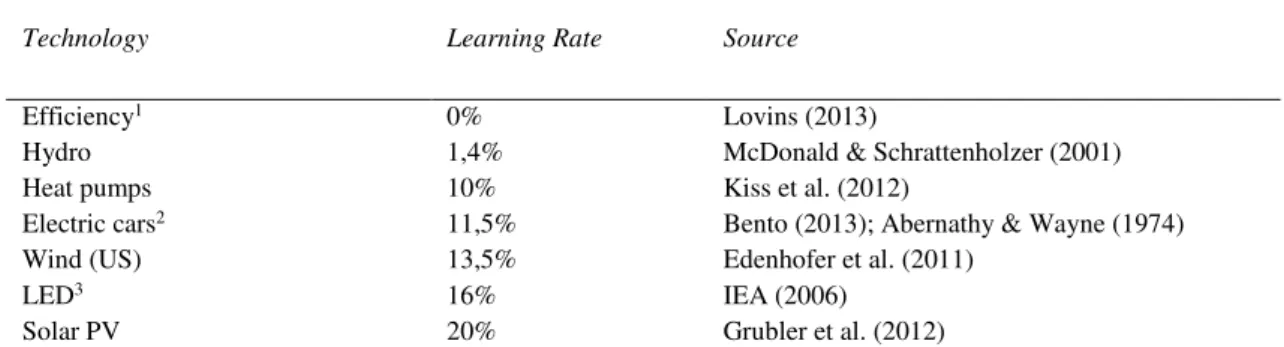
The first approach is based on the learning rates of these technologies as reported in the literature. The learning rates summarizes all the history of the installations and costs of the technologies. Their level typically correlates to the stage of development (or maturity) and uncertainty around technologies (Grubler et al., 1999; McDonald & Schrattenholzer 2001; Shayegh et al. 2017). Appendix 1 shows the highly similar patterns of learning rates comparing with other well-established measures of technology risk from the literature (e.g. Oxera, 2011).
14
Table 1 presents the values for the learning rates assumed in this study, which are consistent with the recent reviews of the literature (Rubin et al., 2015; Weiss et al., 2010).
As an alternative measure of the technology risk, we use a financial quantification extracted from cleantech market indexes trends, available on the Nasdaq Global Indexes website1 for
almost all renewable energy categories covered in our sampled projects – namely, solar, wind, biofuels, natural resources, lighting, green buildings, green transport and hydro global indexes. For each index, data were available from October 2010 onward. The goal was to capture a measure of the risk deriving from the type of energy resource employed in terms of volatility of the corresponding index. Therefore, for each project, the technology risk is estimated by
measuring the volatility of the associated index in the three years before the specific launch date of the crowdfunding campaign. Although very different in nature and sources employed, both the approaches used to measure technology risk deliver consistent results.
Table 1 – Learning rates as a measure of technological risk
Technology Learning Rate Source
Efficiency1 0% Lovins (2013)
Hydro 1,4% McDonald & Schrattenholzer (2001)
Heat pumps 10% Kiss et al. (2012)
Electric cars2 11,5% Bento (2013); Abernathy & Wayne (1974)
Wind (US) 13,5% Edenhofer et al. (2011)
LED3 16% IEA (2006)
Solar PV 20% Grubler et al. (2012)
1 Includes projects both on “energy efficiency” and “production efficiency”. Assumed no learning rate because already economic using conventional technologies. 2 Assumed the same historical learning rates as for automobiles. 3 Assumed the same historical
rates as for compact fluorescent light bulbs.
To investigate whether the risk of the country where the project is installed is accounted for in the project’s return, we considered the time series of country risk premiums compiled by Aswath Damodaran at New York University2, according to the country where the energy plant
or manufacturing facility is located.
1 Green Global Market Indexes available at https://indexes.nasdaqomx.com/Index/. 2 Country Risk Premiums available at http://pages.stern.nyu.edu/~adamodar/
15
Finally, in order to investigate the role of national culture factors we retrieve the cultural dimension scores from Hofstede et al. (2010) which are available from Hofstede's website. These scores are primarily collected by undertaking a psychological survey of IBM employees across countries between 1967 and 1973. About 88,000 IBM employees in 72 countries were surveyed as part of the project. Such results were further updated in 2010. It is worth stressing that the literature (Zheng et al., 2012; Hofstede & Hofstede, 2001) espouses that cultural variables are extremely stable over a long time horizon. The full list of the variables used in our work is reported in Table 2.
Table 2– List of Variables
Variablea Variable name Expected
sign Source
Internal Rate of Return IRR Crowdfunding Platforms
Net IRR – Net Internal Rate of Return NIRR Crowdfunding Platforms, Country Risk Premiums from
http://pages.stern.nyu.edu/~adamodar/ Technology Risk – Proxied using
learning curves, or, financially, as the standard deviation of specialized NASDAQ indexes weekly returns 3 years before project’s launch
TRISK + Learning curves from literature (see Table 1); indexes from Bloomberg
Log Project Size – Natural logarithm of the total amount collected in each project
LSIZE + Crowdfunding Platforms
Maturity – Maturity of the crowdfunded projects
MAT - Crowdfunding Platforms
Individualism – Degree of individualism in a country
Individuality + Hofstede, 2010
Long-Term Orientation – Degree of efforts towards forecasting future outcomes
Long-Term Orientation
+ Hofstede, 2010
Risk/return profile and average investment size
Log Average Investment – Natural logarithm of the ratio Investment Amount/Number of investors
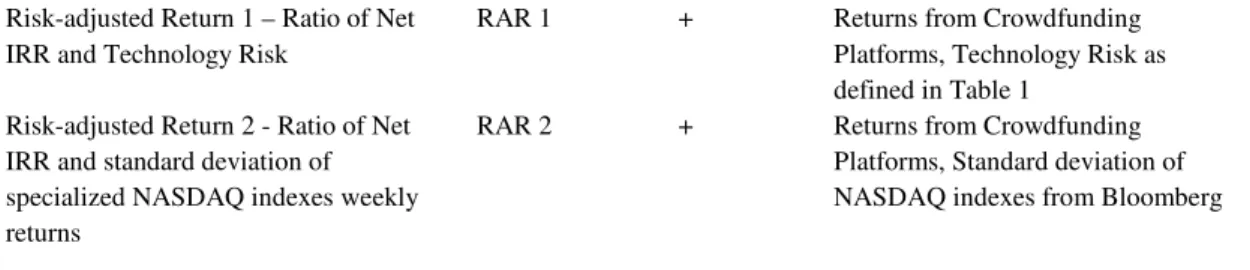
16 Risk-adjusted Return 1 – Ratio of Net
IRR and Technology Risk
RAR 1 + Returns from Crowdfunding Platforms, Technology Risk as defined in Table 1
Risk-adjusted Return 2 - Ratio of Net IRR and standard deviation of specialized NASDAQ indexes weekly returns
RAR 2 + Returns from Crowdfunding Platforms, Standard deviation of NASDAQ indexes from Bloomberg
Evidences from the data sample (Table 3) show that the target amount and, consequently, the amount effectively collected can largely vary. Returns and maturities can range from 2.5% to 18% and from 0.5 to 25 years respectively, depending on the conditions linked to each
initiative. Some of the platforms also provide visibility on the number of investors which have contributed to the funding of a specific projects.
Table 3 – Summary statistics for variables
N Mean S.D. 1 2 3 4 5 6 7 8 9 10 11 1. Amount 346 479609.1 1608976 1 2. Target 192 521809.1 2361563 .747 1 3. Maturity 331 7.308218 5.01302 -.137 -.062 1 4. IRR 334 .055475 .018718 .203 .171 -.348 1 5. N. of Investors 260 156.4538 155.995 .776 .421 -.207 .208 1 6. Tech. Risk 323 .167477 .046462 -.270 -.225 .346 -.190 -.331 1 7. Uncertainty Avoidance 365 61.66027 17.5707 .003 -.139 -.543 .033 .038 -.168 1 8. Standard Deviation 315 .040221 .00505 -.170 -.198 .286 -.191 -.158 .904 -.141 1 9. Individualism 365 72.49589 14.5243 .009 .093 .236 -.415 -.280 -.144 .229 -.150 1 10. LT Orientation 365 65.50685 15.6626 -.011 -.113 .124 -.362 -.174 -.102 .367 -.092 .839 1 11. Indulgence 365 53.6137 16.1469 -.089 .053 .450 -.372 -.346 .020 -.030 .026 .742 .496 1
Exhibit 1 represents the frequency distribution of IRRs for the projects included in the sample. The majority of the proposed returns is below 5%, a level that appears inconsistent with the risk profile of cleantech projects, especially for the ones using relatively immature technologies.
17
Exhibit 1: The distribution of projects’ returns by technology according to the internal return rates (IRR) of the projects
3.2 Methodology
We test the effects of technology risk, project size, and project maturity on the returns on the crowdfunded projects by running the following regression:
= + + + + ∑ + (1)
where is the IRR of project i net of the country risk spread of the location where the project is expected to be realized, is a measure of the technology risk associated with project i, is the natural logarithm of the crowdfunding target for project i, is the maturity of project i, and β is a set of control variables.
We further investigate whether the relationship between risk and returns of crowdfunded projects is affected by the degree of investors’ rationality. With returns inconsistent with risks, a possible interpretation could be that bounded rationality of investors is preventing them to fully assess the risk/return profile of projects. On the other hand, with crowdfunders showing to be able to assess the risk/return profile of investments, the interpretation of crowdfunders seeking
0 20 40 60 80 100 120 0-3% 3.01%-4% 4.01%-5% 5.01%-6% 6.01%-7% 7.01%-8% 8.01%-9% 9.01%-10% >10% N u m b e r o f p ro je ct s
18
extra-financial returns (besides the financial one) - such as the utility derived from supporting a social cause - would be corroborated.
In our dataset we observe the total amount of financial resources gathered by projects as well as the total number of individual crowdfunders supporting each project. We are therefore able to compute the average investment size of the projects. With rational crowdfunders, we would expect the average investment size to increase with better risk/return profiles, ceteris paribus. We test this hypothesis by running the following regression:
= + + + + ∑ + (2)
where is the natural logarithm of the average investment of project i with the average investment computed as the ratio of the total amount of capital gathered via crowdfunding and the total number of investors who contributed to the crowdfunding campaign. is a measure of the risk-adjusted returns associated with project i. The variable RAR is modeled on the Sharpe ratio commonly used in the theory and practice of finance. It is a synthetic measure of the return on a certain investment adjusted to take into account the risk profile of the investment itself. We estimate RAR using two distinct specifications: for RAR 1 the
denominator is the Technology Risk measure associated with the energy technology employed in the project, while for RAR 2 it is the standard deviation of the NASDAQ index related to the technology of each project in the three years before the launch of the crowdfunding campaign.
We estimate the models with Ordinary Least Squares (OLS) regressions and use robust standard errors reporting t-statistics.
4. Results
4.1 Net returns
Table 4 shows the results of the estimations of the models. Model 1 provides our baseline results, which only considers the technology risk and controls for the country effects. The main coefficient of interest is with the expectation that it is negative. This follows the hypothesis that
19
crowdfunders on average do not price the risks associated with the projects they fund. In particular, once the country risk of the projects has been accounted for, investors in cleantech crowdfunded projects do not (fully) factor technological risks in the returns they accept to receive. The coefficient for the variable is -0.080 (t-stat -3.51) indicating a statistically significant negative relationship between technological risk and the Net IRR. In Model 2, we only consider the target size and we control for the country effects. The coefficient for the variable is 0.005 (t-stat 2.67) indicating a statistically significant positive relationship between the amount of capital sought by crowdfunders and the Net IRR. In Model 3, we only consider the maturity of the project and we control for the country effects. The coefficient for the variable is -0.001 (t-stat -3.54) indicating a statistically significant negative relationship between maturity and the Net IRR. Considering the tenet of finance according to which, ceteris paribus, financial assets with a longer maturity horizon are riskier—and risk is typically associated with higher returns—, and that energy assets such as power plants (coal, natural gas, nuclear and so on) have often long lifetimes, during which several variables can change like raw materials or carbon prices, our results indicate that the risk profile of the projects as far as the maturity is concerned is not consistent with the offered net returns level. In Model 4, the technology risk, the size of the project and the maturity are tested together along controls for country effects. In this model, which has a good overall fit (with a R² of about 54%) only the risk associated with the technology type remains significant with a coefficient of -0.079 (t-stat -2,79).
In Model 5 and 6, technology risk is measured using the volatility of the NASDAQ indexes associated with each technology. In Model 5, the financial measure of technology risk shows a coefficient equal to -0.839 (t-stat -4.74) indicating a statistically significant negative relationship between risk and the Net IRR. Finally, we test this new financial measure of technology risk along project maturity and size: the risk variable remains (highly) statistically significant with a coefficient of -0.566 (t-stat -2.32).
We explore whether there are cultural and social dimensions that could moderate a lax approach to pricing correctly risks. In table 5 we investigate whether national cultural dimensions
20
statistically significant relationship between Individuality and returns, with a coefficient of 0.001 (t-stat 7.44). This is consistent with the view that society where individuals care less about others beyond themselves and their immediate families. Ceteris paribus, the projects crowdfunded in countries characterized by relatively high degree of individuality are positively associated with higher net projects’ returns.
In Model 2, we find a positive and statistically significant relationship between Long-term Orientation and returns with a coefficient of 0.001 (t-stat 8.24). This would consistent with the view that investors with a long-term perspective are more interested in the sustainability of their investment in the long-term horizon.
Table 4 – Baseline results
Dependent variables: Net IRR
1 2 3 4 5 6
Technology Risk -.080***
(.022) -.079*** (.028) -.839*** (.177) -.566** (.224)
Project Size (log) .005***
(.002) (.001) .001 (.001) .001
Maturity -.001***
(.000) (.000) -.000 -.001** (.000)
Country Controls Yes Yes Yes Yes Yes Yes
N 293 182 330 167 287 160
R² .477 .403 .442 .537 .468 .505 In Model 1 and 4, Technology Risk is measured on the basis of Learning Curves identified in the literature (see Table 1). In Model 5 and 6, Technology Risk is mesured from a financial perspective using the volatility (Standard Deviation of the weekly returns) of the NASDAQ indexes associated with each specific type of energy technology; for each project the volatility is computed covering the three years before the project’s launch on the relative crowdfunding platform. Robust standard errors in parentheses. Notation of the significance levels: *p<0.1; **p<0.05; ***p<0.01.
Table 5 – Effect of the cultural factors on projects’ Net IRR
Dependent variables: Net IRR
1 2
Technology Risk -.096***
(.030) -.083*** (.031)
Project Size (log) .000
(.000) .002** (.001) Maturity -.000** (.000) (.000) -.000 Individuality .001*** (.000) Long-term Orientation .001*** (.000) N 167 167 R² .456 .564
21 4.2 Risk/return profile and investment size
We are able to identify two possible interpretations for crowdfunding returns not being consistent with the risk profile of projects: bounded rationality and cognitive biases like crowdfunders receiving a psychological return -along the financial one- from investing in projects that benefit society. In order to detect whether any of the two proposed explanations plays a role for different levels of investments, we analyze the relationship between the level of attractiveness of projects measured as average investment size by crowdfunders’ per project and financial quality in terms of risk-adjusted returns. If projects with better risk-return profiles are associated, on average, with projects that result more attractive to crowdfunders, then the interpretation of purely irrational investment decisions made by crowdfunders should be discarded for larger scale (more institutional) investors.
In order to perform this analysis, we introduce the variable RAR which is modeled on the Sharpe ratio commonly used in the theory and practice of finance. The Sharpe ratio is a synthetic measure of the return on a certain investment adjusted to take into account the risk profile of the investment itself. Computationally, the Sharpe ratio is equal to the return minus the risk-free return divided by the standard deviation of return on the investment (Scholz and Wilkens, 2006). We compute the ratio using as numerator the IRR of the project minus the measure of the country risk. As denominator we use two different specifications: for RAR 1 the denominator is the Technology Risk measure associated with the energy technology employed in the project, while for RAR 2 it is the standard deviation of the NASDAQ index related to the technology of each project. is the natural logarithm of the crowdfunding target for project i, is the maturity of project i, and is a set of control variables.
22
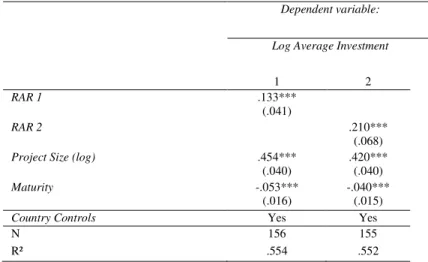
Table 6 –Regression analysis: average investment from crowdfunders
Dependent variable:
Log Average Investment
1 2
RAR 1 .133***
(.041)
RAR 2 .210***
(.068)
Project Size (log) .454***
(.040) .420*** (.040)
Maturity -.053***
(.016) -.040*** (.015)
Country Controls Yes Yes
N 156 155
R² .554 .552 Robust standard errors in parentheses. Notation of the significance levels: *p<0.1; **p<0.05; ***p<0.01.
In Table 6 we show that both the Risk-adjusted Return measures are positively associated with the logarithm of the average investments, the coefficients being 0.133 (t-stat 3.22) and 2.10 (t-stat 3.08) respectively. This result supports the view that larger average investments by crowdfunders are associated on average, ceteris paribus, with higher risk-adjusted returns. Importantly, we are not claiming any causal relationship here but also an association. This result supports the view that larger crowdfunding investors are able, on average, to appreciate the risk/return quality of projects. Therefore, the interpretation of bounded rationality of crowdfunders is not (fully) corroborated for this category of investors.
4.3 Robustness checks
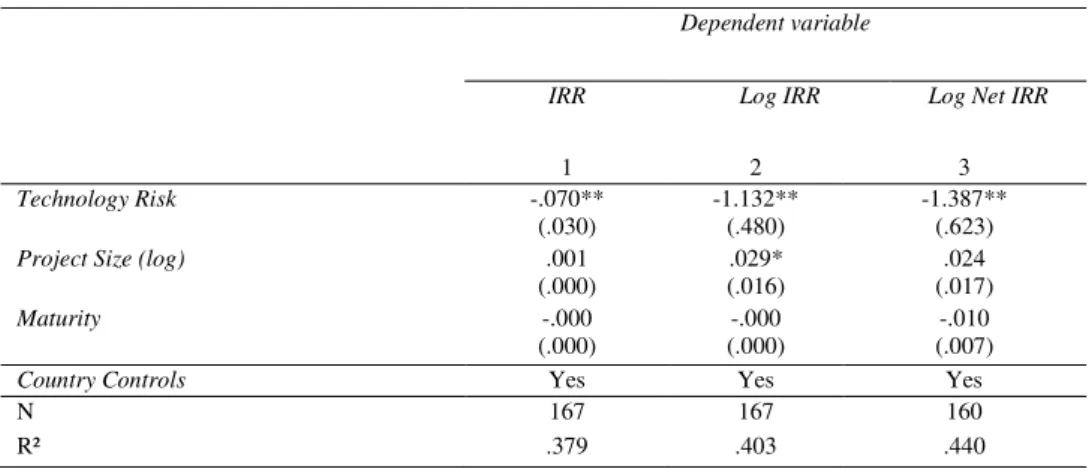
We run various robustness checks to ensure that the results are not driven by models or variables misspecification. In Table 7, we show the results we obtain by running the baseline model introduced in 4.1 with alternative definitions of the dependent variable. In Model 1 we use the straight IRR as reported by the crowdfunding platforms, in Model 2 the natural logarithm of the IRR is used instead. Finally, in Model 3, we report the results obtained when the natural logarithm of the Net IRR is employed instead. In each of the three specifications, the technology risk
23
variable is negative and statistically significant at a 5% level, while the other two variables are not with the exception of size (10% level) when the IRR is expressed in logarithmic terms.
Table 7 – Results of the regression analysis: alternative measures of the returns
Dependent variable
IRR Log IRR Log Net IRR
1 2 3
Technology Risk -.070**
(.030) -1.132** (.480) -1.387** (.623)
Project Size (log) .001
(.000) (.016) .029* (.017) .024
Maturity -.000
(.000) (.000) -.000 (.007) -.010
Country Controls Yes Yes Yes
N 167 167 160
R² .379 .403 .440 Robust standard errors in parentheses. Notation of the significance levels: *p<0.1; **p<0.05; ***p<0.01.
5. Discussion
This paper examines the determinants of relationship between technological risks and returns of projects crowdfunded. This is an important issue given the raising importance that
crowdfunding is having in financing innovation and technology deployment at a moment of transformational change motivated by the need to avoid catastrophic climate change. We analyze a novel database composed of 365 projects on clean energy technologies of 17
European crowdfunding platforms that raised a significant amount of capital from 2013 to 2017. The multivariate analysis includes variables that proxy technological risk with learning curves, a central measure of technology evolution in innovation and technological change studies (Rubin et al., 2015). The models also control for the influence of the characteristics of the projects and cultural dimensions.
Technological risk turns out to be the most significant variable explaining the differences in returns of clean-tech projects financed through crowdfunding. This evidence is in striking contrast with the tenet of modern finance according to which returns are positively associated
24
with the level of risk embedded in projects. In financial terms, this means that platforms do not seem to price correctly the technological risk of the projects and concomitantly crowdfunders are accepting to take additional risks for the same reward. This behavior may be driven by a type of investors that evaluate clean-tech crowdfunding projects not solely for the associated financial returns but also for non-financial considerations such as the environmental and social impact.
Early stage technologies, with typically higher learning rates (Grubler et al. 1999; McDonald & Schrattenholzer 2001; Shayegh et al. 2017), are surrounded by more uncertainties around the evolution of costs and profits, increasing the risk of losses or of no profits of the investment. Despite the increased risk, the analysis shows that crowdfunders accept to receive lower returns because of their different motivations to invest which may be related to bounded rationality and altruism.
Overall, the inverse relationship between risk and returns and the consequent apparent mispricing of the analyzed project echoes the concerns about the estimated returns for equity crowdfunding by Signori & Vismara (2016). The authors find that expected annualized return for an initial crowdfunding investor is 8.8%, a level which is not consistent (lower) with the returns offered by venture capitalists (Gianfrate & Loewenthal, 2015).
Project amount and maturity have little or no effect in the excess rates of returns. Only maturity presents some signs of significance, with predominantly a negative effect (but weak) on the returns. This counterintuitive effect again reinforces the conclusion that crowdfunders behave differently from more traditional investors in the sense that expected returns are disconnected from traditional drivers (risk or maturity).
The characteristics of the countries play an important role in the definition of the premium rate. Cultural factors of the country hosting the projects have an effect on the returns. This is
particularly the case of individualism (i.e., preference for loosely social connections, as opposed to collectivism) and long-term orientation (i.e., preference for encouraging and preparing
25
changes for the future, as opposed to resistance towards change), as defined by Hofstede (2010). These results confirm the early expectation about the positive and significant relationship between long-term orientation and returns. The positive relationship between individualism and returns is not surprising as either collective goals, such as environmental protection, receive less priority in a more individualist society and so we expected a positive effect of individualism in the rewards of clean-tech projects.
The results have several implications for the policy-making and the crowdfunding research. Crowdfunding is raising across sectors and has the potential to enlarge the sources of financing for innovation and deployment of environmental technologies, especially for those in the formative phase that have scarce opportunities for funding its increasing needs of investment. Crowdfunding can also promote sustainable development by enabling the widespread access to clean technologies in low-income economies. Policies should seek to reduce the perceived risk of new technologies, particularly the dissemination of information to crowdfunders in order to raise the incentives (including the allowed returns) and the level of participation.
In the future, we need to understand why crowdfunding platforms are not pricing correctly technological risk. Such investigation would eventually uncover important factors that drive the decision about the pricing of the projects, namely through the focus on more project level variables—such as the possibility to refund investors in case of failure to meet a target (Wash & Solomon, 2011)—instead of category level technology risks as explored in the paper. In
addition, we need to understand how transformative emerging innovations, which have a typical high risk, high reward profile, could successfully find the means in the time and scale needed through crowdfunding.
6. Conclusion
The paper examines the effect of risk profile in the returns of crowdfunded projects. We study the projects that have raised money for clean technologies through crowdfunding in Europe,
26
from 2013 and 2017. These low carbon technologies are at different stages of development and have distinct risk profiles. This empirical case therefore allows us to improve our understanding about the drivers of the investment in crowdfunding, particularly in terms of the effect of risk in project formulation. We find that technological risks contribute to decrease the excess of returns of the projects, in contrast to the predictions from the standard finance literature. Altruism and bounded rationality partly explain that difference. In addition, we find that countries’
technological capacity and cultural dimensions significantly explain the variance in returns in terms of the differences of individualism and long-term orientation. We also show that while on average there is a negative relationship between returns and risks, larger average individual investments are associated to the projects that have superior return/risk profiles. These projects in turn have a large share of mature technologies.
Implications of these results include the need to improve the conceptualization on the drivers of crowdfunding’s returns to incorporate behavioral factors. They also provide important lessons for policy-making to increase the investments in clean technologies with crowdfunding. Technological risk is not likely to limit the potential of crowdfunding to finance the
development and deployment of low carbon technologies (especially by unlocking the potential of investment by a large number of microfunders). However, policies should improve the technological risk-adjusted returns of emerging technologies in order to attract larger investors that provide higher average investments. In the future, more empirical studies should analyze the effect of technological risk in crowdfunding projects in other sectors (e.g. medicine, pharmaceutical, information and communication technologies) to infer whether the pattern found in clean-tech is generalizable to the rest of the economy.
Importantly, relevant implications for financial regulators and scholar emerge from our findings regarding risk profile of crowdfunded projects not being in line with the returns offered to investors. We lay the ground for the question on whether crowdfunding is a sustainable business model and whether it poses risks to the global financial stability and real economy. If that is the case, possible policies to be considered include increasing transparency requirements for
27
crowdfunding platforms, enhancing third party supervision, introducing independent rating of the projects, promoting the financial education of crowdfunders. Research is needed to
understand whether and how mechanisms adopted in other areas of the financial system can be applied effectively to the crowdfunding sphere. In addition, research should also study the behavioral motivations of crowdfunders specifically in the context of the development of new sustainable innovations.
References
Abernathy, W. J., & Utterback, J. M. (1978). Patterns of industrial innovation. Technology Review, 64, 254-228. Abernathy, W. J., & Wayne, K. (1974). Limits of the learning curve. Harvard Business Review, 52(5), 109-119. Agrawal, A., Catalini, C., Goldfarb, A. (2010). The Geography of Crowdfunding. SSRN Electronic Journal.
Ahlers G.K.C., Cumming D., Gunther C., Schweizer D. (2012). Signaling in Equity Crowdfunding. SSRN Electronic Journal.
Ang, J.S. (1991). Small business uniqueness and the theory of financial management. The Journal of Small Business Finance, 1(1): 1-13.
Argote, L., Beckman, S. L., & Epple, D. (1990). The persistence and transfer of learning in industrial settings. Management Science, 36(2), 140-154.
Arrow, K.J. (1971). The economic implications of learning by doing. The Review of Economic Studies 29(3), 155–173. Belleflamme, P., Lambert, T., Schwienbacher, A. (2010). Crowdfunding: An Industrial Organization Perspective. Prepared for the workshop Digital Business Models: Understanding Strategies, Paris, pp. 25–26.
Belleflamme, P., Lambert, T., Schwienbacher, A. (2012). Crowdfunding: Tapping the Right Crowd. SSRN eLibrary. Belleflamme, P., Lambert, T., Schwienbacher, A. (2013). Individual crowdfunding practices. SSRN Electronic Journal. Bento, N. (2013). New Evidences in Technology Scaling Dynamics and the Role of the Formative Phase. International Institute for Applied Systems Analysis, IIASA Interim Report 13-004, Laxenburg.
Berger, A., G. Udell, (1995). Relationship Lending and Lines of Credit in Small Firm Finance. Journal of Business 68, 351-381.
Burtch, G., Ghose, A., Wattal, S. (2011). An Empirical Examination of the Antecedents and Consequences of Investment Patterns in Crowd-Funded Markets. SSRN Electronic Journal.
Carpenter, R.E., Petersen, B.C. (2002). Is the growth of small firms constrained by internal finance?, The Review of Economics and Statistics, 84(2): 298–309.
Cassar, G. (2004). The Financing of Business Start-ups. Journal of Business Venturing, 19, 261-283.
Cheng, L., Daniels, S., Geyer, W., Muller, M. (2013). Crowdfunding inside the Enterprise: employee initiatives for innovation and collaboration. CHI 2013: Changing Perspectives, Paris, France.
Chittenden, F., Hall, G., Hutchinson, P. (1996). Small firm growth, access to capital markets and financial structure: Review of issues and an empirical investigation. Small Business Economics, 8(1): 59-67.
Cosh, A., Cumming, D., Hughes, A. (2009). Outside Entrepreneurial Capital. The Economic Journal, 119(540), 1494-1533.
28
De Buysere, K; Gajda, O; Kleverlaan, R and Marom, D. 2012. A Framework for European Crowdfunding. Available at: http://evpa.eu.com/wpcontent/uploads/2010/11/European_Crowdfunding_Framework_Oct_2012.pdf
Edenhofer, O., Pichs-Madruga, R., Sokona, Y., Seyboth, K., Matschoss, P., Kadner, S., ... & von Stechow, C. (2011). IPCC special report on renewable energy sources and climate change mitigation. Prepared By Working Group III of the Intergovernmental Panel on Climate Change, Cambridge University Press, Cambridge, UK.
European Commission (2005). Best practices of public support for early-stage equity finance. Final report of the expert group, Directorate-General for Enterprise and Industry.
Fisher, P., J. Kruegar, T. Greitemeyer, C. Vogrincic, A. Kastenmuller, Dieter Frey, M. Heene, M. Wicher, and M. Kambacher (2011). The Bystander-Effect: A Meta-Analytic Review on Bystander Intervention in Dangerous and Non-Dangerous Emergencies. Psychological Bulletin, 137(4), 517-537.
Florida, R.L., Kenney, M. (1988). Venture Capital, High Technology and Regional Development. Regional Studies, 22, 33-48.
Florida, R., Smith, D. (1993). Venture capital formation, investment and regional Industrialization. Annals of the Association of American Geographers, 83(3), 434-5.
Gallagher, K. S., Grübler, A., Kuhl, L., Nemet, G., & Wilson, C. (2012). The Energy Technology Innovation System. Annual Review of Environment and Resources, 37, 137-162.
Gerber, E.M., Hui J.S., Kuo, P.Y. (2011). Crowdfunding: why the people are motivated to post and fund projects on crowdfunding platforms. Northwestern University Creative Action Lab, Sheridan Drive, Evanston.
Gompers, P., Lerner, J. (2004). The venture capital cycle. MIT Press.
Gianfrate G., Loewenthal, S. (2015). Private Equity During the Financial Crisis. Journal of Private Equity 19(1), 14– 26.
Gorman, M., Sahlman, W.A. (1989). What do venture capitalists do? Journal of Business Venturing 4, 231–248. Greenberg, M.D., Hariharan K., Gerber E., Pardo B. (2013). Crowdfuding Support Tools: Predicting Success & Failure. CHI 2013: Changing Perspectives, Paris, France.
Grubler, A. (2010). The costs of the French nuclear scale-up: A case of negative learning by doing. Energy Policy, 38(9), 5174-5188.
Grubler, A. (2012). Energy transitions research: Insights and cautionary tales. Energy Policy, 50, 8-16.
Grubler, A., Nakicenovic, N., & Victor, D. G. (1999). Dynamics of energy technologies and global change. Energy Policy, 27(5), 247-280.
Gualandri, E., Schwizer P. (2008). Bridging the Equity gap: il caso delle PMI innovative. Studi e Note di Economia, Anno XIII, n. 1-2008, pp. 101-138.
Gupta, K. (2017). Do economic and societal factors influence the financial performance of alternative energy firms?. Energy Economics, 65, 172–182.
Harms, M. (2007). What Drives Motivation to Participate Financially in a Crowdfunding Community?. Thesis Master in Marketing, University of Amsterdam.
Hartmann, G. C., & Lakatos, A. I. (1998). Assessing technology risk–a case study. Research-Technology Management, 41(2), 32-38.
Hawkens, P. (2017). Drawdown: The Most Comprehensive Plan Ever Proposed to Reverse Global Warming. Penguin Books.
Healey, S. (2015). Separating Economies of Scale and Learning Effects in Technology Cost Improvements. IIASA Interim Report. IIASA, Laxenburg, Austria: IR-15-009.
Henriques, I, and P. Sadorsky. (2008). Oil prices and the stock prices of alternative energy companies, Energy Economics, 30 (2008), pp. 998-1010.
Him, P.H. (2013). TMI: Honesy claims and risk of overdisclosure in crowdfunding campaigns. Paper abstract submission to the Crowdfunding Conference at the University of Colorado-Boulder.
29
Howe, J. (2008). Crowdsourcing. Why the Power of the Crowd is Driving Future of Business. New York: Three Rivers Press.
IEA (2015), Projected Costs of Generating Electricity 2015, IEA/OECD, Paris. IEA (2010), Projected Costs of Generating Electricity 2010, IEA/OECD, Paris.
IEA (2006). Light's Labour's Lost: Policies for Energy-Efficient Lighting. IEA/OCDE, Paris. IEA (2005), Projected Costs of Generating Electricity 2005, IEA/OECD, Paris.
Kahneman, D. (2003). Maps of bounded rationality: Psychology for behavioral economics. American Economic Review, 93(5), 1449-1475.
Kim, K., Viswanathan, S. (2013). The experts in the crowd: the role of reputable investors in a crowdfunding market. SSRN Electronic Journal. Available at: http://ssrn.com/abstract=2258243.
Kiss, A.A., Landaeta, S.J.F., & Ferreira, C. I. (2012). Mastering heat pumps selection for energy efficient distillation. Chem. Eng. Trans, 29, 397-402.
Kleemann F.G., Voss G., Rieder K. (2008). Un(der)paid Innovators: The Commercial Utilization of Consumer Work through Crowdsourcing. Science, Technology & Innovation Studies 4:1, 5-26.
Kortum, S., Lerner, J., (2000). Assessing the contribution of venture capital to innovation. RAND Journal of Economics 31, 674.
Kumar, Surender, Managi, Shunsuke, & Matsuda, Akimi (2012) Stock prices of clean energy firms, oil and carbon markets : a vector autoregressive analysis. Energy Economics, 34(1), pp. 215-226.
Kuo, D. C. L., Lin, C. J. H., Huang, S. X. S., & Lin, Y. C. (2014). Investigating the effects of project scales on the patterns and performance of successfully funded, technology-oriented innovative crowdfunding projects. In Industrial Engineering and Engineering Management (IEEM), 2014 IEEE International Conference on (pp. 184-188).
Kuppuswamy, V., Bayus, B.L., (2013). Crowdfunding Creative Ideas: The Dynamics of Project Backers in Kickstarter. SSRN Electronic Journal.
Lerner, J., (1995). Venture Capitalists and the Oversight of Private Firms. Journal of Finance, 50, 310-318.
Lin, M., Viswanathan, S. (2013). Home Bias in Online Investments: An Empirical Study of an Online Crowd Funding Market. papers.ssrn.com.
Linde, L., Prasad, A. (2000). Venture Support Systems Project: Angel Investors. Cambridge: MIT Entrepreneurship Center.
Lovins, A. (2013). Reinventing fire: Bold business solutions for the new energy era. Chelsea Green Publishing. Mason, C., (2007). “Venture capital: a geographical perspective" in H Landstrom (ed) Handbook of Research on Venture Capital, Edward Elgar, Cheltenham, pp. 86-112.
Mazzucato, M., & Semieniuk, G. (2018). Financing renewable energy: who is financing what and why it matters. Technological Forecasting and Social Change, 127, 8-22.
McDonald, A., & Schrattenholzer, L. (2001). Learning rates for energy technologies. Energy Policy, 29(4), 255-261. Mollick, E. (2014). The dynamics of crowdfunding: An exploratory study. Journal of Business Venturing, 29(1), 1-16. Nemet, G. F. (2009). Interim monitoring of cost dynamics for publicly supported energy technologies. Energy Policy, 37(3), 825-835.
Nordhaus, W.D. (2009). The perils of the learning model for modeling endogenous technological change (No. w14638). National Bureau of Economic Research.
Ordanini, A., Miceli, L., Pizzetti, M., Parasuraman, A. (2011). Crowd-funding: transforming customers into investors through innovative service platforms. Journal of Service Management 22 (4), 443-470.
Oxera (2011), Discount rates for low-carbon and renewable generation technologies, Prepared for the Committee on Climate Change, April, Oxera Consulting Ltd, Brussels.