Social Capital in Temporary
Inter-organizational Projects
A Third Sector Perspective
Rosana da Rosa Portella Tondolo1
Claudia Cristina Bitencourt2
Vilmar Antônio Gonçalves Tondolo3
Abstract
Social Capital emerges from the relationship among actors in several kinds of activities. Temporary inter-organizational project is one of those activities. Regarding these projects, social capital has the hole of being a way to nonprofit organizations access resources. In this context, these study aims to propose dimensions and categories of analysis to investigate social capital in the context of temporary inter-organizational projects in the Brazilian Third Sector. In order to achieve this goal we developed a literature review covering the main international journals of management field. As main results we may highlight the proposal of to consider mobilization as an important dimension in the study of social capital. Additionally, we regard as central to understand resources mobilization in the development of temporary inter-organizational projects in the third sector.
Keywords: Social Capital. Third Sector. Temporary Inter-organizational Projects.
1 Doutora em Administração pela Universidade do Vale do Rio dos Sinos (Unisinos). Pós-doutoranda no programa de Pós-Graduação em Administração da Universidade do Sul de Santa Catarina (Unisul). [email protected]
2 Doutora em Administração pela Universidade Federal do Rio Grande do Sul (UFRGS). Professora da Universidade do Vale do Rio dos Sinos (Unisinos). [email protected]
3 Doutorado em Administração pela Universidade do Vale do Rio dos Sinos (Unisinos). Professor da Universidade de Caxias do Sul (UCS). [email protected]
Resumo
O Capital Social emerge da relação entre atores em diversos tipos de atividades. Uma dessas ativi-dades são os projetos interorganizacionais temporários. Nesses projetos, o capital social tem papel de constituir fonte de acesso a recursos para as organizações sem fins lucrativos. Nesse contexto, este estudo tem como objetivo propor dimensões e categorias de análise para o estudo do capital social no contexto de projetos interorganizacionais temporários no terceiro setor brasileiro. A fim de atender ao objetivo foi desenvolvida uma revisão de literatura englobando os principais periódicos internacionais da área de gestão. Como principais resultados pode-se destacar a inclusão da dimensão mobilizadora no estudo do capital social. Considera-se central o entendimento da mobilização de recursos no desenvolvimento de projetos interorganizacionais temporários no terceiro setor.
Social capital has been studied in different fields and areas of knowledge. In the management field, social capital arises mainly in the relationships among individuals or main players that are involved in a same project and which are seeking the same objective. These project may be characterized as permanent or temporary and involve main actors from the same or different organizations.
Accordingly, temporary inter-organizational projects developed by organizations has increased recently (Oerlemans; Pretorius, 2010). This boost may be due to associative forms of competition or even to the organizations’ instinct for survival. In the third sector this is not different. Organizations in this sector are increasingly seeking for participation of public and private initiative. Thereby, many projects developed in the third sector have been carried out as partnerships form. This increases the interest of researchers to find out how this type of relationship can be managed.
In this sense, this paper aims to present a theoretical study on social capital highlighting the context of the temporary inter-organizational project in Brazilian third sector. In order to attend this objective we have done a theoretical examination on social capital, since its definition to the latest studies on the subject. These previous studies were valuable to present propositions considering the subject, social capital and its context of analysis – a temporary project developed in Brazilian third sector.
We used to carry out this study works of Whetten (1989) and Bacharach (1989) as methodological guidelines. The construction of the propositions was based on seminal studies that were analyzed in the research context. The choice of proposition is based on the Whetten (1989), which highlights the main difference between propositions and hypotheses. For that author, propositions involve concepts while hypotheses require measurements. Therefore, a proposition is a conceptual affirmation that can be tested which in future will become a hypothesis (Whetten, 1989).
This theoretical study is organized as follows. First, we describe the research context: temporary inter-organizational project in Brazilian third sector, followed by the theoretical review on social capital and the discussion of the study of social capital in inter-relational projects within the Brazilian third sector. We conclude presenting theoretical propositions.
Research Context: the brazilian third sector
Brazilian third sector is quite a heterogeneous field. Non-profit enti-ties from private initiative, which share public purposes, are part of it. In this sense, this type of organization has emerged in the field of public policies, operating project, programs, and/or social services. Those programs pursue to fulfill social needs of the beneficiaries of those initiatives (Fernandes; Maciel; Barros, 2011).
In Brazil the third sector is directly linked to the management model that was adopted in the late 20th Century. In this model, social needs that
emerge from social questions are shared with other sectors of society. It generates a new social management model. As consequence of this process, it is established a wider scope of third sector action is in catering to public policies (Fernandes; Maciel; Barros, 2011).
Brazilian third sector encompasses various kinds of arrangement between the State and civil society. This arrangement includes the imple-mentation and co-management of public policies, especially those of a social nature. Thereby, it establishes non-governmental actors in the development of these policies (Pimenta; Saraiva; Corrêa, 2006).
Brazil is also following the global trend of growth in the Third Sector. According to the Brazilian Institute of Geography and Statistics, in 2010 there were approximately 290.692 private foundations and NPOs (IBGE; IPEA; ABONG; GIFE, 2012). The manpower in the third Brazilian sector is 3.3% of the active population of the country (Salamon, 2010). For
instan-ce, in the Brazilian context, Third Sector organizations provide access to health, education and the labor market by providing training. In addition, these organizations develop actions against poverty, violence and corruption. The management of these organizations, most of the time, seems to be fragile, especially with regard to the measurement of results and evalua-tions (Campos; Andion, 2011). Nonprofit organizaevalua-tions are daily subjected to the execution and implementation of projects, which have their own goals and resources, and are often the sources of livelihood of this type of organization. Thus the management issue becomes even more important, especially regarding the measurement of the results presented by these projects, as well as its evaluation and impact generated in the social context (Campos; Andion, 2011).
In this regards, it is remarkable that the particularities shape this sector, which involve the actors mobilization for the development of projects and activities, since many of the people working in these organizations are volunteer (Salamon, 2010). Another aspect to be highlighted is the organi-zation focus on activities of public interest, not profit. Although the Third Sector represents a considerable part of the economy, generating jobs and income (Salamon, 1994, 2010), a significant portion of income included in this industry comes from donations and much of its workforce is voluntary. Thus, the realization of interorganizational projects emerges as a busi-ness opportunity that has grown in recent times (Oerlemans; Pretorius, 2010). In the third sector, organizations are increasingly seeking the participation of public and private sector. So many projects developed in this sector are conducted in partnership with different actor’s format.
In this view, third sector requires especial attention in order to deter-mine the dynamics of the sector itself, as well as, to monitor and evaluate the management processes. It is also important the need for knowledge on how the changes occur and the effects caused by the actions of these organizations (Fernandes; Maciel; Barros, 2011).
Thus, it becomes important to bring evidence and insights that can contribute to this discussion on the understanding of the relationships es-tablished between the actors and the management mechanisms involved in the management of these projects. Therefore one may perceive a point of convergence between the managerial and academic interests, highlighting the need for theoretical and empirical studies that feed this discussion and can bring light to new reflections.
What is a Temporary Inter-Organizational Project?
According to Jones and Lichtenstein (2014, p. 210) “inter-organi-zational projects involve two or more organi“inter-organi-zational actors from distinct organizations working jointly to create a tangible product/service in a limi-ted period of time”. The literature on project management is quite vast. Some techniques have already been exploited in order to coordinate the actions that involve the projects. However, there are few studies on inter--organizational projects (Jones; Lichtenstein, 2014).
By definition, inter-organizational projects are temporary. In these projects relationships are established to achieve an objective, which may be common to the main actors, or may cover multiple objectives (each main actor has a different goal), but these goals are prearranged by the project partici-pants. When all objectives are achieved the project organization is literally dissolved. Additionally, time is crucial to carry out an inter-organizational project (Jones; Lichtenstein, 2014).
Inter-organizational projects are more intensive in the third sector than in other sectors. That type of project is a way to the nonprofit organiza-tions to obtain resources. Therefore, particularly in the third sector, studies involving social capital and inter-organizational relationships contribute to a large extent to the theoretical advancement and to perfecting and improving management practices (Calixto, 2009).
Definition and Origin of Social Capital
Social capital was developed based on three origins (Baron; Field; Schuller, 2000), all of them in the field of social sciences. Within this reasoning, the first refers to studies which created and disseminated the term, notably the work of Pierre Bourdieu (1980); James Coleman (1988) and Robert Putnam (1995). The second genealogy highlights key elements that compose social capital: trust, social cohesion, network, rules and institutions. The third, more extensive one includes all works relating to social capital even when they do not explicitly cite the concept. In this genealogy, the work of Emile Durkheim and Max Weber stands out (Baron; Field; Schuller, 2000).
Accordingly, the use of the term social capital can be determined as being introduced in the early 1980’s when Pierre Bourdieu referred to the advantages and opportunities of belonging to certain communities (Portes, 2000; Albagli; Maciel, 2002). Bourdieu was followed by James Coleman, who concentrated his investigations on individuals or small groups as unit of analysis of the social capital. Even though their studies showed small variations between studies both authors touched upon the benefits to indi-viduals or families stemming from their ties to third parties (Portes, 2000).
Portes (1998) defends that social capital can be originated from three separate sources, the first one presenting social capital from the aspect of social control; the second one from family brokered benefits and the third one from non-family network brokered resources (Portes, 1998).
Both, Bourdieu (1980) and Coleman (1988) studies stimulated other studies focusing on social capital in different areas, and therefore, the concept no longer was limited to a specific area within Sociology, being recognize into several areas (Portes, 1998, 2000). That dissemination originated nu-merous associations of social capital to other subjects generating a diversity of themes related concepts and definitions. In figure 1 we present the main definitions the authors have developed.
Figure 1 – Concepts and origins of social capital
Concepts Authors
Social capital is the aggregate of the actual or potential resources which are linked to possession of a durable network of more or less institutionalized relationships of mutual acquaintance or recognition.
Bourdieu (1980) Social capital is a variety of entities with two elements in common,
consis-ting of some aspect of social structures, and they facilitate certain action of actors (persons or corporate actors) with the structure.
Coleman (1988) Social capital is a resource that actors derive from specific social structures
and then use to pursue their interests. It is created by changes in the relationship among actors.
Baker (1990) Social capital is the set of elements of the social structures that affects
relations among people and are inputs or arguments of the production and/or utility function.
Schiff (1992) Social capital Social is similar to friends, colleagues and more general
contacts through whom you receive opportunities to use your human and financial capital.
Burt (1997) Social capital consists of features of social life – social networks, norms, and
trust – that enable participants to act together more effectively to pursue shared objectives.
Putnam (1995)
Source: Adapted from Portes (1998) e Walker (2008).
In order to attend our goal, we adopt that the following concept: Social capital is a resource that has been developed among actors from a specific social structure, and it is created by established exchanges in the relationships among actors (Baker, 1990). Thus, social capital is seen as an
input, which means that more intense relationships (ties) generate greater results stemming from this social capital (Schiff, 1992).
Accordingly, Bourdieu (2003) defends that social capital differs from other kinds of capital since it increase with use. The maintenance and growth of social capital is due to the integration among main actors within the network. However, Coleman (1988) comprehends social capital as being similar to human and physical capital, as social capital is not entirely fungible, and it can be specific for certain activities. Just as a certain form of social capital can be valuable and facilitate certain actions, it may also be unnecessary and compensate damages by other actions (Coleman, 1988).
Putnam’s study appears as a successor to Coleman since both have very close conceptual visions (Walker, 2008). However, it is important to stress that while Coleman seeks to explain the consequences of social rela-tions, Putnam highlights the ways to improve society’s social relations. In addition, both authors point out high priority on the performance according to rules and are strongly committed to collective values, thereby questioning the value of human capital as dissociated from ample social relationships, thus disagreeing with more orthodox approaches, which defend individua-lism and rationality (Albagli, Maciel, 2002).
Putnam (1995) highlights social relations and the presence of trust and cooperation as sources of mutual benefits. Additionally, Nahapiet and Ghoshal (1998) defend the existence of three dimensions of social capital: structural, cognitive and relational. The relational dimension, which measures trust, rules, obligations and social identification, grows in various directions in networks with the presence of strong and reciprocal ties.
According to Albagli and Maciel (2002) two assumptions used by Putnam in his definition of social capital (networks, norms and trust) are implicit in concept. This is due to the fact that networks and norms are em-pirically associated and have significant economic impact on communities, and also, an instrumental function emerges for social capital. Moreover, trust is achieved when there is mutual acquaintanceship among members of a society and a strong tradition of community action.
According to Sarate and Macke (2007) social capital has inexhaustible sources if used, however if not used it become scarce. These authors defend that social capital happens in relationships not being the exclusive property of individuals. This is why the development of social capital is significantly affected by factors that structure the evolution of the social relationships.
As social capital touches on the lines of social life (contact networks, norms and trust), it enables participants to act in concert more effectively in order to pursue common objectives, thereby disseminating knowledge, learning and local development (Putnam, 1995).
Specifically, in the sociology field authors approach social capital in a tripartite form, as well as, the implications of this concept, which can be seen as follows: (1) a source of social control; (2) a source of benefits mediated by family and (3) a source of resources mediated by non-family relationships (Portes; Landolt, 2000).
Social capital was not only disseminated in sociology, but also mi-grated to other areas such as management, economy, human and political science amongst others. Even if the term, social capital was originated in sociology by Bourdieu’s and Coleman’s studies, even thought nowadays the concept of social capital is applied to organizational studies, and it is increase attention by researchers and professionals (Adler; Kwon, 2002).
Evolution of the Concept of Social Capital
in Organizational Studies
Since conception of social capital studies in the 80’s many studies have been done and published throughout the world. Recently, in the field of organizational studies social capital is largely explored. One of the first studies was undertaken by Burt (1997), who investigates in which way the value to an individual of social capital is conditioned by the number of individuals that do the same job. The author’s findings highlight the fact that when the number of people carrying out the same actions increases the social capital diminishes. In 1998, Nahapiet and Ghoshal published a theoretical study in this field. In that study, the authors investigated social capital as an enabler in creating intellectual capital.
In 1998, Tsai and Ghoshal published in the Academy of Management Journal a study with the aim of examining the relationships between these dimensions and the standards of resource exchanges and innovation of products in the analyze organization.
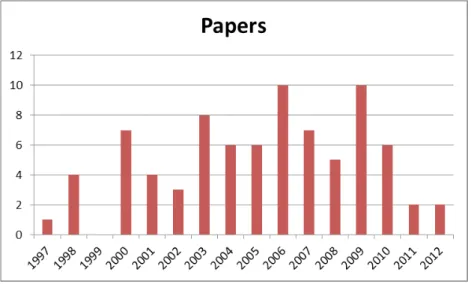
Since 2000, studies on social capital gained more visibility and interest in the field of organizational studies, which drew many authors to the subject. Considering the increase of interest in the area, a survey of 9 influential journals4 was carried out, and it was possible to identify the evolution of the
publications over the years (1997 to 2012), as it can be seen in the Figure 2. Figure 2 – Survey of articles published from 1997 to 2012
Source: Authors of this study
Through the analysis we identify 81 articles published in the main journals cited above, it was possible to identify different focuses on the stu-dy of social capital. Thereby, we found studies addressing the relationship
4 Academy of Management Journal (AMJ); Academy of Management Review (AMR); Administrative Science Quarterly (ASQ); Journal of Business Ethics (JBE); Journal of Management Studies (JMS); Journal of Organizational
between social capital and: (i) organization’s performance; (ii) social ties; (iii) innovation; (iv) knowledge and learning; (v) success; and (vi) resources. Moreover, we also identify secondary themes, such as: participation on boards; technological differential; cost of sales; acquisition of funding for biotechnology based companies and the influence on business decisions is also considered.
Luo (2003) presented a significant study, which addressed the way as industrial conditions influence the relationships among executives and other entities, as buyers, suppliers, competitors, distributors and the regulators of an emerging market. The results of that research confirm the major argument the study proposes, that managerial relationships are formed by industrial conditions and confirms the contingence and dependence on network vision. In that way, social or personal ties are related to: industry characteristics that encompass different opportunities or threats; the executive’s vision of how his business depends on opportunities or vulnerability to threat.
Blyler and Coff (2003) approach social capital as a key aspect to understand both the generation and appropriation of income. The authors established an explicit connection between social capital and dynamic capabilities. In addition, the authors explored the way as social capital in-fluences those who benefit from the gains, as how it encourages dynamic capabilities, and how it facilitates the income appropriators. For the authors these findings are important because they lead to a prediction that income originates from a capacity that can be registered by many traditional per-formance measurements (Blyler; Coff, 2003).
The literature also shows how social capital is associated to the deve-lopment of a competitive advantage. The study by Galdámez, Carpinetti and Gerolamo (2009) presents a relationship of social capital within the context of local productive arrangements (LPAs). According to the authors, there is theoretical and empirical relation between social capital and competitive advantage. Social capital in the LPAs directly influences the level of coo-peration and trust among the parties to these arrangements. The level of
cooperation influences the exchange of information, which can be produc-tive, technological or market oriented, besides enabling an integration of competences. Thus, higher levels of social capital in a LPA lead to greater levels of cooperation and more exchanges of information and competence integration (Galdámez; Carpinetti; Gerolamo, 2009).
Galdámez, Carpinetti and Gerolamo (2009) highlight that social capital also influences the level of trust among members of LPA. For these authors, as the highest relationship, the highest will be the social capital, and therefore the trust between them. The relationship of trust between members facilitates the flow of information and therefore develops a tech-nological and production capacity in the region.
Thus, the authors cited above identified a relationship between the level of social capital and the LPA’s competitive advantage, since the com-petence in innovation and improvement processes within an arrangement are based on undecipherable knowledge, trust and institutional structures, which are hard to replicate (Galdámez; Carpinetti; Gerolamo, 2009).
Acquaah (2007) aimed to replicate the research developed in China by Peng and Luo (2000). Acquaah (2007) replicated this research in the emer-ging African Sub-Saharan region context. In order to achieve the objective, he sought to answer three questions: Does social capital assist in improving a company’s performance? Are the effects of social capital as observed by the performance of Asian companies – particularly China – valid in African Sub-Sahara? How does the strategic orientation of a company affect the rela-tionship between social capital and organizational performance? The results of the study imply that social capital is developed by each of the dimensions independently of management, with different effect on the organizational performance and depending on the strategic orientation (Acquaah, 2007).
Results shown by Acquaah (2007) are coherent with those of Peng and Luo (2000), both defend the position that social capital when develo-ped in a positive way between managers of different companies, improves
organizational performance. Social capital in the public sphere also has a positive effect on organizational performance. Therefore, the results of both studies, China and Ghana clearly show that social capital of the network relationships with the top managers of other companies, and of government official is beneficial for companies in emerging economies. Conversely, re-sults found by Acquaah (2007) show that the social capital of top managers with other Ghanaian companies is more important than with government officials. Thereby, Acquaah (2007) concludes that the social capital of the leaders is an important source of resources, information and learning, which are used to improve performance and that the impact of social capital on organizational performance is harnessed to the strategic and competitive orientation of the company.
Another study involving performance was carried out by Moran (2005). That study aimed to identify the social impact of the managers’ social capital on managerial performance. For this two dimensions of social capital were compared, the structural dimension and the relational dimen-sion. According to the research, of Moran (2005) considers that the relational dimension offers considerable advantages for managerial performance even when compared to the benefits of the network structure. Comparatively analyzing the benefits stemming from the structural and relational dimen-sions the imbrication of the relational dimension is a particularly important factor for entrepreneurial behavior (Moran, 2005).
Besides, it also was possible to identify those studies that explore social capital through a literature review, as well as, others that approach the theme through meta-analysis. In the literature there are many studies showing the measure of social capital, which basically represent two focuses: (i) studies that aimed to measure social capital in communities (Putnam, 2004; Onyx, Bullen, 2000; Grootaert et al., 2003); and (ii) studies that aimed to measure social capital in companies and their influences (Batjargal, 2003; Reed; Lubatkin; Srinivasan, 2006; Koka; Prescott, 2002; Achquaah, 2007;
Florin; Lubatkin; Schulze, 2003; Pil; Leana, 2009; Somaya; Williamson; Lo-rinkova, 2008; Stam; Elfring, 2008; Shaw et al., 2005; Moran, 2005; Fischer; Pollock, 2004; Oh; Chung; Labianca, 2004; Wu, 2008).
A similar analysis was carried out by Adler and Kwon (2002), in which the authors presented a survey of previous studies that had dealt with social capital in the organizational area. It was identified that the relationships that involve social capital address aspects such as: professional success; assistance in seeking jobs; facilitation in changing units and the innovation of products; creation of intellectual capital; effectiveness of multi-functional groups; reducer of turnover rates; facilitation of entrepreneurship; setting up of companies; strengthening the relationships in the chain; regional produc-tion networks; and inter organizaproduc-tional learning (Adler; Kwon, 2002). These authors’ main objective was to develop an integrating framework, which would identify the sources, benefits, risks and contingencies of social capital.
In this view, the present study seeks to use previous studies, in a contributing way, to analyze the subject of social capital in the context of the analysis of a temporary interorganizational project in Brazilian third sector. To this end the discussion of the dimensions and categories of social capital analysis are fundamental.
Social Capital Dimensions
and Categories of Analysis
Nahapiet and Ghoshal (1998) present three dimensions of social capi-tal, structural, cognitive and relational. According to Nahapiet and Ghoshal (1998), the structural dimension refers to the system of relationships and the ties among people or units. That dimension is defined as the main actor location and the relationships that he/she has in a social structure, thereby offering advantages to him/her. These advantages are obtained when indi-viduals use certain positions at work, information or yet access to specific resources (Tsai; Ghoshal, 1998).
The cognitive dimension refers to the resources that are supplied by representations, interpretations and systems of meanings, which are associated to the involved main actors (Nahapiet; Ghoshal, 1998). That dimension is based on language codes and the shared paradigms, thereby facilitating the common understanding of collective objectives and of the forms of acting in the social system (Tsai; Ghoshal, 1998).
Finally, the relational dimension describes the kind of individual relationships that develop among individuals, referring to the assets that are created and potentialized through relationships, which promote trust, cre-dibility, norms, and sanctions, obligations, and expectations in relationships (Nahapiet; Ghoshal, 1998).
In this sense, Sarate and Macke (2007), based on Nahapiet and Ghoshal (1998) sought an explanation of what the analysis categories would be in each of the dimensions, as shown in Figure 3.
Figure 3 – Dimensions of social capital
Source: Sarate, Macke (2007, p. 3) adapted from Nahapiet, Ghoshal (1998).
Considering the previously analysis of the main international journals in which 81 papers were detailed analyzed, we sought to identify the cate-gories that were used to analyze the formation and stock of social capital. This analysis sought to classify the categories from the articles according to the dimensions and categories that were proposed by Nahapiet and Ghoshal (1998). Thus, it was possible to identify categories that were aligned with the dimensions and categories proposed by Nahapiet and Ghoshal (1998) and also additional categories.
Structural Dimension – Network connections; – Network configuration; – Organization adequation
Cognitive Dimension – Shared codes and language; – Shared narratives Relational Dimension – Trust; – Norms; – Obligations and
In the current literature there are a significant number of articles that uses the structural dimension; most of them deal with relationships, ties, network centrality, horizontal and vertical connections. On the other hand, social interaction emerges as addressed category by the cognitive dimension of social capital. Some articles explore the relational dimension of social ca-pital dealing basically with trust as a category of analysis. All such categories are aligned with the categories proposed by Nahapiet and Ghoshal (1998). However, this study’s bibliographical analysis found another three catego-ries, trade and combination of resources (Tsai; Ghoshal, 1998), the acquisition,
reconfiguration, integration and release (Blyler; Coff, 2003); and shared vision (in the collective sense) (Tsai; Ghoshal, 1998; Weick, 1993).
The Study of Social Capital in Inter-Relational
Projects in Brazilian Third Sector
The categories of analyses for measuring social capital in temporary inter-relational projects will be presented in this section. To this end a ca-reful reflection was undertaken considering the categories used in previous studies and the research context.
This study considered the adaptation of the categories developed in the previous studies that were analyzed and finally suggesting categories for measuring social capital in the desired context. Thus, it is inferred that the study of social capital in the temporary inter-organizational project in Brazilian third sector may be conducted through three dimensions, as follow: structural, cognitive and relational, as suggested by Nahapiet and Ghoshal (1998), and mobilization, an additional dimension suggested by this study base on (e.g. Blyler; Coff, 2003; Tsai; Ghoshal, 1998). The mobilizing di-mension aims to measure effectiveness or yet, the effect of social capital in managing resources. Considering the third sector, this dimension is justified since it deals with the mobilization of tangible and intangible resources, one of the most significant forms of carrying out the projects.
Considering the investigation in articles from important journals and in the context of this research, the structural dimension must be composed through the analysis of the network, by observing and studying network configuration, thereby analyzing the relationships among main actors, the nodes in the network (horizontal and vertical connections), and quality/ intensity of ties. Thereby, we suggest the following proposition:
P1: The more Third Sector Organizations show developed structural dimensions enabling communication between main actors, the higher will be the stock of social capital in a temporary inter-organizational project.
In other words, the more the configuration (network) allows com-munication among actor’s the higher will be the social capital in a project. In addition, the dense connections among actors, the higher the quality/ intensity of the ties between these actors, and the higher the project stock of social capital.
The cognitive dimension, in its turn, must be analyzed as of the main actors’ commitment to social interaction and shared vision among actors in the network, which means these main actors have a common goal. In this sector specifically, the goal means to stimulate some kind of benefit to a group of people, and for this reason, the civil society organizations end up by developing this shared vision. Besides, it is suggested that to measure shared vision the sensemaking definition be used. Considering this, regarding the cognitive dimension we have the following proposition:
P2: The more Third Sector Organizations show developed cognitive dimension, the higher will be the stock of social capital in a temporary inter-organizational project.
In other words, the larger the commitment of the main actor to social interaction the higher will be the sock of social capital within a project. And, the closer the actors’ vision as well as the existence of common goals, the higher will be the project’s social capital.
The relational dimension can be analyzed through trust, norms, obligations and expectations, and social identification. Therefore, trust is one of the main motivator for social capital, promoting the stimulus of the intensity of relationships and supplying a greater quantity of exchanges. Thus, regarding the relational dimension we have the following proposition:
P3: The more Third Sector Organizations show developed relational dimension, the higher will be the stock of social capital a temporary inter-organizational project.
In other words, the higher the level of trust among main actors, the more stock of social capital there will be in a project. Consequently, the more institutionalized and clear the norms/obligations for the actors, the higher will be the stock of social capital of the project, and the more the actors identifies with the action and with the other actors involved, the higher will be the stock of social capital.
Mobilization of resources at first sight does not fit the framework of any of the dimensions presented. However, in the specific context, as well as, in most organizations of this sector, resource mobilization is fundamental as it is the propellant of social projects and it maintains this sort of organization. Therefore, it is important to check if the resource mobilization is directly related to the analyzed organization’s social capital, since organizations that show significant sized networks and relationships that are strongly built upon trust tend to present a significant quantity of resource mobilization. Covering this aspect, we present the following proposition:
P4: The more the Third Sector Organizations present significant/considerable sized networks and relationships that are strongly rooted on trust, the more they tend to present a significant quantity of resource mobilization in executing a temporary inter-organizational project.
In other words, the more tangible and intangible resources an or-ganization attracts, the higher will be social capital achieved. Thus, it was possible to determine that many of the categories of analysis presented in previous studies may be approached to measure social capital in the third
sector. However, to this happen, it will be necessary an adaptation of these categories considering the context of analysis. In this sense, this study proposes four dimensions to measure social capital in the third sector, is as follows: structural dimension, cognitive dimension, relational dimension, and mobilizing dimension (suggested by this study, vis-à-vis with the specificity of the empirical context).
The construction of mobilizing dimension was inspired by previous studies that addressed the connection between resources and capabilities and social capital in the organizational context (Andriessen; Gubbins, 2009; Arregle et al., 2007; Blyler; Coff, 2003; Gopalakrishnan; Scilitoe; Santoro, 2008; Luo, 2003; Maurer; Ebers, 2006; Nahapiet; Ghoshal, 1998; Tsai, 2000; Tsai; Ghoshal, 1998; Wu, 2008; Youndt; Subramaniam; Snell, 2004). The analysis categories are presented in each of these dimensions as can be seen in Figure 4.
Figure 4 – Dimensions and Categories of social capital in the third sector
Source: Drawn up by the author. Source: Authors of this study
This study hopes to contribute to the literature focusing on the analysis of social capital in the third sector. This would assist future research on social capital in the third sector using certain dimensions and categories as guidelines.
Structural Dimension
– Network analysis; – Network configuration (relationships between actors, nodes composing the network – horizontal and vertical Cognitive Dimension – Actors commitment to social interaction; – Shared vision (sensemaking) Relational Dimension – Trust; – Norms; – Obligations and expectations; Mobilizing Dimension – Mobilization of resources (tangible and intangible).
Final Considerations
This theoretical study sought to propose dimensions of analysis and categories for the study of social capital regarding temporary inter--organizational project in the third sector. Moreover, this study contributes by presenting theoretical proposals regarding the subject, and these may further become hypotheses to be tested in an empirical context of a tem-porary inter-organizational project.
For this purpose, four generalist propositions were presented, sho-wing the relationship of each dimension with Brazilian third sector social capital stock, and these propositions were opened focusing the categories of analysis for each dimension. The propositions reflect the aspects concerning, as follows: (1) structural dimension, which addresses network configuration, connections among actors, quality/intensity of the ties among main actors; (2) cognitive dimension, that covers the main actors’ commitment to social interaction and the shared vision among actors’; (3) relational dimension, that deals with trust, norms and obligations, and social identification; and (4) mobilizing dimension, which is proposed by this study and concerns resource mobilization.
We suggest mobilizing dimension as an additional dimension for the third sector. This dimension is needed since the organizations acting in this sector significantly use resource mobilization, both to carry out daily activi-ties and to develop projects as well. In this sense, considering specifically this sector, the need to measure the mobilization of resources is proposed, whether the resources are tangible or intangible. This dimension seeks to measure the effect of social capital on resource management.
This study sought to contribute to the field of organizational stu-dies, more specifically in studies involving the third sector. Accordingly, this study is different from the Adler and Kwon (2002) study, since while
the authors seek to propose an integrative framework, this study intends to suggest proposition for the investigation of social capital in temporary inter-organizational projects in the Brazilian third sector.
We suggest for further studies the application of these propositions in an empirical context. That suggestion is also to associate Figure 3, which is the result of this study to other theories or even other contexts.
References
ACQUAAH, M. Managerial social capital, strategic orientation, and organizational performance in an emerging economy. Strategic Management Journal, v. 28, p. 1.235-1.255, 2007.
ADLER, P. S.; KWON, S. W. Social capital: prospect for a new concept. Academy of
Management Review, v. 27, n. 1, p. 17-40, 2002.
ALBAGLI, S.; MACIEL, M. L. Capital social e empreendedorismo local. Projeto de pesquisa política para promoção de sistemas produtivos locais de MPME brasileiras. Rio de Janeiro: UFRJ; IE, Redesist, Finep, Sebrae, 2002.
ANDRIESSEN, D.; GUBBINS, C. Metaphor Analysis as an Approach for Exploring Theoretical Concepts: The case of social capital. Organization Studies, v. 30, n. 8, p. 845-863, 2009.
ARREGLE, J. et al. The Development of Organizational Social Capital: attributes of family firms. Journal of Management Studies, v. 44, n. 1, p. 73-95, 2007.
BACHARACH, S. B. Organizational Theories: Some Criteria for Evaluation. Academy
of Management Review, v. 14, n. 4, p. 496-515, 1989.
BAKER, W. E. Market networks and corporate behavior. American Journal of Sociology, v. 96, n. 3, p. 589-625, 1990.
BARON, S.; FIELD, J.; SCHULLER, T. Social Capital. Oxford: Oxford University Press, 2000.
BATJARGAL, B. Social capital and entrepreneurial performance in Russia: A lon-gitudinal study. Organization Studies, v. 24, n. 4, p. 535-556, 2003.
BLYLER, M.; COFF, R. W. Dynamic capabilities, social capital, and rent appro-priation: ties that split pies. Strategic Management Journal, v. 24, p. 677-689, 2003.
BOURDIEU, P. Le capital social, notes provisoires. In: Actes de la recherche en sciences
sociales, v. 31, p. 2-3, 1980.
BOURDIEU, P. Razões práticas: sobre a teoria da ação. 4. ed. Campinas: Papirus, 2003. BURT, R. S. The contingent value of social capital. Administrative Science Quarterly, v. 43, p. 339-365, 1997.
CALIXTO, L. As inter-relações ONGs ambientalistas, estado e setor privado: uma análise à luz das hipóteses de Tocqueville. Revista Alcance – Eletrônica, v. 16, n. 2, p. 241-259, 2009.
CAMPOS, L. M. S.; ANDION, M. C. M. Avaliação de Projetos Sociais em Orga-nizações da Sociedade Civil: um estudo sobre concepções e práticas. In: ENCON-TRO DA ANPAD – ENANPAD, 35, 2011, Rio de Janeiro. Anais... Rio de Janeiro: Anpad, 2011.
COLEMAN, J. S. Social capital in the creation of human capital. The American Journal
of Sociology, v. 94, p. 95-120, 1988.
FERNANDES, R. M. C.; MACIEL, A. L. S.; BARROS, X. M. T. Estudo sobre o
terceiro setor no Rio Grande do Sul: perfil, gestão e impactos sociais. 1. ed. Porto Alegre: Fundação Irmão José Otão, 2011.
FISCHER, H. M.; POLLOCK, T. G. Effects of social capital and power on surviving transformational change: the case of initial public offerings. Academy of Management
Journal, v. 47, n. 4, p. 463-481, 2004.
FLORIN, J.; LUBATKIN, M.; SCHULZE, W. A social capital model of high-growth ventures. Academy of Management Journal, v. 46, n. 3, p. 374-384, 2003.
GALDÁMEZ, E. V. C.; CARPINETTI, L. C. R.; GEROLAMO, M. C. Proposta de um sistema de avaliação do desempenho para arranjos produtivos locais. Gestão
e Produção, v. 16, n. 1, p. 133-151, 2009.
GROOTAERT, C. et al. Questionário integrado para medir capital social (QI-MCS). Grupo Temático sobre Capital Social. Washington, D.C.: World Bank, 2003. GOPALAKRISHNAN, S.; SCILLITOE, J. L.; SANTORO, M. D. Tapping deep pockets: The role of resources and social capital on financial capital acquisition by biotechnology firms in biotech-pharma alliances. Journal of Management Studies, v. 45, n. 8, p. 1.354-1.376, 2008.
INSTITUTO BRASILEIRO DE GEOGRAFIA E ESTATÍSTICA (IBGE); INS-TITUTO DE PESQUISA ECONÔMICA APLICADA (IPEA); ASSOCIAÇÃO BRASILEIRA DE ORGANIZAÇÕES NÃO GOVERNAMENTAIS (ABONG); GRUPO DE INSTITUTOS, FUNDAÇÕES E EMPRESAS (GIFE). As fundações
privadas e associações sem fins lucrativos no Brasil 2010. In: Estudos e Pesquisas Informação
Econômica, Rio de Janeiro: Instituto Brasileiro de Geografia e Estatística n. 20, ISSN 1679-480X, 2012. Disponível em: <http://ftp.ibge.gov.br/Fundacoes_Privadas_e_As-sociacoes/2010/fasfil.pdf>. Acesso em: 17 out. 2014.
JONES, C.; LICHTENSTEIN, B. Projetos interorganizacionais temporários: como as imersões temporais e sociais realçam a coordenação e gerenciam a incerteza. In: CROPPER, S. et al. (Eds.). Handbook de relações interorganizacionais da Oxford. Porto Alegre: Bookman, 2014. p. 208-229.
KOKA, B. R.; PRESCOTT, J. E. Strategic alliances as social capital: a multidimen-sional view. Strategic Management Journal, v. 23, p. 795-816, 2002.
LUO, Y. Industrial Dynamics and Managerial Networking in an emerging market: The case of China. Strategic Management Journal, v. 24, p. 1.315-1.327, 2003. MAURER, I.; EBERS, M. Dynamics of Social Capital and Their Performance Implications: Lessons from Biotechnology start-ups. Administrative Science Quarterly, v. 51, p. 262-292, 2006.
MORAN, P. Structural vs. Relational embeddedness: social capital and managerial performance. Strategic Management Journal, v. 26, p. 1.129-1.151, 2005.
NAHAPIET, J.; GHOSHAL, S. Social capital, intellectual capital and the organiza-tional advantage. Academy of Management Review, v. 23, n. 2, p. 242-266, 1998. OERLEMANS, L.; PRETORIUS, T. Governing temporary inter-organizational projects. Essays Innovate, v. 4, p. 31-35, 2010.
OH, H.; CHUNG, M.; LABIANCA, G. Group social capital and group effective-ness: the role of informal socializing ties. Academy of Management Journal, v. 47, n. 6, p. 860-875, 2004.
ONYX, J.; BULLEN, P. Measuring social capital in five communities. The Journal
of Applied Behavioral Science, v. 36, n. 1, p. 23-42, 2000.
PENG, M. W.; LUO, Y. Managerial ties and firm performance in a transition eco-nomy: the nature of a micro–macro link. Academy of Management Journal, v. 43, n. 3, p. 486-501, 2000.
PIL, F. K.; LEANA, C. Applying organizational research to public school reform: The effects of teacher human and social capital on student performance. Academy
of Management Journal, v. 52, n. 6, p. 1.101-1.124, 2009.
PIMENTA, S. M.; SARAIVA, L. A. S.; CORRÊA, M. L. Terceiro setor: dilemas e polêmicas. São Paulo: Saraiva, 2006.
PORTES, A. The two meanings of social capital. Sociological Forum, v. 15, n. 1, p. 1-12, 2000.
______. Social capital: Its origins and applications in modern sociology. Annual Review
of Sociology, v. 24, p. 1-24, 1998.
PORTES, A.; LANDOLT, P. Social capital: Promise and pitfalls of its role in deve-lopment. Journal of Latina American Studies, v. 32, p. 29-47, 2000.
PUTNAM, R. Bowling Alone: America’s Declining Social Capital. Journal of
Demo-cracy, v. 6, n. 1, p. 65-78, 1995.
PUTNAM, R. Using social capital to help integrate planning theory, research, and practice. Journal of the American Planning Association, v. 70, n. 2, p. 142-192, 2004. REED, K. K.; LUBATKIN, M.; SRINIVASAN, N. Proposing and testing an intel-lectual capital-based view of the firm. Journal of Management Studies, v. 43, n. 4, p. 867- 893, 2006.
SALAMON, L. M. The Rise of the Nonprofit Sector. Foreign Affairs, v. 73, n. 4, p. 109-122, 1994.
______. Putting the Civil Society Sector on the Economic Map of the World. Annals
of Public and Cooperative Economics, v. 81, n. 2, p. 167-210, 2010.
SARATE, J. A. R.; MACKE, J. Fatores explicativos do capital social em uma cidade da serra gaúcha: a percepção dos estudantes de Administração. ENCONTRO NACIO-NAL DA ASSOCIAÇÃO NACIONACIO-NAL DE PÓS-GRADUAÇÃO E PESQUISA EM ADMINISTRAÇÃO, 31., 2007, Rio de Janeiro. Anais... Rio de Janeiro, RJ, set. 2007. SCHIFF, M. Social capital, labor mobility, and welfare. Rationalite and Society, v. 4, p. 157-175, 1992.
SHAW, J. et al. Turnover, social capital losses, and performance. Academy of
SOMAYA, D.; WILLIAMSON, I. O.; LORINKOVA, N. Gone but not lost: The different performance impacts of employee mobility between cooperator versus competitors. Academy of Management Journal, v. 51, n. 5, p. 936-953, 2008.
STAM, W.; ELFRING, T. Entrepreneurial orientation and new venture perfor-mance: The moderating role of intra- and extra-industry social capital. Academy of
Management Journal, v. 51, n. 1, p. 97-111, 2008.
TSAI, W.; GHOSHAL, S. Social capital and value creation: the role of intrafirm networks. The Academy of Management Journal, v. 41, n. 4, p. 464-476, 1998.
TSAI, W. Social Capital, Strategic Relatedness and the Formation of Intraorganiza-tional Linkages. Strategic Management Journal, v. 21, p. 925-939, 2000.
WALKER, E. Contingent pathways from joiner to activist: the indirect effect of participation in voluntary associations on civic engagement. Sociological Forum, v. 23, n. 1, p. 116-144, 2008.
WEICK, K. E. The collapse of sensemaking in organizations: The Mann Gulch Disaster. Administrative Science Quarterly, v. 38, p. 628-652, 1993.
WHETTEN, D. A. What Constitutes a Theoretical Contribution? The Academy of
Management Review, v. 14, n. 4, p. 490-495, 1989.
WU, W. Dimensions of social capital and Firm Competitiveness Improvement: The Mediating Role of Information Sharing. Journal of Management Studies, v. 45, n. 1, p. 122-146, 2008.
YOUNDT, M. A.; SUBRAMANIAM, M.; SNELL, S. A. Intellectual Capital Profiles: An Examination of Investments and Returns. Journal of Management Studies, v. 41, n. 2, p. 335-361, 2004.
Recebido em: 21/10/2014 Aceito em: 7/5/2015