EDITORS:
MARA MADALENO, MARGARITA ROBAINA, MARTA FERREIRA
DIAS, VICTOR MOUTINHO, JORGE SOUSA
3
University of Aveiro
Department of Economics, Management, and Industrial
Engineering (DEGEI)
ME
32015
2
ndInternational Meeting on Energy and Environmental
Economics
18
thSeptember 2015
FINAL VERSION: 30
thSeptember 2015
2
ndMeeting on Energy and Environmental
Economics
18
thSeptember, 2015
DEGEI, Universidade de Aveiro, Aveiro
ME
4
Title
ME3 2015: Proceedings of the 2nd International Meeting on Energy and Environmental Economics
Editors
Mara Madaleno, Margarita Robaina, Marta Ferreira Dias, Victor Moutinho, Jorge Sousa
Scientific Committee
Anabela Botelho; Mara Madaleno (Chair); Marta Ferreira Dias; Margarita Robaina Alves; Victor Moutinho; Jorge Vasconcelos
Design
Organizing Commitee of the 2nd International Meeting on Energy and Environmental Economics
CHAIR: Mara Madaleno
CO-CHAIRS: Margarita Robaina, Marta Ferreira Dias, Victor Moutinho, Jorge Sousa
Publisher
UA Editora, University of Aveiro 1st edition – September 2015
ISBN
ISBN 978-972-789-459-8
Cataloging in publication
International Meeting on Energy and Environmental Economics, 2, Universidade de Aveiro, 2015
ME3 2015 [Electronic resource]: proceedings of the 2nd International Meeting on Energy and Environmental Economics / eds. Mara Madaleno...[et al.]. - Aveiro: UA Editora, 2015. - 188 p.
ISBN 978-972-789-459-8
Keywords: Economics // Energy // Environmental Economics // Renewable Energy //
Energy Policy // Environmental Policy // Allowances // Energy and Macroeconomy
5
INSTITUTIONAL PARTNERS / SPONSORS
University of Aveiro
Department of Economics, Management, and Industrial
Engineering (DEGEI)
GOVCOPP - Research Unit in Governance, Competitiveness and
Public Policies
EDP - Energias de Portugal
TRUSTENERGY – Energy for the future
2
ndMeeting on Energy and Environmental
Economics
18
thSeptember, 2015
DEGEI, Universidade de Aveiro, Aveiro
ME
6
DEGEI – Proud to host the 2
ndME
3, 2015
The Department of Economics, Management, and Industrial Engineering (DEGEI) of the University of Aveiro was proud to host the 2nd International Meeting on Energy and Environmental Economics conference, which brought together a total of 16 accepted papers, an effort which involved a total of 57 authors and co-authors, following the peer-review process. Research can thus be seen to increasingly be a team effort. This brings the total number of participants in the ME3 2015 to 45 people. Our thanks to the Organizing Committee, the Scientific Committee, the staff of DEGEI, the Nucleus of Economics Students (NEEC), and to the UA Editora. Special thanks to our sponsors who made the 2nd ME3 possible: DEGEI, UA, GOVCOPP, EDP and Trustenergy. In the 2nd ME3 we had the pleasure of welcoming and listening to Monica Giulietti, from the School of Business and Economics, University of Loughborough in UK and Gürkan Kumbaroğlu, President-Elected of the International Association for Energy Economics and Boğaziçi University in Turkey. Our thanks to these keynote speakers for having shared their valuable experience with us. We hope that the 2nd ME3 was as enjoyable for you as it was for us, at DEGEI, and wish you all the best for the future.
Carlos Costa Full Professor
Director of the Department of Economics, Management, and Industrial Engineering (DEGEI), University of Aveiro
7
Organizing Committee Message
As chair of the 2nd International Meeting on Energy and Environmental Economics (ME3) I was pleased to welcome you all at the Department of Economics, Management and Industrial Engineering (DEGEI) from the University of Aveiro and to wish you all a very pleasant Meeting. I’m here representing four more colleagues which have been working very hard with me to turn this meeting possible. They are Margarita Robaina, Marta Ferreira Dias and Victor Moutinho, all professors from this department and also Jorge Sousa, our colleague and professor at ISEL in Lisbon. The meeting is very young because it started in 2014. In 2015 we have turned possible its 2nd edition. It is our intention to keep it in the forward years, turning it an annual event, given that this year we have accomplished our goal of increasing the number of submissions and also of international submissions with respect to the previous year. This year, we had 4 parallel sessions, 2 in the morning and 2 in the afternoon, with 16 papers of very high quality.
But the ME3 consists in a meeting of researchers, companies and institutions working in the energy and environmental economic fields. The meeting has as main goal the share of experiences and results throughout the scientific, entrepreneurial and institutional communities whose interests are the areas of Energy and Environmental Economics.
With this in mind we have also invited companies and institutions whose presentations occurred in the afternoon. The realization of a meeting under these subjects intends to improve the interchange of knowledge and scientific knowledge but also to connect scientific research to company’s reality, once that in the meeting we have the simultaneous presence of persons representing companies and institutions connected to energy markets and resources, companies of high national importance. This year we had EDP, REN, Martifer and ADENE.
This 2nd ME3 was special for another additional reason. There, we also had the formal presentation of the newly created Associação Portuguesa de Economia da Energia – APEEN (or Portuguese Association of Energy Economics), the Portuguese affiliate of International Association for Energy Economics (IAEE).
The idea of creating this association has resulted from some scientific meetings with other Portuguese University researchers, companies and institutions, and from works developed by a group of researchers/professors from University of Aveiro. Thus the opportunity to create in Portugal the APEEN emerged, a future branch of the International Association of Economists of Energy (IAEE). At the gala dinner which happened at day 18th we have formally presented all the founding members of the APEEN (companies, institutions and professors/researchers) and the founding president at its earlier creation and starting date, Professor Doctor Jorge Vasconcelos.
8
The goals of APEEN as an organization consist in the promotion of the mutual association of persons interested in Energy Economics, in order to create a professional discussion forum; to proportionate means for professional communication and the interchange of experiences and ideas between the persons interested in Energy Economics; to promote the professional communication between the persons interested in Energy Economics in Portugal and from different countries while being an affiliate of IAEE; and to educate the community in questions about Energy Economics.
To be able to fulfil these goals, the association will promote the organization of conferences, meetings and seminars over issues related with Energy Economics and Environment (being the ME3 one of the first in this action field), the dissemination of works, debates and conclusions which result from these activities and other activities considered as relevant for APEEN and its members.
Bodies
Direction: President Jorge Vasconcelos
Vice-President Catarina Roseta Palma Vice-President Isabel Soares
Vice-President Jorge de Sousa Vice-President Margarita Robaina Vice-President Maria José Clara Vice-President Pedro Neves Ferreira Secretary Marta Ferreira Dias Treasurer Mara Madaleno
General Assembly Table: President Carlos Costa Pina
First Secretary Lígia Pinto
Second Secretary António Cardoso Marques
Fiscal Council – Audit Committee: President Carlos Pinho
Vowel Júlia Seixas
9
Legend: Founding Members photo after the signing of the by-laws
Thank you to all participants of the 2nd ME3, to the direction of this department, to the research center GOVCOOP, to our colleagues, department staff and students who helped us is this conference, and to Trustenergy and EDP for their financial support. So, we wish that you have all enjoyed the meeting and feel free to contact us if you need anything. We wish you the best and thank you all for turning this event possible. We hope to see you again for the next year.
Mara Madaleno (CHAIR do 2nd ME3)
Professora Auxiliar – Economia – DEGEI – UA
Investigadora do GOVCOOP; Vice-Diretora do Mestrado em Economia; Tesoureira da APEEN e membro fundadora E-mail: [email protected]
Margarita Robaina (CO-CHAIR do 2nd ME3) Professora Auxiliar – Economia – DEGEI – UA
Investigadora do GOVCOOP; Vice-Diretora do Mestrado em Turismo; Vice-Presidente da APEEN e membro fundadora
10
SPONSORS:
Marta Ferreira Dias (CO-CHAIR do 2nd ME3) Professora Auxiliar – Economia – DEGEI – UA
Investigadora do GOVCOOP; Diretora da Licenciatura em Economia; Secretária da APEEN e membro fundadora
E-mail: [email protected]
Victor Moutinho (CO-CHAIR do 2nd ME3) Professor Auxiliar – Gestão – DEGEI – UA
Investigador do CEFAGE; Membro fundador APEEN E-mail: [email protected]
Jorge Sousa (CO-CHAIR do 2nd ME3)
Professor Coordenador do Instituto Superior de Engenharia de Lisboa (ISEL); Presidente da ADEEEA - Área Departamental de Engenharia Eletrotécnica de Energia e Automação, Secção de Energia e Sistemas
Investigador do INESC-ID Lisboa; Vice-Presidente da APEEN e membro fundador
11
Contents
REVISITING COMPRESSED AIR ENERGY STORAGE ... Catarina Matos1, Patrícia Pereira da Silva2, Júlio Carneiro3 ... 14 USING CHOICE EXPERIMENTS AND CONTINGENT VALUATION TO ASSESS ENVIRONMENTAL IMPACTS OF WIND FARMS IN PORTUGAL ...
Botelho, A.1, Lourenço-Gomes, L.2*, Pinto, L.M.C.3, Sousa, S.4, Valente, M.5 ... 23 TO BE LINEAR OR NOT LINEAR, THAT IS THE QUESTION: A NEW LOOK OVER THE FINANCIAL DEPTH NONLINEARITY: EVIDENCE FROM EUROPE ...
José Alberto Fuinhas1, António Cardoso Marques1, Ricardo Carreira2 ... 36 ASSESSING ENVIRONMENTAL IMPACTS OF PHOTOVOLTAIC FARMS IN
PORTUGAL: A STATED PREFERENCE APPROACH ... Botelho, A.1, Lourenço-Gomes, L.2, Pinto, L.M.C.3, Sousa, S.4, Valente, M.5* ... 48 USING STATED PREFERENCE METHODS TO ASSESS ENVIRONMENTAL
IMPACTS OF DAMS IN PORTUGAL: LOCAL VS NATIONAL WELFARE EFFECTS .. Botelho, A.1, Lourenço-Gomes, L.2, Pinto, L.M.C.3, Sousa, S.4*, Valente, M.5 ... 63 POLICY INTERACTION AND RESOURCES SUBSTITUTION ... Susana Silva1, Isabel Soares2, Óscar Afonso3 ... 78 RENEWABLE ENERGY AND GREENHOUSE GAS EMISSIONS FROM THE
WASTE SECTORS OF EUROPEAN UNION MEMBER STATES: A PANEL DATA ANALYSIS ...
Hélde Domingos1, José R. Pires Manso2, Alexandre M. De Melo Faria3 ... 94 CLEAN AND DIRTY TECHNOLOGIES UNDER ENVIRONMENTAL POLICY ... Mónica Meireles1*, Isabel Soares2, Oscar Afonso3 ... 110 ON THE RELATIONSHIP OF ENERGY AND CO2: THE EFFECT OF FINANCIAL DEEP ON OIL PRODUCING COUNTRIES ...
Mónica Alexandra Lopes 1, José Alberto Fuinhas 2, António Cardoso Marques 3 120 CARBON EMISSION PRICES AND STOCK MARKET RETURNS OF SPANISH POWER INDUSTRY ...
Patrícia Pereira da Silva1,2,5, Blanca Moreno3,4, Nuno Carvalho Figueiredo2,5 ... 136 SOCIOECONOMICS IN THE ENVIRONMENTAL IMPACT ASSESSMENT:
EVIDENCE IN THE HYDROELECTRIC POWER PLANTS OF THE PORTUGUESE CENTRO REGION ...
António Magalhães Cardoso1, Joaquim Marques2 ... 147 RENEWABLE ENERGY IS CAUSING ECONOMIC GROWTH? AN EMPIRICAL STUDY UPON COUNTRIES WITH A BARRIER TO DIVERSIFY ENERGY
SOURCES ... Tiago Lopes Afonso1 António Cardoso Marques 2, José Alberto Fuinhas 2 ... 160 THE GLOBE ENERGY-GROWTH NEXUS: A SHORT AND LONG-RUN ANALYSIS. . Luís Miguel Marques 1, José Alberto Fuinhas 2, António Cardoso Marques3 ... 174
63
USING STATED PREFERENCE METHODS TO ASSESS
ENVIRONMENTAL IMPACTS OF DAMS IN PORTUGAL: LOCAL VS
NATIONAL WELFARE EFFECTS
Botelho, A.1, Lourenço-Gomes, L.2, Pinto, L.M.C.3, Sousa, S.4*, Valente, M.5
1
DEGEI and NIMA, University of Aveiro, Portugal, [email protected]
2CETRAD and DESG, University of Trás-os-Montes and Alto Douro,
Portugal, [email protected]
3 EEG and NIMA, University of Minho, Portugal, [email protected],
4* Corresponding author,ISCAC, Polytechnic Institute of Coimbra, Portugal, [email protected]
5 EEG and NIMA, University of Minho, Portugal, [email protected]
ABSTRACT
The construction of dams, particularly large dams, has been highly controversial and the debate over it has become more heated during recent years. Despite their well-known benefits, the activity of dams in the electricity generation process is far from being environmentally harmless. Biodiversity limitation, impacts on fauna and flora, flooding of large areas of farmable land, water quality degradation, landscape intrusion, heritage destruction and noise are just some of the adverse impacts caused by the dams’ activity. However, hydropower has considerable advantages compared with other energy sources, namely it does not produce significant amounts of greenhouse gases emissions and contributes to the diversification of the energy mix, also decreasing the external dependency of the economy. The nature of the benefits of using hydropower is mostly national, while the adverse effects are mostly local, which raises an equity question rarely addressed. We propose to elicit the effects of the presence of specific dams on the welfare of local communities in the vicinity, and compare this number to how much the general population is willing to pay to prevent the effects. To elicit the welfare effects on local residents we use the contingent valuation method; while for the second group we elicit respondents’ willingness to pay to avoid some environmental impacts of hydropower production. The results show that the presence of the selected facilities affects the individuals’ well-being; and that the welfare of the general population is significantly and negatively affected by the environmental effects considered in the study. Thus, the results demonstrate that the welfare of local residents, as well as of the general population, is negatively affected by the existence of large dams and thus the welfare of these stakeholders should be part of the decision-making process regarding the siting of new dams, so as to attain a decision as fair and economically efficient as possible.
2nd Meeting on Energy and Environmental
Economics
18
thSeptember 2015
64
Keywords: Dams, Stated Preference Methods, Contingent Valuation, Discrete
Choice Experiments, Environmental Impacts, Public Attitudes.
1. INTRODUCTION
A major concern in the energy sector has to do with environmental issues, namely the increase in pollution levels and climate change, along with the shortage of fossil fuel reserves. Moreover, most countries, including Portugal, face significant external energy dependency. These issues represent strong motivations for the development of renewable energy sources (RES), which, besides using domestic resources, present smaller environmental impacts than fossil sources. However, RES are not completely "environmentally benign” and may, in fact, be responsible for causing adverse impacts on the environment and people’s wellbeing. Differing either in kind or in intensity between the different technologies, the impacts due to the operation of the different renewables facilities are more noticeable locally and in shorter time horizons in comparison to other energy sources.
Hydropower can play an important role for the fulfilment of the renewables goals in Europe, and contribute significantly to reducing emissions of greenhouse gases. However, dams’ activity is responsible for causing adverse impacts, affecting individuals’ wellbeing, notably local residents, including biodiversity limitation (e.g. Rosenberg et al., 1997; Abbasi and Abbasi, 2000), impacts on fauna and flora (e.g. Awakul and Ogunlana, 2002; Han et al., 2008; Tullos, 2009), flooding of large areas of farmable land (e.g. Rashad and Ismail, 2000; Wang et al., 2013), water quality degradation (e.g. Rashad and Ismail, 2000; Wang et al., 2010), landscape intrusion (e.g. Ouyang et al., 2010; Theobald, 2010), destruction of architectural, historical and archaeological sites (e.g. Pinho et al., 2007; Han et al., 2008; Gunawardena, 2010), noise (e.g. JKA, 2010), among others. These impacts are important and their economic value must be considered in an efficient and complete cost-benefit analysis (CBA) regarding hydropower developments. In addition, as the impacts, positive and negative, affect different groups of people, it is important to analyse the equity effects of the decision. This paper uses two stated preference (SP) approaches to estimate the economic value of adverse environmental impacts associated with the operation of dams in Portugal. Although we apply this methodology to specific Portuguese dams, and the values are based on the opinion of the interviewed individuals, the results from this study provide useful quantitative and qualitative information for an accurate CBA regarding siting decisions on the construction of future dams.
The reminder of this paper is organized as follows. Section 2 presents the current situation of hydropower in Portugal. Section 3 provides an overview of the main methodological issues, in which the valuation methods are explained, the survey design and a brief description of the case studies are presented. Then section 4 presents and discusses the results. Finally, in section 5 the main conclusions of this paper are presented.
2. HYDROPOWER IN PORTUGAL
Portugal is one of the European Union (EU) countries with the highest exploitable hydropower potential. One of the main drivers for this advantageous situation is the high rainfall that characterizes some areas of the country. Figure 1 presents the
65 average annual precipitation map for the Iberian Peninsula, revealing the strong influence exerted both by the Atlantic Ocean and by elevation. Annual precipitation is above 1 500 mm in some parts of northern Portugal, much of coastal Galicia and along the southern borders of the Pyrenees (Ninyerola et al., 2005).
Figure 1: Annual Precipitation in Iberian Peninsula
Source: Ninyerola et al. (2005)
Hydropower has traditionally played a significant role in Portugal’s power mix. In recent years important decisions were taken in this sector with the approval by the Portuguese Government, in December 2007, of the National Programme of Dams with High Hydroelectric Potential (PNBEPH), and other projects, namely power reinforcement operations of several hydropower plants. The PNBEPH primarily aims to increase Portugal`s hydropower capacity and to exploit 70% of its hydropower potential. If coupled with other initiatives for energy production from renewable sources, the PNEBPH is expected to achieve the 2020 target for renewable electricity, thereby contributing to reducing Portugal’s dependency on imported fuels, which in turn will reduce GHG emissions. Under this Programme, the construction of ten hydropower plants was decided, representing a total potential capacity of approximately 1 100 MW and an estimated yearly gross electricity output of 1 630 GWh (OECD, 2011).
Between 2010 and 2013, the installed hydropower capacity increased by about 13%. As shown in Figure 2, about 2/3 of the national installed hydropower in 2013 was concentrated in the North, followed by the Centre region with about 16%. The Alentejo region represented about 12% of the total power, of which almost 80% concerns the Alqueva dam that doubled its power in 2012. Together the remaining regions accounted for only 6% of installed hydropower capacity (Deloitte, 2014).
Figure 2: Distribution of Installed
Hydropower Capacity in Portugal by NUTS II in 2013 (MW)
66
3. METHODOLOGY
3.1. Stated Preference Methods
Determining the economic value of the environmental impacts of the electricity generation process through the use of dams is far from being simple, since there are no markets for the environmental goods and services impacted and, therefore, prices are not available. Nevertheless, the inexistence of prices for these environmental impacts does not necessarily mean they have no value. These resources are called non-market goods and their value may be estimated through two main valuation methods: revealed preferences (RP) and stated preferences (SP). While in the former methods, the value of goods is inferred from the observation of consumers’ behaviour, SP methods ask consumers what they would be willing to pay or accept for a change in an environmental amenity (Adamowicz et al., 1994). These direct methods do not require individuals to make any behavioral change, they only ask individuals to attach an economic value to non-marketed goods and services. Stated preference methods have several advantages: first, they can be used to value any environmental good or service, even at levels of quality that are currently not in existence; second, stated preference methods may be used to elicit values in cases in which the environmental quality change involves a large number of attribute changes (Adamowicz et al., 1994; Bateman et al., 2002; Mendelsohn and Olmstead, 2009). Therefore, we used in this study two SP methods: the contingent valuation (CV) method and the discrete choice experiments (DCE) technique, which we will briefly present next.
3.2. Contingent Valuation Method
The CV method is a direct survey approach to estimating consumer preferences. Using an appropriately designed questionnaire, a hypothetical (or contingent) market for the good in question is described. This contingent market defines the good itself, the institutional context in which it would be provided, and the way it would be financed. Respondents are then asked to express their maximum willingness to pay (WTP) or minimum willingness to accept (WTA) compensation for a hypothetical change in the level of provision of the good (Mitchell and Carson, 1989; Hanley et al., 2001; Atkinson and Mourato, 2008).
In this study, we designed a CV survey with the aim of estimating the minimum money amount respondents would be willing to accept as a compensation for the burdens caused by the presence of a dam in the proximity of their residence. Following Whitehead (2006), each questionnaire was composed of four sections. After an introductory section with general questions on renewable energy sources, section 2 presents specific questions on the production of electricity through hydropower, and the valuation question formulated in the format, since we did not have prior information to aid the construction of response thresholds for a discrete choice format. The payment vehicle chosen was a monetary compensation in the monthly electricity bill. Section 3 contains some additional questions on respondents’ preferences and opinions on different energy sources, renewable and non-renewable. Finally, section 4 includes some questions to gather information on the individuals’ socio, economic and demographic characteristics (e.g., gender,
67 educational level, family situation, income, etc.). The questionnaire was subject to an interactive test and review process using pilot studies.
During the months of June and October 2014, a total of 50 questionnaires were collected among the residents in the local communities near four dams: Picote, Bemposta, Alqueva and Aguieira. These dams are briefly characterized next.
3.2.1. Douro International
Douro international in this study comprises two dams, Picote and Bemposta. The Picote dam is located in the parish of Picote, near the village of Sendim, in the municipality of Miranda do Douro, district of Bragança, in the northeast of Portugal. This plant was built on the international water course of river Douro, downstream of the Miranda hydropower plant and upstream of the Bemposta hydropower plant. The Picote plant has a reservoir of 13.35 hm3 of useful capacity and its area of influence covers the Portuguese municipality of Miranda do Douro and, in its left margin, Spanish territory. Figures 3 and 4 present the exact location and a panoramic image of the Picote power plant.
Figure 3: Location of Picote Dam
Source: Authors’ elaboration
Figure 4: Panoramic Image of Picote Dam
Source: EDP:
http://www.a-nossa-energia.edp.pt/centros_produtores/fotos_videos.php?item_id=38&cp_type=he§io n_type=fotos_videos
The Picote hydropower plant operates since 1958 and has an installed power of 195 MW (3 groups of 65 MW). This plant has recently been subject to a power reinforcement operation, whereby a new underground plant was built with an installed power of 246 MW, known as Picote II. In this operation, EDP - Energias de Portugal, S.A. (the largest generator, distributer and supplier of electricity in Portugal) invested a total of 140 million euros. The construction works began in March 2007
68 and ended in December 2011, giving temporary employment to 425 individuals (EDP, 2013).
The Bemposta dam is located in the parish of Bemposta, municipality of Mogadouro, district of Bragança, in the northeast of Portugal. It was built on the international water course of the river Douro, downstream of the Picote plant, creating a reservoir with 20 hm3 of useful capacity. Its area of influence covers, in the national territory, the municipalities of Miranda do Douro and Mogadouro, and, in its left margin, it covers Spanish territory. The next two figures present the exact location and a panoramic image of the Bemposta plant.
Figure 5: Location of Bemposta Dam
Source: Authors’ elaboration
Figure 6: Panoramic Image of Bemposta Dam
Source: EDP:
http://www.a-nossa-energia.edp.pt/centros_produtores/fotos_videos.php?item_id=10&cp_type=he§io n_type=fotos_videos
The Bemposta hydropower plant, with an installed power of 240 MW (3 groups of 80 MW), began operating in 1964. Recently, taking advantage of the existing hydraulic infrastructures, an investment of 132 million euros was made in strengthening the installed power with the construction of a new central of 191 MW, known as Bemposta II. Construction works began in January 2008 and almost four years later, more specifically in December 2011, Bemposta II began operating. It is noteworthy that in this project, EDP (the owning company) intended to bring art into the dam, in order to mitigate its negative impacts on a landscape of recognized unique aesthetic value (in 2001, the Alto Douro wine region was classified in the world heritage UNESCO list in the category of cultural landscape). This art project had a total cost of 150 000 euros and was signed by the architect Pedro Cabrita Reis who entitled the project as “Of the Colour of the Flowers”: there is a predominance of the yellow colour in the dam’s multiple surfaces as an allusion to the colour of the maia, a kind of flower that covers the surrounding mountains from the end of May (EDP, 2013).
3.2.2. Aguieira Dam
The Aguieira dam is located in the parish of Travanca do Mondego, municipality of Penacova, district of Coimbra, in the centre of Portugal. It was built on the water
69 course of the river Mondego, about 1.7 km downstream of the mouth of the river Dão. Creating a reservoir of 216 hm3 of useful capacity, its zone of influence includes the municipalities of Penacova, Mortágua, Santa Comba Dão, Tábua, Tondela and Carregal do Sal. Figures 7 and 8 present the exact location and a panoramic image of the Aguieira plant.
Figure 7: Location of Aguieira Dam
Source: Authors’ elaboration
Figure 8: Panoramic Image of Aguieira Dam
Source: EDP:
http://www.a-nossa-energia.edp.pt/centros_produtores/fotos_videos.php?item_id=4&cp_type=he§ion _type=fotos_videos
The Aguieira hydropower plant has an installed power of 336 MW and is in operation since 1981. It is also relevant to highlight that this dam, together with the Raiva dam (downstream), is part of a plan to take advantage of the river Mondego for multiple purposes. In addition to energy production, this plan aims to contribute to the regularization of the solid and liquid flow by dampening the winter floods and summer droughts, and the creation of an irrigation system of the Baixo Mondego. The operation management of the Aguieira dam belongs to the company EDP (EDP, 2013).
3.2.3. Alqueva Dam
The Alqueva dam adopts the name of the parish covered by its right bank, belonging to the municipality of Portel, district of Évora, in the southeast of Portugal. It was built in the course of the Guadiana river, creating the largest water reservoir in the country and the largest artificial lake in Europe, with its 25 000 hectares of flooded surface and over 1 100 km of margins covering Portuguese municipalities and Spanish territory. It is important to note that the construction of the Alqueva power plant led to the submersion and the consequent translocation of the village of Luz (municipality of Mourão), which, lying at a quota below 152, was totally submerged by the big lake. Figures 9 and 10 show the exact location and a panoramic image of the Alqueva plant.
70 Figure 9: Location of Alqueva Dam
Source: Authors` elaboration
Figure 10: Panoramic Image of Alqueva Dam
Source: EDP:
http://www.a-nossa-energia.edp.pt/centros_produtores/fotos_videos.php?item_id=5&cp_type=he§i on_type=fotos_videos
The Alqueva hydropower plant is integrated in a “multi-purpose” enterprise for Alqueva, and its exploitation is a responsibility of the company EDP. The long period between the first studies and construction of the dam, about 50 years, made the "Alqueva" a polemic project in Portugal. After several years of advances and retreats, the construction started in 1998 and was completed in January 2002, with operations beginning the following month. The Alqueva hydropower plant, with an installed power of 260 MW (2 groups of 130 MW) has been subject to a power reinforcement operation and, since December 2012, a new central known as Alqueva II is operating with 260 MW of additional power. The Alqueva II power enhancement deployed on the right bank of the river Guadiana, involved the construction of a new hydraulic circuit and a new central, excavated in the open, equipped with two reversible generators. Each has the maximum shaft power of 130 MW, which allows doubling of the current installed capacity. With a power of 520 MW, the central Alqueva is the second largest production centre of the country (EDP, 2013).
3.3. Discrete Choice Experiments
Discrete choice experiments are based on the notion that value is derived from the specific attributes of a good, in accordance with the characteristics theory of value of Lancaster (1966). This survey-based approach has the advantage that respondents are presented with several choice tasks and in each task are simply required to
71 choose their preferred option (comprised of a set of alternatives that differ by the attributes/levels presented). In each choice task, respondents trade off changes in attribute levels against the associated cost (Hanley et al., 1998, 2001; Bateman et
al., 2002; Pearce et al., 2006).
To configure alternative ways of producing electricity through hydropower, the selection’ process of the attributes and respective levels was based on an extensive literature review, on the results from pilot questionnaires and on focus group discussions. The final configuration of the choice sets included the following attributes: effects on landscape, impacts on fauna and flora, noise pollution affecting population, damage on heritage, and a price attribute defined as an increase in the monthly electricity bill. Following the exploratory study the price attribute had three levels (4, 8 and 12 Euros). The remaining attributes are binary, assuming two levels: or the impact is present or absent. Through a D efficient Design for a generic DCE (NGENE software) the attributes levels’ were combined and paired into eight choice sets, from which the respondents were asked to choose their preferred alternative in a questionnaire conducted during the first semester of 2014, among the general population, residing in distinct regions of continental Portugal. Table 1 illustrates a choice task presented to respondents.
Table 1: Choice Set Example
Consider the choice between form A of electricity generation through hydropower and form B of electricity generation also through hydropower. Tick your preferred option:
Form A Form B
Significant impact on the landscape No Yes
Significant impact on the Fauna/Flora No Yes
Produces noise affecting population Yes No
Destroys heritage Yes No
Increase in the monthly electricity bill
€ 12 8
Your choice
Beyond the valuation section comprising the 8 sequential choice questions, the DCE questionnaire included three additional sections: The degree of respondents’ familiarity with renewable energy sources was assessed in an introductory section; preferences and opinions on different energy sources; and socioeconomic and demographic characteristics of the respondents .The questionnaire was subject to an interactive test and review process using pilot studies explained in Botelho et al. (2014).
4. RESULTS
4.1. Local Residents
Local residents were recruited in public places in the villages near the four hydropower plants presented above though interviews were carried out in private. In
72 total, 50 questionnaires were collected: 16 in Aguieira, 23 in Alqueva and 11 in Douro International (which aggregates Picote and Bemposta).
Regarding the socio-demographic characteristics of the sample, 36% of respondents have primary school level of education, 32% are employed, 70% are males, mean age is 51 years old and mean monthly household income per capita is approximately 374 Euros. Air pollution, followed by climate change and water pollution are the environmental problems in Portugal most frequently selected by respondents; most respondents are familiar with the production of electricity using the wind, hydropower and solar photovoltaic, however among these, hydropower is considered the least environmentally friendly. Almost all respondents (98%) consider Portugal as a country with good conditions for developing RES in the production of electricity and consider that this brings benefits for the population. More than an half of respondents refer that renewables do not produce harmful emissions or toxic wastes. In addition they point to other positive environmental effects from the use of renewables. Average monthly electricity bill of respondents is approximately 68 Euros. Regarding the respondents’ relationship with the dams, for 76% of them the dam is visible from their home, and they do not feel much annoyed by its presence. In fact, only the effect on flora and fauna is sometimes identified as negative. About 46% of the respondents stated a positive willingness to accept (WTA) compensation amount, which varied between 1 and 500 Euros per month, for an average of 44.4 Euros per month.
In order to identify the determinants of respondents’ WTA amount we estimated a zero-inflated negative binomial model. This specification is adequate for WTA type data. It assumes that respondents first decide whether or not they are entitled to compensation (a binary variable) and then if yes, they decide on the amount (expressed in positive integers). In addition, according to this specification, the variables determining the decision to be entitled to compensation need not be the same as those determining the decision on the specific amount. The explanatory variables were selected according to previous studies and, when necessary for estimation feasibility, for example due to perfect collinearity between explanatory variables, the specification was adapted.
Table 2: Zero-inflated negative binomial model
Depe ndent Va ri a ble s Explanatory Variables Coefficient (robust stdev) WTA yes/no Annoyance_sn 0.9711 (1.0696) Self-interested 1.3033** (0.6164) Constant -0.5899 (0.4190) WTA amount Incomepc 0.0000 (0.0002) Gender 0.7266*** (0.2753) Annoyance 0.3622 (0.2206)
73 Alqueva 1.0887*** (0.3521) Douro International (Picote + Bemposta) -1.1498*** (0.3093) Constant 2.0966*** (0.3571) Ln(alpha) -1.1363*** (0.3334) alpha 0.3210 (0.1070) N: 50 (zero=27); Wald chi2(4) 103.22***
Note: *significance level of 10%; **significance level of 5%; ***significance level of 1%
Variables’ definition: annoyance_sn, takes the value one if annoyance was reported and zero, otherwise; Self-interested, takes the value one if the respondent, a family member or friends work or have worked in the dam, and zero otherwise; Incomepc, monthly family income per household member; gender takes the value one if male, zero if female.
According to the results presented in the Table 2, we conclude that self-interest is the most important determinant of the decision to receive compensation, with respondents having an interest in the dam because they work/worked, or know someone that works/worked in the dam, being more likely to demand compensation. Regarding the determinants of the amount of compensation, location plays a significant role with residents in Alqueva demanding on average higher amounts than residents in Aguieira, while residents in Douro International demand lower amounts than residents in Aguieira. This result might be explained by: (1) the morphology of the area, as Douro International’s dams are in deeper and narrower valleys than those of Aguieira and Alqueva; (2) by the difference between the size and age of the Alqueva and Aguieira Dams, since Alqueva is significantly newer and bigger. Distinctly from expected, the monthly household income per person was not a determinant statistically significant to explain the WTA amount. Based on the regression model we predict that the amount of compensation would be on average 24.1 Euros per month, being 7.9 Euros in Aguieira, 45 Euros in Alqueva and 4.2 Euros in Douro International. The most significant result obtained is that compensation amounts are clearly site specific. Also relevant is the fact that self-interest and demographic characteristics play some role in the computation of the welfare cost.
4.2. Non-Residents
A set of 250 completed questionnaires were collected during the first semester of 2014 on a national scale. Respondents are on average 49 years old, 29% have a university degree and 36% are employed. Approximately 46% are male. The most significant environmental problem associated with the use of fossil fuel energy they identify is water pollution, followed by CO2 accumulation and climate change. With
respect to renewable energies, most respondents are familiar will almost all sources, except for energy from waves and geothermal. Among renewables, wind and photovoltaic energy is considered environmentally friendly by 99%, followed by
74 hydropower (98%). Respondents reveal a significant interest in knowing which type of energy source is used in the electricity consumed in their homes, and only 6% consider it irrelevant. On average, respondents pay 77 Euros of electricity per month, and most of them see/ have visual contact with some form of electricity production using a renewable energy daily (79%). Regarding the choice tasks presented to respondents, they faced eight choices between two alternatives each (rendering a total of 4000 choices made by all respondents), and 22% of respondents state they considered all attributes in their choice tasks.
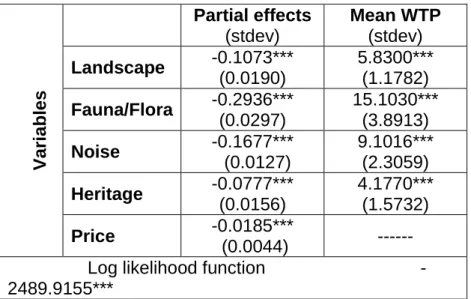
Respondents’ choice data was modelled as a binary logit model with cluster correction, accounting for the binary nature of the dependent variable and the fact that each respondent makes eight different choices. Table 3 presents the estimates of the marginal effects of the attributes considered on respondents’ wellbeing and estimates of respondents’ WTP for the same attributes.
Table 3: Binary logit model (with cluster correction)
Note: *significance level of 10%; **significance level of 5%; ***significance level of 1%
The attribute (environmental impact) that is considered most important and that impacts respondents’ utility most drastically is the impact on fauna and flora. The second most important attribute is the impact of noise; considerably less important are the attributes landscape intrusion and destruction of heritage. Avoiding significant impacts on the fauna and flora increases the probability of choosing an alternative by 0.3 relative to having significant impacts. The effect of significant impacts on landscape, noise and heritage on the probability of choosing an alternative is0.1, 0.16 and 0.08, respectively; for example if an alternative avoids significant impacts on noise it is 16% more likely to be chosen relative to one that does not avoid noise impacts. In line with the marginal effects estimated, respondents are willing to pay, on average, 15 Euros more in their monthly electricity bill to avoid significant impacts of hydropower on the fauna/flora; to avoid significant inconvenience of noise to populations, they are willing to pay on average an increase in their electricity bill of 9 Euros. To avoid significant damages to the landscape and heritage they are willing to pay on average 5.83 Euros and 4.18 Euros, respectively.
V a ria bl e s Partial effects (stdev) Mean WTP (stdev) Landscape -0.1073*** (0.0190) 5.8300*** (1.1782) Fauna/Flora -0.2936*** (0.0297) 15.1030*** (3.8913) Noise -0.1677*** (0.0127) 9.1016*** (2.3059) Heritage -0.0777*** (0.0156) 4.1770*** (1.5732) Price -0.0185*** (0.0044) --- Log likelihood function -2489.9155***
75 In interpreting these results it should be stressed that these WTP estimates of welfare loss imposed by the presence of dams are not additive. The results obtained contain important implications for the location decision regarding dams as location crucially influences the severity of the impacts, namely the morphology of the place. Also, all impacts introduced in the study were considered relevant by respondents. However, not all impacts were equally important. Thus, the decision to locate a dam should pay particular attention to the specific impacts in each location. Finally, it should be noted that respondents attach significantly more importance to the impacts on animals, plants and humans, than impacts on human and natural assets, like landscape and heritage.
5. CONCLUSIONS
The use of hydropower for electricity generation has many advantages when compared with other energy sources, particularly with fossil fuels: it does not generate CO2 emissions, it is renewable, and it is storable to some extent.
Nevertheless, it also has some important adverse environmental impacts associated with the dams’ activity and that are strongly dependent on location and size. The joint application of the CV and DCE approaches allowed the analysis of the welfare effects of two types of stakeholders: local residents (potentially affected by the negative effects caused by the presence of four specific dams installed near their residence) and the population in general (that benefit from all the advantages associated with having electricity generated through the use of a renewable energy source and thus experience some welfare benefits). The most relevant difference of the two samples regards income, age, and education, with local residents being older, less educated and with less income, which reflects the underlying population characteristics. With the study of local residents, we were able to estimate the minimum monetary amount demanded as compensation for the negative impacts caused by the proximity of the four Portuguese dams. Based on the regression model we predict that the amount of compensation would be on average 24.1 Euros per month, being 7.9 Euros in Aguieira, 45 Euros in Alqueva and 4.2 Euros in Douro International. While the study of the general population in continental Portugal, allowed us to compute the value of each environmental impact caused by the dams’ activity, by asking individuals the monetary amount they would be willing to pay in order to have electricity generated through hydropower, but avoiding a specific adverse impact. Respondents are willing to pay, on average, 15 Euros more in their monthly electricity bill to avoid significant impacts of hydropower on the fauna/flora; 9 Euros to avoid significant inconvenience of noise to populations; and to avoid significant damages to the landscape and heritage they are willing to pay on average 5.83 Euros and 4.18 Euros, respectively.The results of this paper confirm the relevance of considering the environmental impacts of dams in the siting decision process, from an economic perspective, since the values estimated are far from negligible. Moreover, as the impacts depend on the site and location of the dams, policy makers should use this information to integrate these parameters into their decision-making process concerning specific projects.
Acknowledgments
The authors gratefully acknowledge the financial support from PTDC/EGE-ECO/122402/2010.
76
REFERENCES
Abbasi, S.A. and Abbasi, N. (2000). “The likely adverse environmental impacts of renewable energy sources”. Applied Energy 65, 121-144.
Adamowicz, W., Louviere, J., and Williams, M. (1994). Combining Revealed and Stated Preference Methods for Valuing Environmental Amenities. Journal of
Environmental Economics and Management, 26: 271-279.
Arrow, K.; Solow, R.; Portney, P.; Leamer, E.; Radner, R. and Schuman, H. (1993). “Report of the NOAA Panel on Contingent Valuation”. Federal Register, Vol. 58, 10, 4601-4614.
Atkinson, G. and Mourato, S. (2008). Environmental Cost-Benefit Analysis. Annual
Review of Environment and Resources, 33: 317-344.
Awakul, P. and Ogunlana, S.O. (2002). “The effect of attitudinal differences on interface conflict on large construction projects. The case of the Pak Mun Dam project”. Environmental Impact Assessment Review 22, 311-335.
Bateman, I.; Carson, R.; Day, B.; Hanemann, M.; Hanley, N.; Hett, T.; Jones-Lee, M.; Loomes, G.; Mourato, S.; Ozdemiroglu, E.; Pearce, D.; Sugden, R. and Swanson, J. (2002). Economic Valuation with Stated Preference Techniques: A Manual. Edwar Elgar: Cheltenham, UK; Northampton, MA, USA.
Botelho, A., Lourenço-Gomes, L., Pinto, L.M.C., and Sousa, S. (2014) How to Design Reliable Discrete Choice Surveys: The Use of Qualitative Research Methods. 2nd
International Conference on Project Evaluation–ICOPEV 2014, organized by CGI–
Research Centre for Industrial and Technolgy Management, School of Engineering of University of Minho, June 2014, 26.
Deloitte (2014). Impacto macroeconómico do setor da eletricidade de origem
renovável em Portugal. Estudo realizado para a APREN – Associação para as
Energias Renováveis.
EDP (2013). Declaração Ambiental 2012: Aproveitamentos Hidroelétricos da Direção de Produção Hidráulica. Direção de Sustentabilidade: Relação com as
Comunidades, agosto de 2013.
Gunawardena, U.A.D.P. (2010). “Inequalities and externalities of power sector: A case of Broadlands hydropower project in Sri Lanka”. Energy Policy 38, 726-734. Han, S.-Y.; Kwak, S.-J. and Yoo, S.-H. (2008). “Valuing environmental impacts of large dam construction in Korea: An application of choice experiments”.
Environmental Impact Assessment Review 28, 256-266.
Hanley, N.; Wright, R.E. and Adamowicz, V. (1998). “Using Choice Experiments to Value the Environment: Design Issues, Current Experience and Future Prospects”.
Environmental and Resource Economics 11 (3-4), 413-428.
Hanley, N.; Mourato, S. and Wright, R.E. (2001). “Choice Modelling Approaches: A Superior Alternative for Environmental Valuation?”, Journal of Economic Surveys,
Vol. 15 (3), 435-462.
JKA (2010). “Noise Impact Assessment”. In: Groot Letaba River Water Development
Project – Environmental Impact Assessment. Department of Water Affairs, Republic
of South Africa.
Lancaster, K. (1966). “A New Approach to Consumer Theory”. Journal of Political
Economy 84, 132-157.
Mendesohn, R. and Olmstead, S. (2009). The Economic Valuation of Environmental Amenities and Disamenities: Methods and Applications. Annual Review of
77 Mitchell, R.C. and Carson, R.T. (1989). Using Surveys to Value Public Goods: The
Contingent Valuation Method. Washington D.C.: Resources for the Future.
Ninyerola, M., Pons, X., and Roure, J. (2005). Atlas climático digital de la Península
Ibérica - Metodología y aplicaciones en bioclimatología y geobotánica. Universitat
Autónoma de Barcelona. Primera edición: setiembre 2005.
OECD (2011). OECD Environmental Performance Reviews: Portugal 2011. OECD Publishing.
Ouyang, W.; Hao, F.; Zhao, C. and Lin, C. (2010). “Vegetation response to 30 years hydropower cascade exploitation in upper stream of Yellow River”. Commun
Nonlinear Sci Numer Simulat 15, 1928-1941.
Pearce, D.; Atkinson, G. and Mourato, S. (2006). Cost-Benefit Analysis and the
Environment: Recent Developments, OECD.
Pinho, P.; Maia, R. and Monterroso, A. (2007). “The quality of Portuguese Environmental Impact Studies: The case of small hydropower projects”.
Environmental Impact Assessment Review 27, 189-205.
Rashad, S. and Ismail, M. (2000). “Environmental-impact assessment of hydro-power in Egypt”. Applied Energy 65, 285-302.
Rosenberg, D., Berkes, F., Bodaly, R., Hecky, R., Kelly, C. and Rudd, J. (1997). “Large-scale impacts of hydroelectric development”. Environ. Rev. Vol. 5, 27-54. Theobald, D.M. (2010). “Estimating natural landscape changes from 1992 to 2030 in the conterminous US”. Landscape Ecology 25, 999-1011.
Tullos, D. (2009). “Assessing the influence of environmental impact assessments on science and policy: An analysis of the Three Gorges Project”. Journal of
Environmental Management 90, 208-223.
Wang, G.; Fang, Q.; Zhang, L.; Chen, W.; Chen, Z. and Hong, H. (2010). “Valuing the effects of hydropower development on watershed ecosystem services: Case studies in the Jiulong River Watershed, Fujian Province, China”. Estuarine, Coastal
and Shelf Science 86, 363-368.
Wang, P.; Lassoie, J.P.; Dong, S. and Morreale, S.J. (2013). “A framework for social impact analysis of large dams: A case study of cascading dams on the Upper-Mekong River, China”. Journal of Environmental Management 117, 131-140.