EUROPEAN ORGANIZATION FOR NUCLEAR RESEARCH (CERN)
CERN-PH-EP/2013-010 2013/05/01
CMS-EXO-12-010
Search for new physics in final states with a lepton and
missing transverse energy in pp collisions at the LHC
The CMS Collaboration
∗Abstract
This letter describes the search for an enhanced production rate of events with a charged lepton and a neutrino in high-energy pp collisions at the LHC. The analysis uses data collected with the CMS detector, with an integrated luminosity of 5.0 fb−1 at√s = 7 TeV, and a further 3.7 fb−1 at√s = 8 TeV. No evidence is found for an excess. The results are interpreted in terms of limits on a heavy charged gauge boson (W0) in the sequential standard model, a split universal extra dimension model, and contact interactions in the helicity-non-conserving model. For the last, values of the binding energy below 10.5 (8.8) TeV in the electron (muon) channel are excluded at a 95% confidence level. Interpreting the`ν final state in terms of a heavy W0 with standard model couplings, masses below 2.90 TeV are excluded.
Submitted to Physical Review D
c
2013 CERN for the benefit of the CMS Collaboration. CC-BY-3.0 license
∗See Appendix A for the list of collaboration members
1
1
Introduction
New heavy gauge bosons are predicted by various extensions of the standard model (SM). The sequential standard model (SSM) [1] postulates the existence of a W0boson, a heavy analogue of the W. In such a theory, the W0is expected to appear as a narrow resonance with decay modes and branching fractions similar to those of the W. For W0 masses above 180 GeV, where the tb decay channel opens up, the predicted branching fraction is about 8.5% for each of the leptonic final states. Previous searches [2, 3] with pp collision data at√s =7 TeV by the Compact Muon Solenoid (CMS) and ATLAS experiments at the Large Hadron Collider (LHC), based on an integrated luminosity of up to 5 fb−1, have excluded SSM W0bosons with masses up to 2.6 TeV. Other models for new physics predict the same final state, such as those with universal extra dimensions (UED) and bulk fermions, or split UED [4, 5]. Such models of extended space-time assume one additional compact dimension of radius R. The split-UED parameter space is defined by 1/R and µ, with µ being the bulk mass parameter of the fermion field in five dimensions. For suitable non-zero values of µ, as assumed by split-UED models, the cross sections are sufficiently large to allow observation by LHC experiments. All SM particles have corresponding Kaluza-Klein (KK) partners, for instance WnKK, where n denotes the n-th KK excitation mode. Only KK-even modes of WnKK couple to SM fermions, owing to KK-parity conservation [6]. Modes with n ≥ 4 have a smaller cross section and are not expected to be accessible at√s =8 TeV, hence the only mode considered is n=2.
Motivated by the observation of mass hierarchies in the fermion sector, theories have been de-veloped where leptons and quarks are composite objects [7]. At energies much lower than the binding energy of these fundamental constituents, typically calledΛ, quark and lepton com-positeness would manifest itself as a four-fermion contact interaction (CI). One of the possible contact interactions between two quarks, a neutrino and a charged lepton is described by the helicity-non-conserving (HNC) model [8]. The corresponding cross section is proportional to the square of the partonic centre-of-mass energy and to Λ−4. While CDF has set a limit on
Λ > 2.81 TeV [9] based on a final state with an electron and a neutrino, no limit in the HNC model has yet been set in the muon channel.
In this letter, a search is presented for an excess of events with an isolated charged lepton (an electron or muon) and a neutrino in the final state, using the CMS detector. The data sample corresponds to an integrated luminosity of 5.0 fb−1at√s=7 TeV collected in 2011, and 3.7 fb−1 at√s =8 TeV collected in 2012. The CMS 2011 result has been published in ref. [2].
2
The CMS detector
The central feature of the CMS apparatus is a superconducting solenoid of 6 m internal di-ameter, providing a magnetic field of 3.8 T. Within the superconducting solenoid volume are a silicon pixel and strip tracker, a lead tungstate crystal electromagnetic calorimeter (ECAL), and a brass/scintillator hadron calorimeter (HCAL). Muons are measured in gas-ionization detectors embedded in the steel return yoke. Extensive forward calorimetry complements the coverage provided by the barrel and endcap detectors. A more detailed description of the CMS detector can be found in Ref. [10]. CMS uses a right-handed coordinate system, with the origin at the nominal interaction point, the x axis pointing to the centre of the LHC, the y axis pointing up (perpendicular to the LHC plane), and the z axis along the anticlockwise-beam direction. The polar angle θ is measured from the positive z axis and the azimuthal angle φ is measured in the x-y plane.
2 4 Signal and backgrounds
3
The search strategy
Candidate events with at least one high transverse momentum (pT) electron or muon are
se-lected using single-lepton triggers. Isolated high-pTleptons are reconstructed using very
strin-gent quality criteria while the neutrino gives rise to experimentally observed missing trans-verse energy (EmissT ). The details on lepton identification and EmissT reconstruction, as optimized for the 2011 analysis, can be found in Ref. [2]. The discriminating variable of this analysis is the transverse mass MTof the lepton–EmissT system, calculated as
MT =
q
2·p`T·EmissT · (1−cos∆φ`,ν), (1)
where∆φ`,νis the azimuthal angle between the charged lepton’s transverse momentum p`Tand
the EmissT direction.
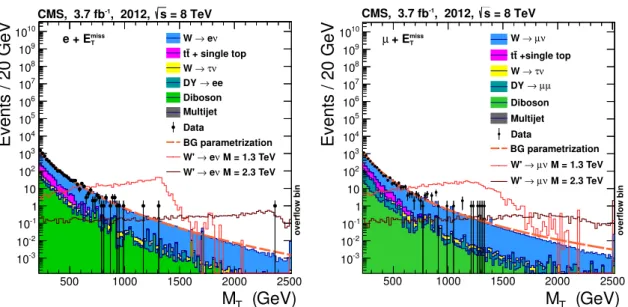
In W0 decays, as well as for the other models considered, the lepton and EmissT are expected to be almost back-to-back in the transverse plane, and balanced in transverse energy. Ad-ditional kinematic criteria therefore select events with a ratio of the lepton pT` and the EmissT , 0.4< p`T/ETmiss<1.5, along with the requirement of the angular difference,|∆φ`,ν−π| <0.2π. For simulated SSM W0events with masses between 0.5 and 2.5 TeV passing these selection crite-ria, the signal efficiency (including 90% geometrical acceptance) is found to be 70–75% with 2% uncertainty in the electron channel and 67–72% with 1% uncertainty in the muon channel. For the HNC contact-interaction model the signal efficiency is independent of the interaction scale Λ and has been determined from simulation to be 80% with 1% uncertainty for the electron channel and 77% with 4% uncertainty for the muon channel. The transverse mass distribu-tions for accepted SM events in the electron and muon channels are shown in Fig. 1, along with two example W0 signals. The observed event with the highest transverse mass in the electron channel has MT = 2.38±0.05 TeV based on ET = 1.2 TeV with 1% uncertainty. In the
muon channel the maximum transverse mass is MT = 1.33±0.03 TeV with a measured p`T of
690±22 GeV. The two types of processes, W0 production and compositeness, can be distin-guished by examining the shape of the lepton-Emiss
T transverse-mass spectrum. Both processes
manifest themselves through an excess of events at the high end of the spectrum. The W0 sig-nal events are expected to concentrate in a Jacobian peak around the W0 mass, as shown in Fig. 1. Compositeness would rather yield an unstructured excess, with the excess relative to the standard model contribution increasing as a function of MT, as shown in Fig. 2.
4
Signal and backgrounds
The W0 (this also includes WnKK=2) and CI signals are generated at leading order (LO) with
PYTHIA 6.4.26. [11] using the CTEQ6L1 [12] parton distribution functions (PDF). They are
scaled to the next-to-next-to-leading order (NNLO) cross section calculated withFEWZ[13, 14]
for each W0 (WKKn=2) mass point. In the absence of higher-order calculations, LO cross sections are used for the CI model.
The primary source of background is the off-peak, high-MTtail of the standard model W→ `ν decays. Other important backgrounds arise from tt, Drell–Yan, and diboson (WW, WZ, ZZ) events. An important background also comes from QCD multijet processes, but this is largely removed by the analysis selections and therefore cannot be readily distinguished in Fig. 1. Con-tributions from decays with τ leptons in the final state that subsequently decay to an electron or muon and neutrinos are considered as well, but found to be negligible. ThePYTHIA6 generator is used for all background processes except for tt, which is generated with MADGRAPH4 [15]
3 (GeV) T M 500 1000 1500 2000 2500 Events / 20 GeV -3 10 -2 10 -1 10 1 10 2 10 3 10 4 10 5 10 6 10 7 10 8 10 9 10 10 10 Diboson ν e → W ee → DY + single top t t ν τ → W Multijet Data M = 1.3 TeV ν e → W' M = 2.3 TeV ν e → W' overflow bin BG parametrization CMS, 3.7 fb-1, 2012, s = 8 TeV e + ET miss (GeV) T M 500 1000 1500 2000 2500 Events / 20 GeV -3 10 -2 10 -1 10 1 10 2 10 3 10 4 10 5 10 6 10 7 10 8 10 9 10 10 10 Diboson ν µ → W µ µ → DY +single top t t ν τ → W Multijet Data overflow bin CMS, 3.7 fb-1, 2012, s = 8 TeV + ET miss µ µ µ ν → W' ν → W' M = 1.3 TeV M = 2.3 TeV BG parametrization
Figure 1: Observed lepton-EmissT transverse mass distributions in the electron (left) and the muon (right) channel. The dashed lines show the parametrization of the background as de-scribed in the text (labelled as BG paramatrization in the legend). Simulated signal distribu-tions for a SSM W0 are also shown, including detector resolution effects. The simulated back-ground labeled as ‘diboson’ includes WW, ZZ, and WZ contributions. The last bin contains the contributions of all bins above the displayed range.
(GeV) T M 1500 Events / 40 GeV -2 10 -1 10 1 10 2 10 W + HNC Λ= 4 TeV = 7 TeV Λ W + HNC = 9 TeV Λ W + HNC W only CMS Simulation, 3.7 fb-1, 2012, s = 8 TeV 1000 2000 2500 3000
Figure 2: Simulated transverse mass distribution shown for contact interaction (HNC model), in the muon+EmissT channel at generator level for CI signals with Λ = 4, 7, and 9 TeV, and the SM background (W→µν).
4 5 Results and exclusion limits
Table 1: Data, background, and signal event yields for different transverse mass thresholds. MT >1.0 TeV MT>1.5 TeV MT >2.0 TeV
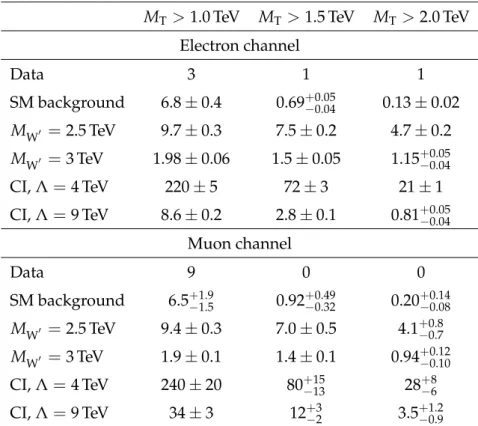
Electron channel Data 3 1 1 SM background 6.8±0.4 0.69+−0.050.04 0.13±0.02 MW0 =2.5 TeV 9.7±0.3 7.5±0.2 4.7±0.2 MW0 =3 TeV 1.98±0.06 1.5±0.05 1.15+0.05 −0.04 CI,Λ=4 TeV 220±5 72±3 21±1 CI,Λ=9 TeV 8.6±0.2 2.8±0.1 0.81+−0.050.04 Muon channel Data 9 0 0 SM background 6.5+−1.91.5 0.92+−0.490.32 0.20+−0.140.08 MW0 =2.5 TeV 9.4±0.3 7.0±0.5 4.1+−0.8 0.7 MW0 =3 TeV 1.9±0.1 1.4±0.1 0.94+−0.12 0.10 CI,Λ=4 TeV 240±20 80−+1513 28+−86 CI,Λ=9 TeV 34±3 12−+32 3.5+−1.20.9
in combination with PYTHIA. The numbers of Monte Carlo events are normalized using the
integrated luminosity of the recorded data and with NNLO cross sections, except diboson and multijet samples, for which the next-to-leading order and LO cross sections are used, respec-tively. In all event samples, additional minimum bias interactions are superimposed onto the main background processes to match the luminosity profile of the analyzed data set.
The background prediction is based on the transverse-mass distributions of these simulations, as seen in Fig. 1. The summed background distribution is parametrized with a function of form f(MT) = (MTa+b)c to avoid event fluctuations due to the limited size of the Monte Carlo
event sample, also shown in Fig. 1. In the low mass control region, e.g. for MT>500 GeV, the
background prediction in the electron channel is 169 events from a direct count and 155±16 events from the parametrization. The corresponding event numbers in the muon channel are 162 and 138±12, from the direct count and the parametrization respectively. The number of observed events in each channel is 153. The expected background due to SM processes drops significantly with increasing MT. The number of events observed and the number expected
from the parametrization, above three characteristic high MT thresholds, are shown in Table 1
for the electron and the muon channels. Also summarised are the expected numbers of W0 and CI signal events, as evaluated from simulation, including systematic uncertainties due to imperfections in the description of the detector performance.
5
Results and exclusion limits
For determining the exclusion limits, systematic uncertainties on the signal and background yields are included via nuisance parameters with a log-normal prior distribution in the same way as in our previous analysis from Ref. [2]. The lepton-energy calibration and resolution distort the transverse mass spectrum. Uncertainties in the energy scale and the energy
reso-5 (GeV) W' M 500 1000 1500 2000 2500 3000 3500 4000 B (fb) × σ 1 10 2 10 3 10 4 10 5 10 Observed 95% CL limit ν e → Observed 95% CL limit W' ν µ → Observed 95% CL limit W' Expected 95% CL limit σ 1 ± Expected 95% CL limit σ 2 ± Expected 95% CL limit SSM W' NNLO PDF uncertainty = 10 TeV NNLO µ with KK W = 0.05 TeV NNLO µ with KK W = 8 TeV s , 2012, -1 CMS, 3.7 fb miss T + E µ , miss T e + E
Figure 3: Limits on the cross section times the single channel branching fraction (σ× B) for heavy W0 bosons based on the 2012 data for the electron and the muon channels. For the individual channels, only the observed limits are shown. For the combination, the observed limit, the expected limit, the 1σ, and the 2σ bands are displayed. The model assumes equal branching fractions for the electron and the muon channel, hence the combination corresponds to doubling the number of events. All limits are displayed for the single channel branching fraction. The W0 mass limits are derived with a Bayesian method for the models of a SSM W0 and WnKK=2in split UED. The WnKK=2is the lowest mass state that can couple to SM fermions and has the same final state as the SM-like W0. Since it has even KK parity it can be produced singly.
(GeV) W' M 1000 1500 2000 2500 3000 SSM W' σ / excl. σ -3 10 -2 10 -1 10 1 10 Observed 95% CL limit Expected 95% CL limit σ 1 ± Expected 95% CL limit σ 2 ± Expected 95% CL limit = 7 / 8 TeV s , 2011 / 2012, -1 CMS, 5.0 / 3.7 fb miss T e + E (GeV) W' M 1000 1500 2000 2500 3000 SSM W' σ / excl. σ -3 10 -2 10 -1 10 1 10 Observed 95% CL limit Expected 95% CL limit σ 1 ± Expected 95% CL limit σ 2 ± Expected 95% CL limit = 7 / 8 TeV s , 2011 / 2012, -1 CMS, 5.0 / 3.7 fb miss T + E µ (GeV) W' M 1000 1500 2000 2500 3000 SSM W' σ / excl. σ -3 10 -2 10 -1 10 1 10 Observed 95% CL limit Expected 95% CL limit σ 1 ± Expected 95% CL limit σ 2 ± Expected 95% CL limit = 7 / 8 TeV s , 2011 / 2012, -1 CMS, 5.0 / 3.7 fb miss T + E µ , miss T e + E
Figure 4: Combination of 2011 and 2012 data for the electron and the muon channels using 5.0 fb−1of data at√s=7 TeV from 2011 and 3.7 fb−1of data at√s=8 TeV from 2012. The up-per row shows the individual combinations for the electron (left) and muon channel (right). To the right the combination of both is displayed. The limits are derived with a Bayesian method. Plotted is the signal strength modifier σexcl./σSSM W0 as a function of the W
0
mass, where σexcl.is
the cross section excluded at a 95% confidence level and σSSM W0 is the cross section predicted
by the SSM. All W0 mass points below the ratio σexcl./σSSM W0 =1, shown as a red dashed line,
6 5 Results and exclusion limits
(GeV)
0 500 1000 1500 2000 2500(GeV)
µ
2 10 3 10 4 10 Excluded Electron 2012 Muon 2012 Combined e + µ 2012 Combined e + µ 2011, 5 fb-1,1/R
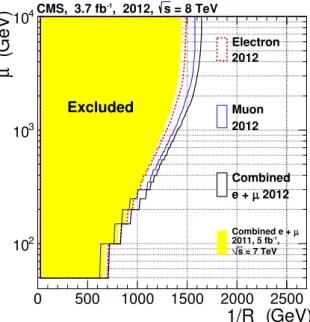
CMS, 3.7 fb-1, 2012, s = 8 TeV s = 7 TeVFigure 5: The 95% confidence limits on the split-UED parameters µ and 1/R derived from the W0 mass limits taking into account the corresponding width of the WnKK=2. For the 3.7 fb−1 of 2012 data the individual limits for the electron and muon channels are shown together with their combination, improving the excluded parameter space based on the 2011 data shown in yellow.
lution make comparable contributions to the overall uncertainty in the electron channel: the energy scale has an uncertainty of 1(3)% in the barrel(endcaps) and the resolution has an un-certainty of 1.4(3)% for the barrel (endcaps) [16]. For muons, the dominant unun-certainty stems from the momentum scale, which is taken to be 5%×pT/ TeV [17] and results in larger errors
on the background and signal event yields in the muon channel, as can be seen in Table 1. The muon pT resolution has been determined with cosmic ray muons to be 10% at high pTwith an
uncertainty of 0.6% [17].
Similarly, the impact of the ETmissenergy scale is modelled by shifting the hadronic component event-by-event by 10%, while the resolution is taken into account by a 10% smearing. In all cases, the impact on the expected number of signal events is around 1% for each source of uncertainty. The background parametrization procedure is repeated using the distorted dis-tributions. Additionally, an uncertainty is derived by fitting the undistorted background with two different functions. The estimates shown in Table 1 include a systematic uncertainty that covers the range of results from these fits, with the statistical uncertainty coming from the fit to the original distribution. Additionally, an uncertainty of 4.4% is considered on the integrated luminosity [18].
The number of data events above a transverse mass threshold MTmin is compared to the ex-pected number of signal and background events, with the MminT threshold being optimized for the best expected exclusion limit, using steps of 50 GeV. Very similar results are achieved when optimizing for discovery. The same optimization procedure is applied for the W0and CI searches but the optimized MT thresholds are specific to each analysis. For a W
0
mass of up to 2.5 TeV the optimization tends to select a value for MminT a little below the peak of the Jacobian, retaining most of the events in the peak. To keep a significant signal contribution for higher masses, the Mmin
T threshold is shifted to lower values owing to the increasing off-shell fraction.
For CI no such effect exists and the optimized Mmin
7
No significant excess has been observed in the data, and upper limits are set on the production cross section times the branching fraction σ× B(W0 → `ν), with` = e or µ, using a Bayesian method with the assumption of a flat prior for the parameter of interest. The expected and observed upper cross section limits on a SSM W0, at 95% confidence level (CL), for √s = 8 TeV data, are shown in Fig. 3 for both channels and their combination. Using the central value of the theoretical NNLO SSM W0 cross section times branching fraction, which is assumed to be identical in the two channels, we exclude masses less than 2.60 TeV in the electron and 2.75 TeV in the muon channel. The expected limits are 2.70 TeV and 2.65 TeV, respectively. The observed limit for W0 →eν is slightly lower than the expectation because of one event with a transverse mass of 2.3 TeV (Fig. 1). Combining both channels, the limit increases to 2.85 TeV (Table 2). To further enhance the sensitivity the new results can be combined with the published [2]√s = 7 TeV results, based on an integrated luminosity of 5 fb−1, thus extending the limit to 2.90 TeV as shown in Fig. 4 and Table 2.
The limit can be reinterpreted in terms of Wn=2
KK mass, as shown in Fig. 3, for values of the Dirac
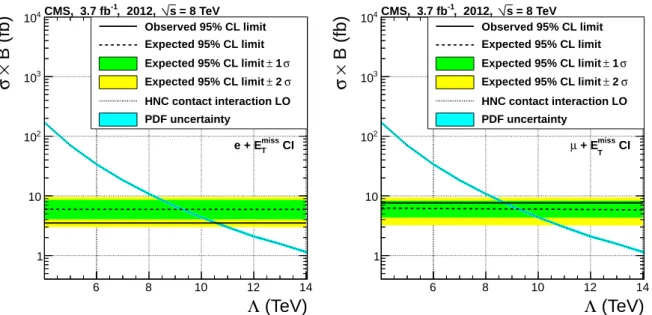
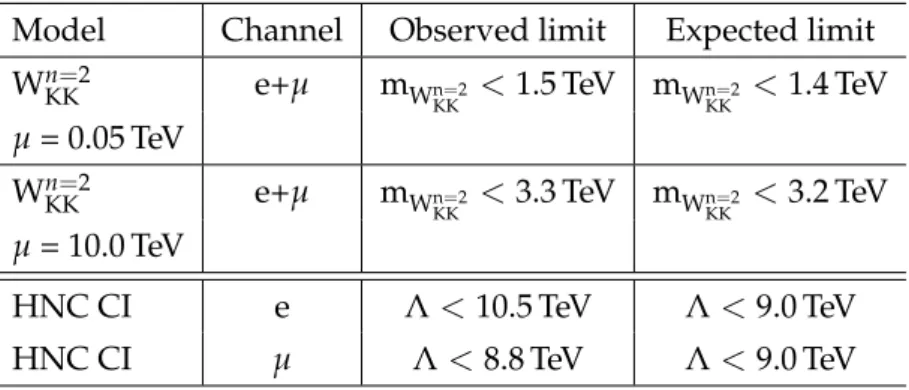
mass term µ = 0.05 TeV and µ = 10 TeV and directly translated to bounds on the split-UED parameter space,(1/R, µ)(Fig. 5). The four-fermion contact interaction of the HNC model is excluded for values of Λ < 10.5 TeV in the electron channel andΛ < 8.8 TeV in the muon channel (Fig. 6). While the expected sensitivity is comparable in both search channels, the exclusion limit in the electron channel is higher because of a downward fluctuation of data (see Table 1) in the search region of MT>1 TeV. These limits are summarized in Table 3.
(TeV) Λ 6 8 10 12 14 B (fb) × σ 1 10 2 10 3 10 4 10 Observed 95% CL limit Expected 95% CL limit σ 1 ± Expected 95% CL limit σ 2 ± Expected 95% CL limit HNC contact interaction LO PDF uncertainty = 8 TeV s , 2012, -1 CMS, 3.7 fb CI miss T e + E (TeV) Λ 6 8 10 12 14 B (fb) × σ 1 10 2 10 3 10 4 10 Observed 95% CL limit Expected 95% CL limit σ 1 ± Expected 95% CL limit σ 2 ± Expected 95% CL limit HNC contact interaction LO PDF uncertainty = 8 TeV s , 2012, -1 CMS, 3.7 fb CI miss T + E µ
Figure 6: Bayesian limits on the cross section times the single channel branching fraction (σ× B) for contact interactions (HNC model) in the electron+EmissT (left) and the muon+EmissT channel (right) based on an integrated luminosity of 3.7 fb−1 of √s = 8 TeV data. The expected limit in either channel excludes values of the new interaction scaleΛ <9 TeV. The observed limit, driven by the data, excludes Λ < 10.5 TeV (8.8) in the electron (muon) channel. The signal efficiency is independent ofΛ.
6
Summary
A search for new physics has been carried out using pp collisions recorded with the CMS detec-tor at centre-of-mass energies of√s=7 TeV and 8 TeV. The transverse mass spectrum of either
8 6 Summary
electrons or muons and missing transverse energy has been measured. The observed spectra are consistent with the standard model expectation, and mass limits on sequential standard model W0 and WnKK=2 have been set at the 95% CL. These are the most stringent limits to date. For the first time, a limit on the compositeness scaleΛ has been set for contact interactions in the HNC model based on the final state with a muon and EmissT . The corresponding exclusion limit in the electron channel significantly improves the existing one.
Table 2: Exclusion limits in TeV on the SSM W0mass for the electron and muon channel as well as their combinations based on 5.0 fb−1 of 2011 data at√s =7 TeV and 3.7 fb−1of 2012 data at
√
s=8 TeV.
Channel Obs. Exp. Obs. Exp. Obs. Exp. 2011 2011 2012 2012 2011+2012 2011+2012
e 2.40 2.45 2.60 2.70 2.70 2.75
µ 2.40 2.45 2.75 2.65 2.75 2.70
e+µ 2.50 2.60 2.85 2.80 2.90 2.90
Table 3: Exclusion limits for other model interpretations for the electron and muon channel or their combination based on 3.7 fb−1of 2012 data at√s =8 TeV.
Model Channel Observed limit Expected limit WnKK=2 e+µ mWn=2 KK <1.5 TeV mWnKK=2 <1.4 TeV µ= 0.05 TeV WnKK=2 e+µ mWn=2 KK <3.3 TeV mWnKK=2 <3.2 TeV µ= 10.0 TeV HNC CI e Λ<10.5 TeV Λ<9.0 TeV HNC CI µ Λ<8.8 TeV Λ<9.0 TeV
Acknowledgements
We congratulate our colleagues in the CERN accelerator departments for the excellent perfor-mance of the LHC and thank the technical and administrative staffs at CERN and at other CMS institutes for their contributions to the success of the CMS effort. In addition, we gratefully ac-knowledge the computing centres and personnel of the Worldwide LHC Computing Grid for delivering so effectively the computing infrastructure essential to our analyses. Finally, we ac-knowledge the enduring support for the construction and operation of the LHC and the CMS detector provided by the following funding agencies: BMWF and FWF (Austria); FNRS and FWO (Belgium); CNPq, CAPES, FAPERJ, and FAPESP (Brazil); MEYS (Bulgaria); CERN; CAS, MoST, and NSFC (China); COLCIENCIAS (Colombia); MSES (Croatia); RPF (Cyprus); MoER, SF0690030s09 and ERDF (Estonia); Academy of Finland, MEC, and HIP (Finland); CEA and CNRS/IN2P3 (France); BMBF, DFG, and HGF (Germany); GSRT (Greece); OTKA and NKTH (Hungary); DAE and DST (India); IPM (Iran); SFI (Ireland); INFN (Italy); NRF and WCU (Re-public of Korea); LAS (Lithuania); CINVESTAV, CONACYT, SEP, and UASLP-FAI (Mexico); MSI (New Zealand); PAEC (Pakistan); MSHE and NSC (Poland); FCT (Portugal); JINR (Arme-nia, Belarus, Georgia, Ukraine, Uzbekistan); MON, RosAtom, RAS and RFBR (Russia); MSTD
References 9
(Serbia); SEIDI and CPAN (Spain); Swiss Funding Agencies (Switzerland); NSC (Taipei); ThEP-Center, IPST and NSTDA (Thailand); TUBITAK and TAEK (Turkey); NASU (Ukraine); STFC (United Kingdom); DOE and NSF (USA).
References
[1] G. Altarelli, B. Mele, and M. Ruiz-Altaba, “Searching for New Heavy Vector Bosons in p ¯p Colliders”, Z. Phys. C 45 (1989) 109, doi:10.1007/BF01556677.
[2] CMS Collaboration, “Search for leptonic decays of W’ bosons in pp collisions at√ s =7 TeV”, JHEP 08 (2012) 023, doi:10.1007/JHEP08(2012)023,
arXiv:1204.4764.
[3] ATLAS Collaboration, “ATLAS search for a heavy gauge boson decaying to a charged lepton and a neutrino in pp collisions at√s =7 TeV”, (2012). arXiv:1209.4446. submitted to Eur. Phys. J. C.
[4] C.-R. Chen et al., “Dark matter and collider phenomenology of split-UED”, JHEP 09 (2009) 078, doi:10.1088/1126-6708/2009/09/078, arXiv:0903.1971.
[5] K. Kong, S. C. Park, and T. G. Rizzo, “Collider Phenomenology with Split-UED”, JHEP
04(2010) 081, doi:10.1007/JHEP04(2010)081, arXiv:1002.0602. [6] T. Appelquist, H.-C. Cheng, and B. A. Dobrescu, “Bounds on universal extra
dimensions”, Phys. Rev. D 64 (2001) 035002, doi:10.1103/PhysRevD.64.035002, arXiv:hep-ph/0012100.
[7] H. Terazawa et al., “Observable effects of the possible sub-structure of leptons and quarks”, Phys. Lett. B 112 (1982) 387, doi:10.1016/0370-2693(82)91075-9. [8] K. D. Lane et al., “Simulations of supercollider physics”, Phys. Rept. 278 (1997) 291,
doi:10.1016/S0370-1573(96)00018-X, arXiv:hep-ph/9412280.
[9] CDF Collaboration, “Search for quark lepton compositeness and a heavy W0boson using the eν channel in p ¯p collisions at√s=1.8 TeV”, Phys. Rev. Lett. 87 (2001) 231803,
doi:10.1103/PhysRevLett.87.231803, arXiv:hep-ex/0107008.
[10] CMS Collaboration, “The CMS experiment at the CERN LHC”, JINST 03 (2008) S08004, doi:10.1088/1748-0221/3/08/S08004.
[11] T. Sj ¨ostrand, S. Mrenna, and P. Z. Skands, “PYTHIA 6.4 Physics and Manual”, JHEP 05 (2006) 026, doi:10.1088/1126-6708/2006/05/026, arXiv:hep-ph/0603175. [12] J. Pumplin et al., “New generation of parton distributions with uncertainties from global
QCD analysis”, JHEP 07 (2002) 012, doi:10.1088/1126-6708/2002/07/012, arXiv:hep-ph/0201195.
[13] R. Gavin et al., “FEWZ 2.0: A code for hadronic Z production at next-to-next-to-leading order”, Comput. Phys. Commun. 182 (2011), no. 11, 2388,
doi:10.1016/j.cpc.2011.06.008, arXiv:1011.3540.
[14] S. Quackenbush et al., “W physics at the LHC with FEWZ 2.1”, Computer Physics Communications 184 (2013), no. 1, 209, doi:10.1016/j.cpc.2012.09.005, arXiv:1201.5896.
10 References
[15] J. Alwall et al., “MadGraph/MadEvent v4: the new web generation”, JHEP 09 (2007) 028, doi:10.1088/1126-6708/2007/09/028.
[16] CMS Collaboration, “ECAL Detector Performance, 2011 Data”, CMS Detector Performance Summary DP-12-007, (2012).
[17] CMS Collaboration, “Performance of CMS muon reconstruction in pp collision events at√ s =7 TeV”, (2011). arXiv:1206.4071. Submitted to JINST.
[18] CMS Collaboration, “CMS Luminosity Based on Pixel Cluster Counting - Summer 2012 Update”, CMS Physics Analysis Summary CMS-PAS-LUM-12-001, (2012).
11
A
The CMS Collaboration
Yerevan Physics Institute, Yerevan, Armenia
S. Chatrchyan, V. Khachatryan, A.M. Sirunyan, A. Tumasyan
Institut f ¨ur Hochenergiephysik der OeAW, Wien, Austria
W. Adam, E. Aguilo, T. Bergauer, M. Dragicevic, J. Er ¨o, C. Fabjan1, M. Friedl, R. Fr ¨uhwirth1, V.M. Ghete, N. H ¨ormann, J. Hrubec, M. Jeitler1, W. Kiesenhofer, V. Kn ¨unz, M. Krammer1, I. Kr¨atschmer, D. Liko, I. Mikulec, M. Pernicka†, D. Rabady2, B. Rahbaran, C. Rohringer,
H. Rohringer, R. Sch ¨ofbeck, J. Strauss, A. Taurok, W. Waltenberger, C.-E. Wulz1
National Centre for Particle and High Energy Physics, Minsk, Belarus
V. Mossolov, N. Shumeiko, J. Suarez Gonzalez
Universiteit Antwerpen, Antwerpen, Belgium
S. Alderweireldt, M. Bansal, S. Bansal, T. Cornelis, E.A. De Wolf, X. Janssen, S. Luyckx, L. Mucibello, S. Ochesanu, B. Roland, R. Rougny, M. Selvaggi, H. Van Haevermaet, P. Van Mechelen, N. Van Remortel, A. Van Spilbeeck
Vrije Universiteit Brussel, Brussel, Belgium
F. Blekman, S. Blyweert, J. D’Hondt, R. Gonzalez Suarez, A. Kalogeropoulos, M. Maes, A. Olbrechts, S. Tavernier, W. Van Doninck, P. Van Mulders, G.P. Van Onsem, I. Villella
Universit´e Libre de Bruxelles, Bruxelles, Belgium
B. Clerbaux, G. De Lentdecker, V. Dero, A.P.R. Gay, T. Hreus, A. L´eonard, P.E. Marage, A. Mohammadi, T. Reis, L. Thomas, C. Vander Velde, P. Vanlaer, J. Wang
Ghent University, Ghent, Belgium
V. Adler, K. Beernaert, A. Cimmino, S. Costantini, G. Garcia, M. Grunewald, B. Klein, J. Lellouch, A. Marinov, J. Mccartin, A.A. Ocampo Rios, D. Ryckbosch, M. Sigamani, N. Strobbe, F. Thyssen, M. Tytgat, S. Walsh, E. Yazgan, N. Zaganidis
Universit´e Catholique de Louvain, Louvain-la-Neuve, Belgium
S. Basegmez, G. Bruno, R. Castello, L. Ceard, C. Delaere, T. du Pree, D. Favart, L. Forthomme, A. Giammanco3, J. Hollar, V. Lemaitre, J. Liao, O. Militaru, C. Nuttens, D. Pagano, A. Pin, K. Piotrzkowski, J.M. Vizan Garcia
Universit´e de Mons, Mons, Belgium
N. Beliy, T. Caebergs, E. Daubie, G.H. Hammad
Centro Brasileiro de Pesquisas Fisicas, Rio de Janeiro, Brazil
G.A. Alves, M. Correa Martins Junior, T. Martins, M.E. Pol, M.H.G. Souza
Universidade do Estado do Rio de Janeiro, Rio de Janeiro, Brazil
W.L. Ald´a J ´unior, W. Carvalho, J. Chinellato, A. Cust ´odio, E.M. Da Costa, D. De Jesus Damiao, C. De Oliveira Martins, S. Fonseca De Souza, H. Malbouisson, M. Malek, D. Matos Figueiredo, L. Mundim, H. Nogima, W.L. Prado Da Silva, A. Santoro, L. Soares Jorge, A. Sznajder, E.J. Tonelli Manganote, A. Vilela Pereira
Universidade Estadual Paulistaa, Universidade Federal do ABCb, S˜ao Paulo, Brazil
T.S. Anjosb, C.A. Bernardesb, F.A. Diasa,4, T.R. Fernandez Perez Tomeia, E.M. Gregoresb, C. Laganaa, F. Marinhoa, P.G. Mercadanteb, S.F. Novaesa, Sandra S. Padulaa
Institute for Nuclear Research and Nuclear Energy, Sofia, Bulgaria
V. Genchev2, P. Iaydjiev2, S. Piperov, M. Rodozov, S. Stoykova, G. Sultanov, V. Tcholakov,
12 A The CMS Collaboration
University of Sofia, Sofia, Bulgaria
A. Dimitrov, R. Hadjiiska, V. Kozhuharov, L. Litov, B. Pavlov, P. Petkov
Institute of High Energy Physics, Beijing, China
J.G. Bian, G.M. Chen, H.S. Chen, C.H. Jiang, D. Liang, S. Liang, X. Meng, J. Tao, J. Wang, X. Wang, Z. Wang, H. Xiao, M. Xu, J. Zang, Z. Zhang
State Key Laboratory of Nuclear Physics and Technology, Peking University, Beijing, China
C. Asawatangtrakuldee, Y. Ban, Y. Guo, W. Li, S. Liu, Y. Mao, S.J. Qian, H. Teng, D. Wang, L. Zhang, W. Zou
Universidad de Los Andes, Bogota, Colombia
C. Avila, C.A. Carrillo Montoya, J.P. Gomez, B. Gomez Moreno, A.F. Osorio Oliveros, J.C. Sanabria
Technical University of Split, Split, Croatia
N. Godinovic, D. Lelas, R. Plestina5, D. Polic, I. Puljak2
University of Split, Split, Croatia
Z. Antunovic, M. Kovac
Institute Rudjer Boskovic, Zagreb, Croatia
V. Brigljevic, S. Duric, K. Kadija, J. Luetic, D. Mekterovic, S. Morovic, L. Tikvica
University of Cyprus, Nicosia, Cyprus
A. Attikis, M. Galanti, G. Mavromanolakis, J. Mousa, C. Nicolaou, F. Ptochos, P.A. Razis
Charles University, Prague, Czech Republic
M. Finger, M. Finger Jr.
Academy of Scientific Research and Technology of the Arab Republic of Egypt, Egyptian Network of High Energy Physics, Cairo, Egypt
Y. Assran6, S. Elgammal7, A. Ellithi Kamel8, A.M. Kuotb Awad9, M.A. Mahmoud9, A. Radi10,11
National Institute of Chemical Physics and Biophysics, Tallinn, Estonia
M. Kadastik, M. M ¨untel, M. Murumaa, M. Raidal, L. Rebane, A. Tiko
Department of Physics, University of Helsinki, Helsinki, Finland
P. Eerola, G. Fedi, M. Voutilainen
Helsinki Institute of Physics, Helsinki, Finland
J. H¨ark ¨onen, A. Heikkinen, V. Karim¨aki, R. Kinnunen, M.J. Kortelainen, T. Lamp´en, K. Lassila-Perini, S. Lehti, T. Lind´en, P. Luukka, T. M¨aenp¨a¨a, T. Peltola, E. Tuominen, J. Tuominiemi, E. Tuovinen, D. Ungaro, L. Wendland
Lappeenranta University of Technology, Lappeenranta, Finland
A. Korpela, T. Tuuva
DSM/IRFU, CEA/Saclay, Gif-sur-Yvette, France
M. Besancon, S. Choudhury, F. Couderc, M. Dejardin, D. Denegri, B. Fabbro, J.L. Faure, F. Ferri, S. Ganjour, A. Givernaud, P. Gras, G. Hamel de Monchenault, P. Jarry, E. Locci, J. Malcles, L. Millischer, A. Nayak, J. Rander, A. Rosowsky, M. Titov
Laboratoire Leprince-Ringuet, Ecole Polytechnique, IN2P3-CNRS, Palaiseau, France
S. Baffioni, F. Beaudette, L. Benhabib, L. Bianchini, M. Bluj12, P. Busson, C. Charlot, N. Daci, T. Dahms, M. Dalchenko, L. Dobrzynski, A. Florent, R. Granier de Cassagnac, M. Haguenauer,
13
P. Min´e, C. Mironov, I.N. Naranjo, M. Nguyen, C. Ochando, P. Paganini, D. Sabes, R. Salerno, Y. Sirois, C. Veelken, A. Zabi
Institut Pluridisciplinaire Hubert Curien, Universit´e de Strasbourg, Universit´e de Haute Alsace Mulhouse, CNRS/IN2P3, Strasbourg, France
J.-L. Agram13, J. Andrea, D. Bloch, D. Bodin, J.-M. Brom, M. Cardaci, E.C. Chabert, C. Collard, E. Conte13, F. Drouhin13, J.-C. Fontaine13, D. Gel´e, U. Goerlach, P. Juillot, A.-C. Le Bihan, P. Van Hove
Universit´e de Lyon, Universit´e Claude Bernard Lyon 1, CNRS-IN2P3, Institut de Physique Nucl´eaire de Lyon, Villeurbanne, France
S. Beauceron, N. Beaupere, O. Bondu, G. Boudoul, S. Brochet, J. Chasserat, R. Chierici2,
D. Contardo, P. Depasse, H. El Mamouni, J. Fay, S. Gascon, M. Gouzevitch, B. Ille, T. Kurca, M. Lethuillier, L. Mirabito, S. Perries, L. Sgandurra, V. Sordini, Y. Tschudi, P. Verdier, S. Viret
Institute of High Energy Physics and Informatization, Tbilisi State University, Tbilisi, Georgia
Z. Tsamalaidze14
RWTH Aachen University, I. Physikalisches Institut, Aachen, Germany
C. Autermann, S. Beranek, B. Calpas, M. Edelhoff, L. Feld, N. Heracleous, O. Hindrichs, R. Jussen, K. Klein, J. Merz, A. Ostapchuk, A. Perieanu, F. Raupach, J. Sammet, S. Schael, D. Sprenger, H. Weber, B. Wittmer, V. Zhukov15
RWTH Aachen University, III. Physikalisches Institut A, Aachen, Germany
M. Ata, J. Caudron, E. Dietz-Laursonn, D. Duchardt, M. Erdmann, R. Fischer, A. G ¨uth, T. Hebbeker, C. Heidemann, K. Hoepfner, D. Klingebiel, S. Knutzen, P. Kreuzer, M. Merschmeyer, A. Meyer, P. Millet, M. Olschewski, K. Padeken, P. Papacz, H. Pieta, H. Reithler, S.A. Schmitz, F. Schneider, L. Sonnenschein, J. Steggemann, D. Teyssier, S. Th ¨uer, M. Weber
RWTH Aachen University, III. Physikalisches Institut B, Aachen, Germany
M. Bontenackels, V. Cherepanov, Y. Erdogan, G. Fl ¨ugge, H. Geenen, M. Geisler, W. Haj Ahmad, F. Hoehle, B. Kargoll, T. Kress, Y. Kuessel, J. Lingemann2, A. Nowack, I.M. Nugent, L. Perchalla, O. Pooth, P. Sauerland, A. Stahl
Deutsches Elektronen-Synchrotron, Hamburg, Germany
M. Aldaya Martin, I. Asin, N. Bartosik, J. Behr, W. Behrenhoff, U. Behrens, M. Bergholz16, A. Bethani, K. Borras, A. Burgmeier, A. Cakir, L. Calligaris, A. Campbell, E. Castro, F. Costanza, D. Dammann, C. Diez Pardos, T. Dorland, G. Eckerlin, D. Eckstein, G. Flucke, A. Geiser, I. Glushkov, P. Gunnellini, S. Habib, J. Hauk, G. Hellwig, H. Jung, M. Kasemann, P. Katsas, C. Kleinwort, H. Kluge, A. Knutsson, M. Kr¨amer, D. Kr ¨ucker, E. Kuznetsova, W. Lange, J. Leonard, W. Lohmann16, B. Lutz, R. Mankel, I. Marfin, M. Marienfeld, I.-A. Melzer-Pellmann,
A.B. Meyer, J. Mnich, A. Mussgiller, S. Naumann-Emme, O. Novgorodova, F. Nowak, J. Olzem, H. Perrey, A. Petrukhin, D. Pitzl, A. Raspereza, P.M. Ribeiro Cipriano, C. Riedl, E. Ron, M. Rosin, J. Salfeld-Nebgen, R. Schmidt16, T. Schoerner-Sadenius, N. Sen, A. Spiridonov, M. Stein, R. Walsh, C. Wissing
University of Hamburg, Hamburg, Germany
V. Blobel, H. Enderle, J. Erfle, U. Gebbert, M. G ¨orner, M. Gosselink, J. Haller, T. Hermanns, R.S. H ¨oing, K. Kaschube, G. Kaussen, H. Kirschenmann, R. Klanner, J. Lange, T. Peiffer, N. Pietsch, D. Rathjens, C. Sander, H. Schettler, P. Schleper, E. Schlieckau, A. Schmidt,
14 A The CMS Collaboration
M. Schr ¨oder, T. Schum, M. Seidel, J. Sibille17, V. Sola, H. Stadie, G. Steinbr ¨uck, J. Thomsen, L. Vanelderen
Institut f ¨ur Experimentelle Kernphysik, Karlsruhe, Germany
C. Barth, C. Baus, J. Berger, C. B ¨oser, T. Chwalek, W. De Boer, A. Descroix, A. Dierlamm, M. Feindt, M. Guthoff2, C. Hackstein, F. Hartmann2, T. Hauth2, M. Heinrich, H. Held, K.H. Hoffmann, U. Husemann, I. Katkov15, J.R. Komaragiri, P. Lobelle Pardo, D. Martschei, S. Mueller, Th. M ¨uller, M. Niegel, A. N ¨urnberg, O. Oberst, A. Oehler, J. Ott, G. Quast, K. Rabbertz, F. Ratnikov, N. Ratnikova, S. R ¨ocker, F.-P. Schilling, G. Schott, H.J. Simonis, F.M. Stober, D. Troendle, R. Ulrich, J. Wagner-Kuhr, S. Wayand, T. Weiler, M. Zeise
Institute of Nuclear Physics ”Demokritos”, Aghia Paraskevi, Greece
G. Anagnostou, G. Daskalakis, T. Geralis, S. Kesisoglou, A. Kyriakis, D. Loukas, I. Manolakos, A. Markou, C. Markou, E. Ntomari
University of Athens, Athens, Greece
L. Gouskos, T.J. Mertzimekis, A. Panagiotou, N. Saoulidou
University of Io´annina, Io´annina, Greece
I. Evangelou, C. Foudas, P. Kokkas, N. Manthos, I. Papadopoulos
KFKI Research Institute for Particle and Nuclear Physics, Budapest, Hungary
G. Bencze, C. Hajdu, P. Hidas, D. Horvath18, F. Sikler, V. Veszpremi, G. Vesztergombi19, A.J. Zsigmond
Institute of Nuclear Research ATOMKI, Debrecen, Hungary
N. Beni, S. Czellar, J. Molnar, J. Palinkas, Z. Szillasi
University of Debrecen, Debrecen, Hungary
J. Karancsi, P. Raics, Z.L. Trocsanyi, B. Ujvari
Panjab University, Chandigarh, India
S.B. Beri, V. Bhatnagar, N. Dhingra, R. Gupta, M. Kaur, M.Z. Mehta, M. Mittal, N. Nishu, L.K. Saini, A. Sharma, J.B. Singh
University of Delhi, Delhi, India
Ashok Kumar, Arun Kumar, S. Ahuja, A. Bhardwaj, B.C. Choudhary, S. Malhotra, M. Naimuddin, K. Ranjan, P. Saxena, V. Sharma, R.K. Shivpuri
Saha Institute of Nuclear Physics, Kolkata, India
S. Banerjee, S. Bhattacharya, K. Chatterjee, S. Dutta, B. Gomber, Sa. Jain, Sh. Jain, R. Khurana, A. Modak, S. Mukherjee, D. Roy, S. Sarkar, M. Sharan
Bhabha Atomic Research Centre, Mumbai, India
A. Abdulsalam, D. Dutta, S. Kailas, V. Kumar, A.K. Mohanty2, L.M. Pant, P. Shukla
Tata Institute of Fundamental Research - EHEP, Mumbai, India
T. Aziz, R.M. Chatterjee, S. Ganguly, M. Guchait20, A. Gurtu21, M. Maity22, G. Majumder, K. Mazumdar, G.B. Mohanty, B. Parida, K. Sudhakar, N. Wickramage
Tata Institute of Fundamental Research - HECR, Mumbai, India
S. Banerjee, S. Dugad
Institute for Research in Fundamental Sciences (IPM), Tehran, Iran
H. Arfaei23, H. Bakhshiansohi, S.M. Etesami24, A. Fahim23, M. Hashemi25, H. Hesari, A. Jafari, M. Khakzad, M. Mohammadi Najafabadi, S. Paktinat Mehdiabadi, B. Safarzadeh26, M. Zeinali
15
INFN Sezione di Baria, Universit`a di Barib, Politecnico di Baric, Bari, Italy
M. Abbresciaa,b, L. Barbonea,b, C. Calabriaa,b,2, S.S. Chhibraa,b, A. Colaleoa, D. Creanzaa,c, N. De Filippisa,c,2, M. De Palmaa,b, L. Fiorea, G. Iasellia,c, G. Maggia,c, M. Maggia, B. Marangellia,b, S. Mya,c, S. Nuzzoa,b, N. Pacificoa, A. Pompilia,b, G. Pugliesea,c, G. Selvaggia,b, L. Silvestrisa,
G. Singha,b, R. Vendittia,b, P. Verwilligena, G. Zitoa
INFN Sezione di Bolognaa, Universit`a di Bolognab, Bologna, Italy
G. Abbiendia, A.C. Benvenutia, D. Bonacorsia,b, S. Braibant-Giacomellia,b, L. Brigliadoria,b, P. Capiluppia,b, A. Castroa,b, F.R. Cavalloa, M. Cuffiania,b, G.M. Dallavallea, F. Fabbria, A. Fanfania,b, D. Fasanellaa,b, P. Giacomellia, C. Grandia, L. Guiduccia,b, S. Marcellinia, G. Masettia, M. Meneghellia,b,2, A. Montanaria, F.L. Navarriaa,b, F. Odoricia, A. Perrottaa, F. Primaveraa,b, A.M. Rossia,b, T. Rovellia,b, G.P. Sirolia,b, N. Tosi, R. Travaglinia,b
INFN Sezione di Cataniaa, Universit`a di Cataniab, Catania, Italy
S. Albergoa,b, G. Cappelloa,b, M. Chiorbolia,b, S. Costaa,b, R. Potenzaa,b, A. Tricomia,b, C. Tuvea,b
INFN Sezione di Firenzea, Universit`a di Firenzeb, Firenze, Italy
G. Barbaglia, V. Ciullia,b, C. Civininia, R. D’Alessandroa,b, E. Focardia,b, S. Frosalia,b, E. Galloa, S. Gonzia,b, M. Meschinia, S. Paolettia, G. Sguazzonia, A. Tropianoa,b
INFN Laboratori Nazionali di Frascati, Frascati, Italy
L. Benussi, S. Bianco, S. Colafranceschi27, F. Fabbri, D. Piccolo
INFN Sezione di Genovaa, Universit`a di Genovab, Genova, Italy
P. Fabbricatorea, R. Musenicha, S. Tosia,b
INFN Sezione di Milano-Bicoccaa, Universit`a di Milano-Bicoccab, Milano, Italy
A. Benagliaa, F. De Guioa,b, L. Di Matteoa,b,2, S. Fiorendia,b, S. Gennaia,2, A. Ghezzia,b, M.T. Lucchini2, S. Malvezzia, R.A. Manzonia,b, A. Martellia,b, A. Massironia,b, D. Menascea, L. Moronia, M. Paganonia,b, D. Pedrinia, S. Ragazzia,b, N. Redaellia, T. Tabarelli de Fatisa,b
INFN Sezione di Napoli a, Universit`a di Napoli ’Federico II’ b, Universit`a della
Basilicata (Potenza)c, Universit`a G. Marconi (Roma)d, Napoli, Italy
S. Buontempoa, N. Cavalloa,c, A. De Cosaa,b,2, O. Doganguna,b, F. Fabozzia,c, A.O.M. Iorioa,b, L. Listaa, S. Meolaa,d,28, M. Merolaa, P. Paoluccia,2
INFN Sezione di Padovaa, Universit`a di Padovab, Universit`a di Trento (Trento)c, Padova,
Italy
P. Azzia, N. Bacchettaa,2, D. Biselloa,b, A. Brancaa,b,2, R. Carlina,b, P. Checchiaa, T. Dorigoa, F. Gasparinia,b, U. Gasparinia,b, A. Gozzelinoa, K. Kanishcheva,c, S. Lacapraraa, I. Lazzizzeraa,c, M. Margonia,b, A.T. Meneguzzoa,b, J. Pazzinia,b, N. Pozzobona,b, P. Ronchesea,b, F. Simonettoa,b, E. Torassaa, M. Tosia,b, S. Vaninia,b, P. Zottoa,b, A. Zucchettaa,b, G. Zumerlea,b
INFN Sezione di Paviaa, Universit`a di Paviab, Pavia, Italy
M. Gabusia,b, S.P. Rattia,b, C. Riccardia,b, P. Torrea,b, P. Vituloa,b
INFN Sezione di Perugiaa, Universit`a di Perugiab, Perugia, Italy
M. Biasinia,b, G.M. Bileia, L. Fan `oa,b, P. Laricciaa,b, G. Mantovania,b, M. Menichellia, A. Nappia,b†, F. Romeoa,b, A. Sahaa, A. Santocchiaa,b, A. Spieziaa,b, S. Taronia,b
INFN Sezione di Pisaa, Universit`a di Pisab, Scuola Normale Superiore di Pisac, Pisa, Italy
P. Azzurria,c, G. Bagliesia, J. Bernardinia, T. Boccalia, G. Broccoloa,c, R. Castaldia, R.T. D’Agnoloa,c,2, R. Dell’Orsoa, F. Fioria,b,2, L. Fo`aa,c, A. Giassia, A. Kraana, F. Ligabuea,c, T. Lomtadzea, L. Martinia,29, A. Messineoa,b, F. Pallaa, A. Rizzia,b, A.T. Serbana,30, P. Spagnoloa, P. Squillaciotia,2, R. Tenchinia, G. Tonellia,b, A. Venturia, P.G. Verdinia
16 A The CMS Collaboration
INFN Sezione di Romaa, Universit`a di Romab, Roma, Italy
L. Baronea,b, F. Cavallaria, D. Del Rea,b, M. Diemoza, C. Fanellia,b, M. Grassia,b,2, E. Longoa,b, P. Meridiania,2, F. Michelia,b, S. Nourbakhsha,b, G. Organtinia,b, R. Paramattia, S. Rahatloua,b, L. Soffia,b
INFN Sezione di Torino a, Universit`a di Torino b, Universit`a del Piemonte Orientale
(No-vara)c, Torino, Italy
N. Amapanea,b, R. Arcidiaconoa,c, S. Argiroa,b, M. Arneodoa,c, C. Biinoa, N. Cartigliaa, S. Casassoa,b, M. Costaa,b, N. Demariaa, C. Mariottia,2, S. Masellia, E. Migliorea,b, V. Monacoa,b, M. Musicha,2, M.M. Obertinoa,c, N. Pastronea, M. Pelliccionia, A. Potenzaa,b, A. Romeroa,b, M. Ruspaa,c, R. Sacchia,b, A. Solanoa,b, A. Staianoa
INFN Sezione di Triestea, Universit`a di Triesteb, Trieste, Italy
S. Belfortea, V. Candelisea,b, M. Casarsaa, F. Cossuttia,2, G. Della Riccaa,b, B. Gobboa, M. Maronea,b,2, D. Montaninoa,b, A. Penzoa, A. Schizzia,b
Kangwon National University, Chunchon, Korea
T.Y. Kim, S.K. Nam
Kyungpook National University, Daegu, Korea
S. Chang, D.H. Kim, G.N. Kim, D.J. Kong, H. Park, D.C. Son
Chonnam National University, Institute for Universe and Elementary Particles, Kwangju, Korea
J.Y. Kim, Zero J. Kim, S. Song
Korea University, Seoul, Korea
S. Choi, D. Gyun, B. Hong, M. Jo, H. Kim, T.J. Kim, K.S. Lee, D.H. Moon, S.K. Park, Y. Roh
University of Seoul, Seoul, Korea
M. Choi, J.H. Kim, C. Park, I.C. Park, S. Park, G. Ryu
Sungkyunkwan University, Suwon, Korea
Y. Choi, Y.K. Choi, J. Goh, M.S. Kim, E. Kwon, B. Lee, J. Lee, S. Lee, H. Seo, I. Yu
Vilnius University, Vilnius, Lithuania
M.J. Bilinskas, I. Grigelionis, M. Janulis, A. Juodagalvis
Centro de Investigacion y de Estudios Avanzados del IPN, Mexico City, Mexico
H. Castilla-Valdez, E. De La Cruz-Burelo, I. Heredia-de La Cruz, R. Lopez-Fernandez, J. Mart´ınez-Ortega, A. Sanchez-Hernandez, L.M. Villasenor-Cendejas
Universidad Iberoamericana, Mexico City, Mexico
S. Carrillo Moreno, F. Vazquez Valencia
Benemerita Universidad Autonoma de Puebla, Puebla, Mexico
H.A. Salazar Ibarguen
Universidad Aut ´onoma de San Luis Potos´ı, San Luis Potos´ı, Mexico
E. Casimiro Linares, A. Morelos Pineda, M.A. Reyes-Santos
University of Auckland, Auckland, New Zealand
D. Krofcheck
University of Canterbury, Christchurch, New Zealand
17
National Centre for Physics, Quaid-I-Azam University, Islamabad, Pakistan
M. Ahmad, M.I. Asghar, J. Butt, H.R. Hoorani, S. Khalid, W.A. Khan, T. Khurshid, S. Qazi, M.A. Shah, M. Shoaib
National Centre for Nuclear Research, Swierk, Poland
H. Bialkowska, B. Boimska, T. Frueboes, M. G ´orski, M. Kazana, K. Nawrocki, K. Romanowska-Rybinska, M. Szleper, G. Wrochna, P. Zalewski
Institute of Experimental Physics, Faculty of Physics, University of Warsaw, Warsaw, Poland
G. Brona, K. Bunkowski, M. Cwiok, W. Dominik, K. Doroba, A. Kalinowski, M. Konecki, J. Krolikowski, M. Misiura, W. Wolszczak
Laborat ´orio de Instrumenta¸c˜ao e F´ısica Experimental de Part´ıculas, Lisboa, Portugal
N. Almeida, P. Bargassa, A. David, P. Faccioli, P.G. Ferreira Parracho, M. Gallinaro, J. Seixas, J. Varela, P. Vischia
Joint Institute for Nuclear Research, Dubna, Russia
I. Belotelov, P. Bunin, I. Golutvin, I. Gorbunov, A. Kamenev, V. Karjavin, G. Kozlov, A. Lanev, A. Malakhov, P. Moisenz, V. Palichik, V. Perelygin, M. Savina, S. Shmatov, V. Smirnov, A. Volodko, A. Zarubin
Petersburg Nuclear Physics Institute, Gatchina (St. Petersburg), Russia
S. Evstyukhin, V. Golovtsov, Y. Ivanov, V. Kim, P. Levchenko, V. Murzin, V. Oreshkin, I. Smirnov, V. Sulimov, L. Uvarov, S. Vavilov, A. Vorobyev, An. Vorobyev
Institute for Nuclear Research, Moscow, Russia
Yu. Andreev, A. Dermenev, S. Gninenko, N. Golubev, M. Kirsanov, N. Krasnikov, V. Matveev, A. Pashenkov, D. Tlisov, A. Toropin
Institute for Theoretical and Experimental Physics, Moscow, Russia
V. Epshteyn, M. Erofeeva, V. Gavrilov, M. Kossov, N. Lychkovskaya, V. Popov, G. Safronov, S. Semenov, I. Shreyber, V. Stolin, E. Vlasov, A. Zhokin
P.N. Lebedev Physical Institute, Moscow, Russia
V. Andreev, M. Azarkin, I. Dremin, M. Kirakosyan, A. Leonidov, G. Mesyats, S.V. Rusakov, A. Vinogradov
Skobeltsyn Institute of Nuclear Physics, Lomonosov Moscow State University, Moscow, Russia
A. Belyaev, E. Boos, M. Dubinin4, L. Dudko, A. Ershov, A. Gribushin, V. Klyukhin, O. Kodolova, I. Lokhtin, A. Markina, S. Obraztsov, M. Perfilov, S. Petrushanko, A. Popov, L. Sarycheva†, V. Savrin, A. Snigirev
State Research Center of Russian Federation, Institute for High Energy Physics, Protvino, Russia
I. Azhgirey, I. Bayshev, S. Bitioukov, V. Grishin2, V. Kachanov, D. Konstantinov, V. Krychkine, V. Petrov, R. Ryutin, A. Sobol, L. Tourtchanovitch, S. Troshin, N. Tyurin, A. Uzunian, A. Volkov
University of Belgrade, Faculty of Physics and Vinca Institute of Nuclear Sciences, Belgrade, Serbia
P. Adzic31, M. Djordjevic, M. Ekmedzic, D. Krpic31, J. Milosevic
Centro de Investigaciones Energ´eticas Medioambientales y Tecnol ´ogicas (CIEMAT), Madrid, Spain
18 A The CMS Collaboration
Llatas, N. Colino, B. De La Cruz, A. Delgado Peris, D. Dom´ınguez V´azquez, C. Fernandez Bedoya, J.P. Fern´andez Ramos, A. Ferrando, J. Flix, M.C. Fouz, P. Garcia-Abia, O. Gonzalez Lopez, S. Goy Lopez, J.M. Hernandez, M.I. Josa, G. Merino, J. Puerta Pelayo, A. Quintario Olmeda, I. Redondo, L. Romero, J. Santaolalla, M.S. Soares, C. Willmott
Universidad Aut ´onoma de Madrid, Madrid, Spain
C. Albajar, G. Codispoti, J.F. de Troc ´oniz
Universidad de Oviedo, Oviedo, Spain
H. Brun, J. Cuevas, J. Fernandez Menendez, S. Folgueras, I. Gonzalez Caballero, L. Lloret Iglesias, J. Piedra Gomez
Instituto de F´ısica de Cantabria (IFCA), CSIC-Universidad de Cantabria, Santander, Spain
J.A. Brochero Cifuentes, I.J. Cabrillo, A. Calderon, S.H. Chuang, J. Duarte Campderros, M. Felcini32, M. Fernandez, G. Gomez, J. Gonzalez Sanchez, A. Graziano, C. Jorda, A. Lopez Virto, J. Marco, R. Marco, C. Martinez Rivero, F. Matorras, F.J. Munoz Sanchez, T. Rodrigo, A.Y. Rodr´ıguez-Marrero, A. Ruiz-Jimeno, L. Scodellaro, I. Vila, R. Vilar Cortabitarte
CERN, European Organization for Nuclear Research, Geneva, Switzerland
D. Abbaneo, E. Auffray, G. Auzinger, M. Bachtis, P. Baillon, A.H. Ball, D. Barney, J.F. Benitez, C. Bernet5, G. Bianchi, P. Bloch, A. Bocci, A. Bonato, C. Botta, H. Breuker, T. Camporesi, G. Cerminara, T. Christiansen, J.A. Coarasa Perez, D. D’Enterria, A. Dabrowski, A. De Roeck, S. Di Guida, M. Dobson, N. Dupont-Sagorin, A. Elliott-Peisert, B. Frisch, W. Funk, G. Georgiou, M. Giffels, D. Gigi, K. Gill, D. Giordano, M. Girone, M. Giunta, F. Glege, R. Gomez-Reino Garrido, P. Govoni, S. Gowdy, R. Guida, J. Hammer, M. Hansen, P. Harris, C. Hartl, J. Harvey, B. Hegner, A. Hinzmann, V. Innocente, P. Janot, K. Kaadze, E. Karavakis, K. Kousouris, P. Lecoq, Y.-J. Lee, P. Lenzi, C. Lourenc¸o, N. Magini, T. M¨aki, M. Malberti, L. Malgeri, M. Mannelli, L. Masetti, F. Meijers, S. Mersi, E. Meschi, R. Moser, M. Mulders, P. Musella, E. Nesvold, L. Orsini, E. Palencia Cortezon, E. Perez, L. Perrozzi, A. Petrilli, A. Pfeiffer, M. Pierini, M. Pimi¨a, D. Piparo, G. Polese, L. Quertenmont, A. Racz, W. Reece, J. Rodrigues Antunes, G. Rolandi33, C. Rovelli34, M. Rovere, H. Sakulin, F. Santanastasio, C. Sch¨afer, C. Schwick, I. Segoni, S. Sekmen, A. Sharma, P. Siegrist, P. Silva, M. Simon, P. Sphicas35, D. Spiga, A. Tsirou, G.I. Veres19, J.R. Vlimant, H.K. W ¨ohri, S.D. Worm36, W.D. Zeuner
Paul Scherrer Institut, Villigen, Switzerland
W. Bertl, K. Deiters, W. Erdmann, K. Gabathuler, R. Horisberger, Q. Ingram, H.C. Kaestli, S. K ¨onig, D. Kotlinski, U. Langenegger, F. Meier, D. Renker, T. Rohe
Institute for Particle Physics, ETH Zurich, Zurich, Switzerland
F. Bachmair, L. B¨ani, P. Bortignon, M.A. Buchmann, B. Casal, N. Chanon, A. Deisher, G. Dissertori, M. Dittmar, M. Doneg`a, M. D ¨unser, P. Eller, J. Eugster, K. Freudenreich, C. Grab, D. Hits, P. Lecomte, W. Lustermann, A.C. Marini, P. Martinez Ruiz del Arbol, N. Mohr, F. Moortgat, C. N¨ageli37, P. Nef, F. Nessi-Tedaldi, F. Pandolfi, L. Pape, F. Pauss, M. Peruzzi,
F.J. Ronga, M. Rossini, L. Sala, A.K. Sanchez, A. Starodumov38, B. Stieger, M. Takahashi,
L. Tauscher†, A. Thea, K. Theofilatos, D. Treille, C. Urscheler, R. Wallny, H.A. Weber, L. Wehrli
Universit¨at Z ¨urich, Zurich, Switzerland
C. Amsler39, V. Chiochia, S. De Visscher, C. Favaro, M. Ivova Rikova, B. Kilminster, B. Millan Mejias, P. Otiougova, P. Robmann, H. Snoek, S. Tupputi, M. Verzetti
National Central University, Chung-Li, Taiwan
19
National Taiwan University (NTU), Taipei, Taiwan
P. Bartalini, P. Chang, Y.H. Chang, Y.W. Chang, Y. Chao, K.F. Chen, C. Dietz, U. Grundler, W.-S. Hou, Y. Hsiung, K.Y. Kao, Y.J. Lei, R.-W.-S. Lu, D. Majumder, E. Petrakou, X. Shi, J.G. Shiu, Y.M. Tzeng, X. Wan, M. Wang
Chulalongkorn University, Bangkok, Thailand
B. Asavapibhop, E. Simili, N. Srimanobhas, N. Suwonjandee
Cukurova University, Adana, Turkey
A. Adiguzel, M.N. Bakirci40, S. Cerci41, C. Dozen, I. Dumanoglu, E. Eskut, S. Girgis, G. Gokbulut, E. Gurpinar, I. Hos, E.E. Kangal, T. Karaman, G. Karapinar42, A. Kayis Topaksu,
G. Onengut, K. Ozdemir, S. Ozturk43, A. Polatoz, K. Sogut44, D. Sunar Cerci41, B. Tali41,
H. Topakli40, L.N. Vergili, M. Vergili
Middle East Technical University, Physics Department, Ankara, Turkey
I.V. Akin, T. Aliev, B. Bilin, S. Bilmis, M. Deniz, H. Gamsizkan, A.M. Guler, K. Ocalan, A. Ozpineci, M. Serin, R. Sever, U.E. Surat, M. Yalvac, E. Yildirim, M. Zeyrek
Bogazici University, Istanbul, Turkey
E. G ¨ulmez, B. Isildak45, M. Kaya46, O. Kaya46, S. Ozkorucuklu47, N. Sonmez48 Istanbul Technical University, Istanbul, Turkey
H. Bahtiyar49, E. Barlas, K. Cankocak, Y.O. G ¨unaydin50, F.I. Vardarlı, M. Y ¨ucel
National Scientific Center, Kharkov Institute of Physics and Technology, Kharkov, Ukraine
L. Levchuk
University of Bristol, Bristol, United Kingdom
J.J. Brooke, E. Clement, D. Cussans, H. Flacher, R. Frazier, J. Goldstein, M. Grimes, G.P. Heath, H.F. Heath, L. Kreczko, S. Metson, D.M. Newbold36, K. Nirunpong, A. Poll, S. Senkin, V.J. Smith, T. Williams
Rutherford Appleton Laboratory, Didcot, United Kingdom
L. Basso51, K.W. Bell, A. Belyaev51, C. Brew, R.M. Brown, D.J.A. Cockerill, J.A. Coughlan,
K. Harder, S. Harper, J. Jackson, B.W. Kennedy, E. Olaiya, D. Petyt, B.C. Radburn-Smith, C.H. Shepherd-Themistocleous, I.R. Tomalin, W.J. Womersley
Imperial College, London, United Kingdom
R. Bainbridge, G. Ball, R. Beuselinck, O. Buchmuller, D. Colling, N. Cripps, M. Cutajar, P. Dauncey, G. Davies, M. Della Negra, W. Ferguson, J. Fulcher, D. Futyan, A. Gilbert, A. Guneratne Bryer, G. Hall, Z. Hatherell, J. Hays, G. Iles, M. Jarvis, G. Karapostoli, M. Kenzie, L. Lyons, A.-M. Magnan, J. Marrouche, B. Mathias, R. Nandi, J. Nash, A. Nikitenko38, J. Pela,
M. Pesaresi, K. Petridis, M. Pioppi52, D.M. Raymond, S. Rogerson, A. Rose, C. Seez, P. Sharp†,
A. Sparrow, M. Stoye, A. Tapper, M. Vazquez Acosta, T. Virdee, S. Wakefield, N. Wardle, T. Whyntie
Brunel University, Uxbridge, United Kingdom
M. Chadwick, J.E. Cole, P.R. Hobson, A. Khan, P. Kyberd, D. Leggat, D. Leslie, W. Martin, I.D. Reid, P. Symonds, L. Teodorescu, M. Turner
Baylor University, Waco, USA
K. Hatakeyama, H. Liu, T. Scarborough
The University of Alabama, Tuscaloosa, USA
20 A The CMS Collaboration
Boston University, Boston, USA
A. Avetisyan, T. Bose, C. Fantasia, A. Heister, P. Lawson, D. Lazic, J. Rohlf, D. Sperka, J. St. John, L. Sulak
Brown University, Providence, USA
J. Alimena, S. Bhattacharya, G. Christopher, D. Cutts, Z. Demiragli, A. Ferapontov, A. Garabedian, U. Heintz, S. Jabeen, G. Kukartsev, E. Laird, G. Landsberg, M. Luk, M. Narain, M. Segala, T. Sinthuprasith, T. Speer
University of California, Davis, Davis, USA
R. Breedon, G. Breto, M. Calderon De La Barca Sanchez, M. Caulfield, S. Chauhan, M. Chertok, J. Conway, R. Conway, P.T. Cox, J. Dolen, R. Erbacher, M. Gardner, R. Houtz, W. Ko, A. Kopecky, R. Lander, O. Mall, T. Miceli, R. Nelson, D. Pellett, F. Ricci-Tam, B. Rutherford, M. Searle, J. Smith, M. Squires, M. Tripathi, R. Vasquez Sierra, R. Yohay
University of California, Los Angeles, USA
V. Andreev, D. Cline, R. Cousins, J. Duris, S. Erhan, P. Everaerts, C. Farrell, J. Hauser, M. Ignatenko, C. Jarvis, G. Rakness, P. Schlein†, P. Traczyk, V. Valuev, M. Weber
University of California, Riverside, Riverside, USA
J. Babb, R. Clare, M.E. Dinardo, J. Ellison, J.W. Gary, F. Giordano, G. Hanson, H. Liu, O.R. Long, A. Luthra, H. Nguyen, S. Paramesvaran, J. Sturdy, S. Sumowidagdo, R. Wilken, S. Wimpenny
University of California, San Diego, La Jolla, USA
W. Andrews, J.G. Branson, G.B. Cerati, S. Cittolin, D. Evans, A. Holzner, R. Kelley, M. Lebourgeois, J. Letts, I. Macneill, B. Mangano, S. Padhi, C. Palmer, G. Petrucciani, M. Pieri, M. Sani, V. Sharma, S. Simon, E. Sudano, M. Tadel, Y. Tu, A. Vartak, S. Wasserbaech53,
F. W ¨urthwein, A. Yagil, J. Yoo
University of California, Santa Barbara, Santa Barbara, USA
D. Barge, R. Bellan, C. Campagnari, M. D’Alfonso, T. Danielson, K. Flowers, P. Geffert, C. George, F. Golf, J. Incandela, C. Justus, P. Kalavase, D. Kovalskyi, V. Krutelyov, S. Lowette, R. Maga ˜na Villalba, N. Mccoll, V. Pavlunin, J. Ribnik, J. Richman, R. Rossin, D. Stuart, W. To, C. West
California Institute of Technology, Pasadena, USA
A. Apresyan, A. Bornheim, J. Bunn, Y. Chen, E. Di Marco, J. Duarte, M. Gataullin, D. Kcira, Y. Ma, A. Mott, H.B. Newman, C. Rogan, M. Spiropulu, V. Timciuc, J. Veverka, R. Wilkinson, S. Xie, Y. Yang, R.Y. Zhu
Carnegie Mellon University, Pittsburgh, USA
V. Azzolini, A. Calamba, R. Carroll, T. Ferguson, Y. Iiyama, D.W. Jang, Y.F. Liu, M. Paulini, H. Vogel, I. Vorobiev
University of Colorado at Boulder, Boulder, USA
J.P. Cumalat, B.R. Drell, W.T. Ford, A. Gaz, E. Luiggi Lopez, J.G. Smith, K. Stenson, K.A. Ulmer, S.R. Wagner
Cornell University, Ithaca, USA
J. Alexander, A. Chatterjee, N. Eggert, L.K. Gibbons, B. Heltsley, W. Hopkins, A. Khukhu-naishvili, B. Kreis, N. Mirman, G. Nicolas Kaufman, J.R. Patterson, A. Ryd, E. Salvati, W. Sun, W.D. Teo, J. Thom, J. Thompson, J. Tucker, Y. Weng, L. Winstrom, P. Wittich
Fairfield University, Fairfield, USA
21
Fermi National Accelerator Laboratory, Batavia, USA
S. Abdullin, M. Albrow, J. Anderson, L.A.T. Bauerdick, A. Beretvas, J. Berryhill, P.C. Bhat, K. Burkett, J.N. Butler, V. Chetluru, H.W.K. Cheung, F. Chlebana, S. Cihangir, V.D. Elvira, I. Fisk, J. Freeman, Y. Gao, D. Green, O. Gutsche, J. Hanlon, R.M. Harris, J. Hirschauer, B. Hooberman, S. Jindariani, M. Johnson, U. Joshi, B. Klima, S. Kunori, S. Kwan, C. Leonidopoulos54, J. Linacre, D. Lincoln, R. Lipton, J. Lykken, K. Maeshima, J.M. Marraffino, V.I. Martinez Outschoorn, S. Maruyama, D. Mason, P. McBride, K. Mishra, S. Mrenna, Y. Musienko55, C. Newman-Holmes, V. O’Dell, O. Prokofyev, E. Sexton-Kennedy, S. Sharma, W.J. Spalding, L. Spiegel, L. Taylor, S. Tkaczyk, N.V. Tran, L. Uplegger, E.W. Vaandering, R. Vidal, J. Whitmore, W. Wu, F. Yang, J.C. Yun
University of Florida, Gainesville, USA
D. Acosta, P. Avery, D. Bourilkov, M. Chen, T. Cheng, S. Das, M. De Gruttola, G.P. Di Giovanni, D. Dobur, A. Drozdetskiy, R.D. Field, M. Fisher, Y. Fu, I.K. Furic, J. Gartner, J. Hugon, B. Kim, J. Konigsberg, A. Korytov, A. Kropivnitskaya, T. Kypreos, J.F. Low, K. Matchev, P. Milenovic56, G. Mitselmakher, L. Muniz, M. Park, R. Remington, A. Rinkevicius, P. Sellers, N. Skhirtladze, M. Snowball, J. Yelton, M. Zakaria
Florida International University, Miami, USA
V. Gaultney, S. Hewamanage, L.M. Lebolo, S. Linn, P. Markowitz, G. Martinez, J.L. Rodriguez
Florida State University, Tallahassee, USA
T. Adams, A. Askew, J. Bochenek, J. Chen, B. Diamond, S.V. Gleyzer, J. Haas, S. Hagopian, V. Hagopian, M. Jenkins, K.F. Johnson, H. Prosper, V. Veeraraghavan, M. Weinberg
Florida Institute of Technology, Melbourne, USA
M.M. Baarmand, B. Dorney, M. Hohlmann, H. Kalakhety, I. Vodopiyanov, F. Yumiceva
University of Illinois at Chicago (UIC), Chicago, USA
M.R. Adams, L. Apanasevich, Y. Bai, V.E. Bazterra, R.R. Betts, I. Bucinskaite, J. Callner, R. Cavanaugh, O. Evdokimov, L. Gauthier, C.E. Gerber, D.J. Hofman, S. Khalatyan, F. Lacroix, C. O’Brien, C. Silkworth, D. Strom, P. Turner, N. Varelas
The University of Iowa, Iowa City, USA
U. Akgun, E.A. Albayrak, B. Bilki57, W. Clarida, F. Duru, S. Griffiths, J.-P. Merlo,
H. Mermerkaya58, A. Mestvirishvili, A. Moeller, J. Nachtman, C.R. Newsom, E. Norbeck, Y. Onel, F. Ozok49, S. Sen, P. Tan, E. Tiras, J. Wetzel, T. Yetkin, K. Yi
Johns Hopkins University, Baltimore, USA
B.A. Barnett, B. Blumenfeld, S. Bolognesi, D. Fehling, G. Giurgiu, A.V. Gritsan, Z.J. Guo, G. Hu, P. Maksimovic, M. Swartz, A. Whitbeck
The University of Kansas, Lawrence, USA
P. Baringer, A. Bean, G. Benelli, R.P. Kenny Iii, M. Murray, D. Noonan, S. Sanders, R. Stringer, G. Tinti, J.S. Wood
Kansas State University, Manhattan, USA
A.F. Barfuss, T. Bolton, I. Chakaberia, A. Ivanov, S. Khalil, M. Makouski, Y. Maravin, S. Shrestha, I. Svintradze
Lawrence Livermore National Laboratory, Livermore, USA
J. Gronberg, D. Lange, F. Rebassoo, D. Wright
University of Maryland, College Park, USA
22 A The CMS Collaboration
Y. Lu, M. Marionneau, A.C. Mignerey, K. Pedro, A. Peterman, A. Skuja, J. Temple, M.B. Tonjes, S.C. Tonwar
Massachusetts Institute of Technology, Cambridge, USA
A. Apyan, G. Bauer, J. Bendavid, W. Busza, E. Butz, I.A. Cali, M. Chan, V. Dutta, G. Gomez Ceballos, M. Goncharov, Y. Kim, M. Klute, K. Krajczar59, A. Levin, P.D. Luckey, T. Ma, S. Nahn, C. Paus, D. Ralph, C. Roland, G. Roland, M. Rudolph, G.S.F. Stephans, F. St ¨ockli, K. Sumorok, K. Sung, D. Velicanu, E.A. Wenger, R. Wolf, B. Wyslouch, M. Yang, Y. Yilmaz, A.S. Yoon, M. Zanetti, V. Zhukova
University of Minnesota, Minneapolis, USA
B. Dahmes, A. De Benedetti, G. Franzoni, A. Gude, S.C. Kao, K. Klapoetke, Y. Kubota, J. Mans, N. Pastika, R. Rusack, M. Sasseville, A. Singovsky, N. Tambe, J. Turkewitz
University of Mississippi, Oxford, USA
L.M. Cremaldi, R. Kroeger, L. Perera, R. Rahmat, D.A. Sanders
University of Nebraska-Lincoln, Lincoln, USA
E. Avdeeva, K. Bloom, S. Bose, D.R. Claes, A. Dominguez, M. Eads, J. Keller, I. Kravchenko, J. Lazo-Flores, S. Malik, G.R. Snow
State University of New York at Buffalo, Buffalo, USA
A. Godshalk, I. Iashvili, S. Jain, A. Kharchilava, A. Kumar, S. Rappoccio, Z. Wan
Northeastern University, Boston, USA
G. Alverson, E. Barberis, D. Baumgartel, M. Chasco, J. Haley, D. Nash, T. Orimoto, D. Trocino, D. Wood, J. Zhang
Northwestern University, Evanston, USA
A. Anastassov, K.A. Hahn, A. Kubik, L. Lusito, N. Mucia, N. Odell, R.A. Ofierzynski, B. Pollack, A. Pozdnyakov, M. Schmitt, S. Stoynev, M. Velasco, S. Won
University of Notre Dame, Notre Dame, USA
D. Berry, A. Brinkerhoff, K.M. Chan, M. Hildreth, C. Jessop, D.J. Karmgard, J. Kolb, K. Lannon, W. Luo, S. Lynch, N. Marinelli, D.M. Morse, T. Pearson, M. Planer, R. Ruchti, J. Slaunwhite, N. Valls, M. Wayne, M. Wolf
The Ohio State University, Columbus, USA
L. Antonelli, B. Bylsma, L.S. Durkin, C. Hill, R. Hughes, K. Kotov, T.Y. Ling, D. Puigh, M. Rodenburg, C. Vuosalo, G. Williams, B.L. Winer
Princeton University, Princeton, USA
E. Berry, P. Elmer, V. Halyo, P. Hebda, J. Hegeman, A. Hunt, P. Jindal, S.A. Koay, D. Lopes Pegna, P. Lujan, D. Marlow, T. Medvedeva, M. Mooney, J. Olsen, P. Pirou´e, X. Quan, A. Raval, H. Saka, D. Stickland, C. Tully, J.S. Werner, S.C. Zenz, A. Zuranski
University of Puerto Rico, Mayaguez, USA
E. Brownson, A. Lopez, H. Mendez, J.E. Ramirez Vargas
Purdue University, West Lafayette, USA
E. Alagoz, V.E. Barnes, D. Benedetti, G. Bolla, D. Bortoletto, M. De Mattia, A. Everett, Z. Hu, M. Jones, O. Koybasi, M. Kress, A.T. Laasanen, N. Leonardo, V. Maroussov, P. Merkel, D.H. Miller, N. Neumeister, I. Shipsey, D. Silvers, A. Svyatkovskiy, M. Vidal Marono, H.D. Yoo, J. Zablocki, Y. Zheng
23
Purdue University Calumet, Hammond, USA
S. Guragain, N. Parashar
Rice University, Houston, USA
A. Adair, B. Akgun, C. Boulahouache, K.M. Ecklund, F.J.M. Geurts, W. Li, B.P. Padley, R. Redjimi, J. Roberts, J. Zabel
University of Rochester, Rochester, USA
B. Betchart, A. Bodek, Y.S. Chung, R. Covarelli, P. de Barbaro, R. Demina, Y. Eshaq, T. Ferbel, A. Garcia-Bellido, P. Goldenzweig, J. Han, A. Harel, D.C. Miner, D. Vishnevskiy, M. Zielinski
The Rockefeller University, New York, USA
A. Bhatti, R. Ciesielski, L. Demortier, K. Goulianos, G. Lungu, S. Malik, C. Mesropian
Rutgers, The State University of New Jersey, Piscataway, USA
S. Arora, A. Barker, J.P. Chou, C. Contreras-Campana, E. Contreras-Campana, D. Duggan, D. Ferencek, Y. Gershtein, R. Gray, E. Halkiadakis, D. Hidas, A. Lath, S. Panwalkar, M. Park, R. Patel, V. Rekovic, J. Robles, K. Rose, S. Salur, S. Schnetzer, C. Seitz, S. Somalwar, R. Stone, S. Thomas, M. Walker
University of Tennessee, Knoxville, USA
G. Cerizza, M. Hollingsworth, S. Spanier, Z.C. Yang, A. York
Texas A&M University, College Station, USA
R. Eusebi, W. Flanagan, J. Gilmore, T. Kamon60, V. Khotilovich, R. Montalvo, I. Osipenkov, Y. Pakhotin, A. Perloff, J. Roe, A. Safonov, T. Sakuma, S. Sengupta, I. Suarez, A. Tatarinov, D. Toback
Texas Tech University, Lubbock, USA
N. Akchurin, J. Damgov, C. Dragoiu, P.R. Dudero, C. Jeong, K. Kovitanggoon, S.W. Lee, T. Libeiro, I. Volobouev
Vanderbilt University, Nashville, USA
E. Appelt, A.G. Delannoy, C. Florez, S. Greene, A. Gurrola, W. Johns, P. Kurt, C. Maguire, A. Melo, M. Sharma, P. Sheldon, B. Snook, S. Tuo, J. Velkovska
University of Virginia, Charlottesville, USA
M.W. Arenton, M. Balazs, S. Boutle, B. Cox, B. Francis, J. Goodell, R. Hirosky, A. Ledovskoy, C. Lin, C. Neu, J. Wood
Wayne State University, Detroit, USA
S. Gollapinni, R. Harr, P.E. Karchin, C. Kottachchi Kankanamge Don, P. Lamichhane, A. Sakharov
University of Wisconsin, Madison, USA
M. Anderson, D.A. Belknap, L. Borrello, D. Carlsmith, M. Cepeda, S. Dasu, E. Friis, L. Gray, K.S. Grogg, M. Grothe, R. Hall-Wilton, M. Herndon, A. Herv´e, P. Klabbers, J. Klukas, A. Lanaro, C. Lazaridis, R. Loveless, A. Mohapatra, M.U. Mozer, I. Ojalvo, F. Palmonari, G.A. Pierro, I. Ross, A. Savin, W.H. Smith, J. Swanson
†: Deceased
1: Also at Vienna University of Technology, Vienna, Austria
2: Also at CERN, European Organization for Nuclear Research, Geneva, Switzerland 3: Also at National Institute of Chemical Physics and Biophysics, Tallinn, Estonia 4: Also at California Institute of Technology, Pasadena, USA
24 A The CMS Collaboration
5: Also at Laboratoire Leprince-Ringuet, Ecole Polytechnique, IN2P3-CNRS, Palaiseau, France 6: Also at Suez Canal University, Suez, Egypt
7: Also at Zewail City of Science and Technology, Zewail, Egypt 8: Also at Cairo University, Cairo, Egypt
9: Also at Fayoum University, El-Fayoum, Egypt 10: Also at British University in Egypt, Cairo, Egypt 11: Now at Ain Shams University, Cairo, Egypt
12: Also at National Centre for Nuclear Research, Swierk, Poland 13: Also at Universit´e de Haute Alsace, Mulhouse, France
14: Also at Joint Institute for Nuclear Research, Dubna, Russia
15: Also at Skobeltsyn Institute of Nuclear Physics, Lomonosov Moscow State University, Moscow, Russia
16: Also at Brandenburg University of Technology, Cottbus, Germany 17: Also at The University of Kansas, Lawrence, USA
18: Also at Institute of Nuclear Research ATOMKI, Debrecen, Hungary 19: Also at E ¨otv ¨os Lor´and University, Budapest, Hungary
20: Also at Tata Institute of Fundamental Research - HECR, Mumbai, India 21: Now at King Abdulaziz University, Jeddah, Saudi Arabia
22: Also at University of Visva-Bharati, Santiniketan, India 23: Also at Sharif University of Technology, Tehran, Iran 24: Also at Isfahan University of Technology, Isfahan, Iran 25: Also at Shiraz University, Shiraz, Iran
26: Also at Plasma Physics Research Center, Science and Research Branch, Islamic Azad University, Tehran, Iran
27: Also at Facolt`a Ingegneria, Universit`a di Roma, Roma, Italy 28: Also at Universit`a degli Studi Guglielmo Marconi, Roma, Italy 29: Also at Universit`a degli Studi di Siena, Siena, Italy
30: Also at University of Bucharest, Faculty of Physics, Bucuresti-Magurele, Romania 31: Also at Faculty of Physics, University of Belgrade, Belgrade, Serbia
32: Also at University of California, Los Angeles, USA 33: Also at Scuola Normale e Sezione dell’INFN, Pisa, Italy 34: Also at INFN Sezione di Roma, Roma, Italy
35: Also at University of Athens, Athens, Greece
36: Also at Rutherford Appleton Laboratory, Didcot, United Kingdom 37: Also at Paul Scherrer Institut, Villigen, Switzerland
38: Also at Institute for Theoretical and Experimental Physics, Moscow, Russia 39: Also at Albert Einstein Center for Fundamental Physics, Bern, Switzerland 40: Also at Gaziosmanpasa University, Tokat, Turkey
41: Also at Adiyaman University, Adiyaman, Turkey 42: Also at Izmir Institute of Technology, Izmir, Turkey 43: Also at The University of Iowa, Iowa City, USA 44: Also at Mersin University, Mersin, Turkey 45: Also at Ozyegin University, Istanbul, Turkey 46: Also at Kafkas University, Kars, Turkey
47: Also at Suleyman Demirel University, Isparta, Turkey 48: Also at Ege University, Izmir, Turkey
49: Also at Mimar Sinan University, Istanbul, Istanbul, Turkey
50: Also at Kahramanmaras S ¨utc ¨u Imam University, Kahramanmaras, Turkey
25
United Kingdom
52: Also at INFN Sezione di Perugia; Universit`a di Perugia, Perugia, Italy 53: Also at Utah Valley University, Orem, USA
54: Now at University of Edinburgh, Scotland, Edinburgh, United Kingdom 55: Also at Institute for Nuclear Research, Moscow, Russia
56: Also at University of Belgrade, Faculty of Physics and Vinca Institute of Nuclear Sciences, Belgrade, Serbia
57: Also at Argonne National Laboratory, Argonne, USA 58: Also at Erzincan University, Erzincan, Turkey
59: Also at KFKI Research Institute for Particle and Nuclear Physics, Budapest, Hungary 60: Also at Kyungpook National University, Daegu, Korea