1. INtroDUctIoN
Understanding the factors that influence academic achievement is a major concern of educational psychologists, because it has important implications for education improvement. The use of multiple outcomes variables is recommended in order to ensure that several goals and dimensions of learning are represented (Marks, 2000).
In this study we’ll consider two learning outcomes: perceived learning, which can be defined as students’ positive thoughts and feelings towards learning in class, and academic achievement, described as the grades obtained by the students.
There are several factors that may explain the learning outcomes, namely personality and motivation. A review of recent empirical studies on the relationship between Big Five personality dimensions (Costa & McCrae, 1992a) and academic achievement found some consistent results. A meta-analysis showed that conscientiousness is strongly and consistently associated with academic achievement (O´Connor & Paunonen, 2007). Notably, the
literature indicates that the narrow personality traits or facets of this factor “are generally stronger predictors of academic performance than are the Big Five personality factors themselves” (p. 970). Also the positive correlation between conscientiousness and academic performance is commonly interpreted in terms of motivation (p. 987). Motivation is a broad construct that can be addressed by different theories. Based on self-determination theory (Deci & Ryan, 1985), several studies highlight the importance of intrinsic motivation in the quality of learning. These authors consider that human behavior intrinsically motivated may be defined as the behavior the individual will choose in order to feel competent and self-determined in his relationship with the environment. This leads the subject to seek and select situations that allow him to use abilities, even if it requires a bigger effort. Within this scope, conscientiousness and intrinsic motivation are considered crucial to understand the quality and success of student learning. Thus, this study aims to relate conscientiousness, intrinsic motivation and perceived learning, and its direct and indirect relationships with academic achievement.
aBStract
This paper aims to relate conscientiousness, intrinsic motivation and perceived learning, and its direct and indirect relationships with academic achievement. An empirical study was undertaken, involving a representative sample of 1986 Portuguese high school students. A structural model reveals that conscientiousness directly and positively influences intrinsic motivation, perceived learning and academic achievement. In turn, intrinsic motivation directly and positively influences perceived learning and academic achievement. Corroborating previous studies, these findings suggest that personal factors are essential to improve student´s learning outcomes, namely academic achievement. Recommendations for teachers and school managers are addressed.
Key WorDS: academic achievement, perceived learning, conscientiousness, intrinsic motivation.
coNScIeNtIoUSNeSS aND INtrINSIc
MotIVatIoN aS preDIctorS
of perceIVeD learNINg aND
acaDeMIc achIeVeMeNt
UDK 378:159.9 / JEL A21 ; I21 / ORIGINAL SCIENTIFIC PAPER
aNa paUla carDoSo PROFESSOR HIGHER SCHOOL OF EDUCATION, POLYTECHNIC INSTITUTE OF VISEU VISEU, PORTUGAL [email protected] MaNUela ferreIra PROFESSOR HIGHER SCHOOL OF HEALTH, POLYTECHNIC INSTITUTE OF VISEU VISEU, PORTUGAL [email protected]
JoSÉ lUÍS aBraNteS PROFESSOR HIGHER SCHOOL OF TECHNOLOGY AND MANAGEMENT, POLYTECHNIC INSTITUTE OF VISEU VISEU, PORTUGAL [email protected] clÁUDIa SeaBra PROFESSOR HIGHER SCHOOL OF TECHNOLOGY AND MANAGEMENT, POLYTECHNIC INSTITUTE OF VISEU VISEU, PORTUGAL [email protected]
2. lIteratUre reVIeW
2.1. Conscientiousness
Conscientiousness is one of the Big Five Personality factors (Costa & McCrae, 1992a), a dominant conceptualization of personality structure in the current literature. It is the most important of the Big Five predictors associated to the learning performance (Raad & Schouwenburg, 1996; Richardson & Abraham, 2009), and also the “best predictor across a broad spectrum of academic achievement measures and explains five times as much in GPA [grade point average] as does intelligence” (Kappe & Van der Flier, 2012, p. 605).
This factor assesses the degree of organization, persistence and motivation for a behavior oriented towards a goal. It contrasts persons who are reliable with those who are careless (Costa & McCrae, 1992b).
It is an aspect of “what once called character; high C scorers are scrupulous, punctual, and reliable. Low scorers are not necessarily lacking in moral principles, but they are less exacting in applying them, just they are more lackadaisical in working toward their goals” (Costa & McCrae, 1992a, p. 16).
Conscientiousness facets are: competence (C1); order (C2); dutifulness (C3); achievement striving (C4), self-discipline (C5) e deliberation (C6). The facets achievement-striving, self-discipline and dutifulness have been “the strongest and most consistent predictors of academic performance” (O´Connor & Paunonen, 2007, p. 979). The first involves being ambitious, diligent and persistent; the second, involves being motivated to finish tasks and focused; and the third, comprises a concern on fulfilling moral obligations.
This construct is an important predictor of academic achievement as a substantial body of research points out (O’ Connor & Paunonen, 2007). Conscientious students are deemed to be more organized, careful, self-disciplined and achievement oriented (McCrae & Costa, 1987). The relation between conscientiousness and academic performance has often been interpreted in terms of motivation: conscientious students are thought to be more motivated to perform well academically than less conscientiousness students (Chamorro-Premuzik & Furnham, 2005). So it is likely that they have a sense of direction and work hard to achieve their goals. Thus we proposed that:
H1: A higher degree of conscientiousness leads to a higher intrinsic motivation.
H2: A higher degree of conscientiousness leads to a higher perceived learning.
H3: A higher degree of conscientiousness leads to a higher academic achievement.
2.2. Intrinsic motivation
Motivation is “a hypothetical construct used to describe the internal forces and/or external that lead to the initiation, direction, intensity and persistence of behavior” (Vallerand & Blanchard, 1998, p. 15). We can say that motivation is the force that drives us to carry out activities. We are motivated when we are able to sustain the efforts needed to accomplish the goals we set to ourselves and that we feel appealed to pursue (Ferreira et al., 2011). Self-determination theory considers humans to be actively seeking optimal challenges and new experiences to master and integrate (Deci & Ryan, 1985; Deci & Ryan, 1991). Educational research has long recognized two basic types of motivational orientations, intrinsic and extrinsic, which have potentially different consequences on learning (Standage et al., 2005).
Intrinsic motivation refers to the engagement in activities for their own sake, namely for the feeling of pleasure, interest, and satisfaction that derive directly from participation (Deci & Ryan, 1985). When intrinsically motivated, individuals are fully self-regulated, engage in activities out of interest, experience a sense of volition, and function without the aid of external rewards and/or constraints (Deci & Ryan, 1985).
On the other hand, extrinsic motivation refers to a variety of behaviors that are undertaken for reasons other than the activity itself, such as external rewards, benefits, punishments, or obligations (Deci & Ryan, 1985).
The empirical studies stress the importance of intrinsic motivation in learning quality. Intrinsically motivated students are thought to seek out challenges, to extend and exercise their capabilities, and to explore and learn, compared with extrinsically motivated students who seek rewards such as grades, ego enhancement and social recognition (Ryan & Deci, 2000).
Students’ motivated behaviors regarding choice of tasks as well as their effort and persistence in academic tasks have been directly related to their level of intrinsic motivation (Ferrer-Caja & Weiss, 2000, 2002). Besides, there is a strong relationship between intrinsic motivation and the use of self-regulated strategies related to learning performance. Classroom environments that enhance perceived autonomy by providing students choices and opportunities for self-direction have been associated with increased intrinsic motivation, while extrinsic rewards were found to undermine intrinsic motivation (Young, 2005).
When students are intrinsically motivated they are likely to be more hard-working and committed in learning activities which is essential for raising learning outcomes. So we formulated the following hypotheses:
H4: A higher level of intrinsic motivation leads to a higher level of perceived learning.
H5: A higher level of intrinsic motivation leads to a higher level of academic achievement.
3. MoDel DeVelopMeNt
Based on previous research, our conceptual model presents the major determinants of learning outcomes (perceived learning and academic achievement) (Figure
1.). To sum up the model briefly, the conscientiousness directly and positively influences intrinsic motivation, perceived learning and academic achievement. In turn, intrinsic motivation directly and positively influences perceived learning and academic achievement (Figure 1).
Figure 1: Conceptual framework
4. MethoD
4.1. Sample and data collection
Data was gathered from a representative sample of 1986
highschool students from eighteen schools from the center region of Portugal. Of the total number of respondents, 38.5% were male, and 61.5% were female, aged between 14 and 22 years (the average age of males was 16.69 years, SD=1.13, and that of females was 16.62 years, SD=1.14), and attending different levels of secondary education (10.º, 11.º and 12.º school year); 21.2% of the students had failed at least once, 36% studiedless than an hour per day, whereas 45% studied one to two hours, and 8% studied between three to five hours.
Regarding the type of study support, that is not provided by the teachers , we found that, at school, 33.8% of respondents never received any support, 30.1% are supported occasionally and 4.2% say they are always supported; as for support outside of school, 36.8% said they were never supported, 26.9% receive occasional support and 4,6% admit they are always supported. Answering the same question, but regarding the family support, 34.5% of students are never supported, 29.2% are supported from time to time, and 4.0% are always supported, whereas outside of the family, the responses indicate that 46,5% of students never received support, 23.8% respond they are supported from time to time and only 2,0% said that are always supported.
4.2. Survey instrument
The study included measures used in previous research. A pretest was taken bya small sample of high school students to verify the factors reliability through Cronbach’s alpha. The pretest results helped to refine the questionnaire.
The constructs addressed are measured through existing scales, which have been shown to exhibit sound psychometric properties. The items were designed to be answered using a 5-point Likert-type scale, with 1 indicating strongly agree and 5 strongly disagree.
Conscientiousness is composed by two items (“I try to perform all the tasks assigned to me conscientiously”, and “I have a clear set of goals and work toward them in an orderly fashion”) from one of the subscales of the NEO-Five Factor Inventory (NEO-FFI) (Costa & McCrae, 1992a). Intrinsic motivation was operationalized using four item adapted from Young (2005) (“Having satisfaction of improving my personal knowledge and skills”; “Having a sense of personal accomplishment”; “Completing exciting and challenging class activities”; “Enjoying learning about an interesting subject”).
Perceived learning is one of the factors that results from the five-factor “Student Evaluation Model” developed by Marks (2000), and is measured by two items (“I am learning a lot in this course”; “As a result of taking this course, I have more positive feelings toward this field of study”).
Academic achievement is the score resulting from the classification of the 1st and 2nd period of the last discipline attended, and the average level from all disciplines frequented (for a list of constructs, items, reliabilities and their sources, see Appendix A).
5. reSUltS aND DIScUSSIoN
A confirmatory factor analysis assessed the validity of the measures, using full-information maximum likelihood estimation procedures in LISREL 8.54 software (Jöreskog & Sörbom, 1996). Although the chi-square for this model is significant (χ2=204.30, df=38, p<0.00), the fit indexes reveal a good model. The other generic adequacy measures are NFI=0.99, PNFI=0.68, CFI=0.99, IFI=0.99 and RMSEA=0.047. The large and significant standardized
loadings of each item on its intended construct provide evidence of convergent validity (average loading is 0.79). All possible pairs of constructs passed discriminant validity test (Fornell & Larcker, 1981) (see Appendix A).
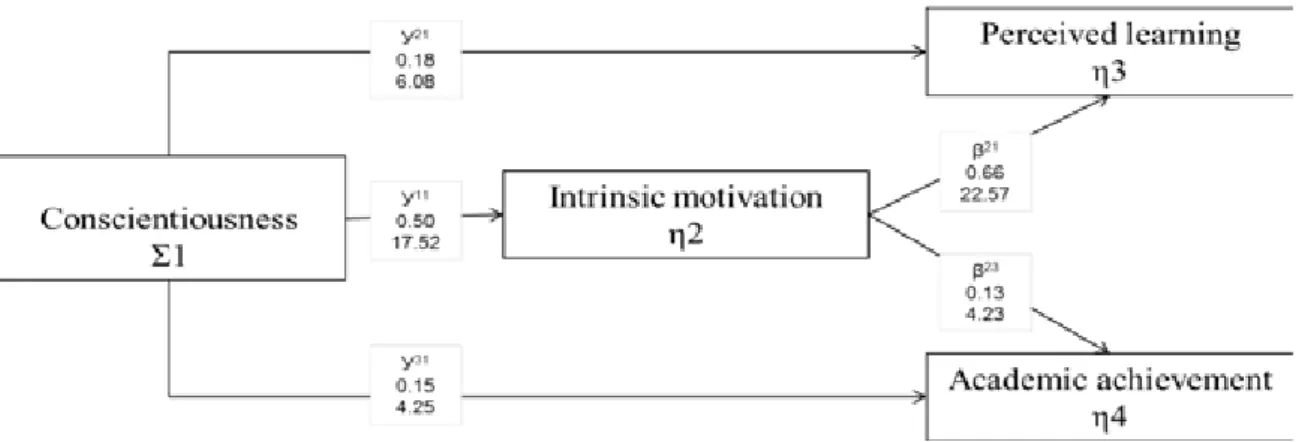
The final structural model has a chi-square of 205.81 (df=39, p<0.00), and the fit indexes suggest a good fit on the model to the data (NFI=0.99, PNFI=0.70, CFI=0.99, IFI=0.99, and RMSEA=0.046). The estimation results for the structural paths are in Figure 2. The results confirm all 5 hypotheses.
Figure 2: Conceptual framework
The findings revealed that conscientiousness has a positive impact on intrinsic motivation, and also on learning outcomes (perceived learning and academic achievement). These results are in line with previous empirical research that emphasizes the importance of personality factors on academic achievement (Gilles & Bailleux, 2001; Noftle & Robins, 2007; Poropat, 2009).
Conscientiousness is the most important factor of the Big Five predictors. Students who scores high on this factor have a high aspiration levels and work hard to achieve their goals; they are very diligent and purposeful and have a sense of direction. Thus they are more likely to be intrinsically motivated and to perform better on academic tasks.
Similarly, intrinsic motivation positively affects perceived learning. Students with higher levels of intrinsic motivation are more likely to self-evaluate themselves as learning a lot in the course and they have more positive feelings toward the field of study after taking a course, two indicators that overall characterize perceived learning. Also it influences positively the grades obtained on the course, and so, students’ academic achievement.
Thus, it is important to build an active learning environment, contrary to the traditional classroom (Cardoso et al., 2011) in order to increase high school students’ motivation (Garcia & Pontrich, 1996; Stipek et al., 1998) and to enhance intellectual development (McKeachie, 1990).
6. coNclUSIoN
Conscientiousness and intrinsic motivation showed to be relevant predictors of learning performance in high school students. Corroborating previous studies, these findings suggest that personal factors are important to improve students’ learning outcomes, namely perceived learning and academic achievement.
The findings provide useful information for teachers and school managers. First, it is relevant to take into account students’ personal dispositions for a better identification of students who may not perform well (less organized, little self-disciplined, careless…) and implement strategies to enhance particular students’ performance.
Second, it is important to develop institutional and pedagogical strategies that might increase the students’ academic motivation, and their engagement in learning activities that should be stimulating and challenging. In particular, teachers should design learning environments where students actively participate in the knowledge construction, providing opportunities for choice and self-direction. Thus, students may extend and exercise their capabilities, develop their autonomy and competence, and so improve their academic achievement.
acKNoWleDgeMeNtS
Polytechnic Institute of Viseu, the Center for Studies in Education, Technologies and Health (CI&DETS) and the Portuguese Foundation for Science and Technology (FCT).
Appendix A. Constructs, scale items and reliabilities
Constructs, scale items and reliabilities Std. coefficients T-values
coNScIeNtIoUSNeSS
(Scale 1 = Strongly disagree / 5 = Strongly agree) (a=.661, ρvc(n)=.50, ρ=.66)
V1 I try to perform all the tasks assigned to me conscientiously 0.69 24.80 V2 I have a clear set of goals and work toward them in an orderly fashion 0.72 25.62 Adapted from Costa e McCrae (1992a)
INtrINSIc MotIVatIoN
(Scale 1 = Strongly disagree / 5 = Strongly agree) (a=.855, ρvc(n)=.60, ρ=.86)
V3 Having satisfaction of improving my personal knowledge and skills 0.83 43.16
V4 Having a sense of personal accomplishment 0.85 44.99
V5 Completing exciting and challenging class activities 0.72 35.57
V6 Enjoying learning about interesting subjects 0.69 33.57
Adapted from Young (2005)
perceIVeD learNINg
(Scale 1 = Strongly disagree / 5 = Strongly agree) (a=.77, ρvc(n)=.63, ρ=.78)
V7 I am learning a lot in this course 0.84 39.60
V8 As a result of taking this course, I have more positive feelings toward this field of study 0.75 34.83 Adapted from Marks (2000)
acaDeMIc achIeVeMeNt
(Ratio scale) (a=.90, ρvc(n)=.78, ρ=.91)
V9 Classification obtained in the 1st period in the discipline 0.95 54.60 V10 Classification obtained in the 2nd period in the discipline 0.96 55.67
V11 Average classification on the set of all disciplines 0.73 37.60
Adapted from Young et al. (2003)
Notes: a = Internal reliability (Cronbach, 1951) ρvc(n) = MVE(Fornell & Larker, 1981) ρ = Composit reliability (Bagozzi, 1980)
1. Bagozzi, R. P. (1980). Causal models in marketing. New York: Wiley. 2. Cardoso, A. P., Ferreira, M., Abrantes, J. L., Seabra, & C., Costa,
C. (2011). Personal and pedagogical interaction factors as determinants of academic achievement. Procedia – Social and
Behavioral Sciences, 29, 1596-1605.
3. Chamorro-Premuzic, T., & Furnham, A. (2005). Personality and
intellectual competence. Mahwah, NJ: Lawrence Erlbaum.
4. Costa, P. T., & McCrae, R. R. (1992a). Revised NEO Personality Inventory (NEO-PI-R) and NEO Five-Factor Inventory (NEO-FFI): Professional manual. Odessa: Psychological Assessment Resources Inc.
5. Costa, P. T., & McCrae, R. R. (1992b). Four ways five factors are basic. Personality and Individual Differences, 13 (6), 653-665. 6. Cronbach, L. (1951). Coefficient Alpha and the internal structure of
tests. Psychometrika, 16, 297-334.
7. Deci, E. L., & Ryan, R. M. (1985). Intrinsic motivation and
self-determination in human behaviour. New York: Plenum.
8. Deci, E. L., & Ryan, R. M. (1991). A motivational approach to self: Integration in personality. In R. A. Dienstbier (Ed.), Nebraska
symposium on motivation: Perspectives on motivation (Vol. 38, pp.
237-288). Lincoln, NE: University of Nebraska.
9. Ferreira, M., Cardoso, A. P., & Abrantes, J. L. (2011). Motivation and relationship of the student with the school as factor involved in the perceived learning. Procedia – Social and Behavioral Sciences, 29, 1707-1714.
10. Ferrer-Caja, E., & Weiss, M. R. (2000). Predictors of intrinsic motivation among adolescent students in physical education.
Research Quarterly for Exercise and Sport, 71, 267-279.
11. Ferrer-Caja, E., & Weiss, M. R. (2002). Cross-validation of a model of intrinsic motivation with students enrolled in high school elective courses. Journal of Experimental Education, 71 (1), 41-66. 12. Fornell, C., & Larcker, D. (1981). Evaluating structural equation
models with unobservable variables and measurement error.
Journal of Marketing Research, 18 (1), 39-50.
13. Garcia, T., & Pontrich, P. R. (1996). The effects of autonomy on motivation and performance in the college classroom.
Contemporary Educational Psychology, 21 (4), 477-486.
14. Gilles, P. Y., & Bailleux, C. (2001). Personality traits and abilities as predictors of academic achievement. European Journal of
Psychology of Education, 16, 3-15.
15. Jöreskog, K., & Sörbom, D. (1996). LISREL 8. User´s Reference Guide. Chicago: Scientific Software International.
16. Kappe, R., & Van der Flier, H. (2012). Predicting academic success in higher education: What’s more important than being smart?
European Journal of Psychology of Education, 27, 605-619.
17. Marks, R. B. (2000). Determinants of student evaluation of global measures of instructor and course value. Journal of Marketing
Education, 22 (2), 108-119.
18. McCrae, R. R., & Costa, P. T. (1987). Validation of the five-factor model of personality across instruments and observers. Journal of
Personality and Social Psychology, 52, 81-90.
19. McKeachie, W. J. (1990). Research on college teaching: The historical background. Journal of Educational Psychology, 82, 189-200. 20. Noftle, E., & Robins, R. (2007). Personality predictors of academic
outcomes: Big Five correlates of GPA and SAT scores. Journal of
Personality and Social Psychology, 93, 116-130.
21. O’Connor, M. C., & Paunonen, S. V. (2007). Big Five personality predictors of post-secondary academic performance. Personality
and Individual Differences, 43, 971-990.
22. Poropat, A. E. (2009). A meta-analysis of the Five-Factor model of personality and academic performance. Psychological Bulletin, 2, 322-338.
23. Raad, B., & Schouwenburg, H. (1996). Personality in learning and education: A review. European Journal of Personality, 10, 303-336. 24. Richardson, M., & Abraham, C. (2009). Conscientiousness and
achievement motivation predict performance. European Journal of
Personality, 23, 589-605.
25. Ryan, R. M., & Deci, E. (2000). Self-determination theory and the facilitation of intrinsic motivation, social development, and well-being. American Psychologist, 55 (1), 68-78.
26. Standage, M., Duda, J., & Ntoumanis, N. (2005). A test of self-determination theory in school physical education, British Journal
of Educational Psychology, 75, 411-433.
27. Stipek, D. J., Salmon, J. S., & Givven, K. B. (1998). The value of practices suggested by motivation research and promoted by mathematics education reformers. Journal of Research in
Mathematics Education, 29 (4), 465-488.
28. Vallerand, R. J., & Blanchard, C. (1998). Education permanente et motivation: Contribution du modèle hiérarchique de la motivation intrinsèque et extrinsèque. Education Permanente, 136, 15-35. 29. Young, M., Klemz, B., & Murphy, J. (2003). Enhancing learning
outcomes: The effects of instructional technology, learning styles, instructional methods, and student behaviour. Journal of Marketing
Education, 25 (2), 130-142.
30. Young, M. R. (2005). The motivational effects of the classroom environment in facilitating self-regulated learning. Journal of
Marketing Education, 27 (1), 25-40.