Introduction
Glaucoma is an optic neuropathy in which the main risk factor is intra-ocular pressure (IOP). However, a
number of patients still show signs of disease progression despite an other-wise normal IOP value. The search for other variables involved in glau-coma pathogenesis and progression
has identified both systemic and ocu-lar signs of vascuocu-lar dysfunction in glaucoma patients, such as migraine (Wang et al. 1997), peripheral vaso-spasm (Broadway & Drance 1998), systemic hypotension (Hayreh et al. 1999) and cerebral microvascular ischaemia (Stroman et al. 1995). Sev-eral studies have shown that glaucoma patients have altered blood flow veloc-ities, as determined by colour Doppler imaging (CDI) (Galassi et al. 1992) (Harris et al. 1994) (Michelson et al. 1995). However, due to limitations known in this technology, vessel diam-eter cannot be measured by CDI and thus flow cannot be accurately mea-sured. Nevertheless, CDI is a widely validated technique (Stalmans et al. 2009) (Founti et al. 2011) that may provide further information about autoregulation in these vessels, which is reportedly defective in glaucoma patients (Grieshaber et al. 2007) (Nicolela 2008). Gosling index or pul-satility index (PI) and mean flow velocities (MFV) have been used for decades now to study cerebral arteries vasoreactivity (Werner et al. 1990) (Bellapart & Fraser 2009). Both vari-ables provide additional information about the Doppler waveform behav-iour, playing an important role in diagnosing cerebral arteries vasospasm (Sloan et al. 1989) or arterial occlu-sion (Alexandrov et al. 1999). Its clini-cal use in ophthalmology, however, has not been as widespread as the Pourcelot index or resistive index (RI), with few studies determining its significance in glaucoma. Two studies
Disturbed correlation between
arterial resistance and pulsatility
in glaucoma patients
Luı´s Abega˜o Pinto,
1,2Evelien Vandewalle
3and Ingeborg Stalmans
31Department of Ophthalmology, Centro Hospitalar de Lisboa Central, Portugal 2
Institute of Molecular Medicine, Faculty of Medicine, Lisbon University, Portugal
3Department of Ophthalmology, University Hospitals Leuven, Belgium
ABSTRACT.
Purpose: (i) To investigate whether pulsatility index (PI) and mean flow veloc-ities (MFV) are altered in glaucoma patients. (ii) To evaluate the significance of PI in retrobulbar autoregulation capacity.
Methods: Patients with primary open-angle glaucoma (POAG; n = 49), nor-mal tension glaucoma (NTG; n = 62) and healthy controls (n = 48) under-went colour Doppler imaging measurements of the retrobulbar vasculature. Kruskal–Wallis test was used to compare variables between the three diagnos-tic groups. Restricted cubic splines were used to determine nonlinearities between the resistive index (RI) and PI correlations.
Results: Mean flow velocities (MFV) were lower in both short posterior ciliary arteries (SCPA) and central retinal arteries (CRA) from the two glaucoma groups (p < 0.04 versus healthy controls). No differences were detected in RI or PI in any arteries of the three diagnostic groups (p > 0.08). In healthy individuals, correlations between RI and PI were linear in all arteries. In both POAG and NTG patients, CRA presented a nonlinear curve with a cutpoint at RI 0.77 (p < 0.001) and 0.61 (p = 0.03), respectively, above which the slope increased nearly five- and tenfold (POAG: 1.96 to 10.06; NTG: )0.46– 4.06), respectively. A nonlinear correlation in the ophthalmic artery was only observed in NTG patients, with a cutpoint at RI 0.82 (p < 0.001), above which the slope increased from 3.47 to 14.03.
Conclusions: Glaucoma patients do not present the linear relationships between RI and PI observed in healthy individuals. Their nonlinear relations may be indicative of an altered autoregulation and suggest a possible threshold RI could be determined above which autoregulatory disturbances become more relevant.
Key words: blood flow – colour Doppler imaging – glaucoma – pulsatility index – vascular dys-function
Acta Ophthalmol. 2012: 90: e214–e220
ª 2012 The Authors
Acta Ophthalmologicaª 2012 Acta Ophthalmologica Scandinavica Foundation
failed to identify differences in PI between healthy individuals and pri-mary open-angle glaucoma (POAG) (Januleviciene et al. 2008) or normal tension glaucoma (NTG) (Chiou et al. 1999). In both cases, no further analy-sis was made to test how PI could relate to other variables. Our study aims to clarify whether PI or MFV can provide further insights on vascu-lar autoregulation in glaucoma.
Methods
Subject groupsThree cohorts of individuals over 18 years old were recruited for the study: patients with NTG (n = 62), patients with POAG (n = 49) and healthy control subjects (n = 48) of comparable age. This latter group was recruited from the persons accompa-nying the patients. Glaucoma patients were defined as having characteristic optic disc damage and visual field loss (Jamel 1997) (Zeyen 1999). For the diagnosis of POAG, an untreated IOP of 21 mm Hg or greater was required. Current medical treatment, including topical IOL lowering drugs, was con-tinued. The healthy volunteers were screened by a senior member of the glaucoma clinic (IST) and those with a family history of glaucoma, an increased or asymmetrical cup⁄ disc ratio or any other optic disc structural change (notching, disc haemorrhage) or an IOP above 21-mm Hg were excluded as possible glaucoma sus-pects. Patients with a history of ocular trauma or eye disease (except glau-coma) that could not be accounted for by refractive error were excluded.
Information regarding functional and structural damage from glaucoma patients was collected from exams undertaken on the day of the study visit.
Measuring devices
Intra-ocular pressure was measured with the Goldmann applanation tonometer (GAT). Central corneal thickness (CCT) was measured using a Pachmate DGH55 (DGH Technol-ogy Inc., Exton, PA, USA). Retrobul-bar flow velocities (peak systolic velocity [PSV], end diastolic velocity [EDV], MFV, RI and PI) were mea-sured with the Antares CDI device
(Siemens, Munich, Germany). Visual acuity was tested using the Early Treatment of Diabetic Retinopathy.
Study chart placed in the same loca-tion at the same distance from the patient under the same illumination for all subjects. Blood pressure mea-surement was taken from subject’s right arm using an electronic sphyg-momanometer (Omron, Schaumburg, IL 60173, USA.).
Experimental design
Patients were instructed to avoid caf-feine intake, smoking and exercise for 3 hr prior to the study visit. The study was approved by the ethical review committee (Institutional Review Board) at the University Hospitals Leuven and was conducted in accor-dance with Good Clinical Practice within the tenets of the Helsinki agreement. Each patient⁄ subject was required to sign an informed consent statement before being enrolled into the study and prior to any study mea-surements being taken. During the study visit, the following examinations were performed in the same order: visual acuity (using the ETDRS chart placed in the same location at the same distance from the patient under the same illumination for all subjects), IOP measurement by GAT, pachyme-try, blood pressure and heart rate measurements, and finally CDI. All CDI measurements were performed by a single observer (LAP) masked to the patient diagnosis. Only one eye
per patient was included in the study. The eye with greater glaucomatous damage was selected in the glaucoma patients, and a randomly selected eye in the healthy individuals.
Statistical analysis
Kruskal–Wallis tests were used to com-pare the three diagnostic groups on dif-ferent variables. Mann–Whitney test was used in pairwise comparisons. Restricted cubic splines were used to verify if there was any evidence for nonlinearity in the relation between the RI and PI. Piecewise linear regression models were used to determine the optimal cutpoint (i.e. the cutpoint yielding the highest likelihood) between the two intervals. Sensitivity analyses were performed to verify if the result was not due to an (influential) subject with a high RI value. The analyses were performed for each artery and for healthy controls, POAG and NTG subjects separately. Analyses were per-formed using SAS software, version 9.2 of the SAS System for Windows (SAS Institute Inc., Cary, NC, USA).
Results
Patient characteristics
Table 1 summarizes the patient char-acteristics in the different diagnostic groups with their comparative p val-ues. Kruskal–Wallis test indicated no overall differences between the studied groups in age, blood pressure (BP)
Table 1. Patients characteristics.
Healthy NTG POAG Kruskal–Wallis⁄ Mann–Whitney N 48 62 49 Age 71.7 (9.5) 70.4 (11) 70.1 (11.7) 0.95 IOP 14.3 (2.9) 13.2 (2.7) 14.6 (3.9) 0.04 Visual acuity 0.2 (0.3) 0.4 (0.6) 0.3 (0.3) 0.02 MD – 8.44 (8.22) 8.63 (9.95) 0.33 RNFL – 0.15 (0.08) 0.16 (0.09) 0.46
Cup⁄ disc ratio – 0.65 (0.15) 0.61 (0.17) 0.24
CCT 565.9 (32.5) 545.6 (35.3) 547.0 (38.2) 0.08
Systolic BP 151.8 (20.8) 141.7 (25.4) 146.5 (20.5) 0.09 Diastolic BP 82.7 (11.6) 80.7 (12.6) 84.7 (11.4) 0.19
MOPP 91.1 (12.1) 86.6 (19.5) 90.6 (13.1) 0.50
Pulse 69.3 (10.4) 67.3 (12.7) 68.4 (10.6) 0.55
Mean values (and SD) are depicted. Kruskal–Wallis indicates P values of overall differences between the diagnostic groups; Mann–Whitney was used in pairwise comparisons.
MD = mean defect, RNFL = retinal nerve fibre layer, CCT = central corneal thickness, BP = blood pressure, NTG = normal tension glaucoma, POAG = primary open-angle glau-coma, IOP = intraocular pressure, MOPP = median ocular perfusion pressure ([2⁄ 3 dia-stolic + 1⁄ 3 systolic BPs]-Goldmann tonometry).
systolic or diastolic, median ocular perfusion pressure (MOPP) and pulse (p ranged from 0.09 to 0.95). The same test identified statistically, non-clinically significant differences in visual acuity and IOP when compar-ing between the three groups (p = 0.02 and p = 0.04, respectively). Moreover, a pairwise Mann–Whitney test revealed no IOP differences between healthy versus NTG (p = 0.09), healthy versus POAG (p = 0.41) and between the two types of glaucoma (p = 0.19). Similar pairwise testing indicated that visual acuity was higher in the healthy subjects ver-sus POAG (p = 0.0095) and NTG (p = 0.0385), whereas there was no difference in visual acuity between NTG and POAG (p = 0.9770). Topi-cal and systemic medications are sum-marized in Table 2.
Retrobulbar flow velocities in glaucoma patients and healthy controls
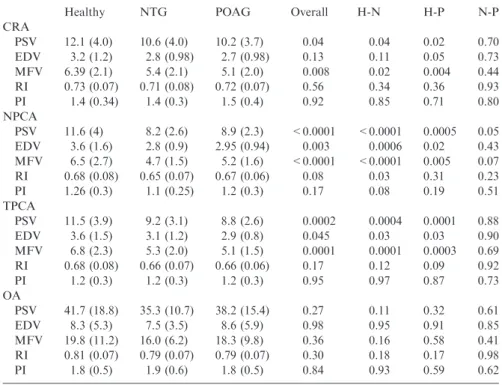
Table 3 depicts the data from CDI examinations. The RI and PI from each of the four arteries were not statis-tically different between any of the three diagnostic groups (p ranged from 0.14 to 0.84 and from 0.11 to 0.99, respectively). The measurements in the CRA, nasal short posterior ciliary arteries (NPCA) and temporal poster-ior ciliary artery (TPCA) of both glau-coma groups revealed a decrease in PSV and MFV when compared to healthy controls (p < 0.04 in all pair-wise comparisons). End diastolic veloc-ity was significantly lower in the TPCA and NPCA of glaucoma patients when compared to healthy individuals (p < 0.001). In the EDV from the CRA, the decrease between glaucoma patients and healthy controls did not reach statistical significance (healthy versus NTG p = 0.11; healthy versus POAG = 0.05). In the ophthalmic artery (OA), none of the variables was significantly different between the three groups (p > 0.05 in all comparisons). No differences were detected in any of the studied flow velocities or indexes between the two glaucoma groups (p values ranging from 0.05 to 0.98). The RI did not present a correlation with the MOPP in any of the four arteries in the diagnostic groups (p values ranging from 0.12 to 0.98 – data not shown). We did not identify a correlation between MOPP and either functional
(visual field Mean Deviation) or struc-tural damage (cup⁄ disc ratio, retinal nerve fibre layer on HRT examination) in the both glaucoma groups (NTG: p > 0.52, p > 0.45; POAG: p > 0.18; p > 0.70; respectively).
Relationship between RI and PI in retro-bulbar arteries in glaucoma patients and healthy controls
There was a positive correlation between RI and PI in all the four vessels of the three diagnostic groups
(p < 0.001 – data not shown). This correlation was, however, not always linear (Table 4). More specifically, a nonlinear relationship was detected only in the CRA of both glaucoma groups, but not in the CRA of healthy individuals (p values: NTG 0.033; POAG <0.001; Healthy 0.74). Mea-surements in the CRA of POAG patients revealed a cutpoint at RI = 0.77 in which the slope of the RI⁄ PI relationship increases by approx-imately five times, from 1.96 to 10.1 (Fig. 1A). The nonlinear curve in the
Table 2. Topical and systemic medications.
Healthy NTG POAG
Topical
Beta blockers – 28 (45.1) 22 (44.9)
Prostaglandin analogues – 36 (58.1) 30 (61.2)
Carbonic anhydrase inhibitors – 20 (32.2) 20 (40.8)
a-adrenergic agents – 6 (9.7) 4 (8.2)
Systemic
Beta blockers 10 (20.1) 12 (19.4) 8 (16.3)
Carbonic anhydrase inhibitors – 4 (6.45) 3 (6.12)
Renin-angiotensin system inhibitors 18 (37.5) 26 (41.9) 17 (34.7)
Calcium channel blockers 4 (8.33) 6 (9.68) 4 (8.16)
Number of patients and percentage (between brackets) are depicted. NTG = normal tension glaucoma, POAG = primary open-angle glaucoma. Table 3. Comparison of flow velocities between diagnostic groups.
Healthy NTG POAG Overall H-N H-P N-P
CRA PSV 12.1 (4.0) 10.6 (4.0) 10.2 (3.7) 0.04 0.04 0.02 0.70 EDV 3.2 (1.2) 2.8 (0.98) 2.7 (0.98) 0.13 0.11 0.05 0.73 MFV 6.39 (2.1) 5.4 (2.1) 5.1 (2.0) 0.008 0.02 0.004 0.44 RI 0.73 (0.07) 0.71 (0.08) 0.72 (0.07) 0.56 0.34 0.36 0.93 PI 1.4 (0.34) 1.4 (0.3) 1.5 (0.4) 0.92 0.85 0.71 0.80 NPCA PSV 11.6 (4) 8.2 (2.6) 8.9 (2.3) <0.0001 <0.0001 0.0005 0.05 EDV 3.6 (1.6) 2.8 (0.9) 2.95 (0.94) 0.003 0.0006 0.02 0.43 MFV 6.5 (2.7) 4.7 (1.5) 5.2 (1.6) <0.0001 <0.0001 0.005 0.07 RI 0.68 (0.08) 0.65 (0.07) 0.67 (0.06) 0.08 0.03 0.31 0.23 PI 1.26 (0.3) 1.1 (0.25) 1.2 (0.3) 0.17 0.08 0.19 0.51 TPCA PSV 11.5 (3.9) 9.2 (3.1) 8.8 (2.6) 0.0002 0.0004 0.0001 0.88 EDV 3.6 (1.5) 3.1 (1.2) 2.9 (0.8) 0.045 0.03 0.03 0.90 MFV 6.8 (2.3) 5.3 (2.0) 5.1 (1.5) 0.0001 0.0001 0.0003 0.69 RI 0.68 (0.08) 0.66 (0.07) 0.66 (0.06) 0.17 0.12 0.09 0.92 PI 1.2 (0.3) 1.2 (0.3) 1.2 (0.3) 0.95 0.97 0.87 0.73 OA PSV 41.7 (18.8) 35.3 (10.7) 38.2 (15.4) 0.27 0.11 0.32 0.61 EDV 8.3 (5.3) 7.5 (3.5) 8.6 (5.9) 0.98 0.95 0.91 0.85 MFV 19.8 (11.2) 16.0 (6.2) 18.3 (9.8) 0.36 0.16 0.58 0.41 RI 0.81 (0.07) 0.79 (0.07) 0.79 (0.07) 0.30 0.18 0.17 0.98 PI 1.8 (0.5) 1.9 (0.6) 1.8 (0.5) 0.84 0.93 0.59 0.62
Velocities and indexes of the three diagnostic groups, at each of the four vessels. Pairwise com-parisons (H versus NTG, H versus POAG, and NTG versus POAG) were done with a Mann– Whitney test. Overall comparison was done with a Kruskal–Wallis test. Mean values (SD) are depicted.
H = healthy, NTG = normal tension glaucoma, POAG = primary open-angle glaucoma, CRA = central retinal artery, NPCA = nasal posterior ciliary artery, TPCA =temporal pos-terior ciliary artery, OA = ophthalmic artery, PSV = peak systolic velocity, EDV = end dia-stolic velocity, MFV = mean flow velocity, RI = resistive index, PI = pulsatility index.
CRA of NTG patients revealed a cut-point at RI = 0.61, marking a nearly tenfold increase in the curve slope from )0.46 to 4.06 (Fig. 1B). In the RI ⁄ PI curves from the short CPAs, linearity testing in both nasal short posterior cil-iary arteries (NPCA) and TPCA revealed a linear relationship in all of the three diagnostic groups (p values between 0.33 and 0.92). In the OA, nonlinearity between RI and PI was only observed in the NTG group, with a cutpoint at RI = 0.82, from which the slope significantly increased from 3.47 to 14.3 (Fig. 1D).
Relationship between RI and MFV in ret-robulbar arteries in glaucoma patients and healthy controls
There was a positive correlation between RI and MFV in the CRA (p < 0.01), while a negative correlation between these variables was detected in
the OA (p < 0.01) in all three diagnos-tic groups. This correlation was not sta-tistically significant in neither the NPCA nor the TPCA of the three diag-nostic groups (p > 0.05) (Table 5).
Discussion
This study was conducted to evaluate the relevance of PI and MFV in glaucoma patients. Secondly, we checked whether correlations could be determined between these variables and the information generally provided in CDI studies, such as PSV, EDV and RI. Glaucoma patients, both POAG and NTG, revealed lower velocities (PSV, EDV and MFV) when compared to healthy individuals. Lower PSVs have been consistently found in glau-coma populations (Galassi et al. 1992) (Michelson et al. 1995) (Harris et al. 1994) and are associated with both structural and functional damage,
including defects in both retinal nerve fibre layer (Januleviciene et al. 2008) and visual field (Zeitz et al. 2006). Our findings regarding MFV are consistent with other results in POAG patients that found reduced flow velocities on retrobulbar arteries (Garho¨fer et al. 2010) and in the cerebral circulation (Harris et al. 2003). These disturbances in ocular blood flow in glaucoma, in which unstable perfusion and ischae-mia⁄ reperfusion damage may play a role, have been attributed to an imbal-ance in vessels autoregulation (Flam-mer et al. 1999) (Flam(Flam-mer et al. 2002). A more thorough analysis of the Dopp-ler waveform can provide additional information about that ocular and sys-temic vascular dysfunction. For instance, increased ratios between sys-tolic and diassys-tolic MFV in the OA have been reported to reflect systemic ath-erosclerosis and coronary heart disease (Maruyoshi et al. 2010). (A) (B) (C) (D) CRA - NTG
Central retina artery – pulsatility index
Central retina artery – resistance index 4 3 2 1 0 0.5 0.6 0.7 0.8 0.9 1.0 OA-NTG
Ophthalmic artery – pulsatility index
4 5 3 2 1 0
Ophthalmic artery – resistance index
0.5 0.6 0.7 0.8 0.9 1.0 CRA - POAG 2.5 2.4 2.3 2.2 2.1 2.0 1.9 1.8 1.7 1.6 1.5 1.4 1.3
Central retina artery – pulsatility index
Central retina artery – resistance index 1.2 1.1 1.0 0.9 0.5 0.6 0.7 0.8 0.9 1.0 CRA - Healthy 2.5 2.6 2.7 2.4 2.3 2.2 2.1 2.0 1.9 1.8 1.7 1.6 1.5 1.4 1.3
Central retina artery – pulsatility index
1.2 1.1 1.0 0.9 0.8 0.7
Central retina artery – resistance index
0.5 0.6 0.7 0.8 0.9 1.0
Fig. 1. Piecewise linear regression models of (resistance index-pulsatility index) RI-PI relationship. Nonlinearity of the curve and determination of a cutpoint was detected in central retinal arteries (CRA) of primary open-angle glaucoma (POAG) (A), normotensional glaucoma (NTG) (B) and in ophthalmic arteries (OA) of NTG (D). Cutpoint of CRA–POAG was determined at RI = 0.77 (p < 0.001) while in NTG that cutpoint was at RI = 0.61 (p = 0.03). In OA–NTG, the optimal cutpoint in the nonlinear relationship was detected at RI = 0.82 (p < 0.001). In the CRA of the healthy group, no cut point was detected (C).
Stratification of risk of glaucoma progression has been proposed by studying variables such as RI and PSV (Zeitz et al. 2006) (Martı´nez & Sa´n-chez 2005). Resistive index has been used as an indirect measure of periph-eral vascular resistance. The Doppler waveform can nevertheless provide additional information about flow. Variables such as PI have been exten-sively used in other fields of medicine such as cardiology and neurology to study downstream vascular resistance. Resistive index is particularly impor-tant in studying vasoreactivity and vessel compliance, as increases in PI are associated with increases in flow
velocities pulsation just before loss of autoregulation (Czosnyka et al. 1997) (Nelson et al. 1992). Interestingly, in territories that may show remarkable similarities to the retrobulbar circula-tion such as the cerebral arteries, a high PI in middle cerebral artery has been described as an independent risk factor for stroke (Wijnhoud et al. 2011). As evidence is mounting about the existence of a lack of regulation in ocular blood flow (OBF) in glaucoma, studying changes in PI patterns may prove to be a useful tool to further explore this item. Our results show that in healthy individuals there is a constant, linear relation between RI
and PI, independently of the individ-ual RI value. This may suggest that healthy patients have, throughout the entire vascular physiological resistance range, a preserved autoregulatory mechanism. Glaucoma patients, how-ever, have nonlinear responses with specific cutpoints above which a five-to-tenfold increase in PI exist. These results suggest that there is a limit in the vessel ability to adapt to increased resistance. Interestingly, these patterns of nonlinear correlations are not seen in all arteries, nor are their cutpoints the same between POAG and NTG groups. The OA, for instance, presents this nonlinear behaviour only in NTG and not in POAG patients. Addition-ally, the cutpoints in the CRA from NTG patients occur at a lower RI than in POAG patients. Our results thus suggest a stronger vascular dys-function in NTG, where non-IOP-related risk factors are more likely to be involved. In fact, NTG patients are more prone to show signs of vascular dysfunction (Su et al. 2008) and over-all autonomic nervous system dysfunc-tion (Gherghel et al. 2004) than POAG patients.
Short ciliary arteries of both glau-coma and healthy groups behaved in a linear fashion. Although these are the arteries most important in the blood supply to the optic nerve head, and thus of crucial important in glau-coma OBF studies, they also supply the choroidal compartment. This structure behaves as a high-flow, low-resistance compartment with a lack of auto-regulatory ability (Hayreh 1990). As PI reflects downstream vascular resistance, this likely explains why increases in PI were not observed in these vessels. Our results thus suggest that these imbalances in autoregula-tion are preferentially observed in some vascular beds rather than in oth-ers. The CRA supplies the strongly regulated retinal arteries and is there-fore more likely to show signs of altered vasoreactivity than arteries supplying lesser regulated territories such as choroid (TPCA and NPCA) or the orbital region as a whole (OA). Our findings about the differences in retrobulbar vessels’ autoregulation using PI show a remarkable overlap with findings on ocular vessel regula-tion using correlaregula-tions between MFV and ocular perfusion pressure (Garho¨-fer et al. 2010) done in POAG
Table 4. Nonlinearity between resistive index (RI) and pulsatility index (PI) in the diagnostic groups.
p-value Cutpoint
Curve slopes
Before cutpoint After cutpoint Healthy CRA 0.7395 – – – NPCA 0.4196 – – – TPCA 0.6758 – – – OA 0.2474 – – – POAG CRA <0.0001 0.7700 1.96 10.06 NPCA 0.9173 – – – TPCA 0.6758 – – – OA 0.3229 – – – NTG CRA 0.0339 0.6100 )0.46 4.06 NPCA 0.3260 – – – TPCA 0.7774 – – – OA <0.0001 0.8233 3.47 14.03
Piecewise linear regression models of the RI-PI curves for each of the four arteries of the three diagnostic groups. p-values for non-linear relationship (cutpoints) are depicted. Optimal cut-point if curve nonlinear described, curve slopes before and after the optimal cutcut-point are pre-sented.
NTG = normal tension glaucoma, POAG = primary open-angle glaucoma, CRA = central retinal artery, NPCA = nasal posterior ciliary artery, TPCA = temporal posterior ciliary artery, OA = ophthalmic artery.
Table 5. Correlation between mean flow velocities and resistive index in the different diagnostic groups. Healthy NTG POAG p r p r p r CRA 0.70 0.71 <0.01 0.33 <0.01 0.41 NPCA 0.35 – 0.35 – 0.31 – TPCA 0.06 – 0.88 – 0.11 – OA <0.001 )0.56 <0.001 )0.46 0.002 )0.44
Spearman correlations are indicated. R are shown when p value is significant (p < 0.05). CRA = central retinal artery, NPCA = nasal short posterior ciliary arteries, TPCA = tempo-ral short posterior ciliary arteries, OA = ophthalmic artery, NTG = normal tension glaucoma, POAG = primary open-angle glaucoma.
patients. Interestingly, our cutpoint for OA is remarkably similar to the RI value Martinez et al. found to be associated with increased progression [Martı´nez & Sa´nchez (2005)]. Our data suggest that the rationale for patients progressing faster when OA RI is above 0.82 could be the overrid-ing of the vessels’ ability to adapt to increased resistance.
Further studies are needed to fur-ther evaluate these cutpoints, and whether vasoreactivity tests such as oxygen breathing or acetazolamide administration would be able to mod-ulate such cutpoints or alter the slope characteristics. This may be clinically important as recent evidence points to an improvement in vasoreactivity in treated glaucoma patients (Venkatar-aman et al. 2010).
Another interesting result relates to the correlation between RI and MFV, which is not similar in all the retrobul-bar arteries. This is intriguing, as the higher values of PI seen in the arteries with high RI would suggest MFV to be decreased. Nevertheless, in the CRA of all groups, we detected a posi-tive correlation between RI and MFV. This would suggest increases in the RI to have a different physiological mean-ing in each of the vessels analysed. Discussion about the nature of this variable in the retrobulbar arteries and to the relevance of other properties such as the artery compliance has been so far inconclusive (Stalmans et al. 2011). Nevertheless, our results suggest that high values of RI have a different meaning in a larger, muscular artery such as the OA than in the smaller, highly regulated, thinner-walled CRA.
Our study has several limitations. The systemic medication used by patients to lower blood pressure or for IOP-lowering purposes may have had a significant impact on ocular blood flow. However, the even distri-bution of these medications over the three groups would suggest a similar impact on the retrobulbar arteries that were studied. Additionally, our popu-lation presented with a high MOPP when compared for other reports assessing ocular blood flow (Resch et al. 2011) (Kavroulaki et al. 2010). This increased perfusion pressure must be taken into account when compar-ing conclusions as it may influence the arteries resistance and diameter at the time of study.
In summary, our data suggest that CDI can identify disturbances in the autoregulatory mechanisms of the ret-robulbar arteries. PI and MFV may prove to be valuable assets in the study of ocular blood flow. To our knowledge, this is the first study using these correlations to find cutpoint in the blood vessels’ autoregulation.
Acknowledgements
This paper was presented at the Asso-ciation for Research in Vision and Ophthalmology (ARVO) meeting; Fort Lauderdale, FL; May 3, 2011.
References
Alexandrov AV, Demchuk AM, Wein TH & Grotta JC (1999): Yield of transcranial Doppler in acute cerebral ischemia. Ann Neur 30: 1604–1609.
Bellapart J & Fraser JF (2009): Transcranial Doppler assessment of cerebral autoregula-tion. Ultrasound Med Biol 35: 883–893. Broadway DC & Drance SM (1998):
Glau-coma and vasospasm. Br J Ophthalmol 82: 862–870.
Chiou HJ, Chou YH, Liu CJ, Hsu CC, Tiu CM, Teng MM & Chang CY (1999): Eval-uation of ocular arterial changes in glau-coma with color Doppler ultrasonography. J Ultrasound Med 18: 295–302.
Czosnyka M, Smielewski P, Kirkpatrick P, Laing RJ, Menon D & Pickard JD (1997): Continuous assessment of the cerebral vasomotor reactivity in head injury. Neuro-surgery 41: 11–17.
Flammer J, Haefliger IO, Orgu¨l S & Resink T (1999): Vascular dysregulation: a princi-pal risk factor for glaucomatous damage? J Glaucoma 8: 212–219.
Flammer J, Orgul S, Costa VP, Orzalesic N & Krieglsteind GK (2002): The impact of ocular blood flow in glaucoma. Progress in Retinal and Eye Research 21: 359–393. Founti P, Harris A, Papadopoulou D et al.
(2011): Agreement among three examiners of colour Doppler imaging retrobulbar blood flow velocity measurements. Acta Ophthal-mol [Epub ahead of print].
Galassi F, Nuzzaci G, Sodi A, Casi P & Vi-elmo A (1992): Color Doppler imaging in evaluation of optic nerve blood supply in normal and glaucomatous subjects. Int Ophthalmol 16: 273–276.
Garho¨fer G, Fuchsja¨ger-Mayrl G, Vass C, Pemp B, Hommer A & Schmetterer L (2010): Retrobulbar blood flow velocities in open angle glaucoma and their association with mean arterial blood pressure. Invest Ophthalmol Vis Sci 51: 6652–6657. Gherghel D, Hosking LS & Orgul S (2004):
Autonomic nervous system, circadian rhythms, and primary open-angle glau-coma. Surv Ophthalmol 49: 491–508.
Grieshaber MC, Mozaffarieh M & Flammer J (2007): What is the link between vascular dysregulation and glaucoma? Surv Oph-thalmol 52: 144–154.
Harris A, Sergott RC, Spaeth GL, Katz JL, Shoemaker JA & Martin BJ (1994): Color Doppler analysis of ocular vessel blood velocity in normal-tensional glaucoma. Am J Ophthalmol 118: 642–649.
Harris A, Zarfati D, Zalish M, Biller J, Sheets CW, Rechtman E, Migliardi R & Garzozi HJ (2003): Reduced cerebrovascu-lar blood flow velocities and vasoreactivity in open-angle glaucoma. Am J Ophthalmol 135: 144–147.
Hayreh SS (1990): In vivo choroidal circula-tion and its watershed zones. Eye (Lond) 4: 273–289.
Hayreh SS, Podhajsky P & Zimmerman MB (1999): Role of nocturnal arterial hypoten-sion in optic nerve head ischemic disorders. Ophthalmologica 213: 76–96.
Jamel H (1997): Target pressure in glaucoma therapy. J Glaucoma 6: 133–138.
Januleviciene I, Sliesoraityte I, Siesky B & Harris A (2008): Diagnostic compatibility of structural and haemodynamic parame-ters in open-angle glaucoma patients. Acta Ophthalmol 86: 552–557.
Kavroulaki D, Gugleta K, Kochkorov A, Katamay R, Flammer J & Orgul S (2010): Influence of gender and menopausal status on peripheral and choroidal circulation. Acta Ophthalmol 88: 850–853.
Martı´nez A & Sa´nchez M (2005): Predictive value of colour Doppler imaging in a pro-spective study of visual field progression in primary open-angle glaucoma. Acta Oph-thalmol Scand 83: 176–22.
Maruyoshi H, Kojima S, Kojima S, Nagayo-shi Y, Horibata Y, Kaikita K, Sugiyama S & Ogawa H (2010): Waveform of ophthal-mic artery Doppler flow predicts the sever-ity of systemic atherosclerosis. Circ J 74: 1251–1256.
Michelson G, Groh MJ, Groh ME & Grundler A (1995): Advanced primary open-angle glaucoma is associated with decreased ophthalmic artery blood-flow velocity. Ger J Ophthalmol 4: 21–24. Nelson RJ, Czosnyka M, Pickard JD,
Mak-symowicz W, Perry S, Martin JL & Lovick AH (1992): Experimental aspects of cere-brospinal hemodynamics: the relationship between blood flow velocity waveform and cerebral autoregulation. Neurosurgery 31: 705–709.
Nicolela MT (2008): Clinical clues of vascular dysregulation and its association with glau-coma. Can J Ophthalmol 43: 337–341. Resch H, Schmidl D, Hommer A et al.
(2011): Correlation of optic disc morphol-ogy and ocular perfusion parameters in patients with primary open angle glau-coma. Acta Ophthalmol 89: e544–549. Sloan MA, Haley EC Jr, Kassell NF, Henry
ML, Stewart SR, Beskin RR, Sevilla EA & Torner JC (1989): Sensitivity and specificity of transcranial Doppler ultrasonography in the diagnosis of vasospasm following
subarachnoid hemorrhage. Neurology 39: 1514–1518.
Stalmans I, Siesky B, Zeyen T, Fieuws S & Harris A (2009): Reproducibility of color Doppler imaging. Graefes Arch Clin Exp Ophthalmol 247: 1531–1538.
Stalmans I, Vandewalle E, Anderson DR et al. (2011): Use of colour Doppler imag-ing in ocular blood flow research. Acta Ophthalmol 89: e609–630.
Stroman GA, Stewart WC, Golnik KC, Cure´ JK & Olinger RE (1995): Magnetic reso-nance imaging in patients with low-tension glaucoma. Arch Ophthalmol 113: 168–172. Su WW, Cheng ST, Ho WJ, Tsay PK, Wu SC
& Chang SH (2008): Glaucoma is associated with peripheral vascular endothelial dys-function. Ophthalmology 115: 1173–1178. Venkataraman ST, Hudson C, Rachmiel R,
Buys YM, Markowitz SN, Fisher JA, Trope GE & Flanagan JG (2010): Retinal
arterio-lar vascuarterio-lar reactivity in untreated and pro-gressive primary open-angle glaucoma. Invest Ophthalmol Vis Sci 51: 2043–2050. Wang JJ, Mitchell P & Smith W (1997): Is
there an association between migraine headache and open-angle glaucoma? Find-ings from the Blue Mountains Eye Study Ophthalmology 104: 1714–1719.
Werner C, Kochs E, Rau M & Schulte EJ (1990): Transcranial Doppler sonography as a supplement in the detection of cerebral circulatory arrest. J Neurosurg Anesthesiol 2: 159–165.
Wijnhoud AD, Koudstaal PJ & Dippel DW (2011): The prognostic value of pulsatility index, flow velocity, and their ratio, mea-sured with TCD ultrasound, in patients with a recent TIA or ischemic stroke. Acta Neurol Scand, [Epub ahead of print]. Zeitz O, Galambos P, Wagenfeld L et al.
(2006): Glaucoma progression is associated
with decreased blood flow velocities in the short posterior ciliary artery. Br J Ophthal-mol 90: 1245–1248.
Zeyen T (1999): Target pressures in glau-coma. Bull Soc Belge Ophthalmol 274: 61– 65. Received on August 9th, 2011. Accepted on October 29th, 2011. Correspondence: Ingeborg Stalmans, MD, PhD Department of Ophthalmology University Hospitals Leuven
Campus St Raphael, Kapucijnenvoer 33 B-3000 Leuven, Belgium
Tel: +32 16 33 23 72 Fax: +32 16 33 23 67