DOCUMENTATION
ICOM-CC
18th Triennial Conference
2017 Copenhagen
HÉLIA MARÇAL NOVA University of Lisbon Caparica/Lisbon, Portugal University of Lisbon Lisbon, Portugal
RITA MACEDO* NOVA University of Lisbon Caparica/Lisbon, Portugal
[email protected] *Author for correspondence
KEYWORDS: documentation, decision making, performance-based art, conservation problem, transmission, body-archive
ABSTRACT
The preservation of performance-based art-works, such as installations and performances, is often accompanied by frequent discussions re-garding their documentation. How can perfor-mance-based artworks, which are unrepeatable and contextual, be documented after the event? This paper aims to reflect upon the purpose of the documentation of performance-based artworks and about how the micro-decisions conservators make during the documentation process can influence and are influenced by their intentions. In this context, the concepts and practices of documentation are critically examined. With this goal in mind, the artwork
Identificación (1975) by the Portuguese artist
Manoel Barbosa (b. 1953) and the documen-tation produced in two different contexts by two different people (a choreographer and a conservator) are discussed.
The aim of documentation:
Micro-decisions in the
documentation of
performance-based artworks
INTRODUCTION
Documentation is crucial in current conservation practice. This notion, however, has become an umbrella concept, comprising many types of practices and documents produced by different people inside and outside art institutions. There is, for example, the documentation of the conservation
process of a given object: 1) condition and treatment reports; 2) technical
multimedia documents (photos and videos, 3D and other digitally created images, analytical results, etc.); 3) historical research data; and 4) all documents related to inventory, insurance and inter-departmental exchange. Documentation may also refer to an archive related to a certain artwork or collection. This is, for example, the case with the Cranach Digital Archive (Hendenreich et al. 2014, 1), which consists of a ‘digital repository of art historical and technological, conservation and scientific information’ about the artist Lucas Cranach the Elder (c. 1472–1553). Finally, producing documentation is a conservation strategy for contemporary art preservation. This can be considered ‘a form of materialised memory’, which, although very relevant for material-oriented artworks, becomes invaluable for performance-based works ‘which fully rely on documentation for their future existence’ (Saaze 2015, 56). The documentation process for performance-based artworks, however, starts by gathering all published and unpublished documentation. The use of this terminology, once again, broadens the notion of ‘documentation’. The indeterminacy created by the use of the term ‘documentation’ for all these different situations creates some confusion, especially since curators, registrars, artists and audiences also produce documentation.
Thinking about the documentation process in conservation is the first step to reviewing terminologies and procedures and to developing new strategies for preserving performance-based artworks. Conservation literature, however, rarely reflects upon the documentation process, focusing instead on the results of that process.1 But after all, what does it mean to ‘document’ a
performance-based artwork in the context of conservation? What is the difference between the documentation created by artists and curators and the documents produced by conservators?
Due to the transient nature of performance-based artworks and to the impossibility of their representation (Phelan 1993), these questions are even more relevant. Are performance-based artworks ontologically incapable
2
DOCUMENTATION
THE AIM OF DOCUMENTATION: MICRO-DECISIONS IN THE DOCUMENTATION OF PERFORMANCE-BASED ARTWORKS
ICOM-CC
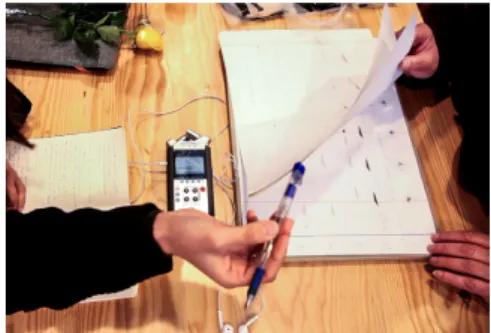
18th Triennial Conference 2017 CopenhagenFigure 1. Rovisco and Barbosa discussing the score created for Identificación (1975)
of being documented? It is important to acknowledge that ‘documents’ are considered by many museum professionals as material traces that aim to represent performance-based works and thus to represent the
un-representable. This tendency can be seen in many museums that list
performance artworks in their collections and yet acquire and exhibit their material traces or related documentation (Calonje 2015). In these cases, transient works get lost either in the myriad of documents that remain, or in the absolute void of documents that do not exist. But how can these blurred lines become more recognisable? How does the decision-making process in conservation, and the micro-decisions made by the conservator, affect documentation practices? Or even, how can performance practices affect documentation practices in conservation?
The goal of this paper is to reflect upon the aim of the documentation of performance-based artworks and how the micro-decisions conservators make during the documentation process can influence and are influenced by their intentions. In this context, concepts and practices of documentation are critically examined. With this purpose in mind, the artwork Identificación (1975) by the Portuguese artist Manoel Barbosa (b. 1953) and the documentation produced in two different contexts by two different people (a choreographer and a conservator) is discussed.
ON MANOEL BARBOSA’S IDENTIFICACIÓN (1975) AND ITS RE-ACTUALISATIONS
The Portuguese artist Manoel Barbosa created Identificación in 1975. Having been invited to participate in an art festival in Barcelona during the repressive regime of Franco-era Spain, and having come directly from the Portuguese Colonial War (1961–74) in Angola, Barbosa decided to show a happening – Identificación – as a gesture of identification with the Catalan people.
The artwork consisted of two parts. Outside the festival’s building, the artist walked around in circles, producing a spiral with his movement which started from the centre and continued outwards to the edges of the space. During the movement, he carried two tins of acrylic cobalt paint. Once the walk was over, the artist poured the paint from one tin to the other, repeating that action at least five times (Barbosa 2015). After the last pouring, the artist walked into the festival’s building, followed by the audience. The second part of the performance started as he passed through the door. This consisted of four performers, two male and two female, walking in a straight line while performing mechanical gestures. These performers followed a very rigorous score prepared by the artist which aimed to recreate an atmosphere of oppression and aggression performed by the male performers, followed, in the last moments of the performance, by a catharsis of liberation by the female performers. This catharsis was embodied by a disruption in time and space – where before there had been silence, at the end of the performance the violence of crashing mirrors echoed around the room.
Very few props were used in this performance and, besides a score created by the artist (Figure 1), none of the original materials resisted the passage
3
DOCUMENTATION
THE AIM OF DOCUMENTATION: MICRO-DECISIONS IN THE DOCUMENTATION OF PERFORMANCE-BASED ARTWORKS
ICOM-CC
18th Triennial Conference 2017 Copenhagenof time. Despite the clear limitations of any documentation produced in these conditions, the choreographer Vânia Rovisco, as part of her art project REACTING TO TIME – The Portuguese in Performance Art, decided to
transmit this work. According to Rovisco, this project attempts ‘to update
the specific bodily memory of those early experiments [in Portuguese performance art]. To access the source of that information, update it, pass it on by direct experience and present it publicly: these are the goals of the project. It’s about building a living archive embodied in the present’ (AADK 2016).
Drawing from the concept of ‘body-archive’ introduced by dance and performance studies theorist André Lepecki (Lepecki 2010), Rovisco considers that bodies have an embodied knowledge and that ignoring such a source, ‘which comes from a relation of accumulated reflexive cultural actions . . . is a flaw in the recognition of a heritage that belongs to all of us’ (AADK 2016). In the absence of the archive, Rovisco recovers the memories of the artist, which are embedded in his words and his performative practice (i.e. his body), transmitting them through her own body. She does so by transferring this corporeal knowledge to an undetermined number of workshop participants, during a full week. The workshop participants, who do not need any previous knowledge or dance practice, engage in the process of transmission by embodying the gestures and the score and, at the end of the week, by presenting the performance work in a given venue. This process not only transports the memories of the artwork into the present day, through their ‘actualisation’ (Lepecki 2010), but, with the work’s presentation, it also establishes a dialogue between the artist’s generation and its legacy. According to Rovisco, more than transmitting the specific gestures that constitute the performance artwork, she trains the bodies to truly understand the temporalities of the work (Rovisco 2016). What she aims at transmitting is not necessarily the work as it was, but the spirit it embodied, the tension it created, the disruption it generated (Rovisco 2016).
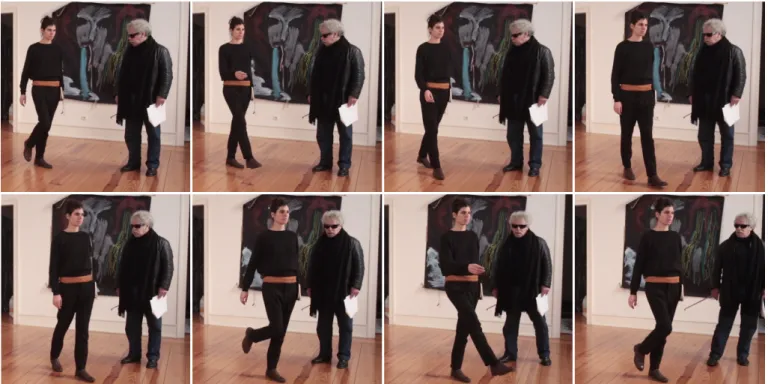
From 2015 onwards, Identificación was transmitted five times, on five different locations, with five different sets of workshop participants (see Figure 2). Besides the bodily transmission, Vânia Rovisco, together with her colleagues, produced a large volume of photo and video documentation, which can also be transmitted for present and future generations. As part of her project, she has also co-produced a documentary about the whole transmission process: from Manoel Barbosa to her, from her to the workshop participants, and from the various participants to the different audiences. At the same time, as she refined her own transmission process, each new opportunity offered new ways to pass on the embodied knowledge to workshop participants (Rovisco 2016). The documents produced in this process include: 1) a notebook delivered to participants; 2) raw multimedia data, which is available to interested researchers (Rovisco 2016); 3) a short and a long documentary; 4) photo and video documentation created by audiences and by the venues; 5) academic and non-academic essays; and, finally, according to Rovisco’s perspective, 6) her own performative body, and the bodies of all workshop participants, that work as a material repository of continually transmitted memories. The final documentation
4
DOCUMENTATION
THE AIM OF DOCUMENTATION: MICRO-DECISIONS IN THE DOCUMENTATION OF PERFORMANCE-BASED ARTWORKS
ICOM-CC
18th Triennial Conference 2017 Copenhagenof Identificación’s re-actualisation, in this case, took the form not of a technical document, like those produced by conservators, but of an artistic documentary. In the same way, the micro-decisions that drove Rovisco’s documentation process (which occurred concomitantly with her artistic process) influenced and were influenced by her performative practice and by her intention to transmit the bodily practice of the work. But how is Rovisco’s documentation different from the documentation produced in the context of the work’s conservation?
Figure 2. Composition showing pictures of the five different re-performances of
Identificación: 1) Lisbon, Portugal; 2) Guimarães, Portugal; 3) Torres Vedras, Portugal; 4) Blanca, Spain; 5) Porto, Portugal
PRACTICES OF DOCUMENTATION/DOCUMENTATION OF PRACTICES
Producing documentation is never an isolated act. As any other action, it involves conscious or unconscious decision-making processes, which, in themselves, comprise many micro-decisions (Marçal et al. 2014). The decision-making process starts with a conservation problem, where the context of the conservation action is clarified, and usually ends with a conservation strategy. The micro-decisions that are made during the first step will influence all the following steps. At the same time, whether
documentation is a strategy in itself or just a step towards a conservation
strategy that includes the work’s presentation, it is important to define what the expectations for the document produced in this process are. In conservation, despite being considered an incomplete account of the artwork, documentation is also seen as a vehicle for transmitting an artwork’s legacy into the future – as an action that materialises the immaterial. Besides gathering all relevant documents and analysing them, there are many ways of producing documentation, from interviewing the artist to observing and registering the event.
Due to the lack of original documents that share an indexical relationship with the event, the documentation process for Identificación was particularly
5
DOCUMENTATION
THE AIM OF DOCUMENTATION: MICRO-DECISIONS IN THE DOCUMENTATION OF PERFORMANCE-BASED ARTWORKS
ICOM-CC
18th Triennial Conference 2017 Copenhagenchallenging. In this case, our documentation process, as conservators, consisted of: 1) two interviews with Manoel Barbosa; 2) observation of Vânia Rovisco’s processes (through their documentation); 3) interviews with workshop participants and audience members; and, finally, 4) active participation in Vânia Rovisco’s first transmission, including the public presentation of the performance, followed by an auto-ethnographical account about the process.2 After the completion of the documentation,
Vânia Rovisco was interviewed on three occasions and the documentation results were compared.
Taking aim at the conservation problem
By comparing both documentation processes, it is possible to see that as the documentation context changes, so does the aim of conservation (or conservation problem) and thus the documentation itself. In the final documentation, it becomes evident that the documentation context justifies particular choices.
In the case of the type of artist interview, for example, it becomes clear that while in conservation there is a continued reliance on semi-structured interviews (Beerkens et al. 2012), Rovisco chose methods that are more closely related to her practice. In the first sessions, the context of the work was explored and Barbosa’s score for Identificación was reviewed (Figure 1). The following meetings, however, focused on many aspects of the movement and of the body (see Figure 3). These steps were completed in what can be considered an open interview, where themes of the interview were previously identified but the conversation occurred naturally. Regarding the depth of specific questions, there were also some differences. Keeping up with conservation’s relevant literature (Beerkens et al. 2012), details such as the performer’s clothes and the space and lighting in the original performance were focused on in the artist interview. The choreographer, on the other hand, focused on the
6
DOCUMENTATION
THE AIM OF DOCUMENTATION: MICRO-DECISIONS IN THE DOCUMENTATION OF PERFORMANCE-BASED ARTWORKS
ICOM-CC
18th Triennial Conference 2017 CopenhagenFigure 4. Detail from Rovisco’s journal
meaning of the work and on specific gestures, such as the mechanical gesture that was continually repeated by performers, without paying particular attention to the details of the original performance work.
The structure and taxonomy of the final document was also expectedly
different. The conservation document was technical (i.e. intended as a manual for future presentations of the work) and the document produced by Rovisco can be considered an artistic sub-product of her practice. Conservators produced a structured document around the possibilities for future preservation of the work’s tangible and intangible features. That was done by introducing fields such as ‘Conditions for reinterpretation’, ‘Location of material remains and props’, ‘Documents about the work’, ‘Related works’, ‘Previous presentations’, ‘Transmission efforts’ and ‘Performative aspects of the work’ to the usual documentation fields that include broad subjects like ‘Creative process’ or even ‘Historical context’ and narrow details such as ‘Spatial conditions’. Moreover, in order to accommodate the impossibility of describing many features that are only conveyed by practice, a new field called ‘Documentation of the absence’,3 which discusses the limitations of the documentation
process, was introduced.
Rovisco’s documentation, in contrast, is guided by her rhythm. According to her, she chose a particular filmmaker to film her documentary because he shared her sense of timing – that is, he shared her way of seeing how every process occurred, without being in a hurry (Rovisco 2016). Simultaneously, the choreographer mentions that, before each workshop day, and in each different venue, she discussed space viewpoints and angles with the filmmaker. This holistic view of the filming process, once again, cannot be conveyed. It is part of a negotiation between the filmmaker and the choreographer that is developed through continued practice. Rovisco and the filmmaker continued their collaboration in the post-production of the video, where, many times, the pace of the performance’s movement was translated into various image transitions and in other aspects of the editing. Besides the documentary, the choreographer produced a text in the form of a journal (Figure 4) detailing each encounter with the artist as well as her personal remarks about each transmission, following a method similar to auto-ethnography.
In this written documentation, the differences between the type of discourse used in conservation and by the choreographer are even more obvious. While conservators provided a detailed account of the main features of the performance work, the choreographer delivered a phenomenological-ideographic report, focusing on the artist’s feelings and emotions and on her own inspirations for her artistic approach to the work.
All of the micro-decisions made by Rovisco, from the choice of filmmaker to the discussions about viewpoints, every second of the video editing and every word she chose to illustrate her thoughts in her journal-like account, directly influenced the final documentation. At the same time, all these decisions were made because she was documenting her process in order to produce a documentary film. The conservation documentation was also influenced by micro-decisions that included the choice of
7
DOCUMENTATION
THE AIM OF DOCUMENTATION: MICRO-DECISIONS IN THE DOCUMENTATION OF PERFORMANCE-BASED ARTWORKS
ICOM-CC
18th Triennial Conference 2017 Copenhagenspecific words during the interviews, the selection of specific words used to describe the indescribable and even the auto-ethnographical account that was produced as part of the participation in the workshop. And, once again, the structure of the final conservation document was influenced by these decisions inasmuch as these decisions were influenced by the conservation context – which includes its aim.
The micro-decisions that each documenter made during the documentation process are particularly relevant, as they have not only influenced the final document, but they will also influence future documentation processes and thus future decisions about the work. But how can the different ways of understanding documentation affect the ways of creating documentation? Returning to Rovisco’s project, and to Lepecki’s concept of ‘body-archive’, can the body of the conservator also be a repository of memories?
REFRAMING DOCUMENTATION IN THE CONSERVATION OF PERFORMANCE-BASED ARTWORKS: IT IS ALL ABOUT CONTEXT
By means of the previous analysis, it is possible so see that the different approaches to documentation and the document in different disciplines has some practical consequences: different ways of understanding documentation demand different ways of producing documentation. First, it is important to acknowledge that any documentation will always be lacunar. Artists’ descriptions about their own works, even if complemented by visual documentation, are incomplete and there are some features of the work that are impossible to translate into words. Manoel Barbosa’s mechanical gesture, for example, can only be conveyed through bodily practice. And, although Rovisco’s transmission practices raise the issue of the body as document, the conservator’s body cannot become an archive of all performance-based artworks that exist in a given museum collection. It is possible, however, to draw from the corporeal practice of performance by participating in the execution of the work and by providing auto-ethnographical accounts about that process in the final documentation.
Finally, introducing an initial statement about the ‘aim of documentation’ in the produced documentation – for example by introducing new fields aimed at the specificities of the context – would not only alter the way documentation is produced, but it would also allow a better understanding of the conservation context. This would inform future decision-making processes, as it could provide a privileged view of the conservation context at the time. Through this step, documentation processes gain continuity, linking past and future decisions.
ACKNOWLEDGEMENTS
The authors wish to thank artist Manoel Barbosa and choreographer Vânia Rovisco for their availability and for the photographic credits. This paper was supported by the Fundação para a Ciência e Tecnologia (SFRH/BD/90040/2012).
8
DOCUMENTATION
THE AIM OF DOCUMENTATION: MICRO-DECISIONS IN THE DOCUMENTATION OF PERFORMANCE-BASED ARTWORKS
ICOM-CC
18th Triennial Conference 2017 CopenhagenHow to cite this article:
Marçal, H. and R. Macedo. 2017. The aim of documentation: Micro-decisions in the documentation of performance-based artworks. In ICOM-CC 18th Triennial Conference Preprints,
Copenhagen, 4–8 September 2017, ed. J. Bridgland,
art. 0204. Paris: International Council of Museums.
NOTES
1 In the conservation literature, very few papers discuss the documentation process of
performance-based artworks. Relevant literature is usually focused on the documentation of selected case studies or in discussing documentation techniques, such as artist interviews (Beerkens et al. 2012, for example), or even documentation frameworks (Heydenreich 2011). More recently, some publications, such as the special issue of Revista de História
da Arte – Performing Documentation in the Conservation of Contemporary Art (edited
by L. Matos, R. Macedo and G. Heydenreich, published in Lisbon in 2015 and available online at http://revistaharte.fcsh.unl.pt/rhaw4/RHAw4.pdf), were dedicated to reflecting upon the documentation process.
2 According to conservator Sanneke Stigter, auto-ethnography, ‘a self-reflexive qualitative
research method from the social sciences which foregrounds the researcher’s subjectivity’, emerges as a good complement to conservation documentation by ‘reflecting on personally induced processes while controlling and advancing them’ (Stigter 2016, 227–28).
3 The term ‘documentation of absence’ was inspired by Vieira’s (2014) notion of ‘curatorship
of absence’.
REFERENCES
AADK. 2016. Reacting to time: The Portuguese in performance art, English version.
http://www.aadkportugal.com/reacting-to-time-en/about/ (accessed 13 October 2016). BARBOSA, M., Serpa, personal communication, 19 April 2015.
BEERKENS, L., P.-B. ’T HOEN, I. HUMMELEN, V. VAN SAAZE, T. SCHOLTE, and S. STIGTER, eds. 2012. The artist interview: For conservation and presentation of contemporary
art. Heijningen: Jap Sam Books.
CALONJE, T. 2015. Introduction. In Live forever: Collecting live art, ed. T. Calonje, 11–26. London: Koenig Books.
HEYDENREICH, G. 2011. Documentation of change – Change of documentation. In Inside
installation: Theory and practice in the care of complex artworks, eds. T. Scholte
and G. Wharton, 155–71. Amsterdam: Amsterdam University Press.
HEYDENREICH, G., D. GÖRRES, J. HERRSCHAFT, H. SMITH-CONTINI, J. STAHLMANN, and I. SANDNER. 2014. The Cranach Digital Archive: Objectives and opportunities for interdisciplinary and inter-institutional research resources. In ICOM-CC 17th Triennial
Conference Preprints, Melbourne, 15–19 September 2014, ed. J. Bridgland, art. 0201.
Paris: International Council of Museums.
LEPECKI, A. 2010. The body as archive: Will to re-enact and the afterlives of dances. Dance
Research Journal 42 (2): 28–48.
MARÇAL, H., R. MACEDO, and A.M. DUARTE. 2014. The inevitable subjective nature of conservation: Psychological insights on the process of decision-making. In ICOM-CC
17th Triennial Conference Preprints, Melbourne, 15–19 September 2014, ed.
J. Bridgland, art. 1904. Paris: International Council of Museums. PHELAN, P. 1993. Unmarked: The politics of performance. London: Routledge. ROVISCO, V., Videoconference, personal communication, 4 October 2016.
SAAZE, V. VAN. 2015. In the absence of documentation: Remembering Tino Sehgal’s constructed situations. Revista de História da Arte – Série W 4 (2015): 55–63. STIGTER, S. 2016. Autoethnography as a new approach in conservation. Studies in
Conservation 61(2): 227–32. DOI: 10.1080/00393630.2016.1183104 .
VIEIRA, A.B. 2014. Ser pós-moderno entre o Frágil e o ACARTE. Revista Punkto 2014 (ix). http://www.revistapunkto.com/2014/09/ser-pos-moderno-entre-o-fragil-e-o_45.html (in Portuguese, accessed 24 October 2016).