15
New data on the spatial distribution of endemic ground
beetles (Coleoptera: Carabidae) from Madeira Island
MÁRIO BOIEIRO, MAB STUDY GROUP* & ARTUR R.M. SERRANOBoieiro, M., MAB Study Group & A.R.M. Serrano (in press). New data on the spatial distribution of endemic ground beetles (Coleoptera: Carabidae) from Madeira Island. Arquipelago. Life and Marine Sciences 29: 15-23.
Based on standardised sampling methods covering a large fraction of native forest on Ma-deira Island, new distribution data is reported for 33 species of endemic ground beetles. Most of these species have been found in new localities and their distribution range is now better known. Dromius angustus alutaceus Wollaston, 1857 was "rediscovered" after more than fifty years since the last known record and two rare Philorhizus species (P.
conicipen-nis (Fauvel, 1905) and P. vieirai Mateu, 1957) were also located. Furthermore, two other
arboreal endemics (Olisthopus ericae Wollaston, 1854 and O. maderensis Wollaston, 1854) were recorded from many new localities. This work represents a considerable improvement of the knowledge on the distribution of ground beetle species endemic to Madeira, hence contributing to future management plans targeting the conservation of endemic biota. Key words: island biodiversity, Laurisilva, Macaronesia, endemic rare species
Mário Boieiro (e-mail: [email protected]) & Artur R.M. Serrano, Centro de Biologia Am-biental, Departamento de Biologia Animal, Faculdade de Ciências da Universidade de Lis-boa,Ed. C2, 2º Piso, Campo Grande, PT-1749-016 Lisboa, Portugal. *MAB Study Group – Madeiran Arthropod Biodiversity Study Group: Carlos Aguiar, Carla Barrinha & Israel de Faria e Silva, Centro de Biologia Ambiental, Departamento de Biologia Animal, Faculdade de Ciências da Universidade de Lisboa, Ed. C2, 2º Piso, Campo Grande, PT-1749-016 Lisboa, Portugal; Isabel R. Amorim, Paulo A.V. Borges, Pedro Cardoso, Fernando Pereira & Carla Rego, CITA-A (Azorean Biodiversity Group), Departamento de Ciências Agrárias, Universidade dos Açores. Pico da Urze, PT-9700-042 Angra do Heroísmo, Terceira, Açores, Portugal; Dília Menezes, Parque Natural da Madeira, Qta. do Bom Sucesso, Ca-minho do Meio, PT-9064-512 Funchal, Madeira, Portugal; Sérvio Ribeiro, CITA-A (Azo-rean Biodiversity Group), Departamento de Ciências Agrárias, Universidade dos Açores. Pico da Urze, PT-9700-042 Angra do Heroísmo, Terceira, Açores, Portugal; Lab. Evolu-tionary Ecology of Canopy Insects, Department of Biodiversity, Evolution and Environ-ment, Instituto de Ciências Exatas e Biológicas, Universidade Federal de Ouro Preto, Brazil.
INTRODUCTION
Madeira Island is a biodiversity hotspot due to its unique taxonomic diversity and large number of endemic species (Jardim & Francisco 2000; Cook 2007; Borges et al. 2008). For this reason Madei-ra (as well as every other Macaronesian island) forms part of the Mediterranean hotspot and is therefore included in the Global Biodiversity Hot-
spots network (Myers et al. 2000). Nevertheless, the endemic biodiversity of Madeira faces several conservation threats common to other island envi-ronments (Whittaker & Fernández-Palacios 2007; New 2008; Silva et al. 2008). Human-driven ex-tinctions have been reported since the Portuguese arrival in the 15th century (Goodfriend et al. 1994; Gardiner 2003; Fontaine et al. 2007) and the survival and conservation status of many en-
demic species is of concern (Becker 1992; Assing 1997; Martín et al. 2008).
The taxonomic diversity of Madeiran ground beetles is reasonably well known. During the last two decades some genera have been thoroughly revised and new species described (Erber 1990a; Machado 1995; Wrase & Jaeger 1996; Lompe 1997; 1999; Donabauer 2008; Serrano & Boieiro 2008; Serrano et al. 2009; Wrase 2010). More ver, studies on species distribution and general biology have also been published (Erber 1990b; Erber & Aguiar 1996). Seventy-three ground beetle species and subspecies are endemic to the Madeiran archipelago, most of which occur in Madeira Island (Serrano & Boieiro 2008; Wrase 2010). Some genera are particularly speciose, being represented by a considerable number of endemic species on the island (e.g. Calathus, O thomus and Trechus), but for most of them infor-mation on abundance, distribution, phenology and ecology is still limited. In this study we provide information on the distribution and abundance of Madeiran endemic ground beetles, particularly those species associated with the native forest – the Laurisilva. We also report the third record of Dromius angustus alutaceus Wollaston, 1857 and provide a picture of this rare endemic subspecies.
MATERIAL AND METHODS
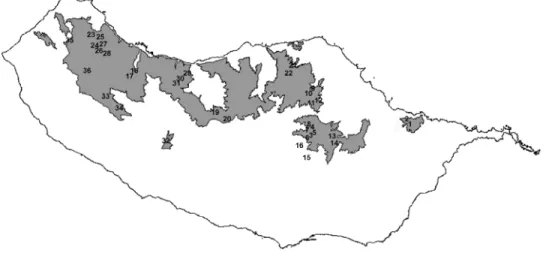
Thirty-six sites were sampled in Madeira Island, most of them located within the Laurisilva (Fig. 1). Two standardised sampling techniques were applied, namely: (1) pitfall trapping with baited (Turquin solution) and unbaited (ethyleneglycol 10%) traps and (2) direct sampling of four micro-habitats (dead trees, living trees, under stones and leaf litter). Pitfall trapping was conducted during a two-week period and was performed both in May-June 2006 (sites 1 to 28) and June 2007 (sites 29 to 36). Direct sampling was performed controlling for effort time in each location during June 2007 in most of the sampling sites. Direct sampling included the ground, dead tree trunks and subcortical searching. The sampling design was semi-quantitative with a sampling unit de-fined as 30 minute/person of effective fieldwork. For each species we present information on the technique used for sampling, site location code (see Table 1) and number of males and females captured. More information concerning the study areas and sampling date/period are provided in Table 1. The specimens collected during this study are deposited in the entomological collec-tion of the Faculty of Sciences of the University of Lisbon (Portugal).
17 Table 1. Site code, location (geographic coordinates in decimal degrees) and altitude of the study areas and indication of the sampling date/period according to the technique applied (pitfall trapping or direct sampling).
Code Site Lat (N) Lon (W) Altitude (m) trapping period Pitfall sampling Direct
1 Funduras 32.7493 -16.8114 500 22-05 to 05-06-2006 04-06-2007 2 Funduras 32.7540 -16.8099 552 22-05 to 05-06-2006 04-06-2007 3 Fajã da Nogueira – Lvda. Pte. Roquete 32.7391 -16.9156 1074 23-05 to 06-06-2006 - 4 Fajã da Nogueira – Mtdo. do Leacoque 32.7415 -16.9161 630 23-05 to 06-06-2006 06-06-2007 5 Fajã da Nogueira – Casa do Levadeiro 32.7406 -16.9136 989 23-05 to 06-06-2006 - 6 Fajã da Nogueira – Mtdo. do Leacoque 32.7418 -16.9177 614 23-05 to 06-06-2006 06-06-2007 7 Fajã da Nogueira – Tanque 32.7425 -16.9168 845 23-05 to 06-06-2006 06-06-2007 8 Fajã da Nogueira - Til Gigante 32.7457 -16.9150 841 23-05 to 06-06-2006 06-06-2007 9 Queimadas 32.7873 -16.9047 841 24-05 to 07-06-2006 05-06-2007 10 Pico das Pedras 32.7841 -16.9055 883 24-05 to 07-06-2006 05-06-2007 11 Achada do Teixeira 32.7733 -16.9081 1211 24-05 to 07-06-2006 05-06-2007 12 Achada do Teixeira 32.7762 -16.9022 1103 24-05 to 07-06-2006 05-06-2007 13 Ribeiro Frio – Viveiro 32.7354 -16.8864 906 24-05 to 07-06-2006 05-06-2007 14 Ribeiro Frio – Cottages 32.7319 -16.8861 994 24-05 to 07-06-2006 05-06-2007 15 Pico do Areeiro 32.7231 -16.9109 1533 24-05 to 07-06-2006 - 16 Pico do Areeiro 32.7287 -16.9202 1594 24-05 to 07-06-2006 - 17 Chão da Ribeira 32.7933 -17.1122 519 25-05 to 08-06-2006 07-06-2007 18 Chão da Ribeira 32.7957 -17.1117 491 25-05 to 08-06-2006 07-06-2007 19 Chão dos Louros 32.7636 -17.0190 748 25-05 to 08-06-2006 07-06-2007 20 Encumeada 32.7558 -17.0143 999 25-05 to 08-06-2006 - 21 Ribeiro Bonito – Levada 32.8047 -16.9346 568 25-05 to 08-06-2006 09-06-2007 22 Ribeiro Bonito - Ribeiro 32.7985 -16.9360 560 25-05 to 08-06-2006 09-06-2007 23 Fanal 32.8302 -17.1585 755 26-05 to 09-06-2006 - 24 Fanal (Lvda. Cedros) 32.8259 -17.1580 820 26-05 to 09-06-2006 09-06-2007 25 Fanal 32.8236 -17.1560 890 26-05 to 09-06-2006 09-06-2007 26 Fanal 32.8226 -17.1539 889 26-05 to 09-06-2006 09-06-2007 27 Fanal 32.8182 -17.1521 1023 26-05 to 09-06-2006 09-06-2007 28 Fanal 32.8062 -17.1409 1134 26-05 to 09-06-2006 10-06-2007 29 Ginjas 32.7758 -17.0534 869 08-06 to 22-06-2007 23-06-2007 30 Caramujo 32.7722 -17.0529 981 08-06 to 22-06-2007 - 31 Caramujo 32.7746 -17.0559 1001 08-06 to 22-06-2007 - 32 Rabaças 32.7413 -17.0783 993 10-06 to 24-06-2007 - 33 Rabaçal 32.7647 -17.1341 930 10-06 to 24-06-2007 25-06-2007 34 Risco 32.7608 -17.1256 1048 10-06 to 24-06-2007 25-06-2007 35 Casa do Elias 32.8268 -17.1883 814 26-06 to 10-07-2007 - 36 Galhano 32.7971 -17.1729 975 27-06 to 11-07-2007 -
RESULTS
During this study a total of 33 ground beetle spe-cies and subspespe-cies endemic to Madeira were sampled. The species collected are herein listed alphabetically and follow the nomenclature pro-posed in Löbl & Smetana (2003). Numbers refer to the site codes in Table 1.
Bradycellus assingi Wrase & Jaeger, 1996 Pitfall: 5 (1♂), 11 (9♂, 2♀), 12 (3♂), 20 (2♂, 1♀)
Direct sampling: 11 (1♂), 12 (1♂)
Bradycellus excultus Wollaston, 1854
Pitfall: 3 (1♂), 5 (3♂), 23 (1♂, 1♀), 25 (1♀), 27 (1♂, 1♀), 28 (1♀), 29 (3♂, 2♀), 31 (8♂), 36 (1♂) Direct sampling: 27 (1♀)
This species was found for the first time at Gin-jas, Caramujo and Galhano.
Bradycellus maderensis Mateu, 1958 Pitfall: 14 (3♂)
Direct sampling: 14 (2♂)
Bradycellus wollastoni Wrase & Jaeger, 1996 Pitfall: 5 (1♂), 14 (1♂), 26 (1♂), 28 (1♂, 1♀), 35 (1♂, 6♀)
Calathus colasianus Mateu, 1970
Pitfall: 1 (1♂, 1♀), 2 (2♂, 1♀), 3 (1♂, 1♀), 17 (1♂), 19 (1♀), 27 (1♂), 30 (1♂), 31 (1♀)
Direct sampling: 1 (5♂, 4♀), 4 (3♂, 1♀), 6 (2♂), 11 (1♂), 17 (1♂), 19 (1♂)
Knowledge on the distribution of C. colasianus improved considerably and this endemic is actu-ally more widespread than previously thought.
Calathus complanatus Dejean, 1828 Pitfall: 11 (1♂)
Calathus vividus (Fabricius, 1801)
Pitfall: 11 (2♂, 1♀), 33 (2♂, 2♀), 34 (1♂, 2♀) Two new records from areas in the vicinity of previously known occurrence sites.
Cymindis maderae Wollaston, 1857 Pitfall: 11 (1♂, 1♀), 32 (20♂, 13♀)
Record of this species at Rabaças is interesting due to the isolation of this small forest fragment.
Dromius angustus alutaceus Wollaston, 1857 Direct sampling: 13 (1♂)
This is the first finding of this endemic subspecies in the last fifty years (Fig. 2). A single specimen was found at Ribeiro Frio about 5 km from the nearest historical citation.
Loricera wollastonii Javet, 1852
Pitfall: 12 (1♀), 27 (1♂, 2♀), 28 (1♂, 1♀) A widespread but uncommon ground beetle now found at lower altitudes in the Fanal region.
Nesarpalus gregarius (Fauvel, 1897) Pitfall: 3 (1♂)
A widespread endemic now recorded in the vicin-ity of the Levada da Ponte do Roquete (Fajã da Nogueira), near two known areas of occurrence.
Olisthopus ericae Wollaston, 1854 Pitfall: 11 (1♂, 1♀) Direct sampling: 1 (2♂, 5♀), 2 (18♂, 7♀), 4 (1♂, 3♀), 6 (39♂, 53♀), 7 (3♂), 8 (8♂, 6♀), 9 (6♂, 4♀), 10 (10♂, 7♀), 11 (38♂, 29♀), 12 (20♂, 17♀), 13 (14♂, 19♀), 14 (10♂, 7♀), 17 (3♂, 2♀), 19 (31♂, 22♀), 21 (2♀), 24 (118♂, 92♀), 25 (36♂, 29♀), 26 (10♂, 10♀), 27 (42♂, 33♀), 28 (31♂, 21♀), 29 (20♂, 11♀), 33 (17♂, 22♀), 34 (17♂, 11♀)
The distribution of this endemic was greatly im-proved and the species is now known from a number of localities between Fanal on the west and Funduras on the east of Madeira Island.
Olisthopus madeirensis Wollaston, 1854 Pitfall: 20 (1♀) Direct sampling: 1 (1♀), 2 (3♂, 1♀), 4 (1♂), 9 (2♂), 10 (10♂, 17♀), 11 (4♂, 4♀), 12 (1♂, 3♀), 17 (6♂, 1♀), 19 (1♀), 21 (3♂, 1♀), 24 (19♂, 10♀), 25 (2♂, 1♀), 26 (3♀), 27 (1♂, 3♀), 28 (1♂, 1♀), 29 (4♂)
The known distribution of O. madeirensis was broadened to a range similar to that of its conge-ner (from Fanal eastwards to Funduras). How-ever, this endemic seems much less abundant than its close relative.
19 Fig. 2. Dorsal view of a male Dromius angustus alutaceusWollaston, 1857
Orthomus annae (Donabauer, 2008)
= Orthomus susanae Serrano & Borges, 2009 Pitfall: 21 (2 ♂), 22 (1♂), 24 (7♂, 17♀), 25 (3♂, 8♀), 26 (6♂, 17♀), 27 (8♂, 5♀)
Direct sampling: 22 (1♂), 25 (1♂, 1♀), 27 (2♂, 1♀)
A recently described species apparently restricted to only two areas in Madeira Island. Jiménez-Valverde and colleagues (2008) used predictive distribution modelling to evaluate the potential distribution of this species in Madeira and identi-fied several additional areas with a high probabil-ity of occurrence.
Orthomus berrai (Battoni, 1987)
Pitfall: 1 (2♂, 5♀), 2 (4♂, 10♀), 21 (2♂, 2♀), 22 (1♂, 2♀)
Direct sampling: 1 (1♀), 2 (1♂, 2♀), 8 (2♂), 13 (1♂), 22 (1♂, 1♀)
This species was believed to be restricted to the eastern part of Madeira Island but has now been found in new localities in the north.
Orthomus curtus (Wollaston, 1854)
Pitfall: 1 (9♂, 5♀), 2 (12♂, 9♀), 3 (1♀), 4 (1♂, 1♀), 5 (29♂, 23♀), 6 (2♂, 4♀), 7 (1♂), 8 (9♂, 4♀), 9 (18♂, 5♀), 10 (16♂, 7♀), 11 (7♂, 1♀), 12 (27♂, 11♀), 13 (4♂, 10♀), 14 (5♂, 5♀), 19 (13♂, 24♀), 20 (30♂, 27♀), 21 (7♂, 6♀), 22 (2♂, 3♀), 23 (2♀), 29 (37♂, 33♀), 30 (20♂, 16♀), 31 (18♂, 16♀) Direct sampling: 2 (2♂), 7 (1♂), 9 (2♂, 4♀), 12 (3♂), 13 (1♀), 19 (2♂, 1♀)
This common endemic is now known to occur in several locations between Fanal and Funduras.
Orthomus dilaticollis (Wollaston, 1854)
Pitfall: 12 (1♂), 17 (1♂, 1♀), 25 (3♂), 27 (20♂, 17♀), 28 (7♂, 8♀), 33 (2♂, 2♀), 34 (1♂) Direct sampling: 12 (1♂)
This endemic species was only known from a few locations in Madeira (Wollaston 1854; Jeannel 1938; Serrano & Aguiar 1997; Donabauer 2008). It has now been recorded from a number of sites in western Madeira as well as from Achada do Teixeira.
Orthomus gracilipes (Wollaston, 1854)
Pitfall: 12 (2♂, 1♀), 13 (1♀), 17 (1♂, 1♀), 18 (2♀), 19 (6♂, 3♀), 24 (1♂, 1♀), 25 (2♂, 1♀), 29 (1♂, 2♀), 30 (1♀), 31 (1♀), 33 (1♂), 35 (1♀) Direct sampling: 6 (1♀)
New localities of occurrence of this endemic were found in western Madeira, all lying within the limits of the known species distribution range.
Orthomus lundbladi Jeannel, 1938 Pitfall: 32 (1♂), 34 (3♂, 9♀)
This endemic is apparently restricted to western Madeira and was now found in the Rabaças forest fragment.
Paradromius insularis (Wollaston, 1854) Pitfall: 25 (1♂)
Direct sampling: 1 (1♀), 6 (2♀), 8 (2♂, 2♀), 9 (1♂), 13 (3♂, 1♀), 14 (2♂, 3♀), 18 (1♂), 25 (1♀), 26 (6♂, 1♀), 29 (3♂, 1♀)
Several new localities were recorded within the previously known range of this widespread en-demic.
Philorhizus conicipennis (Fauvel, 1905) Direct sampling: 6 (1♀), 8 (1♀)
This rare species was found near areas of previ-ous citations.
Philorhizus vieirai Mateu, 1957 Direct sampling: 11 (1♂)
This rare endemic was known from only two lo-cations and this new record lies close to one of them.
Scarites abbreviatus Dejean, 1825
Pitfall: 1 (4♂, 9♀), 2 (8♂, 16♀), 3 (2♂), 4 (10♂), 5 (1♂), 6 (4♂), 7 (2♂, 2♀), 8 (6♂), 9 (3♂), 10 (2♂), 11 (2♂), 12 (2♂, 2♀), 13 (13♂, 5♀), 14 (13♂), 19 (12♂), 21 (5♀), 22 (2♀), 24 (1♂), 25 (17♂, 1♀), 26 (13♂), 27 (1♂), 29 (1♂), 31 (1♂), 33 (1♂), 34 (4♂, 3♀), 35 (3♂) Direct sampling: 4 (1♂) 8 (2♂) 13 (2♂, 1♀), 21 (1♀), 27 (1♂, 1♀), 28 (1♀)
Some new localities are reported within the dis-tribution range of this widespread endemic.
Syntomus lundbladi (Jeannel, 1938) Pitfall: 16 (2♀)
Trechus custos Wollaston, 1854 Pitfall: 19 (2♂, 2♀), 29 (1♀) Direct sampling: 1 (5♂, 2♀), 2 (10♂, 7♀), 4 (13♂, 2♀), 6 (8♂, 4♀), 7 (9♂, 3♀), 10 (2♂, 2♀), 11 (3♂, 1♀), 12 (2♂), 13 (2♂), 14 (3♂), 17 (5♂, 2♀), 18 (8♂, 2♀), 19 (5♂, 2♀), 21 (5♂, 5♀), 34 (1♀)
Some new localities are reported within the range of this widespread endemic.
Trechus decolor Jeannel, 1938 Pitfall: 17 (2♀), 18 (4♂, 11♀), 20 (3♀)
All records lie within the previously known
dis-Trechus dilutus Wollaston, 1854 Pitfall: 24 (9♂, 2♀), 35 (1♂)
Two new localities are reported at the western limit of the species range.
Trechus flavomarginatus Wollaston, 1854 Pitfall: 11 (6♂, 7♀), 20 (1♂, 3♀)
Two new localities are reported lying within the known range of the species.
Trechus maderensis Csiki, 1928 Pitfall: 17 (1♀), 34 (1♂)
Reported for the first time from Chão da Ribeira.
Trechus minyops Wollaston, 1862
Pitfall: 4 (1♂), 7 (1♂), 11 (1♂, 1♀), 12 (1♀) Reported for the first time from Fajã da Nogueira.
Trechus nugax Lompe, 1997
Pitfall: 24 (1♂, 1♀), 27 (8♂, 3♀), 28 (5♂, 2♀), 35 (2♂)
Several new records are reported near known localities of this restricted endemic.
Trechus umbricola Wollaston, 1854
Pitfall: 5 (1♂), 6 (1♂), 9 (25♂, 62♀), 10 (1♂, 13♀), 12 (1♀), 14 (1♀), 20 (4♂, 7♀), 22 (2♀), 24 (2♀), 25 (1♀), 26 (1♀), 28 (1♀)
Direct sampling: 9 (4♂, 2♀), 10 (5♂, 1♀), 19 (1♂), 22 (1♀), 25 (1♀), 28 (1♂), 34 (1♂)
Several new records are reported within the dis-tribution area of this widespread endemic.
Zargus pellucidus Wollaston, 1854 Direct sampling: 8 (2♂)
A new distribution record is reported for this rare endemic species.
DISCUSSION
The standardised and extensive sampling design adopted in our study (Fig. 1) contributes with crucial information to the knowledge on the spa-tial distribution of Madeiran endemic ground bee-tles associated with Laurisilva. New localities have been identified even for some widespread
21 chus custos and T. umbricola, which in some
cases implied a redefinition of the species range. Furthermore, more restricted species such as Or-thomus berrai, O. dilaticollis, O. lundbladi, Tre-chus nugax and Syntomus lundbladi were found in some areas at a distance from their historical locations. In the case of the two former species these additional records implied a considerable increase to the known distribution range.
Very interesting results were also obtained from direct sampling in living and dead trees. The endemic Dromius angustus alutaceus was "redis-covered" following its latest finding more than 50 years ago. Wollaston (1857) reported a single specimen from the proximity of Santo António da Serra and several others at Monte and Camacha, considering this endemic as very restricted. One hundred years later, Mateu (1957) cited a few specimens from Queimadas, Santo António da Serra and Santa Ana and provided a redescription of this endemic subspecies. The paucity of cita-tions during the last 50 years generated some concern on the possible extinction of this en-demic. We found a single specimen of D. angus-tus alutaceus at Ribeiro Frio by direct sampling on living trees on the 5 June 2007. The specimen morphology (Fig. 2) agrees with the original de-scription as well as with the redede-scription of Ma-teu (1957): elytra are opaque with a strong mi-crosculpture, elytral striae are well marked and male genitalia is provided with an apical hook. Machado (1992) highlighted the singular distribu-tion of Dromius angustus and its relictual occur-rence in Madeira and the Canary Islands, where distinct subspecies are known to occur. Taking into consideration the consistency in morphologi-cal variation in specimens from the different is-lands, it could be interesting to assess the degree of genetic differentiation among island popula-tions in order to evaluate their taxonomic dis-tinctness.
Interesting findings were also made among other arboreal species. Two rare Philorhizus spe-cies have been recorded in this study, both as singletons at each site of occurrence. Moreover, the number of known localities more than dou-bled for the two endemic Olisthopus and the dis-tribution range of these species is now better known. These results on the distribution and abundance of arboreal ground beetles reinforce
the idea that in groups with a somewhat heteroge-neous ecology a combination of sampling tech-niques (e.g., direct sampling, pitfall trapping, Ber-lese extraction) should be adopted for species inventories and assessing species abundance (e.g. Cardoso 2009).
Basic information on species abundance and distribution is the raw material upon which to make inferences on species conservation status. During the last decade there has been a growing concern for the need to address specific conserva-tion measures for invertebrates, in spite of some bias towards the conservation of emblematic and charismatic species or groups (e.g. Cardoso et al. 2011a, b). Some relevant information on Madei-ran insect biodiversity and conservation has re-cently been published (e.g. Borges et al. 2008; Martín et al. 2008, 2010; Silva et al. 2008; Boieiro et al. 2010). However, major efforts must still be undertaken to further enhance our knowl-edge on species assemblages and ecology if we are to conserve the unique invertebrate fauna of Madeira.
ACKNOWLEDGEMENTS
We acknowledge Madeira Nature Park Service particularly its former director Susana Fontinha for the help in fieldwork planning and im-plementation. We are also thankful to the nature wardens H. Fernandes and M. Gomes for their valuable support during fieldwork. Financial support was provided by Science and Technology Foundation (FCT, Portugal) through projects PDCT/BIA-BDE/59202/2004 and PTDC/BIA-BEC/99138/2008. I.R. Amorim and C. Rego were supported by FCT fellowships (BPD/29578/2006 and BPD/66934/2009 respectively).
REFERENCES
Assing, V. 1997. A revision of the Madeiran species of
Geostiba (Coleoptera: Staphylinidae). Supplement
I. Revue Suisse de Zoologie 104: 345-355.
Becker, P. 1992. Colonization of islands by carnivorous and herbivorous Heteroptera and Coleoptera: effects of island area, plant species richness, and “extinction” rates. Journal of
Boieiro, M., D. Menezes, C. Rego & A.R.M. Serrano 2010. Spatial patterns of endemism and the conservation of beetles (Carabidae and Staphylinidae) in Madeira Island. Pp. 115-132 in: Serrano, A.R.M., P.A.V. Borges, M. Boieiro & P. Oromí (Eds). Terrestrial Arthropods of
Macaronesia: Biodiversity, Ecology and Evolution.
Sociedade Portuguesa de Entomologia, Lisboa. 327 pp.
Borges, P.A.V., C. Abreu, A.M.F. Aguiar, P. Carvalho, R. Jardim, I. Melo, P. Oliveira, C. Sérgio, A.R.M. Serrano & P. Vieira (Eds) 2008. A List of the
Terrestrial Fungi, Flora and Fauna of Madeira and Selvagens Archipelagos. Direcção Regional do
Ambiente da Madeira and Universidade dos Açores, Funchal and Angra do Heroísmo. 438 pp. Cardoso, P. 2009. Standardization and optimization of
arthropod inventories – the case of Iberian spiders.
Biodiversity and Conservation 18: 3949-3962.
Cardoso, P., P.A.V. Borges, K. Triantis, M.A. Fernández & J.L. Martín 2011a. Adapting the IUCN red listing criteria for invertebrates.
Biological Conservation 144: 2432-2440.
Cardoso, P., T.L. Erwin, P.A.V. Borges & T.R. New 2011b. The seven impediments in invertebrate conservation and how to overcome them.
Biological Conservation 144: 2647-2655.
Cook, L.M. 2007. Species richness in Madeiran land snails, and its causes. Journal of Biogeography 35: 647-653.
Donabauer, M. 2008. Zwei neue Arten der Gattungen
Nesorthomus und Eutrichopus (Coleoptera: Carabidae: Pterostichini). Zeitschrift
Arbeitsgemeinschaft Österrreichischer Entomologen 60: 117-120.
Erber, D. 1990a. Thalassophilus pieperi n. sp., a new cavernicolous carabid beetle from Madeira.
Bocagiana 140: 1-7.
Erber, D. 1990b. New and little known coleoptera from Madeira. Results of excursions to Madeira in the years 1986-1990. Boletim do Museu Municipal do
Funchal 42: 147-181.
Erber, D. & F. Aguiar 1996. New and remarkable species of the coleopterous fauna of Madeira.
Boletim do Museu Municipal do Funchal 48: 41-
62.
Fontaine, B., et al. 2007. The European union’s 2010 target: Putting rare species in focus. Biological
Conservation 139: 167-185.
Gardiner, B.O.C. 2003. The possible cause of extinction of Pieris brassicae wollastoni Butler (Lepidoptera: Pieridae). Entomologists’ Gazette 54: 267-268.
the snail fauna of Madeira. Journal of
Biogeography 21: 309–320.
Jardim, R. & D. Francisco 2000. Endemic Flora of
Madeira. Múchia Pubs., Funchal. 339 pp.
Jeannel, R. 1938. Die Arthropodenfauna von Madeira nach den Ergebnissen der Reise von Prof. Dr. O. Lundblad Juli–August 1935. V. Coleoptera : Carabidae. Arkiv för Zoologi 30A(10): 1–18. Jiménez-Valverde, A, J. Hortal, J. Lobo, P.A.V.
Borges, C. Abreu, A.M.F. Aguiar, M. Boieiro, S. Fontinha, R. Jardim, P. Oliveira, C. Sérgio, A.R.M. Serrano, M. Sim-Sim, D. Nunes & E.B. Azevedo 2008. Using predictive models of species distribution to validate biodiversity data: case studies for Madeira Island. Pp. 27-56 in: Borges, P.A.V., C. Abreu, A.M.F. Aguiar, P. Carvalho, S. Fontinha, R. Jardim, I. Melo, P. Oliveira, A.R.M. Serrano & P. Vieira (Eds). A List of the Terrestrial
Fungi, Flora and Fauna of Madeira and Selvagens Archipelagos. Direcção Regional do Ambiente da
Madeira and Universidade dos Açores, Funchal and Angra do Heroísmo. 438 pp.
Löbl, I. & A. Smetana (Eds) 2003. Catalogue of
Palaearctic Coleoptera. Vol. 1. Stenstrup, Apollo
Books. 819 pp.
Lompe, A. 1997. Neue Trechus-Arten von Madeira (Coleoptera, Carabidae). Entomologische Blätter 93: 51-55.
Lompe, A. 1999. Revision der Trechus-Arten Madeiras und Porto Santos (Coleoptera, Carabidae).
Entomologische Blätter 95: 93–143.
Machado, A. 1992. Monografia de los Carabidos de
las Islas Canarias. Intituto de Estudos Canarios, La
Laguna. 734 pp.
Machado, A. 1995. Ground beetles of Macaronesia, an overview (Coleoptera, Carabidae). Boletim do
Museu Municipal do Funchal Sup. 4: 395-410.
Martín, J.L, M. Arechavaleta, P.A.V. Borges & B. Faria (Eds) 2008. TOP 100 - As Cem Espécies
Ameaçadas Prioritárias em Termos de Gestão na Região Europeia Biogeográfica da Macaronésia.
Consejería de Medio Ambiente y Ordenación Territorial, Gobierno de Canarias. 500 pp.
Martín, J.L., P. Cardoso, M. Arechavaleta, P.A.V. Borges, B.F. Faria, C. Abreu, A.F. Aguiar, J.A. Carvalho, A.C. Costa, R.T. Cunha, F.M. Fernandes, R. Gabriel, R. Jardim, C. Lobo, A.M.F. Martins, P. Oliveira, P. Rodrigues, L. Silva, D. Teixeira, I.R. Amorim, N. Homem, B. Martins, M. Martins & E. Mendonça 2010. Using taxonomically unbiased criteria to prioritize resource allocation for oceanic island species conservation. Biodiversity and Conservation 19:
23 Philorhizus Hope, de las Islas Canarias y Madera
(Col. Carabidae). Bulletin du Institut Royal des
Sciences Naturelles de Belgique 33 (29): 1-30.
Myers, N., R.A. Mittermeier, C.G. Mittermeier, G.A.B. Fonseca & J. Kent 2000. Biodiversity hotspots for conservation priorities. Nature 403: 853–858. New, T. (Ed) 2008. Insect Conservation and Islands.
Springer, Dordrecht, The Netherlands. 445 pp. Serrano, A.R.M. & C.A.S. Aguiar 1997. An approach
to the ground beetles (Coleoptera, Carabidae) of two fragments of laurel forest (Madeira Island).
Portugaliae Zoologica 4(2): 9-19.
Serrano, A.R.M., C.A.S. Aguiar, M.C. Boieiro, P.A.V. Borges, C. Rego, I.A. Rosário, S.P. Ribeiro & F. Pereira 2009. A new species of Orthomus Chaudoir, 1838 (Coleoptera: Carabidae) from Madeira island (Macaronesia) and notes on related species. Zootaxa 1972: 20-34.
Serrano, A.R.M. & M. Boieiro 2008. Carabidae. Pp. 310-313 in: Borges, P.A.V., C. Abreu, A.M.F. Aguiar, P. Carvalho, S. Fontinha, R. Jardim, I. Melo, P. Oliveira, A.R.M. Serrano & P. Vieira (Eds). A List of the Terrestrial Fungi, Flora and
Fauna of Madeira and Selvagens Archipelagos.
Direcção Regional do Ambiente da Madeira and
Universidade dos Açores, Funchal and Angra do Heroísmo. 438 pp.
Silva, L., E.O. Land & J.L. Rodríguez Luengo (Eds) 2008. Invasive Terrestrial Flora & Fauna of Macaronesia. TOP 100 in Azores, Madeira and Canaries. ARENA, Ponta Delgada. 546 pp.
Whittaker, R.J. & J.M. Fernández-Palacios 2007.
Island Biogeography: Ecology, Evolution, and Conservation. Oxford University Press, Oxford.
412 pp.
Wollaston, T.V. 1854. Insecta Maderensia, being an
Account of the Insects of the Islands of the Madeiran Group. London. 634 pp.
Wollaston, T.V. 1857. Catalogue of the Coleopterous
Insects of Madeira in the collection of the British Museum. London. 234 pp.
Wrase, D.W. 2010. A new species of genus Zargus Wollaston 1854 from Madeira (Coleoptera, Carabidae, Licinini). Linzer biologische Beiträge 42: 325-334.
Wrase, D.W. & B. Jaeger 1996. Revision der
Bradycellus-Arten der Atlantischen Inseln aus der
verwandtschaft des Br. excultus Woll. (Coleoptera, Carabidae, Harpalini). Linzer biologische Beiträge 28: 497-515.
Received 15 Nov 2011. Accepted 20 March 2012, Published online 22 May 2012