Acta Scientiarum
http://www.uem.br/acta ISSN printed: 1679-9275 ISSN on-line: 1807-8621
Doi: 10.4025/actasciagron.v39i3.32781
Nitrogen management effects on soil mineral nitrogen, plant
nutrition and yield of super early cycle common bean genotypes
Adriano Stephan Nascente*, Maria da Conceição Santana Carvalho, Leonardo Cunha Melo and
Paulo Holanda Rosa
Empresa Brasileira de Pesquisa Agropecuária, Embrapa Arroz e Feijão, Rod. GO-462, Km 12, Cx. Postal 179, 75375-000, Fazenda Capivara, Santo Antônio de Goiás, Goiás, Brazil. *Author for correspondence. Email: [email protected]
ABSTRACT. This study was conducted to measure the effects of the timing of nitrogen fertilization (NF) on soil N-NH4+ and N-NO3-, macronutrient contents in the leaves and grains, and the grain yield of super early
genotypes (SEG) of common bean. Field experiments were performed for four growing seasons in an Oxisol soil in Santo Antônio de Goiás, Brazil, using a randomized block experimental design in a split plot scheme. The plots were planted with common bean SEG, and the subplots were the NF timings, including a treatment without N fertilization. The available soil N with improved fertility and medium to high levels of organic matter were enough to meet the N demands of the common bean crop in order to achieve yields of up to 3,000 kg ha-1.
Fertilization with N, regardless of the time of application, provided no increase in the yield components, grain yield and the N, P and K contents in the leaves and grains of the common bean SEG. The genotypes CNFC 15873 and CNFC 15875 had higher grain yields in the rainfed summer, and the genotype CNFC 15874 had higher grain yields in the irrigated winter growing season. It can be inferred that the use of common bean SEG, with life cycles ranging from 65 to 77 days, can be a promising technology, providing grain yields similar to the control (IPR Colibri).
Keywords: Phaseolus vulgaris L., early application of N, fertilization, Brazilian Cerrado, sustainable agriculture.
Nitrogênio mineral do solo, nutrição de plantas e produtividade de genótipos de ciclo
superprecoces de feijão-comum em função do manejo de nitrogênio
RESUMO. O presente estudo teve como objetivo medir N-NH4+ e N-NO3- no solo, teores de
macronutrientes em folhas e grãos e produtividade de grãos de genótipos superprecoces (GSP) de feijão-comum em função da época de aplicação de nitrogênio (EAN). Experimentos de campo foram realizados por quatro safras em Latossolo em Santo Antônio de Goiás, no delineamento experimental de blocos casualizados em esquema de parcelas subdivididas. As parcelas foram compostas pelos GSP de feijão-comum e as subparcelas pela EAN. Incluiu-se também um tratamento sem adubação nitrogenada. A disponibilidade de N no solo com níveis médios e altos de fertilidade e matéria orgânica foi suficiente para atender a demanda de feijão-comum para alcançar produtividades de até 3.000 kg ha-1. A adubação com N, independentemente da época de aplicação, não
proporcionou incrementos nos componentes de produção, produtividade de grãos e teores de N, P e K nas folhas e grãos de GSP do feijão-comum. Genótipos CNFC 15873 e 15875 CNFC tiveram maiores produtividades no verão chuvoso e o genótipo CNFC 15874 na safra irrigada de inverno. Pode-se inferir que o uso de GSP do feijão-comum com ciclo de vida variando de 65 a 77 dias mostrou ser tecnologia promissora, com produtividade de grãos semelhantes ao controle (IPR Colibri).
Palavras-chave: Phaseolus vulgaris L., aplicação antecipada de N, fertilização, Cerrado brasileiro, agricultura sustentável.
Introduction
The common bean (Phaseolus vulgaris L.) crop is economically important in many countries of the world and is considered an important source of protein for human consumption. In the 2014 harvest, 25 million Mg of common bean grain was produced worldwide, and the principal producers were India (4.11 million Mg), Myanmar (3.74 million Mg), Brazil (3.29 million Mg), the USA (1.32 million Mg) and Mexico (1.27 million Mg)
Nacional de Abastecimento [CONAB], 2016). The Brazilian common bean average grain yield in the 2015/2016 growing season was 1,105 kg ha-1, but some farmers are reaching grain yields higher than 3,500 kg ha-1 (CONAB, 2016).
The use of irrigated super early cycle common bean genotypes (SEG) that achieve high grain yields in less time, saving irrigation water and power and reducing the cost of production, is an important desire for farmers. This technology would also allow for the best use of the land, such as the cultivation of two crops during the rainy season, or the cultivation of three crops during the same year in irrigated areas. In addition, the use of SEGs would reduce production costs and risks because the shortest cycle cultivars would provide the most rapid withdrawal of the crop from the field. Therefore, the crop is less subjected to insect attacks, diseases and weeds. Producing more food in less time is very important for many developing countries, such as those in Asia, the Americas and in Eastern and Southern Africa, where the crop in part of the daily human diet (Maingi, Shisanya, Gitonga, & Hormetz, 2001; Rosales-Serna, Kohashi-Shibata, Acosta-Gallegos, Trejo-López, & Kelly, 2004).
The Brazilian Agricultural Research Corporation (Embrapa) by the National Rice and Beans Research Center has developed new genotypes of common beans with super early cycles. These genotypes have life cycles of 65-75 days, compared with life cycle lengths of 95-105 days for traditional cultivars.
In common bean production, nitrogen (N) is the most required nutrient and is one of the most limiting nutrients for the majority of agricultural crops (Nascente, Kluthcouski, Crusciol, Cobucci, & Oliveira, 2011). According to the conventional recommendation for irrigated common bean crops, top-dressed N fertilization normally consists of one N application (90 kg ha-1) at the growth stage V4 (third trifoliate) (Barbosa Filho, Cobucci, & Mendes, 2005). However, the common bean SEG reaches the V4 stage 12-15 days after sowing instead of 25-30 days after showing, which is required for traditional cultivars. Therefore, it is likely that if all N was applied at sowing, it would provide better results than the traditional N application utilized for conventional cultivars. In other words, the 40% reduction in the life cycle length in the common bean SEG could mean that the available time for N uptake would be insufficient if N was applied in the same manner as the traditional cultivars.
However, no studies on N management for common bean SEG exist. It is important to establish sources, amounts and time of nitrogen fertilization (NF) in these genotypes in order to create more efficient N use application methods (Malavolta, 2006; Fageria, Baligar, & Jones, 2010; Pagani & Mallarino, 2012; Crusciol, Nascente, Soratto, & Rosolem, 2013). Additionally, an evaluation of the changes in the mineral form of N in the soil would allow for a better understanding of the effects of N fertilization in the common bean SEG development (Fageria, 2014).
We have three hypotheses: 1 - The super early cycle common bean genotypes are a viable alternative for farmers with grain yield similar to that of traditionally grown crops; 2 - The application of all N at sowing of the crop provides higher grain yield than the split application of N; and 3 - The application of the total N at sowing provides significant changes in soil mineral N availability which affects the development of common bean plants. Therefore, the objective of this study was to measure the effects of N fertilization timing on soil ammonium and nitrate, the macro nutrient content in the leaves and grains and the grain yield of super early common bean genotypes.
Material and methods
Site description
The field experiments were conducted over four consecutive growing seasons (winter 2014, summer 2014/2015, winter 2015 and summer 2015/2016) at Capivara Farm, located in the city of Santo Antônio de Goiás, Goiás State, Brazil. The geographical coordinates of the site are 16° 28' 00" South, 49° 17' 00" West. The altitude of the site is 823 m. The climate is tropical savanna, considered Aw according to the Köppen classification system. There are two well-defined seasons, the dry season that extends from May to September (autumn / winter) and the rainy season that extends from October to April (spring / summer). The historic average annual rainfall ranges from 1,500 to 1,700 mm. The historic average annual temperature is 22.7°C, ranging annually from 14.2 to 34.8°C.
Nitrogen on super early common bean 371
determined by titration with a 0.025 mol L–1 NaOH solution. Phosphorus and exchangeable K were extracted with a Mehlich 1 extracting solution (0.05 M HCl in 0.0125 M H2SO4). The extracts were colorimetrically analyzed for P, and flame photometry was used to analyze K. The micronutrients (Fe, Zn, Cu, and Mn) were determined in a Mehlich 1 extract by atomic absorption, and organic matter was determined by using the Walkley and Black method.
Trials were performed in different areas in each growing season. The experimental areas had been cultivated in a no-tillage system (NTS) for seven consecutive years. The last crop rotations were soybean (spring/summer), followed by corn (summer), and then common bean (autumn/winter) was planted for the trials conducted in the winter (2014 and 2015). In the
trial performed in the summer (2014/2015 and 2015/2016), corn from the last summer was the last crop. The dry biomass of corn residue on the soil surface at common bean sowing was 2 Mg ha-1 in the winter of the 2014 growing season, 8 Mg ha -1 in the summer of the 2014/2015 growing season,
12 Mg ha-1 in the winter 2015 growing season and 4 Mg ha-1 in the summers of 2015/2016.
Experimental design and treatments
The experimental design was a randomized complete block layout arranged in a split-plot scheme with four replicates for four growing seasons (2014, 2014/2015, 2015, and 2015/2016). The main plots were planted with common bean SEG and a control (IPR Colibri - control, CNFC 15873, CNFC 15874, and CNFC 15875), and the subplots were N fertilizer application timings (90 kg of N at sowing, 90 kg N at top-dressing, and 45
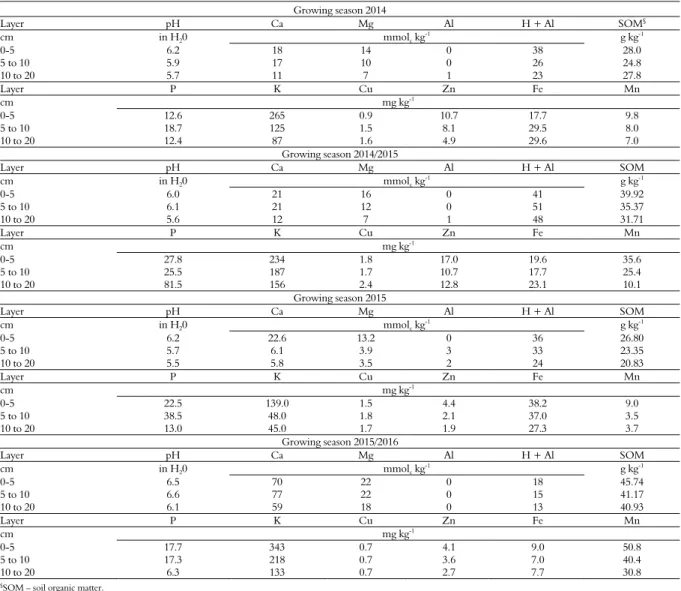
Table 1. Chemical soil attributes from the experimental area at the beginning of the trials. Santo Antônio de Goiás, Goiás State, Brazil, growing seasons 2014 and 2015.
Growing season 2014
Layer pH Ca Mg Al H + Al SOM§
cm in H20 mmolc kg
-1
g kg-1
0-5 6.2 18 14 0 38 28.0
5 to 10 5.9 17 10 0 26 24.8
10 to 20 5.7 11 7 1 23 27.8
Layer P K Cu Zn Fe Mn
cm mg kg-1
0-5 12.6 265 0.9 10.7 17.7 9.8
5 to 10 18.7 125 1.5 8.1 29.5 8.0
10 to 20 12.4 87 1.6 4.9 29.6 7.0
Growing season 2014/2015
Layer pH Ca Mg Al H + Al SOM
cm in H20 mmolc kg
-1
g kg-1
0-5 6.0 21 16 0 41 39.92
5 to 10 6.1 21 12 0 51 35.37
10 to 20 5.6 12 7 1 48 31.71
Layer P K Cu Zn Fe Mn
cm mg kg-1
0-5 27.8 234 1.8 17.0 19.6 35.6
5 to 10 25.5 187 1.7 10.7 17.7 25.4
10 to 20 81.5 156 2.4 12.8 23.1 10.1
Growing season 2015
Layer pH Ca Mg Al H + Al SOM
cm in H20 mmolc kg
-1 g kg-1
0-5 6.2 22.6 13.2 0 36 26.80
5 to 10 5.7 6.1 3.9 3 33 23.35
10 to 20 5.5 5.8 3.5 2 24 20.83
Layer P K Cu Zn Fe Mn
cm mg kg-1
0-5 22.5 139.0 1.5 4.4 38.2 9.0
5 to 10 38.5 48.0 1.8 2.1 37.0 3.5
10 to 20 13.0 45.0 1.7 1.9 27.3 3.7
Growing season 2015/2016
Layer pH Ca Mg Al H + Al SOM
cm in H20 mmolc kg
-1 g kg-1
0-5 6.5 70 22 0 18 45.74
5 to 10 6.6 77 22 0 15 41.17
10 to 20 6.1 59 18 0 13 40.93
Layer P K Cu Zn Fe Mn
cm mg kg-1
0-5 17.7 343 0.7 4.1 9.0 50.8
5 to 10 17.3 218 0.7 3.6 7.0 40.4
10 to 20 6.3 133 0.7 2.7 7.7 30.8
kg of N at sowing plus 45 kg at top-dressing) with urea as the N source. A treatment without N fertilization was also included as a control. Top-dressing fertilization was done at the V4 phenological stage (third trifoliate expanded leaf). The main plots consisted of 10 thirty-two-meter-long rows. The sub plots consisted of 10 eight-meter-long rows. The useful area of each subplot was determined as the six central meters of the four central rows.
Common bean management
Approximately 15 days before sowing, the experimental area was desiccated with glyphosate + 2,4-D. The base fertilization was calculated according to the soil chemical characteristics and the recommendations of Sousa and Lobato (2003). The base fertilizer consisted of 105 kg ha-1 of P
2O5 (triple superphosphate) and 52.5 kg ha-1 of K
2O (potassium chloride) and were applied together at sowing. Nitrogen fertilization was applied only at sowing and/or as top-dressing, according to each treatment.
The sowing of the common bean cultivars was performed mechanically using a no-till seeder (Semeato, model Personale Drill 13, Passo Fundo, Rio Grande do Sul State, Brazil) on May 20th, 2014, November 8th, 2014, May 29th, 2015, and November 11th, 2015, at a 0.45 m row spacing and at a seeding rate of 15 seeds per meter. Cultural practices were performed according to crop
recommendations for the control of weeds, diseases and insects.
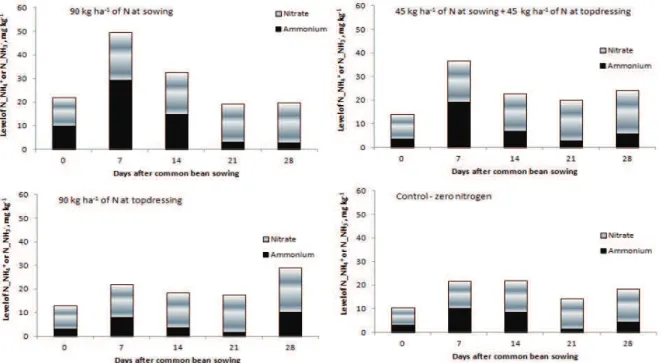
In the 2014 and 2015 growing seasons, a center pivot irrigation system was used due to a dry winter (Figure 1). For water management, we used the methods recommended by Doorenbos and Pruitt (1976). Seedling emergence occurred at six (2014), five (2014/2015), eight (2015) and five (2015/2016) days after sowing. The average of the V4 stage was at 16, 13, 15, and 12 days after emergence in the growing seasons 2014, 2014/2015, 2015 and 2015/2016, respectively. The average growing season (length of time from emergence to harvest) was 77 days (August 11th, 2014), 65 days (January 17th, 2015), 70 days (August 15th, 2015) and 66 days (January 30th, 2016).
Soil mineral N-NH4+ and N-NO
3- evaluation
In the trials performed in the winter (2014 and 2015), soil mineral N analysis was performed. Soil sampling was performed with an auger at 0, 7, 14, 21, and 28 days after sowing (DAS) in the 2014 growing season, and at 4, 11, 18, and 25 DAS in the 2015 growing season. Soil was sampled in all treatments and replicated following the method suggested by Nascente, Li, and Crusciol (2013). Thus, eight sub-samples were collected in each composite sample from each sub plot at a depth of 0-10 cm, which were homogenized by hand, labeled, wrapped in plastic bags, kept in a cooler with ice and sent to the lab for analysis.
Nitrogen on super early common bean 373
The analyses of mineral N were performed on the same day as the soil sample collection. From each soil sample, a representative aliquot of 20 g was removed and mixed with 60 ml of extraction solution KCl 2 mol L-1 (Bremner, 1965). After shaking for 1 h and decanting the solid material, the supernatant was filtered using filter paper. This supernatant was used to quantify the levels of nitrate and ammonium. For this experiment, the method proposed by Griess (1879) was used where nitrate was indirectly quantified in the form of the nitrite ion after a reaction with sulphanilamide and N-α-naphthalene diamine. The ammonium was measured according to the methodology of Berthelot (1859). Both mineral N sources were measured using spectrophotometry coupled to an FIA ("Flow Injection Analysis") following the methodology used by Gine, Bergamin Filho, Zagato, and Reis (1980). With the results of ammonium and nitrate, the N-NH4+ and N-NO3- and the total inorganic N (N-NH4+ + N-NO3-) were calculated.
Nutritional status of common bean
Common bean leaf samples were collected from the upper third trifoliate at the R6 growth stage (full blooming). The leaves from 30 plants per subplot were collected as proposed by Malavolta, Vitti, and Oliveira (1997), washed and then dried under a forced-air circulation oven at 65°C for 72 hours before grinding. The concentrations of N, P, and K were determined using the methods described by Malavolta et al. (1997). Nitrogen was extracted with H2SO4, and the other nutrients were extracted with a nitro-perchloric solution. The N concentration in the digested solution was determined by Kjeldahl analysis. The P and K concentrations were determined by atomic absorption spectrophotometry.
Common bean harvesting
The harvested common bean grains from the usable area were weighed and the grain yield was expressed in humidity of 130 g kg-1. The following yield components were assessed: the number of pods per plant, the number of grains per pod (evaluated in 10 plants per plot that were chosen at random), and the weight of 100 grains (calculated from eight random samples per plot).
In each sub plot, one sample of 100 g of grains was taken for nutrient analyses. The grains were ground and analyzed to determine the levels of
macronutrients (N, P, and K) according to the methodology proposed by Malavolta et al. (1997).
Statistical analyses
Data were subjected to analysis of variance (PROC GLM), and the means were compared by Tukey’s test at p≤0.05. For the N-NH4+, N-NO3 -and total (N-NH4+ + N-NO3-), we also developed graphs to visualize their levels during common bean development. Dunnett's test was performed at a significance of p ≤ 0.05 to compare the control (0) nitrogen level with each N treatment. These analyses were performed using SAS.
Results
Inorganic N measurement in the soil
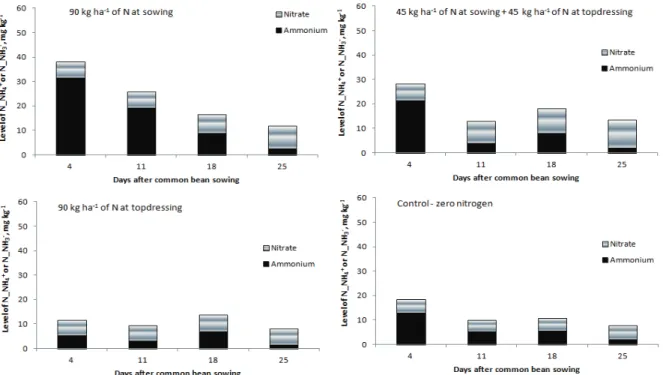
In the two winter seasons (2014 and 2015), the N-ammonium levels in the soil were higher when the N fertilizer was placed at common bean sowing, followed by the split fertilizer application, and the lower N values were observed with the N top-dressing application (Figures 1 and 2). In addition, higher N-ammonium levels occurred at the early stage of common bean development, which eventually decreased with advancing crop development. In winter 2014, the N-nitrate levels in the soil increased up to 28 days after sowing common bean. In winter 2015, the N-nitrate levels in the soil were increased in the treatments with the split fertilizer application and with the N application at sowing. It is worth noting that despite the differences between N application timing in both growing seasons, in all evaluations, there was an N availability of at least 10 mg kg-1 of N-inorganic in the soil, which reflects an approximate 20 kg ha-1 of N in the soil.
Yield components and grain yield
Figure 2. N-ammonium, N-nitrate and total inorganic N (N-ammonium + N-nitrate) levels at the 0-10 cm soil layer as affected by nitrogen management during the 2015 growing season.
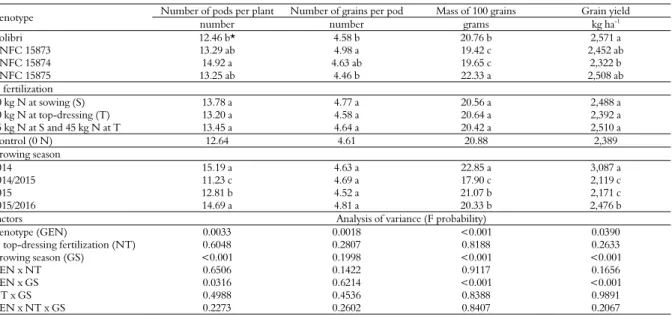
The number of pods per plant was higher in the 2014 winter and 2015/2016 summer growing seasons for all the materials evaluated (Table 3). The cultivar IPR Colibri had the lowest values of pods per plant in the 2014 winter and 2014/2015 summer growing seasons. The genotype CNFC 15873 had the highest number of pods per plant in the 2014 winter, 2015 winter and 2015/2016 summer growing seasons. The genotype CNFC 15874 obtained the highest number of pods per plant in all tested growing seasons. The genotype CNFC 15875 showed higher values in the 2014 winter, 2014/2015 summer and 2015/2016 summer growing seasons. In winter 2014, the 100 grain mass had higher values for all genotypes and did not differ from the values obtained in winter 2015 in the genotypes IPR Colibri, CNFC 15874, and CNFC 15875 and in the 2015-2016 summer growing season in the genotypes IPR Colibri and CNFC 15875 (Table 2). The cultivar IPR Colibri showed the highest values in the 2014 winter, 2015 winter and 2015/2016 summer growing seasons. The genotype CNFC 15873 had the highest values only in the 2014/2015 summer growing season. The genotype CNFC 15874 had higher values in the 2014 and 2015 winter growing seasons. The genotype CNFC 15875 had highest 100 grain mass in all growing seasons.
The common bean grain yield was higher in the 2014 winter growing season for all genotypes; however, for the IPR Colibri cultivar, this grain
yield was similar to that obtained in the 2015/2016 summer growing season (Table 3). There were no differences among genotypes in the 2014 winter growing season. In the 2014/2015 summer growing season, the genotypes CNFC 15873 and CNFC 15875 were the most productive and differed from the other materials. In the 2015 winter growing season, the genotypes CNFC 15874 and IPR Colibri were the most productive, and the genotype CNFC 15874 differed from the genotypes CNFC 15873 and 15875. In the 2015/2016 summer growing seasons, the IPR Colibri control was the most productive and differed from the other genotypes.
Nutrient concentrationsin the grain and leaves of common bean
Nitrogen on super early common bean 375
season were observed. The 2014 winter growing season noted the highest K concentration in the leaves of common bean. Additionally, there was no differences between N fertilization treatments and the control treatment (without nitrogen) for the analyzed variables.
Discussion
Higher soil N-NH4+ levels at the early common bean development stages and the reduction of these levels with advancing crop development in both growing seasons, winter 2014 and winter 2015, were observed. The ammonium in aerobic soil quickly
turns into nitrate (Fageria, 2014), thus, it appears that the existing N-NH4+ in the soil must have turned into N-NO3-, which could be determined by the increased N-NH4+ concentration in the subsequent evaluations (Figures 1 and 2). Nitrate is easily leachable in the soil, especially in areas with high rainfall. However, as the assessment of the soil N-NH4+ and N-NO3- was made in the dry season, and irrigation was performed to provide water without causing excess, it is likely that the amount of water applied was not sufficient to create a significant reduction in the soil N-NO3- levels.
Table 2. The number of pods per plant, number of grains per pod, mass of 100 grains and grain yield of super early common bean as a function of the genotype (main plot) and nitrogen fertilization timing (sub plots). Santo Antônio de Goiás, Goiás State; growing seasons 2014, 2014/2015, 2015 and 2015/2016.
Genotype Number of pods per plant Number of grains per pod Mass of 100 grains Grain yield
number number grams kg ha-1
Colibri 12.46 b* 4.58 b 20.76 b 2,571 a
CNFC 15873 13.29 ab 4.98 a 19.42 c 2,452 ab
CNFC 15874 14.92 a 4.63 ab 19.65 c 2,322 b
CNFC 15875 13.25 ab 4.46 b 22.33 a 2,508 ab
N fertilization
90 kg N at sowing (S) 13.78 a 4.77 a 20.56 a 2,488 a
90 kg N at top-dressing (T) 13.20 a 4.58 a 20.64 a 2,392 a
45 kg N at S and 45 kg N at T 13.45 a 4.64 a 20.42 a 2,510 a
Control (0 N) 12.64 4.61 20.88 2,389
Growing season
2014 15.19 a 4.63 a 22.85 a 3,087 a
2014/2015 11.23 c 4.69 a 17.90 c 2,119 c
2015 12.81 b 4.52 a 21.07 b 2,171 c
2015/2016 14.69 a 4.81 a 20.33 b 2,476 b
Factors Analysis of variance (F probability)
Genotype (GEN) 0.0033 0.0018 <0.001 0.0390
N top-dressing fertilization (NT) 0.6048 0.2807 0.8188 0.2633
Growing season (GS) <0.001 0.1998 <0.001 <0.001
GEN x NT 0.6506 0.1422 0.9117 0.1656
GEN x GS 0.0316 0.6214 <0.001 <0.001
NT x GS 0.4988 0.4536 0.8388 0.9891
GEN x NT x GS 0.2273 0.2602 0.8407 0.2067
*Means followed by the same letter in column do not differ by the Tukey test at 5% probability.
Table 3. The number of pods per plant, mass of 100 grains and grain yield of super early common bean as a function of the genotype (main plot) and growing seasons, Santo Antônio de Goiás, Goiás State, growing seasons 2014, 2014/2015, 2015 and 2015/2016.
Number of pods per plant
Genotype Growing seasons
2014 2014/2015 2015 2015/2016
Colibri 12.75 bAB* 9.92 bC 12.25 bBC 14.92 aA
CNFC 15873 15.25 abA 10.67 bB 13.92 abA 13.33 aA
CNFC 15874 16.00 aA 12.67 aB 14.83 aAB 16.17 aA
CNFC 15875 16.75 aA 11.67 abBC 10.25 cC 14.33 aAB
Mass of 100 grains (g)
Genotype Growing seasons
2014 2014/2015 2015 2015/2016
Colibri 22.79 abA 16.53 cB 21.57 aA 22.13 Aa
CNFC 15873 21.63 bA 18.27 abC 18.18 bC 19.60 bB
CNFC 15874 22.80 abA 17.44 bcB 21.74 aA 16.61 cB
CNFC 15875 24.19 aA 19.37 aB 22.79 aA 22.96 aA
Grain yield (kg ha-1
)
Genotype Growing seasons
2014 2014/2015 2015 2015/2016
Colibri 3306 aA 1780 bC 2165 abB 3034 aA
CNFC 15873 2866 aA 2379 aBC 2117 bC 2447 bB
CNFC 15874 3089 aA 1955 bC 2463 aB 1782 cC
CNFC 15875 3085 aA 2362 aB 1941 bC 2643 bB
Table 4. Nitrogen, phosphorus and potassium concentrations in the leaves and grains of super early common bean as a function of the genotype (main plot) and N fertilization timing (subplots), Santo Antônio de Goiás, Goiás State; growing seasons 2014, 2014/2015, 2015 and 2015/2016.
Genotype
Leaves Grains N P K N P K
---g kg-1---
Colibri 45.98 a* 3.67 a 24.65 a 35.39 a 5.10 a 10.58 a
CNFC 15873 44.69 a 3.61 a 26.38 a 35.09 a 4.94 ab 10.48a
CNFC 15874 47.65 a 3.70 a 26.50 a 34.31 a 4.79 b 10.79 a
CNFC 15875 45.30 a 3.42 a 25.79 a 34.12 a 4.84 b 10.95 a
N fertilization
90 kg N at sowing (S) 46.09 a 3.59 a 25.53 a 34.96 a 4.94 a 10.71 a
90 kg N at topdressing (T) 46.12 a 3.65 a 25.72 a 34.09 a 4.94 a 10.75 a
45 kg N at S and 45 kg N at T 45.51 a 3.56 a 26.24 a 35.14 a 4.86 a 10.64 a
Control (0 N) 45.76 3.53 25.99 34.53 4.91 10.54
Growing season
2014 46.22 b 2.71 c 41.19 a 30.23 c 4.44 c 8.09 c
2014/2015 30.68 c 2.31 c 25.30 b 34.28 b 5.20 a 6.27 d
2015 61.27 a 5.99 a 19.39 c 37.12 a 5.12 a 15.47 a
2015/2016 45.45 b 3.31 b 17.43 d 37.29 a 4.90 b 12.98 b
Factors
Genotype (GEN) 0.0610 0.4305 0.0780 0.5307 0.0060 0.4500
N top-dressing fertilization (NT) 0.9800 0.3076 0.8709 0.4297 0.5431 0.9288
Growing season (GS) <0.001 0.0143 <0.001 <0.001 <0.001 <0.001
GEN x NT 0.9798 0.8723 0.9968 0.5077 0.9561 0.3245
GEN x GS 0.1976 0.6054 0.1635 0.9152 0.0984 0.0790
NT x GS 0.9973 0.3615 0.9812 0.9578 0.4191 0.0938
GEN x NT x GS 0.9956 0.9884 0.9999 0.9972 0.9730 0.9890
*Means followed by the same letter in column do not differ by the Tukey test at 5% probability.
Larger amounts of the N-NH4+ and N-NO3- in all N application treatments at common bean sowing were observed, followed by the split N application (45 kg ha-1 at sowing and 45 kg ha-1 at topdressing fertilization). Fertilization was made with urea fertilizer, and it was expected that the applications would increase the soil N-NH4+. As the ammonium is transformed into nitrate, this nitrogen component also increased its levels in the soil. The N-NH4+ and N-NO3- content in the soil were higher in the first two weeks after common bean sowing. These higher levels may be helpful for short-cycle plants, such as the super early short-cycle common bean that reaches the V4 stage at 12-15 days (the phase that begins rapid crop growth), where the availability of nutrients is necessary, particularly N, to prevent limiting plant growth. It is noteworthy that, despite the higher inorganic N values in the soil in the N application treatments at common bean sowing, in all treatments, there were relatively high levels of N during the first four weeks of crop development, including the treatment without a N application (Figures 1 and 2). This clearly shows that in these conditions, plants had sufficient N for their initial growth, and thus the early application of N further increased available N in the soil above what the plant would be able to absorb in the initial stages (before V4). This N excess was greater in the 2014 winter growing season, probably because of the reduced amount of straw residue in the system, resulting in a lower N immobilization by microorganisms.
Nitrogen on super early common bean 377
During the first weeks of crop development, including the control treatment, there was enough N available in the soil for plants to support yield levels of approximately 3,000 kg ha-1. Kluthcouski, Aidar, Thung, and Oliveira (2006) reported that the productivity of common bean was higher when N fertilization, with doses up to 120 kg ha-1, was carried out entirely at sowing; this research was done in tropical low lands, where the results can be explained by the presence of impermeable layers in subsoil that limits N losses by leaching. Binotti et al. (2007), in winter growing seasons, beans grown in succession to corn in no-tillage systems also found no effect of split N on grain yield. According to Soratto, Fernandes, Pilon, Crusciol, and Borghi (2013), the topdressing application, besides increasing the cost of production, could cause damage to crops as a consequence of the crop machinery traffic (Kluthcouski et al., 2006), and it is less effective than the early application of N in the early stage of the crop cycle (Soratto, Arf, Rodrigues, Buzetti, & Silva, 2003; Soratto, Crusciol, Silva, & Lemos, 2005; Kluthcouski et al., 2006; Nascente et al., 2012). However, the application of the entire N at sowing should be used with caution in areas with a high amount of rainfall or in sandy soils, as it can increase the risk of N loss (volatilization, leaching, denitrification) due to the rapid increase in available soil N above the ability to be taken up by the plants (Fageria, 2014).
The SEG genotype CNFC 15873 and 15875 CNFC did not have different grain yield values from the standard cultivar (IPR Colibri) (Table 3). Based on the results, it appears that such genotypes are promising for use in summer growing seasons. On the other hand, it is worth noting that the genotype CNFC 15874 showed the highest grain yield in the winter growing season. Thus, based on the evaluated environments, we can recommend the use of genotypes CNFC 15873 and CNFC 15875 for cultivation in summer and CNFC 15874 for cultivation in winter.
Conclusion
The soil available N with improved fertility and medium to high levels of organic matter was sufficient to meet the demand of the common bean crop to achieve yield levels up to 3,000 kg ha-1. Fertilization with N, regardless of the time of application, provided no increase in the yield components, the grain yield or the concentrations of N, P, and K in the leaves and grains of super early common bean genotypes.
The N-NH4+ levels in the soil were higher in the early stages of crop development, influenced by the N-urea amounts applied at sowing. The N-NO3- content
that was originally high in the soil further increased with the application of the N-urea at sowing and with the advancement in the crop development. Under these conditions, the N application timing did not affect grain yield; however, the rapid increase in N availability in the soil caused by the application of N fertilizer in periods of low plant demand constituted potential losses to the environment and low fertilization efficiency.
The genotypes CNFC 15873 and CNFC 15875 had higher grain yields in the summer rainfed growing season. On the other hand, the genotype CNFC 15874 had higher grain yield in irrigated winter growing seasons. Based on the results, it can be inferred that the use of super early common bean genotypes may be a promising technology that provides similar grain yields to the control cultivar IPR Colibri), with growth cycles ranging from 65 to 77 days.
Acknowledgements
We acknowledge the National Council for Scientific and Technological Development (CNPq) for financial support (Process 471812/2013-7) and for an award for excellence in research of the first author.
References
Alvarez, A. C. C., Arf, O., Alvarez, R. C. F., & Pereira, J. C. R. (2005). Response of the bean plant to the application of rates and sources of side dressing nitrogen, in no-tillage system. Acta Scientiarum. Agronomy,
27(1), 69-75.
Araújo, R. S., Rava, C. A., Stone, L. F., & Zimmermann, M. J. O. (1996). Common bean crop in Brazil. Piracicaba, SP: Associação Brasileira para Pesquisa de Potassa e do Fosfato.
Barbosa Filho, M. P., Cobucci, T., & Mendes, P. N. (2005).
Adubação nitrogenada no cultivo do feijoeiro comum irrigado sob plantio direto. Santo Antônio de Goiás, GO: Embrapa Arroz e Feijão.
Berthelot, M. (1859) Violet d’aniline. Repertoire Chimique Application, 1, 282-284.
Binotti, F. F. S., Arf, O., Romanini, J. A, Fernandes, F. A., Sá, M. E., & Buzetti, S. (2007). Soil management and nitrogen fertilization on winter irrigated common bean.
Bragantia, 66(1), 121-129.
Bremner, J. M. (1965). Organic forms of nitrogen. In C. A. Blackm (Ed.), Methods of soil analysis (p. 1238-1255). Madison, US: American Society of Agronomy.
Claessen, M. E. C., 1997. Manual for methods of soil analysis (2nd ed.). Rio de Janeiro, RJ: Embrapa Solos.
Companhia Nacional de Abastecimento [CONAB]. (2016).
Crusciol, C. A. C., Nascente, A. S., Soratto, R. P., & Rosolem, C. A. (2013). Upland rice growth and mineral nutrition as affected by cultivars and sulfur availability.
Soil Science Society of America Journal, 77(1), 328-335. Doorenbos. J., & Pruitt, W. O. (1976). Crop and water
requirements (FAO Irrigation and Drainage Paper, n. 24) Rome: IT: FAO.
Empresa Brasileira de Pesquisa Agropecuária [EMBRAPA]. (2006). Sistema brasileiro de classificação de solos. Rio de Janeiro, RJ: Centro Nacional de Pesquisa de 6 Solos. Fageria, N. K. (2014). Nitrogen management in crop production.
Boca Raton, CA: CRC Press.
Fageria, N. K., Baligar, V. C., & Jones, C. A. (2010). Growth and mineral nutrition of field crops. Boca Raton, CA: CRC Press.
Food and Agriculture Organization of the United Nations [FAOSTAT]. (2016). Production: Crops. Retrieved on May 16, 2016 from http://faostat3.fao.org/browse/ Q/QC/E Gine, M. F., Bergamin Filho, H., Zagato, E. A. G., & Reis, B.
F. (1980). Simultaneous determination of nitrate and nitrite by flow injection analysis. Anal. Chim. Acta,114(1), 191-197.
Griess, P. (1879). Bemerkungen zu der abhandlung der H.H. Weselsky und Benedikt: Ueber einige azoverbindungen.
Chemische Berichte,12(1), 426-428.
Kluthcouski, J., Aidar, H., Thung, M., & Oliveira, F. R. A. (2006). Manejo antecipado do nitrogênio nas principais culturas anuais. Informações Agronômicas, 113(1), 1-24. Maingi, J. M.; Shisanya, C. A.; Gitonga, N. M., &
Hormetz, B. (2001). Nitrogen fixation by common bean (Phaseolus vulgaris L.) in pure and mixed stands in semi-arid south-east Kenya. European Journal of Agronomy, 14(1), 1-12.
Malavolta, E. (2006). Manual de nutrição mineral de plantas. São Paulo, SP: Editora Agronômica Ceres.
Malavolta, E., Vitti, G. C., & Oliveira, A. S. (1997). Avaliação do estado nutricional das plantas: princípios e aplicações (2. ed.). Piracicaba, SP: Potafos.
Martinez, J. P., Silva, H., Ledent, J. F., & Pinto, M. (2007). Effect of drought stress on the osmotic adjustment, cell wall elasticity and cell volume of six cultivars of common beans (Phaseolus vulgaris L.). European Journal of Agronomy,
26(1), 30-38.
Nascente, A. S., Kluthcouski, J., Cobucci, T., Rabelo, R. R., Oliveira, P., & Crusciol, C. A. C. (2011). Upland rice yield under different soil management systems and nitrogen application times. Pesquisa Agropecuária Tropical,
41(1), 60-65.
Nascente, A. S., Kluthcouski, J., Crusciol, C. A. C., Cobucci, T., & Oliveira, P. (2012). Fertilization of common bean cultivars in tropical lowlands. Pesquisa Agropecuária Tropical,42(4), 407-415.
Nascente, A. S., Li, Y. C., & Crusciol, C. A. C. (2013). Cover crops and no-till effects on physical fractions of soil organic matter. Soil and Tillage Research, 130(1), 52-57. Pagani, A., & Mallarino, A. P. (2012). Soil pH and crop grain
yield as affected by the source and rate of lime. Soil Science Society of America Journal, 76(5), 1877-1886.
Rosales-Serna, R., Kohashi-Shibata, J., Acosta-Gallegos, J. A., Trejo-López, C., & Kelly, J. D. (2004). Biomass distribution, maturity acceleration and yield in drought-stressed common bean cultivars. Field Crops Research, 85(2-3), 203-211.
Soratto, R. P., Arf, O., Rodrigues, R. A. F., Buzetti, S., & Silva, T. R. B. (2003). Common bean response to soil tillage, water management and nitrogen split application. Acta Scientiarum. Agronomy. 25(1), 89- 96. Soratto, R. P., Crusciol, C. A. C., Silva, L. M., & Lemos,
L. B. (2005). Late nitrogen application on common bean in no-tillage system. Bragantia, 64(2), 211-218. Soratto, R. P., Fernandes, A. M., Pilon, C., Crusciol, C. A.
C., & Borghi, E. (2013). Timing of nitrogen application on common bean cultivated after single corn or intercropped with palisade grass. Pesquisa Agropecuária Brasileira, 48(10), 1351-1359.
Sousa, D. M. G., & Lobato, E. (2003). Cerrado: correção do solo e adubação. Planaltina, DF: Embrapa Cerrados.
Received on July 18, 2016. Accepted on October 23, 2016.