Heterosis and combining ability in bell pepper lines with resistance to
multiple pathogens
1Heterose e capacidade combinatória em linhagens de pimentão com resistência a
múltiplos patógenos
Danilo Gustavo Nogueira2, Regis de Castro Carvalho2*, Wilson Roberto Maluf2, Douglas Willian Nogueira2 and César Augusto Ticona-Benavente3
ABSTRACT - The aim of this study was to develop bell pepper hybrids with resistance to multiple pathogens and make inferences in regard to components of heterosis in hybrids obtained from lines presumed to be resistant to Pepper yellow mosaic virus (PepYMV),Phytophthora capsici, orMeloidogyne incognita. The studies were carried out in a greenhouse. We used ten lines, thirty experimental hybrids, and seven controls (Konan-R, Magali-R, Martha-R, Stephany, Mallorca, Magnata Super, and Criollo de Morelos-334). For all experiments, a randomized block design was used with three replications (with plots composed of 16 plants). For evaluation of the reactions toP. capsici and to PepYMV, the percentages of asymptomatic plants were considered. For evaluation of the reactions to M. incognita, the reproduction index and the reproduction factor of the nematode were calculated. The additive gene effects were important for all the traits evaluated, and for percentage of plants resistant to PepYMV and P. capsici, the non-additive effects were also important. The alleles that control resistance to PepYMV, toP. capsici, and toM. incognitahave a degree of dominance near 1, in absolute value, which indicates a favorable situation for obtaining hybrids that accumulate multiple resistance to these pathogens.
Key words:Capsicum annuum. Disease resistance. Plant breeding.
RESUMO - O objetivo deste trabalho foi desenvolver híbridos de pimentão com resistência a múltiplos patógenos e inferir sobre os componentes da heterose em híbridos obtidos a partir de linhagens presumivelmente resistentes ao Pepper yellow mosaic virus (PepYMV),Phytophthora capsici ouMeloidogyne incognita. Os trabalhos foram realizados em casa de vegetação. Foram utilizadas dez linhagens, trinta híbridos experimentais, e sete testemunhas comerciais (Konan-R, Magali-R, Martha-R, Stephany, Mallorca, Magnata Super e Criollo de Morelos-334). Em todos os experimentos, utilizou-se o delineamento em blocos casualizados, com três repetições (com parcelas de 16 plantas). Na avaliação das reações a P. capsici e ao PepYMV, foram consideradas as percentagens de plantas sem sintomas. Na avaliação das reações a M. incognita, foram calculados o índice de reprodução e o fator de reprodução do nematoide. Os efeitos gênicos aditivos foram importantes para todos os caracteres avaliados e, para percentagem de plantas resistentes a PepYMV e P. capsici, os efeitos gênicos não-aditivos foram também importantes. Os alelos que controlam resistência a PepYMV, aP. capsici e aM. incognitapossuem grau de dominância próximo de 1, em valor absoluto, o que indica uma situação favorável à obtenção de híbridos com resistência múltipla a estes patógenos.
Palavras-chave:Capsicum annuum. Resistência a doenças. Melhoramento de plantas.
DOI: 10.5935/1806-6690.20180011 *Autor para correspondência
Recebido para publicação em 30/11/2016; aprovado em 21/03/2017
1Parte da Tese de Doutorado do primeiro autor, financiada pela FAPEMIG
2Departamento de Biologia, Genética e Melhoramento de Plantas, Universidade Federal de Lavras, Lavras-MG, Brasil, [email protected],
INTRODUCTION
Bell pepper (Capsicum annuum L.) is one of the
most widespread vegetables and very widely consumedin
natura in Brazil, and it is among the ten crops of greatest
economic importance in the vegetable market. Bell pepper production is predominantly in open fields, concentrated in the states of São Paulo, Minas Gerais and Paraná which together produce an average of 160 thousand tons per year, comprising around 50% of the planted area in Brazil, which is 12,000 hectares (AGRIANUAL, 2016; HENZ et al., 2007; MOURAet al., 2012). One of the
main factors for the increase in planted area and yields is the use of more productive commercial hybrid or cultivars with resistance to a greater number of diseases
(NASCIMENTOet al., 2007, 2010).
In spite of breakthroughs in improving productive systems, diseases have been major drawbacks for a more expressive increase in yields. Among the main diseases
of this crop are those caused by Phytophthora capsici
Leonian, Pepper yellow mosaic virus (PepYMV), and
Meloidogyne incognita.
P. capsici brings about blight or root rot, which
has shown to be one of this crop’s most destructive
diseases throughout the world (MCGREGOR et al.,
2011; NAEGELE; TOMLINSON; HAUSBECK, 2015). This pathogen can infect all parts of the plant, rotting root and its collar, fruit, causing black lesions on stem, brown circular lesions on leaves, and its death (FOSTER;
HAUSBECK, 2010; NAEGELEet al., 2014). PepYMV
occurs naturally in most Brazilian crop producing regions, causing serious losses, and being this crop’s major viral
disease (INOUE-NAGATAet al., 2002; LUCINDAet al.,
2012; MOURAet al., 2011).M. incognita decreases fruit
yield and it is found in crop fields (GISBERTet al., 2013;
SÁNCHEZ-SOLANA et al., 2016). Conversely, most
commercial varieties shown to be resistant toM. javanica
(PEIXOTO; MALUF; CAMPOS, 1995).
Genetic Capsicum genus variability has enabled
cultivars to become resistant to these pathogens, which has been a priority in bell pepper breeding programs
(CANDOLE; CONNER; JI, 2010; DI DATO et al.,
2015; FAZARI et al., 2012; NOGUEIRAet al., 2012).
This genetic resistance can be exploited in hybrid combinations, which allow the combination of different desirable traits, both qualitative and quantitative, in a single genotype.
The aim of this study was to develop bell pepper hybrids with resistance to multiple pathogens and make inferences in regard to components of heterosis in hybrids obtained from lines presumed to be resistant to PepYMV,
Phytophthora capsici, andMeloidogyne incognita.
MATERIAL AND METHODS
The studies were carried out in a greenhouse in the experimental area of the company HortiAgro Sementes S.A., in the municipality of Ijaci, MG, Brazil.
The genetic material tested consisted of 47 bell pepper genotypes composed of (a) ten lines (used as parents in obtaining experimental hybrids); (b) thirty experimental hybrids, twenty of which were obtained from crosses of two groups of parents (group I – female parents: 1=PIX-044B-01-01, 2=PIX-044B-13-01, 3=PIX-045B-27-02, 4=PIX-045B-32-03, and 5=PIX-052B-06-01; group II – male parents: 1’=Carolina Wonder, 2’=Charleston Belle, 3’=MYR-29-09-05, and 4’=MYR-29-11-08), and ten were additional hybrids corresponding to the crosses: F1(PIX-044B-01-01 x PIM-13), F1(PIX-044B-13-01 x 01), F1(PIX-045B-27-02 x PIX-052B-06-01), F1(PIX-045B-32-03 x PIX-052B-06-PIX-052B-06-01), F1(PIM-13 x MYR-29-09-05), F1(PIM-F1(PIM-13 x MYR-29-11-08), F1(Carolina Wonder x MYR-29-09-05), F1(Carolina Wonder x 29-11-08), F1(Charleston Belle x MYR-29-09-05), and F1(Charleston Belle x MYR-29-11-08); and (c) six commercial controls (Konan-R, Magali-R, Martha-R, Stephany, Mallorca, Magnata Super), as well as the accession Criollo de Morelos-334). In all the experiments, Magnata Super and Criollo de Morelos-334 were used as controls for susceptibilities and resistance
to the pathogens (P. capsici,PepYMV and M. incognita),
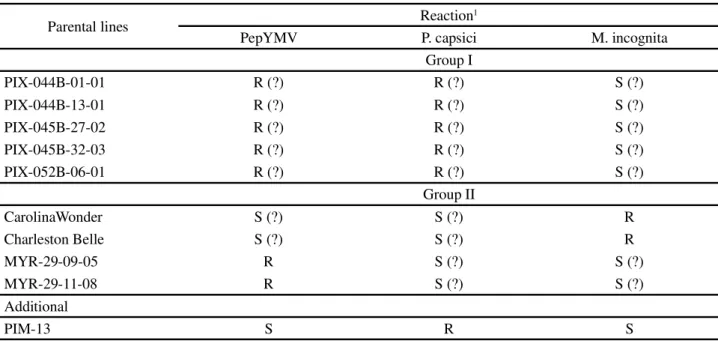
respectively. The parent lines and their characteristics are described in Table 1. In diallel analysis, only data from the 20 hybrids obtained from crosses of the parents of group I with those of group II were used.
The lines PIX-044B-01-01, PIX-044B-13-01, PIX-045B-27-02, PIX-045B-32-03, and PIX-052B-06-01 came from breeding programs conducted at the company HortiAgro Sementes S.A., and given their genealogy and the selection processes used, they are presumably
resistant to both PepYMV andP. capsici, but susceptible
toM. incognita. PIM-013 is an elite line from HortiAgro
with resistance to P. capsici, and susceptibility to both
PepYMV andM. incognita.09-05 and
MYR-29-11-08 are HortiAgro lines selected for greater uniformity of fruit shape by successive self-pollination from the open pollination population MYR-29, considered resistant
to PepYMV (NASCIMENTO et al., 2007).
MYR-29-09-05 and MYR-29-11-08 are known to be resistant to
PepYMV, but are, apriori,presumed susceptible to both
P. capsici and M. incognita, although this still needs to
be confirmed. Carolina Wonder and Charleston Belle are lines obtained by the U.S. Vegetable Laboratory, USDA/ ARS, Charleston, SC, USA; they are homozygous for
the N gene, which confers resistance to the nematode M.
Table 1 -Description of parental lines in regard to reaction to the pathogens PepYMV,P. capsici, andM.incognita in bell pepper
1 S = Susceptibility; R = Resistance; (?) = indicates presumed resistance (R) or susceptibility (S) based on genealogy and/or on previously obtained
information
Parental lines Reaction1
PepYMV P. capsici M. incognita
Group I
PIX-044B-01-01 R (?) R (?) S (?)
PIX-044B-13-01 R (?) R (?) S (?)
PIX-045B-27-02 R (?) R (?) S (?)
PIX-045B-32-03 R (?) R (?) S (?)
PIX-052B-06-01 R (?) R (?) S (?)
Group II
CarolinaWonder S (?) S (?) R
Charleston Belle S (?) S (?) R
MYR-29-09-05 R S (?) S (?)
MYR-29-11-08 R S (?) S (?)
Additional
PIM-13 S R S
to PepYMV and toP. capsici are presumed to be toward
susceptibility, although they have not been described by the authors and, therefore, require confirmation.
The reactions of the bell pepper genotypes to
PepYMV, P. capsici, and M. incognita were evaluated in
experiments carried out independently.
In all of the three experiments, the treatments were
sown in 128-cell polystyrene trays containing Topstratoâ
commercial substrate. In each cell, two seeds were sown and, after germination, the plants were thinned, leaving only one plant per cell. Randomized block experimental designs were used, with three replications. The number of plants per plot was 16. Before and after the inoculations, the trays were kept in a greenhouse.
Experiment 1
In the experiment for evaluation of reactions to PepYMV, a potyvirus isolate used, sorologically characterized as PepYMV, provided by the company Sakata Sudamerica and obtained in the region of Lins, SP, coming from naturally infected bell pepper plants with systemic
symptoms. To maintain the virus isolate, Nicotiana
tabacum plants (TNN) and Ikeda cultivar bell pepper plants
(susceptible to PepYMV), infected with PepYMV were kept in both silica-gel desiccators and in liquid nitrogen at the controlled temperature of -80 ºC (ultrafreezer). Inoculum for later use in screening for resistance was
replicated in N. tabacum indicator plants (TNN) kept in
greenhouses with screens; the plants were substituted at intervals of around two months. For inoculation in sweet pepper, tobacco leaves infected with PepYMV, used as the source of inoculum, were macerated in 0.01 M phosphate buffer, pH 7.0. After that, the sweet pepper plants to be tested were sprinkled with carborundum (400 mesh) and then the plant extract solution was applied on the leaves. After inoculation, the plants were watered and kept in greenhouses. Two inoculations were performed to avoid possible escapes: the first when the plants achieved the first fully-expanded definitive leaf stage, and the second, seven days after the first. Evaluations were made weekly, from the 15th to the 40th day after the first inoculation, for a total of five evaluations; the evaluations performed on the 40th day were taken as definitive evaluations. Scores were attributed to each plant, ranging from 1 to 5, according to the
scale of Nascimentoet al. (2007), the scores representing:
1- no symptoms; 2- lightened color between leaf veins; 3- light mosaic; 4- highly developed mosaic, without leaf deformation; 5- yellow mosaic, blister-like, with leaf deformation. Plants that had a score of 1 in the evaluation on the 40th day were considered asymptomatic.
Experiment 2
In evaluation of the reactions of resistance to
Phytophthora capsici, the isolates of this pathogen, Pc11 and
SP, respectively) were kept in test tubes containing PDA (potato dextrose agar) medium and stored in a Biochemical Oxygen Demand (BOD) chamber. The media containing the isolates were once more cut in small pieces and then placed on top of new Petri dishes containing PDA, where they remained for 4 to 5 days in a BOD chamber at a temperature of 27 ºC. For sporangium production, the media containing the isolates were once more cut in small pieces and placed on 9-cm diameter Petri dishes containing a medium composed of tomato juice/
agar (200 ml of Superbomâ tomato juice, 3 g of calcium
carbonate, 17 g of agar, and 800 mL of distilled water) at 28 ºC, under continuous light for seven days. After that, 10 – 15 mL of distilled water was added per dish, and light scraping was performed with a Drigalski spatula to detach the sporangia. To release the zoospores, the sporangium suspension was left for an hour at room temperature. The suspension was then filtered through a double gauze layer, and an aliquot of the filtered material was removed to count the number of zoospores in a Neubauer chamber. To do so, the suspension was shaken in a Vortex for one minute to stimulate encysting of the zoospores. After counting was performed and dilution was established at
the desired concentration (104 zoospores/mL), the zoospore
suspension was used immediately. Inoculations were made on seedlings, obtained as previously described and kept
in polysterene trays. An inoculum concentration of 104
zoospores/mL was used, applying 5 mL of the suspension in each tray cell near the root collar of the plants at 40 days after germination. Evaluations were made as of the third day after inoculation, extending to the 15 th day. Scores ranging from 1 to 3 were attributed to each plant, according to the
scale of Nascimentoet al. (2007), the scores representing:
1- without symptoms; 2- necrosis and wilting; 3- without leaves and dry. Plants with a score of 1 in evaluation on the 15 th day were considered asymptomatic.
Experiment 3
In evaluation of reactions to M. incognita, the
reproduction index and the reproduction factor of the
nematode were evaluated. A known isolate ofMeloidogyne
incognita was used as a source of inoculum, which was
previously multiplied and maintained on tomato plants - Solanum lycopersicum (= Lycopersicon esculentum),
cultivar Santa Clara. Extraction of nematode eggs was performed according to the method of Hussey and Barker (1973), modified by Bonetti and Ferraz (1981). Tomato roots containing root knots were cut in pieces of around 0.5 cm length and ground in a blender for 40 seconds with sodium hypochlorite solution at 0.5%. After that, the solution containing the eggs was run through a sieve with a 0.074 mm mesh on top of a sieve with a 0.028 mm mesh; the eggs were then thoroughly washed under running water. The nematode eggs, taken from the sieve with the smaller mesh, were collected and quantified in a stereomicroscope. The substrate was infested 15 days
after seed germination using an automatic syringe for veterinary use. An aliquot of the solution containing 2,000 nematodes eggs (initial population) per plant was used for infestation of the substrate in the trays. The viability of the inoculum was quantified by means of hatching chambers. As the inoculum used had viability of 60.4%, the number of viable eggs inoculated on each plant was therefore 1,208. The seedlings were watered daily up to the time of evaluations, which began at 75 days of plant age (60 days after inoculation), when the root system of each plant was cut with a scissors and ground in a blender according to the technique of Hussey and Barker (1973), modified by Bonetti and Ferraz (1981). This was followed by counting the eggs of the final population, using a Peters slide and a stereomicroscope. Finally, the number of eggs per fresh root mass was calculated.
The tomato cultivar TOM-584 was used as a susceptible standard control for comparison with nematode reproduction on the bell pepper seedlings. The reproduction index was calculated in the following manner: (number of eggs per gram of root/mean number of eggs per gram of root of the TOM-584 plants) x 100. The reproduction factor was calculated in the following manner: final population/initial population of viable eggs. The genetic-statistical analyses for all the traits evaluated consisted of analyses of variance, with breakdown of degrees of freedom, according to the partial diallel model of Miranda Filho and Geraldi (1984), through Genes software (CRUZ, 2013).
RESULTS AND DISCUSSION
PepYMV
Analysis of variance showed significant differences among the treatments for percentage of plants asymptomatic to Pepper yellow mosaic virus (PepYMV) (Table 2). In diallel analysis, both the variety effects of groups I and II and effects of average heterosis ( ),
varietal heterosis (hi, hj), and specific heterosis (Sij) were
significant, indicating the existence of additive gene effects and that significant heterosis is also manifested in their crosses (Table 2).
The estimates of general combining abilities (GCAs) ranged from -5.46 to 7.04 (amplitude of 12.5) among the lines of group I, and from -9.85 to 7.05 (amplitude of 16.9) among the lines of group II (Table
3). In regard to the average (μ= 72.62), the amplitudes
Table 2 - Summary of analyses of variance for percentage of plants asymptomatic to PepYMV, Phytophthora capsici, reproduction index (RI), and reproduction factor (RF) ofMeloidogyne incognita in bell pepper
ns, **,*: not significant, and significant at 1% and 5% probability by the F test, respectively
Source of variation DF Mean Square
PepYMV Phytophthora capsici Reproduction Index (RI) Reproduction Factor (RF)
Blocks 2 85.937 102.246 1640.36 150.397
Treatments 28 2077.487 ** 2451.634 ** 46246.077 ** 2215.883**
Lines of group I vs group II 1 11334.146** 41669.190** 296991.606** 11286.849**
Among lines of group I (vi) 4 577.670** 522.249** 12242.546** 438.293**
Among lines of group II (vj) 3 8172.877** 792.488** 214981.734** 12179.491**
Heterosis 20 1000.309** 1125.505** 15199.158** 623.312**
Average heterosis (Ħ) 1 8003.729** 15467.164 ** 234021.842** 7023.348**
Varietal heterosis of group I (hi) 4 154.806* 376.416** 6565.625* 183.577ns Varietal heterosis of group II (hj) 3 2899.214** 792.371** 8191.634** 1022.849**
Specific heterosis (Sij) 12 223.799** 263.346** 1592.159ns 136.670ns
Mean error 56 41.31 72.08 1686.58 125.24
Mean 89.88 75.53 96.76 22.73
C.V. % 7.15 11.24 42.44 49.22
plants to the PepYMV than the lines of group I. The
non-additive effects, Sij (that represent specific combining
ability [SCA] or, in a similar manner, specific heterosis), for their part, ranged from -15.74 to 9.84 (total amplitude of 25.58) (Table 3).
This value indicates an important contribution of the non-additive effects, whose amplitude represents
around 35% of the average (μ= 72.62) (Table 4), in
relation to the additive effects of GCA.
In the cases in which both the parents of group I (parents 2, 3, and 4) and of group II (parents 3’ and 4’) exhibited 100% asymptomatic plants (Table 5), the heterosis relative to the average of the parents (HRAP%) was 0% (Table 4), a consequence of the absence of genetic divergence among the parents for resistance to PepYMV. Conversely, in crosses involving the same parents 2, 3, and 4 of group I with the lines (parents 1’, 2’) susceptible to PepYMV, the estimates of heterosis ranged from values near 50% to values near 99%, always in the direction of greater percentage of asymptomatic plants, which indicates that resistance is controlled by dominant alleles whose mean degree of dominance tends to 1. The existence of two lines (1 and 5) in group I not totally fixed for the trait of resistance to PepYMV (Table 5) results in values of heterosis in the hybrids discrepant from the previous bands, especially in the case of parent 1, in which the percentage of asymptomatic plants is significantly less than 100%.
P. capsici
For resistance toP. capsici, analysis of variance
(Table 2) showed that the most relevant source of variation was the contrast between the lines of group I (1, 2, 3, 4, 5) and those of group II (1’, 2’, 3’, 4’), reflecting a considerable difference between the parents of group I (resistant) compared to those of
group II (Table 5). Both the varietal effects (vi, vj)
and the components of heterosis ( , hi, hj, Sij) were
significant (Table 2), indicating the importance of both the additive effects and the non-additive effects in expression of the trait.
The estimates of general combining ability (GCA) ranged from -9.06 to 11.25 (with an amplitude of
20.31) for gi, and from -7.81 to 7.19 (with an amplitude
of 15.00) for gj (Table 3). In comparison to the average
(μ= 57.70) of plants resistant toP. capsici, these values
1 = PIX-044B-01-01, 2 = PIX-044B-13-01, 3 = PIX-045B-27-02, 4 = PIX-045B-32-03, 5 = PIX-052B-06-01. 1’ = Carolina Wonder, 2’ = Charleston Belle, 3’ = MYR-29-09-05, 4’ = MYR-29-11-08
All the hybrids tested in the diallel represented
combinations between the lines resistant toP. capsici (of
group I) with less resistant or susceptible lines (of group II). In combinations of the lines of group I (1, 2, 3, 4, 5) with the lines that proved to be more susceptible from
group II (3’, 4’), the estimates of heterosis in relation to the average of the parents (HRAP%) ranged from +28.80% to +90.76% (Table 4), indicating incomplete dominance of the alleles that control the biggest percentage of asymptomatic plants. In combinations
µ PepYMV Phytophthora capsici RI RF
72.62 ± 1.40 55.70 ± 1.68 168.01 ± 8.44 34.01 ± 2.03
d 22.12 ± 1.40 41.58 ± 1.68 96.42 ± 8.44 18.98 ± 2.03
hm 20.82 ± 1.68 28.94 ± 2.02 -112.58 ± 10.15 -19.50 ± 2.44
Line of group I vi hi gi = 1/2vi+ hi vi hi gi = 1/2vi + hi vi hi gi = 1/2vi + hi vi hi gi = 1/2vi + hi 1- -15.92 2.5 -5.46 1.21 1.26 1.87 54.64 -32.61 -5.29 14.44 -9.31 -2.09 2- 5.74 4.17 7.04 1.21 -9.66 -9.06 -66.29 22.59 -10.56 -15.34 4.2 -3.47 3- 5.74 3.62 6.49 -4.84 -5.59 -8.01 19.35 8.31 17.99 6.22 1.7 4.81 4- 5.74 -7.72 -4.85 1.21 10.64 11.25 -90.73 37.81 -7.56 -11 3.84 -1.66 5- -1.29 -2.58 -3.22 1.21 3.35 3.95 83.02 -36.1 5.42 5.67 -0.43 2.41
Standard error 3.74 2.64 4.48 3.16 22.52 15.92 5.42 3.83
Line of group II vj hj gj = 1/2vj + hj vj hj gj = 1/2vj + hj vj hj gj = 1/2vj + hj vj hj gj = 1/2vj + hj 1’- -50 20.75 -4.25 11.46 -4.38 1.35 -70.82 -16.91 -52.34 -14.49 -6.13 -13.37 2’- -50 15.15 -9.85 19.75 -10.6 -0.73 -68.36 -19.28 -53.48 -14.2 -6.53 -13.65 3’- 50 -17.95 7.05 -15.61 -0.01 -7.81 -70.04 -16.36 -51.38 -14.33 -5.9 -13.05 4’- 50 -17.95 7.05 -15.61 14.99 7.19 209.28 52.56 157.2 43 18.57 40.07
Standard error 3.62 2.43 4.34 2.91 21.8 14.63 5.25 3.52
Sij
1 x 1’ 4.83 4.37 4.78 1.96
1 x 2’ -15.74 6.45 5.37 2.2
1 x 3’ 5.45 -11.5 5.87 2.18
1 x 4’ 5.45 0.63 -16.03 -6.34
2 x 1’ 4.25 6.97 8.1 2.86
2 x 2’ 9.84 -11.8 12.38 3.79
2 x 3’ -7.04 -4.68 7.9 2.72
2 x 4’ -7.04 9.47 -28.38 -9.39
3 x 1’ 4.8 1.77 -18.66 -5.02
3 x 2’ 8.18 -0.31 -18.61 -4.96
3 x 3’ -6.49 -3.64 -15.71 -3.98
3 x 4’ -6.49 2.18 52.98 13.97
4 x 1’ -8.97 1.25 11.15 2.62
4 x 2’ -0.72 1.25 6.78 1.5
4 x 3’ 4.85 6.25 6.91 1.42
4 x 4’ 4.85 -8.75 -24.84 -5.56
5 x 1’ -4.91 -14.37 -5.38 -2.43
5 x 2’ -1.56 4.37 -5.92 -2.54
5 x 3’ 3.23 13.5 -4.97 -2.35
5 x 4’ 3.23 -3.54 16.28 7.32
Standard error 3.24 3.88 19.5 4.69
Table 3 -Estimates of the variety “per se” (vi and vj), of varietal heterosis (hiand hj), of general (gi and gj) and specific (sij) combination abilities for percentage of plants asymptomatic to PepYMV, Phytophthora capsici, reproduction index (RI), and reproduction factor
Identification of the treatments
HRAP%
PepYMV P.capsici M. incognita
(1) (2) RI (3) RF (4)
MF1 – Mp % MF1 – Mp % MF1 – Mp % MF1 – Mp %
1 x 1’ 48.91 123.31 30.21 47.17 -157.32 -98.38 -32.99 -97.06
1 x 2’ 22.73 57.32 26.06 38.22 -159.1 -98.73 -33.15 -97.16
1 x 3’ 10.83 12.08 18.75 37.13 -155.69 -97.12 -32.55 -95.54
1 x 4’ 10.83 12.08 45.83 90.76 -108.67 -36.22 -16.59 -26.43
2 x 1’ 50.00 99.01 21.87 34.16 -98.8 -99.37 -18.56 -97.21
2 x 2’ 50.00 99.01 -3.1 -4.55 -96.9 -96.24 -18.03 -93.82
2 x 3’ 0.00 0.00 14.58 28.88 -98.46 -98.62 -18.48 -96.38
2 x 4’ 0.00 0.00 43.75 86.63 -65.81 -27.48 -6.11 -12.76
3 x 1’ 50.00 99.01 20.74 33.99 -139.85 -98.31 -28.96 -96.90
3 x 2’ 47.77 94.6 12.42 19.07 -142.87 -99.06 -29.29 -97.60
3 x 3’ 0.00 0.00 19.69 41.5 -136.35 -95.57 -27.68 -92.40
3 x 4’ 0.00 0.00 40.53 85.38 1.27 0.45 14.75 25.14
4 x 1’ 24.87 49.25 36.46 56.93 -80.52 -92.33 -19.17 -90.14
4 x 2’ 27.52 54.50 30.23 44.33 -87.27 -98.64 -20.69 -96.70
4 x 3’ 0.00 0.00 45.83 90.76 -84.22 -96.12 -20.14 -94.38
4 x 4’ 0.00 0.00 45.83 90.76 -47.07 -20.70 -2.65 -5.29
5 x 1’ 34.07 72.52 13.54 21.14 -170.99 -98.22 -28.50 -96.28
5 x 2’ 31.82 67.74 26.06 38.22 -173.91 -99.18 -29.01 -97.58
5 x 3’ 3.52 3.63 45.83 90.76 -170.03 -97.44 -28.20 -94.99
5 x 4’ 3.52 3.63 43.75 86.64 -79.84 -25.41 5.96 10.20
DMS 23.27 27.85 139.90 33.78
1 = PIX-044B-01-01, 2 = PIX-044B-13-01, 3 = PIX-045B-27-02, 4 = PIX-045B-32-03, 5 = PIX-052B-06-01,1’ = Carolina Wonder, 2’ = Charleston Belle, 3’ = MYR-29-09-05, 4’ = MYR-29-11-08. Mp = Mean of the parents; MF1 = Mean of the hybrid; HRAP% = heterosis relative to the average of the parents, expressed in %. (1) % of plants asymptomatic after inoculation with PepYMV; (2) % plants asymptomatic after inoculation withP. capsici; (3) nematode reproduction index; (4) nematode reproduction factor
Table 4 - Estimates of values and relative percentage of heterosis in relation to the average of the parents (HRAP) for percentage of plants asymptomatic to PepYMV, Phytophthora capsici, reproduction index (RI), and reproduction factor (RF) ofMeloidogyne incognita in bell pepper hybrids
of lines of group I with lines 1’ and 2’ of group II (intermediate levels of resistance), the values of HRAP% ranged from +21.14% to +56.93% for crossing with 1’ and from -4.55% to +44.33% for crossing with 2’. Since
the allele(s) that control resistance toP. capsici in group
I have dominant action, a negative value of HRAP% in combinations with 2’ may be indicative of recessive gene action of the alleles that control intermediate resistance to
P. capsici in 1’ or 2’. The data obtained, however, do not
definitively clarify this supposition since the genotypes of the lines are not totally fixed for the trait of resistance toP. capsici.
M. incognita
For both the characteristics that evaluated resistance toM. incognita(reproduction index - RI, and reproduction
factor - RF), differences between groups, among lines
within each group (vi, vj), and heterosis (Table 2) were
Parental lines PepYMV P. capsici M. incognita
%1 %1 RI1 RF1
Group I
1= PIX-044B-01-01 78.3 bcd 100.0 a 318.5 de 66.9 cd
2= PIX-044B-13-01 100.0 a 100.0 a 197.6 bcd 37.1 abcd
3= PIX-045B-27-02 100.0 a 93.9 ab 283.3 cde 58.7 cd
4= PIX-045B-32-03 100.0 a 100.0 a 173.2 bc 41.5 cd
5= PIX-052B-06-01 92.9 abc 100.0 a 346.9 e 58.2 cd
Group II
1’= CarolinaWonder 0.0 e 27.1 ef 0.2 a 0.0 a
2’= Charleston Belle 0.0 e 35.4 e 2.7 a 0.3 a
3’= MYR-29-09-05 100.0 a 0.0 g 1.0 a 0.2 a
4’= MYR-29-11-08 100.0 a 0.0 g 280.3 cde 57.6 cd
Additional
PIM-013 0.0 e 100.0 a 159.0 bc 34.7 abcd
Controls
Criollo de Morellos 100.0 a 100.0 a 1.6 a 0.2 a
Magnata Super 0.0 e 2.1 fg 157.0 bc 37.1 abcd
effects in expression of resistance to M. incognita, such that the response of the hybrids in regard to M. incognita can be predicted based on the reactions of their parents.
All the lines of group I were confirmed as susceptible to nematodes (Table 5) and the significant
differences in the components vi and hi can thus
be attributed to small differences in the genotypic background of these susceptible lines. However, three of the lines of group II (1’, 2’, 3’) were considered resistant and only one (4’), susceptible (Table 5), a fact that was reflected in the high mean squares for the differences in
varietal heterosis within group II (vj) (Table 2).
The hybrids studied were therefore of two types: those in which one of the parents (1’, 2’, 3’) was resistant, and those in which both parents were susceptible. The hybrids with one resistant parent exhibited all the estimates of HRAP% slightly lower than 100% (Table 4), an indication that the average degree of dominance of the allele(s) that
control resistance to M. incognita is only slightly lower
than 1. The hybrids with both parents susceptible, for their part, were also all susceptible, and the values of HRAP% varied, both for RI and for RF, from values
near zero to 37% (Table 4), reflecting some background differences among the susceptible genotypes.
It is known that lines 1’ and 2’ have the N gene,
which confers resistance toM. incognita(FERY; DUKES;
THIES, 1998). However, the resistant line 3’ and the susceptible line 4’ were obtained through selection from an open pollination population (MYR-29), which was, a priori,
taken as susceptible to M. incognita. It is possible that
MYR-29 population included a percentage of resistant and
susceptible plants to M. incognita (Table 5). The gene(s)
that confer(s) resistance in 3’ (MYR-29-09-05) must be studied to identify whether it or they are alleles of N.
Except for the lines 1=PIX-044B-01-01 (in regard to resistance to PepYMV), 1’=Carolina Wonder and
2’=Charleston Belle (for resistance to P. capsici), and
3’=MYR-29-09-05 (in regard to the reproduction index
and factor of M. incognita), all the others exhibited the
presumed reactions in relation to PepYMV, P. capsici,
and M. incognita (Table 5). The hybrids obtained from the
combinations between the lines of group I (1, 2, 3, 4, 5) with the lines of group II (1’, 2’, 3’) had multiple resistance to the three phytopathogens considered.
Table 5 - Percentage (%) of plants asymptomatic to PepYMV and toP. capsici, reproduction index, and factor ofM. incognita in bell
pepper
CONCLUSIONS
1. Additive gene effects were important for all the traits evaluated, however non-additive effects were also important for percentage of plants resistant to PepYMV and Phytophthora capsici;
2. The values of heterosis relative to the average of the parents (HRAP%) for resistance to PepYMV and
P. capsici for most hybrids were in the direction of
conferring greater resistance;
3. For the reproduction index (RI) and reproduction factor
(RF) ofMeloidogyne incognita, the values of heterosis
relative to the average of the parents (HRAP%) were mostly negative, that is, in the direction of a greater degree of resistance;
4. The alleles that control resistance to PepYMV, to P.
capsici, and toM. incognitahave a degree of dominance
near 1, in absolute value, which indicates a favorable situation for obtaining hybrids that accumulate multiple resistance to these pathogens.
ACKNOWLEDGMENTS
Our thanks to the Fundação de Amparo à Pesquisa do Estado de Minas Gerais (FAPEMIG) for granting scholarships; to the Conselho Nacional de Desenvolvimento Científico e Tecnológico (CNPq); to the Coordenação de Aperfeiçoamento de Pessoal de Nível Superior (CAPES); to the Universidade Federal de Lavras (UFLA) - FAPEMIG, and Fundação de Desenvolvimento Científico e Cultural (FUNDECC) for financial resources and infrastructure; and to the company HortiAgro Sementes S.A. for support in carrying out the experiments.
REFERENCES
AGRIANUAL.Anuário da Agricultura Brasileira. São Paulo: Instituto AgraFNP, 2016. 600 p.
BONETTI, J. I. S.; FERRAZ, S. Modificações do método de Hussey & Barker para extração de ovos de Meloidogyne exígua em raízes de cafeeiro.Fitopatologia Brasileira, v. 6, n. 3, p. 553-561, 1981.
CANDOLE, B. L.; CONNER, P. J.; JI, P. ScreeningCapsicum annuum accessions for resistance to six isolates ofPhytophthora capsici.HortScience, v. 45, n. 2, p. 254-259, 2010.
CRUZ, C. D. Genes: a software package for analysis in experimental statistics and quantitative genetics. Acta Scientiarum. Agronomy, v. 35, n. 3, p. 271-276, 2013. DI DATO, F.et al. Genetic diversity and assessment of markers linked to resistance and pungency genes in Capsicum germplasm.
Euphytica, v. 204, n. 1, p. 103-119, 2015.
FAZARI, A. et al. The root-knot nematode resistance N-gene co-localizes in the Me-genes cluster on the pepper (Capsicum annuum L.) P9 chromosome.Plant Breeding, v. 131, n. 5, p. 665-673, 2012.
FERY, R. L.; DUKES, P. D.; THIES, J. A. ‘Carolina Wonder’ and ‘Charleston Belle’: southern root-knot nematode - resistant bell peppers.HortScience, v. 33, n. 5, p. 900-902, 1998.
FOSTER, J. M.; HAUSBECK, M. K. Resistance of pepper to phytophthora crown, root, and fruit rot Is affected by isolate virulence.Plant Disease, v. 94, n. 1, p. 24-30, 2010.
GISBERT, C. et al. Resistance of pepper germplasm to
Meloidogyne incognita.Annals of Applied Biology, v. 162, n. 1, p. 110-118, 2013.
HENZ, G. P.et al. Como cultivar pimentão.Cultivar Hortaliças e Frutas, n. 42, p. 2-7, 2007.
HUSSEY, R. S.; BARKER, K. R. A comparison of methods of collecting inocula of Meloidogyne spp. including a new
technique.Plant Disease Reporter, v. 57, n. 12, p. 1025-1028, 1973.
INOUE-NAGATA, A. K. et al. Pepper yellow mosaic virus, a new potyvirus in sweet-pepper,Capsicum annuum.Archives of Virology, v. 147, n. 4, p. 849-855, 2002.
LUCINDA, N. et al. Complete genome sequence of pepper yellow mosaic virus, a potyvirus, occurring in Brazil.Archives of Virology, v. 157, n. 7, p. 1397-1401, 2012.
MCGREGOR, C. et al. Genotypic and phenotypic variation among pepper accessions resistant to Phytophthora capsici. HortScience, v. 46, n. 9, p. 1235-1240, 2011.
MIRANDA FILHO, J. B.; GERALDI, I. O. An adapted model for the analysis of partial diallel crosses.Revista Brasileira de Genética, v. 7, n. 4, p. 677-688, 1984.
MOURA, M. F.et al. A classification of Pepper yellow mosaic
virus isolates into pathotypes. European Journal of Plant Pathology, v. 131, n. 4, p. 549-552, 2011.
MOURA, M. F. et al. Análise comparativa da região
codificadora para a proteína capsidial de isolados de PepYMV e PVY coletados em pimentão .Summa Phytopathologica, v. 38, n. 1, p. 93-96, 2012.
NAEGELE R. P. et al. QTL Mapping of fruit rot resistance
to the plant pathogenPhytophthora capsiciin a recombinant
inbred lineCapsicum annuum population.Phytopathology, v. 104, n. 5, p. 479-483, 2014.
NAEGELE R. P.; TOMLINSON A. J.; HAUSBECK M. K. Evaluation of a diverse, worldwide collection of wild, cultivated, and Landrace Pepper (Capsicum annuum) for resistance to
phytophthora fruit rot, genetic diversity, and population structure.
Phytopathology, v. 105, n. 1, p. 110-118, 2015.
NASCIMENTO I. R. et al. Reação de híbridos, linhagens e
progênies de pimentão à requeima causada por Phytophthora capsici e ao mosaico amarelo causado porPepper yellow mosaic virus(PepYMV).Ciência e Agrotecnologia, v. 31, n. 1, p.
NASCIMENTO, I. R. et al. Capacidade combinatória de linhagens de pimentão a partir de análise dialélica multivariada. Acta Scientiarum. Agronomy, v. 32, n. 2, p. 235-240, 2010.
NOGUEIRA, D. W. et al. Seleção assistida com uso de
marcador molecular para resistência a potyvírus em pimentão.
Pesquisa Agropecuária Brasileira, v. 47, n. 7, p. 955-963,
2012.
PEIXOTO, J. R.; MALUF, W. R.; CAMPOS, V. P. Avaliação de genótipos de pimentão quanto a resistência a Meloidogyne incognita (raça 2) e Meloidogyne javanica. Horticultura Brasileira, v. 13, n. 2, p. 154-158, 1995.
SÁNCHEZ-SOLANA, F.et al. Nematode quantitative resistance
conferred by the pepper genetic background presents additive effects and is stable against different isolates of Meloidogyne incognita.Plant Pathology, v. 65, n. 4, p. 673-681, 2016.