Revista Ambiente & Água - An Interdisciplinary Journal of Applied Science: v. 8, n.2, 2013. –
Watershed services payments to smallholders in the Brazilian
Amazon: challenges and perspectives
doi: 10.4136/ambi-agua.1056
Ricardo de O. Figueiredo 1*, Jan Börner 2, and Eric A. Davidson 3
1EMBRAPA Meio Ambiente- Jaguariúna, SP, Brasil 2University of Bonn - Bonn, Germany
Center for Development Research (ZEF)
3The Woods Hole Research Center - Falmouth, MA, USA *Autor correspondente: e-mail: [email protected],
[email protected], [email protected]
ABSTRACT
Several hydrobiogeochemical research activities have been conducted in the Eastern Amazon, contributing to the understanding of how changes in forests and agro-ecosystems affect the provision of services to ecosystems. The findings have demonstrated that good agricultural practices and the presence of natural secondary vegetation favored by the management of small family farms are important factors for hydrobiogeochemical cycling, aquatic ecosystem conservation, soil conservation, and mitigation of trace gases emissions from biomass burning in Amazonian small catchments. Two challenges for watershed service management arise in this context. First, low population densities and the relatively flat landscape mean that a critical mass of downstream beneficiaries of such services - a prerequisite for public intervention is more difficult to identify than in more densely populated mountainous areas. Second, although watershed service providers (farmers) are also to a considerable extent service beneficiaries, conflicts over land and cultural heterogeneities among settlers inhibit local collective action to safeguard the quality of stream water. Including small landholders in carbon payment schemes that compensate for the maintenance of riverbank vegetation would appear to be a cost-effective means to secure watershed services as additional benefits of forest-based mitigation of climate change.
Keywords: Stream water quality, hydrobiogeochemistry, good agricultural practices, watershed management, payments for ecosystem services.
Pagamento por serviços hídricos a agricultores familiares na
Amazônia oriental: desafios e perspectivas
RESUMO
7
montanhosas mais densamente povoadas. Em segundo lugar, os provedores de serviços hídricos (produtores rurais) sejam em certa medida também beneficiários, os conflitos de terra e a heterogenidade cultural entre eles inibe uma ação coletiva local para salvaguardar a qualidade da água. A inclusão de agricultores familiares em arranjos para pagamento por carbono que compensem a manutenção da vegetação ripária parece ser uma solução financeira efetiva para assegurar os serviços hídricos como benefícios adicionais na mitigação das mudanças climáticas com base na conservação de florestas.
Palavras-chave: Qualidade de água fluvial, hydrobiogeoquímica, boas práticas agrícolas, manejo de bacia, pagamento por serviços ecossistêmicos.
1. INTRODUCTION
Agricultural frontiers in the Brazilian Amazonia are expanding into the forest, compromising terrestrial and aquatic ecosystem structure and function, including fluxes of nutrients, carbon and water in small catchments (Tomasella et al., 2009). These first and second order streams comprise 80% of the total riverine habitat throughout this region (McClain and Elsenbeer, 2001). Several hydrobiogeochemical research activities have been conducted in the Eastern Amazon, contributing to the understanding of how changes in forests and agro-ecosystems affect ecosystem service provision.
In addition to carbon storage and biodiversity maintenance, water cycling is an important environmental service provided by the conservation of the Amazonian forests. The magnitude and value of these services are poorly quantified (Fearnside, 2005). Among other urgent policy actions, it has been suggested that family agriculture should be fortified rather than the current policy focus on promoting large landholders (Fearnside, 2001). In this sense, among other measures, it is suggested that consideration should be given to the possibility of payments for environmental services as a source of support.
In the Eastern Amazon in Brazil, the use of fire for land preparation is still a widespread practice in many traditional agricultural systems. Reducing the use of fire could be an important step towards sustainable agriculture for small land holders. Conservative practices, such as mulching in combination with zero tillage, have shown promising results in experiments (Sommer, 2001). Innovative policy programs, such as payments for environmental services, could help to promote the introduction of this and other alternatives to slash-and-burn agriculture by compensating farmers for additional watershed services, including forest conservation. Bennett et al. (2013) provide an accurate snapshot of the scale, size, shape, and direction of investments in watershed services worldwide. However, the development of payments for watershed services schemes currently hinges on a better understanding of the biophysical determinants of hydrological service provision, especially in the Amazon region.
In the present manuscript we review research on hydrobiogeochemistry of Amazonian agro-ecosystems in small land holder and large-scale producer managed watersheds. Given the clear link between agricultural practices and stream water quality, we discuss the potential role of payments for watershed services plans in the regional context.
2. HYDROBIOGEOCHEMICAL ASPECTS
8
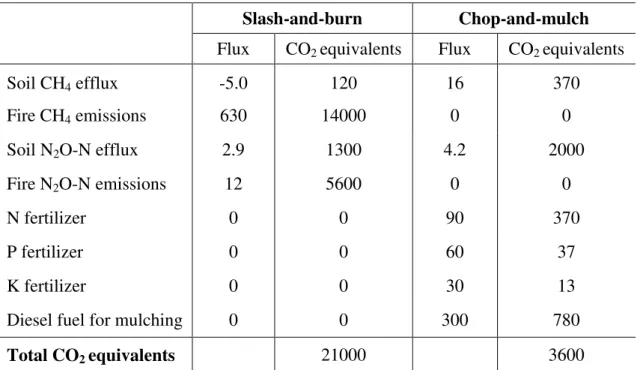
secondary vegetation favored by small landholder farm management are important factors for hydrobiogeochemical cycling, aquatic ecosystem conservation, soil conservation, and mitigation of trace gas emissions from biomass burning in small Amazonian catchments (Davidson et al., 2008). In Table 1, we present a calculation for two different systems in eastern Amazonia which shows that the GWP (Greenhouse Warming Potential) CO2 (dioxide
carbon) equivalents from soil emissions, fertilizer use, and diesel fuel use in the chop-and-mulch system were not trivial, but they were nearly six times smaller than the total GWP CO2
equivalents of slash-and-burn system extensively used by small landholder farming in the region
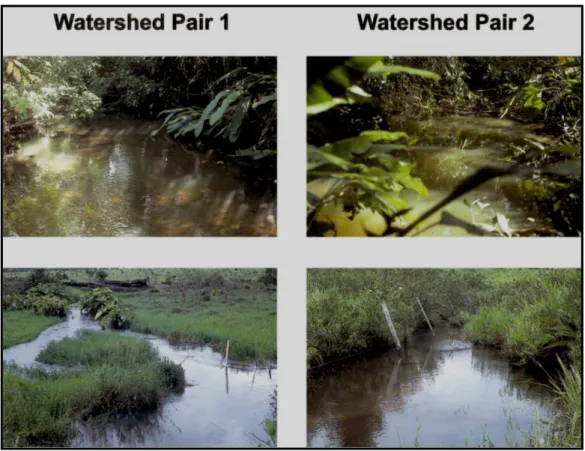
Other biogeochemical catchment studies more specifically related to water resources have shown pasture stream channels were deeper and had a lower cover of sandy bottom habitat and a higher cover of aquatic grass habitat than the forest streams, as well as lower concentrations of dissolved oxygen and nitrate (NO3-) and higher concentrations of dissolved
iron (Fe2+) and phosphate (PO43-) (Neill et al., 2006). The stream chemistry of these two pairs
of forest and pasture watersheds are compared in Table 2.
Table 1. Comparison of greenhouse warming potentials (GWP) for a 100-year time frame of emissions from slash-and-burn and chop-and-mulch cropping systems over approximately a 2-year cycle.
Slash-and-burn Chop-and-mulch
Flux CO2 equivalents Flux CO2 equivalents
Soil CH4 efflux -5.0 120 16 370
Fire CH4 emissions 630 14000 0 0
Soil N2O-N efflux 2.9 1300 4.2 2000
Fire N2O-N emissions 12 5600 0 0
N fertilizer 0 0 90 370
P fertilizer 0 0 60 37
K fertilizer 0 0 30 13
Diesel fuel for mulching 0 0 300 780
Total CO2 equivalents 21000 3600
Note: All values are in kg ha-1, except for diesel fuel, which is in L ha-1. All values are rounded to two
significant figures. CH4, methane; N2O, nitrous oxide; N, nitrogen; P, phosphorus; K, potassium.
Source: Davidson et al. (2008).
9
Table 2. Nutrient, cation and total suspended sediment concentrations in forest and pasture streams at Nova Vida Ranch, Rondônia, Brazil, during the period of low flows in August to September of 1998 and 1999. Different superscripts indicate that forest and pasture means within each stream pair were significantly different (t-test, p < 0.05).
Parameters Units Forest Watershed 1 Pasture Forest Watershed 2 Pasture
Dissolved Oxygen mg L-1 6.9a 0.1b 6.7a 0.1b
NO3- µM 10.7a 6.5b 8.1a 3.5b
NH4+ µM 4.5a 6.9a 4.9a 4.0a
PO43- µM 0.2a 1.8b 0.5a 0.8a
DIN:DIP 76 7 26 9
Ca2+ µM 87a 104a 112a 110a
Mg2+ µM 79a 95a 123a 109a
K+ µM 84a 189b 64a 209b
Na+ µM 63a 85b 67a 104b
Fe2+ µM 19a 956b 15a 441b
Total suspended sediments mg L-1 11.4a 13.5a 6.0a 19.2b
Source: Neill et al. (2006).
Figure 1. Photos of (top) forest and (bottom) pasture studied streams. Source: Neill et al. (2001)
10
catchment, where we can see the cattle trail conveying the water of the overland flow. In the same region another study testing the effects of the landscape characteristics on river water chemistry, performed a multiple linear regression analysis and estimated a threefold increase of phosphate concentration in stream water due to an increase of 10% in the pasture area of a river basin (Ballester et al., 2003).
Identifying the sources and mechanisms of solute contribution to Amazonian streams is necessary for understanding nutrient cycling processes in mature tropical forests and the long-term effects of land use change in the region. Regarding this objective, a particular watershed where the soil was previously enriched in cations by forest clearing and burning 30 years previously showed an increase in the leaching of cations during the wet season which in turn increased the input of these elements into the streams (Markewitz et al., 2001).
Figure 2. Photograph of a pasture hill slope as viewed from the overland flow sampling location, with runoff at the end of an 11-mm rainstorm. In the photo we can see the cattle trail conveying the water.
Source: Biggs et al. (2006).
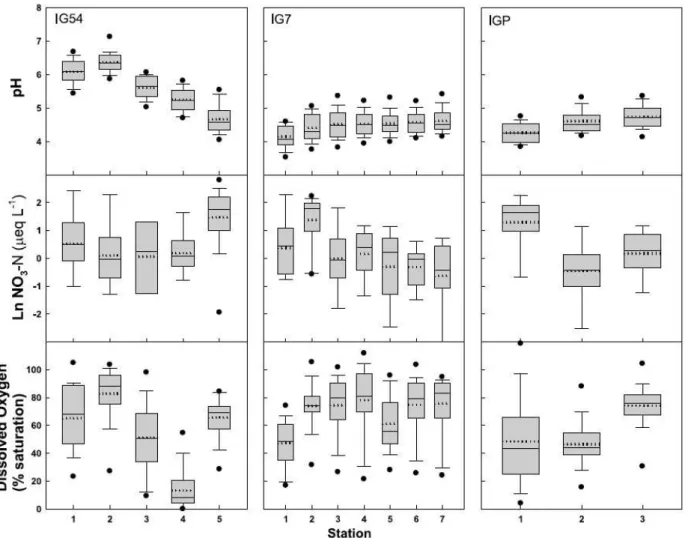
In contrast to pasture streams, where crops were grown near the stream, increases in steam concentrations of nitrate, sodium, chloride, and turbidity have been observed to increase with increasing crop cover area (Figueiredo et al., 2010). In this evaluation, land use change affected water chemistry and other measures of stream water quality in eastern Amazon catchments. Box plot graphs in Figure 3 illustrate upstream‐downstream trends for pH, nitrate (as Ln NO3−‐N), and dissolved oxygen (DO) in three streams (IG54, IG7 and IGP).
11
hand, nitrate upstream‐downstream declines were associated with a decreasing in the percentage of forest area, while agricultural inputs are suspected of causing the observed nitrate spike and dissolved oxygen collapse in station 4 of the IG54.
Figure 3. Upstream‐downstream trends for pH, nitrate (Ln NO3−‐N), and dissolved oxygen (DO) in
three streams of eastern Amazonia (IG54, IG7, and IGP). Lower and upper boundaries of the box are the 25th and 75th percentile, dots are the 5th and 95th, the solid line is the median, and the dotted line is the mean for samples that were collected monthly from April 2003 to October 2005.
Source: Figueiredo et al. (2010).
The benefits of small landholder production systems in term of watershed services are strongly related to the amount of secondary forests available in the landscape. Secondary forests may become increasingly important as moderators of hydrologic cycles in the Amazon Basin as agricultural lands are abandoned and often later cleared again for agriculture (Vieira et al., 2003). In catchments primarily occupied by small landholders, large areas of secondary forest, together with good agriculture practices that avoid slash-and-burn land preparation, resulted in the conservation of almost natural stream characteristics (Figueiredo, 2009).
12
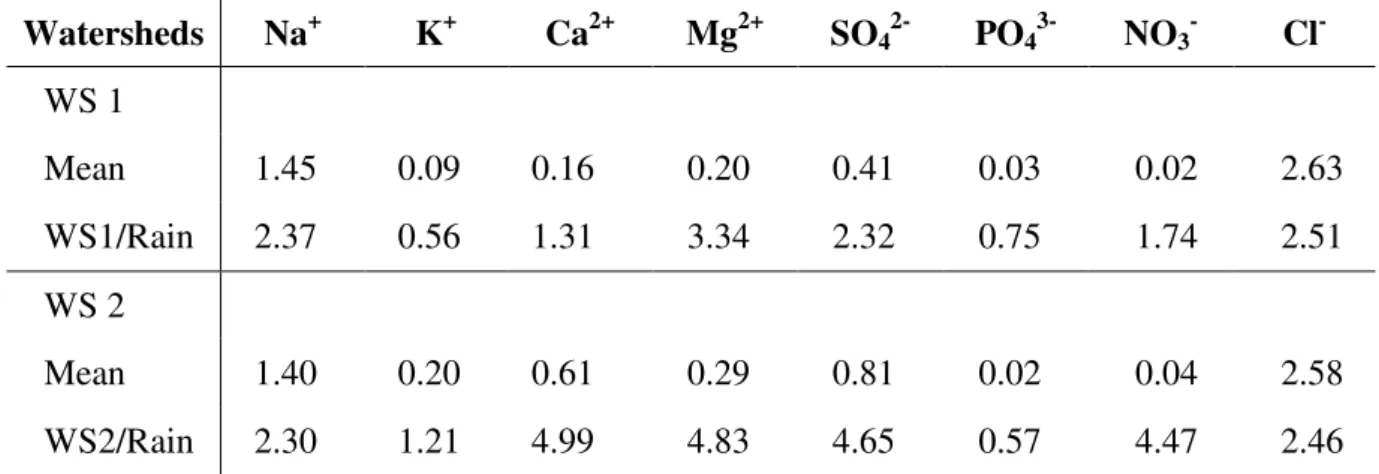
land preparation and ratio of concentrations in base flow to the concentrations in rain. This approach demonstrates larger losses of potassium, calcium, magnesium, sulfate, and nitrate from slash-and-burn agriculture watershed soils compared to chop-and-mulching watershed soils losses to stream water.
Table 3. Mean chemical composition (in mg L-1) of base flow water of two watersheds, and ratio of
concentrations in base flow to the concentration in rain (Q/P ratio). WS1= 25.5 ha chop-and-mulching agriculture watershed; WS2= 28.6 ha slash-and-burn agriculture watershed.
Watersheds Na+ K+ Ca2+ Mg2+ SO42- PO43- NO3- Cl-
WS 1
Mean 1.45 0.09 0.16 0.20 0.41 0.03 0.02 2.63
WS1/Rain 2.37 0.56 1.31 3.34 2.32 0.75 1.74 2.51
WS 2
Mean 1.40 0.20 0.61 0.29 0.81 0.02 0.04 2.58
WS2/Rain 2.30 1.21 4.99 4.83 4.65 0.57 4.47 2.46
Source: Modified from Wickel (2004).
Another study in the eastern Amazonia that analyzed stream water chemistry in nine watersheds also measured larger catchment output of calcium related to fire in agriculture fields (Barroso, 2011). In Figure 4, we can see larger concentrations due to slash-and-burn agriculture in the M4, M5 and M6 watersheds.
C
a2
+
(µ
E
L-1)
MR2 MR1 M7 M6 M5 M4 M3 M2 M1 60
50
40
30
20
10
0
Figure 4. Box plot graph of calcium concentrations along one year period (n=12) in stream water at nine catchments in the Marapanim River Basin, eastern Amazonia.
Source: Barroso (2011).
13
seven streams of the same agriculture region registered seventy-three species distributed in six orders, twenty six families and sixty three genera (Figure 5) (Brejão, 2011).
Moreover, a few of these studies have surveyed sustainable indicators that can be measured in Amazon soils and streams, using rapid field measurements that would allow their use by environmental regulatory agencies. Turbidity, temperature, pH, and dissolved oxygen appear to be the simplest and most indicative parameters for detecting effects of land‐use change on water quality in this region (Figueiredo et al., 2010). These measurements could be used as indicators for the payment of watershed services in this region. But further steps are needed, particularly in relation to the values of these environmental services.
Figure 5. Two of the seventy-three species registered by Brejão (2011) in seven streams of the same agriculture region. From left to right the species in this photos are: Crenuchus spilurus and Hyphessobrycon heterorhabdus.
It can be concluded from the studies shown above and other studies that small landholder agriculture that does not use fire for land management andthat preserves large areas of forest (secondary or mature forests), including riparian zones, can help to mitigate impacts to water quality in small Amazonian streams. This invites study of the possibility of paying for watershed services to small landholders who use conservative agriculture practices in the region, and also possibly compensating large-scale farmers in some way for the same environmental service.
3. Challenges of setting up payments for Ecosystem Services plans in the
Amazon
14
A fundamental precondition for PES to be feasible is that ecosystem service beneficiaries are willing to pay for at least the costs of setting up and running a given PES scheme. In the case of watershed services, these beneficiaries are typically spatially clustered downstream water users. Many other ecosystem services, such as carbon capture and species habitat provision, result in benefits to society as a whole. In the context of the Amazon, two important challenges arise for PES implementers:
1. Identifying beneficiaries: Low population densities and the relatively flat landscape
mean that a critical mass of downstream beneficiaries of such services - a prerequisite for public intervention - is more difficult to identify than in more densely populated mountainous areas.
2. Promoting local collective action: While watershed service providers (farmers) are also to considerable extent service beneficiaries, land disputes and cultural heterogeneities among settlers inhibit local collective efforts to safeguard stream water quality.
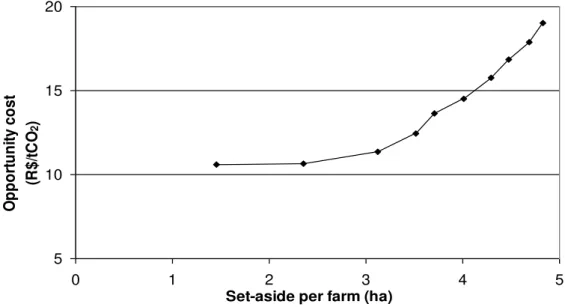
With regard to the first challenge, it is crucial to identify a sufficiently large group of service beneficiaries. Experiences from PES efforts around the world show that watershed services can often piggyback in PES plans that address other more globally valued ecosystem services, such as carbon capture and habitat conservation. Mechanisms that link several services are called bundling or layering (Wunder and Wertz-Kanounnikoff, 2009). Economic analyses of conservation opportunity costs of small landholders in the eastern Brazilian Amazon suggest that the costs of setting aside an additional hectare of secondary deforestation lie between roughly R$ 10-20 per ton of CO2 (Figure 6) (Börner et al., 2007).
This is slightly higher than cost-estimates for the retirement of extensive pastures (Bowman et al., 2012; Nepstad et al., 2009; Wunder et al., 2008).
Figure 6. Opportunity costs per unit of avoided CO2 emission in smallholder
systems in the eastern Brazilian Amazon.
Source: Modified from Börner et al. (2007).
For many reasons, including transport infrastructure quality and land tenure security, PES schemes may be more competitively established in the eastern Amazon setting than at
today’s agricultural frontiers, where the costs of implementing local interventions tend to be high. Based on the existing Brazilian Forest Law, carbon payment schemes in the Brazilian
5 10 15 20
0 1 2 3 4 5
Set-aside per farm (ha)
O
p
p
o
rt
u
n
it
y
c
o
s
t
(R
$
/t
C
O2
15
Amazon could be optimized in terms of watershed service provision, e.g. through higher rewards for the conservation and restoration of riparian vegetation.
With regard to the second challenge, tenure insecurity and the lack of a consistent land register system still represent an important barrier to conservation initiatives in many parts of the Amazon. Collective conservation action is unlikely to come about wherever the social relationship between watershed service providers and service users is dominated by conflicts over land. Efforts to build spatially explicit land registers linked to pragmatic land reform strategies, such as the Cadastro Ambiental Rural (CAR) and the Terra Legal Program,
represent promising initiatives in that regard.
4. OUTLOOK AND CONCLUSIONS
We have shown that there are: 1. clear differences in water quality indicators between traditionally managed and fire-free managed watersheds; and, 2. clear differences between small landholder versus large-scale producer-managed watersheds.
Watershed services alone, however, are unlikely to evoke sufficient local demand for establishing PES schemes in most Amazonian settings. Optimizing carbon payment schemes, for example, in the context of currently mushrooming REDD+ schemes in the region may represent an opportunity to improve watershed service provision through ecosystem service bundling.
The high degree of dependence of the local population on stream water resources may, nonetheless, also justify public interventions purely based on replacement cost criteria. The potential costs of establishing and maintaining decentralized water treatment facilities as natural watershed services degrade are likely to be higher than investments in promoting improved community watershed management schemes.
5. ACKNOWLEDGEMENTS
Authors are grateful to Maria de Cléofas Faggion Alencar for providing bibliographic assistance.
6. REFERENCES
BALLESTER, M. V. R.; VICTORIA, D. C.; KRUSCHE, A. V.; COBURN, R.; VICTORIA, R. L.; RICHEY, J. E. A remote sensing/GIS-based physical template to understand the biogeochemistry of the Ji-Paraná river basin (Western Amazônia). Remote Sensing of
Environment, n. 87, n. 4, p. 429-445, 2003. http://dx.doi.org/10.1016/j.rse.2002.10.001
BARROSO, D. F. R. Fluxos hidrogeoquímicos em águas fluviais de microbacias do Nordeste paraense e a sua relação com o uso da terra. 121f. 2011. Dissertação (Mestrado em Ciências Ambientais) - Universidade Federal do Pará, Belém, 2011. BENNETT, G.; CARROLL, N.; HAMILTON, K. Charting new waters: state of watershed
payments 2012. Washington, DC: Forest Trends, 2013. Available at: <http://www.ecosystemmarketplace.com/reports/sowp2012>. Access: May 2013.
16
BÖRNER, J.; MENDOZA, A.; VOSTI, S. A. Ecosystem services, agriculture, and rural poverty in the Eastern Brazilian Amazon: interrelationships and policy prescriptions.
Ecological Economics, v. 64, n. 2, p. 356-373, 2007. http://dx.doi.org/10.1016
/j.ecolecon.2007.03.001
BOWMAN, M. S.; SOARES-FILHO, B. S.; MERRY, F. D.; NEPSTAD, D. C.; RODRIGUES, H.; ALMEIDA, O. T. Persistence of cattle ranching in the Brazilian Amazon: a spatial analysis of the rationale for beef production. Land Use Policy, v. 29, n. 3, p. 558-568, 2012. http://dx.doi.org/10.1016/j.landusepol.2011.09.009
BREJÃO, G. L. Estradas, alagados antrópicos, peixes e a fragmentação de redes fluviais
em uma paisagem agrícola do nordeste do Pará. 94f. 2011. Dissertação (Mestrado
em Ciências Ambientais) - Universidade Federal do Pará, Belém, 2011.
CARVALHO, G.; MOUTINHO, P.; NEPSTAD, D.; MATTOS, L.; SANTILLI, M. An Amazon perspective on the forest-climate connection: opportunity for climate mitigation, conservation and development? Environment, Development and Sustainability, v. 6, n. 1/2, p. 163–174, 2004. http://dx.doi.org/10.1023/B:ENVI .0000003635.86980.c0
CORRÊA, J. M.; GERHARD, P.; FIGUEIREDO, R. O. Ictiofauna de igarapés de pequenas bacias de drenagem em área agrícola do Nordeste Paraense, Amazonia Oriental.
Revista Ambiente & Água, v. 7, n. 2, p. 214-230, 2012. http://dx.doi.
org/10.4136/ambi-agua.739
DAVIDSON, E. A.; SÁ, T. D. A.; CARVALHO, C. J. R.; FIGUEIREDO, R. O.; KATO, M. S. A.; KATO, O. R. et al. An integrated greenhouse gas assessment of an alternative to slash-and-burn agriculture in eastern Amazonia. Global Change Biology, v. 14, n. 5, p. 998-1007, 2008. http://dx.doi.org/10.1111/j.1365-2486.2008.01542.x
FEARNSIDE, P. Deforestation in Brazilian Amazonia: history, rates and consequences.
Conservation Biology, v. 19, n. 3, p. 680-688, 2005.
http://dx.doi.org/10.1111/j.1523-1739.2005.00697.x
FEARNSIDE, P. Land-tenure issues as factors in environmental destruction in Brazilian Amazonia: the case of southern Pará. World Development, v. 29, n. 8, p. 1361-1372, 2001. http://dx.doi.org/10.1016/S0305-750X(01)00039-0
FIGUEIREDO, R. O.; MARKEWITZ, D.; DAVIDSON, E. A.; SCHULER, A. E.; WATRIN, O. S.; SILVA, P. S. Land-use effects on the chemical attributes of low-order streams in the eastern Amazon. Journal of Geophysical Research: Biogeosciences, v. 115, n. G4, 2010. http://dx.doi.org/10.1029/2009JG001202
FIGUEIREDO, R. O. Processos hidrológicos e biogeoquímicos em bacias hidrográficas sob usos agrícola e agroflorestal na Amazônia Brasileira. In: PORRO, R. (Ed.). Alternativa
agroflorestal na Amazônia em transformação. Brasília: Embrapa Informação
Tecnológica, 2009. p. 477-500.
17
MCCLAIN, M, E.; COSSÍO, R. E. The use of riparian environments in the rural Peruvian Amazon. Environmental Conservation, v. 30, n. 3, p. 242-248, 2003.
MCCLAIN, M. E.; ELSENBEER, H. Terrestrial inputs to Amazon streams and internal biogeochemical processing. In: MCCLAIN, M. E.; VICTORIA. R. L.; RICHEY, J. E.
The Biogeochemistry of the Amazon Basin. New York: Oxford University Press,
2001. p. 185-208.
NEILL, C.; DEEGAN, L. A.; THOMAS, S. M.; HAUPERT, C. L.; KRUSCHE, A. V.; BALLESTER, V. M. et al. Deforestation alters the hydraulic and biogeochemical characteristics of small lowland Amazonian streams. Hydrological Processes, v. 20, n. 12, p. 2563-2580, 2006. http://dx.doi.org/10.1002/hyp.6216
NEILL, C.; DEEGAN, L. A.; THOMAS, S. M.; CERRI, C. C. Deforestation for pasture alters nitrogen and phosphorus in small Amazonian streams. Ecological Applications, v. 11, p. 1817-1828, 2001. http://dx.doi.org/10.1890/1051-0761(2001)011[1817:DFPANA] 2.0.CO;2
NEPSTAD, D. C.; SOARES-FILHO, B. S.; MERRY, F. D.; LIMA, A.; MOUTINHO, P. R.; CARTER, J. et al. The end of deforestation in the Brazilian Amazon. Science, v. 326, p. 1350-1351, 2009.
SOMMER R. No Fires! Slash-and-Mulch - A Promising Alternative. ZEFnews, n. 6, p. 8, 2001.
TOMASELLA, J.; NEILL, C.; FIGUEIREDO, R.O.; NOBRE, A. D. Water and chemical budgets at the catchment scale including nutrient Exports From Intact Forests and Disturbed Landscapes. In: KELLER, M.; BUSTAMANTE, M.; GASH, J.; SILVA DIAS, P. Amazonia and global change. Washington: America Geophysical Union, 2009. p. 505-524. (Geophysical Monograph Series, 186).
VIEIRA, I. C. G.; ALMEIDA, A. S.; DAVIDSON, E. A.; STONE, T. A.; CARVALHO, C. J. R.; GUERRERO, J. B. Classifying successional forests using Landsat spectral properties and ecological characteristics in eastern Amazônia. Remote Sensing of
Environment, v. 87, n. 4, p. 470-481, 2003. http://dx.doi.org/10.1016/j.rse.2002.09.002
WICKEL, B. Water and nutrient dynamics of a humid tropical watershed in Eastern
Amazonia. [S.l.]: University of Bonn, 2004. 120p. (Ecology and Development Series,
21)
WUNDER, S.; WERTZ-KANOUNNIKOFF, S. Payments for ecosystem services: a new way of conserving biodiversity in forests. Journal of Sustainable Forestry, v. 28, n. 3/5, p. 576-596, 2009. http://dx.doi.org/10.1080/10549810902905669
WUNDER, S.; BÖRNER, J.; RÜGNITZ, M. T.; PEREIRA, L. Pagamentos por serviços
ambientais: perspectivas para a Amazônia. Brasília: Ministério do Meio Ambiente,