* Corresponding author:
E-mail: ademir.fontana@ embrapa.br
Received: January 9, 2017
Approved: May 22, 2017
How to cite: Fontana A, Chagas CS, Donagemma GK, Menezes AR, Calderano Filho B. Soils developed on geomorphic surfaces in the mountain region of the State of Rio de Janeiro. Rev Bras Cienc Solo. 2017;41:e0160574.
https://doi.org/10.1590/18069657rbcs20160574
Copyright: This is an open-access article distributed under the terms of the Creative Commons Attribution License, which permits unrestricted use, distribution, and reproduction in any medium, provided that the original author and source are credited.
Soils Developed on Geomorphic
Surfaces in the Mountain Region of
the State of Rio de Janeiro
Ademir Fontana(1)*, Cesar da Silva Chagas(1), Guilherme Kangussu Donagemma(1), Andressa Rosas de Menezes(2) and Braz Calderano Filho(1)
(1)
Empresa Brasileira de Pesquisa Agropecuária, Embrapa Solos, Rio de Janeiro, Rio de Janeiro, Brasil. (2)
Universidade Federal Rural do Rio de Janeiro, Departamento de Solos, Programa de Pós-Graduação em Agronomia, Seropédica, Rio de Janeiro, Brasil.
ABSTRACT: The evaluation of soils in representative landscapes constitutes an opportunity to evaluate spatial distribution, discuss formation processes, and apply this knowledge to land use and management. In this sense, from the perspective of an environmentally diversified region, the aim of the present study is to evaluate the occurrence and understand the formation of soils in different geomorphic surfaces of a landscape from a mountain region in the state of Rio de Janeiro. The study was developed in the Pito Aceso microbasin in the municipality of Bom Jardim, composed of narrow valleys and a rugged mountain domain, with elevation between 640 and 1,270 m. In a representative landscape, the geomorphic surfaces were obtained from the slope segments and flow lines. On the geomorphic surfaces, soil profiles were described by their morphological properties, collected, and analyzed to describe the chemical and physical properties of each horizon. Geomorphological aspects and possible variations of the parent material directly affected pedogenesis and led to distinct soil classes in the landscape. Variation in the geomorphic surfaces directs the processes for soil formation under current conditions, as well as the preservation of polygenetic soils. Soils of lower development and with greater participation of the exchangeable cations were identified at the summit (talus deposit) (Neossolo Litólico and Cambissolo Húmico) and toeslope (colluvial-alluvial) (Neossolo Flúvico), whereas more developed soils with lower nutrient content occur in the concave (Argissolos Vermelho and Amarelo) and convex (Latossolo Amarelo) backslope, except for the Argissolo Vermelho-Amarelo in the shoulder, which had high exchangeable cations contents.
INTRODUCTION
Agriculture in the mountainous region of the state of Rio de Janeiro is developed in all parts of the landscape, where the topographical features of mountainous relief associated with intense rainfall impel erosive processes, intensifying soil losses and sediment transport to water courses (Mendes, 2006). In this region, technological levels and cropping intensity vary substantially, promoting different ways to evaluate soil and different implications for conservation or degradation.
Knowledge of soil at different levels of detail and soil dynamics is necessary due to the importance of soil in the environment as a provider of services in water quantity and quality, carbon storage, nutrient cycling, biodiversity, vegetation support, or as an agricultural production factor for land use and management planning. The basic unit of study is the soil genesis environment, the pedoenvironment, which provides for analysis of soil formation and dynamics, as well as landscape evolution. In addition, these evaluations can be related to soil surveys, allowing the lack of information and mapping in various scales of detail to be improved.
The examination of soil profiles and characterization in a representative landscape are taken as a unit for making inferences regarding soil genesis, which can be carried out by evaluation of the soil-landscape relationship. In this evaluation, the occurrence of soils is the basis of landscape segmentation into geomorphic surfaces, which is obtained mainly by the combination of the slope elements and form, characterizing the pedoenvironment. Daniels et al. (1971) refer to geomorphic surfaces as a landscape portion defined in time and space, containing geographical limits modeled by environmental components. According to the conceptual model proposed by Ruhe (1956), the interaction of slope segments and the environment explains soil diversity. Additionally, Hugget (1975) shows that the relief forms from water flow models make for variations in soil characteristics and properties in different landscape segments.
Basically, pedogenetic models and theories express the influence of the processes involved in soil differentiation, which can be observed in the morphology, chemical, physical, and mineralogical properties. Regarding processes, they denote the arrangement and extent of the formation factors, such as relief, parent material, climate, and biota, all acting in a certain period of time. The first concept of formation factors was made by Vasilii Vasilevich Dokuchaev (Dokuchaev, 1967) and complemented by Hans Jenny (Jenny, 1941) in proposing the equation model for soil formation, which is known as the factorial-functional or mental-theoretical model (Lepsch, 2010; Kämpf and Curi, 2012a).
The application of the concepts presented is reported in the studies of Silva and Vidal-Torrado (1999), Cooper and Vidal-Torrado (2000), Nunes et al. (2001), Figueiredo et al. (2004), Lima et al. (2006), Moreau et al. (2006), Silva et al. (2007), Corrêa et al. (2008), Almeida et al. (2009), Clemente et al. (2009), Campos et al. (2007, 2010, 2011, 2012), Cooper et al. (2010), Pereira et al. (2013), Martins and Rosolen (2014), Rodolfo Júnior et al. (2015), aiming to elucidate the occurrence and formation of soil based on evaluation of the soil-landscape relationship in Brazil. Notably, there are few studies concerning the soil-landscape relationship in the mountain region of the state of Rio de Janeiro, such as the study of Calderano Filho et al. (2010).
MATERIALS AND METHODS
The study was conducted in the Pito Aceso microbasin in the municipality of Bom Jardim, a mountainous region in the state of Rio de Janeiro (RJ) (Figure 1). The regional geomorphology comprises the coastal massifs of the Serra dos Órgãos Plateau, with the predominance of high hills, mountains, and small mountain alignments (Matos et al., 1980; Dantas, 2001). In the Pito Aceso microbasin, the topography is marked by narrow valleys, slopes of differentiated altitudes, and rugged relief, with elevation between 640 and 1,270 m.
The lithology consists of rocks from the Rio Negro complex (orthogneisses and migmatites) (Matos et al., 1980). The parent material comprises the product of alteration of the rocks mentioned, as well as colluviums transported in different phases (Calderano Filho et al., 2010). In the lowland, the material is composed of sandy clay sediments, comprising different alluvial and colluvial deposits.
The climate of the region, according to Köppen classification system, is Cwa, which means dry winter and rainy summer, defined as subtropical, with winter temperatures below 18 °C and summer temperatures above 22 °C. Average annual temperature is 20.3 °C and average annual rainfall is about 1,350 mm (Carvalho Júnior et al., 2013). The primary vegetation is Overgreen Rainforest, equivalent to Dense Ombrophylous Forest, with large tree species and dense formation (Dantas, 2001).
The selected landscape was compartmentalized by the slope segments (Ruhe, 1960) and flow lines - curvature and profile (Hugget, 1975). From this combination, points were established for opening pits for soil profiles and then morphology was described and each horizon was sampled (Santos et al., 2013a). Based on morphological properties and chemical and physical properties, the soils were classified according to the Brazilian Soil Classification System (Santos et al., 2013b).
Figure 1. Location of the area studied in the Pito Aceso microbasin, Municipality of Bom Jardim, State of Rio de Janeiro (RJ).
776800
1,000
UTM Projection Datum SAD 69 Zone 24S
777600 778400 779200 780000
500 0 1,000 Meters
140000 150000 160000
7530000
7540000
7550000
7533700
7534600
7535500
7536400
7537300
Rio de Janeiro State
Pito Aceso Microbasin
Bom Jardim County
P6
P3 P2
P1 P7
P5 P4
S N
For laboratory analyses, the samples of each horizon were dried in an oven at 50 °C and sieved in a 2 mm mesh, obtaining fine soil. Physical analyses (particle size analysis - coarse sand, fine sand, silt, and clay) and chemical analyses (pH, sorption complex - Ca2+, Mg2+, K+, Na+, Al3+, and H+, organic carbon, sulfuric acid digestion, and selective extraction of iron by ammonium oxalate acid and dithionite-citrate-bicarbonate) were performed in the fine earth according to the methods described in Donagema et al. (2011). Chemical fractionation of the organic matter was carried out by the technique of differential solubility in basic and acidic solutions, obtaining the organic carbon content in the humic fractions: fulvic acids, humic acids, and humin (Benites et al., 2003).
RESULTS AND DISCUSSION
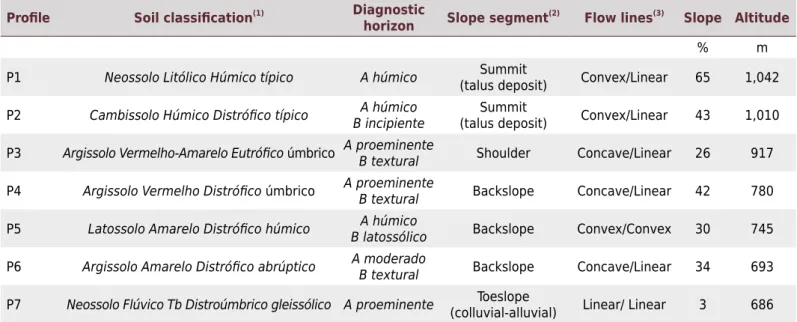
Evaluation of the landscape by its structural components shows significant variations as to slope segments, flow lines, relief forms, declivity, and altitude, which were jointly defined as distinct pedoenvironments (Table 1, Figure 2). In general, in each soil profile expressive differences are highlighted mainly by the depth, thickness, and color of the surface and subsurface horizons (Figure 2), which causes the occurrence of different diagnostic horizons, the surface A húmico (P1, P2, and P5), A prominant (P3, P4, and P7), and A moderado (P6) horizons, whereas the subsurface horizons were B incipient, B textural, and B latossólico (Table 1). From these variations in diagnostic horizons and other characteristics, and the properties of each profile, the soil classes were Neossolos, Cambissolos, Argissolos, and Latossolos (Table 1), which correspond to the Entisols, Inceptisols, Ultisols, and Oxisols, respectively, according to Soil Taxonomy (Soil Survey Staff, 2014).
The soils with more pedogenetic evolution were identified by the sequence of horizons A-Bt or A-Bt-Bw (Argissolos - P3, P4, and P6), and they occupy the shoulder and concave backslope, whereas in the A-Bw sequence (Latossolo - P5) they are in the convex backslope (Table 1, Figure 2). In contrary conditions, soils with the lowest pedogenetic evolution occur at the summit (talus deposit), with the sequence of horizons A-R (Neossolo Litólico - P1) or A-Bi (Cambissolo - P2), and toeslope, with the horizon sequence A-C-Cg (Neossolo Flúvico - P7) (Table 2).
The curvature considerably influences the lateral distribution of the pedological, hydrological, and geomorphic processes and, therefore, the soils that result from interactions among
Table 1. Soil classification and landscape characterization in the Pito Aceso basin, municipality of Bom Jardim (RJ)
Profile Soil classification(1) Diagnostic
horizon Slope segment (2)
Flow lines(3) Slope Altitude
% m
P1 Neossolo Litólico Húmico típico A húmico Summit
(talus deposit) Convex/Linear 65 1,042
P2 Cambissolo Húmico Distrófico típico A húmico
B incipiente
Summit
(talus deposit) Convex/Linear 43 1,010
P3 Argissolo Vermelho-Amarelo Eutrófico úmbrico A proeminente
B textural Shoulder Concave/Linear 26 917
P4 Argissolo Vermelho Distrófico úmbrico A proeminente
B textural Backslope Concave/Linear 42 780
P5 Latossolo Amarelo Distrófico húmico A húmico
B latossólico Backslope Convex/Convex 30 745
P6 Argissolo Amarelo Distrófico abrúptico A moderado
B textural Backslope Concave/Linear 34 693
P7 Neossolo Flúvico Tb Distroúmbrico gleissólico A proeminente Toeslope
(colluvial-alluvial) Linear/ Linear 3 686
(1)
Santos et al. (2013b). (2)
Ruhe (1960). (3)
these processes (Pennock et al., 1987). The influence on soil properties has mainly been related to the concave and convex flow lines that control the distribution of water and soluble materials from the highest to the lowest part of the landscape. Thus, there is a close relationship between curvature and the occurrence of soil classes. In this case, the deepest soils have small variance in morphological properties and physical and chemical properties along the soil profile, such as the Latossolos that occupy the convex shape, whereas, in the contrary situation, the Cambissolos and Argissolos occur in the concave shape. For the Argissolos, occurrence in these conditions is related to high slope and the convergent water flow on these geomorphic surfaces, which favors morphogenesis (Chagas, 2006).
Variations in soil genesis were evidenced by morphological properties. The thickness of the surface horizons ranged from 0.25 m (P7) to 1.25 m (P2). In the subsurface horizons, the limit is due to the presence of the ground water level in the Neossolo Flúvico (1.00 m) (Table 2). In color expression, a marked characteristic in the surface horizons is the predominance of dark colors, registered by the value and chroma from 1 to 3, except for lighter colors in the P6 profile, value 4 and chroma 4 to 6 (Table 2). For the surface horizons, dark colors mainly reflect the influence of a higher amount of organic matter, and for many horizons this is associated with soil quality. In this context, the smaller thickness and relatively clear color of the Ap and A horizon in the Argissolo Amarelo can be attributed to losses of mineral and organic colloidal material by lateral removal, due to the higher water flow in the lower position of the landscape. In this same soil, in the AB horizon, lighter color can be attributed to the intense translocation of colloidal material, which is corroborated by the lower contents of organic carbon (OC) and clay compared to the Bt1 horizon (Tables 2 and 4).
A decrease in the value and chroma in the A2 horizon in relation to the overlying (A1) and underlying (AB) horizons was observed in the profile with the A húmico horizon, especially in the Latossolo Amarelo (Table 2). This darkening can be attributed in part to Figure 2. Schematic drawing of landscape and arrangement of soil profiles. Flow of the slope
represented by dotted lines and landscape structure by solid lines. P1: Neossolo Litólico; P2: Cambissolo Húmico; P3: Argissolo Vermelho-Amarelo; P4: Argissolo Vermelho; P5: Latossolo Amarelo; P6: Argissolo Amarelo; and P7: Neossolo Flúvico.
P1 P2 P3 P4 P5
P6 P7
P1 P2
P3
P5 P4
P6
Table 2. Morphological properties and organic carbon of the soils from the Pito Aceso basin, municipality of Bom Jardim (RJ)
Hor(1) Depth Texture Structure Color OC
m moist g kg-1
P1 - Neossolo Litólico Húmico típico
Ap 0.00-0.40 sandy loam lr. st. sm. and vsm. gra. 10YR 2/1 76.2
R 0.40+
P2 - Cambissolo Húmico Distrófico típico
Ap 0.00-0.33 clay loam st. vsm. and sm. gra. 10YR 2/1 37.6
A1 0.33-1.00 sand clay st. vsm. and sm. gra. 10YR 2/1 28.4
A2 1.00-1.10 sand clay st. vsm. and sm. gra. 10YR 2/2 18.3
AB 1.10-1.25 sand clay wk. sm. and med. sab. 7.5YR 3/2 13.5
Bi 1.25-1.50+
clay loam wk. sm. and med. sab. 5YR 4/4 8.8
P3 - Argissolo Vermelho-Amarelo Eutrófico úmbrico
Ap 0.00-0.27 sandy clay loam mo. med. and lg. gra. 5YR 3/1 16.8
AB 0.27-0.43 sandy clay loam mo. med. sab. 5YR 3/2 12.9
BA 0.43-0.63 sand clay mo. med. sab. 5YR 3/4 9.2
Bt1 0.63-0.80 sand clay mo. sm. and med. sab. and ab. 5YR 3/4 7.0
Bt2 0.80-1.20 clay mo. med. sab. and ab. 5YR 4/4 4.9
BC 1.20-1.50+
sand clay wk. sm. and med. sab. and ab. 5YR 3/4 4.3
P4 - Argissolo Vermelho Distrófico úmbrico
Ap 0.00-0.48 sandy clay loam mo. sm. and med. gra. 5YR 3/3 11.8
BA 0.48-0.75 sand clay mo. med. sab. 3.5YR 3/4 7.0
Bt1 0.75-0.95 clay mo. med. sab. 2.5YR 3/3 10.1
Bt2 0.95-1.10 clay mo. med. sab. 2.5YR 3/4 8.4
Bt3 1.10-1.33 very clayey mo. med. sab. 2.5YR 4/5 6.4
Bw 1.33-1.80+
clay wk. sm. and med. sab. 2.5YR 4/7 5.4
P5 - Latossolo Amarelo Distrófico húmico
Ap 0.00-0.20 clay mo. sm. and med. gra. 7.5YR 3/2 17.2
A1 0.20-0.38 clay mod. sm. and med. gra. 7.5YR 3/3 15.8
A2 0.38-0.61 clay st. sm. gra. 7.5YR 2.5/2 17.2
AB 0.61-0.85 clay wk. med. sab. 10YR 3/3 10.9
BA 0.85-1.05 clay wk. med. sab. 10YR 4/6 7.3
Bw1 1.05-1.47 clay wk. med. sab. 10YR 5/8 4.9
Bw2 1.47-1.80+
clay wk. med. sab. that is undone
st. vsm. gra. 8.5YR 6/8 3.5
P6 - Argissolo Amarelo Distrófico abrúptico
Ap 0.00-0.26 sandy clay loam mo. sm. and med. gra. and
wk. sm. and med. sab. 7.5YR 4/4 9.9
A 0.26-0.40 sandy loam wk. sm. and med. sab. 10YR 4/4 7.3
AB 0.40-0.62 sandy loam wk. sm. and med. sab. 10YR 4/6 3.7
Bt1 0.62-1.04 clay mo. med. sab. 7.5YR 4/4 6.0
Bt2 1.04-1.60+
clay mo. sm. and med. sab. 7.5YR 5/8 4.5
P7 - Neossolo Flúvico Tb Distroúmbrico gleissólico
Ap 0.00-0.25 sandy clay loam mo. med. and gr gra. 10YR 3/3 11.5
C 0.25-0.63 sandy clay loam wk. sm. and med. sab. 10YR 5/6 3.5
Cg 0.63-1.00+
sandy clay loam massive 7.5YR 6/2 3.6
(1)
the increase in OC contents in this horizon (Table 2) and the higher participation of fulvic and humic acid fractions, which represent 50 % of OC, with predominance of humic acids (26 %) (Table 3). Humic acids impart a dark color to soil due to their intense black color. For the other surface horizons, the influence of these two fractions was lower (<38 %), with humic acid values lower than 15 % (Table 3).
Studies of soils with variations in color in surface horizons and darkening with depth was highlighted in a Latossolo Amarelo with an A humic horizon at the 1st Soil Classification and Correlation Meeting (Embrapa, 1979), as well as observed in other soil profiles with the A horizon described in the same region (Calderano Filho, 2012). In this respect, Calegari (2008) highlights the occurrence of soil profiles with this same pattern of color variation in an A húmico horizon developed in Latossolos from different regions of Brazil.
In the subsurface horizons, the colors ranged from 2.5YR (red) to 10YR (yellow), with values from 3 to 6 and chrome from 4 to 8 (Table 2). The soil color variation can be attributed in part to the chemical and mineralogical composition of the rock, such as varied sources of iron, and/or attributed to the dynamics of iron oxide formation and expression. For free drainage environments, the gradient between the yellow and red color is attributed to the differentiated formation and expression of goethite and hematite. The yellowish color indicates greater expression of goethite, while the reddish color denotes the presence of hematite (Sposito, 1989; Inda Jr et al., 2012; Ribeiro et al., 2012).
The relationship between different parent materials, mainly in regard to their mineralogical composition, and color in the subsurface was highlighted by Santos (2009) in soil profiles from three toposequences in the Paraíba do Sul region, state of Rio de Janeiro. In that
Table 3. Humic fraction contribution to the organic carbon of the soils from the Pito Aceso basin, municipality of Bom Jardim (RJ)
Horizon C-FAF C-FAH C-HUM C-FAF + C-FAH
%
P4 - Argissolo Vermelho Distrófico úmbrico
Ap 22.0 28.8 40.7 50.8
BA 37.1 14.3 74.3 51.4
Bt1 29.7 22.8 53.5 52.5
Bt2 31.0 21.4 75.0 52.4
Bt3 37.5 6.3 68.8 43.8
Bw 33.3 9.3 40.7 42.6
P5 - Latossolo Amarelo Distrófico húmico
Ap 12.8 12.8 30.8 25.6
A1 14.6 14.6 29.1 29.2
A2 23.8 25.6 11.0 49.4
AB 14.7 22.9 43.1 37.6
BA 13.7 16.4 61.6 30.1
Bw1 34.7 12.2 34.7 46.9
Bw2 34.3 2.9 71.4 37.2
P6 - Argissolo Amarelo Distrófico abrúptico
Ap 28.3 17.2 37.4 45.5
A 27.4 17.8 37.0 45.2
AB 27.0 16.2 83.8 43.2
Bt1 41.7 10.0 45.0 51.7
Bt2 33.3 4.4 93.3 37.7
study, soils developed from basic materials (basalt and gabbro) had 5YR color in the intermediate part of the profile and 7.5YR in the underground. In contrast, along the toposequence, acidic rocks (muscovite-biotite gneiss) with lower iron contents had a varied color, reddish in the upper and middle thirds (2.5YR, 5YR, and 7.5YR) becoming yellowish in the lower third, where the 7.5YR and 10YR become more evident.
In hydromorphic environments, such as that observed in the Cg2 horizon (Neossolo Flúvico), iron is reduced and, for that reason, the grayish color expresses mixing of predominantly kaolinite mineral and organic matter. The occurrence of mottled indicates iron oxidation in the aeration zones, according to the seasonality of hydromorphism by fluctuation in the ground water level. In the Bt1 and Bt2 horizons in Argissolo Vermelho and Amarelo, a decrease in value and chroma was observed in relation to the overlying horizons, characterizing a slight darkening in soil color. As a differential pattern, these horizons have colloidal organic matter in their morphology as films deposited on the surface of soil aggregates. Meanwhile, in the Argissolo Vermelho, the effect of the substantial humic acid increase in these horizons (black color) is added, around 22 % of the OC, whereas in the Argissolo Amarelo the increase was in fulvic acids (yellow-brown) and about 42 % of OC (Table 3).
In this same line of observation, Oenning (2001), Almeida et al. (2009), Botelho (2011), and Lunardi Neto (2012) report an expressive degree of darkening for the AB, BA, and Bt horizons in soils from the states of Santa Catarina and Rio Grande do Sul. The authors highlight the dark horizons related to the occurrence of organic material on the peds surface and the increase in OC, which was attributed to illuviation of colloidal organic matter. In addition, Oenning (2001), Botelho (2011), and Lunardi Neto (2012) discuss the greater participation of humic acids in several soil profiles, thus emphasizing the participation of the humic fraction in the dark color in the subsurface horizons. For the same soils, Almeida et al. (2009) and Botelho (2011) reject the occurrence of a buried A horizon, which was defined by the similarity of sand fractions between the horizons along the soil profile. Regarding deposition of colloidal organic matter, the authors suggest that the organic compounds associated with aluminum and iron may have accumulated as clay-humic complexes during events after the development of the B textural horizon. This darkening concurs with the maximum accumulation of fine clay in the AB and BA subsurface horizons and not with the horizons that exhibit clay accumulation in the profile. The OC contents in the surface horizons have a large amplitude, from 3.7 to 76.2 g kg-1, whereas the amplitude in the subsurface horizons is from 3.5 to 10.1 g kg-1 (Table 2). The observation of a wide range of OC contents along the landscape may be associated with different soil formation conditions, especially for the surface horizons. Considering that the current conditions of humid climate and mountainous relief favor decomposition of the organic material and higher erosion due to surface runoff, the surface horizons with high OC contents have characteristics of “Relictual Soils - Paleosols’’ (Queiroz Neto and Castro, 1974; Lepsch and Buol, 1988; Buol and Eswaram, 1999; Calegari, 2008). These authors associate relictual soils with a stable landscape, where the cold climate propitious the accumulation of organic matter by the significant decrease in biogeochemical processes, thus the organic matter is preserved through the formation of organomineral complexes. According to Schaetzl and Anderson (2005), under relictual soil conditions, accumulation of large amounts of organic matter on the surface occurred in the past climate, where grass species predominated and a drier climate in the late Pleistocene to medium Holocene (Calegari, 2008).
horizon and seasonal hydromorphism lead to a decrease in the decomposition rates of organic matter by biogeochemical processes.
For the other chemical properties, the pH values in water and KCl varied slightly within each soil profile, and the pH in water was higher than 5.4 in all the horizons of Cambissolo and Argissolos Vermelho-Amarelo and Amarelo (Table 4). The lower values for pH in KCl compared to pH in water give a negative ΔpH and express the predominance of negative charges, giving the soils cation exchange capacity. Together with this observation, there is a gradient in the soil profile and through the landscape of the exchangeable cations. The sum of exchangeable bases (SB) decreases from the summit to the toeslope, as well as at depth; it varies from 3.5 to 12.3 cmolc kg
-1 at the summit and shoulder, while
in the other positions it does not exceed 2.3 cmolc kg
-1 (Table 4).
The SB gradient along the landscape may be related to rochosity at the summit and shoulder, where the weathering of the primary minerals serves as a constant source of calcium and magnesium. Along the slope, the leaching of the elements is attributed to removal of bases from pedogenic evolution, or to the colluvial nature of reworked and weathered material. In further analysis, the variation of the parent material along the landscape contributes differentiated as source of primary minerals, and consequently in the contribution of these in the soils.
In regard to potential acidity, the Al3+ contents vary greatly between and within the profiles, especially in the Argissolo Vermelho-Amarelo, with absence of this element throughout the soil profile, and for the surface horizons of the Latossolo Amarelo, in which the contents are around 2.2 cmolc kg
-1 (Table 4). In the Bt1 and Bt2 horizons of the Argissolo
Vermelho and in the A2 and AB horizons of the Latossolo Amarelo, the Al3+ contents are higher than the overlying and underlying horizons. That pattern is attributed an increase in the OC contents and the predominance of humic fractions with higher reactivity, such as fulvic and humic acids (Tables 2 and 3).
The values of cation exchange capacity (CEC) in the soil profiles decreased with depth, except for the gley horizon. The values ranged from 3.7 to 35.1 cmolc kg
-1 in the surface
horizons and from 5.1 to 11.4 cmolc kg
-1 in the subsurface horizons (Table 4). The high
Table 4. Chemical and physical properties of the soils from the Pito Aceso basin, municipality of Bom Jardim (RJ)
Horizon pH SB Al3+ CEC V m CS FS Silt Clay CS/FS
H2O KCl cmolc kg
-1
% g kg-1
P1 - Neossolo Litólico Húmico típico
Ap 5.3 4.1 8.8 0.9 34.2 26 9 488 159 228 125 3.07
R
P2 - Cambissolo Húmico Distrófico típico
Ap 6.1 4.8 12.3 0.1 35.1 35 1 298 121 248 333 2.46
A1 6.0 4.4 9.7 0.2 20.8 47 2 338 113 194 355 2.99
A2 5.7 4.1 4.2 1.2 14.2 30 22 321 144 181 354 2.23
AB 5.7 4.1 3.5 1.2 11.6 30 26 341 149 170 340 2.28
Bi 5.6 4.0 4.0 1.5 10.7 37 27 251 130 284 335 1.93
P3 - Argissolo Vermelho-Amarelo Eutrófico úmbrico
Ap 6.2 5.1 6.9 0 10.1 68 0 377 177 181 265 2.13
AB 6.3 4.9 7.0 0 9.7 72 0 332 164 156 348 2.02
BA 6.4 4.6 6.2 0 9.1 68 0 312 154 144 390 2.03
Bt1 6.3 4.9 5.5 0 8.2 67 0 320 120 120 440 2.70
Bt2 6.2 4.9 4.8 0 9.0 53 0 258 145 101 496 1.78
BC 6.1 4.8 4.4 0 6.6 67 0 294 161 48 497 1.83
P4 - Argissolo Vermelho Distrófico úmbrico
Ap 4.9 3.9 2.3 0.7 9.0 26 23 528 102 86 284 5.18
BA 4.9 3.9 1.7 0.8 7.9 22 32 428 110 75 387 3.89
Bt1 4.8 3.9 1.6 1.6 11.4 14 50 313 78 74 535 4.01
Bt2 4.9 3.9 1.5 1.2 10.3 15 44 295 72 36 597 4.1
Bt3 5.0 4.1 1.1 0.9 7.9 14 45 272 68 41 619 4.0
Bw 5.0 4.2 0.9 0.6 6.4 14 40 315 72 36 577 4.38
P5 - Latossolo Amarelo Distrófico húmico
Ap 4.5 3.9 1.9 1.7 13.9 14 47 343 105 100 452 3.27
A1 4.5 4.0 1.1 2.2 14.0 8 67 335 91 101 473 3.68
A2 4.6 4.0 1.1 2.2 15.0 7 67 333 103 91 473 3.23
AB 4.9 4.0 0.9 2.1 11.6 8 70 341 103 63 493 3.31
BA 5.0 4.1 0.8 1.4 8.4 10 64 326 113 48 513 2.88
Bw1 4.7 4.1 0.6 1.0 6.0 10 62 322 117 49 512 2.75
Bw2 4.8 4.2 0.6 0.7 5.2 12 54 326 119 42 513 2.74
P6 - Argissolo Amarelo Distrófico abrúptico
Ap 5.6 4.1 1.5 0.4 5.8 26 21 413 166 178 243 2.49
A 5.4 4.0 0.8 0.5 4.3 19 38 474 166 178 182 2.66
AB 5.6 4.0 0.9 0.3 3.7 24 25 493 135 191 181 2.58
Bt1 5.4 4.0 1.1 0.7 5.8 19 39 311 112 130 447 2.78
Bt2 5.4 4.2 0.7 0.4 4.9 14 36 275 98 118 509 2.33
P7 - Neossolo Flúvico Tb Distroúmbrico gleissólico
Ap 4.3 3.7 1.1 1.8 10.7 10 62 353 173 188 286 2.04
C 4.6 3.8 0.8 1.1 5.1 16 58 479 200 119 202 2.40
Cg 5.3 3.9 2.6 0.5 6.3 41 16 364 218 174 244 1.67
(Table 4). In this context, occurrence of the translocation and removal process is conducted by soil relief in favor of the relative and/or absolute increase in clay contents. In this sense, the position and curvature of the geomorphic surface become significant in the differentiated formation along the landscape, as in the formation of the textural gradient in the Argissolos.
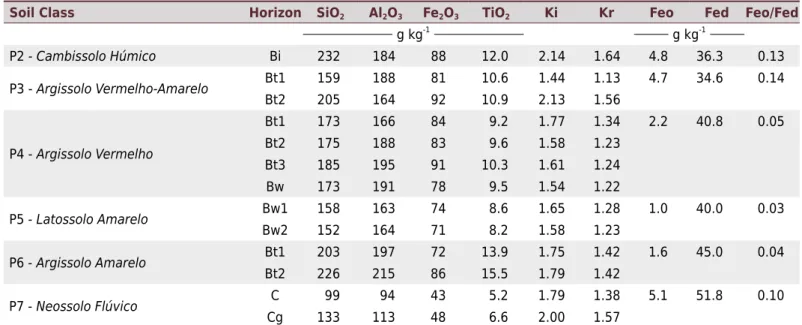
As regards the composition obtained by sulfuric acid digestion of the subsurface horizons, SiO2 and Al2O3 are predominantly present, with contents from 94 to 232 g kg
-1, most of
them greater than 150 g kg-1. However, the Fe
2O3 were approximately half of the previous oxides (43 to 92 g kg-1) (Table 5). In this context, similar results were obtained by Pereira and Anjos (1999) in soils developed in different rocks and sediments, and Chagas et al. (2013) in Argissolos developed from noritic granulites in the northwest region of the state of Rio de Janeiro. Santos (2009), in the Ribeirão do Cachimbal microbasin in the Paraíba do Sul region, highlights equitable distribution between SiO2, Al2O3, and Fe2O3 in basic rocks, while for acid rock, Fe2O3 was approximately 1/3 in comparison to SiO2 and Al2O3. The Ki and Kr values also had a similar pattern to the study under discussion.
According to Resende and Santana (1988), the qualitative composition of the clay mineralogy can be inferred by the molecular relations of the Ki and Kr index. The Ki values in the profiles ranged from 1.44 to 2.14, with most less than 1.8, and the Kr ranged from 1.13 to 1.64. The values of both indexes >0.75 indicate the predominance of kaolinite in the clay fraction. This evidence was also reported by Calderano Filho (2012). Thus, kaolinite was often accompanied by goethite and gibbsite.
In fact, the iron oxide contents obtained by selective extraction show wide variation among the soil profiles. Highest values were observed in the C horizon of the Neossolo Flúvico, both for the Feo (1.0 to 5.1 g kg-1) and Fed contents (34.6 to 51.8 g kg-1) (Table 5). The lowest Feo contents were found in the backslope soil profiles, while, for the Fed, there was a tendency to increase from the summit to the toeslope. The predominance of high crystallinity forms of iron was detected by the Feo/Fed ratio and contents ranged from 0.03 to 0.14. In the slope profiles, contents were less than 0.05, which are lower than those found in the summit soil profiles (talus deposit) and toeslope (Table 5). In soils developed from different parent materials, Pereira and Anjos (1999) reported the variation among the subsurface horizons. These authors observed predominance of Fed,
Table 5. Oxides obtained by sulfuric acid digestion and selective extraction of the soils from the Pito Aceso basin, municipality of
Bom Jardim (RJ)
Soil Class Horizon SiO2 Al2O3 Fe2O3 TiO2 Ki Kr Feo Fed Feo/Fed
g kg-1
g kg-1
P2 - Cambissolo Húmico Bi 232 184 88 12.0 2.14 1.64 4.8 36.3 0.13
P3 - Argissolo Vermelho-Amarelo Bt1 159 188 81 10.6 1.44 1.13 4.7 34.6 0.14
Bt2 205 164 92 10.9 2.13 1.56
P4 - Argissolo Vermelho
Bt1 173 166 84 9.2 1.77 1.34 2.2 40.8 0.05
Bt2 175 188 83 9.6 1.58 1.23
Bt3 185 195 91 10.3 1.61 1.24
Bw 173 191 78 9.5 1.54 1.22
P5 - Latossolo Amarelo Bw1 158 163 74 8.6 1.65 1.28 1.0 40.0 0.03
Bw2 152 164 71 8.2 1.58 1.23
P6 - Argissolo Amarelo Bt1 203 197 72 13.9 1.75 1.42 1.6 45.0 0.04
Bt2 226 215 86 15.5 1.79 1.42
P7 - Neossolo Flúvico C 99 94 43 5.2 1.79 1.38 5.1 51.8 0.10
Cg 133 113 48 6.6 2.00 1.57
Ki = (SiO2/Al2O3) × 1.7; Kr = (SiO2 × 1.7)/(Al2O3 + (0.64 × Fe2O3); Feo: iron extracted by oxalate ammonium acid; and Fed: iron extracted by
and greater Feo participation in the Cg horizons, which resulted in Feo/Fed ratios similar to those of this study. Santos (2009) observed wide variation in these oxides among the soil classes and among the horizons of each soil profile; the Feo/Fed ratio was slightly lower in the soils formed on the slope (backslope).
The differentiated formation of the soils is revealed by the application of theories and models that include the factors, mechanisms, and processes of soil formation. These will be approached clearly by variations in the degree of pedogenetic development, depending on the morphological, physical, chemical, and mineralogical properties of the profiles studied. The Neossolo Litólico and Cambissolo Húmico have the lowest degree of development, which is attributed to rejuvenation (morphogenesis > pedogenesis) through constant deposition of rock fragments as a talus deposit. In the Neossolo Flúvico, the constant accumulation of sediments is mainly due to the deposition of alluvial materials with different particle sizes and chemical compositions. Furthermore, for the Neossolo Flúvico with seasonal hydromorphism, expression of the great majority of pedogenetic processes is limited by its lowland position and proximity to the watercourse. As a reflection of seasonal hydromorphism, the anaerobic condition leads to reduction of Fe3+ to Fe2+ and, thus, the colorlessness of the iron oxides. In this process, the grayish colors stand out as a consequence of the mixture of kaolinite and organic matter, resulting in the gleization process (reduction/oxidation) (Kämpf and Curi, 2012b).
Nevertheless, Argissolos occur mainly where the flow lines lead to water convergence (concave curvature), providing greater water infiltration in the soil profile and surface runoff. The greater internal water flow in the profile contributes to expression of downward translocation of dispersed colloidal organic and mineral materials, as observed by the textural gradient and increase in OC contents in the subsurface. In this soil, the absolute increase in the clay content in the subsurface horizon is caused by the pedogenetic process of argilluviation (eluviation/illuviation), which was observed through the relative increase in the clay content and by the cutans in the Bt1 and Bt2 horizons. In association with the previous process, surface runoff promotes selective removal of the mineral and organic colloidal particles by the elutriation process (Kämpf and Curi, 2012b). The argilluviation or elutriation processes occurring in an isolated or combined manner direct the formation of the B textural horizon.
In the Latossolo Amarelo and Argissolo Vermelho, the presence of the Bw horizon suggests considerable evolution of soils due to lower participation of silicate minerals in the clay fraction and consequent relative increase in oxides, attributed to the process of ferralitization (desilication and oxidation) (Kämpf and Curi, 2012b), which is favored by the combination of free drainage in the soil profile and high rainfall. In addition to the action of pedogenetic processes, possible variations in the chemical and mineralogical composition of the parent material lead to differences in the sorption complex and color variation in the subsurface. However, the presence of colluvium is considered possible since variations in the relationship between coarse sand and fine sand were found, as in Argissolo Vermelho-Amarelo from the significant change between the Bt1 and Bt2 horizons, in the Argissolo Vermelho between the Ap and BA horizons, and the Latossolo Amarelo between the AB and BA horizons (Table 4).
material deposited from summit surfaces provides latossólicas porperties, especially microaggregates, kaolinite mineralogy, and oxides.
In the present landscape, the occurrence of Latossolos demarcates the resilience of these soils and their strong association with accentuated development of the surface horizons and the structure of the profile as a whole. In the surface of occurrence, the convex relief form is highlighted, as a factor that influences divergence of the lines of water flow, minimizing the erosive action of the surface water. The study by Chagas (2006) showed the influence of curvature on the degree of weathering of soils, with the most developed soils always occupying the slopes with convex curvature, similar to that verified in this study.
The occurrence of the Bt horizon over Bw in the Argissolo Vermelho suggests the occurrence of differentiated pedogenic processes, indicating possible polygenetic formation. According to Bocquier (1973), it is possible that transformations from one soil to another are not complete, especially in the deeper layers or horizons of the soil profile, since accumulations and transformations make them more superficial. Coltrinari et al. (1978) indicate the possibility of significant clay accumulation at the top of a B latossólico horizon because of translocation of the clay fraction, mainly as a result of the water percolation through the profiles. In the landscape of the present study, this would be controlled by climatic variation throughout the Pleistocene/Holocene, as highlighted by Lepsch and Buol (1986), Pessenda et al. (2005), and Calegari (2008).
CONCLUSIONS
Local geomorphological features are associated with possible variations in the chemical and mineralogical composition of the parent material, directly influencing pedogenesis and conditioning the occurrence of distinct soil classes in the landscape. Variation in the geomorphic surfaces conditions soil formation processes under current conditions and preservation of polygenetic soils.
Soils with a lower degree of development (Neossolos and Cambissolos) and with greater participation of the sorption complex were identified at the summit (talus deposit) and toeslope (colluvial-alluvial), whereas the more developed soils with lower nutrient content occurred in the concave (Argissolos) and convex (Latossolo) backslope, except for the Argissolo Vermelho-Amarelo in the shoulder, which had high content of the sorption complex.
The formation of the A húmico horizon can be explained by the climate and vegetation conditions, while its current occurrence is due to the condition of greater stability of relief features, as in the Latossolo. The influence of the microclimate near the rocky base with lower temperature at higher altitude (>1,000 m) and the physical protection provided by the rock fragments is increased for the Neossolo Litólico and Cambissolo Húmico.
The development of a textural gradient in the Argissolos results from the combination of several processes and, in this study, it was closely related to water activity on the soil surface, whose concave curvature and linear profile condition both water infiltration in the soil profile and surface flow, removing particles of colloidal size and/or water percolation in the profile that facilitates the translocation of the colloidal mineral material.
ACKNOWLEDGMENTS
Landscape dynamics associated to indicators to subsidize land use planning and the characterization of environmental services. Thanks also to the researcher Fabiano de Carvalho Balieiro from Embrapa Solos for the landscape design presented in figure 2.
REFERENCES
Almeida JA, Cararo DC, Uberti AAA. Genesis of the sombric horizon in Ultisols (Red Argisols) in Southern Santa Catarina, Brazil. Rev Bras Cienc Solo. 2009;33:405-16. https://doi.org/10.1590/S0100-06832009000200018
Benites VM, Madari B, Machado PLOA. Extração e fracionamento quantitativo de substâncias húmicas do solo: um procedimento simplificado de baixo custo. Rio de Janeiro: Embrapa Solos,
2003. (Comunicado técnico, 16).
Bocquier G. Genése et évolution de deux toposéquences de sols tropicaux du Tchad:
interprétation biogéodynamique. Paris: Orstom, 1973.
Botelho MR. Gênese de horizontes subsuperficiais escuros de solos em área do Batólito Pelotas,
RS [tese]. Pelotas: Universidade Federal de Pelotas; 2011.
Buol SW, Eswaran H. Oxisols. Adv Agron. 1999;68:151-95.
https://doi.org/10.1016/S0065-2113(08)60845-7
Campos MCC, Marques Júnior J, Pereira GT, Montanari R, Camargo LA. Relações solo-paisagem em uma litossequência arenito-basalto na região de Pereira Barreto, SP. Rev Bras Cienc Solo. 2007;31:519-29. https://doi.org/10.1590/S0100-06832007000300012
Campos MCC, Ribeiro MR, Souza Júnior VS, Ribeiro Filho MR, Almeida MC.
Relações solo-superfície geomórfica em uma topossequência várzea-terra firme na região de Humaitá (AM). Rev Bras Cienc Solo. 2012;36:325-36.
https://doi.org/10.1590/S0100-06832012000200002
Campos MCC, Ribeiro MR, Souza Júnior VS, Ribeiro Filho MR, Costa EUC. Segmentos de vertente e atributos do solo de uma topossequência na região de Manicoré, AM. Rev Cienc Agron. 2010;41:501-10. https://doi.org/10.1590/S1806-66902010000400001
Campos MCC, Ribeiro MR, Souza Júnior VS, Ribeiro Filho MR, Souza RVCC. Relações solo-paisagem em uma topossequência sobre substrato granítico em Santo Antônio do Matupi, Manicoré (AM). Rev Bras Cienc Solo. 2011;35:13-23. https://doi.org/10.1590/S0100-06832011000100002
Calegari MR. Ocorrência e significado paleoambiental do Horizonte A húmico em Latossolos [tese]. Piracicaba: Escola Superior de Agricultura “Luiz de Queiroz”; 2008.
Calderano Filho B. Análise geoambiental de paisagens rurais montanhosas da Serra do Mar
utilizando redes neurais artificiais. Subsídios a sustentabilidade ambiental de ecossistemas
frágeis e fragmentados sob interferência antrópica [tese]. Rio de Janeiro: Universidade Federal do Rio de Janeiro; 2012.
Calderano Filho B, Polivanov H, Guerra AJT, Chagas CS, Carvalho Júnior W, Calderano SB. Estudo geoambiental do município de Bom Jardim - RJ, com suporte de geotecnologias: subsídios
ao planejamento de paisagens rurais montanhosas. Sociedade & Natureza. 2010;22:55-73.
https://doi.org/10.1590/S1982-45132010000100005
Carvalho Júnior W, Chagas CS, Calderano Filho B, Bhering SB, Donagemma GK, Calderano SB,
Araújo FO, Pereira NR. Zoneamento agroecológico do município de Bom Jardim, região serrana
do Estado do Rio de Janeiro. Rio de Janeiro: Embrapa Solos; 2013. (Boletim de pesquisa e desenvolvimento, 230).
Clemente EP, Schaefer CEGR, Oliveira FS, Albuquerque Filho MR, Alves RV, Sá MMF, Melo WF, Corrêa GR. Topossequência de solos na Ilha da Trindade, Atlântico Sul. Rev Bras Cienc Solo.
2009;33:1357-71. https://doi.org/10.1590/S0100-06832009000500028
Chagas CS. Mapeamento digital de solos por correlação ambiental e redes neurais em uma
bacia hidrográfica no domínio de mar de morros [tese]. Viçosa: Universidade Federal de
Chagas CS, Fontana A, Carvalho Junior W, Caires SM. Atributos topográficos
na diferenciação de Argissolos. Rev Bras Cienc Solo. 2013;37:1441-53. https://doi.org/10.1590/S0100-06832013000600002
Coltrinari L, Coutard JP, Nakashima P. Itinerário de excursão ao Vale do Parateí, SP. In: Colóquio
interdisciplinar Franco-Brasileiro “Estudo e cartografia de formações superficiais e suas aplicações em regiões tropicais”; São Paulo. São Paulo: Guias das Excursões; 1978. p.11-28.
Cooper M, Vidal-Torrado P. Gênese de ferri-argilãs em horizontes b texturais de uma sequência de solos sobre diabásio em Piracicaba (SP). Sci Agric. 2000;57:745-50. https://doi.org/10.1590/S0103-90162000000400024
Cooper M, Vidal-Torrado P, Grimaldi M. Soil structure transformations from ferralic to nitic horizons on a toposequence in Southeastern Brazil. Rev Bras Cienc Solo. 2010;34:1685-99. https://doi.org/10.1590/S0100-06832010000500021
Corrêa MM, Ker JC, Barrón V, Torrent J, Curi N, Torres TCP. Caracterização física, química, mineralógica e micromorfológica de horizontes coesos e fragipãs de solos vermelhos e amarelos do ambiente tabuleiros costeiros. Rev Bras Cienc Solo. 2008;32:297-313. https://doi.org/10.1590/S0100-06832008000100028
Daniels RB, Gamble EE, Cady JG. The relation between geomorphology and soil morphology and genesis. Adv Agron. 1971;23:51-88. https://doi.org/10.1016/S0065-2113(08)60150-9
Dantas ME. Geomorfologia do Estado do Rio de Janeiro. In: CPRM. Serviço Geológico do Brasil. Rio de Janeiro: geologia, geomorfologia, geoquímica, geofísica, recursos minerais, economia mineral, hidrogeologia, estudos de chuvas intensas, solos, aptidão agrícola, uso e cobertura
do solo, inventário de escorregamentos, diagnóstico geoambiental [CD ROM]. Rio de Janeiro:
Embrapa Solos; Niterói: DRM- RJ; 2001.
Dokuchaev VV. Russian Chernozem. Jerusalem: Israel Program of Scientific Translation; 1967.
Donagema GK, Campos DVB, Calderano SB, Teixeira WG, Viana JHM, organizadores. Manual de métodos de análise do solo. 2a ed rev. Rio de Janeiro: Embrapa Solos; 2011.
Empresa Brasileira de Pesquisa Agropecuária - Embrapa. Centro Nacional de Pesquisa de Solos.
Anais da 1a
. Reunião de Classificação, Correlação e Interpretação de Aptidão Agrícola de Solos;
1979; Rio de Janeiro, SNLCS-SBCS.
Figueiredo MA, Varajão AFDC, Fabris JD, Loutfi IS, Carvalho AP. Alteração superficial e pedogeomorfologia no Sul do Complexo Bação - Quadrilátero Ferrífero (MG). Rev Bras Cienc
Solo. 2004;28:713-29. https://doi.org/10.1590/S0100-06832004000400012
Hugget RJ. Soil landscape system: a model of soil genesis. Geoderma. 1975;1:1-22. https://doi.org/10.1016/0016-7061(75)90035-X
Inda Jr AV, Klamt E, Nascimento PC. Composição da fase sólida mineral do solo. In: Meurer EJ, editor. Fundamentos de química do solo. 5a ed. Porto Alegre: Evangraf, 2012. p.29-59.
Jenny H. Factors of soil formation - A system of quantitative pedology. New York: Mac Graw Hill; 1941.
Kämpf N, Curi N. Conceitos de solo e sua evolução histórica. In: Ker JC, Curi N, Schaefer CEGR, Vidal-Torrado P, editores. Pedologia: fundamentos. Viçosa, MG: Sociedade Brasileira de Ciência do Solo; 2012a. p.1-20.
Kämpf N, Curi N. Formação e evolução do solo (pedogênese). In: Ker JC, Curi N, Schaefer CEGR, Vidal-Torrado P, editores. Pedologia: fundamentos. Viçosa, MG: Sociedade Brasileira de Ciência do Solo; 2012b. p.207-302.
Lepsch IF. Formação e conservação dos solos. 2a ed. São Paulo: Oficina de Textos; 2010. Lepsch IF, Buol SW. Oxisol-landscape relationship in Brazil. In: Proceedings of the 8th International Soil Classification Workshop; Campinas; 1986. Rio de Janeiro: Embrapa, SNLCS;
University of Puerto Rico; 1988. p.174-89.
Lima HN, Mello JWV, Schaefer CEGR, Ker JC, Lima AMN. Mineralogia e química de três solos
de uma topossequência da Bacia Sedimentar do Alto Solimões, Amazônia Ocidental. Rev Bras
Lunardi Neto A. Gênese de horizontes subsuperficiais escurecidos em Argissolos de Santa
Catarina e em Luvissolo da Campanha Gaúcha [tese]. Lages: Universidade do Estado de Santa Catarina; 2012.
Matos GMM, Ferrari PG, Cavalcanti JC. Projeto faixa calcaria Cordeiro/Cantagalo. Belo Horizonte:
Departamento Nacional de Produção Mineral, 1980.
Martins FP, Rosolen VS. Caracterização morfológica e física de uma catena (Latossolo- Gleissolo)
no campo de murundu do Córrego da Fortaleza, chapada Uberlândia-Uberaba, Uberlândia-MG. Caminhos de Geografia. 2014;15:186-200.
Mendes CAR. Erosão superficial em encosta íngreme sob cultivo perene e com pousio no
Município de Bom Jardim - RJ [tese]. Rio de Janeiro: Universidade Federal do Rio de Janeiro; 2006.
Moreau AMSS, Costa LM, Ker JC, Gomes FH. Gênese de horizonte coeso, fragipã e duripã em solos do tabuleiro costeiro do sul da Bahia. Rev Bras Cienc Solo. 2006;30:1021-30. https://doi.org/10.1590/S0100-06832006000600011
Nunes WAGA, Ker JC, Schaefer CEGR, Fernandes Filho EI, Gomes FH. Relação solo-paisagem-material de origem e gênese de alguns solos no domínio
do “Mar de Morros”, Minas Gerais. Rev Bras Cienc Solo. 2001;25:341-54.
https://doi.org/10.1590/S0100-06832001000200011
Oenning I. Gênese e classificação de solos argilosos com horizonte B escurecido do Sul do Brasil
[dissertação]. Viçosa: Universidade Federal de Viçosa; 2001.
Pennock DJ, Zebarth BJ, De Jong E. Landform classification and soil distribution
in hummocky terrain, Saskatchewan, Canada. Geoderma. 1987;40:297-315. https://doi.org/10.1016/0016-7061(87)90040-1
Pereira MG, Anjos LHC. Formas extraíveis de ferro em solos do Estado do Rio de Janeiro. Rev
Bras Cienc Solo. 1999;23:371-82. https://doi.org/10.1590/S0100-06831999000200020
Pereira MG, Schiavo JA, Fontana A, Dias Neto AH, Miranda LPM. Caracterização e classificação
de solos em uma topossequência sobre calcário na Serra da Bodoquena, MS. Rev Bras Cienc Solo. 2013;37:25-36. https://doi.org/10.1590/S0100-06832013000100003
Pessenda LCR, Gouveia SEM, Freitas HA, Ribeiro AS, Aravena R, Bendasolli JA,
Ledru MP, Siefeddine AF, Scheel-Ybert R. Isótopos do carbono e suas aplicações em estudos
paleoambientais. In: Souza CRG, Suguio K, Oliveira AMS, Oliveira PE, editores. Quaternário do
Brasil. Ribeirão Preto: Holos Editora; 2005. p.75-93.
Queiroz Neto JP, Castro SS. Formações superficiais e Latossolo Vermelho-Amarelo húmico na
área de Bragança Paulista, estado de São Paulo, Brasil. In: Anais 18° Congresso Brasileiro de Geologia; 1974; Porto Alegre. Porto Alegre: Sociedade Brasileira de Geologia; 1974. p.65-83.
Resende M, Santana DP. Uso das relações Ki e Kr na estimativa da mineralogia para
classificação dos Latossolos. In: Anais da 3a Reunião de Classificação, Correlação de Solos
e Interpretação de Aptidão Agrícola; 1988; Rio de Janeiro. Rio de Janeiro: Embrapa SNLCS; 1988. p.225-32.
Ribeiro MR, Oliveira LB, Araújo Filho JC. Caracterização morfológica do solo. In: Ker JC, Curi
N, Schaefer CEGR, Vidal-Torrado P, editores. Pedologia: fundamentos. Viçosa, MG: Sociedade Brasileira de Ciência do Solo; 2012. p.47-80.
Rodolfo Júnior F, Araújo LG, Souza RQ, Batista FPS, Oliveira DNS, Lacerda MPC. Relações
solo-paisagem em topossequências na fazenda Água Limpa, Distrito Federal. Nativa, 2015;03:27-35. https://doi.org/10.14583/2318-7670
Ruhe RV. Geomorphic surfaces and the nature of soils. Soil Sci. 1956;82:441-56.
Ruhe RV. Elements of soil landscape. In: Transactions of the 7th International Congress of Soil Science; 1960. Madison: Soc Soil Sci; 1960. p.165-70.
Santos HG, Jacomine PKT, Anjos LHC, Oliveira VA, Oliveira JB, Coelho MR, Lumbreras JF, Cunha TJF. Sistema brasileiro de classificação de solos. 3a ed. Rio de Janeiro: Embrapa Solos; 2013b.
Santos RD, Lemos RC, Santos HG, Ker JC, Anjos LHC, Shimizu SH. Manual de descrição e coleta
de solo no campo. 6a ed rev ampl. Viçosa, MG: Sociedade Brasileira de Ciência do Solo. 2013a.
Schaetzl R, Anderson S. Soil: genesis and geomorphology. Cambridge: Cambridge University Press; 2005.
Silva AC, Vidal-Torrado P. Gênese dos Latossolos Húmicos e sua relação com a evolução da paisagem numa área cratônica do sul de Minas Gerais. Rev Bras Cienc Solo. 1999;23:329-41. https://doi.org/10.1590/S0100-06831999000200017
Silva AC, Vidal-Torrado P, Pérez MG, Martin Neto L, Vasquez FM. Relações entre matéria orgânica
do solo e declividade de vertentes em toposseqüência de Latossolos do Sul de Minas Gerais. Rev Bras Cienc Solo. 2007;31:1059-68. https://doi.org/ 10.1590/S0100-06832007000500022
Soil Survey Staff. Keys to soil taxonomy. 12th ed. Washington, DC: United States Department of
Agriculture, Natural Resources Conservation Service; 2014.