Mathema cal model for supply chain design with
me postponement
Marcos Wagner Jesus Servare Junior1, Patricia Alcântara Cardoso2, Marta Monteiro da Costa Cruz3,Marcia Helena Moreira Paiva4
1Programa de Pós-Graduação em Engenharia Civil – Transportes, UFES, [email protected] 2Programa de Pós-Graduação em Engenharia Civil – Transportes, UFES, [email protected] 3Programa de Pós-Graduação em Engenharia Civil – Transportes, UFES, [email protected] 4Programa de Pós-Graduação em Engenharia Elétrica, UFES, [email protected]
Recebido:
13 de fevereiro de 2017
Aceito para publicação:
6 de julho de 2018
Publicado:
31 de dezembro de 2018
Editor de área:
Claudio Barbieri da Cunha
ABSTRACT
Designing a supply chain is a major strategic issue due to its impact on efficiency and responsiveness. The design becomes more complex when the goal is to reduce
distribu-on costs and use the me postpdistribu-onement in the supply chain. The mathema cal mod-els currently studied in the literature consider various actors involved in the network. However, in real problems there are different combina ons of actors, crea ng own transporta on flows and increasing the complexity of a supply chain. This paper pro-poses a model for designing supply chains with me postponement from a mixed inte-ger non-linear programming formula on to minimize the total costs, considering the transporta on, facili es opening and opera onal costs. The model allows the possibility of a hybrid facility, that is, two kinds of facili es opened in the same place, an important opportunity to saving costs. Some sets of instances were simulated to find the op mal solu on of that model and analyze the supply chain behavior in different instances sizes. These scenarios were solved by a commercial solver and its performance was assessed. The model presents feasibility of use for small and medium-sized instances with enough compu ng me to aid in management decision making.
RESUMO
Projetar cadeia de suprimentos é uma importante decisão estratégica e seu impacto influencia diretamente na eficiência e no nível de serviço. O projeto se torna mais com-plexo quando o obje vo é minimizar o custo de distribuição e u lizar a postergação de tempo na cadeia de suprimentos. Os modelos matemá cos atualmente estudados na literatura de cadeia de suprimentos consideram vários atores. Entretanto, em prob-lemas reais existem diferentes combinações desses atores, criando fluxos próprios de transportes e aumentando a complexidade da cadeia de suprimentos. Este ar go propõe um modelo matemá co para projetar a cadeia de suprimentos com postergação de tempo a par r da programação não linear inteira mista para minimizar o custo total, considerando os custos de transportes, abertura de instalações e operacionais. O modelo permite a possibilidade de uma instalação híbrida, ou seja, dois pos de in-stalações abertas no mesmo local, sendo uma importante oportunidade de redução de custos. Diferentes conjuntos de instâncias foram simulados para buscar a solução ó ma e analisar o comportamento da cadeia de suprimentos em diferentes tamanhos de cenários, os quais foram resolvidos usando um solver comercial e suas performances foram estudadas. O modelo proposto apresenta viabilidade em seu uso para instâncias pequenas e médias com tempo computacional suficiente para auxílio no processo de tomada de decisão.
Keywords:
Supply Chain Design, Time postponement, Mathema cal Model.
Palavras-chaves:
Projeto de cadeia de suprimentos, Postergação de Tempo,
Modelo Matemá co.
DOI:10.14295/transportes.v26i4.1324
1. INTRODUCTION
Decisions regarding product distribution are important strategic issues for most organizations. Speci ically, the inventory location problem is a critical component in the supply chain’s strate Speci
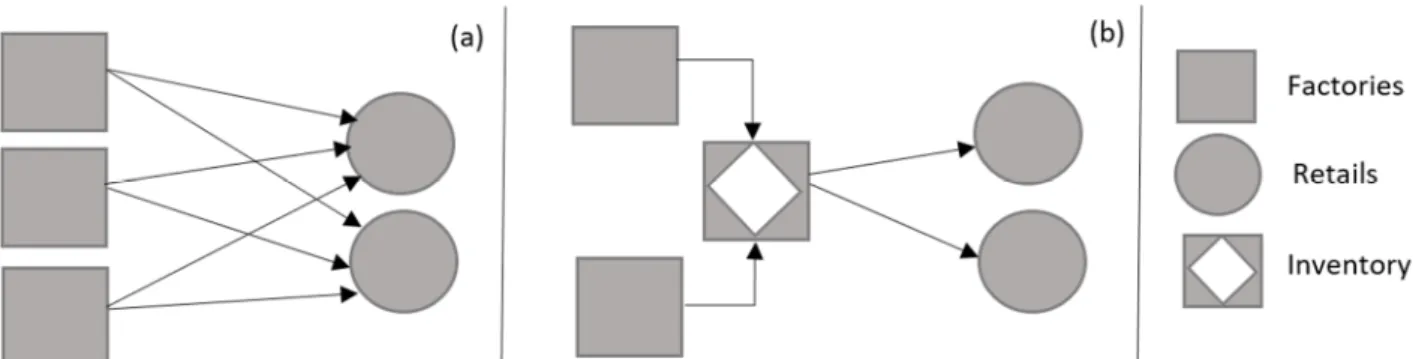
ically, the inventory location problem is a critical component in the supply chain’s strate-gic management planning. Some important factors such as costs and distances to the points of consumption, as well as the moment that products should move downstream in the supply chain must be considered. The challenge of making the product available in the required place and time is a challenge that must be solved in order to design the best logistics supply chain. The use of modern tools and technology to assist in this process is observed every moment. Therefore, we need to consider some important factors such as costs and distances to the points of consumption and demand for each of these regions. Choosing the best supply chain con iguration and providing the demand with the product availability in the place and time in which it is required are de iance in this kind of problem. Time postponement is one of the consequences from practice of inventory centralization at a speci ic point in the supply chain, the inventory could be opened in a supplier or factory (see Figure 1), before sending to following node, if the inventory were opened in the retail will be a different problem type know by speculation principle.
Figure 1. Supply chain without Time Postponement (a) and supply chain with Time Postponement (b) Time postponement can be de ined as the delaying of product movement as late as possible within a physical distribution process (Cardoso, 2002). Researches regarding time postpone- ment cover different areas, such as pharmaceutical industries (Razmi et al., 2013) and auto in-dustry (Nozick and Turnquist, 2001). Thus, the organizations seek effective ways to rethink their logistical investments. The re-de inition of the boundaries of these organizations, their skills, eliminating unnecessary steps and restructuring processes are factors that contribute to this end (Ferreira and Alcantara, 2011).
Inventory policies directly in luence the strategic decisions of a company, due to its capacity, transportation decisions, responsiveness, and investments. This characterization may impact the competitiveness of the organization and may promote the minimization of costs and, even, to maximize the responsiveness (Fernandes et al., 2011).
The number of companies that centralize the receiving processes, storage, order picking, packing and shipping has increased (Santos, 2006; Rodrigues and Pizzolato, 2013). The central-ization is expected to minimize logistics costs. Other companies and authors are looking for integrated transportation and inventory policies in order to minimize logistic costs (e.g. Peres
et al., 2017).
In order to minimize costs and use the time postponement in logistics network some authors [e.g., (Lau and Lau, 1996; Garcia-Dastugue and Lambert, 2007; Çelebi, 2015)] present in the literature different mathematical models that aim to optimize this management process.
Thus, the use of mathematical modeling to obtain an exact solution for problems of this type contributes to an alternative decision to a business agent. Different than others, this paper presents a model that allows the inclusion of a hybrid facility to design a supply chain with time postponement (SCDTP) using mixed integer non-linear pro-gramming to obtain the minimum total cost.
2. LITERATURE REVIEW
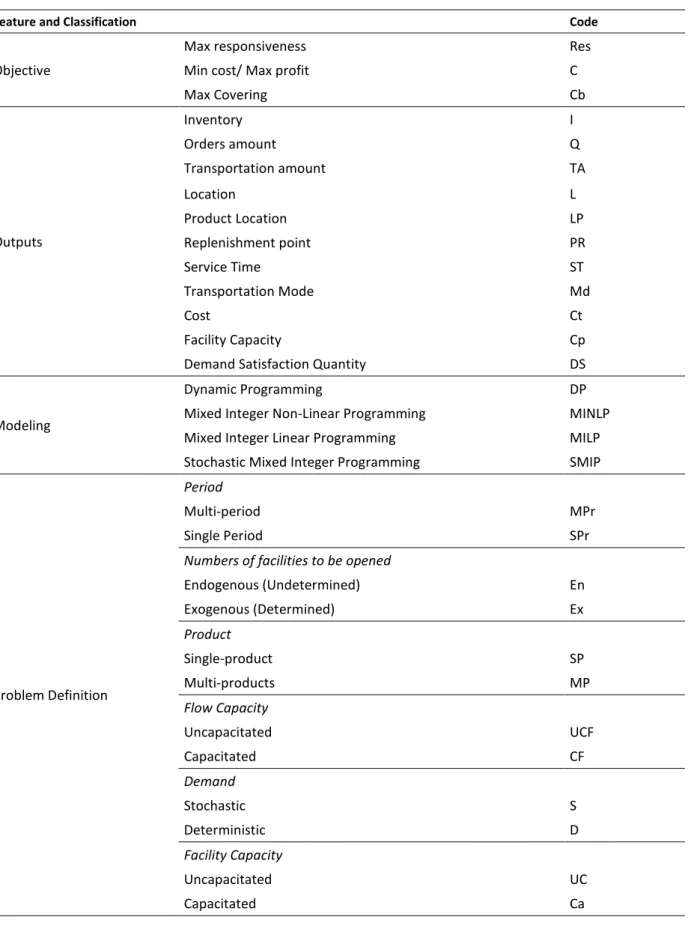
The concept of postponement was de ined by Alderson (1950) as the ordering of stages of value aggregation in manufacturing and marketing processes. This concept proposes to modify the form, identity, or place of goods occurring at the last possible point in the processes of manu-facture and physical distribution. The most important goal of the principle is to reduce the risks by keeping the products in one place and only changing them when the following echelon makes the order. Postponing the movement of the product was denominated time postponement; on the other hand, the post-ponement in the product differentiation was denominated form postponement.Cardoso (2002) points out the relationship between the economies related to the use of safety stock and time postponement. Furthermore, the author highlights the reduction of safety stock as an important advantage of time postponement costs. Time postponement requires the implementation of speci ic inventory policies that focus the products on a single point in the distribution channel until the order is placed (Ferreira, 2009). Servare Junior and Cardoso (2016) presented a literature review of SCDTP models to support the development of robust models, which are capable to take into account all logistics costs. These models are classi ied into four features and their characteristics. For each characteristic a code is proposed (see Table 1). ● Objective: The objective function presented in the paper, that is the main information which the authors want to optimize as minimizing cost or maximizing pro it (C), maxim-izing covering (Cb) and maximizing responsiveness (Res). ● Outputs: The variables used in the development of the mathematical models, each paper presents its variables to optimize the objective function and to be subject to con-straints of model, e.g. transportation mode (Md), facility location (L) and product location (LP). ● Modeling: In this section the model was classi ied according to the kind of mathe-matical programming, i.e. dynamic (DP), mixed integer non-linear (MINLP), mixed integer linear (MILP) or stochastic mixed integer programming (SMIP). ● Problem De inition: The main models characteristics as the how many periods and products the model consider to plan, the quantity of facilities that could be opened, if the vehicle and facility have a ixed capacity value.
These models range from simple single-product and single-period uncapacitated facility models [e.g. (Nozick and Turnquist, 2001)] to complex multi-product multi-period multi-mode models [e.g. (Kutanoglu and Lohiya, 2008)] and they are usually aimed at determining minimum cost or maximum pro it system design. Because of the increasing importance of network responsiveness in supply chain manage-ment, this has recently been considered as a signi icant additional objective for multi-objective supply chain network design [e.g. (Gaur and Ravindran, 2006)].
The solution methods for each model are then presented by Servare Junior and Cardoso (2016) in Table 2.
Table 1: Classification of Supply Chain Design with Time Postponement (Servare Junior and Cardoso, 2016).
Feature and Classification Code
Objective
Max responsiveness Res Min cost/ Max profit C
Max Covering Cb Outputs Inventory I Orders amount Q Transportation amount TA Location L Product Location LP Replenishment point PR Service Time ST Transportation Mode Md Cost Ct Facility Capacity Cp Demand Satisfaction Quantity DS
Modeling
Dynamic Programming DP Mixed Integer Non-Linear Programming MINLP Mixed Integer Linear Programming MILP Stochastic Mixed Integer Programming SMIP
Problem Definition
Period
Multi-period MPr
Single Period SPr
Numbers of facilities to be opened
Endogenous (Undetermined) En Exogenous (Determined) Ex Product Single-product SP Multi-products MP Flow Capacity Uncapacitated UCF Capacitated CF Demand Stochastic S Deterministic D Facility Capacity Uncapacitated UC Capacitated Ca
Table 2: Coding of reviewed articles in Supply Chain Design with Time Postponement (Servare Junior and Cardoso,
2016).
Reference Papers Problem Definition Modelling Output Objectives Solution method
Lau and Lau (1996) SPr; En; MP; UCF; UC; D MINLP Q C Heuristic
Das and Tyagi (1997) SPr; En; SP; UCF; UC; D MINLP TA C Heuristic
Eynan (1999) SPr; En; SP; UCF; UC; S MILP I C Exact
Nozick and Turnquist (2001) Spr; En; SP; UCF; UC; D MILP TA; L C Exact
Aviv and Ferdegruen (2001) Mpr; En; MP; UCF; UC; S DP LP C -
Gaur and Ravindran (2006) SPr; En; SP; UCF; Ca; D MINLP TA; L; Q; PR C; Res Heuristic Garcia-Dastugue and Lambert (2007) MPr; En; SP; UCF; UC; D MILP ST C Exact Kutanoglu and Lohiya (2008) MPr; En; MP; UCF; UC; D MINLP I; Md; DS C Heuristic Razmi et al. (2013) SPr; Ex; SP; UCF; Ca; S SMIP TA; L; Ct; Cp C; Cb Heuristic
Çelebi (2015) MPr; Ex; SP; UCF; Ca; D MILP I C GA
Lau and Lau (1996) used a Lagrangian multiplication procedure and then applied a heuristic for solving the problem MINLP. The implementation was the Levenberg-Marquardt algorithm, with the subroutine IMSL. From an initial solution to the implementation of heuristics enabled the convergence to the optimal solution in the instances that the authors indicated. Das and Tiagy (1997) use exact techniques through solvers to achieve the results to a MINLP problem and then select 8 customer areas and 3 facilities in the Southeastern United States, using data from secondary sources. The implementation of the model indicates the degree of centralization of inventory in each proposed scenario. They are suggested and solved 5 scenar-ios that range among them the features of the model formulation costs. Applications of Eynan (1999) model had the effect of centralizing inventories, for example, the pro it from the adoption of the planning tool. Nozick and Turnquist (2001) submit weights to balance the objective function according to the scenario of studies and, as a case, the model was applied in an automotive industry case study in the United States. The model was solved with 698 consumers zones, and the scenarios output presented answer with lower cost and greater coverage opening 23 and 64 warehouses, respectively. Aviv and Ferdegruen (2001) present the mathematical formulation, but do not make use of the model. Several algebraic applications and tests are carried out to simplify the problem. Gaur and Ravindran (2006) used two commercial solvers for solving the model. In this case, the authors present an algorithm that uses the solvers to perform steps proposed. Garcı́a-Dastugue and Lambert (2007) used exact techniques to solve the model in the indicated instances. Kutanoglu and Lohyia (2008) proposed the model to solve- two cases, the irst there was one facility, and the second there were three facilities, with the General Algebraic Modeling System (GAMS) modeling language together with CPLEX for the generated instances. A pharmaceutical distribution company in Tehran, Iran, was a case study analyzed by Razmi et al. (2013). In their paper, the distribution network has 2 factories, 6 available warehouses and 20 consumer areas. The plants produce, stock, ship and deliver drugs to customers. They implemented the same technique to ind the model solution and proposed scenarios. Çelebi (2015) executed a heuristic, the Genetic Algorithm, for solve the model.
Based on the aforementioned considerations, this work developed a SCDTP model including supply, production, distribution and inventory location in a supply chain and solved it using a commercial solver to ind the optimal solution in the instances created.
3. PROBLEM DEFINITION
The SCDTP discussed in this paper is a multi-stage logistics network including production, dis-tribution, retails and two possibilities of inventory location, the irst appearance is in the 1st level, the suppliers ship their products to this place located in one of the suppliers and the other possibility occurs in the 2nd level, the inventory will be inside of one of factories. The complete process of the SCDTP under consideration is illustrated in Figure 2.Figure 2. Time postponement process in the studied network
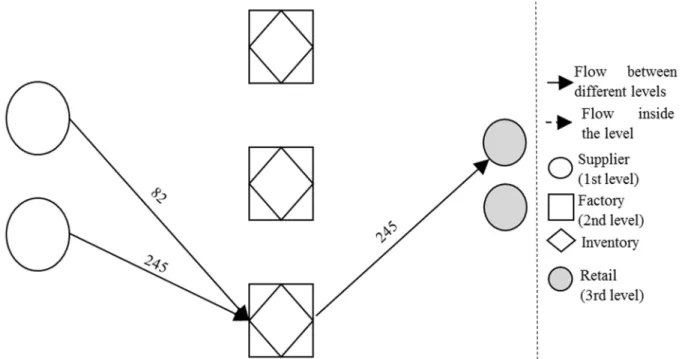
As illustrated in Figure 3, the supplies are shipped from the suppliers to retails through pro-duction centers, to use these supplies to produce goods, and inventory located in 1st or 2nd level. Retails and suppliers are assumed to be predetermined and ixed. The supplies are shipped to inventory or production centers and, then, if the supplies were shipped to inventory, they are shipped to production center or if the supplies were shipped to production center the products made in production center are shipped to inventory, this one located in the 2nd level. As a way to reduce costs, the proposal for this work includes the use of hybrid facilities. These facilities are able to contain two different types of facilities in the same location, saving space and preventing the company from having to buy other spaces. The model will be able to tell the manager which facilities will be combined and present him the best location. The SCDTP therefore considers a hybrid inventory-production facility whereby both inven-tory and production centers are established at the same location. The resulting cost saving is re lected in the objective function, which considers both the tradeoff of ixed opening costs of facilities and variable transportation costs. Thus, unlike previous models with hybrid facilities
(e.g. Pshivaee et al.,2010; Servare Junior et al., 2012), the use of hybrid-collection facilities is a decision variable in the SCDTP model.
Figure 3. A supply chain network with time postponement With the above situations in mind, the main issues to be addressed by this study are to de-termine the location and the number of production centers, and the location of the inventory or inventory-product center, that represent the degree of centralization of the network, and also to determine the product low between the facilities. SCDTP is not a case-based network and because of its generic nature, it can support a variety of industries such as pharmaceutical in-dustries (e.g. Razmi et al., 2013) and auto industry (e.g. Nozick and Turnquist, 2001). It is important to note that the SCDTP is designed to take network costs into account, such as the variable costs - transportation costs - and the ixed costs - opening and operational costs. According to Table 1, the problem in question can be coded as shown in Table 3.
Table 3: Coding of the problem in question
Problem Definition Modelling Output Objectives Solution method
SPr; Ex; SP; UCF; Ca; D MINLP I; TA. L; Ct C Exact
3.1. Model formula=on
To support the presentation of the proposed mathematical model, we irst provide a verbal de-scription of the model as follows. Minimize costs Subject to ● satisfying all forward and reverse demands,● balancing of lows between nodes, ● capacity constraints, ● logical constraints related to time postponement, ● non-negativity and binary constraints. The following notation are used in formulation of the model. Sets H: Fixed supplier locations ℎ ∈ I: Set of potential inventory locations in a supplier ∈ : Set of potential production center locations ! ∈ K: Set of potential inventory locations in a production center " ∈ # L: Set of potential inventory locations in a production center " ∈ # E: Set of joint potential sites between production centers and inventory ∈ $, ⊂ , ⊂ # Parameters
': Fixed cost of opening an inventory location in the 1st level of network (: Fixed cost of opening production center !.
): Fixed cost of opening production center !
*: Fixed saving cost associated with opening inventory location and produc- tion center at location
+': Shipping cost per unit of products from supplier ℎ to inventory location
,'(: Shipping cost per unit of products from inventory location i to production center j
(): Shipping cost per unit of products from production center ! to inventory location " -).: Shipping cost per unit of products from inventory location " to retail +(: Shipping cost per unit of products from supplier ℎ to production center ! (.: Shipping cost per unit of products from supplier ℎ to production center ! ': Operational cost in inventory location !(: Operational cost in production center ! "): Operational cost in inventory location " +: Quantity of products offered by the supplier ℎ ': Capacity for inventory location /(: Capacity for inventory location 0): Capacity of inventory location " .: Demand of retail Variables
1': 1 if an inventory location is opened in the 1st level of network; 0 otherwise 2(: 1 if a production center ! is opened; 0 otherwise
3): if an inventory location " is opened in the 2nd level of network; 0 otherwise 4+': Quantity of products shipped from supplier ℎ to inventory location
5'(: Quantity of products shipped from inventory location to production center ! (): Quantity of products shipped from production center ! to inventory location k 6).: Quantity of products shipped from inventory location " to retail 7+(: Quantity of products shipped from supplier ℎ to production center ! (.: Quantity of products shipped from production center ! to retail The time postponement design problem developed in this work is presented below: 8 9 '1' '∈: 9 (2( (∈; 9 )3) )∈< 9 *3*2* *∈= 9 9 +'4+' '∈: +∈> 9 9 ,'(5'( (∈; '∈: 9 9 () () )∈< (∈; 9 9 -).6). .∈? )∈< 9 9 +(7+( (∈; +∈> 9 9 (. (. .∈? (∈; 9 '1' '∈: 9 !(2( (∈; 9 ")3) )∈< Subject to 9 4+' '∈: 9 7+( (∈; + ∀ ℎ ∈ 9 4+' +∈> 9 5'( (∈; ∀ ∈ 9 5'( '∈: 9 7+( +∈> 9 () )∈< 9 (. .∈? ∀ ! ∈ 9 () (∈; 9 A). .∈? ∀ " ∈ # 9 4+' +∈> ≤ '1' ∀ ∈ 9 5'( (∈; ≤ '1' ∀ ∈ 9 5'( '∈: 9 7+( +∈> ≤ /(2( ∀ ! ∈ 9 () )∈< 9 (. .∈? ≤ /(2( ∀ ! ∈ 9 () ≤ 0)3) ∀ " ∈ # (∈; 9 A). ≤ 0)3) ∀ " ∈ # .∈? 9 A). 9 (. (∈; ≤ . ∀ ∈ C )∈< (2) (3) (4) (5) (6) (1) (7) (8) (9) (10) (11) (12)
(17) (18) (19) (20) 9 1' '∈: 9 3) )∈< 1 9 7+( (∈; ≤ E1 9 1' '∈: F ∙ + ∀ ℎ ∈ 9 (. (∈; ≤ E1 9 3) )∈< F ∙ . ∀ ∈ C 4+', 5'(, '), A)., 7+(, (. ≥ 0 ∀ ∈ , ! ∈ , " ∈ #, ℎ ∈ , ∈ C 1', 2(, 3) ∈ J0,1K ∀ ∈ , ! ∈ , " ∈ # The objective function (1) minimizes the total costs including ixed opening costs, transpor-tation costs and the cost savings associated with integrating inventory location and production centers at the same locations. Constraints (2) ensure that the demands of all production centers are satis ied, shipped directly from suppliers or through the inventory located in the 1st level. The Equations (3) – (5) assure the low balance at suppliers, inventories, production centers and retails [e.g. Pshivaae et al. (2010), Servare Junior et al. (2012) and Razmi et al. (2013)]. Constraints (8) – (12) are capacity constraints on facilities, which also prohibit the supplies and products from being transferred to facilities that are not opened. If the principle of post-ponement by Alderson (1950) de ines that the inventory can not be located at retail, speci ically this case is called by speculation, and as the inventory centralization is a consequence of time postponement, then the Constraint (13) ensure will be opened one inventory in the supply chain in the irst or second level of the supply chain (e.g. Das and Tiagy, 1997; Nozick and Turnquist, 2001; Razmi et al., 2013).
If any Xi = 1, the inventory is opened in the irst level of supply chain and the products will be not be shipped to an inventory in second level, this condition is assured by Equations (14), oth-erwise, if the inventory in the second level, the Constraint (15) guarantees that the suppliers ship their products to the inventory opened in that level. Finally, Constraints (16) and (17) enforce the binary and nonnegativity restrictions on the corresponding decision variables. The term 9 *3*2* *∈= in the objective function (1) is non-linear because it involves the multiplication of two binary variables. As Pishvaee et al. (2010) and Servare Junior et al. (2012), in order to avoid the com-plexity from a MINLP model, the above model is linearized reformulating the objective function as follows and by de ining a new variable: * 3*∗ 2* * J0; 1K ∀ ∈ $ (13) (14) (16) (15)
(21) Because the objective function minimizes costs, it has a tendency to put the value of * var-iable to 1. Therefore, we should only prohibit the value of * to be 1 in three conditions: when both of 3* and 2*or one of them is equal to zero. This can be achieved by adding the following constraint to the model: 2 ∗ * ≤ 3* 2* Adding constraints (19) and (21) the model (1) - (17), the objective function (1) may be re-placed by (20) making a linear model. Considering each feature of the models, adding the constraints of them to allow the creation of supply chain design with these actors and with time postponement, the model was developed presenting a new possible combination of participants, besides the possibility of opening a fa-cility (factory) on the second node and the discount associated with this installation is a hybrid facility with the inventory working on it.
4. COMPUTATIONAL PROCEDURES
15 different scenarios were created, so that a model of behavior analysis is performed from the increased number of participants in the network. Three groups of instances were produced ac-cording to the number of participants in each scenario, the irst group Instances 1-5, with a small amount of characters for each type of facility, increasing this amount in instances 6-10 and, further increasing, in instances 11-15. Table 4 shows the test instances. Also, the column called Group represents the test groups. The Instance column represents all test instances simulated and used. The column H indicates the number of suppliers and column I the number of suppliers that can store the goods originating from other suppliers in each in-stance. The columns J and K represent, respectively, the number of production centers in the 2nd level and the amount thereof that can become an inventory too. Lastly, column L shows the number of retails having a product demand.As a way of observing the behavior of the model, we used the largest number of possible installations as alternatives to open inventory, that is, all the facilities of 1st or 2nd level would be able to be chosen as inventory. Thus, the values of the pairs and and and # were the same. If it is necessary to run the model with different values it is possible, since ≤ and # ≤ .
Table 4: Test problems’ sizes
Group Instances P and Q R and S T
1 1 2 3 2 2 8 5 3 3 15 10 5 4 20 15 8 5 35 20 15 2 6 100 50 30 7 120 100 50 8 150 100 75 9 180 110 90 10 200 125 100
Table 4: Test problems’ sizes (continue)
Group Instances P and Q R and S T
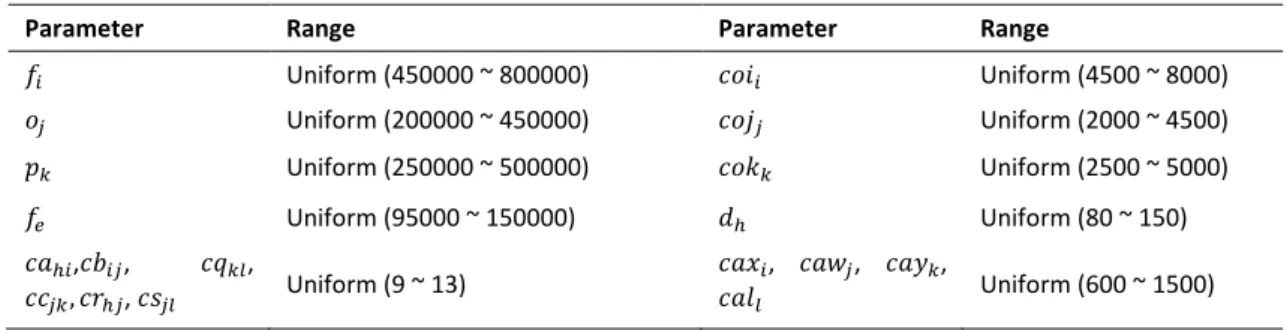
3 11 300 150 150 12 300 200 120 13 300 200 150 14 500 400 200 15 750 500 250 In the absence of actual values for model input parameters, the estimated values were used [See Pshivaae et al. (2010) and Servare Junior et al. (2012)]. Table 5 shows the parameters and ranges of values considered for each one.
Table 5: The values of the parameters used in the test problems
Parameter Range Parameter Range
' Uniform (450000 ~ 800000) ' Uniform (4500 ~ 8000) ( Uniform (200000 ~ 450000) !( Uniform (2000 ~ 4500) ) Uniform (250000 ~ 500000) ") Uniform (2500 ~ 5000) * Uniform (95000 ~ 150000) + Uniform (80 ~ 150) +', ,'(, -)., (), +(, (. Uniform (9 ~ 13) ', /(, 0), . Uniform (600 ~ 1500)
4.1. Computa=onal Results
The test instances aforementioned have been implemented in a commercial solver, the CPLEX 12.5 (IBM, 2012). All the tests are carried out on an Intel core i5 2.50 GHz computer with 4GB RAM and results are obtained [See Table 6].Table 6: Summary of test results
Group Instance Objective Function Inventory Time (Seconds)
1 1 398436 3U 00:52 2 385852 3V 00:47 3 398442 3W 00:94 4 388141 3XY 00:93 5 427830 3Z 01:87 2 6 581892 3VU 06:32 7 609047 3[\ 41:91 8 655430 3XX 52:29 9 703780 3\[ 51:66 10 757288 3XW 87:57 3 11 853506 3W] 184:78 12 979599 3X]^ 660:29 13 941204 3X]] 455:85 14 - - 7491:29* 15 - - 218:38*
After the simulations, we found that it is possible to ind model solutions for small and me-dium-sized. But from the instance #14 the CPLEX was not able to get the solution for lack of memory.
4.2. Discussion of the results
The model solved the instances from 1 to 13, respecting the constraints that the model is subject to, we also observed that instances 14 and 15 could not be solved due to lack of memory. The growth of the Objective Function within each instance group is explained by the increase of suppliers and the demand of customers, as well as a greater low between the facilities. It was also observed that the execution time generally increased as the instances became more com-plex, resulting in values that exceeded 10 minutes of execution or even being unable to complete the solution processing due to lack of memory. Although there are times over than 10 minutes are much longer than the processing time of the irst tests, it is important to note that it is a satisfactory time for the decision making in a supply chain design. The explanation for the irst event is that for some situations the problem became less costly as facilities were added, the model found a location of opening that generated fewer expenses, determined its openness and directed lows to this point, and the expense avoided for this loca-tion covered the of transportation costs that increases as new facilities are added upstream and new demands downstream. In turn, the computational effort could be reduced according to the processing of the algo-rithm from CPLEX 12.5 (IBM, 2012) to ind a solution for MINLP, once it inds a solution accord-ing to the parameters of the algorithm.
As a representation form, according to characteristics presented in Table 5, the schematiza-tion of the problem of Instance #1 is in Figure 3 and the solution found is shown in the Figure 5.
5. CONCLUSION
Because of the increasing importance of network costs and use of inventories in business net- work in supply chain management, this paper presents a mixed integer non-linear program-ming (MINLP) to solve SCDTP problem. Moreover, the model supports multiple levels and also considers cost savings associated with combined inventory and production centers. To reduce the complexity of the proposed MINLP model, the model is linearized by de ining a new variable and adding a constraint to the model. To solve the proposed model, it was used a commercial solver, the CPLEX 12.5 (IBM, 2012), to ind the instance exact solutions. The performance of the software was compared to different sizes of instances.In some cases, commercial solvers such as CPLEX 12.5 (IBM, 2012), are able to solve the problem in a reasonable computational time, considering the complexity of the important deci-sion to be taken. However, for large problems, there is a need for speci ic heuristics or metaheu-ristics, for the CPLEX was not able to inish the solution process, stopping for lack of memory. Thus, this work presented as a viable tool a model that is able to aid in decision making with fast and optimal answers that sustain a decision making with important information. Moreover, in the time postponement literature there was no model that presented characteris- tics like this, which indicated the location of facilities, the centralization of inventories, the quan-tities transported between these facilities and the cost of the entire supply chain design. Future research could be aimed at robust models to accommodate the changing parameters of the business environment during the life-time of the supply chain. In addition, addressing the demand uncertainty in a multi-product multi-period supply chains is a promising research way with signi icant practical relevance. Moreover, heuristics and metaheuristics, as simulated annealing or genetic algorithm, could be used to solve larger instances. Therefore, these techniques have allowed more suitable solu-tions to the problem. ACKNOWLEDGEMENTS
The authors acknowledge to CAPES (Brazilian Federal Agency for Support and Evaluation of Graduate Education) and FAPES – Project no. 287/2016 – for their inancial support.
REFERENCES
Alderson, W. (1950) Marketing ef iciency and the principle of postponement. Cost and pro it outlook. v. 3, pp. 15-18.
Aviv, Y.; and A. Federgruen (2001) Design for postponement: A comprehensive characterization of its bene its under unknown demand distributions. Operations Research, v. 49(4), pp. 578-598. DOI: 10.1287/opre.49.4.578.11229 Cardoso, P. A. (2002) The Principle of Postponement: a study at the supply chain of printing inks. Rio de Janeiro: PUC – Pontifı́-cia Universidade Católica. Doctoral dissertation, 161 p. DOI: 10.17771/PUCRio.acad.3752 Çelebi, D. (2015) Inventory control in a centralized distribution network using genetic algorithms: A case study. Computers & Industrial Engineering, v. 87, pp. 532-539. DOI: 10.1016/j.cie.2015.05.035 Das, C., and R. Tyagi (1997) Role of inventory and transportation costs in determining the optimal degree of centralization. Transportation Research Part E: Logistics and Transportation Review, v. 33(3), p. 171-179. DOI: 10.1016/S1366-5545(97)00019-7
Eynan, A. (1999) The multi-location inventory centralization problem with irst-come, irst-served allocation. European Jour-nal of Operational Research, Vol. 114(1), pp. 38-49. DOI: 10.1016/S0377-2217(98)00036-8 Fernandes, B. C.; F. H. Galamba, F. H.; Tosta; L. I. and R. S. Lima (2011) Impactos da utilização de centros de distribuição na logı́stica de distribuição de produtos acabados. Revista de literatura do transporte, v. 5, pp. 163-181. Ferreira, K. A. (2009) Uma estrutura conceitual para aplicação do postponement: estudo multicaso em empresas da indústria de alimentos. São Carlos: UFSCar – Universidade Federal de São Carlos. Doctoral dissertation, 203 p. Ferreira, K. A., and R. L. C. Alcantara (2011) Postponement: abordagens para sua aplicação em empresas da indústria de ali-mentos. In. XXXI Encontro Nacional de Engenharia de Produção, Belo Horizonte, pp 1-14.
Garcı́a-Dastugue, S. J. and D. M. Lambert (2007) Interorganizational time-based postponement in the supply chain. Journal of Business Logistics, v. 28(1), pp. 57-81. DOI: 10.1002/j.2158-1592.2007.tb00232.x Gaur, S.; and A. R. Ravindran (2006) A bi-criteria model for the inventory aggregation problem under risk pooling. Computers & industrial engineering, v. 51(3), pp. 482-501. DOI: 10.1016/j.cie.2006.08.009 IBM (2012) IBM ILOG CPLEX v12.5: User’s manual for CPLEX. Lau, H. S., and A. H. L. Lau (1996) The newsstand problem: A capacitated multiple-product single-period inventory problem. European Journal of Operational Research, v. 94(1), pp. 29-42. DOI: 10.1016/0377-2217(95)00192-1 Kutanoglu, E.; and D. Lohiya (2008) Integrated inventory and transportation mode selection: A service parts logistics system. Transportation Research Part E: Logistics and Transportation Review, v. 44(5), p. 665-683. DOI: 10.1016/j.tre.2007.02.001 Nozick, L. K., and M. A.Turnquist (2001) Inventory, transportation, service quality and the location of distribution centers. European Journal of Operational Research, v. 129(2), pp. 362-371. DOI: 10.1016/S0377-2217(00)00234-4 Peres, I. T.; H. M. Repolho; R. Martinelli; and N. J. Monteiro (2017) Optimization in inventory-routing problem with planned transshipment: A case study in the retail industry. International Journal of Production Economics, v. 193, p. 748-756. DOI: 10.1016/j.ijpe.2017.09.002 Pishvaee, M. R., Farahani, R. Z., and Dullaert, W (2010). A memetic algorithm for bi-objective integrated foward/reverse lo-gistic network design. Computers & Operations Research, v. 37, pp. 1100 – 1112. DOI: 10.1016/j.cor.2009.09.018 Razmi, J., A. Zahedi-Anaraki, and M. Zakerinia, M. (2013) A bi-objective stochastic optimization model for reliable warehouse network redesign. Mathematical and Computer Modelling, v. 58(11), pp. 1804-1813. DOI: 10.1016/j.mcm.2013.03.009 Rodrigues, E. F., and N. D. Pizzolato.(2013) The economy of distribution centers: The case of large retail networks in Brazil. African Journal of Business Management, v. 7, pp. 1541-1552. DOI: 10.5897/AJBM2013.1579 Santos, A. (2006) Centros de distribuição como vantagem competitiva. Revista de ciências gerenciais, Vol. 10, pp. 34-40. DOI: 10.17921/1415-6571.2006v10n12p34-40 Servare Junior, M. W. J., G. M. Ribeiro, and G. L. D. Chaves (2012). Um modelo matemático para redes logı́sticas com luxos di-retos e reversos e novos integrantes. Proceedings of XXXII Encontro Nacional de Engenharia de Produção, ABEPRO, Bento Gonçalves, pp. 1-14. Available in: http://www.abepro.org.br/biblioteca/enegep2012_TN_WIC_162_943_21087.pdf. Access in: 2017 january. Servare Junior, M. W. J., and P. A. Cardoso (2016) Time postponement in supply chain: a mathematical programming review. Proceedings of 23rd European Management Operations Association Conferece, EUROMA, Trondheim, pp. 1-16. Alessandri, A., A. Di Febbraro, A. Ferrara and E. Punta (1998) Optimal Control of Freeways via Speed Signalling and Ramp Me-tering. Control Engineering Practice, v. 6, n. 6, p. 771–780. DOI: 10.1016/S0967-0661(98)00083-5.