ISSN 0001-3765 www.scielo.br/aabc
Plumbagin quantification in roots of
Plumbago scandens
L.
obtained by different extraction techniques
SELMA R. DE PAIVA1,2, LUCILENE A. LIMA1, MARIA RAQUEL FIGUEIREDO1 and MARIA AUXILIADORA C. KAPLAN3
1Laboratório de Química de Produtos Naturais, Far-Manguinhos, Fiocruz Rua Sizenando Nabuco 100, 21041-250 Rio de Janeiro, RJ, Brasil
2Programa de Pós-Graduação em Biotecnologia Vegetal, UFRJ, 21941-900 Rio de Janeiro, RJ, Brasil 3Núcleo de Pesquisas de Produtos Naturais, UFRJ, 21941-900 Rio de Janeiro, RJ, Brasil
Manuscript received on February 2, 2003; accepted for publication on February 23, 2004; contributed byMaria Auxiliadora C. Kaplan*
ABSTRACT
ThePlumbagogenus belongs to the Plumbaginaceae family and it is known due to its variety of biological uses, most of them attributed to the presence of naphthoquinones. Plumbagin is a naturally occurring naphthoquinone that can be obtained from roots ofPlumbago scandensL. In order to find out the better technique for plumbagin extraction, were applied: static maceration, dynamic maceration, with assistance of ultrasonic waves and in Soxhlet apparatus. Four compounds were qualitatively detected in all extracts: the naphthoquinones plumbagin andepi-isoshinanolone, palmitic acid and sitosterol. Plumbagin was always the major component in all analyzed extracts and it was quantitatively determined by gas chromatograph coupled with mass spectrometer. Soxhlet was the most efficient extraction technique however, prolonged heating time promoted plumbagin degradation.
Key words:Plumbaginaceae,Plumbago scandensL., plumbagin, extraction techniques.
INTRODUCTION
The plant kingdom represents an extraordinary re-source of organic compounds. However, only few plants have been investigated chemically. The rapid disappearance of tropical forests has meant that it is essential to have access to methods which lead to the rapid isolation and identification of bioactive natural products and also minimize the amount of plant material used in a phytochemical study (Hostettmann et al. 1997).
Plumbago scandensL. (Plumbaginaceae) is a
scandent subshrub distributed in America, native
*Member of Academia Brasileira de Ciências Correspondence to: Selma Ribeiro de Paiva E-mail: s
from Brazil. The chemical profile of the genus is marked by the presence of naphthoquinones, flavo-noids and terpeflavo-noids (Paiva et al. 1995).
pigment, produced by members of Plumbagina-ceae, accumulated mostly in roots (Van der Vijver 1972).
OH
O
O
Fig. 1 – Plumbagin structure.
Biological activities of crude plant extracts from different Plumbago species as well as of plumbagin have been studied exhaustively. Plumba-gin showed anticancer (Melo et al. 1974), leish-manicidal (Chan-Bacab and Peña-Rodriguez 2001) and bactericidal (Durga et al. 1990) activities, be-ing also effective against insects (Kubo et al. 1980, Ghosh et al. 1994).
Secondary metabolites concentration in plant organs can vary along the year and different ex-traction techniques may interfere quantitatively and qualitatively in the extract composition.
Conventional extraction methods with organic solvents, as maceration or hot extraction in Soxh-let apparatus, are widely used to obtain plant ex-tracts. The amount of dried plant extract depends on the analytical technique that will be employed (Sargenti and Vichnewski 2000). Other parame-ters should be considered such as: type of solvent, the organic solvent volume, the temperature and the extractive process duration.
The objective of the present work was to find out the better extraction technique of the naphtho-quinone plumbagin, in terms of efficiency.
MATERIALS AND METHODS
Solvents
The solvents used (chloroform and ethyl acetate) were PA grade.
Plant Material
Roots ofPlumbago scandens L. were collected at Fundação Oswaldo Cruzcampus, Rio de Janeiro State, Brazil. A voucher of this plant was deposited at Rio de Janeiro Botanical Garden Herbarium (RB) under the number 340.340.
Extracts Preparation
Roots ofP. scandenswere oven dried at 40◦C and
powdered (5 mm of particle diameter). The plant (9.5 g) was extracted with 300 ml of chloroform by different extraction techniques: static macera-tion (24h), dynamic maceramacera-tion (10h + 14h of static maceration), extraction with aid of ultrasonic waves (2h) and extraction in the Soxhlet apparatus at dif-ferent process duration (2h, 5h, 10h). Chloroform was employed as solvent for these extractions, once it was reported in literature for nafthoquinones ex-traction (Sidhu and Sankaram 1971, Zhong et al. 1984, Pakulski and Budzianowski 1996). All the solutions were evaporated to dryness under reduced pressure. The extraction efficiency was defined as follows:
Percentage extraction
(w/w) =
mass of extracts
mass of dried material (roots)×100
Instruments
Instrumentation consisted of an Agillent Technolo-gies gas chromatograph model 6890N equipped with a mass selective detector, model 5973 and an automatic injector model 5683. Capilar column HP-5MS (5% phenyl, 95% methyl syloxan), 30 m×
0.25 mm×0.25µm. The data acquisition was
per-formed by HP Chemistation Data Acquisition Soft-ware.
Sample Preparation
Chromatographic Conditions
The following conditions were used: helium as carrier gas, mass detector, detector temperature = 280◦C, injector temperature = 270◦C, flow rate
1.0 ml/min, split of 1:20, injection volume = 1.0µl,
initial temperature = 120◦C and oven program from
5◦C/min to 290◦C followed by an isoterm period of
20 min.
Standard Solutions
For system calibration, individual stock solution of plumbagin (previously isolated from roots of
P. scandensand identified by spectrometrical
tech-niques) was prepared with ethyl acetate in volumet-ric flask. Known concentration aliquots of plumba-gin (0.10; 0.50; 1.00; 1.50; 2.00; to 2.50 mg/ml) were used in order to have a standard curve (Fig-ure 2).
y = 73088097,5726x - 6567135,5919 R2 = 0,9991 0 40000000 80000000 120000000 160000000 200000000
0 0,5 1 1,5 2 2,5 3
Concentration of Plumbagin (mg/ml)
Area (AU)
Fig. 2 – Standard curve with known concentration of plumbagin.
RESULTS AND DISCUSSION
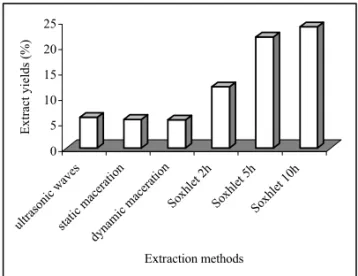
The efficiencies of plumbagin extraction by differ-ent techniques were compared. As expected, Soxh-let extraction was the most efficient technique (Fig-ure 3). Its efficiency is due to the employment of a small volume of solvent which is continuously re-newed in contact with the plant material, promoting more interactions between them.
Extractions in Soxhlet apparatus for 5 hours demonstrated a high efficiency, yielding almost 50% over the extract obtained in 2 hours of extraction. Comparatively 10 hours of extraction yielded ap-proximately 8.5% more than the obtained in 5 hours.
0 5 10 15 20 25
Extract yields (%)
ultras
onic
wav
es
stat
ic macera
tion
dynam
ic m
acerat
ion
Soxh
let 2
h Sox hlet 5h Sox hlet 10h Extraction methods
Fig. 3 – Extract yields (%) of the crude chloroform extracts from roots ofPlumbago scandensL. obtained by different extraction techniques.
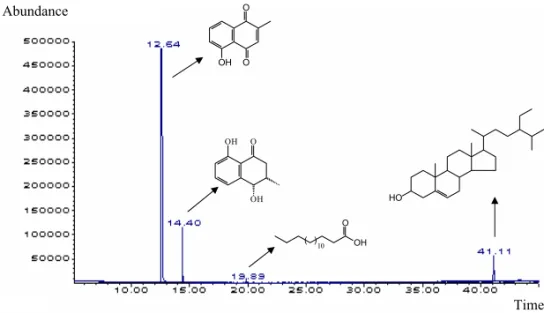
A sample of each extract solution in ethyl ac-etate (2 mg/ml) was submitted to a gas chromato-graph coupled with a mass spectrometer. The sam-ples were submitted to a chromatographic fraction-ation twice in order to guarantee the fidelity of the experiment. None of the used extraction techniques showed qualitative change of the chemical compo-sition, since the same compounds were identified in all extracts by GC/MS retention time and molec-ular fragmentation. The chromatograms and the spectral analysis demonstrated the presence of four main compounds identified as the naphthoquinone plumbagin, the naphthoquinoneepi-isoshinanolone, palmitic acid and sitosterol (Figure 4). Plumbagin was always the major component, independent of the extraction technique. The variation profile of these compounds in different extraction techniques can be observed in Figure 5.
Plumbagin was isolated from roots of P.
scandensand identified by comparison of its
spec-tral data to those reported in the literature (Carvalho 1986). This compound can be dissolved in solvents with low and medium polarity and its melting point is at 74◦C. Its quantitative determination was
O
O OH
O OH
OH
( )
10 OH
O HO
Time Abundance
Fig. 4 – Chromatogram of the crude chloroform extract from roots ofPlumbago scandens obtained by dynamic maceration.
0
2000000
4000000
6000000
8000000
10000000
Area (AU)
st
at
ic m
ace
rat
ion
dyn
ami
c m
ac
er
ation
ultr
as
on
ic waves Soxh
le
t 2h
Sox
hl
et
5
h
Sox
hlet 10
h
Extraction techniques
Epi-isoshinanolone
Palmitic acid
Sitosterol
Fig. 5 – Profile variation of the main constituents of thePlumbago scandensroot extracts obtained by different extraction techniques.
(6.47%), while the highest content was verified in the Soxhlet extraction for 2, 5 and 10 hours (35.78; 57.65 and 50.27, respectively). However, the pro-cess duration of 10 hours demonstrated a decrease
study-TABLE I
Plumbagin content (mg/ml) and its percent-age in roots ofPlumbago scandensaccording to different extraction techniques.
Extraction technique mg/ml % of plumbagin Static maceration 0.18 6.47 Dynamic maceration 0.33 15.51 Assistance of ultrasonic waves 0.44 21.87 Soxhlet – 2 hours 0.93 35.78 Soxhlet – 5 hours 1.56 57.65 Soxhlet – 10 hours 1.06 50.27
ingPlumbagospecies (Sankaram et al. 1976).
The naphthoquinone plumbagin is a compound of great interest due to its biological properties. This work aimed to investigate the better extraction tech-nique for this compound from plant material. Plum-bagin can be isolated in large amounts, especially from roots ofPlumbagospecies and represents an important target for new pharmacological tests. It could be concluded that the extraction in Soxhlet apparatus was optimal to reach high percentage ex-traction of plumbagin, however the process duration should not be so long over 5h, in order to maintain the better yield of plumbagin.
ACKNOWLEDGMENTS
The authors wish to thank the Analytical Center of Far-Manguinhos, Maria Beatriz S. Almeida, André Luis Zanela and Sergio Monteiro and the Brazilian Research National Council for Scientific and Tech-nological Development (CNPq).
RESUMO
O gêneroPlumbagopertence à família Plumbaginaceae e apresenta uma variedade de atividades biológicas, a
maio-ria atribuída à presença de naftoquinonas. Plumbagina
é uma naftoquinona natural que pode ser obtida a
par-tir de raízes dePlumbago scandensL. Na tentativa de descobrir a melhor técnica de extração dessa substância
foram usadas, maceração estática, maceração dinâmica,
extração com auxílio de ultrassom e extração em Soxhlet.
Quatro substâncias foram detectadas qualitativamente: as
naftoquinonas plumbagina eepi-isoshinanolona, o ácido palmítico e o sitosterol. Plumbagina foi sempre o
compo-nente majoritário em todos os extratos analisados e sua
determinação quantitativa foi realizada através de
cro-matografia com fase gasosa acoplada à espectrometria de
massas. A extração em Soxhlet foi a técnica mais
efi-ciente para obtenção de plumbagina, entretanto a longa
exposição a temperaturas elevadas favoreceu a degradação
da plumbagina.
Palavras-chave: Plumbaginaceae,Plumbago scandens L., plumbagina, técnicas de extração.
REFERENCES
Carvalho VR de. 1986. Epi-isoshinanolone from
Plumbago scandens. Phytochemistry 25: 764–765.
Chan-Bacab MJ and Peña-Rodriguez LM.2001.
Plant natural products with leishmanicidal activity. Nat Prod Rep 18: 674–688.
Durga R, Sridhar P and Polasa H.1990. Effects of
plumbagin on antibiotic resistance in bacteria. Indian J Med Res 91: 18–20.
Ghosh D, Som K, Dinda B and Chel G.1994.
Po-tentiality of plumbagin toCulex fatigans. A growth inhibitor. J of Adv Zool 15: 112–115.
Hostettmann K, Wolfender JL and Rodriguez S.
1997. Rapid detection and subsequent isolation of bioactive constituents of crude plant extracts. Planta Med 63: 2–10.
Kubo I, Taniguchi M, Chapya A and Tsujimoto K.
1980. An insect antifeedant and anti-microbial agent fromPlumbago capensis. Planta Med (suppl.): 185–187.
Melo AM, Jardim ML, Santana CF de, Lacet Y,
Filho JL, Lima I and Leoncio OG.1974. First
observations on the topical use of primin, plumbagin and mayteni in patients with skin cancer. Rev Inst Antibiot 14: 9–16.
Paiva SR de, Kaplan MAC and Gottlieb OR.1995.
Systematic positioning of Plumbaginaceae. An Acad Bras Cienc 67: 461–466.
Pakulski G and Budzianowski J.1996. Ellagic acid
Sankaram AVB, Srinivasarao A and Sidhu GS.1976.
Chitranone – a new binaphthoquinone from Plumba-go zeylanica. Phytochemistry 15: 237–238.
Sargenti SR and Vichnewski W.2000. Sonication
and Liquid Chromatography as a Rapid Technique for Extraction and Fractionation of Plant Material. Phytochem Anal 11: 69–73.
Sidhu GS and Sankaram AVB.1971. New
biplumba-gin and 3-chloroplumbabiplumba-gin from Plumbago zeyla-nica. Tetrahedron Lett 26: 2385–2388.
Torssel KBG. 1983. Natural Product Chemistry. A
mechanistic and biosynthetic approach to secondary metabolism, London: John Wiley & Sons Ltd, 401p.
Van der Vijver LM.1972. Distribution of plumbagin
in the Plumbaginaceae. Phytochemistry 11: 3247– 3248.
Zhong SM, Waterman PG and Jeffrevs JAD.1984.