Introduction
Alpinia zerumbet (Pers.) Burtt et Smith (Zingiberaceae) is an herbaceous perennial plant with wide use in Brazil. This plant is among the most cited in folk medicine. It is indicated to treat arterial hypertension [1]. The flavonoids of this species pres-ent remarkable medicinal properties and are related to its main biological activity [2-4]. Mpalantinos et al. [3] isolated and identified the flavonoids rutin and kaempferol-3-O-glucuronide by NMR, which have a high medicinal value in therapeutic uses.
Parameters as time, solvent, temperature and extraction technique influence secondary metabolites extraction. For this reason different procedures have been used for acquisition of bio-logically active compounds from crude plant
extracts. Recent studies mentioned the ultrasonic and microwave methods as efficient in secondary metabolites extraction [5-7]. Solvent type and method of extraction are fundamental factors to consider for optimizing yield extraction [8]. The purpose of this work was to develop and evaluate efficient and simple procedures for extraction of flavonoids from A. zerumbetleaves in short time.
Material and methods
Materials
Samples of Alpinia zerumbet (Pers.) Burtt et Smith leaves were collected in Rio de Janeiro (Rio de Janeiro state, Brazil), at “Núcleo de Pesquisas em Pro dutos Naturais” in the Universidade Federal do www.scielo.br/eq
www.ecletica.iq.unesp.br Volume 34, número 1, 2009
Flavonoid extraction from Alpinia zerumbet (Pers.) Burtt
et Smith leaves using different techniques and solvents
Cristiane P. Victório1,*; Celso Luiz S. Lage2; Ricardo M. Kuster3
1, 2Laboratório de Fisiologia Vegetal, Instituto de Biofísica Carlos Chagas Filho,Universidade Federal do Rio de Janeiro,
Av. Carlos Chagas Filho, s/n, CCS, Bloco G, sala G2-050. Rio de Janeiro - RJ, 21941-902. Brazil.
3Laboratório de Fitoquímica, Núcleo de Pesquisas de Produtos Naturais (NPPN), Universidade Federal do Rio de Janeiro,
Av. Carlos Chagas Filho, s/n, CCS, Bloco H, Rio de Janeiro - RJ, 21941-902. Brazil.
Abstract: The current study aims to verify the best method for a rapid and efficient extraction of flavonoids from Alpinia zerumbet. Dried leaves were extracted using distillated water and ethanol 70% by extraction methods of shaking maceration, ultrasonic, microwave and stirring. By the application of TLC and reversed-phase HPLC techniques the rutin and kaempferol-3-O-glucuronide were detected. Ethanol 70% was more efficient for flavonoids extraction than water. No significant yielding variation was verified for ultrasonic, microwave and stirring methods using ethanol 70% (11 to 14%). The relative concentration of rutin and kaempferol-3-O-glucuronide, respectively, was higher by ultrasonic (1.5 and 5.62 mg g-1dried leaves, respectively) and by microwave (1.0 and 6.64 mg g-1dried leaves) methods using ethanol. Rapid and sim-plified extraction proceeding optimize phytochemical work and acquisition of secondary metabolites.
Rio de Janeiro. Voucher specimen was identified and deposited in the Herbarium of Rio de Janeiro Botanical Garden, accession number RB 433485.
All chemicals used in analysis as methanol and phosphoric acid were of HPLC grades and were purchased from Merck. MilliQ water was utilized to HPLC mobile phase and sample preparation. Kaempferol-3-O -glu-curonide was isolated from Alpinia zerumbetand identified by Nuclear Magnetic Resonance (NMR) [3]. Rutin was purchased from Merck.
Preparation of extracts
Leaves of A. zerumbet were collected from adult plants, in the morning, then plant material was dried for 3 days in stove (60oC) and macerated in 70% ethanol or distillated water, in the same propor-tion of 1 g dried leaves/20 mL solvent (10% w/v).
It was evaluated four extraction methods from dried leaves: maceration in shaker at 100 rpm, ultrasonic bath (40 kHz, Thornton Unique, model 1400 USC), microwave (PANASONIC - Auto Sensor Diet, full power) and stirring (Table 1). In the microwave extraction, the suspensions were irradiated under microwaves in pre-setting proce-dures (3 s power on, 60 s off) for three times to the desired temperature about 60 and 70oC. The tem-perature was measured after turn off the microwave using a thermometer into extracts in Becker. For the ultrasonic extraction, the 30 mL flask containing 1 g of dried leaves plus 20 mL of one of extracting solvents was partially immersed into the ultrasonic
bath and temperature was controlled.
Preliminary results obtained by different extraction time 15 and 30 min for ultrasonic and 1 and 2 days for maceration techniques did not indicate significant differences in relation to extraction time presented in this study.
Crude extracts were filtered in vacuum using Whattman®filter (110 mm ø, 1). Aqueous extracts were frozen, then liophylizated and the hydroalco-holic extracts were evaporated to dry under reduced pressure at 60oC. The dried weight was measured. The yielding was defined as follows: (crude extract weight/plant material weight) x 100. The crude extract obtained by each extraction technique was analyzed directly by TLC and HPLC.
TLC analysis
Aliquots of standards and crude extracts were spotted on TLC plate (silica gel 60 F254 nm, Merck) and developed in different mobile phases below. The elution 5 was more appropriated for rutin and kaem pferol-3-O-glucuronide detection. Compo nents were visualized under ultraviolet light (l254 and 366 nm, Model UVGL-58 Upland/EUA) and detected by spra ying the TLC plates with reagent NP (2-ami no ethyl-phenyl-borate, 1 mg.L-1 in ethanol, Spectrum) and PEG (5% poliethyleneg-lycol-4000, Fluka). The fla vonoids standards rutin (Rf = 0.37) and kaempferol-3-O-glucuronide (Rf = 0.64) was verified in extracts after concomitant run-ning with standards and they were visible as yellow and orange fluorescent spots.
Table 1.Specifications of extraction methods.
Maceration Ultrasonic Microwave Stirring
Extracting solvents distillated water and 70% ethanol
Temperaturea 25oC 40 and 60oC 60 and 70oC 50 and 60oC
Extraction time 3 d 45 min 3x (3 s) 60 min
aData are related to water and ethanol 70% temperatures, respectively.
1 ethyl acetate/ethanol/acetic acid/water (16:1.5:1.0:1.0, v/v/v/v) 2 ethyl acetate /ethanol/ acetic acid/water (7.5:2.0:0.5:0.5, v/v/v/v) 3 ethyl acetate /ethanol/ acetic acid/water (27:1:0.5:0.5, v/v/v/v) 4 ethyl acetate / acetic acid /formic acid/water (100:11:11:27, v/v/v/v)
5 ethyl acetate /formic acid/water (65:20:15, v/v/v)
HPLC analysis
Crude extracts were dissolved in methanol (70%) at 10 mg.mL-1, filtered in vacuum and HPLC analyses were performed on an apparatus Shimadzu equipped with SPD-M10A diode array detector, LC-10AD pump and CBM-10 interface, UV-vis detector. Data were acquired and processed by a reversed-phase column (Lichrosorb RP-18, 25 cm x 5 mm), ambient tem-perature. The solvent system used was a gradient of MilliQ water + 0.1% phosphoric acid (A) and methanol (B). The gradient was as follows: 1-10 min (30% B); 20 min (40% B); 60 min (100% B). The flow rate was 1 mL.min-1. The prepared mobile phase was degassed using ultrasonic agita-tion. The elution was monitored at 254 nm and 360 nm. Flavonoids were identified by compari-son of HPLC retention times, UV spectra and co-elution with authentic samples analyzed in the same conditions. Standards were dissolved in methanol 70% at 1 mg.mL-1and analyzed in the same elution. For co-elution, it was prepared a mixture (1:1, v/v) of extracts at 10 mg.mL-1and standard at 1 mg.mL-1. The injections were repeat-ed three times. Determination of the content of the flavonoids was performed by the external standard method, using authentic standards.
Linearity was observed in concentration range of 0.0078 – 0.0625 mg.mL-1 of rutin (y= 3.10-7x – 31152, R= 0.9991, n= 9) and 0.01325 – 0.25 mg.mL-1of kaempferol-3-O-glucuronide (y= 1.10-7x – 51000, R= 0.9951, n= 9). Each determi-nation was carried out in triplicate. Quantification of flavonoids in the extracts was obtained against these calibration curves of standards, where yis peak area and x concentration in mg.mL-1.
Results and Discussion
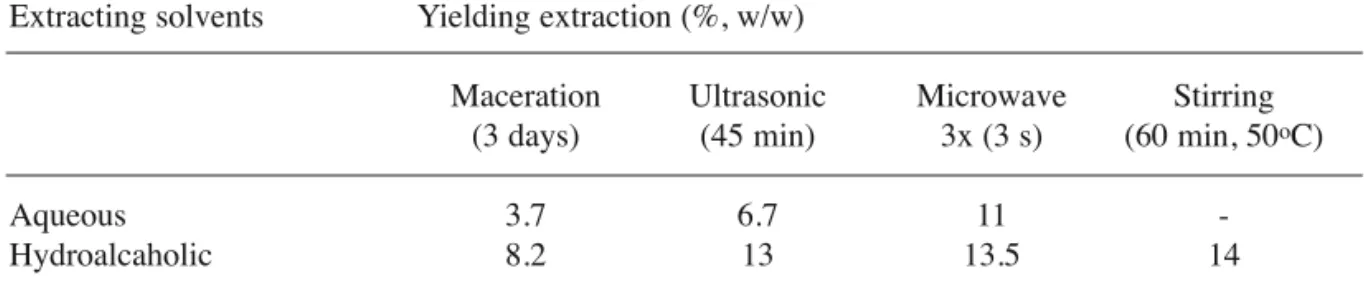
Table 2 shows the extraction yielding obtained for each extraction technique. Regarding the extractive techniques, the most yielding was obtained after ethanol extraction in comparison with distillated water. The lowest yielding was found by maceration technique for both solvents.
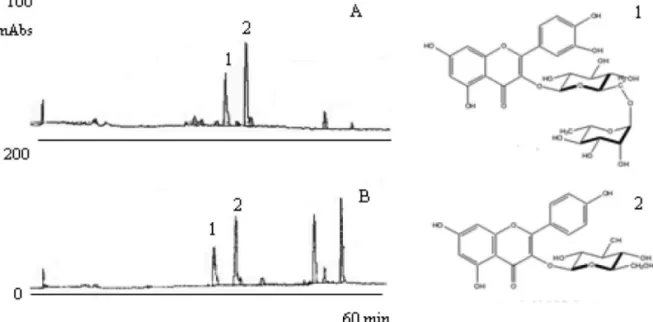
Hydroalcoholic crude extracts analysis using HPLC revealed six main compounds, among them the peak corresponding to rutin (TR: 31.42 min) and kaempferol-3-O-glucuronide (TR: 34.49 min) can be observed right after 30 min, without interference of other components (Figure 1). These flavonoids were also verified through TLC.
Chromatographic profiles of crude extracts obtained through different extraction methods and solvents were similar. The greater variation was achieved in relation to relative con-tent of flavonoids (Figure 2). The visualization of chromatographic profiles for each extraction technique and solvent used permit to evaluate the qualitative and quantitative variations in second-ary metabolites content. In addition, these data present compound profiles related to the biologi-cal effects and medicinal use.
The highest flavonoids extraction occurred at 70% ethanol, by all techniques extraction (Figure 2). Aqueous, alcoholic and hydroalcoholic extracts are commonly used in researches with plant crude extracts [9]. The results in Figure 2 also indicate that these 4 extraction techniques reach significant differ-ences in content of flavonoids in the same mate-rial content. The use of ultrasonic and microwave
Table 2.Yielding from dried leaves extraction of Alpinia zerumbet. Extracting solvents Yielding extraction (%, w/w)
Maceration Ultrasonic Microwave Stirring
(3 days) (45 min) 3x (3 s) (60 min, 50oC)
Aqueous 3.7 6.7 11
-Hydroalcaholic 8.2 13 13.5 14
techniques provide a high flavonoid extraction, followed by stirring (Figure 2). By comparison with the conventional techniques, ultrasonic and microwave techniques resulted in high levels of
flavonoid extracted with the advantage of saving time and solvent. These methods have been reported by the efficiency in extracting secondary metabolites [5,6,10]. Yang and Zhang [11]
veri-Figure 1. Chromatographic profiles (HPLC) of aqueous (A) and hydroalcoholic (B) extracts of Alpinia
zerumbet obtained by ultrasonic extraction: rutin (1, RT 31.42 min) and kaempferol-3-O-glucuronide (2, RT 34.49 min) at 360 nm.
Figure 2. Flavonoid contents in aqueous and hydroalcoholic extracts of Alpinia zerumbet obtained by
fied the efficiency and short extraction time of flavonoids using ultrasonic technique. The use of microwave for extracting biologically com-pounds is recent. Some reports have shown its positives results for extracting phenolic com-pounds, essential oil, flavonoids and alkaloids, more effective than conventional extraction methods [6,12,13].
Extraction methods, involving heating, raised the efficiency of solvents. Microwave, ultrasonic and stirring may improve the flavonoid extraction using as water as 70% ethanol. These techniques present in common, besides higher temperature, a reduced extrac-tion time in comparison with maceraextrac-tion in shaker.
TLC and HPLC chromatographic tech-niques are wide used and favorable for flavonoid detection [14]. Reversed-phase HPLC is one of the most employed techniques for the analysis of flavonoids [15]. Some results using HPLC were reported for Alpinia officinarumand A. purpura-ta species [16,17]. The described HPLC proce-dures could be useful for the qualitative and quantitative analysis of flavonoids in crude extracts, especially from Zingiberaceae family
that has a pronounced presence of flavonoids in its species [18].
Conclusion
From the results obtained in the current study, the relative proportion of these flavonoids was reduced by maceration conventional tech-nique, while microwave and ultrasonic techniques in combination with 70% ethanol solvent were the most efficient. It may suggest that microwave and ultrasonic methods using 70% ethanol are suitable for fast extraction of flavonoids in a simple way, also considering extraction yield and extraction time. These methods also permit the acquisition of flavonoids from little raw plant material.
Acknowledgments
C. P. Victório acknowledges the fellow-ship from CAPES.
Received October 10 2008 Accepted December 05 2008
Cristiane P. Victorio, Celso Luiz S. Lage, Ricardo M. Kuster. Extração de flavonóides de Alpinia zerumbet (Pers.) Burtt et Smith utilizando diferentes técnicas e solventes.
Resumo: O presente estudo teve como objetivo verificar a melhor metodologia de extração para rápida e eficiente obtenção de flavonóides a partir de Alpinia zerumbet. Folhas secas foram extraídas com água destilada e etanol 70%, utilizando as metodologias de extração: maceração sob agitação, ultrassom, microondas e agitador. Para verificação dos flavonóides rutina e kaempferol-3-O-glicuronídeo foram uti-lizadas as técnicas de CCD e CLAE em fase reversa. O solvente etanol 70% foi mais eficiente como extrator. Para as metodologias ultrassom, microondas e agitador, não houve variação significativa para o rendimento utilizando etanol 70% (11 a 14%). A concentração relativa de rutina e kaempferol-3-O -gli-curonídeo respectivamente foi maior pelos métodos de extração ultrassom (1,5 e 5,62 mg g-1 folha seca) e microondas (1,0 e 6,64 mg g-1 folha seca) utilizando etanol 70%. Procedimentos rápidos e simplifica-dos de extração otimizam o trabalho fitoquímico e a obtenção de metabólitos secundários.
Bibliography
[1] R. S. Moura, A. F. Emiliano, L. C. R. Carvalho, M. A. V. Souza, D. C. J. Guedes, Cardiovas. Pharmacol. 46 (2005) 288. [2] L. A. M. A. da Costa, S. M. Morais, M. C. B. R. Dantas, R. A. C. M. Lobo, M. C. Fonteles, Rev. Bras. Farmacol. 79 (1998) 96.
[3] M. A. Mpalantinos, R. Soares de Moura, J. P. Parente, R. M. Kuster, Phytother. 12 (1998) 442.
[4] B. H. Havsteen, Pharmacol. Therapeutics 96 (2002) 67. [5] X. Pan, G. Niu, H. Liu, J. Chromatogr A 922 (2001) 371. [6] X. Pan, G. Niu, H. Liu, Chem. Eng. Process.42 (2003) 129. [7] D. P. Fulzele, R. K. J. Satdive, J. Chromatogr. A 1063 (2005) 9.
[8] A. H. Goli, M. Barzegar, M. A. Sahari, Food Chem. 92 (2004) 521.
[8] N.Turkmen, F. Sari, Y. S. Velioglu, Food Chem. 99 (2006) 835.
[10] R. M. S. Celeghini, J. H. Y. Vilegas, F. M. Lanças, J. Braz. Chem. Soc. 12 (2001) 706.
[11] Y. Yang, F. Zhang, Ultras. Sonochem.15 (2008) 308. [12] A. A. Craveiro, F. J. A. Matos, J. W. Alencar, M. M. Pumel, Flav. Frag. J. 4 (1989) 43.
[13] K. Ganzer, I. Szinai, A. Salgo, J. Chromatogr. 520 (1990) 257.
[14] E. Rijke, P. Out, W. M. A. Niessen, F. Ariese, C. Gooijer, U. A. Th. Brinkman, J. Chromatogr., A 112 (2006) 31. [15] B. H. Oliveira, T. Nakashima, J. D. S. Filho, F. L. Frehse, J. Braz. Chem. Soc.12 (2001) 243.
[16] L. Tao, Z. T. Wang, E. Y. Zhu, Y. H. Lu, D. Z. Wei, South African J. Bot. 72 (2006) 163.
[17] C. P. Victório, I. C. Pamplona, R. M. Kuster, C. L. S. Lage, Braz. J. Med. Plant, in the press.